• About The West Wasn’t Won archive project
  • Archive Quarterly
  • Children
  • Fisheries
  • Land of the Peoples
  • Lawfare
  • Non-Status Era
  • Roadblocks and Restitution
    • Gustafsen Lake
    • Haida
    • Líl’wat
    • Nisga’a

The West Wasn't Won

~ Outlive the colonial world.

The West Wasn't Won

Monthly Archives: July 2024

Friends of Clayoquot, Summer 1994

27 Saturday Jul 2024

Posted by Admin in Reconciliation

≈ Leave a comment

Tags

Clayoquot Sound, environmental alliance, Eva Jacobs, Friends of Clayoquot, Lavina White, mass arrests, Nuu-Chah-nulth, Simon Lucas, Valerie Langer

The largest demonstration of solidarity with Indigenous Peoples and their land titles until Fairy Creek, mass arrests at Clayoquot Sound in 1993 are said to have been at least 850 persons strong. 300 arrests in one day, to stop logging in the Nuu-chah-nulth coastal old-growth forests.

In 1994, the Friends of Clayoquot organization published a journal to document their thinking at the time.
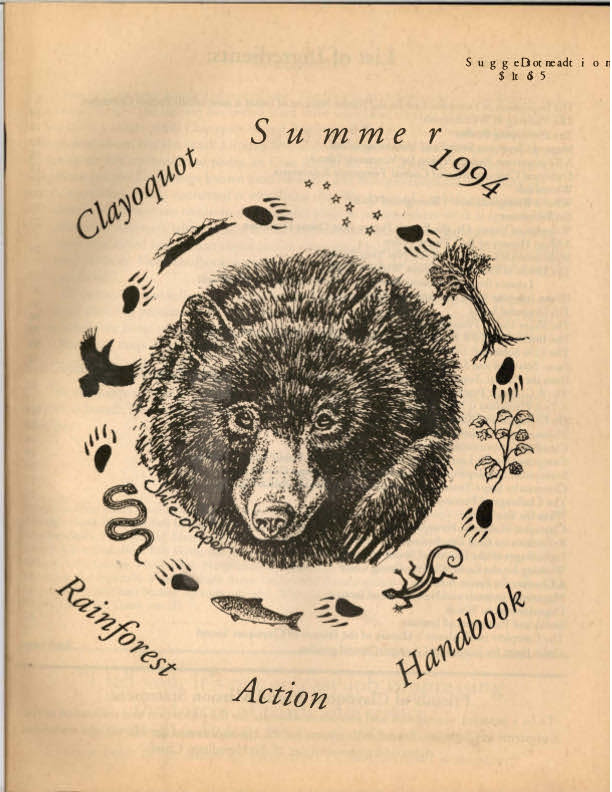
Clayoquot Summer 1994 Rainforest Action Handbook Lavina White. Simon Lucas. Eve KtunaxaDownload

Friends of Clayoquot Sound Mission Statement:

To be a peaceful, courageous and consistent advocate for the protection and restoration of the ecosystems of Clayoquot Sound with respect for the Ha-houlthee of the Ha-wii – the traditional rights and responsibilities of the Hereditary Chiefs.


Excerpt from the 1994 Handbook:

The Thriving of Wild Salmon, a presentation by Simon Lucas,

co-chair of the B.C. Aboriginal Fisheries Commission and the Nuu-Chah-Nulth Tribal Council. He was speaking to the participants of the Suzuki Foundation’s Wild Salmon conference held November 18th, 1988:

“If we are going to rebuild our wild stocks, we have to think about all the things that we have inherited. You and I could stand here for days about the inheritance. Lakes, rivers and creeks, and salmon stocks large and small, no matter how many hatcheries we have, they can never begin to match the abilities of our rivers and creeks and wild stocks to produce fish. If we protect them we have to say “no” to industrial pollution and to the idea of safe levels of poison chemicals. How long are we going to continue to self-destruct? If we befoul the rivers, streams, creeks and lakes, we are befouling ourselves. We have to say NO!

We keep seeing government after government allowing pulp mills to be built before safeguards. They are in place, finally, and we say, “what about the pollution?” “Oh, but that’s going to cost $40 million to see that we’re pollution-free.” Right now we have “safe levels” for our people in this country. We’ve got to say “No, no more.” Otherwise, all of us are just paying lip-service to wild stock.

My vision of the rebuilding of the Kennedy Lake sockeye stocks is an impossible dream if we add the insult of spraying toxic chemicals alongside the stream, as they are doing today, in addition to the painful injury of steep, clear-cut slopes. Our inlets will not provide the environment needed by our young salmon to grow and survive if we allow the salmon farming to grow unchecked. We have many examples: pulp mills, lumber mills, the Fraser River is an example.”


Contents

of “Clayoquot Summer 1994, Rainforest Action Handbook”:

The Imposition of European Law on the Native Nations of (what is now called) British Columbia, by Lavina White and Eva Jacobs

The Thriving of Wild Salmon, a presentation by Simon Lucas, Chair of the Aboriginal Peoples’ Fisheries Commission of British Columbia

The Developing Reality, by Valerie Langer

Maps of Clayoquot Sound and Vancouver Island  

A Conservation Biology Vision for Vancouver Island

Ecological Characteristics of Coastal Temperate Rainforests

Watersheds

What is Bioregionalism?, by Peter Berg

On Extinction

Welcome to Venus: Or, the Earth’s Future after Ozone Depletion

A Short History of B.C. Forest Policy

Multinational Corporations Are Not Your Friends

The Limits of Environmentalism Without Class: Lessons from the Ancient Forest Struggle of the Pacific Northwest

Eleven Inherent Rules of Corporate Behaviour

The Shameful Seven

The Share Group Phenomenon

The International PR Machine: Environmentalism a la Burson-Marsteller

The 12% Solution?

Facts, Statistics and Stuff!!!

Does the Public … Support Clearcutting? Trust the Government to Regulate Logging?

The B.C. Forest Practices Code

A Tree Plantation is Not a Forest

On Ecological and Cultural Restoration

Making Paper Without Trees

Canadian Government Violating International Law

Compensation for Lost Logging Rights: Who Owns Public Lands, Anyway?

Sustainable Development is Possible Only if We Forego Growth

Community Steps Toward an Ecologically Sustainable Forest Culture

The Challenge of Feminism

What Do You Value?

Clayoquot Makes the Newspaper

Reflections on Civil Disobedience

Eight Stages in the Process of Social Movement Success

Working for the Earth Without Going Crazy

A Glossary for Forest Activists

Magazines, Journals and Newsletters of Interest

Organizations to Watch

Books and Publishers of Interest

The Complete (well, almost!) History of the Friends of Clayoquot Sound

Archive Quarterly ~ Summer 24

15 Monday Jul 2024

Posted by Admin in aboriginal title, Non-Status Indian Era, Roadblock

≈ Leave a comment

Tags

aboriginal rights, aboriginal title, Bonaparte, Cache Creek 1974, Indian Status, Indigenous Peoples, Indigenous-focused grad requirement, Jeannette Corbiere-Lavell, Kelowna Accord, Native Peoples Caravan, on-reserve housing, Transformative Change Agreement

Featuring:

A special investigation of the 1974 blockade of Highway 12, at Bonaparte, Secwepemc.

After Elder James Morgan’s house burned down, and there was no access to funds or building materials to rebuild it, the Chief and dozens of others held down a narrow strip of the main transportation artery between Lillooet and the Interior – to levy a $5-per-traveller toll, raising funds to rebuild themselves.

With new interviews and a compilation of reports from the time, the coverage leads into a wider background for the on-reserve housing crisis. With a deep dive into on-reserve housing development since the Peoples were displaced from their usual homes.

The Native Peoples’ Caravan

The people at Cache Creek were soon joined by members of the Ojibway Warriors Society, the American Indian Movement in Canada, and allied that worked quickly together to coordinate the Native Peoples’ Caravan to Ottawa that Fall.

“Tsilhqot’in Nation v. British Columbia”

Tracking the first ever Supreme Court of Canada Declaration of Aboriginal title lands.

– Excerpts from the court rulings; Interviews with the Tsilhqot’in neighbouring nationals whose recognition of Tsilhqot’in title long predates the existence of Canada; Book review: “Lha Yudit’ih We Always Find A Way – Bringing the Tsilhqot’in Title case home” by Lorraine Weir with Chief Roger William; Maps and Timeline.

Celebrating fifty years of Native Women’s Associations

Jeannette Corbiere-Lavell joins us to discuss her legendary case to regain Indian Status after sexist provisions in the Indian Act – and being sued by the Attorney General – withdrew it.

Grandmothers Healing Journey, Honouring the Grandmothers on the Fraser River, and those who lived and died without their rights or recognition, far from their homes, in the cities. Artists reac out in an exhibition at the New Westminster gallery at the Anvil Building.

Excerpts from the Indian Act, as its amendments impacted women and children’s right to Indian Status.

BC’s Indigenous-focused graduation requirement

One year into BC’s Indigenous-focused graduation requirement: a class profile with one course in Sto:lo that thrived. “That class had the perfect combination of sxwōxwiyám – stories from long ago, and sqwélqwel – news from today.”

More:

20 years since the Kelowna Accord: why didn’t it work? Committing to “Closing the gap” in housing,
health, economies and education, felled the federal government.

The Department of Indian Affairs (Minister of the Interior), describes the conditions of landlessness and displacement that have led to today’s crises, in its first Annual Report, 1874.

The “biggest demonstration in BC history” – Indigenous march on the Victoria Legislature, June 25, 1974.

44 pages 8.5×11 black and white

Honouring the indomitable spirit of Indigenous Peoples west of the Rocky Mountains.

Archive Quarterly ~ Summer 24

Subscribe

  • Entries (RSS)
  • Comments (RSS)

Archives

  • December 2025
  • October 2025
  • June 2025
  • May 2025
  • February 2025
  • September 2024
  • August 2024
  • July 2024
  • April 2024
  • March 2024
  • February 2024
  • September 2023
  • August 2023
  • June 2023
  • June 2018
  • December 2017
  • July 2017
  • January 2017
  • December 2016
  • July 2015
  • March 2015
  • February 2015
  • January 2015
  • December 2014
  • September 2014

Categories

  • Archive Quarterly
  • BC treaty process
  • Children
  • Commentary, editorial
    • Uncategorized
  • Comprehensive Claims – Policy and Protest
    • aboriginal title
  • Government Commissions
  • Gustafsen Lake Standoff 1995 – Ts'peten Defense, Secwepemc
  • Haida title
  • Indian Residential School
  • Indigenous Declarations
  • Non-Status Indian Era
  • Reconciliation
  • Roadblock
  • UN Engagement
  • Union of BC Indian Chiefs

Meta

  • Create account
  • Log in

Blog at WordPress.com.

  • Subscribe Subscribed
    • The West Wasn't Won
    • Already have a WordPress.com account? Log in now.
    • The West Wasn't Won
    • Subscribe Subscribed
    • Sign up
    • Log in
    • Report this content
    • View site in Reader
    • Manage subscriptions
    • Collapse this bar
 

Loading Comments...