Since 1951, when Indigenous people were allowed access to the colonial courts, the views of crown lawyers and judges are right there on the record.
Here are some case files from the archive project: factums, memos, early decisions, and case summaries from the time. Most of these records are not maintained online. Only the ruling of the highest court is available, so, in cases that have been in the courts for decades and proceeded through numerous stages, the final result can be very difficult to understand. Lower court rulings are presented here. In some cases, critical decisions are made in the court of appeal and are then never mentioned again. For example, in the famous Delgamuukw decision of 1997, the province of British Columbia abandoned its position that all the Gitksan and Wet’suwet’en “aboriginal rights” had been extinguished. They did this in 1993 at the BC Court of Appeal stage, when the court commissioned an independent expert study of the issue. This change of position was an about-face from BC’s original defense, and explains a lot in the development of the case. To use the same case for another example, it’s essential to understand that both sides in the Delgamuukw litigation agreed to pause the next stage of the legal proceedings while they spent time attempting to negotiate a comprehensive approach to jurisdiction and land decisions. They did this on the recommendation of the Court of Appeal, in 1993. But by 1994, the government’s local forest managers were pushing through logging plans without regard for that condition, attempting to pass off meetings as “consultation” while the plans were a foregone conclusion. Gitksan Chiefs blocked the railway to stop it, and were promptly back in court in a new action: Ryan v Schultz. Cases which are not reported in the BC or Canada Law Review are also difficult to find, unless you go to the courthouse of the trial and buy a copy, like with transcripts.
These artifacts are all part of a bigger stories. These additions are provided here to add to the record.
R. v. Adams (Thomas Russel) – 1990
1990, October 30 Provincial Court ruling, Campbell River Haida “I have no option but to find that the defendant was not required to hold an Indian Food Fish Licence for the herring spawn on kelp in his possession and he is therefor entitled to acquittal on both charges.”
R. v. Adams – DFO letter to counsel: November 21, 1984 “I have directed the Chief of Finance for the Department of Fisheries and Oceans to draft a cheque for Mr. Thomas Russel Adams in the amount of $4,670.00, this being the amount received for the seventeen pails of roe on kelp seized by this Department. the other five pails were seized by the Department of Treasury United States Customs Service and therefore would not be included in the monies ordered returned by the court.”
Ahousaht First Nation v. Canada (Fisheries and Oceans) 2007
Federal Court of Canada Nuu-chah-nulth Case summary by Lawson Lundell LLP, July 20, 2007 “The Federal Court of Canada recently released its decision in Ahousaht First Nation v. Canada (Fisheries and Oceans). The court considered an application by 14 First Nations represented by the Nuu-chah-nulth Tribal Council (“NTC”) for judicial review of the Minister of Fisheries and Oceans regarding the implementation of a commercial groundfish pilot plan on the British Columbia coast (the “Pilot Plan”). The NTC challenged the Minister’s decision on the grounds that the Minister failed to fulfil his duty to consult and accommodate the NTC before implementing the Pilot Plan. After reviewing the process leading up to the Plan’s introduction Federal Court dismissed the application, finding that, although the consultation was not perfect, the flaws did not warrant changing the Minister’s decision.”
Bear Island Foundation and Temagami v. Ontario AG (c.1985)
Supreme Court of Canada. Factum of Intervenor NIB-AFN “The Royal Proclamation applies in the land claim area. It has the force of statute. The onus is on the Respondent to prove abrogation of the procedural requirements enshrined in the Proclamation.” “There is no case law, except the judgments below, in support of the argument that the procedural requirements of the Proclamation were repealed by the Quebec Act.”
R. v. Bob (Bradley) 1979, August 2. British Columbia County Court.
Ruling. Unreported. Lillooet “The accused was charged with unlawfully fishing in contravention of a closure effected under the Fisheries Act and Regulation. The accused claimed he had a lawful excuse to fish because he was fishing pursuant to a reserve right, not an aboriginal or treaty right.” “The historical background for the Defence… (includes) “Recognition of BC Indian Fish Rights by the Federal-Provincial Commission, prepared for UBCIC 1978. I refer to the instructions given to Dominion Commissioner, Mr. Anderson, dated August 25, 1870: “While it appears theoretically desirable as a matter of general policy to diminish the number of small reserves held by an Indian Nation, the circumstances will permit them to concentrate on three or four large reserves, thus making them more accessible to missionaries and school teachers…”
Daniels v. Canada (Indian Affairs and Northern Development), 2016
Supreme Court of Canada. Booklet, “Understanding the Daniels Case” by BC Metis Federation “At its best, the Daniels ruling provides the possibility to “consider” Metis communities as self-determined and self-governing nations with a unique historical connection to the Crown and First Nations.”
R. v. Derriksan (1975)
BC Court of Appeal. Okanagan Ruling. “Section 32 of the Regulations which makes special vision for licensing fishing by Indians reinforces the concept that Indians are not otherwise excepted from the Regulations.”
R. v. Douglas (c. 1985)
BC Provincial Court Sto:lo Defence counsel cross-examination of the crown’s witness, DFO officer Randy Nelson “Q. In this letter you say: “neither released, so I hit their knuckles and arms harder and harder.” Do you agree with that statement? A. Yes. Q. Okay. Now in this letter you talk about Mr. Douglas and that’s Sam Douglas, the accused, right? A. Yes, Your Honour. Q. And you say as follows: “My concern …is that the D.F.O. negotiates with this animal, and that he is a representative on the Salmon Commission.” Now when you say “this animal” you’re talking about Sam Douglas, aren’t you? A. That is correct in that letter, yes Your Honour. …Q. Next paragraph: “If Mr. Douglas is continued to be met with, I would be most disappointed and would like to know the Department’s reasoning for this. It would make about as much sense as opening a Clifford Olsen Day Care Center.” A That’s what the letter says, Your Honour. Q. Now are you telling this Court, that this is humour on your part? A. Humour… yes.”
Fletcher Challenger Canada Limited v. Miller… et al. 1991, Oct 21.
Supreme Court of BC. (C915008 Vancouver Registry) Court Transcript. Re. Walbran Valley. Defendant John Shafer and his Amicus curae, Bruce Clark: “CLARK: Yes. The position in law is that since there is no treaty for the area in question, the legislature of British Columbia does not have jurisdiction. For the same reason the legislature does not have jurisdiction, this court does not have jurisdiction, because this court derives its jurisdiction under the Supreme Court Act which emanates from that legislature, which itself doesn’t have jurisdiction. …So what essentially we have is this jurisdictional question is genuinely preliminary to everything else.” SHAFER: I’m a spokesperson for a native rights organization ca1led Concerned Citizens for Aboriginal Rights. It’s a group of 300 people in Victoria. All of my research and my readings indicated to me that there was — there was a major problem in the province concerning the fact that forest companies and third parties presumed to have the right to plunder unsurrendered native territory and I can see nowhere — in all my readings — I have yet to find a case where you will find an agreement between the native nations asking that Canada or BC rule over them.”
R. v. Gladstone BC Court of Appeal 1993, June 25.
Ruling. Heiltsuk “On or about the 28th day of April, 1988, at or near Vancouver in the Province of British Columbia, did unlawfully attempt to sell Herring Spawn on Kelp other than Herring Spawn on Kelp taken or collected under the authority of a Category J. Licence, contrary to Section 20 ( 3 ) of the Pacific Herring Fishery Regulation and did thereby commit an offence contrary to Section 6l ( 1 ) of the Fishery Act.” Note – The judges of the BC Court of Appeal had widely differing reasons.
Haida Nation v British Columbia (Minister of Forests; Attorney General) BC Court of Appeal. 1997, November 7.
Ruling. “The petitioners claim aboriginal title to a large area of British Columbia much of which is subject to tree farm licence no. 39 (T.F.L. 39) which was originally issued to the respondent MacMillan Bloedel in 1961. “The preliminary issue of law is : whether the interest claimed by the Petitioners, namely aboriginal title, including ownership, title and other aboriginal rights over all of Haida Gwaii (the Queen Charlotte Islands), including the land, water, flora and fauna and resources thereof, is capable of constituting an encumbrance within the meaning of section 28 of the Forest Act.”
Haida Nation v British Columbia (Minister of Forests; Attorney General) 2000, Nov 21
BC Supreme Court
Ruling “The evidence establishes that in September 1998, the Province published updated “British Columbia Consultation Guidelines” governing consultation with Aboriginal peoples concerning their Aboriginal rights and title, for all provincial ministries. Although the guidelines state that “…staff must not explicitly or implicitly confirm the existence of Aboriginal title when consulting with First Nations,”…
Haida Nation v British Columbia (Minister of Forests; Attorney Genera; Weyerhauser) 2002, Feb 27.
BC Court of Appeal. Case analysis prepared for the Union of BC Municipalities by Bull, Housser & Tupper, Sept 2002 “The BC Court of Appeal delivered a landmark decision regarding the duty of the Crown and third parties to consult with First Nations who have asserted, but not proved, aboriginal rights or title. The order made by the Court was subsequently modified with supplemental reasons delivered on August 19, 2002.” “The Court of Appeal made a declaration that the Province had in 2000, and the Province and Weyerhaeuser have now, legally enforceable duties to the Haida to consult with them in good faith.”
The west wasn’t won archive project relies on the work of volunteers for most aspects of building an archive! Drop a line to join the project, contribute documentation, or request research assistance, or… find out more.
This journal offers a curated collection of rare archival material in every issue: maps, timelines, new interviews, key excerpts from original docs, and more.
Honouring the indomitable spirit of Indigenous Peoples west of the Rocky Mountains, the young archive documents British Columbia and Canada’s colonial project and the way it’s carried out in deliberate violation of international law, Peoples’ rights, and its own founding constitution.
Helping answer the need for reliable information in an area that is emphatically suppressed and denied! The West Wasn’t Won’s quarterly journal is just about to complete the first year in print.
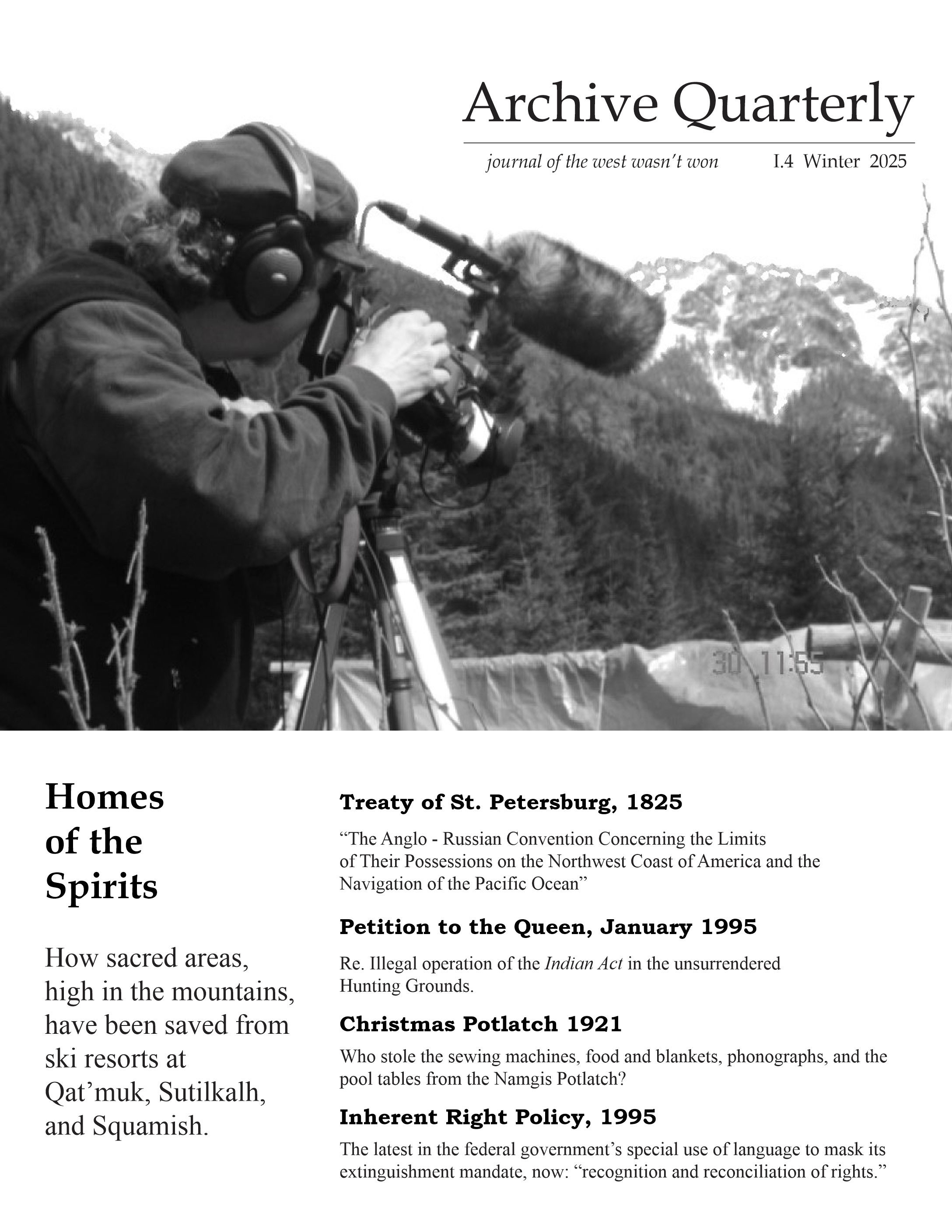
Here is a preview of AQ, Winter 2025, the 4th issue! And a summary of important topics we covered in 2024. And a preview of forthcoming Special Issues each dedicated to one major topic: Title, Status, and Salmon.
FEATURES: Sacred Places v. Ski Resorts Skwelkwek’welt, Sútikalh, Qat’muk, and other favourite spiritual resorts have been protected from development by reoccupations, litigation, and widespread mobilization. The Spirit Homes have been protected at a cost of mass arrests, real and threatened violence, global travel, and community solidarity from the grassroots to the Chief and Council. Interviews with Kanahus Manuel and Rosalin Sam. Petition of January 3, 1995 Text of the 30-year-old application to “an independent and impartial Standing Committee with juridical jurisdiction over boundary disputes between the Indians’ Hunting Grounds and the Crown Governments’ Public Lands.” With a 1997 interview given by Bruce Clark; and comment on the political situation from the extradition hearing, USA v. Pitawanakwat, 2000, which successfully relied in part in the Petition. Defense of Meares Island In March 1985, a provincial logging license in the heart of Nuu-chah-nulth territory was the subject of a court injunction. Read part of the ruling, which pointed out “The fact that there is an issue between the Indians and the province based on Aboriginal claims should not come as a surprise to anyone.” 40 years later, there’s a Tribal park and, still no surprise, no land title resolved in favour of the Nuu-chah-nulth. Imperial BC in 1825 The Anglo-Russian Convention Concerning the Limits of Their Possessions on the Northwest Coast of America and the Navigation of the Pacific Ocean. Looking closer at the Russian American Company; the Fort on the Spanish-Russian border in California; and reading the Yup’ik, Aleut and Innu interventions in American assumptions of jurisdiction. More:Sto:lo Chiefs snub the Queen’s Birthday Party in New Westminster, 1875, with a candid letter telling the government to give back the money for the dinner. Nielsen Report: the new Conservative government identified the Department of Indian Affairs for budget cuts in 1985, putting a cap on spending that wasn’t lifted for almost 30 years. After the secret Christmas Potlatch 1921 in Kwakwala territory, Indian Agents raided the homes of participants, seizing food, blankets, sewing machines, and ceremonial artifacts. Some 75 people were charged, and 45 of them were detained in Oakalla Prison to serve sentences up to six months. The Inherent Right Policy migrates from “extinguishment” to “recognition and reconciliation of rights” without changing the “cede, release, and surrender” component of settlements.
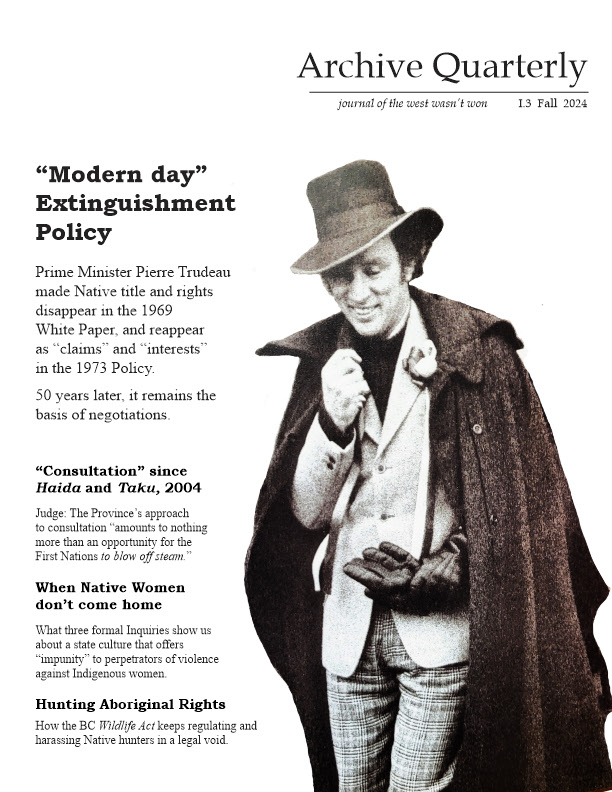
Fall 2024 AQ
FEATURES: Hunting Aboriginal Rights Inventing “uncertainty”: Canada’s Supreme Court consistently side-stepped the question of Aboriginal rights to hunt, refusing to hear legal questions put before them, and turning the constitutional question into matters of compliance with the BC Wildlife Act. Legacy Cases reviewed; Excerpts from decisions in the years-long trials of Francis Haines, Tsilhqot’in, “Old” Jimmie Dennis of Tahltan, and Arthur Dick of Secwepemc.
Inquiries: Missing and Murdered Indigenous Women and Girls An overview and timeline of reports by the Organization of American States’ IACHR; British Columbia’s Inquiry; Canada’s National Inquiry; and the report by Human Rights Watch. International inquiries at the UN treaty body level continue with concerns about the disproportionate disappearance and murder of Indigenous women – and the lack of investigation.
“Modern day” extinguishment policy Tracking the transformation of the Native title and rights identified in the 1973 Calder case, into the Native Claims Policy that mobilizes negotiations to achieve “extinguishment by consent.” Through changing definitions and increasing funding, the Policy has not responded to advances made in courts and harsh international criticism.
20 years since “Consultation” and “accommodation” Two cases of consultation and accommodation were decided together in the Supreme Court of Canada in November of 2004: Haida and Taku. With timelines leading to that litigation. Reflections on change over the last two decades, with President Gaagwiis of Haida. That Day in Court: comments from Victor Guerin about the 1984 case named for his father, Chief of Musqueam, and the first definitions of the duty to consult. Department of Justice, memo: Re. Crown Consultation with Aboriginal Groups Implementation of the procedural right since 2004, “characterized by bad faith, bias, incompetence, unprofessionalism, and errors of fact, law and jurisdiction so numerous” that litigation has proliferated.
More: Sovereignty Peoples Information Network explained why they wouldn’t want a treaty with Canada anyway, in their response to the United Nations’ survey of treaties and constructive arrangements between states and Indigenous Peoples in 1994. Four of their members were in prison within 12 months. Hudson’s Bay Company Governor Simpson arrives in the west, 1824. The Company’s plan was always more than trade, and brought the first Christian Missionaries to carry it out.
56 pages 8.5 x 11 Black and white ISBN 978-1-7387902-6-5 Electromagnetic Print
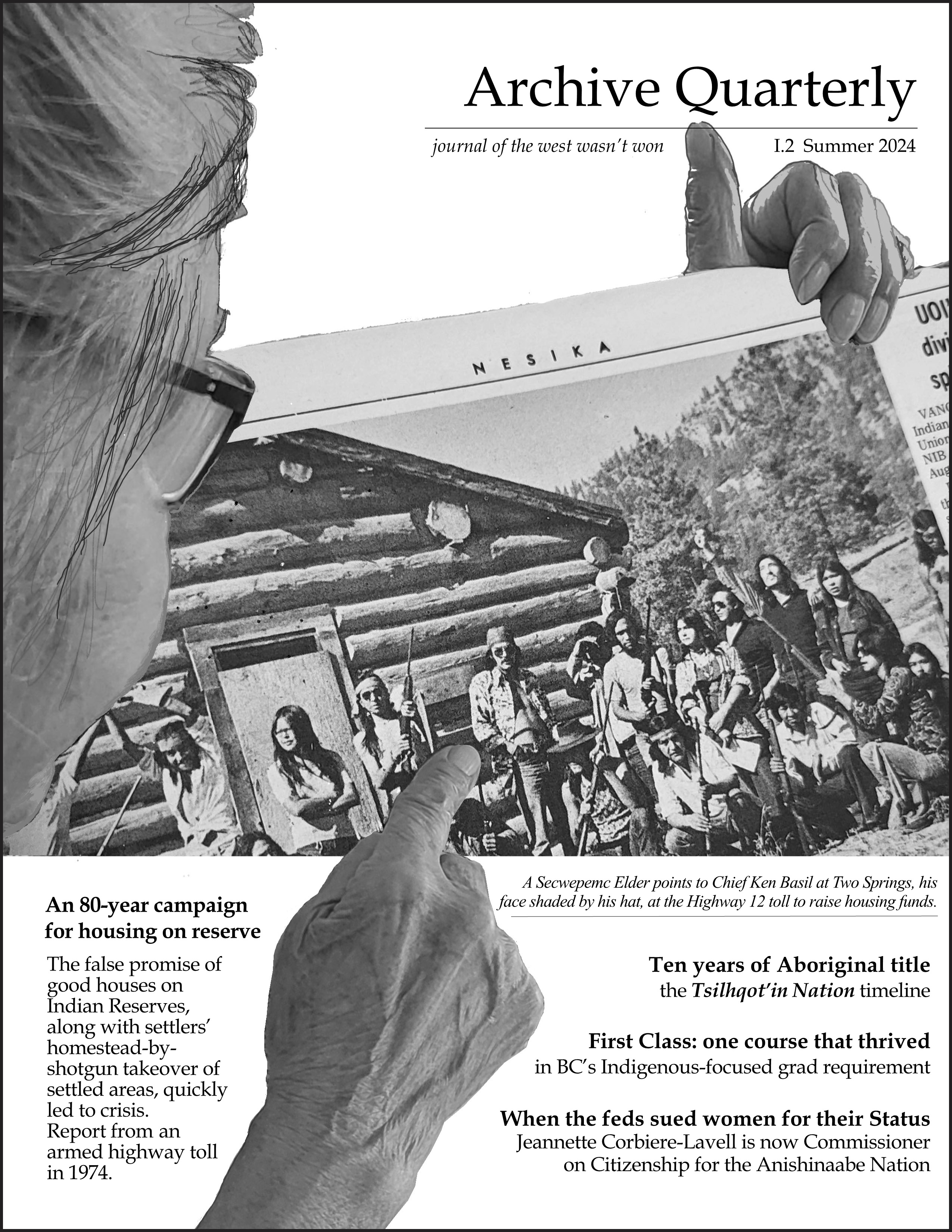
Summer 2024 AQ
FEATURES Bonaparte Highway Toll, 1974 – A new investigation of the summer blockade of Highway 12, at Two Springs, Secwepemc. With new interviews and a compilation of reports from the time, the coverage leads into a wider background for a detailed Timeline of the on-reserve housing crisis. Ten years since Title – Reviewing the Declaration of Aboriginal title in “Tsilhqot’in Nation v. British Columbia, 2014 SCC” – with interviews, a book review of “Lha Yudit’ih ~ We Always Find A Way,” by Lorraine Weir and Chief Roger William; maps of the title area; a Timeline of the case; and a narration of the title case’s progress through the courts, from Lha Yudit’ih. Celebrating fifty years of Native Women’s Associations across Canada! Jeannette Corbiere-Lavell joins us to discuss her legendary case to regain Indian Status after sexist provisions in the Indian Act withdrew it. And: Grandmothers Healing Journey, with photos of the Fraser River canoe trip; and excerpts from the Indian Act as its amendments impacted women and children’s right to Indian Status. First Class: Indigenous-focused graduation requirement – One year into BC’s Indigenous education mandate for secondary students, a class profile with one course made in Sto:lo that thrived. More: 20 years since the Kelowna Accord; the first ever report of the Department of Indian Affairs (Minister of the Interior) in 1874; and a look at the “biggest demonstration in BC history” – Indigenous march on Victoria Legislature, June 25, 1974.
44 pages 8.5×11, black and white ISBN 978¬1¬7387902¬4¬1 Journal of the west wasn’t won archive project Honouring the indomitable spirit of Indigenous Peoples west of the Rocky Mountains. Published by Electromagnetic Print
Spring 2024 AQ
FEATURES: The 1964 treaty, title, and rights hunting case – White and Bob (Snuneymuxw/Nanaimo), with news from the time; an interview of that day in court with Kitty Sparrow; an excerpt from the Respondents Factum; the Supreme Court of Canada’s decision without a hearing; and circumstances at Fort Victoria from “The Smallpox War Against the Haida,” by Dr. Tom Swanky. 1874 BC Lands Act and the Attorney General of Canada’s disallowance of the Province’s unconstitutional assumption of jurisdiction to legislate and dispose of lands in unceded Indian territories. Petition of the Douglas Tribes, 1874 – Chiefs of a hundred communities report Governor James Douglas’ broken promises of lands to be reserved for them against white settlement; conditions of life; and demands for judicial settlement. Allied Tribes protest the Indian Reserve Commission of BC, 1924, by Petition to Ottawa to reject the Commission’s final report. Having cut off 80% of good arable land from the remaining, small Indian Reserves which survived Joseph Trutch’s arbitrary reductions, the McKenna-McBride Commission of 1912-14 added rocky barren lands to parcels that amounted to less than one percent per-person of lands that were given away to settlers by pre-emption. “The Fourth World ~ An Indian Reality,” by George Manuel and Michael Posluns. A review of the 1974 book that exposes the four signal threats to Indigenous Peoples: the Priest, the Game Warden, the Doctor, and the Indian Agent. Sharing stunning reports of sharp dealing in federal and provincial schemes, while Native Community Development Officers (of which Grand Chief Manuel was one) promoted political responses. More: BC’s 2024 attempted amendments to its Lands Act; what Canada’s UNDRIP Act actually says; the Potlatch Laws of 1884.
40 pages, 8.5×11 Black and white ISBN: 978¬1¬7387902¬3¬4 Electromagnetic Print
Forthcoming Special Issues
TITLE contents:
Introduction: Title The Indigenous Territories Fort Government The Governor’s Picnic and the Chilcotin War The Indian Reserves Oakalla The Void Off-reserve
Case Summaries concerning Aboriginal Title & Rights: White and Bob, 1964-65, and Calder, 1969-73 Paulette et al v. The Queen, 1977 to R. v. Haines, 1978 Baker Lake v. Minister of Indian Affairs, 1980, to CPL v. Paul, 1988 R. v. Sparrow, 1990, to Delgamuukw & Gisdayway v. The Queen, 1991 Ryan v. Ft. St. James Forest District M’ger, 1994, to R. v. Côté, 1996 R. v. Pena et al, 1997, to Delgamuukw & Gisdayway v. The Queen, 1997 Halfway River v. BC, 1998, to Paul v. BC, Forest Commission, 2003 Haida Nation v. BC, 2004, to R. v. Marshall; R. v. Bernard, 2005 Cook v. BC Minister of Aboriginal Affairs and Reconciliation, 2007, to West Moberly v. BC, 2011 Tsilhqot’in Nation v. BC, 2014, to Gamlaxyeltxw v. BC, 2020 Nuu-chah-nulth v. BC, 2021, to Nuchatlaht v. BC, 2023
Contrasting Titles: Comparing the colonial court’s definitions of “Aboriginal title” to the declarations of title made by Indigenous Nations.
Declarations: Indigenous Nations state their titles. Excerpts from the historical texts.
Summary: Denial Recognition and Extinguishment Burdens of Proof Adversaries in the Court Room “Interpretation” and “ultimately by negotiation” Innocent Third Parties Good Faith, Bad Faith
Duress and Consent No deed, no surrender. No consent, no jurisdiction. Exhaustion of the Domestic Remedy International Intervention
Timeline: A chronology of events concerning the expression of Land Title and Jurisdiction west of the Rocky Mountains
Glossary of legal terms
STATUS contents:
Introduction: The Indian Department The Registrar An Act for the Gradual Civilization of the Indian Tribes 1857 Enfranchisement Indian Act 1876 Indian Agents The Little Brown Book
A Century of Forced Displacement: On Family Lands – but not on-reserve The Void BC Association for Non-Status Indians, 1969 Native Women’s Associations, 1970s United Native Nations, 1976 BC Native Housing, 1978 National Association of Indian Friendship Centres, 1950s Citizenship, 1951 Indian Act The Double Mother Rule Taxation without Representation
Restoration of Indian Status; Erosion of Band Power: Canadian Charter of Rights and Freedoms, 1982 Bill C-31, 1985, and reinstatement without compensation Erosion of Band powers to confer Status Increased Population; static Reserve Boundaries Charlottetown Accord 1992
Individual Cases concerning Indian Status: Yvonne Bedard Jeanette Lavell Sandra Lovelace Batchewana v Corbiere Powley Harry Daniels Sharon McIvor Descheneaux
Summary Indigenous Control of Indigenous Citizenship The Right to Nationality Self-Determination Traditional Authorities Roads to Restitution
SALMON contents
Following the commodification of salmon by a colony designed to export food and resources.
By the beginning of the 20th century, Newcomer fisheries Commissions were tearing out Indigenous selective weir fisheries in headwater streams, while dumping barge loads of unprocessed salmon at the entrance to the Fraser – when they ran out of cans to pack them in.
Conflict and criminalization of Indigenous fisheries is a century-long, ongoing clash of values between Native and Newcomer.
This Special Issue tracks a cycle of conditional government recognition and partial accommodation, amid headwater to saltwater Indigenous Peoples’ commissions and cooperation and competition.
Featuring:
Band Fishing Bylaws On-reserve
Territorial Fisheries Commissions
Inter-Tribal Fishing Treaty
BC Aboriginal Peoples Fisheries Commission
and
Government Reports: Pearse-McRae; Toy; Cohen; more
and
Winning the Aboriginal right to fish:
Sparrow, van derPeet, Gladstone, Smokehouse, Ahousaht, Lax Kwalaams, Nuu-chah-nulth, Thomas
and
Government Accommodation Programs:
A1 License Buybacks
Aboriginal Fisheries Strategy
Community Fishing Licenses
Aboriginal Aquatic Resources and Oceans Management
PICFI
Pacific Salmon Commission
and
the duty to protect the resource
and
Mandated Negotiations v. Indigenous Peoples’ Rights…
The famous “Indian Magna carta,” or Royal Proclamation, 1763, was preceded by a European treaty of non-competition that ended a global war among imperial colonizers.
British entry to the countries which are now called Canada was not a result of Treaty or Trade with Indigenous Nations, but of war with France. The young Captain Cook, later to visit the northwest coast of America, fought in the British Navy at the battle of Montreal, for control of the St. Lawrence River. A younger George Washington was a British General fighting the “French and Indian Wars.” France was allied and partnered in trade with many tribes since the early 1600s, when French colonists were left to make settlements at Aix la Chappelle and Port Royal. The eventual survival of French settlers and trading forts was due to integration among the geopolitics and economies of the Tribal Nations.
Part of that allegiance was an ongoing military defense against the British. In 1670, the Hudson’s Bay Company was granted a trading and exploration charter to enter North America, north of the French settlements. The “French and Indian Wars” were fought fervently by British Subjects who had moved to settle Colonies along the Atlantic Seaboard, south and east of the Indian-French alliances. A relentless British campaign began in 1754, and in 1760 France abandoned its place in northeastern North America, along with its trading partners and political presence in “the Canadas,” with the conditions of French surrender to Britain in the Articles of Montreal. France surrendered to Britain, but the Shawnee, Algonquins, and Iroquois confederates did not. Their former peace and friendship, enjoyed by France, was succeeded to – was guaranteed by Britain – in the 1760 terms of surrender, the Articles of Montreal. That surrender was only signed by France and Britain, not by Chief Pontiac, for instance, or any other of France’s Algonquin and other Indigenous Allies. However it guaranteed, at France’s insistence: Article 40: The Savage or Indian Allies of his Most Christian Majesty shall be maintained in the lands they occupy if they wish to remain there; they shall not be disturbed on any pretext whatever for having taken arms and served his Most Holy Majesty.
Britain quickly betrayed the terms signed at Montreal in 1760: the trade routes it had succeeded to owed Native nationals a supply of guns and ammunition, among other things, but these were now rationed to a minimal amount that effectively ended the benefit that European trade had brought, and promised. British fur traders bought furs at a fraction of the usual price. Pontiac, the central figure and leader of the Indigenous confederacy, still expected France would return. Under his leadership, the united Tribes of the east coast, Ohio River Valley, and Great Lakes burned or took over every British fort in their lands.
Meanwhile war had broken out between French, Spanish, Portuguese, and British imperial colonists across dozens of places around the world – from Cuba to the Mississippi River; from Bengal to Sumatra – and in mainland Europe. The Seven Years War ended with the Treaty of Paris, February 10, 1763. The “Most Christian” Kings pledged to peace among themselves in that Treaty, and to refuse “assistance or protection, directly or indirectly, to those who would cause any prejudice to either of the high contracting parties.” The Christian Kings’ peace was founded on this pledge of non-interference in the exploitation of non-European, non-Christian Peoples.
While refusing to protect any of the Indigenous Allies who had made their global trade routes and settlements possible, the British King continued to rely on the decisive military might of the Peoples they called “partners,” ultimately fighting British subjects. In an attempt to end or mitigate Pontiac’s continuing war and sacking of British forts, among other things, the Royal Proclamation, October 1763, was an Act to protect Britain’s future in North America. That future would depend on the good will of the Indigenous sovereigns there, and their military might. Desperate to correct His colonial subjects’ violations of the 1760 treaty at Montreal, and the violations of mutual trading agreements made along the Eastern Seaboard with such Chiefs as Powhattan, the King issued this Executive Order to the Governors of the Colonies there. The King relied on his promise in the 1760 Articles of Montreal, now referring to the Native nations as “His Majesty’s Allies” in the 1763 Proclamation. The Indigenous Peoples would not be “molested or disturbed” in their “Hunting Grounds” which are “Reserved to Them or any of them;” and the only judicial jurisdiction any colonial British court would have would be on “Lands surrendered to Us,” by the Native Peoples in public meeting, and “on any Lands not purchased by or ceded to Us,” the Governors would have no rights except to pursue and apprehend colonists for violations of British law.
British Governors were the first to renege on these terms, with the pursuit of Pontiac. The several inter-tribal confederacies were essentially held together by this Shawnee Chief. The confederacies were continually sabotaged; General Amherst’s distribution of smallpox by trade items killed a mass of people; and when a person of great significance was kidnapped, Pontiac made a treaty to cease fighting in 1766 to secure her return. In 1769, Pontiac was murdered by an acquaintance. A fee of a barrel of rum from the fort was paid, it is said.
An image of Chief Pontiac.
The fight for American independence was a direct result of King George III of Britain’s 1763 Royal Proclamation, October 17. The British subjects of the Americas had paid for and fought the French and Indian Wars; they paid taxes while having no representation in England; and their most insatiable wish was to expand westwards across the unceded and unsurrendered lands of the Cherokee, Idaho, Mohegans, Seminoles, and all. The War of Independence for the United States of America began in 1774 and continued until 1783.
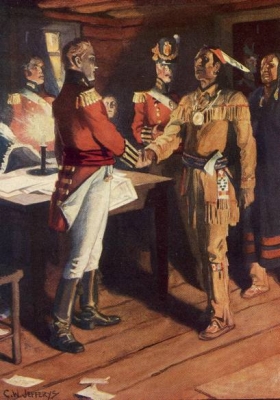
British-American wars were ongoing, and fought substantially by the central confederacies led by Tecumseh, who aligned with the British General Brock in a temporary and mutual truce: to stop American expansion and to guarantee protected Native homelands. After Brock’s demise in battle, General Proctor replaced him and sacrificed Tecumseh’s army to the Kentucky Rifles, abandoning Detroit and the promises to protect Indian lands. So ended the War of 1812, but the fighting continued in raids, massacres, and skirmishes along the 49th parallel as Britain expanded westward, relying on the defense of the Plains Peoples to rebuff American advances. That defense was encouraged and enabled by arms provided by Britain, while the cost in warriors and lands annexed by the USA was paid entirely by the Native nations. The Oregon Boundary Treaty of 1846 brought open warfare to an end, drawing a line through Cree, Kootenay, Sinixt and Coast Salish nations without their participation or signatures.
Native militias fought in the French-British and then British-American wars for fully one century, from the Atlantic Ocean to the Rocky Mountains. Every time, they were promised an alliance worth fighting for: protection of their freedom in their own lands, and fair trade.
See the first part of the February 10 1763 Treaty of Paris below, or view the full doc:
Below, Tecumseh and General Brock, “The Meeting of Isaac Brock and Tecumseh” by Charles William Jefferys
Treaty of Paris February 10, 1763 The Definitive Treaty of Peace and Friendship between his Britannick Majesty, the Most Christian King, and the King of Spain. Concluded at Paris the 10th day of February, 1763. To which the King of Portugal acceded on the same day.
In the Name of the Most Holy and Undivided Trinity, Father, Son, and Holy Ghost. So be it. Be it known to all those whom it shall, or may, in any manner, belong, It has pleased the Most High to diffuse the spirit of union and concord among the Princes, whose divisions had spread troubles in the four parts of the world, and to inspire them with the inclination to cause the comforts of peace to succeed to the misfortunes of a long and bloody war, which having arisen between England and France during the reign of the Most Serene and Most Potent Prince, George the Second, by the grace of God, King of Great Britain, of glorious memory, continued under the reign of the Most Serene and Most Potent Prince, George the Third, his successor, and, in its progress, communicated itself to Spain and Portugal: Consequently, the Most Serene and Most Potent Prince, George the Third, by the grace of God, King of Great Britain, France, and Ireland, Duke of Brunswick and Lunenbourg, Arch Treasurer and Elector of the Holy Roman Empire; the Most Serene and Most Potent Prince, Lewis the Fifteenth, by the grace of God, Most Christian King; and the Most Serene and Most Potent Prince, Charles the Third, by the grace of God, King of Spain and of the Indies, after having laid the foundations of peace in the preliminaries signed at Fontainebleau the third of November last; and the Most Serene and Most Potent Prince, Don Joseph the First, by the grace of God, King of Portugal and of the Algarves, after having acceded thereto, determined to compleat, without delay, this great and important work. For this purpose, the high contracting parties have named and appointed their respective Ambassadors Extraordinary and Ministers Plenipotentiary, viz. his Sacred Majesty the King of Great Britain… (dukes, lords, etc.)…Who, after having duly communicated to each other their full powers, in good form, copies whereof are transcribed at the end of the present treaty of peace, have agreed upon the articles, the tenor of which is as follows: Article I. There shall be a Christian, universal, and perpetual peace, as well by sea as by land, and a sincere and constant friendship shall be reestablished between their Britannick, Most Christian, Catholick, and Most Faithful Majesties, and between their heirs and successors, kingdoms, dominions, provinces, countries, subjects, and vassals, of what quality or condition soever they be, without exception of places or of persons: So that the high contracting parties shall give the greatest attention to maintain between themselves and their said dominions and subjects this reciprocal friendship and correspondence, without permitting, on either side, any kind of hostilities, by sea or by land, to be committed from henceforth, for any cause, or under any pretence whatsoever, and every thing shall be carefully avoided which might hereafter prejudice the union happily reestablished, applying themselves, on the contrary, on every occasion, to procure for each other whatever may contribute to their mutual glory, interests, and advantages, without giving any assistance or protection, directly or indirectly, to those who would cause any prejudice to either of the high contracting parties: there shall be a general oblivion of every thing that may have been done or committed before or since the commencement of the war which is just ended. II. The treaties of Westphalia of 1648; those of Madrid between the Crowns of Great Britain and Spain of 1661, and 1670; the treaties of peace of Nimeguen of 1678, and 1679; of Ryswick of 1697; those of peace and of commerce of Utrecht of 1713; that of Baden of 1714; the treaty of the triple alliance of the Hague of 1717; that of the quadruple alliance of London of 1118; the treaty of peace of Vienna of 1738; the definitive treaty of Aix la Chapelle of 1748; and that of Madrid, between the Crowns of Great Britain and Spain of 1750: as well as the treaties between the Crowns of Spain and Portugal of the 13th of February, 1668; of the 6th of February, 1715; and of the 12th of February, 1761; and that of the 11th of April, 1713, between France and Portugal with the guaranties of Great Britain, serve as a basis and foundation to the peace, and to the present treaty: and for this purpose they are all renewed and confirmed in the best form, as well as all the general, which subsisted between the high contracting parties before the war, as if they were inserted here word for word, so that they are to be exactly observed, for the future, in their whole tenor, and religiously executed on all sides, in all their points, which shall not be derogated from by the present treaty, notwithstanding all that may have been stipulated to the contrary by any of the high contracting parties: and all the said parties declare, that they will not suffer any privilege, favour, or indulgence to subsist, contrary to the treaties above confirmed, except what shall have been agreed and stipulated by the present treaty. III. All the prisoners made, on all sides, as well by land as by sea, and the hostages carried away or given during the war, and to this day, shall be restored, without ransom, six weeks, at least, to be computed from the day of the exchange of the ratification of the present treaty, each crown respectively paying the advances which shall have been made for the subsistance and maintenance of their prisoners by the Sovereign of the country where they shall have been detained, according to the attested receipts and estimates and other authentic vouchers which shall be furnished on one side and the other. And securities shall be reciprocally given for the payment of the debts which the prisoners shall have contracted in the countries where they have been detained until their entire liberty. And all the ships of war and merchant vessels Which shall have been taken since the expiration of the terms agreed upon for the cessation of hostilities by sea shall likewise be restored, bon fide, with all their crews and cargoes: and the execution of this article shall be proceeded upon immediately after the exchange of the ratifications of this treaty. IV. His Most Christian Majesty renounces all pretensions which he has heretofore formed or might have formed to Nova Scotia or Acadia in all its parts, and guaranties the whole of it, and with all its dependencies, to the King of Great Britain: Moreover, his Most Christian Majesty cedes and guaranties to his said Britannick Majesty, in full right, Canada, with all its dependencies, as well as the island of Cape Breton, and all the other islands and coasts in the gulph and river of St. Lawrence, and in general, every thing that depends on the said countries, lands, islands, and coasts, with the sovereignty, property, possession, and all rights acquired by treaty, or otherwise, which the Most Christian King and the Crown of France have had till now over the said countries, lands, islands, places, coasts, and their inhabitants, so that the Most Christian King cedes and makes over the whole to the said King, and to the Crown of Great Britain, and that in the most ample manner and form, without restriction, and without any liberty to depart from the said cession and guaranty under any pretence, or to disturb Great Britain in the possessions above mentioned. His Britannick Majesty, on his side, agrees to grant the liberty of the Catholick religion to the inhabitants of Canada: he will, in consequence, give the most precise and most effectual orders, that his new Roman Catholic subjects may profess the worship of their religion according to the rites of the Romish church. as far as the laws of Great Britain permit. His Britannick Majesty farther agrees, that the French inhabitants, or others who had been subjects of the Most Christian King in Canada, may retire with all safety and freedom wherever they shall think proper, and may sell their estates, provided it be to the subjects of his Britannick Majesty, and bring away their effects as well as their persons, without being restrained in their emigration, under any pretence whatsoever, except that of debts or of criminal prosecutions: The term limited for this emigration shall be fixed to the space of eighteen months, to be computed from the day of the exchange of the ratification of the present treaty. V. The subjects of France shall have the liberty of fishing and drying on a part of the coasts of the island of Newfoundland, such as it is specified in the XIIIth article of the treaty of Utrecht; which article is renewed and confirmed by the present treaty, (except what relates to the island of Cape Breton, as well as to the other islands and coasts in the mouth and in the gulph of St. Lawrence:) And his Britannick Majesty consents to leave to the subjects of the Most Christian King the liberty of fishing in the gulph of St. Lawrence, on condition that the subjects of France do not exercise the said fishery but at the distance of three leagues from all the coasts belonging to Great Britain, as well those of the continent as those of the islands situated in the said gulph of St. Lawrence. And as to what relates to the fishery on the coasts of the island of Cape Breton, out of the said gulph, the subjects of the Most Christian King shall not be permitted to exercise the said fishery but at the distance of fifteen leagues from the coasts of the island of Cape Breton; and the fishery on the coasts of Nova Scotia or Acadia, and every where else out of the said gulph, shall remain on the foot of former treaties. VI. The King of Great Britain cedes the islands of St. Pierre and Macquelon, in full right, to his Most Christian Majesty, to serve as a shelter to the French fishermen; and his said Most Christian Majesty engages not to fortify the said islands; to erect no buildings upon them but merely for the conveniency of the fishery; and to keep upon them a guard of fifty men only for the police. VII. In order to reestablish peace on solid and durable foundations, and to remove for ever all subject of dispute with regard to the limits of the British and French territories on the continent of America; it is agreed, that, for the future, the confines between the dominions of his Britannick Majesty and those of his Most Christian Majesty, in that part of the world, shall be fixed irrevocably by a line drawn along the middle of the River Mississippi, from its source to the river lberville, and from thence, by a line drawn along the middle of this river, and the lakes Maurepas and Pontchartrain to the sea; and for this purpose, the Most Christian King cedes in full right, and guaranties to his Britannick Majesty the river and port of the Mobile, and every thing which he possesses, or ought to possess, on the left side of the river Mississippi, except the town of New Orleans and the island in which it is situated, which shall remain to France, provided that the navigation of the river Mississippi shall be equally free, as well to the subjects of Great Britain as to those of France, in its whole breadth and length, from its source to the sea, and expressly that part which is between the said island of New Orleans and the right bank of that river, as well as the passage both in and out of its mouth: It is farther stipulated, that the vessels belonging to the subjects of either nation shall not be stopped, visited, or subjected to the payment of any duty whatsoever. The stipulations inserted in the IVth article, in favour of the inhabitants of Canada shall also take place with regard to the inhabitants of the countries ceded by this article. VIII. The King of Great Britain shall restore to France the islands of Guadeloupe, of Mariegalante, of Desirade, of Martinico, and of Belleisle; and the fortresses of these islands shall be restored in the same condition they were in when they were conquered by the British arms, provided that his Britannick Majesty’s subjects, who shall have settled in the said islands, or those who shall have any commercial affairs to settle there or in other places restored to France by the present treaty, shall have liberty to sell their lands and their estates, to settle their affairs, to recover their debts, and to bring away their effects as well as their persons, on board vessels, which they shall be permitted to send to the said islands and other places restored as above, and which shall serve for this use only, without being restrained on account of their religion, or under any other pretence whatsoever, except that of debts or of criminal prosecutions: and for this purpose, the term of eighteen months is allowed to his Britannick Majesty’s subjects, to be computed from the day of the exchange of the ratifications of the present treaty; but, as the liberty granted to his Britannick Majesty’s subjects, to bring away their persons and their effects, in vessels of their nation, may be liable to abuses if precautions were not taken to prevent them; it has been expressly agreed between his Britannick Majesty and his Most Christian Majesty, that the number of English vessels which have leave to go to the said islands and places restored to France, shall be limited, as well as the number of tons of each one; that they shall go in ballast; shall set sail at a fixed time; and shall make one voyage only; all the effects belonging to the English being to be embarked at the same time. It has been farther agreed, that his Most Christian Majesty shall cause the necessary passports to be given to the said vessels; that, for the greater security, it shall be allowed to place two French clerks or guards in each of the said vessels, which shall be visited in the landing places and ports of the said islands and places restored to France, and that the merchandize which shall be found t herein shall be confiscated. IX. The Most Christian King cedes and guaranties to his Britannick Majesty, in full right, the islands of Grenada, and the Grenadines, with the same stipulations in favour of the inhabitants of this colony, inserted in the IVth article for those of Canada: And the partition of the islands called neutral, is agreed and fixed, so that those of St. Vincent, Dominico, and Tobago, shall remain in full right to Great Britain, and that of St. Lucia shall be delivered to France, to enjoy the same likewise in full right, and the high contracting parties guaranty the partition so stipulated. X. His Britannick Majesty shall restore to France the island of Goree in the condition it was in when conquered: and his Most Christian Majesty cedes, in full right, and guaranties to the King of Great Britain the river Senegal, with the forts and factories of St. Lewis, Podor, and Galam, and with all the rights and dependencies of the said river Senegal. XI. In the East Indies Great Britain shall restore to France, in the condition they are now in, the different factories which that Crown possessed, as well as on the coast of Coromandel and Orixa as on that of Malabar, as also in Bengal, …



 The West Wasn't Won