
Archive Quarterly ~ Special Issue #1
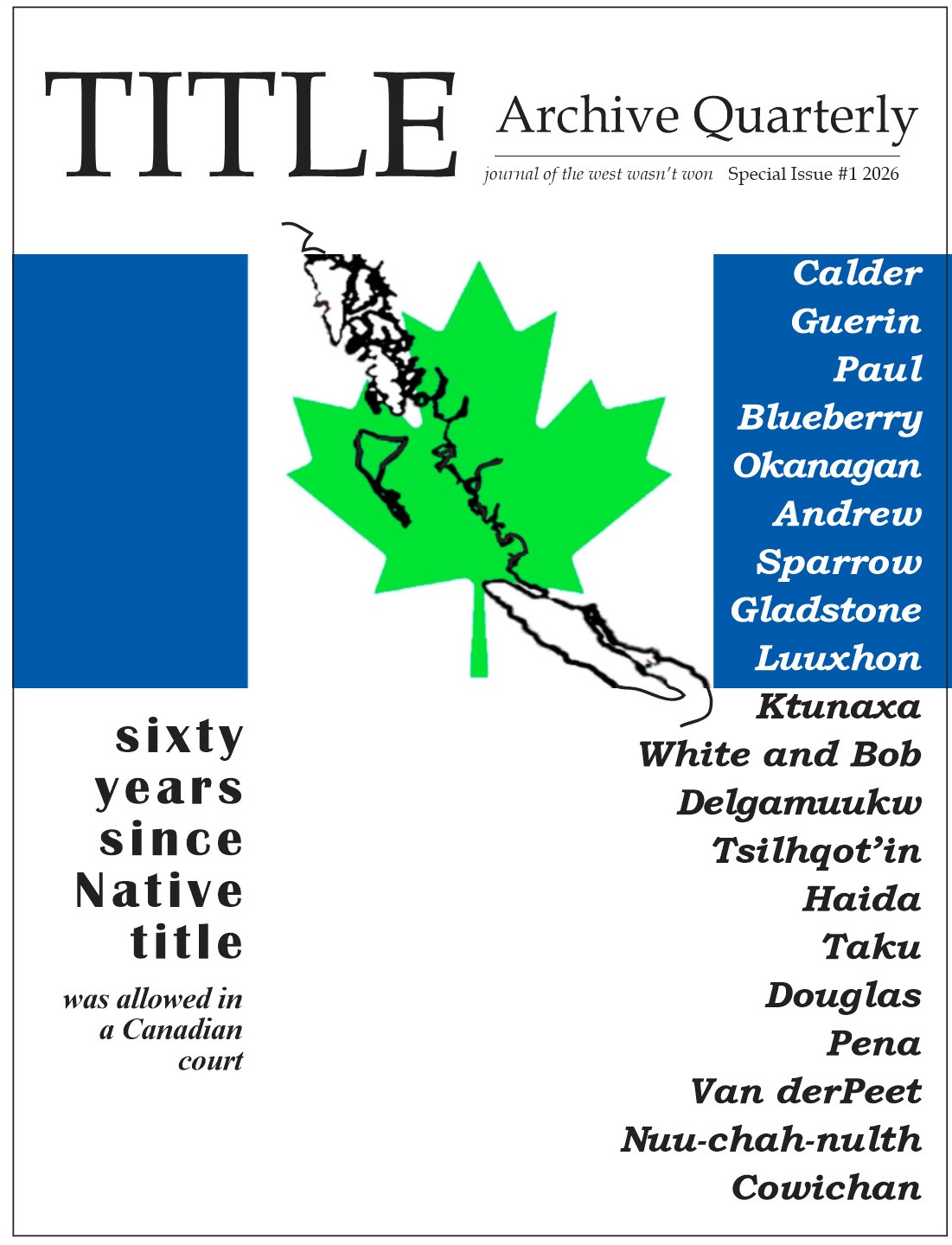
This book is about Indigenous land titles, west of the Rocky Mountains, relying on the testimony and writings of dozens of Indigenous leaders. Furthermore, it is about the recent construct of “Aboriginal title,” and the Canadian courts’ use of the new term to attempt to define Indigenous Peoples into assimilated structures of governance within Canada.
In the Introduction, the book addresses the questions, What is title? Who has title? What is jurisdiction, and where does it come from? It also provides an in-depth review of British Columbia history which is not commonly understood, and describes the situation of Indigenous Peoples in what is now known as British Columbia, Canada, in terms of the colonizing actions of the last two centuries.
At the center of this book is a review of the highlights in legal terms of the results of 70 important title and rights cases. The key meanings are highlighted, providing an easy to follow progress of the BC and Canadian judges’ formulation of Aboriginal rights over 60 years.
The rulings of the colonial court are then summarized and compared to the way Indigenous Peoples describe their own relationship to land, their own jurisdictions, and also international descriptions of the rights of peoples. These comparisons are presented as a chart, with the contrasting titles and descriptions set across from each other, section by section.
There are 26 distinct languages spoken by the original peoples in the area now known as the Province of British Columbia. Among these nations, almost every one wrote a historic Declaration or Statement describing themselves and their country – like a collective affidavit – in the early 20th century. 34 pages of substantial excerpts from these statements are included.
The political, social and economic impact of the court rulings in Canada, particularly in British Columbia, have not produced a logical improvement in terms of decolonization, but a tightening of definitions and restricting of economic opportunities which has created a policy funnel that only rewards actions of assimilation by Indigenous Peoples. The results of key rulings, Native actions for justice, and other factors are examined in an analysis of the current situation in British Columbia. This section describes in detail, with many interesting witness statements, the circumstances surrounding the launch of key cases, and a thorough investigation of the governments’ responses, to the present day.
Finally, to support the reader, a 50 page Timeline of events concerning the expression of land title west of the Rockies is provided. A Glossary of terms with respect to their particular usage in Canada is also provided, and an extensive list of Sources and References.
This research has been supported over many years by many people and organizations, notably: Society for Our Grandmother Earth; the Association for Learning and Preserving the History of WW2 in Asia, BC Chapter; and Skela7ksten Skel7antsut.
This information is brought forward to aid the state, through its citizens, to come to constructive arrangements that do not extinguish Indigenous title and rights, but respect their title lands so that the Peoples can move forward with a self-determining economic future.
As it was said during the Constitution Express: “The authority of Indian nations does not depend on the Canadian constitution. A Canadian constitution can only accommodate Indian rights – it cannot diminish, alter or eliminate them. Such power rests only with the citizens of the various Indian nations.” – From, “Indian Nations and The Constitution – A Position Paper,” Union of B.C. Indian Chiefs. November 15, 1980.
Clouding nations older
than the last
Great Flood,
the young province
of British Columbia
has bought time
and occupation
with bad faith
and violence.
From White and Bob, 1965
to Cowichan, 2025
colonial courts
force assimilation
by hollowing out their
own legal construct:
“Aboriginal title.”
AQ Special Issue #1 – TITLE:
272 pages
black and white
8.5″ x 11″
soft cover
ISBN 9781738790258
ISSN 2819 585X (print) ISSN 2819 5868 (online)
Special Issue of “Archive Quarterly ~ journal of the west wasn’t won”
Print edition:
Available on Amazon for $24.95
Free digital download and/or donation:
 The West Wasn't Won