
This archive project is in development to contribute to the record of Indigenous defense of their title and jurisdiction throughout their nations west of the Rocky Mountains.
You can subscribe to the page and receive new blog posts.
You can ask us about a research question. You can download these docs.
The archive’s parent project is Electromagnetic Print – books that resonate.
You can check out Archive Quarterly ~ journal of The West Wasn’t Won archive project.
What Where Who Why When How
WHAT does the archive project do?
Primarily: recognize and promote the indomitable spirit of Indigenous Peoples.
By producing:
- A physical archive of historical documents
- A digital archive is maintained online www.thewestwasntwon.com
- Archive Quarterly, journal of the archive project, by subscription.
- Ongoing interviews to illuminate social and historic issues.
- Digitization of stored archival material.
- Research assistance for university students, teachers, and community members.
- Travelling exhibits for themed conventions or gatherings.
WHERE does this project work?
– West of the Rocky Mountains to the coast. British Columbia and the Indigenous Nations which are occupied by it.
– Based in Vancouver, frequent trips to the interior and Vancouver Island are necessary for ongoing interviews, access to libraries and archives, and to visit other collections.
– Some interviews are completed entirely by phone and email.
WHY is a comprehensive archive important?
The documentary record concerning Indigenous Peoples disappears faster than old growth forests in BC.
What has survived are collections kept personally by some political leaders and grassroots activists. But these are vulnerable to the whims of their inheritors; to flood and to fire; and to unstable housing.
Since the internet has become the main repository for information, we have seen extensive purges of original government publications, from online sources, in areas concerning title and rights based engagements. For example, the failed 2009 BC Recognition and Reconciliation Legislation initiative has all but been erased.
This will be an archive which can present, side by side, a historical record of political engagement – and bad faith; coercive imposition of Indian Act governance; racist criminalization; government removal of children; restriction of food gathering freedoms; infringement of recognized rights; collaboration between crown political policy and the crown courts; punitive destruction of sustaining lands and waters; and more.
When these ongoing and interwoven means of oppression are viewed as one contiguous strategy – calculated to bring about the destruction of the groups – BC history can be understood.
WHEN did this work start?
This archive project, and the quarterly journal, are the unexpected results of decades of research into Indigenous “roadblocks” in British Columbia.
Asking the questions, “what led up to a “stand-off” position?” and, “what has happened since then? Court case? Resolution? Conflict? Change?”, the answer is that so many events contribute to the situation, amid such extensive acts of colonialism, concerning 26 distinct nations, that the result would be too long for a book; even a series of books.
But most of the original source material has never been published or catalogued, or even referred to. So, it’s no longer a book, or a series, but an archive that is needed.
WHO does this work?
Kerry Coast maintains the physical collection and online collection.
Acquaintances and knowledge keepers, new and old, often give freely their valuable time in interviews. Kerry produces the AQ journal and offers the research assistance services.
Building an archive is not a one-person job. The main idea behind the AQ journal is to raise awareness of the importance of an independent archive, and attract partners who can create a space for this archive to live and grow.
HOW is this work conducted?
Much of the documentary collection in the physical archive has been given by Elders, for safe keeping. Kerry became interested in this history at the time of the 1995 Gustafsen Lake standoff – so her collection starts at that time.
The physical collection is available in micro-collections by planning a travelling exhibit to an event, or as a temporary installation.
The artifacts are being digitized and catalogued as time and opportunity allows. A great partnership with SFU’s Digital Humanities brought grad students together with a huge section of the archive, on fisheries, and digitized over 400 documents.
The Archive Quarterly journal is an intermittent communication; a cluster of materials to be read together, and relevant to understanding today. It brings out rare source material, new interviews with Elders who can put information in context, and related commentary, supporting details, book reviews, maps, timelines, and archival images.
AQ comes out through the existing infrastructure of the Electromagnetic Print book label – and the roadblock research.
Turning the research work into a product (the AQ journal) and online service (research assistance) is also intended to be a strategy to subsidize that larger goal of building the archive and making it accessible. It has not reached the point of paying for itself.
It takes 110 digital subscriptions to AQ, at $22 each, to cover storage costs for a year. Subscribe here!
The cost of physical and online space to house the collections runs to over $2,000 per year.
There is limited sponsorship – the most substantial being the Nkukwa Ta Tmukwa (Society for our grandmother earth), and BC ALPHA (BC Association for Learning and Preserving the History of World War II in Asia). More sponsors are listed on the Archive Quarterly webpage.
Subscriptions to the print and digital editions of AQ is sold in Vancouver and Victoria bookstores, and online at EMP.
Help Build The Archive
What the project needs:
Reach. Distribution and promotion of the journal. Increase subscriptions and ads.
Partners. To build a public archive that can withstand political pressure and pay for itself, or be funded, will require extensive partnerships, a Society, a Board.
Volunteers. Interview transcription,production assistance, annual subscription campaigns, archive digitization. Event organization and support for travelling exhibits and dialogues.
Leadership. Recruitment of skilled organizers to pursue the archive development process.
Funding. The project is not yet self-supporting. It may be that the people who most need the archive service are the ones least able to pay for it. Sponsorship may fit with business, corporate, or government Environment, Social, and Governance goals.
Primary ways to engage, at existing capacity:
Shareable subscription. For organizations, a $200/year group subscription provides a shareable PDF edition of each AQ, and up to 5 print copies each quarter. 4 issues/year.
Founding Sponsorship. With a donation, a Founding Sponsor joins the project and is featured on the Sponsor page of the AQ website, with links to their work. Sponsorships over $500 receive the shareable subscription (above), and one travelling exhibit to an event of their organizing, and a full page ad in a Special Issue of AQ.
Events. Invite AQ! To have a book and subscription sales table; to include as a fundraiser; to speak or join a panel; to meet co-conspirators; to bring a travelling exhibit.
Communications. Mention AQ in your newsletters and outreach campaigns.
Thank you very much for all your work!
Buy us a coffee 🙂
You can make donations directly to the archive project right here, thank you very much!
Financial contributions will help pay for the webhosting and data; for organizing, digitizing, and uploading the archive; and to pursue work that’s underway to build a real public-access home for the physical archive.
Make a one-time donation
Make a monthly donation
Make a yearly donation
Choose an amount
Or enter a custom amount
Your contribution is appreciated.
Your contribution is appreciated.
Your contribution is appreciated.
DonateDonate monthlyDonate yearlyThese posts and digitized archives are shared in good faith for better understanding the state of the colonial present, and how to change it; to prevent genocide through education and ensure free and autonomous futures for self-determining Indigenous Peoples; and to assist decolonization and healing of non-native peoples perpetrating the occupation of these nations.
Advertise with Archive Quarterly
AQ is a vehicle for the archive, and a valuable product.
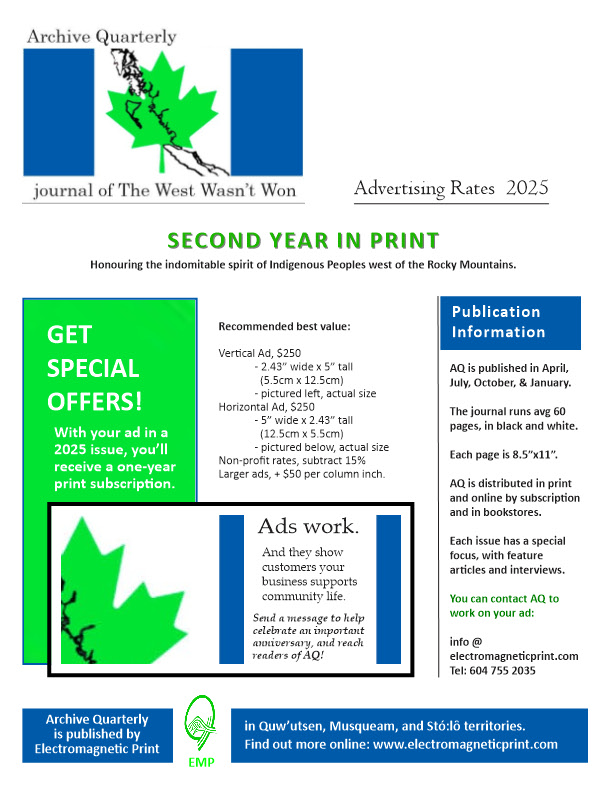
About the archive poster for The West Wasn’t Won:
Kerry Coast is a writer. Her books include, “The Colonial Present: The rule of ignorance and the role of law in British Columbia,” 2013. “Speeches from the Crowd – essays,” 2018. “Home to an Empty House,” 2021. “the picture of intent – Canadian attempts to destroy indigenous peoples,” 2022. “Dealings in Duress: the BC treaty process,” 2013.
Kerry Coast edited “The St’at’imc Runner” newspaper from 2006 – 2011, and co-published “The BC Treaty Negotiating Times” with several important partners, from 2007-2009. She is the founder of Electromagnetic Print, an independent book label.
Working for the realization of a legitimate passport, and an end to colonial identity as a Canadian in an occupation, Kerry has worked for Indigenous Peoples’ rights, the curtailment of colonial power, and an accurate history. This has led her indirectly to UN meetings in New York and Geneva to deliver interventions at ECOSOC meetings of the Expert Mechanism on the Rights of Indigenous Peoples; the Permanent Forum on Indigenous Issues; and meetings with the Special Rapporteur on the Rights of Indigenous Peoples, working with the International Human Rights Association of American Minorities (which is primarily focused on African American people in the USA – as well as colonized and dispossessed peoples globally – and does not consider Indigenous Peoples “minorities”), whose founding lawyer Dr. Yussuf Kly was sent north for safety by his partner in emancipation, Malcolm X. Dr. Kly worked for several years with the Lil’wat Nation, into which Coast is married, and produced the epic petition of no-jurisdiction to the Inter-American Commission on Human Rights, Edmonds v. Canada. That case is currently before the Inter-American Court, having been accepted in 2014 on the basis of not having to further prove exhaustion of “domestic remedy.”
Kerry Coast has always lived beyond the treaty frontier, in the Secwepemc, St’at’imc, Sto:lo, and Musqueam countries which are illegally occupied by Canada.
 The West Wasn't Won