• About The West Wasn’t Won archive project
  • Archive Quarterly
  • Children
  • Fisheries
  • Land of the Peoples
  • Lawfare
  • Non-Status Era
  • Roadblocks and Restitution
    • Gustafsen Lake
    • Haida
    • Líl’wat
    • Nisga’a

The West Wasn't Won

~ Outlive the colonial world.

The West Wasn't Won

Category Archives: BC treaty process

02.24.2024 ~ Today is a great day for history!

24 Saturday Feb 2024

Posted by Admin in aboriginal title, BC treaty process, Children, Comprehensive Claims - Policy and Protest, Government Commissions, Indian Residential School, Indigenous Declarations, Non-Status Indian Era, Reconciliation, UN Engagement, Uncategorized, Union of BC Indian Chiefs

≈ Leave a comment

Tags

Archive Quarterly

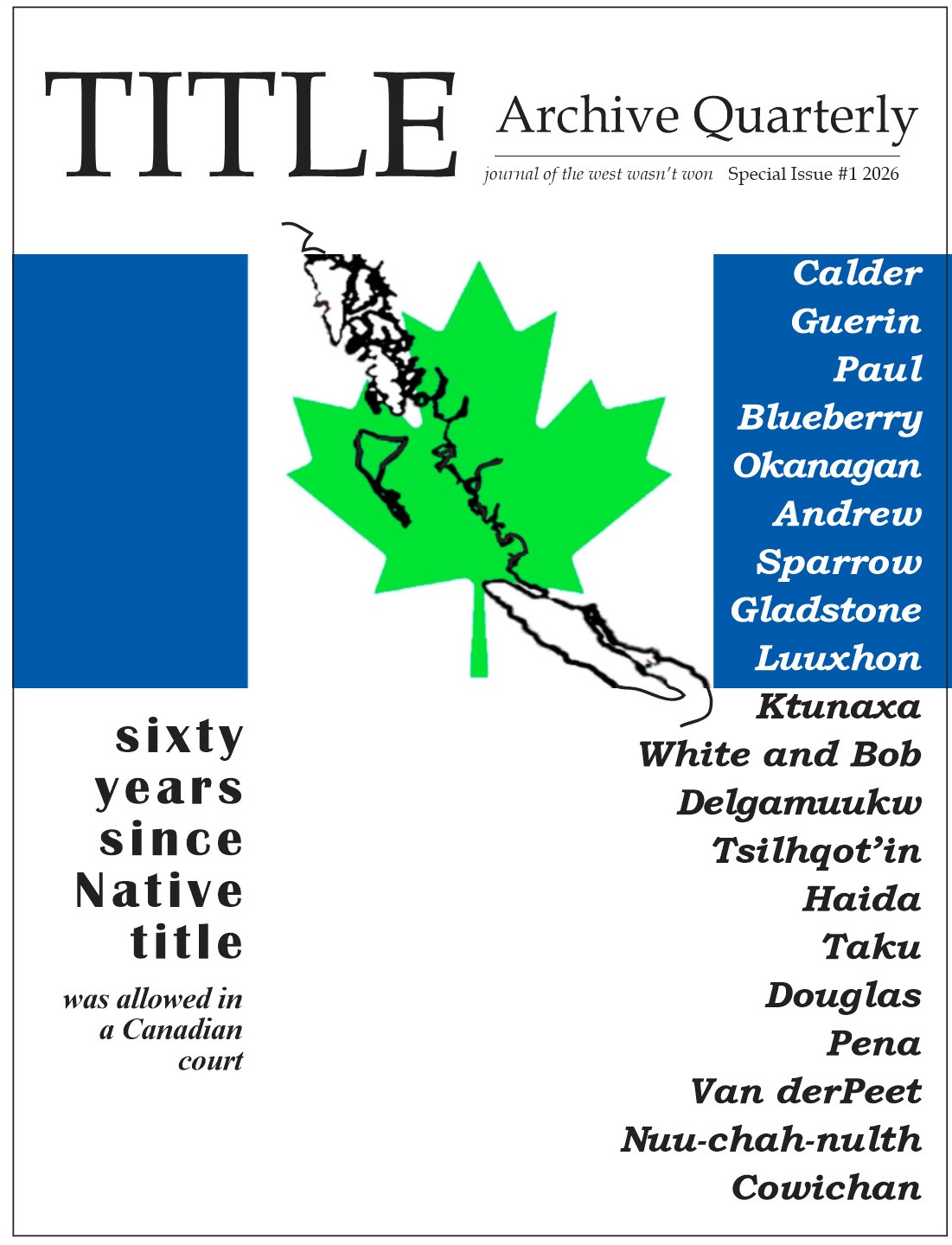
Introducing:    Archive Quarterly

It’s The West Wasn’t Won’s own journal, like a news clipping service across the last two or three hundred years.

Did you know? This month marks a hundred years since the Allied Tribes of British Columbia petitioned to shut down the Indian Reserve Commission report.

If you didn’t, a subscription to Archive Quarterly will really help!

What was hidden from history is what’s needed now.

AQ shakes out the archives for primary sources on Indigenous land and British Columbia, sharing:

~ key extracts from archival artifacts

~ quotes and interviews on the issues as they were

~ relatable commentary and a few side-notes

~ images and timelines that connect past and present

The first April issue will be here in three weeks!

READ ON  for more info

TAKE A LINK  to the Archive Quarterly website to see more and click your Subscription

FOLLOW  AQ on Facebook  for updates 

Archive Quarterly is about it, the west wasn’t won!

BC history is lit from one side – showing settler progress to advantage, while rendering the Indigenous reality of that “progress” indiscernible.

This magazine aims to balance the view. As well as the written records, interviews with Elders reveal circumstances leading up to political movements, court actions and roadblocks, and conditions in their communities at the time.

Excerpts in the journal will be presented in full documents online, where they are accessible to download.

See the highlights from the first issues this year!

Get your subscription now and you can start sharing.

Print subscriptions will hit the mailboxes in the middle of March, and the first issue of AQ will be in bookstores before April.

When you buy a $44 print subscription, you’ll be the first to receive each issue by mail and get a digital copy in your inbox as well.

That’s right, Archive Quarterly comes out four times a year, in April, July, October, and January. It’s $15 in stores.

Digital subscriptions for the year are just $18, and you can share AQ with your contacts.

Subscribe to print or digital here: AQ Subscribe

You can also donate to AQ to become a founding sponsor – thanks!

Group and bulk print subs available, just drop us a line.

If you just can’t afford the subscription, get in touch and we’ll get you in.

By subscribing to AQ today, you’ll be helping to get work done.

Special Issues

Did you know? The ongoing denial of Aboriginal land title – and the tiny size of First Nations reserves – contributes directly to child apprehensions from young Aboriginal families. The situation can’t change without land to build on and live in.

Special Issues are on the way for AQ, focusing on Aboriginal Title, the Non-Status Indian era, Roadblocks, and more. The Special series dives deep and provides historical overviews and insight, and the development takes time and research and communications.

AQ’s online digital archive

It keeps growing, as old docs are scanned and processed and uploaded. The physical archive costs money for storage, and the digital archive costs money for web space.

The magazine comes out of a collection kept up by Electromagnetic Print – EMP, a book label founded to print voices seldom heard in the media, especially the voices of native sovereigntists.

Thank you very much for reading and have a great day!

Kerry Coast, Publisher

Electromagnetic Print

Delgamuukw v. The Queen

11 Monday Dec 2017

Posted by Admin in aboriginal title, BC treaty process, Comprehensive Claims - Policy and Protest

≈ Leave a comment

Tags

aboriginal rights, aboriginal title, Delgamuukw, Gitxsan, Indigenous Peoples, Land claims, Ron George, Sovereignty, Wet'suwet'en

20 years later, Gisdayway family produces searing report on a legacy of dispossession and division following the court ruling that Gitksan and Wetsuwet’en title survives.

On December 11, 1997, the Supreme Court of Canada ruled that British Columbia has not extinguished Gitksan and Wetsuwet’en title and rights. The watershed case collected essential elements of previously recognized Aboriginal rights and articulated a clear sum of those parts: Aboriginal title and rights have not been extinguished by the province; Aboriginal title is a real, economic interest in the land; and Aboriginal title affords the owner the right to use the land and choose what it can be used for.

After December 12, 1997, thousands of column inches rolled off the presses of BC’s daily newspapers in protest. Everyone who made a living in BC was making it off the back of resources extracted from non-treaty, unceded and unsurrendered Indian land, and they were not about to let a legal ruling interrupt that. Farmers, loggers, exporters, truckers and all the businessmen in between drew up their position much in the same way US President Andrew Jackson did, when Justice Marshall said the Cherokee owned their homelands: The judge has made his ruling, now let’s see him come and enforce it!

Well, it wasn’t enforced any more effectively than in Georgia, where Jackson marched the Cherokee away along the Trail of Tears.

Twenty years of unabated logging and mining and development later, the ruling has informed a handful of cases that advanced the legal character of Aboriginal rights – at least, Canada’s definition of those rights. But what has changed on the ground? What is the real legacy of Delgamuukw, when eighty cents on the BC dollar comes directly from extractive industries, and the Indigenous are as poor as ever?

Chief Na’Moks, a Chief of the Tsayu (Beaver Clan) of the Wet’suwet’en, commented on the anniversary of Delgamuukw Day:

When the SCC overturned BC’s Court Decision, we were elated, but that was short lived as the decision has been continually ignored. We hoped that BC and Canada would uphold the Ruling, but they, and industry, chose to “Bury their Heads in the Sand” and pretend it did not apply to them. Continual approvals of Proposed Projects have proven this to be a fact.

According to Ron George, Wet’suwet’en of the Gisdayway lineage, destitute are the grandchildren of those Chiefs who sacrificed a decade of their own lives to protect their lands and bah’lahts – hereditary governance system – in the Canadian courts. That, and the fact that even the Supreme Court of Canada is no match for the governments’ insistence that Indigenous peoples will be ruled according to the state’s convenience, is the subject of his academic report: YOU’VE GOT TO PADDLE YOUR OWN CANOE.

At the time of the trial in BC Supreme Court, 1987 to 1990, George was president of the United Native Nations, based in Vancouver. Urban Gitksan and Wetsuwet’en raised funds to support the cause, and UNN offices housed UBC law students supporting their legal teams when the trial was moved to Vancouver. George, along with most of his family, did not have Indian Status. Gisdayway, the leader of their house, refused to leave home on his ancestral lands and move to the Indian Reserve. So fervent was his refusal that the early-20th-century Indian Agent concerned simply, unilaterally, enfranchised Gisdayway – Thomas George, and his wife Tsaybaysa – Mary George. His home was registered as a pre-emption. Enfranchisement was a Canadian torture device designed to further the destruction of Aboriginal nations, creating “Non-Status Indians” who could not live on Indian Reserves nor participate in any of their business, nor exercise Aboriginal rights.

They still can’t, in spite of the fact that the Supreme Court of Canada ordered a new trial into the Gitksan and Wet’suwet’en complaint to better articulate:

that the common law should develop to recognize aboriginal rights (and title, when necessary) as they were recognized by either de facto practice or by the aboriginal system of governance.

– Delgamuukw v. British Columbia, 1997 SCC, at 159

The new trial was never held. A combination of factors must have interfered: the financial cost – the three year trial, then the longest in Canadian history, came in at $23million; the cost in lives – a number of Chiefs and Elders died during the trial of stress-induced strokes and heart attacks, one of the laments in PADDLE YOUR OWN CANOE; and that the people believed their vindication at court would be enough to force the province to deal fairly.

The Delgamuukw case can certainly be understood as the highest colonial court’s check on a province that never bothered to make treaties with Indigenous Nations, but the machinations of colonialism in British Columbia are so grizzly. As McEachern J. explained the colonizer’s view at the time, in his 1991 ruling on the trial in BC Supreme Court: no Aboriginal title or right could survive the presence of British subjects and the operation of their laws in this place.


The trial and the 1991 BC Supreme Court ruling

On March 8, 1991, the BC Supreme Court ruled against 71 Houses of the distinct Gitksan and Wet’suwet’en nations, in their attempt to prove sovereignty and jurisdiction in their homelands. The ruling was a devastating event. “It was the one day in my life that I was going to quit the practice of law. I just felt I had misled 69 Chiefs and hundreds of people to believe there was some kind of justice in this country,” Peter Grant, one of the plaintiffs’ lawyers, later said of the ruling.

71 Chiefs had stood together to launch the case against The Queen and see it through the courts over a seven year period. They decided the first Chief named, so the case would carry his name, would be Delgamuukw. His position at home was that of the Chief who brings all the other Chiefs together after a day of discussion and debate.

The first words spoken in the trial were this:

“My name is Gisdayway and I am a Wet’suwet’en Chief and a plaintiff in this case. My house owns territory. Each Wet’suwet’en Chief’s house owns several territories. Together we own and govern Wet’suwet’en territory.”

Chief Delgamuukw, Gitksan, spoke next:

“For us the ownership of territories is a marriage of Chief and land. Each Chief has an ancestor who encountered and acknowledged the life of the land. From such encounters come power. The land, the plants, the animals and the people all have spirit and they all must be shown respect; that is the basis of our law.”

The case was launched in 1984, amid blockades against logging and a Gitksan blockade of the CN Rail line, which eventually had forty trains backed up on either side and strangled off the northern BC port. Direct action was a second-last ditch attempt to stop the clearcutting that was bankrupting the land-based peoples, as no legal avenue was open and the governments were not negotiating circumstances around the total devastation of the peoples’ natural wealth.

A documentary film from the time, “Blockade,” by Nettie Wild, captured the moment when RCMP are denied entrance to the Gitwangak Indian Reserve and directed to proceed along their “so-called right of way” – the train tracks. There on the rails the police read out an injunction for the train blockaders’ removal and Art Loring, Eagle Clan of Gitksan, standing in the middle of the track, replied:

Pointing to a very old totem nearby: I’d like to draw your attention to that pole there. Those poles tell us we’re right. We own this land; not the court, not the province, not the federal government. That’s why we do this, because we have a right to. And your courts come in and take us away because you think you have a right. We don’t agree. We’ve lived here far longer than you guys have.

My name is ten thousand years old. My wife’s name is twelve thousand years old.

The last ditch was to sue The Queen for recognition of their sovereignty and jurisdiction. Between 1987 and 1991, the trial encompassed 374 days of argument and evidence: 318 days of testimony. There were 61 witnesses; 53 territorial affidavits; 23,000 pages of transcript evidence at trial. The Elders brought forth their way of life and presented it, through translators, to the court. Gwis Gyen (Stanley Williams), for example, said this:

All the Gitksan people use a common law. This is like an ancient tree that has grown the roots right deep into the ground. This is the way our law is. It’s sunk. This big tree’s roots are sunk deep into the ground, and that’s how our law is.

The results of the litigation were immediate, terrifying and violent. Logging in the territory accelerated. Native school children in Hazelton and Moricetown were beaten and dumped in ditches, informed by their white attackers that “this is for the land claims!”  And 400 pages of written reasons, reminiscent of 19th century colonial logic, were afforded by the presiding judge, Alan McEachern.

Chief Justice McEachern, as he was then, was not circumspect about his contempt for the plaintiffs. He failed to see how the presented histories, maps, villages, house posts, clan system or hereditary titles, demonstrated any sort of ownership or identifiable governance. The province of BC argued,

“Clan membership is even less helpful as a way of identifying the membership of the society of Gitksan. A Clan is not a corporate body. Clan membership is a way of lining people up at Feasts, of determining who is host and who is guest, and it is a way of organizing a rule of incest.”

McEachern dismissed the Elders’ oral histories. In his reasons for dismissing the plaintiffs, he described them as “vagrants” whose lives were “nasty, brutish and short.” Peter Grant put it this way:

It was an opportunity lost. The man who heard the case as the judge did not have the capability of understanding or hearing what was being said to him.


“Treaty process” follows denial of rights

A few months later the report of the BC Claims Task Force was released, and, without a hint of irony, the BC Treaty Commission was in business a year later – with the express purpose of negotiating the extinguishment of Aboriginal rights. A paradox to be sure, since the province’s Supreme Court had just decided there was nothing to negotiate.

This move repeated the governments’ response to the Calder decision of the Supreme Court of Canada in 1973. There, three judges reasoned that the Nisga’a title to Nisga’a lands had never been extinguished. Although the case was dismissed as inconclusive – three other judges disagreed and the seventh refused to rule – it was the first time Aboriginal title had won any judicial support at all. Calder was immediately followed by the introduction of the Comprehensive Claims Policy: a mechanism by which Aboriginal rights, including land rights, would be negotiated away before they were acknowledged as such. The Nisga’a engaged in that mechanism, along with four other “test cases” from across Canada.

It was during this time, at least by 1997, that the Supreme Court of Canada decided Aboriginal title was a form of Aboriginal right. This, they said, protected Aboriginal title under the Constitution of 1982, Section 35, where, “The existing aboriginal and treaty rights of the aboriginal peoples of Canada are hereby recognized and affirmed.” Judicial definition of these rights has progressed along a marked departure from the Indigenous position that Aboriginal rights flow from Aboriginal title, or, what Indigenous peoples meant when they said “Aboriginal title” does not seem to be the same thing that Canadian judges mean when they use the phrase. Indigenous peoples, for instance, don’t seem to agree that their title can be infringed as required by Canada.

The Supreme Court’s reasoning in demarcating a roadmap to Aboriginal title perpetuated fundamental colonial constructs that are anathema to reconciliation. The judges repeated the problematic notion that aboriginal rights are sui generis – a Canadian invention to mystify Indigenous property rights and attach an “inherent limit” on Aboriginal title. And the judges continued to rely on the idea that Great Britain gained sovereignty over the west in 1846 – as they pronounce to this day – simply because Britain had made treaty with every other European power that had previously expressed interest in the area.

In court, the Gitksan and Wet’suwet’en Chiefs categorically rejected the statement of British sovereignty over their lands. Unfortunately, they had given their question over to the jurisdiction of a BC court in the first place. That is the kind of conundrum Indigenous Peoples are in: if they go to a Canadian court for legal recourse against Canada, they will find a judge who is Canadian. It’s an obvious conflict of interest which has resulted in widespread Indigenous appeals to third parties out of the state, to the Inter-American Commission on Human Rights, and to United Nations treaty bodies and Special Rapporteurs.


DISC – then and now

In 1997, the Supreme Court of Canada overturned several of McEachern’s decisions and routed his reasons so that they could never be used again.

The next day, the front page of The Vancouver Sun newspaper featured a huge picture of Edward John, Chair of the First Nations Summit, stating his expectation that the ruling would revolutionize the state’s negotiating mandate within the BC treaty process. The ruling had said, after all:

Aboriginal title encompasses the right to exclusive use and occupation of the land held pursuant to that title for a variety of purposes, which need not be aspects of those aboriginal practices, customs and traditions which are integral to distinctive aboriginal cultures.  The protected uses must not be irreconcilable with the nature of the group’s attachment to that land.

Surely selling 98% of Aboriginal title land to the state, to be developed and parceled off as fee simple title, was a use “irreconcilable with the nature of the groups’ attachment to that land.” But that was about to become the blueprint for engagement under the BC Treaty Commission. The Nisga’a Final Agreement, negotiated under the Comprehensive Claims formula of 1974, was ratified in 1998 and came into law in the year 2000.

Against the First Nations Summit’s suspended disbelief, a group of Indigenous leaders formed to propose a bridge between the Gitksan/Wet’suwet’en ruling and Aboriginal rights on the ground: the Delgamuukw Implementation Steering Committee. “DISC” attempted to gain traction with the Assembly of First Nations and the federal government, to hammer out practical ways and means for Aboriginal peoples to benefit from the ruling. But the initiative was supplanted by an exploratory committee that eventually resulted in the First Nations Governance Institute.

The 1997 decision did not change the federal government’s 1974 policies concerning negotiated extinguishment, which is now referred to as “modified rights” and includes a First Nation’s indemnification of the state for “all past harms,” in the BC treaty process. Robert Nault, as Minister of Indian Affairs in 1999, stated that Canada wouldn’t do anything to alter its “flagship process,” the “made in BC” answer to treaty settlement (and renegotiation) across Canada. Ten years later, Minister of Indian Affairs Chuck Strahl stated that the BC Treaty Commission was not a rights-based approach. In 2009, three years of work by a Chiefs Task Force working with government negotiators at a Common Table reached a final impasse in attempts to bring treaty negotiating mandates up to a minimum that could be seen as equivalent to Aboriginal rights already won in Canadian courts.

Last month, the federal government announced a new sort of DISC: the Department of Indigenous Services, Canada. The Department of Indian Affairs (also known as INAC, AANDC, etc.) has been cleaved in two under the leadership of Trudeau 2, separating land claims from the administration of Aboriginal-specific (ie, underfunded) works and programs like health, education and welfare. The new DISC refers to the latter, while the iconic Canadian “Indian land question” will be split off into version 3.0 of the Comprehensive Claims Policy / BC Treaty process / post-Tsilhqot’in decision… which apparently does not have a name yet, according to government press releases, but will be managed by a new Ministry under Carolyn Bennett: Crown-Indigenous Relations and Northern Affairs.


Cases building on Delgamuukw

In Haida, 2004, the Supreme Court ruled that government agents had a duty to consult and accommodate Aboriginal peoples whenever they contemplated action, such as resource licensing, which might impact Aboriginal title – proven in court or not. The ruling relied on the definition of Aboriginal title defined in Delgamuukw.

The legal brain trust of the colonial state has diverted whatever relief that 2004 SCC ruling might have offered into dissipating channels of “consultation” and “accommodation,” through such mechanisms as Forest and Range Agreements and other revenue sharing agreements. Thus, Aboriginal peoples attempting to benefit from that legal decision have the option of signing off that their economic interests have been accommodated – to mobilize Forest Resource Management Plans, sometimes as yet unwritten – for a paltry per-capita sum. Instead of spending a decade in court, or watching business go on as usual. It’s a provincial scheme sculpted around the lowest common denominator that meets the government obligation to be seen to accommodate economic interests in Aboriginal title.

In 2007, the William case at the BC Supreme Court resulted in a preliminary ruling for a Declaration of Aboriginal title in Tsilhqot’in territory. Seven years later, that case resulted in the first ever declaration of Aboriginal title in Canada, at the Supreme Court of Canada. The case followed the method of proving Aboriginal title which was defined by the Delgamuukw case.

Jack Woodward has been legal counsel for the Tsilhqot’in since the 1980s. He commented on today’s anniversary and what might happen next:

The next step is obvious to me, but perhaps that is because I am a lawyer who thinks constantly about the remedies that are available within the legal system.  With Delgamuukw and Tsilhqot’in, and many other decisions, the courts have opened their doors to Aboriginal people to use the powerful tools found in Section 35 of the Constitution – Aboriginal title, Aboriginal rights and treaty rights.  These are some of the most powerful tools known to our legal system.  They are there to be used.  I believe that the use of those tools is as full an answer as we can ever expect to the questions of decolonization.   In the 20 years following Delgamuukw, Aboriginal people have been very restrained about the use of the courts to seek the available remedies.

According to Ron George’s new report, the governments have found even better ways to get cooperation for resource extraction and development: funding elected Band Council Chiefs to attend the Hereditary Chief feasts – where national business is done; and even funding the purchase of traditional positions within the Feast Hall. The government’s licensing bureau ensures that no Hereditary Chief or his family can avail themselves of their own natural wealth on the land base, by recognizing only the authority of offices which conform with Indian Act / Band Council modes of operation. This action is, in itself, the most fundamental exercise of bad faith on the part of Canadian governments – although the examples are many and chilling – in the legacy of Delgamuukw.

Those three syllables will resonate in the annals of Canadian history forever:                dell-gah-MOOQU. And what will this name call to mind? That Al McEachern got paid. That Indigenous Peoples will never stop fighting for their right to exist as a people, even when the colonizer’s government ignores its Supreme Court. That Canadian indifference to law is a matter of global significance.

In, YOU’VE GOT TO PADDLE YOUR OWN CANOE, Ron George notes the following legacy:

Although some people call the Indian Act an artificial barrier, Atna feels that barrier is very real and is manifested by these attitudes toward us when we ask questions they are unable to, or choose not to, answer. “At one traditional meeting, a chief told one of our family, ‘Well, you should be so fortunate that we allowed you back on reserve’. That was in a Wet’suwet’en traditional meeting. …the whole purpose of the court case was to address that and try to move it away…get away from that. We hang onto it. [our people] hang onto it because it’s a power base…and there’s authority that goes with it.” (Atna / Brian George)

The process may be working for other people, but that’s for them to say. … Lands and resources are being negotiated away, access to our traditional territories are diminishing through resource development, rights are taken away that are entrenched in the constitution and that are recognized in Delgamuukw-Gisdayway 1997. The rightful hereditary people who have rights and title to the land are not being consulted. Consulting with the wrong people is a fast track strategy to resource development, and a resource grab for the ‘sell-outs.’ We need to survive in the new economy and are by no means looking to stop progress, but it’s got to be done in a respectful manner so our kids and grandkids…..We have to survive. We survived thousands of years. We’re going to continue to survive. Well, we have to have a say in it. (Greg George)

What is the legacy of Delgamuukw v. The Queen? Earlier this year, a bronze statue of the late BC Chief Justice Allan McEachern, who died in 2008, was installed in the Great Hall of the Law Courts in downtown Vancouver. And suicide among the youth of Indigenous Nations occupied by Canada outstrips the national average by eight times.


References:

You’ve Got to Paddle Your Own Canoe: The effects of federal legislation on participation in, and exercising of, traditional governance while living off-reserve, by Tsaskiy (Ron George), Department of Educational Psychology and Leadership Studies, University of Victoria, December, 2017

Delgamuukw v. British Columbia, [1997] 3 S.C.R. 1010

Colonialism on Trial: Indigenous land rights and the Gitksan and Wet’suwet’en sovereignty case, Don Monet and Skanu’u (Ardythe Wilson), New Society Publishers, 1992

North at Trent 2015 Lecture Series with Peter Grant, youtube, by TrentFostCtr, 2015

And special thanks to Chief Na’Moks, Wet’suwet’en, and Jack Woodward for fielding a few questions about the impacts of the case.

Indigenous reports force feds ahead of UN review

29 Saturday Jul 2017

Posted by Admin in BC treaty process, Commentary, editorial, UN Engagement

≈ Leave a comment

Tags

Canada, Indigenous Peoples, Sovereignty, UN, United Nations

75% of reports to Committee on racial discrimination sent by Indigenous organizations.

Last week, Canada switched arrogance and condescension for gestures of off-kilter desperation at the Assembly of First Nations’ general assembly. That is probably because on August 14 and 15, Canada will be under the microscope at UN headquarters in Geneva. Fifteen Indigenous Peoples’ organizations have already submitted extensive reports for the Session, detailing Canada’s “seek and destroy” approach to their internationally recognized human rights.

It is a typical Canadian tactic to invent meaningless distractions right before a review by a UN treaty body: their delegates to the Session can then reply to the Committee’s independent experts by talking about “initiatives” or “joint meetings” which do not substantially exist, instead of answering directly.

This time Canada sent four federal ministers to the AFN’s annual assembly, July 25-27, where they implied that Ottawa is going to rescind the Indian Act. Bennett (Minister of Indigenous Affairs), Wilson-Raybould (Minister of Justice), McKenna (Environment) and Goodale (Public Safety), all made vague references to bright promises yet to come.

The only concrete message from Ottawa to the AFN Chiefs – only half of whom showed up at the all-expense-paid meeting in Regina – was that it will no longer claw back unused capital funds to First Nation communities after twelve months of dispersal.

This miserable material figure can and should be unsuccessfully compared to the immaterial, yet golden, future intimated by Bennett’s and Wilson-Raybould’s reported remarks.  “How will your nation and Indigenous government be organized? What is your territory?” Their remarks, on the other hand, will certainly be judged against the picture of Indigenous life under Canada which has been detailed in reports to the UN CERD.

“ Skeena watershed and coastal Indigenous communities depend on the salmon for food, their economies and cultures. This (LNG, Prince Rupert) project is a prime example of what’s wrong with Canada’s approach to engaging Indigenous communities in large-scale industrial developments: It continuously fails to honour the legal obligations to Indigenous Peoples in protecting their traditional resources; The Canadian government generally consults with Band Councils, which were created under the colonial Indian Act, and often fails to consult hereditary leadership or respect traditional governance systems; …”

. Skeena Indigenous Groups’ Submission to UN CERD. July 6, 2017

It is interesting to note that only weeks after this report to the CERD was posted for the Session, Petronas announced its withdrawal from this proposed project, “Pacific NorthWest LNG.”

The UN Committee for the Elimination of Racial Discrimination has dealt Canada sharp rebukes over the last two decades: stop extinguishing Indigenous Peoples’ titles; stop ignoring murderers who target Indigenous women; stop trying to destroy the Lubicon Cree to get oil access.

The UN treaty bodies have an internationally recognized judicial power to issue recommendations to member states in keeping with upholding international human rights conventions. Each committee periodically receives reports from the state under review, and also from non-governmental organizations, civil society, academia, and now from Indigenous Peoples’ organizations.

It is typically the reports from Indigenous Peoples and NGOs which have, in the past, resulted in strong recommendations from UN Committees to Canada. Many of those have produced changes in the government’s behaviour, although such changes have been isolated and usually only in direct connection to the issues reported. In British Columbia this includes instances of forgiveness of government treaty negotiation loans to small Bands; dissolution of treaty societies formed to negotiate in the BC treaty process – against community members’ protests; and possibly the current standstill in BC Treaty Commission business altogether.

Extinguishment “negotiations” are an ongoing problem that is at the center of the CERD’s focus on Canada:

“There are no viable options other than legal court action to counter the BCTC “treaty” process about these overlaps into St’át’imc territory. As negotiations with the outside First Nations progress, the eventual outcome will be the extinguishment of significant portions of St’át’imc territory without the St’át’imc having been involved in any negotiations to this effect.”

. SHADOW REPORT BY THE INTERIOR ALLIANCE: CANADA’S ONGOING                               COLONIZATION OF INDIGENOUS PEOPLES.   UN CERD COMMITTEE JULY 2017

In contradiction to the Interior Alliance’s extensive documentation of the extinguishment effect of Canadian “negotiations,” however, Minister Wilson-Raybould remarked to the press on her government’s plans: “They are explicit in rejecting certain long-standing federal positions—such as the focus on extinguishment, surrender or denial of rights.” Incidentally, that’s what Canada told the CERD in 2007.


Extinguishment, surrender and denial are precisely what Canada offers Indigenous Peoples. There is a veritable firestorm of examples of this, enveloping Indigenous Peoples. It is highly suspect that a Canadian Minister climbs a prominent national stage and says “we’re just about to change,” (again) only days before Canada has to answer a lot of very pointed questions in front of the world.

Consistent Canadian practices are to assimilate and co-opt economic development, to municipalize isolated communities under provincial legislation, to criminalize traditional economies, to rigidly maintain dependency by an overbearing and constantly metamorphosing bureaucracy which can never be finally functional. There is the “First Nations Land Codes” – where a community votes to recognize Canadian supremacy in its traditional territories, just for the privilege to enjoy managerial duties on-reserve. There are the “Strategic Land Use Planning Agreements” – where communities have shared maps of their territories showing cultural values and inadvertently given tacit approval to development in huge “low cultural value” lands. In the national Inquiry into Missing and Murdered Indigenous Women, crucial voices have undoubtedly been denied. Indigenous Peoples’ rights under Article 1 of the International Covenants on Civil and Political, and Social, Economic and Cultural Rights are completely denied. Canada specializes in the forcible removal of Indigenous children from their homes and communities, requiring parents and families to submit and surrender to provincial courts which have no jurisdiction whatsoever in the case of children and families who are not Canadian until they produce a referendum from their nation joining Canada.

Minister Wilson-Raybould, apparently speaking for those Indigenous individuals who have exercised their right to choose a nationality, appealed to the Chiefs to imagine their future as Canadians whose Indigenous rights are recognized and respected.

Ultimately, the Supreme Court of Canada expresses the state’s right to own Indigenous nations it has no treaties with. It is certainly a matter of interest in any investigation of racial discrimination. Apparently the key to Canada’s jurisdiction over nations with which it has no constructive agreements is owing to the fact that the British monarch, appointed by the Christian god, had sent a sailor with orders to discover and possess others’ lands in His name, and he was successful in this because the Christian god was superior, so the Supreme Court of Canada seems to say, to any of the existing nations’ gods. We know it is the presence of other Christian nations which is at issue in the matter of the Canadian court’s opinion on sovereign possession, because the issue was finally settled in 1846, according to Canadian judges, when the USA agreed in the Oregon Treaty to withdraw from pursuing any interests north of the 49th parallel. From that date, Great Britain and now Canada enjoys sovereign possession of all lands from the Pacific Ocean to the Atlantic Ocean above that parallel, except Alaska, as per SCC, because all other Christian nations had, by that time, also promised Great Britain they would pursue no interests there.

Unfortunately for that internationally repugnant display of Canadian faith, which is the state’s current legal precedent, it is not clear that any Indigenous Peoples have formally joined and adhered to Canada. Wilson-Raybould was referring to that popular understanding among the Chiefs. The CERD has been made aware of that understanding, and again in the reports for this Session:

“In particular, we bring to the Committee’s attention the state’s use of its own  imposed Indian Band administration, under the Indian Act, on the state-defined Indian Reserve, to manufacture the appearance of Líl’wat consent to Canada’s disposal of the remainder of Líl’wat customary titles to lands and wealth outside the Reserve.

“Líl’watmc ask that the Committee question Canada about the origins of any rights of jurisdiction it may have in relation to Líl’wat which could justify Canadian licensing and development without the consent and against the Interests of the Líl’watmc under the Convention, and resulting in the continuing displacement and dispossession of Líl’wat.”

Líl’wat report to UNCERD, July 2017, with the International Human Rights                                         Association of American Minorities

The picture developed by fifteen Indigenous Peoples’ organizations shows Canada’s unabated attempts to assimilate Indigenous Peoples – their worldview, identity, economies, individuals, children, histories, and especially their lands and natural wealth – into Canada. Unilateral, non-consensual assimilation is categorically prohibited as a matter of human rights norms, and yet that end of the spectrum of Canada’s colonization is not the worst.

“If Ontario and Canada insist on excluding us from meaningful consultations on the Agreement in Principle, then we insist that Canada and Ontario exclude the areas where our First Nations’ asserted Aboriginal title and rights overlap with the “Algonquins of Ontario” claims, or at least suspend negotiations over  such areas, until such time as we have engaged in meaningful consultations and reached an acceptable accommodation.

“Despite our objections in March 2016, the “Algonquins of Ontario”, Canada and Ontario have proceeded to hold a referendum vote on the AIP.”

ALGONQUIN NATION SECRETARIAT  TO THE UN CERD COMMITTEE                                                          July 2017


“How does one start to describe the horrific conduct of Canada in their relentless efforts to extinguish the rights of Indigenous peoples within their ancestral homelands?”

“While the Supreme Court of Canada has determined that the Canadian and provincial governments have a duty to consult, negotiate, and accommodate Indigenous rights, the governments use these consultation and negotiation processes to coerce, terrorize, terminate, extinguish, and discriminate against Indigenous peoples and our rights.”

Submission to the UNCERD 93rd Session, July 31-August 25, 2017.                                             On behalf of the Mothers and Grandmothers of the Maliseet Nation


“Asubpeeschoseewagong Netum Anishinabek, also known as Grassy Narrows First Nation, is located on the English-Wabigoon River system in North Western Ontario, and is infamous for mercury contamination from an upstream pulp and paper mill. … In 2016, a former mill worker came forward to confess the mill had illegally buried barrels of waste along the river, leading to the persisting contamination and inability of the river system to recover naturally.”

Chiefs of Ontario report to UNCERD, July 2017


“On November 29, 2016, the Canadian Federal Cabinet directed the National Energy Board to approve the Kinder Morgan Trans Mountain pipeline expansion. This pipeline poses an unacceptable risk to the health, safety and livelihoods of First Nations throughout British Columbia, and will contribute to the negative environmental and health impacts experienced by Indigenous Peoples downstream of the tar sands, and of all peoples throughout the world as a result of accelerating global climate change. The Tsleil-Waututh, Squamish, Musqueam, Coldwater, Upper Nicola, Stk’emlupsemc te Secwepemc, Aithchelitz, Shxwhay Village, Yakweakwioose, Kwawkwaw-apilt, Tzeachten, Skowkale, Soowalie, and Squiala peoples have commenced legal proceedings seeking to challenge the federal approval for the Trans Mountain project… It is well established that diluted bitumen contains toxic chemicals that are a threat to drinking water, health, and the well-being of salmon and other beings.”

Submission to the UNCERD 93rd Session, 2017.                                                                                 Union of British Columbia Indian Chiefs.

Minister Bennett, for the federal department of Indigenous and Northern Affairs, said to the AFN Chiefs last week: “We want to partner with you on building on the strengths and assets you have in your communities. You have the power to determine the future of your communities.”

The international community is quite aware that Canada still wishes to build on the strengths and benefits belonging to Indigenous communities, whether Canada co-opts the participation of those communities through “benefits sharing” or “land management” or other agreements achieved under duress. The international community is also aware that Indigenous Peoples have the power to determine the future of their communities, and that Minister Bennett and her government may well have nothing to do with that.

As the Union of BC Indian Chiefs’ report articulated, “We are presently witnessing a great divide between the words of the Canadian government and its actions on the ground. We would like to highlight the term “rights ritualism” for the consideration of the Committee in respect to Canada’s present actions: a way of embracing the language of human rights precisely to deflect real human rights scrutiny and to avoid accountability for human rights abuses. Countries are often willing to accept human rights treaty commitments to earn international approval, but they resist the changes that the treaty obligations require.”


Oweekeno-Kitasoo-Nuxalk Tribal Council: re. land claim settlements

06 Tuesday Dec 2016

Posted by Admin in BC treaty process, Indigenous Declarations

≈ Leave a comment

Tags

Canada, Land claims

Delivered to the First Nations Summit meeting in Vancouver, February 4, 1991. (Note – The First Nations Summit is the party representing Indigenous parties to the BC Treaty Commission.)

oweekeno-kitasoo-nuxalk-re-land-claim-settlement-to-fns-meeting-feb-4-1991

Excerpt:

In the beginning the Creator bestowed upon our forefathers all the lands, waters, air and all its natural resources. This is a fact we all know as it has been handed down to us for generations and generations. With the blessings of the Creator, which today we now call Aboriginal Title and Rights, our First Nations cultivated our tribal territories in harmony with nature and perpetually sustained all natural resources and our peoples through good government, peace and order. Before we talk about land claims today, let us all stand so that we may share with you a few words with the Creator…

… When we talk about land claims we must never forget that the Creator provided all our First Nations with tribal territories adjacent to each other.

… Today, because the leaders of both the Governments of Canada and British Columbia, who we will call the “Crown”, want to totally eliminate our claim to traditional tribal territories, there are efforts made that appear to be dealing with the resolution of land claims, self-government and whatever other “aboriginal title and right” the First Nations claim to still hold. We must not forget the fact that our ancestors gained international recognition that the Crown must gain the consent of the First Nations if they want to take our traditional tribal territories. We must not forget the fact that the Crown, in spite of treaties with many First Nations throughout Canada, have consistently imposed cultural genocide policies and practices on all our First Nations. It is these two key facts that prove the Crown is still trying to eliminate our claim to traditional tribal territories while appearing to try to resolve the Indian problem.

If the Crown is serious and sincere about resolving the land claims question with all our First Nations, then it must consider the following recommendations:

BC Treaty Advocate Elected Chair of UN Permanent Forum on Indigenous Issues

06 Saturday Sep 2014

Posted by Admin in BC treaty process

≈ 1 Comment

Grand Chief Edward John has spent the past 20 years in the BC treaty process, which produces extinguishment Agreements.

Originally posted to the Vancouver Media Co-op, June 10, 2012

The 11th Session of the top forum for Indigenous peoples in the world began with a lurch. The sixteen-member Forum elected, by acclamation, Grand Chief Edward John to be their Chair. The announcement was made during a preliminary meeting, May 6, 2012, at the start of a two week meeting in New York City. Hailing from Tl’azt’en (in northern BC), this Chief will be familiar to anyone who has followed the machinations of the BC treaty process over the last twenty years: John was the founding Chair of the First Nations Summit, an organization formed to “represent First Nations” involved with the BC Treaty Commission (BCTC).

Perhaps, in 1992, the election of a man affiliated with this Summit to Chair the Permanent Forum on Indigenous Issues – understood to be advancing the cause of self-determination, land rights, and everything else contained in the Declaration on the Rights of Indigenous Peoples, would not be an obvious contradiction in terms. However, twenty years later, after the ratification of two extinguishment treaties in that process, this election must be a point of confusion.

When Nisga’a ratified an agreement with British Columbia and Canada in 2000, they released the Nisga’a claim to 100 per cent of their traditional territory in exchange for about 8 per cent of the land back, in Fee Simple Title and with BC holding the underlying title. No alarm bells were rung by Chief John. Every First Nation in BC was watching that process very closely, as they believed, rightly, that future negotiations in the BC treaty process would follow the Nisga’a template.

When, in 2007, Tsawwassen became the first Indigenous people to ratify a Final Agreement produced in the BC Treaty Commission, the text of that document stated:

Tsawwassen First Nation releases Canada, British Columbia and all other persons from all claims, demands, actions, or proceedings, of whatever kind, and whether known or unknown, that the Tsawwassen First Nation ever had, now has or may have in the future, relating to or arising from any act, or omission, before the effective date that may have affected or infringed any aboriginal rights, including aboriginal title, in Canada of the Tsawwassen First Nation.

This clause is also to be found in the Nisga’a Agreement. It is a surrender, rather than the basis of continuing nation-to-nation relations. Tsawwassen made these concessions for a settlement of less than 1 per cent of their traditional territory, held in Fee Simple. The total cash value of the deal was $33.6 million plus self-government funding of $2.9 million annually over the first five years of the treaty – according to government press releases.

Perhaps Chief John takes a leaf out of then-Indian Affairs Minister Chuck Strahl’s book, who declared at the time, “Who am I to say if it’s a good deal or not?”

John is still the Chair of the First Nations Summit today.

Maa-nulth agreed to the same releases when it ratified a Final Agreement in this process later in 2007. Other identical provisions in all three Agreements include the release of Indian Status, including tax-free status; the “modification” (extinguishment) of their aboriginal rights to be only those rights exhaustively defined in the Agreements; the dissolution of the Indian Band; and the termination of Indian Reserve lands: “Fee Simple Lands are not ‘lands reserved for the Indians’ within the meaning of the Constitution Act, 1867, and are not ‘reserves’ as defined in the Indian Act.”

The role of the First Nations Summit in these “negotiations” is, in part, to give advice to the federal government for the allocation of treaty negotiating loans to First Nations for the purpose of developing and ratifying Final Agreements under the BC Treaty Commission. These negotiating allowances average a million dollars a year, and the 80 per cent which is a loan comes due the moment a First Nation leaves the process or begins implementation of their Final Agreement.

Staying at the table is an offer most First Nations cannot afford to refuse, especially for those who have been at it since 1993, but the only alternative is to ratify an Agreement and extinguish title. Treaty negotiating loans are not included in government audits of First Nations accounts – perhaps because such a loan would immediately place that community in third party remedial management.

Chief John has stayed with the process throughout and failed to take any meaningful action to indicate his disapproval of the situation, if he does indeed disapprove. He obviously hasn’t resigned in protest.

Self-determination, recently enshrined in the UN Declaration on the Rights of Indigenous Peoples, goes out with ratification of these Agreements as well, replaced by what the governments, the Treaty Commission, and the First Nations Summit call “self-government” – powers which amount to little more than municipal business under the heavily qualified “Governance” chapters. The presence in each Final Agreement of identical chapters which circumscribe any exercise of self-determination betrays a theme, one which previous leaders dubbed “the BCTC Death Row.”

According to Chief Negotiator Robert Morales, Hul’qumi’num Treaty Group, in 2007, “there is one negotiation going on at 47 tables. These were to be government-to-government negotiations, but that’s not how it turned out.”

By 2006, the First Nations Unity Protocol Agreement included all but one of the treaty-going groups in the province, and had made clear the flaws in the process. Morales said, while Chair of the First Nations Summit Chief Negotiators’ table at the time, “The experience we’re having at the Tables and in meetings is that government comes to every table with the same language, with one approach, whether the Nation is small or large, urban or rural. We have realized that we can’t change those policies on our own, even at my table where 6,000 people are represented.”

Since Morales’ statements, letters, and FNUPA actions, which included blockading a Nanaimo ferry sailing with canoes, the HTG has been in abeyance from the negotiating table and entered a petition describing the exhaustion of domestic remedies within Canada to resolve the outstanding land title issue. That Petition was heard in Washington last year by the Organization of American States’ Inter-American Commission on Human Rights, and a result has not yet been announced.

At the Opening Ceremonies of the PFII 11th Session at UN Headquarters, Deputy Secretary–General of the United Nations Dr. Asha-Rose Migiro noted in her address, “…we don’t have to go far to see examples of Indigenous peoples facing discrimination, even extinguishment.”

As she spoke, Chief John was sitting in front of her.

On the second day of the meeting, an intervention by the North American Indigenous Peoples Caucus delivered by Steven Newcomb claimed that “Negotiations such as in Canada under the Comprehensive Claims Policy… lead to the extinguishment of Indigenous peoples.”

The CCP is the basic platform of the BC negotiations, in direct contrast with the 19 Recommendations by the BC Task Force forming the terms of reference or guidelines for the process in 1992. Those guidelines attracted people to the process because they said, in sum, that the government would be open to all types of discussion and conclusions that would lead to real, workable treaties.

Several independent members of First Nations involved in the treaty process have taken their concerns to an urgent action committee of the United Nations’ Committee for the Elimination of all forms of Racial Discrimination (CERD), in 2009. In reports on Canada’s human rights record regarding Indigenous peoples, the CERD has criticized the process, as in 2007, when they wrote:

While acknowledging the information that the “cede, release and surrender” approach to Aboriginal land titles has been abandoned by the State party (Canada) in favour of “modification” and “non-assertion” approaches, the Committee remains concerned about the lack of perceptible difference in results of these new approaches in comparison to the previous approach.

To date, only four Final Agreements have resulted from the negotiating process implemented by the BC Treaty Commission, one rejected in the community ratification vote, one awaiting federal approval, and two in implementation, but all of them leading to the extinguishment of title of the Indigenous nations concerned.

Aside from these, the negotiation process in BC remains stalled largely due to the evident desire of the governments to pursue policies of extinguishment of Indigenous sovereignty rights, and the equally evident desire of the BC Indigenous nations to resist this demand. But they cannot leave the process without triggering the maturation of the negotiating loan.

While Chief John and the Summit Executive exchange polite letters and press releases with Canadian government officials conducting studies on the BC treaty process, and welcoming “recommendations which outline how the federal government can accelerate treaty negotiations in BC” (First Nations Summit Press Release: May 4, 2012), the cost of remaining in the process grows – and the process remains one of municipalization of Indigenous nations which currently have the internationally recognized right to self-determination and demonstrable title to their territories.

Sliammon First Nation is about to go to a ratification vote this summer.

Jackie MukSamma Timothy, a Sliammon Hereditary Chief, wrote of the situation:

So called “Canada’s” ignorance of our existing and affirmed Title and Rights and the threat of limited financial support for non-participating Nations forced my people into entering the treaty process. And they keep us on the negotiation table, by threatening to demand all the negotiation funds back at once or to limit our financial support by the federal government accordingly. For my Nation it is impossible to pay the amount back or to forgo financial aid. Moreover, the longer the process takes the more power shifts to the benefit of so called “Canada” and “BC”, because in the end any agreement resulting in any kind of payment is better than none, given the fact that we have to pay the loans back. Loans that would not even be necessary without Canada’s wrong-doings and their ignorance of our existing Title and Rights.

The number of irregularities in the BC treaty process is staggering and climbing. It is not unusual for communities to fail to hold a vote annually in order to approve continued borrowing for negotiation funding, or to have votes against continuing the loans ignored, according to vocal Indigenous dissidents. Hereditary Chief Kakila, Tenas Lake, wrote in a letter to the BC Treaty Commission, 2007:

We are advised by the Honourable Minister of Indian and Northern Affairs Jim Prentice that these twelve people (the IN-SHUCK-ch Treaty Society) have since 1993 borrowed $9,717,059.00 to engage in these negotiations. We remind that those are the debts of those people alone. In fact, on October 15, 1994, at a duly convened Samahquam General Assembly, for said purpose, the membership specifically voted, by majority, “no” to any proposed Loan Agreements emanating from the British Columbia Treaty Commission.

Most of the original nineteen recommendations of the British Columbia Task Force, which were agreed on by the three negotiating parties forming the BC treaty process, have long since been abandoned: for example, every Final Agreement produced has been taken to court by neighbouring nations for failure to resolve “overlap” claims. Most negotiations currently underway were initiated by a small minority of community members – over whom the rest of the people in the communities cannot regain control: court actions such asSpookw v.Gitxsan Treaty Society et al, 2011, and the recent blockade by members of the Gitxsan against the Gitxsan Treaty Society show how serious this flaw is. By insisting that the small, mostly isolated communities are “autonomous” in their dealings with the treaty process, the First Nations Summit has absolved itself of any responsibility for those First Nations which it claims to represent.

Both the Tsawwassen and Maa-nulth Final Agreements were ratified in votes where “public relations crisis-management” firms were hired by the government to produce pro-treaty propaganda, and where treaty negotiating teams promoted only those prominent community members who endorsed the Final Agreement, and where immediate fiscal rewards for a “yes” vote were offered to community members.

Bertha Williams, a Tsawwassen Member, wrote in a letter to Rudolfo Stavenhagen, Special Rapporteur on the Human Rights and Fundamental Freedoms of Indigenous People of the United Nations Commission on Human Rights, July 23, 2007:

I would like to reference some very key items that raise very serious question about the legitimacy of this vote. Under “Members Benefits” two cash incentives to voters are stated.“ In particular it states that “each elder over 60 will receive $15,000, shortly after ratification day” and “approximately $1,000 per member on Effective Date.” I feel that these cash incentive are a bribe to vote YES to the Final Agreement. These are the cash guarantees that are written right into the agreement and that are openly promoted, but I know that there are additional monies paid out just to get people to vote on this agreement. As already set out above, the vote will take place without meeting basic requirements for such a fundamental, constitutional vote.

People are not informed about the real content of the agreement they are voting on, but rather the provincial government is paying for the preparation of propaganda material that points to the few mainly cash incentives of the agreement, but fails to point out all the downfalls, such as the extinguishment of our Aboriginal Title to our territories, the loss of the tax exemption and the long-term loss of programs and services that will all result in the further impoverishment of our people.

Many feel that, as a lawyer whose organization gives advice on the allocation of negotiating loans, Chief John is and was aware of how the loan process itself would leave small and isolated communities trapped between descending into a deeper cycle of debt the longer they stuck to their negotiating claims – or acceding to the extinguishment terms offered by Canada, which can afford to wait the process out. That message has been clearly and repeatedly delivered to the Executive of the First Nations Summit by such groups as the First Nations Unity Protocol, as early as 2006.

But Chief John is considered respectable. Earlier this year he received a National Aboriginal Achievement Award, and he is on the Board of Cultural Survival, an international agency which claims to, “publicize Indigenous Peoples’ issues through our award-winning publications; mount letter-writing campaigns and other advocacy efforts to stop environmental destruction and abuses of Native Peoples’ rights; and we work on the ground in Indigenous communities, always at their invitation.”

Most of the Indigenous nations whose territories lie within the Canadian Province of British Columbia have no treaties with Canada. 

The recent appearance of Edward John on the Aboriginal People’s Television Network to state that he does not support extinguishment is not an adequate gesture, when read together with his continued involvement, as Chair of the First Nations Summit, in this well-documented extinguishment process.

The Permanent Forum on Indigenous Issues sends the world a mixed message in its choice of Chair, when considering its stated mandate. Perhaps the message will become very clear when the Permanent Forum reports its recommendations, which will be received by the UN Economic and Social Council to advise member states on Indigenous peoples’ rights the world over.

grand_chief_ed_john_center_chairing_the_11th_session_of_the_un_pfii_2012

Subscribe

  • Entries (RSS)
  • Comments (RSS)

Archives

  • December 2025
  • October 2025
  • June 2025
  • May 2025
  • February 2025
  • September 2024
  • August 2024
  • July 2024
  • April 2024
  • March 2024
  • February 2024
  • September 2023
  • August 2023
  • June 2023
  • June 2018
  • December 2017
  • July 2017
  • January 2017
  • December 2016
  • July 2015
  • March 2015
  • February 2015
  • January 2015
  • December 2014
  • September 2014

Categories

  • Archive Quarterly
  • BC treaty process
  • Children
  • Commentary, editorial
    • Uncategorized
  • Comprehensive Claims – Policy and Protest
    • aboriginal title
  • Government Commissions
  • Gustafsen Lake Standoff 1995 – Ts'peten Defense, Secwepemc
  • Haida title
  • Indian Residential School
  • Indigenous Declarations
  • Non-Status Indian Era
  • Reconciliation
  • Roadblock
  • UN Engagement
  • Union of BC Indian Chiefs

Meta

  • Create account
  • Log in

Blog at WordPress.com.

  • Subscribe Subscribed
    • The West Wasn't Won
    • Already have a WordPress.com account? Log in now.
    • The West Wasn't Won
    • Subscribe Subscribed
    • Sign up
    • Log in
    • Report this content
    • View site in Reader
    • Manage subscriptions
    • Collapse this bar
 

Loading Comments...