• About The West Wasn’t Won archive project
  • Archive Quarterly
  • Children
  • Fisheries
  • Land of the Peoples
  • Lawfare
  • Non-Status Era
  • Roadblocks and Restitution
    • Gustafsen Lake
    • Haida
    • Líl’wat
    • Nisga’a

The West Wasn't Won

~ Outlive the colonial world.

The West Wasn't Won

Category Archives: Uncategorized

UN CERD report is four years overdue – Canada.

12 Friday Dec 2025

Posted by Admin in Uncategorized

≈ Leave a comment

Tags

Canada, indigenous, uncerd

In 2017, the Committee for the Elimination of Racial Discrimination made 32 recommendations to Canada that pertain directly to Indigenous Peoples.

Canada’s last review by the UN Committee for the Elimination of all forms of Racial Discrimination concluded in 2017. The UNCERD provided concluding observations and recommendations, and Canada’s next report was due on November 15, 2021. This report has not been filed, and the corresponding meeting has not been scheduled.

      32 of the CERD’s most recent recommendations relate directly to Indigenous Peoples: from land rights to discrimination and racism in the public education system. They are copied below; the recommendations have not been achieved.

      Furthermore, the Committee drew Canada’s attention to recommendations it made in 1997, and has repeated at every review since then, concerning:

  • the right to consultation and to free, prior and informed consent of Aboriginal peoples whenever their rights may be affected by projects carried out on their lands, as set forth in international standards and the State party’s legislation;
  • to seek in good faith agreements with Aboriginal peoples with regard to their lands and resources
  • find means and ways to establish titles over their lands, and respect their treaty rights;
  • Take appropriate measures to guarantee that procedures before the Special Tribunal Claims are fair and equitable …

That was in 2012.

      When the CERD referred to its 1997 recommendations again in 2017, it got even more specific, adding the following to the list:

  • End the substitution of costly legal challenges as post facto recourse in place of obtaining meaningful free prior and informed consent of Indigenous Peoples.
  • Incorporate the free, prior and informed consent principle in the Canadian regulatory system
  • amend decision making processes around the review and approval of large-scale resource development projects like the Site C dam.
  • Immediately suspend all permits and approvals for the construction of the Site C dam.
  • Conduct a full review in collaboration with Indigenous Peoples of the violations of the right to free prior and informed consent, treaty obligations and international human rights law from the building of this dam and identify alternatives to irreversible destruction of Indigenous lands and subsistence which will be caused by this project.
  • Publicly release the results of any government studies of the Mount Polley disaster and the criminal investigation into the disaster, before the statute of limitations for charges under these Acts expires.
  • …take measures to mitigate the impact through … fair remedy and reparations.

As we all know, Site C is going ahead and BC media shut out Indigenous opposition. We also know the BC government took over a private prosecution of Mount Polley mine’s owners – and dropped the charges. West Coast Environmental Law wrote a great article about that.

As for “costly legal challenges,” they are the only way to identify Section 35 Aboriginal rights in Canada, on a case-by-case basis, unless you surrender your rights in toto and accept a deal with Canada instead.

No review of violations of free, prior, informed consent have gotten underway since 2017.

What will Canada tell the Committee this time?

That on top of a new record-breaking trial over Aboriginal title – the Cowichan 2025 decision is now the longest, at five years of trial – the positive decision in favour of the Tribes was appealed by settler governments before they could have possibly had time to finish reading it?

      And then every purveyor of news media – state or commercial – hammered the incitements to hatred spoken by ignorant civilians, on repeat? To the point that the Cowichan Tribes had to issue a statement concerning the “Misleading and False Information Regarding Aboriginal Title Case,” (October 27) tantamount to a cease and desist order? (October 27)

UN treaty bodies make a difference

In the last reporting cycle to the CERD treaty body, 75% of the reports from Non-Governmental Organizations and civil society were sent by Indigenous organizations – fifteen of them.

UN treaty bodies make a difference, even though Canada does not take its Charter obligation seriously when it comes to educating the public about international human rights law generally, and UN mechanisms in particular.

      The CERD passed remark on the BC treaty process in 2007:

“While acknowledging the information that the “cede, release and surrender” approach to Aboriginal land titles has been abandoned by the State party in favour of “modification” and “non-assertion” approaches, the Committee remains concerned about the lack of perceptible difference in results of these new approaches in comparison to the previous approach.

“The BC Treaty Commission version of the Canada comprehensive claims extinguishment policy has all but collapsed since then. Only one Final Agreement was completed after Tsawwassen and Maa-nulth were heavily lubricated through ratification – within weeks of the CERD report – in 2007, and BC has had to reinvent (yet again) the Indigenous surrender policy that has been formally in place since 1914.”

      They call them “reconciliation of rights” and “jurisdiction” agreements now.

      Reinvention is at the center of all Canada’s reports to treaty bodies, when it comes to Indigenous Peoples.

      Right before the August 2017 date for Canada’s appearance before the CERD, it sent four federal ministers to the Assembly of First Nations annual assembly, July 25-27, where they told everyone that Ottawa is going to rescind the Indian Act. Bennett (Minister of Indigenous Affairs), Wilson-Raybould (Minister of Justice), McKenna (Environment) and Goodale (Public Safety), all described a bright new future to come.

      They did this moments before the in-person report to CERD in Geneva, allowing Canada to reply to all of the issues raised in the fifteen Indigenous reports by referencing the July meeting and the appearance of an announcement there.

      However, the only substance to Ottawa’s mission to the AFN Chiefs in July – half of whom boycotted the all-expense-paid meeting in Regina – was that the Ministry of Crown-Indigenous Relations and Northern Development will no longer claw back unused capital funds after twelve months.

An excerpt from one of the independent reports to the last CERD review of Canada:

“Skeena watershed and coastal Indigenous communities depend on the salmon for food, their economies and cultures. This (LNG, Prince Rupert) project is a prime example of what’s wrong with Canada’s approach to engaging Indigenous communities in large-scale industrial developments: It continuously fails to honour the legal obligations to Indigenous Peoples in protecting their traditional resources; The Canadian government generally consults with Band Councils, which were created under the colonial Indian Act, and often fails to consult hereditary leadership or respect traditional governance systems; …”

  • Skeena Indigenous Groups Submission to UN CERD. July 6, 2017
Skeena groups parallel report to CERD re Canada review 2017Download

It is interesting to note that only weeks after this report to the CERD was posted for the Session, Petronas announced its withdrawal from this proposed project, “Pacific NorthWest LNG.”

About the UNCERD:

The International Convention on the Elimination of all forms of Racial Discrimination was adopted in UN General Assembly in 1965, and entered into force on January 4, 1969.

The Committee is the treaty body which oversees compliance, receiving reports from states and civil society; meeting with states parties at UN headquarters to discuss their progress; and making observations that other states and corporations take into consideration.

The Convention, among all the UN treaties, establishes certain human rights norms which are considered essential for fulfillment of the goals of world peace identified in the UN Charter.

      Colonialism, for instance, is identified as a threat to world peace in that Charter.

The CERD includes clarification in the preamble like,

Considering that the United Nations has condemned colonialism and all practices of segregation and discrimination associated therewith, in whatever form and wherever they exist, and that the Declaration on the Granting of Independence to Colonial Countries and Peoples of 14 December 1960 (General Assembly resolution 1514 (XV)) has affirmed and solemnly proclaimed the necessity of bringing them to a speedy and unconditional end,

Convinced that any doctrine of superiority based on racial differentiation is scientifically false, morally condemnable, socially unjust and dangerous, and that there is no justification for racial discrimination, in theory or in practice, anywhere,

and provisions like,

Article 2, 1.a)

Article 2 1.(a) Each State Party undertakes to engage in no act or practice of racial discrimination against persons, groups of persons or institutions and to ensure that all public authorities and public institutions, national and local, shall act in conformity with this obligation;

(b) Each State Party undertakes not to sponsor, defend or support racial discrimination by any persons or organizations;

(c) Each State Party shall take effective measures to review governmental, national and local policies, and to amend, rescind or nullify any laws and regulations which have the effect of creating or perpetuating racial discrimination wherever it exists;

(d) Each State Party shall prohibit and bring to an end, by all appropriate means, including legislation as required by circumstances, racial discrimination by any persons, group or organization;

Article 5

…equality before the law, notably in the enjoyment of the following rights:

(a) The right to equal treatment before the tribunals and all other organs administering justice;

(c) Political rights, … (v) The right to own property alone as well as in association with others;

The UN treaty bodies play a key role in international human rights law. Many international conventions joined by members of the UN Charter have Committees attached to the treaty, and they review the states on a five-year cycle to monitor compliance and implementation. Other treaty bodies pertain to the Convention Against Torture; the Convention on Civil and Political Rights; the Convention on Economic, Social and Cultural Rights; and so on.

Canada is not a member of the Global Alliance of National Human Rights Institutions, formed in 1993. Of the 192 member states in the United Nations, 110 of them have National Human Rights organizations with membership in GANHRI. The Global Alliance works in concert with the United Nations system, mobilizing human rights education and development within states.

Canada’s next review in Geneva, UN Headquarters, is in March 2026 with the Committee on Civil and Political Rights. The Committee for the CCPR has presented some informed questions to Canada, ahead of its review, about the implementation of Indigenous Peoples’ rights to self-determination. The reports that Canada has posted ahead of the meeting only mention Indigenous communities in terms of health measures that were taken during the COVID pandemic: to prevent transmission of the virus and promote safe operation of schools and daycares; emergency funding for basic needs; and “additional supports to Canada’s network of existing shelters on reserve and in Yukon to help manage or prevent outbreaks in their facilities.”

You can find out more about the UN system at www.ohchr.org


Quotable Concluding Observations of the CERD:

CERD/C/CAN/CO/18, 25 May 2007

21. While welcoming the commitments made in 2005 by the Federal Government and provincial/territorial governments under the Kelowna Accord, aimed at closing socio-economic gaps between Aboriginal and non-Aboriginal Canadians, the Committee remains concerned at the extent of the dramatic inequality in living standards still experienced by Aboriginal peoples. In this regard, the Committee, recognising the importance of the right of indigenous peoples to own, develop, control and use their lands, territories and resources in relation to their enjoyment of economic, social and cultural rights, regrets that in its report, the State party did not address the question of limitations imposed on the use by Aboriginal people of their land, as previously requested by the Committee. The Committee also notes that the State party has yet to fully implement the 1996 recommendations of the Royal Commission on Aboriginal Peoples (art. 5 (e)).

In light of article 5 (e) and of general recommendation no. 23 (1997) on the rights of indigenous peoples, the Committee urges the State party to allocate sufficient resources to remove the obstacles that prevent the enjoyment of economic, social and cultural rights by Aboriginal peoples. The Committee also once again requests the State party to provide information on limitations imposed on the use by Aboriginal people of their land, in its next periodic report, and that it fully implement the 1996 recommendations of the Royal Commission on Aboriginal Peoples without further delay.

22. While acknowledging the information that the “cede, release and surrender” approach to Aboriginal land titles has been abandoned by the State party in favour of “modification” and “non-assertion” approaches, the Committee remains concerned about the lack of perceptible difference in results of these new approaches in comparison to the previous approach. The Committee is also concerned that claims of Aboriginal land rights are being settled primarily through litigation, at a disproportionate cost for the Aboriginal communities concerned due to the strongly adversarial positions taken by the federal and provincial governments (art. 5 (d)(v)).

In line with the recognition by the State party of the inherent right of self-government of Aboriginal peoples under section 35 of the Constitution Act, 1982, the Committee recommends that the State party ensure that the new approaches taken to settle aboriginal land claims do not unduly restrict the progressive development of aboriginal rights. Wherever possible, the Committee urges the State party to engage, in good faith, in negotiations based on recognition and reconciliation, and reiterates its previous recommendation that the State party examine ways and means to facilitate the establishment of proof of Aboriginal title over land in procedures before the courts. Treaties concluded with First Nations should provide for periodic review, including by third parties, where possible.

CERD on Canada 2007 – p6 re cede release surrenderDownload

CERD/C/CAN/CO/21-23, 25 August 2017

Truth and Reconciliation Commission and UN DRIP

17. While welcoming the commitment made to implement all of the Truth and Reconciliation Commission’s (TRC) 94 Calls to Action, the Committee is concerned at the lack of an action plan and full implementation. The Committee is further concerned that the United Nations Declaration on the Rights of Indigenous Peoples (UN DRIP) Action Plan has not yet been adopted, while noting the Ministerial working group established in 2017 to bring laws into compliance with obligations towards Indigenous Peoples.

18. The Committee recommends that the State party:

(a) Develop a concrete action plan to implement the TRC’s 94 Calls to Action, in consultation with Indigenous Peoples.

(b) Implement the UN DRIP, and adopt a legislative framework to implement the Convention including a national action plan, reform of national laws, policies and regulations to bring them into compliance with the Declaration, and annual public reporting.

(c) Ensure that the action plans include regular monitoring, evaluation, and annual reporting of the implementation, including the use of statistical data to evaluate progress.

(d) Develop and implement training programs, in consultation with Indigenous Peoples, for State officials and employees on the TRC’s Calls to Action and the UN DRIP, to ensure their effective impact.

(e) Ensure that the Ministerial working group is transparent and inclusive of Indigenous Peoples. Land rights of Indigenous Peoples

19. Taking note of the recent release of a set of 10 Principles Respecting the Government of Canada’s Relationship with Indigenous Peoples in 2017, the Committee is deeply concerned that:

(a) Violations of the land rights of Indigenous Peoples continue in the State party, in particular environmentally destructive decisions for resource development which affect their lives and territories continue to be undertaken without the free, prior and informed consent of the Indigenous Peoples, resulting in breaches of treaty obligations and international human rights law.

(b) Costly, time consuming and ineffective litigation is often the only remedy in place of seeking free, prior and informed consent, resulting in the State party continuing to issue permits which allow for damage to lands.

(c) According to information received, permits have been issued and construction has commenced at the Site C dam, despite vigorous opposition of Indigenous Peoples affected by this project, which will result in irreversible damage due to flooding of their lands leading to elimination of plants medicines, wildlife, sacred lands and gravesites.

(d) According to information received the Site C dam project proceeded despite a joint environment review for the federal and provincial governments, which reportedly concluded that the impact of this dam on Indigenous Peoples would be permanent, extensive, and irreversible.

(e) According to information received the Mount Polley mine was initially approved without an environment assessment process, consultation with or free, prior and informed consent from the potentially affected Indigenous peoples, and that the mining disaster has resulted in a disproportionate and devastating impact on the water quality, food such as fish, fish habitats, traditional medicines and the health of Indigenous Peoples in the area (art. 5-6).

20. Recalling its general recommendation No. 23 (1997) on the rights of Indigenous Peoples and reiterating its previous recommendation (CERD/C/CO/19-20, para. 20) the Committee recommends that the State party:

(a) Ensure the full implementation of general recommendation 23, in a transparent manner with the full involvement of the First Nations, Inuit, Metis and other Indigenous Peoples with their free prior and informed consent for all matters concerning their land rights.

(b) Prohibit the environmentally destructive development of the territories of Indigenous Peoples, and allow Indigenous Peoples to conduct independent environmental impact studies.

(c) End the substitution of costly legal challenges as post facto recourse in place of obtaining meaningful free prior and informed consent of Indigenous Peoples.

(d) Incorporate the free, prior and informed consent principle in the Canadian regulatory system, and amend decision making processes around the review and approval of large-scale resource development projects like the Site C dam.

(e) Immediately suspend all permits and approvals for the construction of the Site C dam. Conduct a full review in collaboration with Indigenous Peoples of the violations of the right to free prior and informed consent, treaty obligations and international human rights law from the building of this dam and identify alternatives to irreversible destruction of Indigenous lands and subsistence which will be caused by this project.

(f) Publicly release the results of any government studies of the Mount Polley disaster and the criminal investigation into the disaster, before the statute of limitations for charges under these Acts expires.

(g) Monitor the impact of the disaster on affected Indigenous Peoples as a result of the disaster, and take measures to mitigate the impact through provision of safe water and food, access to healthcare, and fair remedy and reparations.
CERD_Cconcluding Observations 2017_CAN_CO_21-23_28714_EDownload

Archive Quarterly – Fall 2025

11 Thursday Dec 2025

Posted by Admin in Archive Quarterly, Uncategorized

≈ Leave a comment

Tags

Aboriginal fishing rights, BC Aboriginal Peoples Fisheries Commission, Canada, Cumulative Effects Framework, DFO, hunting moratorium, Indigenous Peoples, Roadblock, Ruby Dunstan, Sparrow, Stein Valley, Strategic Words and Tactics Team, traditional salmon fisheries, United Nations, World Council of Indigenous Peoples

Journal of “the west wasn’t won” archive project

FALL FEATURES:

Stein Valley and the Voices for the Wilderness

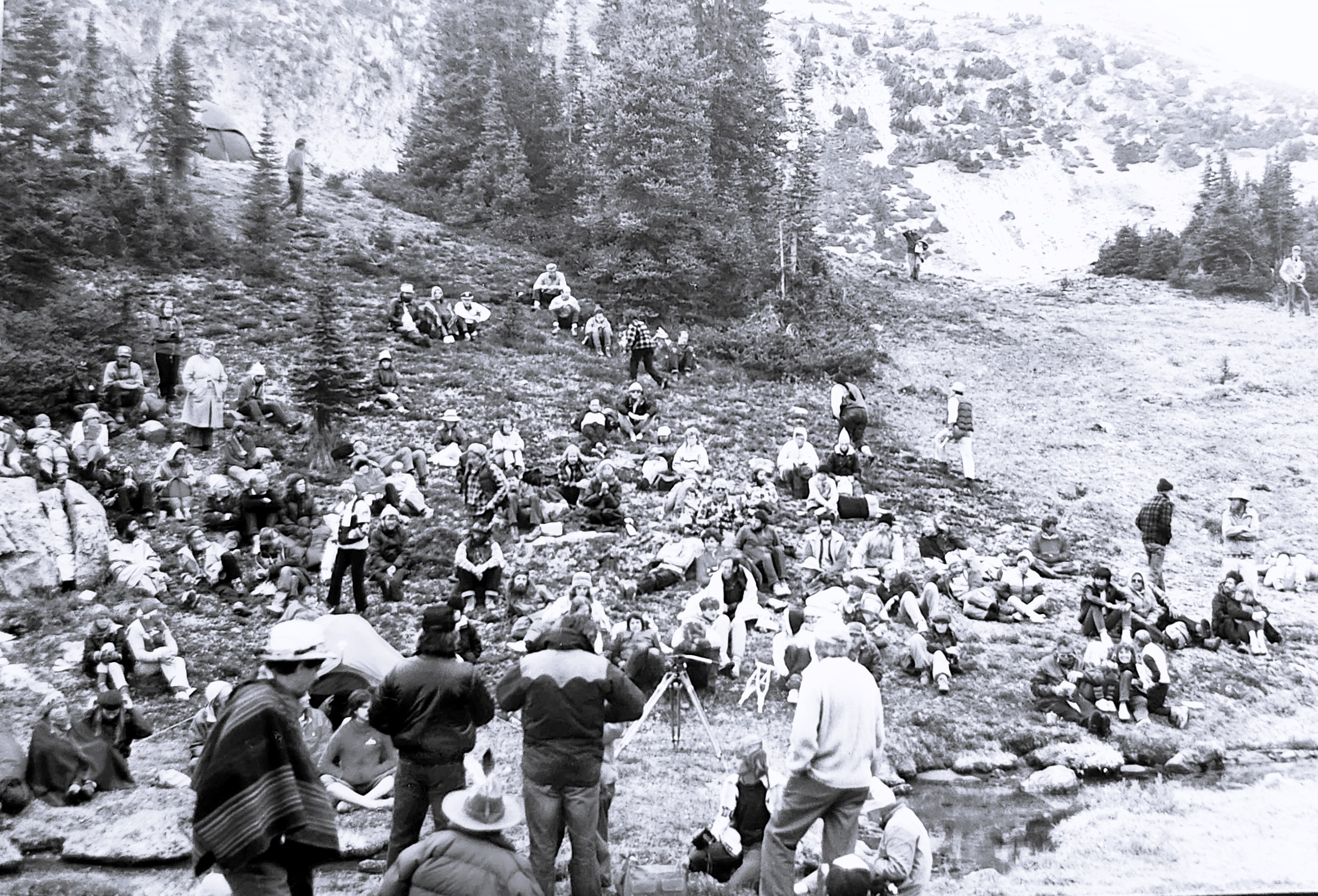
The Nlaka’pamux and St’at’imc nations first declared protection of the entire area in 1985.

A decade of organizing; profile-raising concert festivals; and unflinching determination at endless negotiations with government resulted in the Stein Valley Nlaka’pamux Heritage Park and an unspoiled wilderness.

Here, Chiefs Ruby Dunstan and Byron Spinks of Lytton share their roles, then and now, and personal connections to the Stein.

Park Board member John Haugen explains a little about the UNESCO process for World Heritage Site designation, and Vancouver-based sound ecologist Hildegard Westerkamp shares her photos and recollections of the first festival in the alpine.

At the first Stein Valley Festival, 1985. Photo by Hildegard Westerkamp.

Deer in the headlights.

Hunting moratoriums are issued across Indigenous Nations as resource extraction activity reduces habitat below critical levels amid over-hunting.

Many Peoples have enacted and posted rules on the ground, gone to court for injunctive relief against industries licensed by the crown, and put themselves on the roadblock: between the deer and the headlights.

A bull moose in Taku River Tlingit territory, where the people have appealed to BC hunters not to hunt moose, in spite of BC’s opening of Limited Entry Hunt lotteries. Photo: Taku River Tlingit First Nation.

The Nuxalk Defense of Ista, 1995

Head Chief Nuximlayc’s statement on the 30th Anniversary: “They had been harvesting five million cubic meters of wood – every year – in Nuxalk territory. After the EU stopped buying it, after that, the timber harvest dropped to 200,000 cubic meters. That’s why we still have trees today.”

Nuxalk leaders of the House of Smayusta invited environmentalists to stay and join the reoccupation of Ista, King Island, in September 1995. Many were detained for defying the court injunction, and, later, the court’s jurisdiction.

Nuxalk hereditary Chiefs at Ista, September 1995. Photo from Nuxalk Nation.

When DFO cut the Líl’wat Elders’ fishing nets

A five-week roadblock of the Lillooet Lake Road ensued, after fisheries officers came in and destroyed the Elders’ salmon fishery in 1975.

Wénemqen of Tilálus was 16 years old at the time, and he recalls the roadside discussions, the visiting Chiefs, patrolling the road, media tactics, and jail.

54 people were arrested for “obstructing a public highway” – their own road. The bogus charges were thrown out; the jurisdiction issue remains.

 Líl’wat people sit on the road through their village, blocking traffic from Pemberton to Lillooet. Photo – Lil’wat Peoples Movement, archived online with riseupfeministarchive.

That day in Court: the Sparrow decision turns 35

In 1986, Chief Joe Mathias of Squamish spoke to the BC Aboriginal Peoples Fisheries Commission about recognizing DFO’s right to define conservation.

Reflecting that each community represented at that meeting was grappling with multiple – if not dozens or hundreds – of fishing charges, Mathias asked the Committee to challenge the federal government’s monopoly on “conservation.”

A few years later, the BC Aboriginal Peoples Fisheries Commission developed the Inter-Tribal Fishing Treaty of Mutual Support and Understanding. Image: the Treaty logo.

More:

World Council of Indigenous Peoples

held its first Annual General Meeting in Tseshaht, Nuu-chah-nulth, in October of 1975. Delegates from nineteen countries attended the three-day conference, identifying their barriers to equality as self-determining Peoples and Nations occupied by settler states with foreign values. Their work set the pace for ongoing representation in the international United Nations forum for diplomacy and cooperation.

Welcoming people from around the world to the first WCIP conference. Photo: Ha-SHILTH-sa newspaper, Dec. 1975.

Canada’s “Strategic Words and Tactics Team”

was revealed to Native leaders by sympathetic individuals in government in the 1970s and 80s. The Team has kept busy. Canada’s policy to deny “undefined Aboriginal rights” – including title – provides instead a suite of legislation which enables First Nation Band Councils to surrender their rights, in favour of rights defined by Canada.

*

Archive Quarterly

is published in Vancouver, Musqueam

by Electromagnetic Print.

Fall 2025 AQ:

48 pages

8.5×11, black and white

ISSN 2819 585X (print)

ISSN 2819 5868 (online)

Subscribe to AQ print or digital

How did the National Day of Action become Canada’s “Aboriginal Day”?

19 Thursday Jun 2025

Posted by Admin in Reconciliation, Uncategorized

≈ Leave a comment

Tags

Aboriginal Day Canada, aboriginal title, Indigenous Peoples, National Day of Action

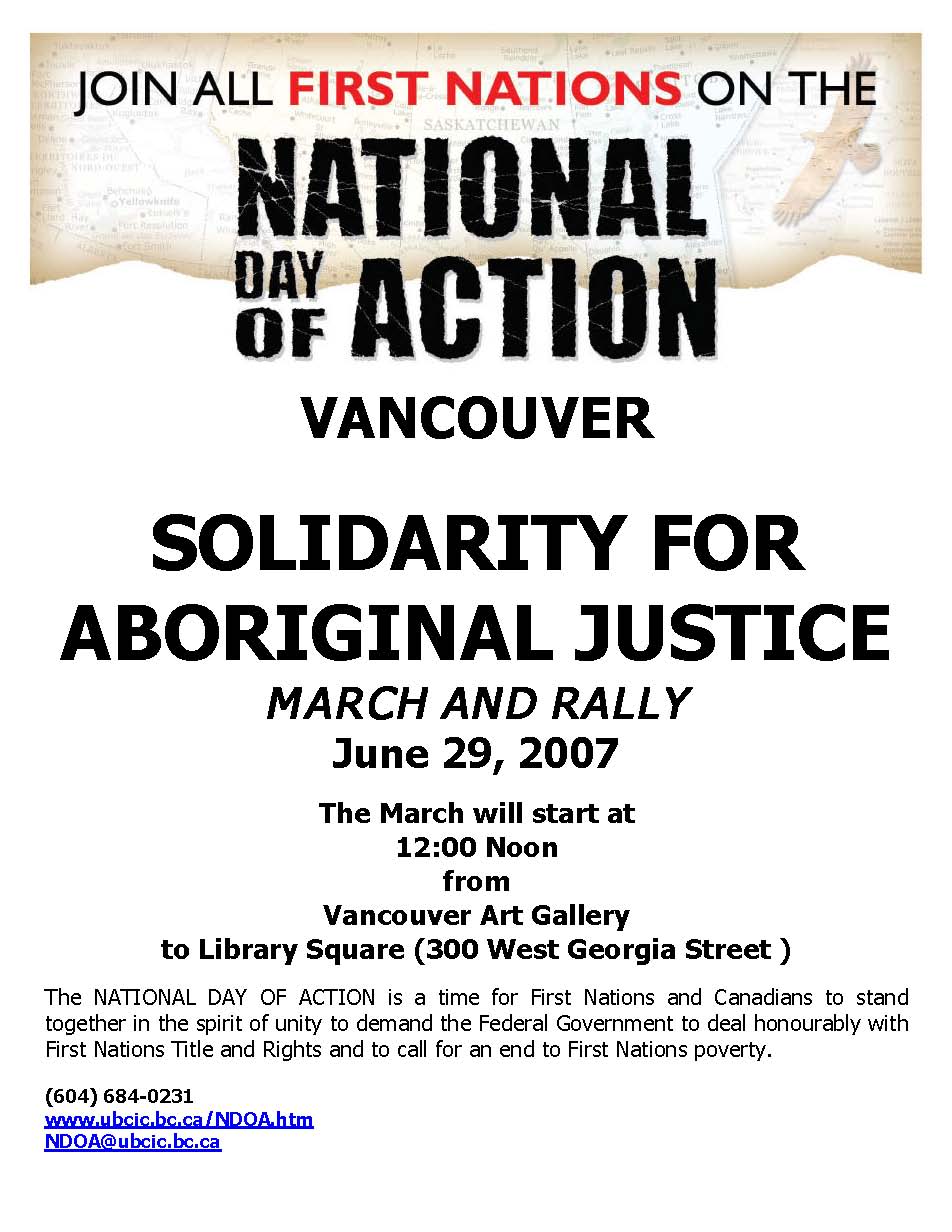
The Assembly of First Nations called for a National Day of Action in 2007. The call was answered in over 100 locations across Canada, where people stopped traffic, trains, and TV news on June 29th.

AFN Chief Phil Fontaine made the call for immediate action to address the situation of Indigenous Peoples in Canada.

      At the end of the first National Day of Action, June 29, the AFN press release explained:

“The national chief called on the federal government to honour its promises to First Nations; to implement the plan agreed to at the first ministers meeting on aboriginal issues in Kelowna, BC; to apologize to survivors of residential schools; and to work with First Nations to give life to their rights as recognized in Canada’s constitution.”

Indigenous communities and organizations took the chance to promote the urgency of issues on the ground, while they could rely, for the day, on “law enforcement officials for their commitment to a measured and non-confrontational approach,” according to the AFN Chief’s press statement, June 2007.

A poster advertising the first ever National Day of Action in 2007.

A second National Day of Action was called for May 29, 2008. And a third – unannounced – continued in their tracks in June 2009.


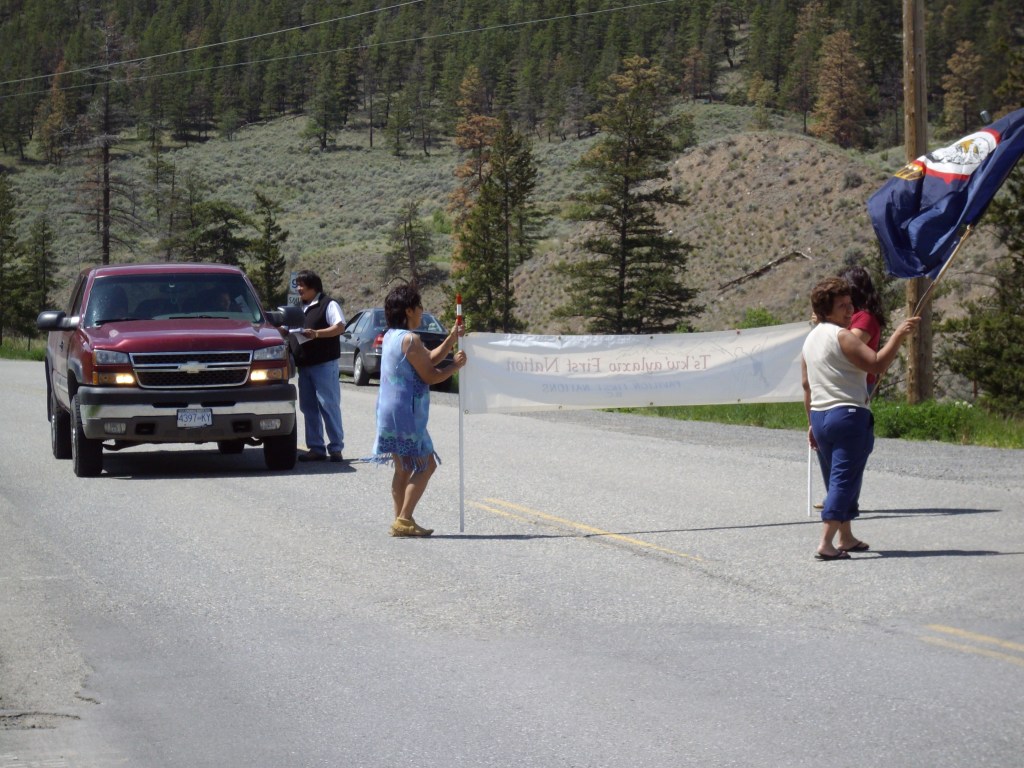
“The message we gave was, our rights are being trampled on and Canada goes out to international governments and makes it look like everything’s alright, and it’s not. Canada is actually in denial. The government may put out a positive message, but if you go back to the First Nations, they’re not happy with any of it.” Chief Desmond Peter, pictured, at an information roadblock on Highway 12 through Tsk’wáy’laxw. May 29, 2008. (The St’át’imc Runner newspaper, July 2009)

On June 19, 2009, Canada’s Governor General broke in to what was becoming an annual thing: 24-hour roadblocks truly marking the solstice season with “the longest day of the year” for Canada.

      GG Michaelle Jean declared, in a three-paragraph news release, that “National Aboriginal Day is celebrated on June 21, 2009.”

      Remarking on the first anniversary of Prime Minister Stephen Harper’s formal apology to Indian Residential School students in 2008, Jean said:

      “The time has come to move beyond the injustices of the past and build a future together that history will show brought us together in respect, dignity, equality and solidarity. This is how we will break down the solitudes that, for too long, have isolated us from one another. In the spirit of this new age, let us look to our youth, whose full participation in creating a new era of harmony is our best chance for success.”

Ever after, Canada looked to the youth and funded all manner of song and dance displays, made funds available for celebrations in every town and city, and called it reconciliation in action.

The National Day of Action was displaced from the calendar, as communities supported their young people to enjoy some pride in their identity and talents, and pick up a cheque for their otherwise little-noticed culture.

      The issues which brought out the information roadblocks, signs, banners, speeches, and occupation of railways, were not reconciled.

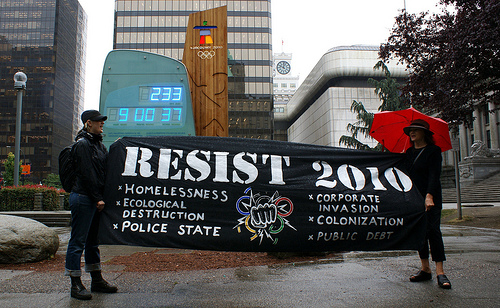
      In Vancouver, 2009, an “Aboriginal Solidarity Day” took place at Trout Lake on June 29th, and on June 24th the Olympic Resistance Network marched downtown; but by June of 2010 there was no continuation of the coast-to-coast-to-coast event.

The first National Day of Action got results. Federal damage-control went into effect within days of the first call to action in 2007.

      “Indian Affairs Minister Jim Prentice has been conducting a cross-country campaign to deflect wide-spread direct action campaigns during the June 29 Day of Action. In particular, a long-outstanding specific claim has apparently been settled, expanding the Roseau River First Nation reserve territory on the eve of June 21, National Aboriginal Day (although important questions have already been raised about the future uses of the land parcel). Chief Terrance Nelson has publicly acknowledged this settlement. While he has emphasized that problems with Ottawa remain, he has called off his threat to block major rail lines. This use of recent specific-claims reforms as an immediate tool to neutralize protest this month reflects the wider tendency of the present government to drive policy change primarily in response to immediate political embarrassment.” So reported James Lawson, a teacher at UVic, in the Socialist Project’s “The Bullet.”

The 2007 Day of Action had raised the visibility of severe circumstances, endured under protest, for generations. They are circumstances that have been rationalized all along by Canada’s quest for development, and to “build this country.”

      Land claims negotiations were going nowhere. In BC, $975million in funding to the BC treaty process over 15 years (most of it to federal and provincial teams), had settled nothing.

      Canada’s Supreme Court continued in its unilateral and assimilationist strategy to turn “Aboriginal title” into “the right to be consulted,” confirming the “pleasure of the crown” over poorly defined rights in its 1997 Delgamuukw ruling and subsequent interpretations; and in its Haida and Taku, ruling, 2004; and in Tsilhqot’in Nation, 2007.

      Prime Minister Paul Martin’s very brief attempt to release $5billion in Transformative Change Accord funding, to housing, education, land issues, and more, had just brought down his government. The Liberals were swept away by a vote of no-confidence in Parliament just days after the first chapter of that Accord was signed in BC, the Kelowna Accord, at the end of 2005. Martin tried to push a Private Member’s Bill through to disperse the assembled budget, but it failed and suddenly in its place – six months later – a $2billion Indian Residential Schools Survivors Settlement Agreement was presented.

    One of the cringey details amplified in the call for action was the federal government’s ongoing 2% limit on annual funding increases to Aboriginal communities, clamped on in 1986 at a time when the housing deficit in Native communities was estimated to be worth $400million, and climbing. Reckoning by the federal subsidy of about $10,000 per new house build, at that time, those 40,000 houses still haven’t been built. The 2% cap didn’t move until 2016.

The National Day of Action was called to touch the brakes on Canada’s relentless extractive industries, shipping the natural wealth of Indigenous Nations off the continent by the super tanker, and leaving First Nations futures in the clear-cuts, toxic tailings dumps, encroaching settler suburbia, and hydro and pipeline rights-of-way.

    The unmitigated Canadian legacies were then, and are now: denial of the registrable values of their land titles; running circles in policy whirlwinds around education and child welfare – that all puffed out before any traction was gained; virtual landlessness; and the shackles of an Indian Act which, to date, prevents all manner of economic development on-reserve.

      In the further spirit of Canada’s “reconciliation of Aboriginal societies with the sovereignty of the crown,” (Van derPeet, 1996) First Nations have since been invited to import Canadian legislation over themselves by consent, thereby releasing their own laws along with the arbitrary Indian Act controls of all manner of socio-economic development. This is not seen as a suitable resolution by many.

Arguably, the National Day of Action never completed its work.

      On May 29, 2008, Ontario’s Minister of Aboriginal Affairs said of the NDOA, “I’m confident this day will serve to strengthen relationships based on mutual respect and understanding.”         

     “Aboriginal Day” 2025, however, brings an escalating situation in Canada’s idea that it can fast-track industrial development over Indigenous rights.

On June 29, 2007, Minister of Indian Affairs (as it was then) Jim Prentice said, “The express purpose of this day was to raise awareness of the serious issues facing Aboriginal People in this country.” But since Canada has taken charge of telling Canadians what those issues are, controlling the narrative with its flood of publicly-subsidized propaganda in aid of “Aboriginal Day,” it is made to seem that those serious issues don’t foremost include land and jurisdiction; reparation and restoration; and self-determination at an international standard of recognition, not the starvation afforded by a Canada UNDRIPA that has nothing in it.

Another consideration in taking the date was described by BC Premier Gordon Campbell in June 2009:

      “National Aboriginal Day, June 21, is an important opportunity for all Canadians… In just 236 days, the eyes of almost every continent will turn to British Columbia for the 2010 Olympic Winter Games. They will see our spectacular natural environment. … And they will no doubt see, and judge for themselves, our relationships with First Nations.”

      “We have signed modern-day treaties with six First Nations… We can all take pride as a province for the steps we have taken together to build a New Relationship… So as we celebrate National Aboriginal Day, and move towards Canada Day, we should recognize the tremendous contributions First Nations have made to our province and our country.”

“I congratulate the federal government on continuing this process of reconciliation by declaring June National Aboriginal History Month. The celebration of National Aboriginal Day on June 21 will now be bolstered by a month of cultural awareness.”

Campbell’s brief self-congratulatory affirmation of the announcement of Aboriginal Day was answered immediately, by many, including Chief Kakila, Hereditary Chief Clarke Smith of Tenas Lake, Samáhquam, St’át’imc:

      “Mr. Premier. Your words and statements are empty. Canada and BC Government purposely created laws against us Aboriginal people for over 100 years. … How can you even think that BC is trying to build a New Relationship? … All the Supreme Court Decisions such as the Delgamuukw mean nothing to you Greedy Leaders. Court Rulings you don’t follow. … Perhaps you need to really read the Delgamuukw Supreme Court Decision, it states that the “BC Government cannot extinguish Aboriginal Title and the Rights that flow from such Title.”

“All the evidence is in the Minutes of Decisions your governments made over the last century or so. How to rid of the Indians.”

The last-minute declaration by the Governor General in 2009 didn’t change the reality.

One Tribal newspaper carried three June events which dulled the media spin.

      “Ancestors Block Trans-Canada Highway Expansion. Neskonlith, Secwepemc. The disturbance of human remains believed to be more than 2,800 years old has halted work on the Trans-Canada Highway near Chase.”

     “Alberta oil held up on Highway 52. On June 20, the Kelly Lake Cree Nation, near Beaverlodge, about 500 kilometres from Edmonton, began stopping all oil and gas rigs from passing along Highway 52, a remote highway mainly used by crews traveling between Alberta and B.C.”

     “Mohawks at Akwesasne stop border guards. Canadian border guards at the Akwesasne Reserve international crossing are involved in a militarization of the Canada-US border. However, the presence of Canadian police carrying guns on and around the Reserve is not welcome. It has been described by Akwesasne leaders as an open conflict. Mohawk sovereigntists blocked entry to the guards. Canada and USA are also demanding new ID for natives crossing the border, apparently in violation of the Jay Treaty.”

In 2007, the Assembly of First Nations stretched its considerable wingspan to shelter more than 100 community-based demonstrations. In 2009, the unmistakeable message of the Governor General was that only celebrations of reconciliation are safe on Canadian streets.

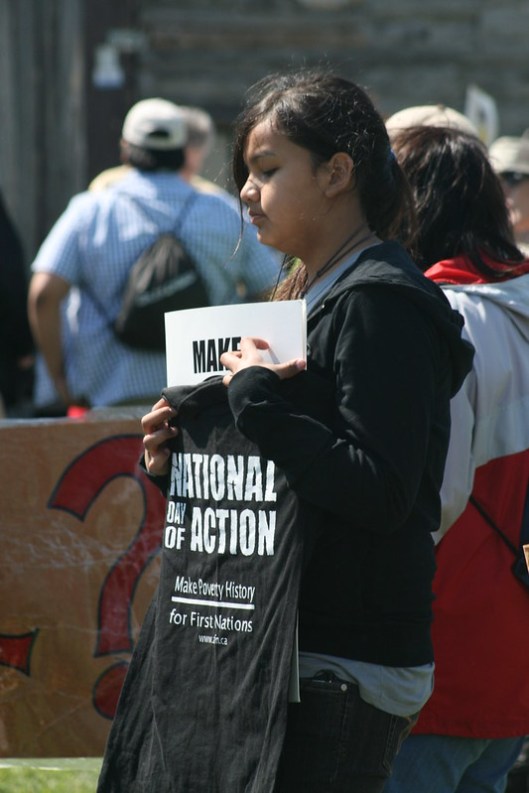
With the T-shirt for the day, on May 29, 2008, in Ottawa. Photo by Powless, on Flickr.

Closing Statement of the Gitxsan and Wet’suwet’en in Delgamuukw v. The Queen

14 Wednesday May 2025

Posted by Admin in Uncategorized

≈ Leave a comment

Tags

aboriginal title, bc-land-question, Delgamuukw, gisdaywa, Gitxsan, law, trial, Wet'suwet'en

On May 14, 1990, the Gitxsan and Wet’suwet’en Plaintiffs in Delgamuukw v. The Queen made their closing statements at the end of their trial.

As reprinted in the United Native Nations 1990 book of their AGM presentations, they said:

     “We, the Gitksan and Wet’suwet’en people, are in the court to state the truth of the ownership and jurisdiction we exercise over our territories.

     Three years have passed since we made our opening statements to this court at that time you did not know who Delgamuukw and Gisdaywa were. Now, this court knows I am Gisdaywa, a Wet’suwet’en Chief who has responsibility for the House of Kaiyexwaniits of the Gitdumden. I have explained how my House holds the Biiwenii Ben Territory and had the privilege of showing it to you. Long ago my ancestors encountered the spirit of that Land and accepted the responsibility to care for it. In return, the Land has fed the House Members and those whom the Chiefs permitted to harvest its resources. Those who have obeyed the laws of respect and balance have prospered there.

     I am Delgamuukw, the third since this trial started. I also have obligations to my House and the Territories of my House. You have heard oral histories of the Gitksan and Wet’suwet’en that tell of the many groups that migrated into our Territories. Many stayed, contributing to our culture, acknowledging the authority of our chiefs and obeying our laws.

     Of all these groups, only the Europeans failed to recognize our ownership and jurisdiction. This court now has an opportunity to redress this situation.

     We, the Hereditary Chiefs, decided against wearing blankets and regalia in this courtroom because we believe that our authority would not be respected by the government lawyers. Under our law, disrespect for people and for their territory requires compensation.

     We, the Gitksan and Wet’suwet’en, must be compensated for loss of the Land’s present integrity and for the loss of economic rents.

     We ask that the court, not only acknowledge our ownership and jurisdiction over the Land, but to restore it to a form adequate for Nature to heal in terms of restoration. We would like to see clearcuts and plantations returned to forests, contaminated rivers and lakes returned to their original pristine state, reservoirs of drowned forests returned to living lakes and life-sustaining flows to diverted rivers.

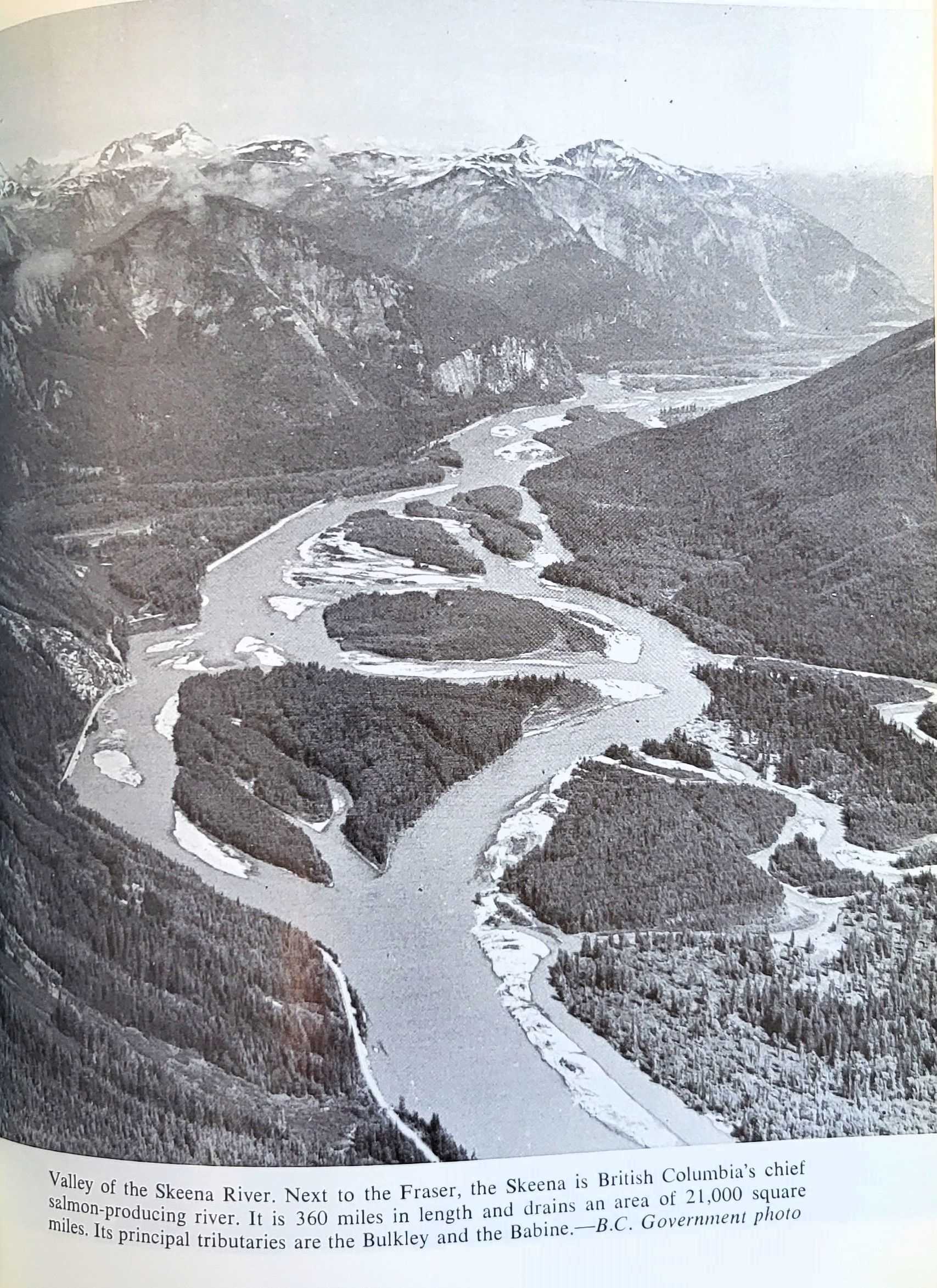
Skeena River Valley, Gitksan.

     We realize that the true financial value of this compensation for restoration would bankrupt both the federal and provincial governments. Compensation must remain an ongoing obligation of the federal and provincial governments “Until Our hearts are satisfied.”

The Gitxsan Chief, Delgamuukw, as he was in 1987, Albert Tait. The name and title had carried on and, by the time of the 1991 hearings, was owned by Earl Muldoe - one of the authors of this May 14 statement.

     However, this compensation should not be viewed by this court as an alternative to the acknowledgement of our ownership and jurisdiction of our Land. We do not want financial compensation without the recognition of our authority over our Territories.

     We are asking you to make declarations on Gitksan and Wet’suwet’en Aboriginal Title. We, the Gitksan and Wet’suwet’en people, own our Lands.

     I will identify those areas where the powers of the province and the federal governments need to be restrained in order for us to exercise our responsibilities under Aboriginal Title.

     First, we the Chiefs must have our authority recognized in order to exercise our responsibility to protect the Land for the future, and to conserve resources. We must have the power to manage all human activity that bring change to the Land, Air or Water on all of our territories.

     Second, to enable each House to provide for its members and all those living in their Territory, the Chiefs must have control over the local economy by managing natural resource allocations within their Territories. This would include licensing, leasing, and permitting. As well, royalties and taxation payments from resource use on our Territories must be paid to us.

     It is not our intention to exert any powers over the non-Gitksan and Wet’suwet’en people living in our Territories. Fee-simple lands held by third parties as of October, 1984, would be exempt from this resource allocation.

     We see the pulling back of these central government powers as being the minimum required to restore not only individual self-reliance but also community self-reliance. We have presented you with ample evidence of the effects on our Land resulting from government resource management. We have also given evidence of the effect that centralized economic management and government welfare has had on our people. The governments’ system does not work. We, the Hereditary Chiefs, believe we can change the situation under our laws and practices through our authority.

     Our system of government is as powerful today and will be as powerful tomorrow, as it was one hundred or ten thousand years ago. You have heard both ancient and modern histories tell of

how our system has remained relevant through the evolving ecological, cultural and economic circumstances in which our people have found themselves. To say we disobey our laws and ignore our Chiefs’ authority because we change a piece of technology, or use our Land in a different way, is a desperate argument.

This case then is about learning from the past so we can repair the present and pass on a healthier Land to our grandchildren. It is not about retrieving frozen rights from a nineteenth century ice-box.

Our Aboriginal Title is found in common law and takes precedence over the provincial crown. We do not have to, and will not, surrender our Aboriginal Title in order to be recognized by the federal government. We are self-governing.

     However, we see a layering of responsibilities among the Gitksan and Wet’suwet’en, the federal government, and the provincial government being resolved in an ongoing series of negotiations. Given the strong imperative for the, Gitksan and Wet’suwet’en, British Columbia and Canada have social and economic activities continue within our Territories, consensus on the necessary political and administrative framework must be found.

     We are asking this court to properly apply common law. We want a declaration of recognition and affirmation of our continued ownership and jurisdiction. We will not surrender or diminish our Title and rights. We do not request a “right” to use and occupy the Land, and we refuse extended Reserve Lands. We will decide what our future relationship will be with Canada and British Columbia on that basis.

     We ask nothing more than what should have occurred prior to Confederation, and prior to this province entering Confederation. We are here to right the wrongs that have been occurring for over one hundred years. This court has the power to recognize and affirm Gitksan and Wetsuwet’en ownership and jurisdiction.

Closing Statement of the Chiefs

By

Gisdaywa a.k.a. Alfred Joseph

Delgamuukw a.k.a. Earl Muldoe

Yagalahl a.k.a. Dora Wilson-Kenni

Maas Gaak a.k.a. Don Ryan

May 14, 1990

Delgamuukw – closing statement of the Chiefs May 14 1990Download

On the record – if you can find the record!

25 Tuesday Feb 2025

Posted by Admin in aboriginal title, Haida title, Uncategorized

≈ Leave a comment

Tags

aboriginal rights, aboriginal title, Canada, Haida Nation, history, indigenous, Indigenous Peoples, justice, Lawfare, news

Since 1951, when Indigenous people were allowed access to the colonial courts, the views of crown lawyers and judges are right there on the record.

Here are some case files from the archive project: factums, memos, early decisions, and case summaries from the time.
Most of these records are not maintained online. Only the ruling of the highest court is available, so, in cases that have been in the courts for decades and proceeded through numerous stages, the final result can be very difficult to understand. Lower court rulings are presented here.
In some cases, critical decisions are made in the court of appeal and are then never mentioned again. For example, in the famous Delgamuukw decision of 1997, the province of British Columbia abandoned its position that all the Gitksan and Wet’suwet’en “aboriginal rights” had been extinguished. They did this in 1993 at the BC Court of Appeal stage, when the court commissioned an independent expert study of the issue. This change of position was an about-face from BC’s original defense, and explains a lot in the development of the case.
To use the same case for another example, it’s essential to understand that both sides in the Delgamuukw litigation agreed to pause the next stage of the legal proceedings while they spent time attempting to negotiate a comprehensive approach to jurisdiction and land decisions. They did this on the recommendation of the Court of Appeal, in 1993. But by 1994, the government’s local forest managers were pushing through logging plans without regard for that condition, attempting to pass off meetings as “consultation” while the plans were a foregone conclusion. Gitksan Chiefs blocked the railway to stop it, and were promptly back in court in a new action: Ryan v Schultz.
Cases which are not reported in the BC or Canada Law Review are also difficult to find, unless you go to the courthouse of the trial and buy a copy, like with transcripts.

Here is a list of some of the new uploads in Lawfare!

These artifacts are all part of a bigger stories. These additions are provided here to add to the record.

R. v. Adams (Thomas Russel) – 1990

1990, October 30 Provincial Court ruling, Campbell River
Haida
“I have no option but to find that the defendant was not required to hold an Indian Food Fish Licence for the herring spawn on kelp in his possession and he is therefor entitled to acquittal on both charges.”

R. v. Adams – DFO letter to counsel: November 21, 1984
“I have directed the Chief of Finance for the Department of Fisheries and Oceans to draft a cheque for Mr. Thomas Russel Adams in the amount of $4,670.00, this being the amount received for the seventeen pails of roe on kelp seized by this Department. the other five pails were seized by the Department of Treasury United States Customs Service and therefore would not be included in the monies ordered returned by the court.”

Ahousaht First Nation v. Canada (Fisheries and Oceans) 2007

Federal Court of Canada
Nuu-chah-nulth
Case summary by Lawson Lundell LLP, July 20, 2007
“The Federal Court of Canada recently released its decision in Ahousaht First Nation v. Canada (Fisheries and Oceans). The court considered an application by 14 First Nations represented by the Nuu-chah-nulth Tribal Council (“NTC”) for judicial review of the Minister of Fisheries and Oceans regarding the implementation of a commercial groundfish pilot plan on the British Columbia coast (the “Pilot Plan”). The NTC challenged the Minister’s decision on the grounds that the Minister failed to fulfil his duty to consult and accommodate the NTC before implementing the Pilot Plan. After reviewing the process leading up to the Plan’s introduction Federal Court dismissed the application, finding that, although the consultation was not perfect, the flaws did not warrant changing the Minister’s decision.”

Bear Island Foundation and Temagami v. Ontario AG (c.1985)

Supreme Court of Canada.
Factum of Intervenor NIB-AFN
“The Royal Proclamation applies in the land claim area. It has the force of statute. The onus is on the Respondent to prove abrogation of the procedural requirements enshrined in the Proclamation.”
“There is no case law, except the judgments below, in support of the argument that the procedural requirements of the Proclamation were repealed by the Quebec Act.”

R. v. Bob (Bradley) 1979, August 2. British Columbia County Court.

Ruling. Unreported.
Lillooet
“The accused was charged with unlawfully fishing in contravention of a closure effected under the Fisheries Act and Regulation. The accused claimed he had a lawful excuse to fish because he was fishing pursuant to a reserve right, not an aboriginal or treaty right.”
“The historical background for the Defence… (includes) “Recognition of BC Indian Fish Rights by the Federal-Provincial Commission, prepared for UBCIC 1978. I refer to the instructions given to Dominion Commissioner, Mr. Anderson, dated August 25, 1870:
“While it appears theoretically desirable as a matter of general policy to diminish the number of small reserves held by an Indian Nation, the circumstances will permit them to concentrate on three or four large reserves, thus making them more accessible to missionaries and school teachers…”

Daniels v. Canada (Indian Affairs and Northern Development), 2016

Supreme Court of Canada.
Booklet, “Understanding the Daniels Case” by BC Metis Federation
“At its best, the Daniels ruling provides the possibility to “consider” Metis communities as self-determined and self-governing nations with a unique historical connection to the Crown and First Nations.”

R. v. Derriksan (1975)

BC Court of Appeal.
Okanagan
Ruling.
“Section 32 of the Regulations which makes special vision for licensing fishing by Indians reinforces the concept that Indians are not otherwise excepted from the Regulations.”

R. v. Douglas (c. 1985)

BC Provincial Court
Sto:lo
Defence counsel cross-examination of the crown’s witness, DFO officer Randy Nelson
“Q. In this letter you say: “neither released, so I hit their knuckles and arms harder and harder.” Do you agree with that statement?
A. Yes.
Q. Okay. Now in this letter you talk about Mr. Douglas and that’s Sam Douglas, the accused, right?
A. Yes, Your Honour.
Q. And you say as follows: “My concern …is that the D.F.O. negotiates with this animal, and that he is a representative on the Salmon Commission.” Now when you say “this animal” you’re talking about Sam Douglas, aren’t you?
A. That is correct in that letter, yes Your Honour.
…Q. Next paragraph: “If Mr. Douglas is continued to be met with, I would be most disappointed and would like to know the Department’s reasoning for this. It would make about as much sense as opening a Clifford Olsen Day Care Center.”
A That’s what the letter says, Your Honour.
Q. Now are you telling this Court, that this is humour on your part?
A. Humour… yes.”

Fletcher Challenger Canada Limited v. Miller… et al. 1991, Oct 21.

Supreme Court of BC.
(C915008 Vancouver Registry)
Court Transcript. Re. Walbran Valley. Defendant John Shafer and his Amicus curae, Bruce Clark:
“CLARK: Yes. The position in law is that since there is no treaty for the area in question, the legislature of British Columbia does not have jurisdiction. For the same reason the legislature does not have jurisdiction, this court does not have jurisdiction, because this court derives its jurisdiction under the Supreme Court Act which emanates from that legislature, which itself doesn’t have jurisdiction. …So what essentially we have is this jurisdictional question is genuinely preliminary to everything else.”
SHAFER: I’m a spokesperson for a native rights organization ca1led Concerned Citizens for Aboriginal Rights. It’s a group of 300 people in Victoria. All of my research and my readings indicated to me that there was — there was a major problem in the province concerning the fact that forest companies and third parties presumed to have the right to plunder unsurrendered native territory and I can see nowhere — in all my readings — I have yet to find a case where you will find an agreement between the native nations asking that Canada or BC rule over them.”

R. v. Gladstone BC Court of Appeal 1993, June 25.

Ruling.
Heiltsuk
“On or about the 28th day of April, 1988, at or near Vancouver in the Province of British Columbia, did unlawfully attempt to sell Herring Spawn on Kelp other than Herring Spawn on Kelp taken or collected under the authority of a Category J. Licence, contrary to Section 20 ( 3 ) of the Pacific Herring Fishery Regulation and did thereby commit an offence contrary to Section 6l ( 1 ) of the Fishery Act.”
Note – The judges of the BC Court of Appeal had widely differing reasons.

Haida Nation v British Columbia (Minister of Forests; Attorney General) BC Court of Appeal. 1997, November 7.

Ruling.
“The petitioners claim aboriginal title to a large area of British Columbia much of which is subject to tree farm licence no. 39 (T.F.L. 39) which was originally issued to the respondent MacMillan Bloedel in 1961.
“The preliminary issue of law is : whether the interest claimed by the Petitioners, namely aboriginal title, including ownership, title and other aboriginal rights over all of Haida Gwaii (the Queen Charlotte Islands), including the land, water, flora and fauna and resources thereof, is capable of constituting an encumbrance within the meaning of section 28 of the Forest Act.”

Haida Nation v British Columbia (Minister of Forests; Attorney General) 2000, Nov 21

BC Supreme Court

Ruling
“The evidence establishes that in September 1998, the Province published updated “British Columbia Consultation Guidelines” governing consultation with Aboriginal peoples concerning their Aboriginal rights and title, for all provincial ministries. Although the guidelines state that “…staff must not explicitly or implicitly confirm the existence of Aboriginal title when consulting with First Nations,”…

Haida Nation v British Columbia (Minister of Forests; Attorney Genera; Weyerhauser) 2002, Feb 27.

BC Court of Appeal.
Case analysis prepared for the Union of BC Municipalities by Bull, Housser & Tupper, Sept 2002
“The BC Court of Appeal delivered a landmark decision regarding the duty of the Crown and third parties to consult with First Nations who have asserted, but not proved, aboriginal rights or title. The order made by the Court was subsequently modified with supplemental reasons delivered on August 19, 2002.”
“The Court of Appeal made a declaration that the Province had in 2000, and the Province and Weyerhaeuser have now, legally enforceable duties to the Haida to consult with them in good faith.”


The west wasn’t won archive project relies on the work of volunteers for most aspects of building an archive! Drop a line to join the project, contribute documentation, or request research assistance, or… find out more.

Archive Quarterly ~ journal of The West Wasn’t Won archive project

13 Thursday Feb 2025

Posted by Admin in Uncategorized

≈ Leave a comment

Tags

aboriginal rights, aboriginal title, Archive Quarterly, Indigenous Peoples, Sovereignty

This journal offers a curated collection of rare archival material in every issue: maps, timelines, new interviews, key excerpts from original docs, and more.

Honouring the indomitable spirit of Indigenous Peoples west of the Rocky Mountains, the young archive documents British Columbia and Canada’s colonial project and the way it’s carried out in deliberate violation of international law, Peoples’ rights, and its own founding constitution.

Subscribe!

Helping answer the need for reliable information in an area that is emphatically suppressed and denied! The West Wasn’t Won’s quarterly journal is just about to complete the first year in print.

Here is a preview of AQ, Winter 2025, the 4th issue! And a summary of important topics we covered in 2024. And a preview of forthcoming Special Issues each dedicated to one major topic: Title, Status, and Salmon.

Follow Archive Quarterly on Facebook: https://www.facebook.com/people/Archive-Quarterly/61556330064894/?_rdr

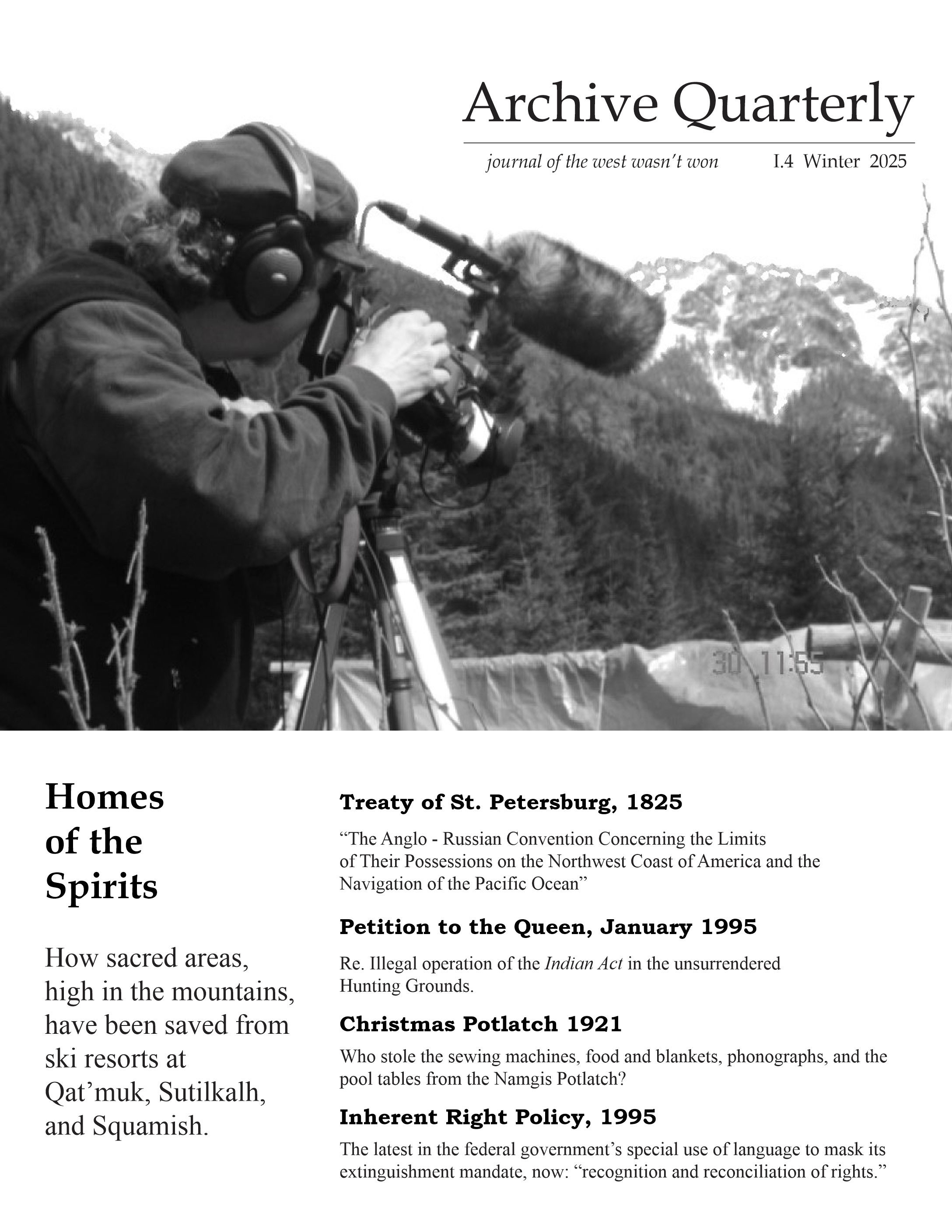
Winter 2025 cover of Archive Quarterly.

Winter 2025 AQ

FEATURES:
Sacred Places v. Ski Resorts
Skwelkwek’welt, Sútikalh, Qat’muk, and other favourite spiritual resorts have been protected from development by reoccupations, litigation, and widespread mobilization. The Spirit Homes have been protected at a cost of mass arrests, real and threatened violence, global travel, and community solidarity from the grassroots to the Chief and Council. Interviews with Kanahus Manuel and Rosalin Sam.
Petition of January 3, 1995
Text of the 30-year-old application to “an independent and impartial Standing Committee with juridical jurisdiction over boundary disputes between the Indians’ Hunting Grounds and the Crown Governments’ Public Lands.” With a 1997 interview given by Bruce Clark; and comment on the political situation from the extradition hearing, USA v. Pitawanakwat, 2000, which successfully relied in part in the Petition.
Defense of Meares Island
In March 1985, a provincial logging license in the heart of Nuu-chah-nulth territory was the subject of a court injunction. Read part of the ruling, which pointed out “The fact that there is an issue between the Indians and the province based on Aboriginal claims should not come as a surprise to anyone.” 40 years later, there’s a Tribal park and, still no surprise, no land title resolved in favour of the Nuu-chah-nulth.
Imperial BC in 1825
The Anglo-Russian Convention Concerning the Limits of Their Possessions on the Northwest Coast of America and the Navigation of the Pacific Ocean. Looking closer at the Russian American Company; the Fort on the Spanish-Russian border in California; and reading the Yup’ik, Aleut and Innu interventions in American assumptions of jurisdiction.
More: Sto:lo Chiefs snub the Queen’s Birthday Party in New Westminster, 1875, with a candid letter telling the government to give back the money for the dinner. Nielsen Report: the new Conservative government identified the Department of Indian Affairs for budget cuts in 1985, putting a cap on spending that wasn’t lifted for almost 30 years. After the secret Christmas Potlatch 1921 in Kwakwala territory, Indian Agents raided the homes of participants, seizing food, blankets, sewing machines, and ceremonial artifacts. Some 75 people were charged, and 45 of them were detained in Oakalla Prison to serve sentences up to six months. The Inherent Right Policy migrates from “extinguishment” to “recognition and reconciliation of rights” without changing the “cede, release, and surrender” component of settlements.


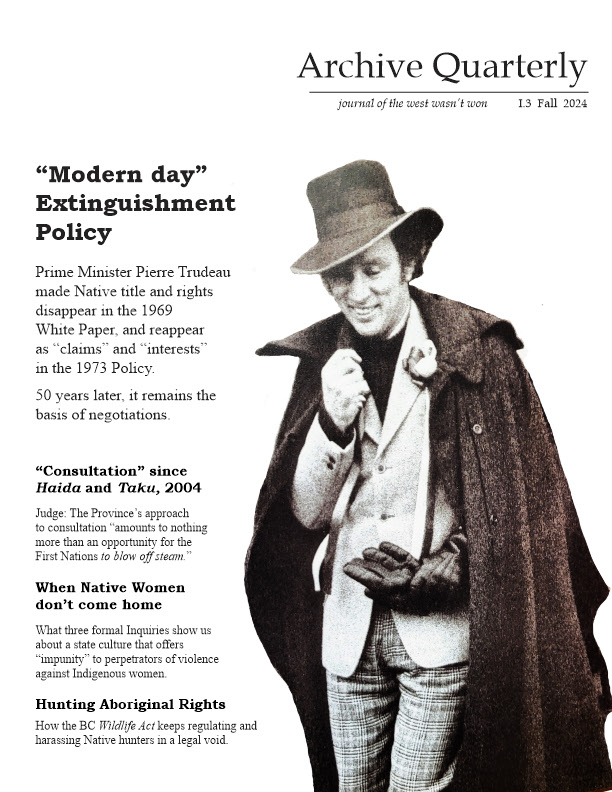
Fall 2024 AQ

FEATURES:
Hunting Aboriginal Rights
Inventing “uncertainty”: Canada’s Supreme Court consistently side-stepped the question of Aboriginal rights to hunt, refusing to hear legal questions put before them, and turning the constitutional question into matters of compliance with the BC Wildlife Act.
Legacy Cases reviewed; Excerpts from decisions in the years-long trials of Francis Haines, Tsilhqot’in, “Old” Jimmie Dennis of Tahltan, and Arthur Dick of Secwepemc.


Inquiries: Missing and Murdered Indigenous Women and Girls An overview and timeline of reports by the Organization of American States’ IACHR; British Columbia’s Inquiry; Canada’s National Inquiry; and the report by Human Rights Watch. International inquiries at the UN treaty body level continue with concerns about the disproportionate disappearance and murder of Indigenous women – and the lack of investigation.


“Modern day” extinguishment policy
Tracking the transformation of the Native title and rights identified in the 1973 Calder case, into the Native Claims Policy that mobilizes negotiations to achieve “extinguishment by consent.” Through changing definitions and increasing funding, the Policy has not responded to advances made in courts and harsh international criticism.


20 years since “Consultation” and “accommodation”
Two cases of consultation and accommodation were decided together in the Supreme Court of Canada in November of 2004: Haida and Taku. With timelines leading to that litigation.
Reflections on change over the last two decades, with President Gaagwiis of Haida.
That Day in Court: comments from Victor Guerin about the 1984 case named for his father, Chief of Musqueam, and the first definitions of the duty to consult.
Department of Justice, memo: Re. Crown Consultation with Aboriginal Groups
Implementation of the procedural right since 2004, “characterized by bad faith, bias, incompetence, unprofessionalism, and errors of fact, law and jurisdiction so numerous” that litigation has proliferated.


More:
Sovereignty Peoples Information Network explained why they wouldn’t want a treaty with Canada anyway, in their response to the United Nations’ survey of treaties and constructive arrangements between states and Indigenous Peoples in 1994. Four of their members were in prison within 12 months.
Hudson’s Bay Company Governor Simpson arrives in the west, 1824. The Company’s plan was always more than trade, and brought the first Christian Missionaries to carry it out.

56 pages
8.5 x 11
Black and white
ISBN 978-1-7387902-6-5
Electromagnetic Print


Summer 2024 AQ

FEATURES
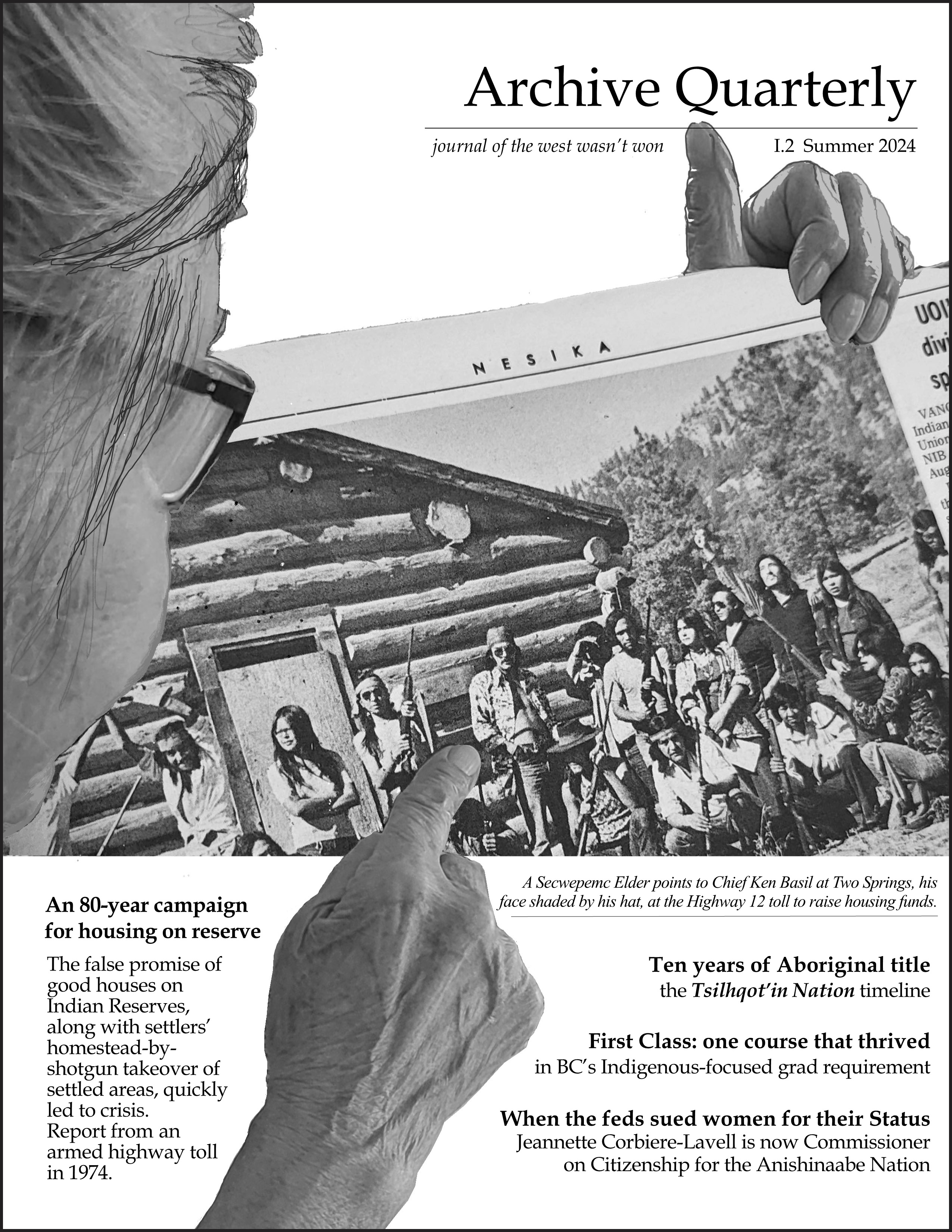
Bonaparte Highway Toll, 1974 – A new investigation of the summer blockade of Highway 12, at Two Springs, Secwepemc. With new interviews and a compilation of reports from the time, the coverage leads into a wider background for a detailed Timeline of the on-reserve housing crisis.
Ten years since Title – Reviewing the Declaration of Aboriginal title in “Tsilhqot’in Nation v. British Columbia, 2014 SCC” – with interviews, a book review of “Lha Yudit’ih ~ We Always Find A Way,” by Lorraine Weir and Chief Roger William; maps of the title area; a Timeline of the case; and a narration of the title case’s progress through the courts, from Lha Yudit’ih.
Celebrating fifty years of Native Women’s Associations across Canada! Jeannette Corbiere-Lavell joins us to discuss her legendary case to regain Indian Status after sexist provisions in the Indian Act withdrew it.
And: Grandmothers Healing Journey, with photos of the Fraser River canoe trip; and excerpts from the Indian Act as its amendments impacted women and children’s right to Indian Status.
First Class: Indigenous-focused graduation requirement – One year into BC’s Indigenous education mandate for secondary students, a class profile with one course made in Sto:lo that thrived.
More: 20 years since the Kelowna Accord; the first ever report of the Department of Indian Affairs (Minister of the Interior) in 1874; and a look at the “biggest demonstration in BC history” – Indigenous march on Victoria Legislature, June 25, 1974.

44 pages
8.5×11, black and white
ISBN 978¬1¬7387902¬4¬1
Journal of the west wasn’t won archive project
Honouring the indomitable spirit of Indigenous Peoples west of the Rocky Mountains.
Published by Electromagnetic Print


Spring 2024 AQ

FEATURES:
The 1964 treaty, title, and rights hunting case – White and Bob (Snuneymuxw/Nanaimo), with news from the time; an interview of that day in court with Kitty Sparrow; an excerpt from the Respondents Factum; the Supreme Court of Canada’s decision without a hearing; and circumstances at Fort Victoria from “The Smallpox War Against the Haida,” by Dr. Tom Swanky.
1874 BC Lands Act and the Attorney General of Canada’s disallowance of the Province’s unconstitutional assumption of jurisdiction to legislate and dispose of lands in unceded Indian territories.
Petition of the Douglas Tribes, 1874 – Chiefs of a hundred communities report Governor James Douglas’ broken promises of lands to be reserved for them against white settlement; conditions of life; and demands for judicial settlement.
Allied Tribes protest the Indian Reserve Commission of BC, 1924, by Petition to Ottawa to reject the Commission’s final report. Having cut off 80% of good arable land from the remaining, small Indian Reserves which survived Joseph Trutch’s arbitrary reductions, the McKenna-McBride Commission of 1912-14 added rocky barren lands to parcels that amounted to less than one percent per-person of lands that were given away to settlers by pre-emption.
“The Fourth World ~ An Indian Reality,” by George Manuel and Michael Posluns. A review of the 1974 book that exposes the four signal threats to Indigenous Peoples: the Priest, the Game Warden, the Doctor, and the Indian Agent. Sharing stunning reports of sharp dealing in federal and provincial schemes, while Native Community Development Officers (of which Grand Chief Manuel was one) promoted political responses.
More: BC’s 2024 attempted amendments to its Lands Act; what Canada’s UNDRIP Act actually says; the Potlatch Laws of 1884.

40 pages, 8.5×11
Black and white
ISBN: 978¬1¬7387902¬3¬4
Electromagnetic Print


Forthcoming Special Issues

TITLE contents:

Introduction:
Title
The Indigenous Territories
Fort Government
The Governor’s Picnic and the Chilcotin War
The Indian Reserves
Oakalla
The Void Off-reserve

Case Summaries concerning Aboriginal Title & Rights:
White and Bob, 1964-65, and Calder, 1969-73
Paulette et al v. The Queen, 1977 to R. v. Haines, 1978
Baker Lake v. Minister of Indian Affairs, 1980, to CPL v. Paul, 1988
R. v. Sparrow, 1990, to Delgamuukw & Gisdayway v. The Queen, 1991
Ryan v. Ft. St. James Forest District M’ger, 1994, to R. v. Côté, 1996
R. v. Pena et al, 1997, to Delgamuukw & Gisdayway v. The Queen, 1997
Halfway River v. BC, 1998, to Paul v. BC, Forest Commission, 2003
Haida Nation v. BC, 2004, to R. v. Marshall; R. v. Bernard, 2005
Cook v. BC Minister of Aboriginal Affairs and Reconciliation, 2007, to West Moberly v. BC, 2011
Tsilhqot’in Nation v. BC, 2014, to Gamlaxyeltxw v. BC, 2020
Nuu-chah-nulth v. BC, 2021, to Nuchatlaht v. BC, 2023

Contrasting Titles:
Comparing the colonial court’s definitions of “Aboriginal title” to the declarations of title made by Indigenous Nations.

Declarations:
Indigenous Nations state their titles. Excerpts from the historical texts.

Summary:
Denial
Recognition and Extinguishment
Burdens of Proof
Adversaries in the Court Room
“Interpretation” and “ultimately by negotiation”
Innocent Third Parties
Good Faith, Bad Faith

Duress and Consent
No deed, no surrender. No consent, no jurisdiction.
Exhaustion of the Domestic Remedy
International Intervention

Timeline:
A chronology of events concerning the expression of Land Title and Jurisdiction west of the Rocky Mountains

Glossary of legal terms


STATUS contents:

Introduction:
The Indian Department
The Registrar
An Act for the Gradual Civilization of the Indian Tribes 1857
Enfranchisement
Indian Act 1876
Indian Agents
The Little Brown Book

A Century of Forced Displacement:
On Family Lands – but not on-reserve
The Void
BC Association for Non-Status Indians, 1969
Native Women’s Associations, 1970s
United Native Nations, 1976
BC Native Housing, 1978
National Association of Indian Friendship Centres, 1950s
Citizenship, 1951 Indian Act
The Double Mother Rule
Taxation without Representation

Restoration of Indian Status; Erosion of Band Power:
Canadian Charter of Rights and Freedoms, 1982
Bill C-31, 1985, and reinstatement without compensation
Erosion of Band powers to confer Status
Increased Population; static Reserve Boundaries
Charlottetown Accord 1992

Individual Cases concerning Indian Status:
Yvonne Bedard
Jeanette Lavell
Sandra Lovelace
Batchewana v Corbiere
Powley
Harry Daniels
Sharon McIvor
Descheneaux

Summary
Indigenous Control of Indigenous Citizenship
The Right to Nationality
Self-Determination
Traditional Authorities
Roads to Restitution


SALMON contents

Following the commodification of salmon by a colony designed to export food and resources. 

By the beginning of the 20th century, Newcomer fisheries Commissions were tearing out Indigenous selective weir fisheries in headwater streams, while dumping barge loads of unprocessed salmon at the entrance to the Fraser – when they ran out of cans to pack them in.

Conflict and criminalization of Indigenous fisheries is a century-long, ongoing clash of values between Native and Newcomer.

This Special Issue tracks a cycle of conditional government recognition and partial accommodation, amid headwater to saltwater Indigenous Peoples’ commissions and cooperation and competition. 

Featuring:

Band Fishing Bylaws On-reserve

Territorial Fisheries Commissions

Inter-Tribal Fishing Treaty

BC Aboriginal Peoples Fisheries Commission

and

Government Reports: Pearse-McRae; Toy; Cohen; more

and

Winning the Aboriginal right to fish:

Sparrow, van derPeet, Gladstone, Smokehouse, Ahousaht, Lax Kwalaams,  Nuu-chah-nulth, Thomas

and

Government Accommodation Programs:

A1 License Buybacks

Aboriginal Fisheries Strategy

Community Fishing Licenses

Aboriginal Aquatic Resources and Oceans Management 

PICFI

Pacific Salmon Commission

and

the duty to protect the resource

and

Mandated Negotiations v. Indigenous Peoples’ Rights…


Treaty of Imperial Non-interference

09 Sunday Feb 2025

Posted by Admin in aboriginal title, Uncategorized

≈ Leave a comment

Tags

aboriginal rights, aboriginal title, american-revolution, Articles of Montreal 1760, Canada, france, history, Indigenous Peoples, Pontiac, St. Pierre, Tecumseh, war

Treaty of Paris, February 10, 1763

The famous “Indian Magna carta,” or Royal Proclamation, 1763, was preceded by a European treaty of non-competition that ended a global war among imperial colonizers.

British entry to the countries which are now called Canada was not a result of Treaty or Trade with Indigenous Nations, but of war with France.
The young Captain Cook, later to visit the northwest coast of America, fought in the British Navy at the battle of Montreal, for control of the St. Lawrence River. A younger George Washington was a British General fighting the “French and Indian Wars.”
France was allied and partnered in trade with many tribes since the early 1600s, when French colonists were left to make settlements at Aix la Chappelle and Port Royal. The eventual survival of French settlers and trading forts was due to integration among the geopolitics and economies of the Tribal Nations.


Part of that allegiance was an ongoing military defense against the British. In 1670, the Hudson’s Bay Company was granted a trading and exploration charter to enter North America, north of the French settlements.
The “French and Indian Wars” were fought fervently by British Subjects who had moved to settle Colonies along the Atlantic Seaboard, south and east of the Indian-French alliances. A relentless British campaign began in 1754, and in 1760 France abandoned its place in northeastern North America, along with its trading partners and political presence in “the Canadas,” with the conditions of French surrender to Britain in the Articles of Montreal.
France surrendered to Britain, but the Shawnee, Algonquins, and Iroquois confederates did not. Their former peace and friendship, enjoyed by France, was succeeded to – was guaranteed by Britain – in the 1760 terms of surrender, the Articles of Montreal. That surrender was only signed by France and Britain, not by Chief Pontiac, for instance, or any other of France’s Algonquin and other Indigenous Allies. However it guaranteed, at France’s insistence:
Article 40: The Savage or Indian Allies of his Most Christian Majesty shall be maintained in the lands they occupy if they wish to remain there; they shall not be disturbed on any pretext whatever for having taken arms and served his Most Holy Majesty.

Britain quickly betrayed the terms signed at Montreal in 1760: the trade routes it had succeeded to owed Native nationals a supply of guns and ammunition, among other things, but these were now rationed to a minimal amount that effectively ended the benefit that European trade had brought, and promised. British fur traders bought furs at a fraction of the usual price.
Pontiac, the central figure and leader of the Indigenous confederacy, still expected France would return. Under his leadership, the united Tribes of the east coast, Ohio River Valley, and Great Lakes burned or took over every British fort in their lands.

Meanwhile war had broken out between French, Spanish, Portuguese, and British imperial colonists across dozens of places around the world – from Cuba to the Mississippi River; from Bengal to Sumatra – and in mainland Europe. The Seven Years War ended with the Treaty of Paris, February 10, 1763.
The “Most Christian” Kings pledged to peace among themselves in that Treaty, and to refuse “assistance or protection, directly or indirectly, to those who would cause any prejudice to either of the high contracting parties.”
The Christian Kings’ peace was founded on this pledge of non-interference in the exploitation of non-European, non-Christian Peoples.

While refusing to protect any of the Indigenous Allies who had made their global trade routes and settlements possible, the British King continued to rely on the decisive military might of the Peoples they called “partners,” ultimately fighting British subjects.
In an attempt to end or mitigate Pontiac’s continuing war and sacking of British forts, among other things, the Royal Proclamation, October 1763, was an Act to protect Britain’s future in North America. That future would depend on the good will of the Indigenous sovereigns there, and their military might. Desperate to correct His colonial subjects’ violations of the 1760 treaty at Montreal, and the violations of mutual trading agreements made along the Eastern Seaboard with such Chiefs as Powhattan, the King issued this Executive Order to the Governors of the Colonies there.
The King relied on his promise in the 1760 Articles of Montreal, now referring to the Native nations as “His Majesty’s Allies” in the 1763 Proclamation. The Indigenous Peoples would not be “molested or disturbed” in their “Hunting Grounds” which are “Reserved to Them or any of them;” and the only judicial jurisdiction any colonial British court would have would be on “Lands surrendered to Us,” by the Native Peoples in public meeting, and “on any Lands not purchased by or ceded to Us,” the Governors would have no rights except to pursue and apprehend colonists for violations of British law.

British Governors were the first to renege on these terms, with the pursuit of Pontiac. The several inter-tribal confederacies were essentially held together by this Shawnee Chief. The confederacies were continually sabotaged; General Amherst’s distribution of smallpox by trade items killed a mass of people; and when a person of great significance was kidnapped, Pontiac made a treaty to cease fighting in 1766 to secure her return. In 1769, Pontiac was murdered by an acquaintance. A fee of a barrel of rum from the fort was paid, it is said.

An image of Chief Pontiac.

The fight for American independence was a direct result of King George III of Britain’s 1763 Royal Proclamation, October 17. The British subjects of the Americas had paid for and fought the French and Indian Wars; they paid taxes while having no representation in England; and their most insatiable wish was to expand westwards across the unceded and unsurrendered lands of the Cherokee, Idaho, Mohegans, Seminoles, and all.
The War of Independence for the United States of America began in 1774 and continued until 1783.


British-American wars were ongoing, and fought substantially by the central confederacies led by Tecumseh, who aligned with the British General Brock in a temporary and mutual truce: to stop American expansion and to guarantee protected Native homelands. After Brock’s demise in battle, General Proctor replaced him and sacrificed Tecumseh’s army to the Kentucky Rifles, abandoning Detroit and the promises to protect Indian lands.
So ended the War of 1812, but the fighting continued in raids, massacres, and skirmishes along the 49th parallel as Britain expanded westward, relying on the defense of the Plains Peoples to rebuff American advances. That defense was encouraged and enabled by arms provided by Britain, while the cost in warriors and lands annexed by the USA was paid entirely by the Native nations.
The Oregon Boundary Treaty of 1846 brought open warfare to an end, drawing a line through Cree, Kootenay, Sinixt and Coast Salish nations without their participation or signatures.


Native militias fought in the French-British and then British-American wars for fully one century, from the Atlantic Ocean to the Rocky Mountains. Every time, they were promised an alliance worth fighting for: protection of their freedom in their own lands, and fair trade.

See the first part of the February 10 1763 Treaty of Paris below, or view the full doc:

treaty of paris Feb 10 1763Download

See also a chapter from “The Story of Canada,” 1760-1774, Pontiac’s War. By T. Fisher Unwin, 1897, Published by Putnam and Sons:

The Story of Canada – 1760-1774. By T Fisher Unwin, 1897. Putnam and SonsDownload

Below, Tecumseh and General Brock, “The Meeting of Isaac Brock and Tecumseh” by Charles William Jefferys

Treaty of Paris February 10, 1763
The Definitive Treaty of Peace and Friendship between his Britannick Majesty, the Most Christian King, and the King of Spain. Concluded at Paris the 10th day of February, 1763. To which the King of Portugal acceded on the same day.

In the Name of the Most Holy and Undivided Trinity, Father, Son, and Holy Ghost. So be it.
Be it known to all those whom it shall, or may, in any manner, belong,
It has pleased the Most High to diffuse the spirit of union and concord among the Princes, whose divisions had spread troubles in the four parts of the world, and to inspire them with the inclination to cause the comforts of peace to succeed to the misfortunes of a long and bloody war, which having arisen between England and France during the reign of the Most Serene and Most Potent Prince, George the Second, by the grace of God, King of Great Britain, of glorious memory, continued under the reign of the Most Serene and Most Potent Prince, George the Third, his successor, and, in its progress, communicated itself to Spain and Portugal: Consequently, the Most Serene and Most Potent Prince, George the Third, by the grace of God, King of Great Britain, France, and Ireland, Duke of Brunswick and Lunenbourg, Arch Treasurer and Elector of the Holy Roman Empire; the Most Serene and Most Potent Prince, Lewis the Fifteenth, by the grace of God, Most Christian King; and the Most Serene and Most Potent Prince, Charles the Third, by the grace of God, King of Spain and of the Indies, after having laid the foundations of peace in the preliminaries signed at Fontainebleau the third of November last; and the Most Serene and Most Potent Prince, Don Joseph the First, by the grace of God, King of Portugal and of the Algarves, after having acceded thereto, determined to compleat, without delay, this great and important work. For this purpose, the high contracting parties have named and appointed their respective Ambassadors Extraordinary and Ministers Plenipotentiary, viz. his Sacred Majesty the King of Great Britain… (dukes, lords, etc.)…Who, after having duly communicated to each other their full powers, in good form, copies whereof are transcribed at the end of the present treaty of peace, have agreed upon the articles, the tenor of which is as follows:
Article I. There shall be a Christian, universal, and perpetual peace, as well by sea as by land, and a sincere and constant friendship shall be reestablished between their Britannick, Most Christian, Catholick, and Most Faithful Majesties, and between their heirs and successors, kingdoms, dominions, provinces, countries, subjects, and vassals, of what quality or condition soever they be, without exception of places or of persons: So that the high contracting parties shall give the greatest attention to maintain between themselves and their said dominions and subjects this reciprocal friendship and correspondence, without permitting, on either side, any kind of hostilities, by sea or by land, to be committed from henceforth, for any cause, or under any pretence whatsoever, and every thing shall be carefully avoided which might hereafter prejudice the union happily reestablished, applying themselves, on the contrary, on every occasion, to procure for each other whatever may contribute to their mutual glory, interests, and advantages, without giving any assistance or protection, directly or indirectly, to those who would cause any prejudice to either of the high contracting parties: there shall be a general oblivion of every thing that may have been done or committed before or since the commencement of the war which is just ended.
II. The treaties of Westphalia of 1648; those of Madrid between the Crowns of Great Britain and Spain of 1661, and 1670; the treaties of peace of Nimeguen of 1678, and 1679; of Ryswick of 1697; those of peace and of commerce of Utrecht of 1713; that of Baden of 1714; the treaty of the triple alliance of the Hague of 1717; that of the quadruple alliance of London of 1118; the treaty of peace of Vienna of 1738; the definitive treaty of Aix la Chapelle of 1748; and that of Madrid, between the Crowns of Great Britain and Spain of 1750: as well as the treaties between the Crowns of Spain and Portugal of the 13th of February, 1668; of the 6th of February, 1715; and of the 12th of February, 1761; and that of the 11th of April, 1713, between France and Portugal with the guaranties of Great Britain, serve as a basis and foundation to the peace, and to the present treaty: and for this purpose they are all renewed and confirmed in the best form, as well as all the general, which subsisted between the high contracting parties before the war, as if they were inserted here word for word, so that they are to be exactly observed, for the future, in their whole tenor, and religiously executed on all sides, in all their points, which shall not be derogated from by the present treaty, notwithstanding all that may have been stipulated to the contrary by any of the high contracting parties: and all the said parties declare, that they will not suffer any privilege, favour, or indulgence to subsist, contrary to the treaties above confirmed, except what shall have been agreed and stipulated by the present treaty.
III. All the prisoners made, on all sides, as well by land as by sea, and the hostages carried away or given during the war, and to this day, shall be restored, without ransom, six weeks, at least, to be computed from the day of the exchange of the ratification of the present treaty, each crown respectively paying the advances which shall have been made for the subsistance and maintenance of their prisoners by the Sovereign of the country where they shall have been detained, according to the attested receipts and estimates and other authentic vouchers which shall be furnished on one side and the other. And securities shall be reciprocally given for the payment of the debts which the prisoners shall have contracted in the countries where they have been detained until their entire liberty. And all the ships of war and merchant vessels Which shall have been taken since the expiration of the terms agreed upon for the cessation of hostilities by sea shall likewise be restored, bon fide, with all their crews and cargoes: and the execution of this article shall be proceeded upon immediately after the exchange of the ratifications of this treaty.
IV. His Most Christian Majesty renounces all pretensions which he has heretofore formed or might have formed to Nova Scotia or Acadia in all its parts, and guaranties the whole of it, and with all its dependencies, to the King of Great Britain: Moreover, his Most Christian Majesty cedes and guaranties to his said Britannick Majesty, in full right, Canada, with all its dependencies, as well as the island of Cape Breton, and all the other islands and coasts in the gulph and river of St. Lawrence, and in general, every thing that depends on the said countries, lands, islands, and coasts, with the sovereignty, property, possession, and all rights acquired by treaty, or otherwise, which the Most Christian King and the Crown of France have had till now over the said countries, lands, islands, places, coasts, and their inhabitants, so that the Most Christian King cedes and makes over the whole to the said King, and to the Crown of Great Britain, and that in the most ample manner and form, without restriction, and without any liberty to depart from the said cession and guaranty under any pretence, or to disturb Great Britain in the possessions above mentioned. His Britannick Majesty, on his side, agrees to grant the liberty of the Catholick religion to the inhabitants of Canada: he will, in consequence, give the most precise and most effectual orders, that his new Roman Catholic subjects may profess the worship of their religion according to the rites of the Romish church. as far as the laws of Great Britain permit. His Britannick Majesty farther agrees, that the French inhabitants, or others who had been subjects of the Most Christian King in Canada, may retire with all safety and freedom wherever they shall think proper, and may sell their estates, provided it be to the subjects of his Britannick Majesty, and bring away their effects as well as their persons, without being restrained in their emigration, under any pretence whatsoever, except that of debts or of criminal prosecutions: The term limited for this emigration shall be fixed to the space of eighteen months, to be computed from the day of the exchange of the ratification of the present treaty.
V. The subjects of France shall have the liberty of fishing and drying on a part of the coasts of the island of Newfoundland, such as it is specified in the XIIIth article of the treaty of Utrecht; which article is renewed and confirmed by the present treaty, (except what relates to the island of Cape Breton, as well as to the other islands and coasts in the mouth and in the gulph of St. Lawrence:) And his Britannick Majesty consents to leave to the subjects of the Most Christian King the liberty of fishing in the gulph of St. Lawrence, on condition that the subjects of France do not exercise the said fishery but at the distance of three leagues from all the coasts belonging to Great Britain, as well those of the continent as those of the islands situated in the said gulph of St. Lawrence. And as to what relates to the fishery on the coasts of the island of Cape Breton, out of the said gulph, the subjects of the Most Christian King shall not be permitted to exercise the said fishery but at the distance of fifteen leagues from the coasts of the island of Cape Breton; and the fishery on the coasts of Nova Scotia or Acadia, and every where else out of the said gulph, shall remain on the foot of former treaties.
VI. The King of Great Britain cedes the islands of St. Pierre and Macquelon, in full right, to his Most Christian Majesty, to serve as a shelter to the French fishermen; and his said Most Christian Majesty engages not to fortify the said islands; to erect no buildings upon them but merely for the conveniency of the fishery; and to keep upon them a guard of fifty men only for the police.
VII. In order to reestablish peace on solid and durable foundations, and to remove for ever all subject of dispute with regard to the limits of the British and French territories on the continent of America; it is agreed, that, for the future, the confines between the dominions of his Britannick Majesty and those of his Most Christian Majesty, in that part of the world, shall be fixed irrevocably by a line drawn along the middle of the River Mississippi, from its source to the river lberville, and from thence, by a line drawn along the middle of this river, and the lakes Maurepas and Pontchartrain to the sea; and for this purpose, the Most Christian King cedes in full right, and guaranties to his Britannick Majesty the river and port of the Mobile, and every thing which he possesses, or ought to possess, on the left side of the river Mississippi, except the town of New Orleans and the island in which it is situated, which shall remain to France, provided that the navigation of the river Mississippi shall be equally free, as well to the subjects of Great Britain as to those of France, in its whole breadth and length, from its source to the sea, and expressly that part which is between the said island of New Orleans and the right bank of that river, as well as the passage both in and out of its mouth: It is farther stipulated, that the vessels belonging to the subjects of either nation shall not be stopped, visited, or subjected to the payment of any duty whatsoever. The stipulations inserted in the IVth article, in favour of the inhabitants of Canada shall also take place with regard to the inhabitants of the countries ceded by this article.
VIII. The King of Great Britain shall restore to France the islands of Guadeloupe, of Mariegalante, of Desirade, of Martinico, and of Belleisle; and the fortresses of these islands shall be restored in the same condition they were in when they were conquered by the British arms, provided that his Britannick Majesty’s subjects, who shall have settled in the said islands, or those who shall have any commercial affairs to settle there or in other places restored to France by the present treaty, shall have liberty to sell their lands and their estates, to settle their affairs, to recover their debts, and to bring away their effects as well as their persons, on board vessels, which they shall be permitted to send to the said islands and other places restored as above, and which shall serve for this use only, without being restrained on account of their religion, or under any other pretence whatsoever, except that of debts or of criminal prosecutions: and for this purpose, the term of eighteen months is allowed to his Britannick Majesty’s subjects, to be computed from the day of the exchange of the ratifications of the present treaty; but, as the liberty granted to his Britannick Majesty’s subjects, to bring away their persons and their effects, in vessels of their nation, may be liable to abuses if precautions were not taken to prevent them; it has been expressly agreed between his Britannick Majesty and his Most Christian Majesty, that the number of English vessels which have leave to go to the said islands and places restored to France, shall be limited, as well as the number of tons of each one; that they shall go in ballast; shall set sail at a fixed time; and shall make one voyage only; all the effects belonging to the English being to be embarked at the same time. It has been farther agreed, that his Most Christian Majesty shall cause the necessary passports to be given to the said vessels; that, for the greater security, it shall be allowed to place two French clerks or guards in each of the said vessels, which shall be visited in the landing places and ports of the said islands and places restored to France, and that the merchandize which shall be found t herein shall be confiscated.
IX. The Most Christian King cedes and guaranties to his Britannick Majesty, in full right, the islands of Grenada, and the Grenadines, with the same stipulations in favour of the inhabitants of this colony, inserted in the IVth article for those of Canada: And the partition of the islands called neutral, is agreed and fixed, so that those of St. Vincent, Dominico, and Tobago, shall remain in full right to Great Britain, and that of St. Lucia shall be delivered to France, to enjoy the same likewise in full right, and the high contracting parties guaranty the partition so stipulated.
X. His Britannick Majesty shall restore to France the island of Goree in the condition it was in when conquered: and his Most Christian Majesty cedes, in full right, and guaranties to the King of Great Britain the river Senegal, with the forts and factories of St. Lewis, Podor, and Galam, and with all the rights and dependencies of the said river Senegal.
XI. In the East Indies Great Britain shall restore to France, in the condition they are now in, the different factories which that Crown possessed, as well as on the coast of Coromandel and Orixa as on that of Malabar, as also in Bengal, …

Native 9/11

11 Wednesday Sep 2024

Posted by Admin in Uncategorized

≈ Leave a comment

September 11 siege at Gustafsen Lake 1995

29 years later, Canada evades the legal and jurisdictional issues they tried to kill along with Secwepemc leaders.

Wolverine, pictured above, was not only the War Chief at Ts’peten, but Chief of Lawfare.

After agreeing to a ceasefire and burning their weapons, Wolverine and a dozen other Sundance defenders walked out of their besieged camp on the advice of John Stevens, their spiritual comrade and advisor, who made them aware that the whole province had been prepared for their assassination by a wall-to-wall media campaign which presented them as terrorists.

When William Jones Ignace, known as Wolverine, walked out of the Ts’peten Sundance grounds on September 17, 1995, he carried a Writ of Arrest to serve upon the representatives of Her Majesty the Queen of England in Right of Canada, whose forces had fired on the camp for 31 days. And whose colonists had sought to deprive the Secwepemc of their natural, internationally protected, rights to their own country, for 137 years.

In the same way that the Sundancers’ petition of January 1995 was stonewalled by BC and Canada’s Attorney General and Governor General, the writ he carried was ignored.

Days earlier, on September 11 1995, Wolverine had shot out the steering column of an Armoured Personnel Carrier, disabling the vehicle, and was later charged with attempted murder for that action. Since he hit his target, the size of a quarter – at the instant the APC’s undercarriage was exposed while rolling over a pine tree – presumably he could have easily shot the soldier standing up out of the hatch.

The APC in question was pursuing two occupants of the camp’s red truck that had just been blown to smithereens by a C-4 landmine (illegal under the international convention), and were fleeing on foot from their now-abandoned, earlier authorized by RCMP, water-run.

Wolverine and the other Defenders of Ts’Peten were not accorded the dignity promised by the Canadian negotiators at “Camp Zulu” upon their agreement to ceasefire and leave the camp. Every Defender was detained and charged criminally, and the international legal challenge was buried and obscured.

The Writ of Arrest was put into Wolverine’s hands to serve upon the Canadian government by the Continental Commission of Indigenous Nations and Organizations (CONIC), who previously in January of 1994 had also intervened in Chiapas, Mexico in similar fashion to avert the total massacre of the Maya Nations of Indigenous Peoples during the uprising of the Ejercito Zapatista de Liberacion Nacional (EZLN).

Unfortunately in Chiapas, January ’94, by the time the CONIC had assembled a delegation of International Indigenous Human Rights Observers the bloodbath was already fully underway with over 200 casualties due to the open armed rebellion of the EZLN against the accelerated pogrom of genocide against the Indigenous Peoples of Mexico to be instituted under the North American Free Trade Agreement (NAFTA).

The following from an article in the Vancouver Media Co-op:

“Native 9/11” – September 11 siege at Gustafsen Lake 1995

In 2016, over a hundred people gathered during the afternoon of September 11 to remember what happened at Ts’peten (“Gustafsen Lake”) on that date in 1995. On that date, more than a dozen Secwepemc sovereigntists were trapped inside a barricade of 400 Royal Canadian Mounted Police (RCMP) – cut off from roads, radio, and satellite phone – at the site of their recent Sundance. A formal inquiry has been demanded ever since.

     Last Sunday, there was solidarity with Secwepemc sovereigntists from Flora Banks (west coast) to Miq Maq (east coast) to Treaty 8 (mid-continent) caravanistas in Quebec. And each of the dozen speakers at the event had been profoundly impacted by the stand-off at Gustafsen Lake.

     “For guys like Wolverine, who set the stage for resistance; what he did was so significant for me that I went home and carried on the resistance. I was a student during the standoff in 1995, but Wolverine was my hero. I had the honour of meeting him two years ago. We took on the second biggest corporation in the world: Imperial Dutch Shell. We took them on, and we saved the Skeena, the Nass and the Stikine Rivers in our territory.” – Hotseta, Tahltan.

Perhaps the most remarkable thing that happened on 9/11 1995 was the state’s use of banned C-4 landmines, and two Armoured Personnel Carriers, to utterly destroy an occupied vehicle making a negotiated and authorized trip to collect drinking water. Or perhaps it was the 77,000 rounds of ammunition that 400 RCMP and Emergency Response Teams fired into the Sundancers’ camp in their unceded, unsurrendered sacred site. Or perhaps the fact that no one was killed? But some remember best how Wolverine, a Secwepemc political leader aged 65 years, disabled an Armoured Personnel Carrier (APC) with one shot to the steering column, when that tank – which was chasing him through a forest – exposed its undercarriage while rolling over a pine tree.

     “Wolverine had a very deep knowledge of the legal parameters of what it means to be Indigenous in this land. If we self-identify as “Indigenous,” “First Nations,” “Aboriginal,” “Metis,” or “Indians,” right away we are complicit within a framework of contractual language of colonization. So, when these cops talk to you, talk to them in your language. Tell them how your grandmothers are connected to your land – that is your true paperwork here.” – Ronnie Dean Harris, Sto:lo, St’át’imc, Nlaka’pamux, Kwikwitlem.

     Wolverine died earlier this year. He penned a formal request for a national inquiry into the events at Gustafsen Lake shortly before he passed on to the spirit world. He had been requesting an inquiry since his incarceration in 1995 for “attempted murder” – meaning his attack on the APC – after the BC court trial proved to be heavily biased in favour of British Columbia.

      British Columbia’s bias in favour of itself over Indigenous Peoples is really at issue, and is why the international nature of these disputes over rights to the soil must be addressed. Everyone who spoke brought forward the places of their fights for land: ”I was sixteen when I got my first fishing charge, going to get a fish for my grandmother. She asked me to get a fish, so I went and got one. I have a couple hundred fishing charges by now,” said Rick Quipp, Sto:lo.

     The people who gathered in Grandview Park, Vancouver, last Sunday – from all corners of occupied British Columbia – demand a formal inquiry into the attempted assassination of those Secwepemc political and spiritual leaders, and their supporters who wouldn’t leave the camp even under threat. And they remember their war heroes.

     “We didn’t feel any fear. We were happy. We did our ceremonies, we were happy, we sang our songs, we told our stories. But they kept tightening our surroundings so we weren’t able to get water. So these two went on the truck to get water from the creek. That’s when their truck was blown up by land mines. Only the dog was killed.” – Flora Samson, Secwepemc language teacher, Ts’peten Defender, Wolverine’s widow

     “My hands are raised especially to the women who go out there and put themselves in harm’s way. They don’t just make the points, they make the changes. On this 21st year, marking the day when 77,000 rounds of live ammunition were fired on Indigenous leaders in ceremony, on sacred lands. …each of you, keep doing that work. Hold that line, wherever you are. Whatever you can do to get the truth out there: not just to dispel the mis-truths, but to get the truths out there. We need every one of you and we need everyone that you know, because we are in the midst of a battle. – Audrey Siegl, Musqueam

There was probably no need for more Indigenous war heroes, but Canada and British Columbia created them anyway. In January of 1995, Secwepemc traditional leadership had launched a legal action to get an appropriate judicial hearing of their complaints against the state. Their complaints were 150 years old at that time, and they were continuing to seek a lawful resolution to Canada’s illegal occupation and assumption of jurisdiction over their territory.

     There is no treaty, no constructive arrangement, no deal between the Secwepemc people and the state that provides for an uninvited Canadian or British Columbian presence on Secwepemc lands. However, Great Britain began to assume jurisdiction before 1858 and the advent of “British Columbia.”

     The Attorney General of BC stonewalled the January 1995 legal application, which was destined for the Governor General of Canada, contrary to his duty as a colonial legal representative for the Province. The Attorney General’s office is the only address available to Indigenous complaints against the state, and then a complaint must be forwarded to the Governor General in order to arrive at the appropriate court. Instead of processing the complaint, the province and its occupying army, the RCMP, staged events which would escalate a confrontation on the ground.

     It is these staged events which resulted in a police and military siege on a spiritual camp in unceded lands. More than events, the RCMP then commandeered all functioning media outlets to report its dictations about what was happening during the siege. The branding of the land defenders as “terrorists,” “thugs,” “doomsday fanatics,” and more, seemed to create an acceptance in the BC public that the “green light to shoot to kill” was justified. The siege did not accomplish its apparent goal of assassinating the Secwepemc leaders, but then a BC Supreme Court trial of the surrendering Ts’peten Defenders – they surrendered to give up their position for a fair trial, which they did not get – detained them in the proceedings of the longest criminal trial in Canadian history. And then in prison.

     Why did BC choose military confrontation over legal arbitration? This is the central question to a formal inquiry into events at Ts’peten in 1995. And the suspected answer to that question is: British Columbia knew then, as it knows now, and as it knew before, that the colonial regime can never win a legal challenge to its assumption of jurisdiction in Indian territories which have never been sold, ceded, or surrendered to the crown.

British Columbia chose assassination of the legal advocates over entering a defined process to a legal resolution, and the Canadian military – as well as the RCMP – stood behind the province.

Quotes from the event:

“If you do nothing to stop the genocide, you are complicit. In our court case, Edmonds v. Canada, IACHR 12-929, we state that we have no treaty with Canada. Canada has no jurisdiction. (applause) I think all the Canadians here speak English. “No” means “no.” In the International Court of Justice, they state that consent is sacrosanct.” – Pau Tuc La Simc, James Louie, Líl’wat

“Now, for us to protect a scared site, as a Sundance Ground, all the occupants at Ts’peten were Sundance Family. We heard that cattle were desecrating our sacred site. When we erected a fence to keep the cattle out, that’s when the altercation started. It was like the wild, wild west. They had the cattlemen come out and intimidate the women, children, and Elders at our camp. They had no actual deed to the land.

     “A lot of people came out to support us: from Haida Gwaii; Haudenosaunee, people came far from down south to honour us as true owners of the territory. The RCMP moved very quickly – they didn’t issue any kind of “Jane Doe” or John Doe” injunction – they just surrounded us. Just as they’re doing in South Dakota right now.” – Miranda Manuel, Secwepemc

“Our struggle has not ended. We are now finally reaching the point where we are beginning to be heard, and we have gained some ground. The courts are beginning to recognize the fact that they have to get our permission before they proceed with their own plans for our lands. That is the job of the young people now. To make sure that the government is called to that task. They have a responsibility to deal with us in a fair fashion before they move onto our lands.” – Bill Lightbown, Kootenai.

Inquiry

An Inquiry into the police and military siege at Gustafsen Lake might reasonably pursue the following unanswered questions:

–  What are the merits of the Ts’peten Defenders’ legal position that the land they were occupying does belong outright to the Sewepemc, and that the RCMP does not have a right to enter that territory without invitation, and that a British Columbia court does not have jurisdiction to hear a land-based jurisdictional dispute between British Columbia and the Secwepemc? In what international court can that question be heard?

– Why did the Attorney General of British Columbia not forward the Secwepemc petition to the Governor General in January of 1995? That action is one of an Attorney General’s prescribed duties. Did that political and legal stonewall predicate confrontation on the ground, instead of in a court room? Was that alternative desired by BC?

– What was the purpose of the RCMP’s several meetings with the cattle rancher Lyle James (who had a provincial license to range his cattle in the area of Gustafsen Lake) late in 1994 and early in 1995, and their interference in his relations with the Sundance leaders, their persuading him not to attend a preliminary meeting with the Sundance leaders, as he had for the previous three years?

– Why were none of the criminal actions of the rancher’s cowboys, violent actions against the Sundancers in June and July, investigated by RCMP at the time? Did those assaults against the Sundancers escalate the prospect of confrontation between the rancher and the Sundancers, putting the latter into a self-defense posture unprotected by the RCMP?

– When RCMP Superintendent Len Olfert admitted in his testimony at trial that the RCMP had been planning for this police and military event since April 1995, even though no shots were fired until August, what was he talking about? This oddity was not investigated further at trial.

– Why was the Aboriginal RCMP Constable Wilson removed from his role as liaison with the campers and replaced by negotiator Mike Webster, of Waco, Texas fame, and “Camp Zulu,” when Constable Wilson had repeatedly reported the Ts’peten Defenders’ desire for a peaceful discussion? And why was Wilson never involved in mediations again?

– Who requested the use of internationally banned landmines against the Ts’peten Defenders, and why? Who authorized that usage, and who supplied the C-4 explosives? What are the repercussions for such illegal usage?

– Who authorized the internationally repugnant use of military action against citizens? Why? Who supplied the resources of the Canadian Armed Forces to the RCMP’s command? Why? What are the repercussion for such illegal action?

– What events surrounded all news media editors’ cooperation, allowing the RCMP to dictate the content of their reporting during the stand-off? And what or who informed the RCMP’s actions in that regard? And how did the RCMP decide exactly what to dictate to the media on a day-to-day basis, and what was their purpose for the content they supplied? And was the media’s resulting extremely biased coverage criminally defamatory, or inciting to hatred?

– On what grounds did the trial judge refuse the jury to consider Wolverine’s lawyer’s testimony? The exemption was stated as a reason for the jury’s finding of guilt in the Ts’peten Defenders. Was the judge’s refusal legal?

– How is it that none of these unprecedented, incredible events have ever been reviewed by any government or civil body?

– What was the cost of that military operation? The trial? The extensive surveillance of the Sundancers long before shots were fired and throughout the stand-off? The activities of RCMP who were meeting with the rancher from 1994 up until and possibly during the stand-off?

Further quotes from Sovereigntists on September 11, 2016:

Audrey Siegl, Musqueam:

“My hands are raised especially to the women who go out there and put themselves in harm’s way. They don’t just make the points, they make the changes. On this 21st year, marking the day when 77,000 rounds of live ammunition were fired on Indigenous leaders in ceremony, on sacred lands, I really thank the ancestors for guiding us, for continuing to have faith in us when we have a hard time having faith in ourselves. I thank all of you who let the ancestors move through them and guide them. We are our ancestors, this is my experience. Each of you, keep doing that work. Hold that line, wherever you are. Whatever you can do to get the truth out there: not just to dispel the mis-truths, but to get the truths out there. We need every one of you and we need everyone that you know, because we are in the midst of a battle. And what we’re fighting for is not just what’s sacred to us, it’s for survival of every life.”

Flora Samson, Secwepemc, Ts’peten Defender:

“Weytk. I feel happy that we’re standing strong together. I pray every day for all the workers and supporters. I thank my granddaughters for helping me through difficult times. My husband left us in March.

     I met Wolverine in 1974, when we were growing gardens in our community. 1974 was our first stand-off, in Cache Creek. We tried to have better housing for our native people, because we lived in very, very poor housing, where there was no running water, no power. Instead, they gave us these great big houses that we have to pay for now.

     But ever since then we have been supporting people in their struggles for good water, for the fish, for our burial grounds. Now it’s the mining that’s going through our countries. I pray for the people in South Dakota now who are trying to protect their land. (applause) My family just returned from there.

     Ever since I’ve known my husband, he was a hard worker. He liked to help the people; to provide for his family and community. We grew big gardens. Later on, we started helping the people who were standing up for their rights. We sent food to them. Wolverine said, “You can’t fight when you don’t have food,” so he started planting big gardens. I thank all the people that came to help, weeding and planting and harvesting in the garden.

     I thank all the people who are standing up for their rights. Wolverine always said, “Never give up. Never give up or these small children; if you give up they will have nothing. They will be walking down the road with little packsacks on their back; they will have nothing.

Now I see his grandchildren speaking up, standing strong, listening to his words.

Keep strong. Support one another. By supporting one another, we all gather as one to fight our enemy. And you know who the enemy is. (audience: “They’re right behind you!” The RCMP were a presence in Grandview Park that day.)

     When we were in Gustafsen Lake, I was on my way up there to bring food to the people up there. I was busy at home canning, and the boys were helping me at home. My son was there. So I brought the food up to Gustafsen Lake, and I was going to come right back and do my canning. But that night they closed the road, nobody could go out, and I was stuck in the camp – me and my two children and grand-children. From then on we couldn’t get out of the camp. Planes and helicopters were flying around, army tanks were surrounding us. They were putting land mines all around us. Every once in awhile we would hear them going off, when the cows would step on them.

     We didn’t feel any fear. We were happy. We did our ceremonies, we were happy, we sang our songs, we told our stories. But they kept tightening our surroundings so we weren’t able to get water. So these two went on the truck to get water from the creek. That’s when their truck was blown up by land mines. Only the dog was killed.

     On the last day, on the 10th, they sent some Elders in to see if we wanted to go out, but nobody wanted to leave. Only two people left at that time, but we all stayed. But the next day our Medicine Man came and he told us we should go. So the four Elders were the last to leave. Everyone else left before us. We were going down the dirt road, and we turned off, and I said, “Oh no!” We could see cops and army people and guns pointing at us from all over the place, even the trees. There were a bunch of dogs. They were all armed and had their shields on. I said, “Is this where they’re going to kill us?” We didn’t know what had happened to the rest of our people who went out ahead of us. I thought they were probably all dead. But they were all there. They were getting handcuffed, and pictures taken. We were the last ones to go out. It was really sad to leave that place. But that’s where they took us to jail. And Wolverine was the one that got the most time – eight years.

     When we were up there, we felt at peace; we weren’t afraid. We all laughed and joked around, sang songs and drummed and prayed. We had to ration our food.

     Last year when we were on our way to Gustafsen Lake for the anniversary, when we started getting close I started shaking. I wanted to see the place. But I got okay when I got there, walking around, looking at the place. But I could picture everything that went on. All the trees that got shot, they were all cut down. I guess they were cutting down the evidence that was caught in the trees.

     But this is what happened. My son was at home on August 18th when that first shot was fired at a cop or an army guy. And yet, when we got to court, he was blamed as the one who shot that first shot. They never did believe us, but it was all on the phone. Because ever since 1974 our phone was tapped, they heard everything. But they wouldn’t let that stand as evidence. So my son had to pay for that. He was put in jail, he was given pills until he went crazy. We fought very hard to get him out of jail. So they put him a “home” that was all fenced up. And they were still giving him pills that were taken off the shelves years and years before. But he made it to run away from that place. On his way home, he froze to death – trying to get away from that place. He paid a high price for that shot, when the guy who took that shot had called me on the phone that day – and he never admitted that in court.”

Miranda Manuel, Secwepemc:

“From our territory to your territory, our hearts are here. Kukwtsam. I would like to speak on the work my grandfather has done over the last 30 years.

     My grandfather launched an inquiry into Gusafsen Lake. What does that mean to Canada? We have human rights violations going on here.

     Now, for us to protect a scared site, as a Sundance Ground, all the occupants at Ts’peten were Sundance Family. We heard that cattle were desecrating our sacred site. When we erected a fence to keep the cattle out, that’s when the altercation started. It was like the wild, wild west. They had the cattlemen come out and intimidate the women, children, and Elders at our camp. They had no actual deed to the land.

     A lot of people came out to support us: from Haida Gwaii; Haudenosaunee, people came far from down south to honour us as true owners of the territory. The RCMP moved very quickly – they didn’t issue any kind of “Jane Doe” or John Doe” injunction – they just surrounded us.

Just as they’re doing in South Dakota right now.

Bill Lightbown, Kootenai:

“Our struggle has not ended. We are now finally reaching the point where we are beginning to be heard, and we have gained some ground. The courts are beginning to recognize the fact that they have a legal obligation to deal with us and our rights; that they have to get our permission before they proceed with their own plans for our lands.

     We are reaching a point now where they have to pay attention. That is the job of the young people now. To make sure that the government is called to that task. They have a responsibility to deal with us in a fair fashion before they move onto our lands.”

Gurpreet Singh:

“I speak now on behalf of the South Asian community. I want to assure you that I stand with you in your struggle against Site C Dam; in your struggle against pipelines; in your struggle for an inquiry into this Gustafsen episode.”

     It’s a shame that Ujjal Dosanjh behaved like a colonialist stooge, when he was the first South Asian Member of the Legislated Assembly in BC. His grandfather was a freedom fighter in India. We want an Inquiry into Gustafsen Lake.”

Matthew Kanes, Git Gaat:

“I stood alongside my brother, Donald Wesley Junior, they resisted at Lelu Island. I spent five months at Lelu Island resisting the drill rigs, at the salmon estuary. It’s a foreign company, from Malaysia, but the RCMP was escorting them and treating us like hostiles. We were peacefully protesting. Most of the time when we encountered them, we asked them for permits. They said they didn’t have to present permits to us, so we kept escorting them off. The eel grass, on Flora Banks, that’s where the (salmon) smolts go until they’re adults. The most crucial part of the Skeena watershed is where the salmon go.”

Hotseta, Tahltan:

“We blockaded Imperial Metals, and we were charged.

     I went home about ten years ago. There was a lot of industry on our territories; a lot of threat of industrial disaster. We took on the second biggest corporation in the world: Imperial Dutch Shell. We took them on, and in the process, we saved the Skeena, the Nass and the Stikine Rivers in our territory. They all come from one spot in our territory. Dutch Shell was going to do fracking in those headwaters, but we stopped them. Another company tried to do the same, but we stopped them also.

     For guys like Wolverine, who set the stage for resistance; what he did was so significant for me that I went home and carried on the resistance. Right now, there is serious hunting by foreigners going into our territories. They refer to our territory as “no limit entry.” We do a lot of work in that regard as well.”

Ishkadi, Tahltan:

“I spent a lot of my life under colonial laws, thinking that I’m not native. It took me awhile to regain my sense of self and to learn my language and my culture. People like Wolverine, of mythical status, when they showed support at our stand against RedChris Mines in 2014.”

Ronnie Dean Harris, Sto:lo, St’át’imc, Nlakapamux, Kwikwitlem:

“I come from a lot of dissent, protest and activism in my bloodline. We gather here today to commemorate a very important standoff that has been erased, buried in the Canadian history by the corporate media, by the education system, and by the policing systems, and by narrative that goes to everything that being Canadian is – which is, un-indigenous.

     Wolverine had a very deep knowledge of the legal parameters of what it means to be Indigenous in this land. Unceded territories, a lack of treaties …and women standing up; mothers leaving their homes to stand up against the corporate state of Canada, USA, and oil giants.

     Tell them how your grandmother was connected to this land; tell them in your own language. That connects you to your sovereignty, and that gets you out of the framework agreements of colonization.

     We’re looking at a colonial corporate state, governed by a figurehead – the queen: it means nothing.

     How your grandmothers are connected to your land – that is your true paperwork here. The problem is we’ve been born into colonization. We’ve been used to asking, we’ve been used to fighting for it, trying to get it. But the problem with that is – that our sovereignty already exists now.”

Chrissie Oleman, New Aiyansh, Nisga’a

“Tomorrow we will be marching in solidarity with standing Rock, South Dakota. We’re asking everyone with a TD bank account to close it.” 

Events of September 11, 1995

On the morning of September 11, 1995, a circle of 400 Royal Canadian Mounted Police constricted the camp of the Ts’peten Sundancers. The spiritual and political leaders of Secwepemc, who had launched a legal action against Canada for its unilateral, military assumption of jurisdiction over Secwepemc homelands and Secwepemc people, were cut off from the world by the police barricade. They were camping at the sacred site of their most recent Sundance ceremony, and refused to leave – even after being provoked, threatened, and assaulted by a local rancher who was in consultations with the RCMP.

     The Sundancers, spiritual leaders, chiefs and their families were now cut off by the RCMP line from their water supply as well. So, on that morning, they sent two people out in a red truck along a predetermined course to fetch water, as agreed by CB radio with the command centre of “Operation Zulu” – the RCMP’s name for their siege at Gustafsen Lake (Ts’peten, to the Secwepemc people).

     As the water carriers proceeded to the water supply, along that predetermined course, the RCMP detonated a C-4 landmine under that red truck, then rammed the truck from the front with an APC and then rammed the truck from behind with another tank, and then opened fire on the two occupants of the truck who fled and were – miraculously – not harmed by the explosives or tanks. They ran from the explosion back towards camp, with their arms raised above their heads to show empty hands. One of the two was hit by a bullet to her bicep, which was at that moment only inches from her head. The bullet was fired from a high caliber sniper rifle.

     Then the Armoured Personnel Carriers pursued the two through a forest of pine trees, driving over the trees as if they were nothing but weeds.

     And then the 400 cops let loose a hail of bullets over the camp. They let loose a hail of 77,000 rounds.

     But the explosion had triggered action by a wary Wolverine. Wolverine, aka William Jones Ignace, age 65, Secwepemc political, community and family leader, set off towards the explosion with a hunting rifle. He ran towards the APC as OJ Pitawanakwat and Suneva Bronson ran away from it, and they eventually swam across the lake back to camp. Wolverine intended to cover the two people escaping, and stop the two APCs from approaching the camp – they were firing as they proceeded. One of the APCs was grounded on a tree stump. The second APC began pursuing Wolverine. Finally the tank’s front end was raised up as the machine drove over a tree, and Wolverine shot out its steering mechanism under the front end. That target was about the size of a 25 cent piece.

     Canada is, and was at the time, a state signator to an international convention which prohibits the use of C-4 plastic explosives, which are detonated by remote control.

     Canada is, and was at the time, also a signator to international conventions which forbid military assault by a state government on a state’s own population. Interestingly, in a legal reality which Canada and British Columbia did all this to obscure, Secwepemc people are not actually, not consensually, citizens of Canada. Canada has actually unilaterally imposed Canadian citizenship on all Indigenous people, as of 1951.

Roadblocking for Title

25 Thursday Apr 2024

Posted by Admin in Haida title, Uncategorized

≈ Leave a comment

Tags

aboriginal rights, aboriginal title, Haida title, Sovereignty

With the recent Haida agreement, “Rising Tides,” where British Columbia recognizes Haida title to its lands and waters as “Aboriginal title,” we are forced to wonder: is this the same “Title” that Indigenous Peoples west of the Rocky Mountains have been roadblocking, litigating, and petitioning international courts for?

No doubt the Haida have little intention of relinquishing their inherent ancestral titles and rights, their internationally recognized Peoples’ rights to self-determination and control of their own natural wealth. But reading the Agreement reveals there is no doubt the province intends to minimize its recognition of what that entails.

“Aboriginal title is defined under Section 35 of the Canada Constitution Act, 1982, and by the common law.” That is, Canadian law.

A sharp reading of the Rising Tides agreement would argue that what has been achieved is actually the unprecedented recognition by the Council of the Haida Nation: recognition of Canadian jurisdiction. In the text, Haida nation recognizes all of the province’s existing fee-simple titles, tenures, and jurisdictions – without compensation. They say they are working to reconcile these jurisdictions now.

British Columbia and Canada have already been forced to recognize Indigenous jurisdiction in countless ways, so the statement of the crown’s recognition is, if anything, diminished by the phrasing “Haida Aboriginal title.”

Is Haida Title the same as Aboriginal title? Not according to every preceding generation of Haida matriarchs and chiefs. (Check out an archival collection of Haida roadblocking, negotiating and lawfare at the ROADBLOCK page of The West Wasn’t Won.)

“Our place in our country… is that the native people have their homelands, and have control over their own lives; absolute control, with all the responsibilities over our resources and lands. We have to have control. Otherwise, I don’t see anything changing for us. …But the thing that I find really terrible is that they [the government] plan to give us empty lands with no more resources.” – Lavina White, former President of the Council of the Haida Nation.

Native articulations of their title is typically so categorical.

“We own this land, lock stock and barrel!” – Nisga’a. “We are the rightful owner of our country and everything pertaining thereto.” – Lillooet. “We stand for compensation to us by the British Columbia government for all lands of ours appropriated, or held by them, including all lands preempted or bought by settlers, miners, lumbermen, etc.” – Southern Interior Chiefs.

Beginning in 1973, the Supreme Court of Canada (SCC) has been building its definition of Aboriginal title, to supersede the existing, well-defined, and independently articulated land titles of native nations.

That was the first year that the “BC Indian Land Question” ever had its day in that court, fully one century past the original legal complaint. The Nisga’a sued for a Declaration that their native title had not been extinguished.

Forty years and hundreds of cases later, the SCC made a Declaration of Aboriginal title in the Tsilhqot’in decision, 2014. It’s the first and only one in Canada.1

The accumulated characteristics of Canada’s Aboriginal title, according to the common law, include that:

  • it is sui generis (unusual, not like normal proprietary title)
  • it therefore cannot be registered as an interest in land (ie, registered with the Land Titles Office)
  • it is “subject to certain carve-outs” (it can be infringed for reasons justifiably important to Canadians)
  • the Aboriginal title holders can not sell their land or dispose of it in any way except by sale or cession to the Crown government (unless by the Crown’s explicit agreement)
  • it is an Aboriginal right
  • it must be proven in court to exist, and part of that proof is continuous, exclusive occupation; and use of the land which is integral to the distinct culture of the Aboriginal people claiming the right
  • Aboriginal peoples cannot use their land for any purpose which contradicts that defining, culturally integral aspect
  • the consultation and accommodation procedures for development of land subject to Aboriginal rights, as defined in Canadian courts, requires Aboriginal people to participate and be bound by the results

The Tsilhqot’in decision is the first and only example of judicial recognition of Aboriginal title in Canada. The Haida agreement is the first and only example of political recognition of Aboriginal title.

No one can fault the Haida for tempering their position, for seeking a real working solution to saving their future. Hopefully the Rising Tides is only an increment, in an unfolding event that resurrects Haida title.


The West Wasn’t Won has a new journal!

Archive Quarterly celebrates its first edition this month.

A curated collection in every edition, these journals will each fill a sizable gap in authentic readings available to inform the restitution process between settler society and Indigenous societies today.

AQ’s very first Special Issue will focus on Title, coming June 21.

You can subscribe HERE

Or get the e-book for your mobile HERE

  1. As of the time of writing, the Tsilhqot’in decision, 2014, was the only Supreme Court of Canada declaration of Aboriginal title. Since then, at the end of April 2024, a qualified victory by the Nuuchatlaht People was won in BC Supreme Court, where the BCSC made a finding for Aboriginal title to “small spots” within the Nuuchatlaht territory. British Columbia’s “small spots’ theory refers to site-specific places, like a fishing spot or hunting blind, and it is a theory that was specifically rejected by the Supreme Court of Canada in Tsilhqotin 2014. It is also entirely rejected by Indigenous Peoples. However, April 2024 in Nuuchatlaht represents the first time that a BC court has ever made a Declaration of Aboriginal title. In the 2007 BCSC decision in Tsilhqot’in, Justice Vickers gave an opinion on Aboriginal title, but not a Declaration. ↩︎

02.24.2024 ~ Today is a great day for history!

24 Saturday Feb 2024

Posted by Admin in aboriginal title, BC treaty process, Children, Comprehensive Claims - Policy and Protest, Government Commissions, Indian Residential School, Indigenous Declarations, Non-Status Indian Era, Reconciliation, UN Engagement, Uncategorized, Union of BC Indian Chiefs

≈ Leave a comment

Tags

Archive Quarterly

Introducing:    Archive Quarterly

It’s The West Wasn’t Won’s own journal, like a news clipping service across the last two or three hundred years.

Did you know? This month marks a hundred years since the Allied Tribes of British Columbia petitioned to shut down the Indian Reserve Commission report.

If you didn’t, a subscription to Archive Quarterly will really help!

What was hidden from history is what’s needed now.

AQ shakes out the archives for primary sources on Indigenous land and British Columbia, sharing:

~ key extracts from archival artifacts

~ quotes and interviews on the issues as they were

~ relatable commentary and a few side-notes

~ images and timelines that connect past and present

The first April issue will be here in three weeks!

READ ON  for more info

TAKE A LINK  to the Archive Quarterly website to see more and click your Subscription

FOLLOW  AQ on Facebook  for updates 

Archive Quarterly is about it, the west wasn’t won!

BC history is lit from one side – showing settler progress to advantage, while rendering the Indigenous reality of that “progress” indiscernible.

This magazine aims to balance the view. As well as the written records, interviews with Elders reveal circumstances leading up to political movements, court actions and roadblocks, and conditions in their communities at the time.

Excerpts in the journal will be presented in full documents online, where they are accessible to download.

See the highlights from the first issues this year!

Get your subscription now and you can start sharing.

Print subscriptions will hit the mailboxes in the middle of March, and the first issue of AQ will be in bookstores before April.

When you buy a $44 print subscription, you’ll be the first to receive each issue by mail and get a digital copy in your inbox as well.

That’s right, Archive Quarterly comes out four times a year, in April, July, October, and January. It’s $15 in stores.

Digital subscriptions for the year are just $18, and you can share AQ with your contacts.

Subscribe to print or digital here: AQ Subscribe

You can also donate to AQ to become a founding sponsor – thanks!

Group and bulk print subs available, just drop us a line.

If you just can’t afford the subscription, get in touch and we’ll get you in.

By subscribing to AQ today, you’ll be helping to get work done.

Special Issues

Did you know? The ongoing denial of Aboriginal land title – and the tiny size of First Nations reserves – contributes directly to child apprehensions from young Aboriginal families. The situation can’t change without land to build on and live in.

Special Issues are on the way for AQ, focusing on Aboriginal Title, the Non-Status Indian era, Roadblocks, and more. The Special series dives deep and provides historical overviews and insight, and the development takes time and research and communications.

AQ’s online digital archive

It keeps growing, as old docs are scanned and processed and uploaded. The physical archive costs money for storage, and the digital archive costs money for web space.

The magazine comes out of a collection kept up by Electromagnetic Print – EMP, a book label founded to print voices seldom heard in the media, especially the voices of native sovereigntists.

Thank you very much for reading and have a great day!

Kerry Coast, Publisher

Electromagnetic Print

← Older posts

Subscribe

  • Entries (RSS)
  • Comments (RSS)

Archives

  • December 2025
  • October 2025
  • June 2025
  • May 2025
  • February 2025
  • September 2024
  • August 2024
  • July 2024
  • April 2024
  • March 2024
  • February 2024
  • September 2023
  • August 2023
  • June 2023
  • June 2018
  • December 2017
  • July 2017
  • January 2017
  • December 2016
  • July 2015
  • March 2015
  • February 2015
  • January 2015
  • December 2014
  • September 2014

Categories

  • Archive Quarterly
  • BC treaty process
  • Children
  • Commentary, editorial
    • Uncategorized
  • Comprehensive Claims – Policy and Protest
    • aboriginal title
  • Government Commissions
  • Gustafsen Lake Standoff 1995 – Ts'peten Defense, Secwepemc
  • Haida title
  • Indian Residential School
  • Indigenous Declarations
  • Non-Status Indian Era
  • Reconciliation
  • Roadblock
  • UN Engagement
  • Union of BC Indian Chiefs

Meta

  • Create account
  • Log in

Blog at WordPress.com.

  • Subscribe Subscribed
    • The West Wasn't Won
    • Already have a WordPress.com account? Log in now.
    • The West Wasn't Won
    • Subscribe Subscribed
    • Sign up
    • Log in
    • Report this content
    • View site in Reader
    • Manage subscriptions
    • Collapse this bar
 

Loading Comments...