• About The West Wasn’t Won archive project
  • Archive Quarterly
  • Children
  • Fisheries
  • Land of the Peoples
  • Lawfare
  • Non-Status Era
  • Roadblocks and Restitution
    • Gustafsen Lake
    • Haida
    • Líl’wat
    • Nisga’a

The West Wasn't Won

~ Outlive the colonial world.

The West Wasn't Won

Category Archives: Comprehensive Claims – Policy and Protest

The Cowichan decision in five points

30 Thursday Oct 2025

Posted by Admin in aboriginal title

≈ Leave a comment

Tags

aboriginal title, Canada, Comprehensive Claims Policy, Cowichan, history, indigenous, Indigenous Peoples, Land claims, news, politics, Richmond, Tl'uqtinus

Concerning, how does a declaration of Aboriginal title affect the non-Native people now living in the ancestral village of Tl’uqtinus, where Cowichan title has been judicially declared?

Tl’uqtinus – tah-look-TEEN-oosh (*an approximate anglicism) – is a 1,846-acre area which overlaps the City of Richmond, lying along the Fraser River.

      On August 7 of this year, the Supreme Court of British Columbia gave a ruling on the Cowichan Tribes’ claim to Aboriginal title to that area. This case is now the longest-ever Aboriginal title case, running over 500 days in trial.

      The judge made a declaration of Aboriginal title to most of the area, which is a seasonal Cowichan fishing village. Madam Justice Young decided that, “The Crown grants of fee simple interest in the Cowichan Title Lands, and the Crown vesting of the soil and freehold interest in the Richmond Tl’uqtinus Lands (Highways) in the Cowichan Title Lands, unjustifiably infringe the Cowichan Nation Aboriginal title to these lands.” She concluded that most of the current land titles in the area are “defective.”

Since then, panic has gripped the province of British Columbia – just as it has after every successful Aboriginal rights case since the first one in 1964. The Province of BC, Canada, and the City of Richmond are appealing the ruling instead of entering negotiations with the Cowichan Tribes.

      The judge suspended the effect of her declaration for eighteen months, to provide time for transition, but all levels of settler government have made it clear they intend to fight cooperation with Cowichan interests and title every step of the way – as they have after every declaratory recognition of Aboriginal land rights since 1875.

The following analysis is based on an extensive survey of Aboriginal rights litigation arising west of the Rocky Mountains; an extensive survey of the circumstances leading up to such litigation and the clear public statements made by Indigenous plaintiffs, as well as the statements of claim; an extensive inventory of provincial behaviours since colonization; and a review of non-Native reaction to the Cowichan title case.

1. Aboriginal title is not the same as fee simple title

What Canada has all along been calling “Aboriginal title” – a sui generis and abnormal concept – are actually national titles, flowing from centuries and millennia of law and governance.

      “Aboriginal title” is a colonial construct used by the crown to obscure Indigenous Peoples’ land rights and subject them to the discretion of the crown. The Cowichan, among others, have now outlived that construct. They, like the Tsilhqot’in just before them, have forced the court to recognize the practical aspect of Aboriginal title. The court, in Cowichan, has ordered that the government of British Columbia must negotiate a resolution to the title conflict. (See the Summary of Declarations below)

      In case after case, for fifty years, crown courts have reduced the meaning of their own invention, “Aboriginal title lands,” to mean nothing more than the right to use and occupy “small spots,” or “postage stamp title” – around fishing rocks, hunting blinds, and “fenced village sites” – as if these were private holdings on crown land.

         Settlers have been left not understanding what Indigenous Peoples’ land titles really are, while the courts have attempted to define them out of existence.

2. Co-existence of Aboriginal title and fee-simple ownership

Because what “Aboriginal title” actually refers to is those national titles, and the underlying title belonging to that Indigenous Nation or People, the underlying Indigenous land title co-exists with individual property ownership in almost exactly the same way that fee simple title holders relate to what they thought was underlying crown title.

      There have always been individual land titles throughout Indigenous Nations. The nations are made up of Clan and House Lands, and titles which must be upheld in regular actions of governance and social obligation. Not unlike the taxes and bylaws of today’s settler regime.

Recently, many people have piped up to the tune that Aboriginal title, as a right to the land, cannot co-exist with fee-simple property ownership. This represents a level of ignorance that has moved into the hysterically incompetent. The same people who loudly make that statement are quite happily paying their taxes to BC and Canada, in full recognition of the idea that their fee-simple ownership co-exists with underlying crown title. They also fully expect to go along with crown appropriation schemes, maybe for a hydro right-of-way, or for a city works infrastructure project; to receive their non-negotiable compensation for that part of their property that was used; and to go on with their land-holding.

3. Displacement

Native plaintiffs have never set out to displace individual property owners in title litigation.

     Ever since the Nisga’a title case in 1973, every court action has specifically excluded claims to ownership of the fee-simple title of individual homes and properties. This includes the Cowichan claim.

Indigenous Peoples demand recognition of their underlying title.

       In this way, Native communities have protected settlers from their own colonial government’s theft, bad faith and lies.

     In many instances, First Nations have attempted to negotiate with the crown for the buy-out and return of lands which the crown sold to settlers or developers. These negotiations were not litigation.

4. Cowichan fishing rights

Tl’uqtinus is a fishing village. A thousand Cowichan people would go there – well into the 20th century – to harvest salmon returning up the Fraser River. They navigated the Salish Sea from their main territory on “Vancouver Island” with enough people and provisions to live for the season. Their big houses and a few residents stayed year-round on the lower Fraser at Tl’uqtinus.

       As of this decision, the Cowichan are one of only five Indigenous Peoples west of the Rocky Mountains to have a judicial declaration of their right to fish for food. This fact is provided to assist non-Native readers understand the extent of colonial repression of economic, social and cultural rights which they must now correct along with land title.

      The other peoples with recognized Aboriginal fishing rights – not just the very recent legislative “accommodation” of Aboriginal rights without explicit recognition and protection, or the modern-day treaty provisions by agreement – are the Musqueam (Sparrow 1990); the Heiltsuk (Gladstone, 1996); the Saik’uz and Stellat’en (Thomas, 2024); the Nuu-chah-nulth (Nuu-chah-nulth, 2021); and the Douglas Treaty nations (1850-54).

5. “Aboriginal title” is a politically-motivated colonial construct

What Madame Justice Young did not point out in her reasons for judgement in this case, is that “Aboriginal rights” is an invention of Imperial and Colonial British courts, along with Britain’s Privy Council and Foreign Secretary, to set aside the land rights of Original Inhabitants invaded and annexed by the British Empire.

There is currently no legal reality to Aboriginal title in Canada: it remains undefined as sui generis: Aboriginal title land can’t be (won’t be) registered by provincial Land Titles offices; the government says it has no market value because it can only be “surrendered” to the crown by agreement.

This archaic and internationally repugnant discrimination has been the subject of many UN treaty bodies’ observations concerning the situation of Indigenous Peoples in Canada. It is also the reason that the judge in Cowichan can do nothing more than urge the government to negotiate the surrender of the declared Aboriginal title lands, in exchange for rights by agreement. That is Canada’s policy. There is no mechanism to mobilize or actuate Aboriginal title land.

One participant at the Richmond City Hall meeting described the situation to a reporter, “If this brick in the wall comes loose, the whole thing’s going to come down.” That is the perspective of a non-Native person who knows absolutely nothing about the Cowichan Tribes.

A few more observations

The Richmond meeting, October 28

When Richmond’s Mayor Brodie called a little meeting for last Tuesday night, which was, in his words, “intended to influence the court,” the Cowichan representatives naturally did not attend. The Indigenous experience in the court of public opinion has been dismal: the 2002 BC Treaty Referendum; the 1992 Charlottetown Accord; etc.

      Unfortunately, while the province of BC has wasted no time appealing the decision in toto, and loudly repeated its historical refusal to recognize Indigenous Peoples’ equality to other Peoples, the Cowichan Tribes are not going to make a lot of public statements to reassure the Richmond citizens (however much they undoubtedly would like to), when those political statements could then be interpreted by the appeal court to undermine their legal position.

      Settlers might be interested to take their own initiative, to learn about the Cowichan Tribes, and to see if their racism survives education.

Life on Aboriginal title lands

Newcomers to BC have lived with the practical reality of national Indigenous titles underlying their fee-simple holdings since at least 1985, in the Sechelt Self-Government Agreement. Well, Indigenous titles have laid under the settler land tenure system all this time; the title-holders have just been very patient in waiting for the newcomers to gain consciousness in relation to their surroundings.

      More recently, the 2014 Supreme Court of Canada Tsilhqot’in decision – for the very first time – made a declaration of Aboriginal title to marked, mapped areas on the ground. Those areas also include lands which were sold to settlers by the crown that didn’t own them. No one has been evicted (although one guy who dredged a salmon spawning stream to improve irrigation will surely be reprimanded). In the Haida Rising Tides Agreement, 2024, settlers seem to have survived provincial recognition of Haida title to Haida Gwaii. In 2002 the Haida filed a statement of claim to their entire territory with the BC Supreme Court, but, such was its indefatigable certainty, BC was compelled to provide a series of stop-gap agreements since then, Rising Tides being the most recent, which have stopped that litigation from proceeding.

      Other jurisdictions where non-Native property owners have interests which are actively recognized, respected, and served by Indigenous Nations are in Tsawwassen, since the 2007 treaty; in Powell River, since the 2007 Sliammon treaty; in Nisga’a, since the 2000 Final Agreement; in Westbank, where people bought 99-year lease holds following the Westbank Self Government agreement; and in Kamloops, following an adjustment of the Indian Act to mobilize housing development on-reserve in the urban center.  

The difference here is that “Aboriginal title” is an “undefined Aboriginal right.” Extinguishing undefined Aboriginal rights is the lead purpose of government Agreements with First Nations today, whether it be under the BC Treaty Commission, or in the new Sectoral Agreement Strategy where the same suite of treaty rights are determined one at a time by stand-alone deals like the “Education Jurisdiction Agreements,” or, for Children and Families, under the federal enabling legislation in Bill C-92; or, for Lands, under the First Nations Lands Management Act; or in Health, Resources, or Taxation authorities.

The written decision in Cowichan

The decision in Cowichan Tribes v. Canada makes excellent reading. The judge has included many selections from the Quw’utsun Elders’ testimony at trial. Their way of life is truly awe inspiring, and the many descriptions of Quw’utsun ways of governance are enlightening. Justice Young has also included much of the pivotal evidence concerning the history of Tl’uqtinus, such as descriptions of the village provided by Captains of the British Navy, maps of the area made by colonists and showing the village site, et cetera.

      At the same time, Young has included all the parties’ positions on the issue, and the real extent of institutionalized settler denial and racism is there for all the world to read, in the Province, Canada’s, and the City of Richmond’s outrageous statements.

Title Insurance

      The State of Hawaii has adapted to a similar stolen-and-settled land situation by enabling “Title Insurance.” In the same way that homeowners buy fire or flood insurance, they also buy title insurance specific to mitigating the inevitable recognition of underlying Indigenous title to their property.

      This development followed a successful Indigenous Hawaiian title case against the state in about 2004.

Pleading ignorance

Pleading ignorance is very rarely a reasonable explanation for illegal behaviour with ongoing harms. What plagues the people of Richmond today is not Aboriginal title, but racist denial and the courts’, politicians’, and media’s refusal to do anything more than insult the title holders.

      The Supreme Court of Canada first swerved to avoid even hearing the title argument in 1965, in the Snuneymuxw hunting case, White and Bob. The courts have protected settler ignorance for as long as possible, but perhaps the Cowichan decision is a watershed moment – following many precipitous moments.

      The Tla-o-quiaht won an injunction against logging Meares Island in 1985 on the basis of their Aboriginal rights. The Nisga’a started negotiating their land claim in 1976 on the basis of their 1973 Calder ruling. The BC Treaty Commission was formed in 1992 to settle land claims. By 1981, Native claims were being pursued by almost every Indigenous tribe “in” BC, under the Office of Native Claims Commission, 1974. Canada’s policy on Native Claims has been so unfair that few agreements have been reached, west of the Rockies.

      No one can claim to be surprised that Indigenous Peoples have land rights.

Helpful quotes from previous rulings:

“The province has been violating Aboriginal title in an unconstitutional, and therefore illegal, fashion ever since it joined confederation”

  • Justice Vickers, BC Supreme Court, Tsilhqot’in 2007

“Aboriginal title and rights have never been extinguished by any action taken by the province of British Columbia.”

  • BC Court of Appeal, Delgamuukw, 2003

“The domestic remedy has been exhausted.”

  • Inter-American Court of Human Rights, Washington DC, Hunquminum Treaty Group v. BC 2009 (Note – the Hunquminum Treaty Group is a Cowichan organization)

EXCERPTS from the decision in Cowichan

Cowichan Tribes v. Canada (Attorney General), BC Supreme Court, August 7, 2025

The Full Ruling:

Cowichan v Canada BCSC August 7 2025Download

From the Introduction to the case, by Justice Young:

•         Between 1871–1914, Crown grants of fee simple interest were issued over the whole of the Claim Area, including the Cowichan Title Lands.

      The first purchase of Cowichan Title Lands was made by Richard Moody who was the first Chief Commissioner of Lands and Works for the Colony of British Columbia and was tasked with ensuring that Indian reserves were created at sites of Indian settlements. Because occupied Indian settlements were appropriated, and could not be sold, most of the Crown grants in the Cowichan Title Lands were made without statutory authority.

•         British Columbia was admitted into Canada on July 20, 1871 under the BC Terms of Union. The effect of Article 13 of the BC Terms of Union was to extend appropriation of Indian settlement lands post‑Confederation, limiting the Province’s ability to sell the land without first dealing with the Cowichan’s interest. As a result, the post-Confederation Crown grants in the Cowichan Title Lands were made without constitutional authority because they were made under legislation that was constitutionally limited by Article 13.

•         The Crown grants of fee simple interest deprived the Cowichan of their village lands, severely impeded their ability to fish the south arm of the Fraser River, and are an unjustified infringement of their Aboriginal title. Subsequent dispositions of the Cowichan’s land, including BC’s vesting of Richmond with fee simple interests and the soil and freehold of highways, are also unjustified infringements. Additionally, some of Canada and the VFPA’s activities on the Cowichan Title Lands unjustifiably infringe the Cowichan’s Aboriginal title.

•         The Province has no jurisdiction to extinguish Aboriginal title. The Crown grants of fee simple interest did not displace or extinguish the Cowichan’s Aboriginal title.

*emphasis added

Summary of the Cowichan Ruling, Justice Young

D.       SUMMARY OF THE DECLARATIONS

[3724]  In summary, I make the following declarations:

•         The descendants of the Cowichan Nation, including the Cowichan Tribes, Stz’uminus, Penelakut and Halalt, have Aboriginal title to a portion of the Lands of Tl’uqtinus, the Cowichan Title Lands, within the meaning of s. 35(1) of the Constitution Act, 1982.

•         The Crown grants of fee simple interest in the Cowichan Title Lands, and the Crown vesting of the soil and freehold interest in the Richmond Tl’uqtinus Lands (Highways) in the Cowichan Title Lands, unjustifiably infringe the Cowichan Nation Aboriginal title to these lands.

•         Canada’s fee simple titles and interests in Lot 1 in Sections 27 and 22 (except those in the YVR Fuel Project lands), Lot 2 in Section 23, and Lot 9 in Sections 23 and 26, and Richmond’s fee simple titles and interests in Lot E in Sections 23 and 26 and Lot K in Section 27, are defective and invalid.

•         With respect to the Cowichan Title Lands, Canada owes a duty to the descendants of the Cowichan Nation, including the Cowichan Tribes, Stz’uminus, Penelakut, and Halalt, to negotiate in good faith reconciliation of Canada’s fee simple interests in the YVR Fuel Project lands with Cowichan Aboriginal title, in a manner consistent with the honour of the Crown.

•         With respect to the Cowichan Title Lands, British Columbia owes a duty to the descendants of the Cowichan Nation, including the Cowichan Tribes, Stz’uminus, Penelakut, and Halalt, to negotiate in good faith reconciliation of the Crown granted fee simple interests held by third parties and the Crown vesting of the soil and freehold interest to Richmond with Cowichan Aboriginal title, in a manner consistent with the honour of the Crown.

•         The descendants of the Cowichan Nation, including the Cowichan Tribes, Stz’uminus, Penelakut and Halalt, have an Aboriginal right to fish the south (i.e., main) arm of the Fraser River for food purposes within the meaning of s. 35(1) of the Constitution Act, 1982.

E.       CONCLUSION

[3725]  Most of the Cowichan’s Aboriginal title lands at Tl’uqtinus were granted away over 150 years ago. Since that time, the Cowichan have pursued the return of their land, first through the JIRC process, causing Gilbert Sproat to write to the Lieutenant Governor in 1878: “The ancient fishing ground on the Lower Fraser of the Cowichan nation … has been sold and now belongs to a white non-resident. What can be done in such a matter?” Although it has taken a very long time, the Cowichan have now established their Aboriginal title to that land. These declarations will assist in restoring the Cowichan to their stl’ulnup at Tl’uqtinus and facilitating the revitalization of their historical practice of fishing for food on the Fraser River and teaching their children their traditional ways. Nevertheless, much remains to be resolved through negotiation and reconciliation between the Crown and the Cowichan.

[3726]  Additionally, the determinations in this case will impact the historic relationships between the Cowichan, Musqueam and TFN, and relations moving forward. The fact is all the parties have continued interests, rights and obligations around the south arm of the Fraser River and limited resources need to be shared and preserved.

[3727]  Much has been written about reconciliation. The principles of reconciliation defined by the Truth and Reconciliation Commission of Canada include the process of healing relationships that required public truth sharing, apology and commemoration that acknowledges and redresses past harms. Litigation is the antithesis of a healing environment as the adversarial system pits parties, and sometimes kin, against one another. Yet at times it is necessary in order to resolve impasses such as those that arose here, halting negotiations. Now that this multi‑year journey has concluded, it is my sincere hope that the parties have the answers they need to return to negotiations and reconcile the outstanding issues.

F.       COSTS

[3728]  The plaintiffs have been successful in this trial and are entitled to their costs. If the parties cannot agree on the scale or apportionment of costs they may apply to the Court for a hearing on the matter.

                 “B. M. Young, J.”                  

The Honourable Madam Justice Young

On the record – if you can find the record!

25 Tuesday Feb 2025

Posted by Admin in aboriginal title, Haida title, Uncategorized

≈ Leave a comment

Tags

aboriginal rights, aboriginal title, Canada, Haida Nation, history, indigenous, Indigenous Peoples, justice, Lawfare, news

Since 1951, when Indigenous people were allowed access to the colonial courts, the views of crown lawyers and judges are right there on the record.

Here are some case files from the archive project: factums, memos, early decisions, and case summaries from the time.
Most of these records are not maintained online. Only the ruling of the highest court is available, so, in cases that have been in the courts for decades and proceeded through numerous stages, the final result can be very difficult to understand. Lower court rulings are presented here.
In some cases, critical decisions are made in the court of appeal and are then never mentioned again. For example, in the famous Delgamuukw decision of 1997, the province of British Columbia abandoned its position that all the Gitksan and Wet’suwet’en “aboriginal rights” had been extinguished. They did this in 1993 at the BC Court of Appeal stage, when the court commissioned an independent expert study of the issue. This change of position was an about-face from BC’s original defense, and explains a lot in the development of the case.
To use the same case for another example, it’s essential to understand that both sides in the Delgamuukw litigation agreed to pause the next stage of the legal proceedings while they spent time attempting to negotiate a comprehensive approach to jurisdiction and land decisions. They did this on the recommendation of the Court of Appeal, in 1993. But by 1994, the government’s local forest managers were pushing through logging plans without regard for that condition, attempting to pass off meetings as “consultation” while the plans were a foregone conclusion. Gitksan Chiefs blocked the railway to stop it, and were promptly back in court in a new action: Ryan v Schultz.
Cases which are not reported in the BC or Canada Law Review are also difficult to find, unless you go to the courthouse of the trial and buy a copy, like with transcripts.

Here is a list of some of the new uploads in Lawfare!

These artifacts are all part of a bigger stories. These additions are provided here to add to the record.

R. v. Adams (Thomas Russel) – 1990

1990, October 30 Provincial Court ruling, Campbell River
Haida
“I have no option but to find that the defendant was not required to hold an Indian Food Fish Licence for the herring spawn on kelp in his possession and he is therefor entitled to acquittal on both charges.”

R. v. Adams – DFO letter to counsel: November 21, 1984
“I have directed the Chief of Finance for the Department of Fisheries and Oceans to draft a cheque for Mr. Thomas Russel Adams in the amount of $4,670.00, this being the amount received for the seventeen pails of roe on kelp seized by this Department. the other five pails were seized by the Department of Treasury United States Customs Service and therefore would not be included in the monies ordered returned by the court.”

Ahousaht First Nation v. Canada (Fisheries and Oceans) 2007

Federal Court of Canada
Nuu-chah-nulth
Case summary by Lawson Lundell LLP, July 20, 2007
“The Federal Court of Canada recently released its decision in Ahousaht First Nation v. Canada (Fisheries and Oceans). The court considered an application by 14 First Nations represented by the Nuu-chah-nulth Tribal Council (“NTC”) for judicial review of the Minister of Fisheries and Oceans regarding the implementation of a commercial groundfish pilot plan on the British Columbia coast (the “Pilot Plan”). The NTC challenged the Minister’s decision on the grounds that the Minister failed to fulfil his duty to consult and accommodate the NTC before implementing the Pilot Plan. After reviewing the process leading up to the Plan’s introduction Federal Court dismissed the application, finding that, although the consultation was not perfect, the flaws did not warrant changing the Minister’s decision.”

Bear Island Foundation and Temagami v. Ontario AG (c.1985)

Supreme Court of Canada.
Factum of Intervenor NIB-AFN
“The Royal Proclamation applies in the land claim area. It has the force of statute. The onus is on the Respondent to prove abrogation of the procedural requirements enshrined in the Proclamation.”
“There is no case law, except the judgments below, in support of the argument that the procedural requirements of the Proclamation were repealed by the Quebec Act.”

R. v. Bob (Bradley) 1979, August 2. British Columbia County Court.

Ruling. Unreported.
Lillooet
“The accused was charged with unlawfully fishing in contravention of a closure effected under the Fisheries Act and Regulation. The accused claimed he had a lawful excuse to fish because he was fishing pursuant to a reserve right, not an aboriginal or treaty right.”
“The historical background for the Defence… (includes) “Recognition of BC Indian Fish Rights by the Federal-Provincial Commission, prepared for UBCIC 1978. I refer to the instructions given to Dominion Commissioner, Mr. Anderson, dated August 25, 1870:
“While it appears theoretically desirable as a matter of general policy to diminish the number of small reserves held by an Indian Nation, the circumstances will permit them to concentrate on three or four large reserves, thus making them more accessible to missionaries and school teachers…”

Daniels v. Canada (Indian Affairs and Northern Development), 2016

Supreme Court of Canada.
Booklet, “Understanding the Daniels Case” by BC Metis Federation
“At its best, the Daniels ruling provides the possibility to “consider” Metis communities as self-determined and self-governing nations with a unique historical connection to the Crown and First Nations.”

R. v. Derriksan (1975)

BC Court of Appeal.
Okanagan
Ruling.
“Section 32 of the Regulations which makes special vision for licensing fishing by Indians reinforces the concept that Indians are not otherwise excepted from the Regulations.”

R. v. Douglas (c. 1985)

BC Provincial Court
Sto:lo
Defence counsel cross-examination of the crown’s witness, DFO officer Randy Nelson
“Q. In this letter you say: “neither released, so I hit their knuckles and arms harder and harder.” Do you agree with that statement?
A. Yes.
Q. Okay. Now in this letter you talk about Mr. Douglas and that’s Sam Douglas, the accused, right?
A. Yes, Your Honour.
Q. And you say as follows: “My concern …is that the D.F.O. negotiates with this animal, and that he is a representative on the Salmon Commission.” Now when you say “this animal” you’re talking about Sam Douglas, aren’t you?
A. That is correct in that letter, yes Your Honour.
…Q. Next paragraph: “If Mr. Douglas is continued to be met with, I would be most disappointed and would like to know the Department’s reasoning for this. It would make about as much sense as opening a Clifford Olsen Day Care Center.”
A That’s what the letter says, Your Honour.
Q. Now are you telling this Court, that this is humour on your part?
A. Humour… yes.”

Fletcher Challenger Canada Limited v. Miller… et al. 1991, Oct 21.

Supreme Court of BC.
(C915008 Vancouver Registry)
Court Transcript. Re. Walbran Valley. Defendant John Shafer and his Amicus curae, Bruce Clark:
“CLARK: Yes. The position in law is that since there is no treaty for the area in question, the legislature of British Columbia does not have jurisdiction. For the same reason the legislature does not have jurisdiction, this court does not have jurisdiction, because this court derives its jurisdiction under the Supreme Court Act which emanates from that legislature, which itself doesn’t have jurisdiction. …So what essentially we have is this jurisdictional question is genuinely preliminary to everything else.”
SHAFER: I’m a spokesperson for a native rights organization ca1led Concerned Citizens for Aboriginal Rights. It’s a group of 300 people in Victoria. All of my research and my readings indicated to me that there was — there was a major problem in the province concerning the fact that forest companies and third parties presumed to have the right to plunder unsurrendered native territory and I can see nowhere — in all my readings — I have yet to find a case where you will find an agreement between the native nations asking that Canada or BC rule over them.”

R. v. Gladstone BC Court of Appeal 1993, June 25.

Ruling.
Heiltsuk
“On or about the 28th day of April, 1988, at or near Vancouver in the Province of British Columbia, did unlawfully attempt to sell Herring Spawn on Kelp other than Herring Spawn on Kelp taken or collected under the authority of a Category J. Licence, contrary to Section 20 ( 3 ) of the Pacific Herring Fishery Regulation and did thereby commit an offence contrary to Section 6l ( 1 ) of the Fishery Act.”
Note – The judges of the BC Court of Appeal had widely differing reasons.

Haida Nation v British Columbia (Minister of Forests; Attorney General) BC Court of Appeal. 1997, November 7.

Ruling.
“The petitioners claim aboriginal title to a large area of British Columbia much of which is subject to tree farm licence no. 39 (T.F.L. 39) which was originally issued to the respondent MacMillan Bloedel in 1961.
“The preliminary issue of law is : whether the interest claimed by the Petitioners, namely aboriginal title, including ownership, title and other aboriginal rights over all of Haida Gwaii (the Queen Charlotte Islands), including the land, water, flora and fauna and resources thereof, is capable of constituting an encumbrance within the meaning of section 28 of the Forest Act.”

Haida Nation v British Columbia (Minister of Forests; Attorney General) 2000, Nov 21

BC Supreme Court

Ruling
“The evidence establishes that in September 1998, the Province published updated “British Columbia Consultation Guidelines” governing consultation with Aboriginal peoples concerning their Aboriginal rights and title, for all provincial ministries. Although the guidelines state that “…staff must not explicitly or implicitly confirm the existence of Aboriginal title when consulting with First Nations,”…

Haida Nation v British Columbia (Minister of Forests; Attorney Genera; Weyerhauser) 2002, Feb 27.

BC Court of Appeal.
Case analysis prepared for the Union of BC Municipalities by Bull, Housser & Tupper, Sept 2002
“The BC Court of Appeal delivered a landmark decision regarding the duty of the Crown and third parties to consult with First Nations who have asserted, but not proved, aboriginal rights or title. The order made by the Court was subsequently modified with supplemental reasons delivered on August 19, 2002.”
“The Court of Appeal made a declaration that the Province had in 2000, and the Province and Weyerhaeuser have now, legally enforceable duties to the Haida to consult with them in good faith.”


The west wasn’t won archive project relies on the work of volunteers for most aspects of building an archive! Drop a line to join the project, contribute documentation, or request research assistance, or… find out more.

Treaty of Imperial Non-interference

09 Sunday Feb 2025

Posted by Admin in aboriginal title, Uncategorized

≈ Leave a comment

Tags

aboriginal rights, aboriginal title, american-revolution, Articles of Montreal 1760, Canada, france, history, Indigenous Peoples, Pontiac, St. Pierre, Tecumseh, war

Treaty of Paris, February 10, 1763

The famous “Indian Magna carta,” or Royal Proclamation, 1763, was preceded by a European treaty of non-competition that ended a global war among imperial colonizers.

British entry to the countries which are now called Canada was not a result of Treaty or Trade with Indigenous Nations, but of war with France.
The young Captain Cook, later to visit the northwest coast of America, fought in the British Navy at the battle of Montreal, for control of the St. Lawrence River. A younger George Washington was a British General fighting the “French and Indian Wars.”
France was allied and partnered in trade with many tribes since the early 1600s, when French colonists were left to make settlements at Aix la Chappelle and Port Royal. The eventual survival of French settlers and trading forts was due to integration among the geopolitics and economies of the Tribal Nations.


Part of that allegiance was an ongoing military defense against the British. In 1670, the Hudson’s Bay Company was granted a trading and exploration charter to enter North America, north of the French settlements.
The “French and Indian Wars” were fought fervently by British Subjects who had moved to settle Colonies along the Atlantic Seaboard, south and east of the Indian-French alliances. A relentless British campaign began in 1754, and in 1760 France abandoned its place in northeastern North America, along with its trading partners and political presence in “the Canadas,” with the conditions of French surrender to Britain in the Articles of Montreal.
France surrendered to Britain, but the Shawnee, Algonquins, and Iroquois confederates did not. Their former peace and friendship, enjoyed by France, was succeeded to – was guaranteed by Britain – in the 1760 terms of surrender, the Articles of Montreal. That surrender was only signed by France and Britain, not by Chief Pontiac, for instance, or any other of France’s Algonquin and other Indigenous Allies. However it guaranteed, at France’s insistence:
Article 40: The Savage or Indian Allies of his Most Christian Majesty shall be maintained in the lands they occupy if they wish to remain there; they shall not be disturbed on any pretext whatever for having taken arms and served his Most Holy Majesty.

Britain quickly betrayed the terms signed at Montreal in 1760: the trade routes it had succeeded to owed Native nationals a supply of guns and ammunition, among other things, but these were now rationed to a minimal amount that effectively ended the benefit that European trade had brought, and promised. British fur traders bought furs at a fraction of the usual price.
Pontiac, the central figure and leader of the Indigenous confederacy, still expected France would return. Under his leadership, the united Tribes of the east coast, Ohio River Valley, and Great Lakes burned or took over every British fort in their lands.

Meanwhile war had broken out between French, Spanish, Portuguese, and British imperial colonists across dozens of places around the world – from Cuba to the Mississippi River; from Bengal to Sumatra – and in mainland Europe. The Seven Years War ended with the Treaty of Paris, February 10, 1763.
The “Most Christian” Kings pledged to peace among themselves in that Treaty, and to refuse “assistance or protection, directly or indirectly, to those who would cause any prejudice to either of the high contracting parties.”
The Christian Kings’ peace was founded on this pledge of non-interference in the exploitation of non-European, non-Christian Peoples.

While refusing to protect any of the Indigenous Allies who had made their global trade routes and settlements possible, the British King continued to rely on the decisive military might of the Peoples they called “partners,” ultimately fighting British subjects.
In an attempt to end or mitigate Pontiac’s continuing war and sacking of British forts, among other things, the Royal Proclamation, October 1763, was an Act to protect Britain’s future in North America. That future would depend on the good will of the Indigenous sovereigns there, and their military might. Desperate to correct His colonial subjects’ violations of the 1760 treaty at Montreal, and the violations of mutual trading agreements made along the Eastern Seaboard with such Chiefs as Powhattan, the King issued this Executive Order to the Governors of the Colonies there.
The King relied on his promise in the 1760 Articles of Montreal, now referring to the Native nations as “His Majesty’s Allies” in the 1763 Proclamation. The Indigenous Peoples would not be “molested or disturbed” in their “Hunting Grounds” which are “Reserved to Them or any of them;” and the only judicial jurisdiction any colonial British court would have would be on “Lands surrendered to Us,” by the Native Peoples in public meeting, and “on any Lands not purchased by or ceded to Us,” the Governors would have no rights except to pursue and apprehend colonists for violations of British law.

British Governors were the first to renege on these terms, with the pursuit of Pontiac. The several inter-tribal confederacies were essentially held together by this Shawnee Chief. The confederacies were continually sabotaged; General Amherst’s distribution of smallpox by trade items killed a mass of people; and when a person of great significance was kidnapped, Pontiac made a treaty to cease fighting in 1766 to secure her return. In 1769, Pontiac was murdered by an acquaintance. A fee of a barrel of rum from the fort was paid, it is said.

An image of Chief Pontiac.

The fight for American independence was a direct result of King George III of Britain’s 1763 Royal Proclamation, October 17. The British subjects of the Americas had paid for and fought the French and Indian Wars; they paid taxes while having no representation in England; and their most insatiable wish was to expand westwards across the unceded and unsurrendered lands of the Cherokee, Idaho, Mohegans, Seminoles, and all.
The War of Independence for the United States of America began in 1774 and continued until 1783.


British-American wars were ongoing, and fought substantially by the central confederacies led by Tecumseh, who aligned with the British General Brock in a temporary and mutual truce: to stop American expansion and to guarantee protected Native homelands. After Brock’s demise in battle, General Proctor replaced him and sacrificed Tecumseh’s army to the Kentucky Rifles, abandoning Detroit and the promises to protect Indian lands.
So ended the War of 1812, but the fighting continued in raids, massacres, and skirmishes along the 49th parallel as Britain expanded westward, relying on the defense of the Plains Peoples to rebuff American advances. That defense was encouraged and enabled by arms provided by Britain, while the cost in warriors and lands annexed by the USA was paid entirely by the Native nations.
The Oregon Boundary Treaty of 1846 brought open warfare to an end, drawing a line through Cree, Kootenay, Sinixt and Coast Salish nations without their participation or signatures.


Native militias fought in the French-British and then British-American wars for fully one century, from the Atlantic Ocean to the Rocky Mountains. Every time, they were promised an alliance worth fighting for: protection of their freedom in their own lands, and fair trade.

See the first part of the February 10 1763 Treaty of Paris below, or view the full doc:

treaty of paris Feb 10 1763Download

See also a chapter from “The Story of Canada,” 1760-1774, Pontiac’s War. By T. Fisher Unwin, 1897, Published by Putnam and Sons:

The Story of Canada – 1760-1774. By T Fisher Unwin, 1897. Putnam and SonsDownload

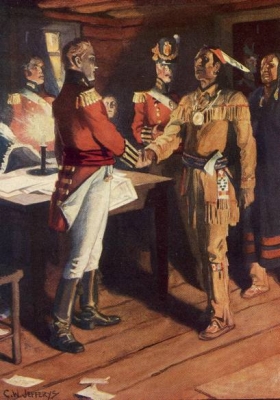
Below, Tecumseh and General Brock, “The Meeting of Isaac Brock and Tecumseh” by Charles William Jefferys

Treaty of Paris February 10, 1763
The Definitive Treaty of Peace and Friendship between his Britannick Majesty, the Most Christian King, and the King of Spain. Concluded at Paris the 10th day of February, 1763. To which the King of Portugal acceded on the same day.

In the Name of the Most Holy and Undivided Trinity, Father, Son, and Holy Ghost. So be it.
Be it known to all those whom it shall, or may, in any manner, belong,
It has pleased the Most High to diffuse the spirit of union and concord among the Princes, whose divisions had spread troubles in the four parts of the world, and to inspire them with the inclination to cause the comforts of peace to succeed to the misfortunes of a long and bloody war, which having arisen between England and France during the reign of the Most Serene and Most Potent Prince, George the Second, by the grace of God, King of Great Britain, of glorious memory, continued under the reign of the Most Serene and Most Potent Prince, George the Third, his successor, and, in its progress, communicated itself to Spain and Portugal: Consequently, the Most Serene and Most Potent Prince, George the Third, by the grace of God, King of Great Britain, France, and Ireland, Duke of Brunswick and Lunenbourg, Arch Treasurer and Elector of the Holy Roman Empire; the Most Serene and Most Potent Prince, Lewis the Fifteenth, by the grace of God, Most Christian King; and the Most Serene and Most Potent Prince, Charles the Third, by the grace of God, King of Spain and of the Indies, after having laid the foundations of peace in the preliminaries signed at Fontainebleau the third of November last; and the Most Serene and Most Potent Prince, Don Joseph the First, by the grace of God, King of Portugal and of the Algarves, after having acceded thereto, determined to compleat, without delay, this great and important work. For this purpose, the high contracting parties have named and appointed their respective Ambassadors Extraordinary and Ministers Plenipotentiary, viz. his Sacred Majesty the King of Great Britain… (dukes, lords, etc.)…Who, after having duly communicated to each other their full powers, in good form, copies whereof are transcribed at the end of the present treaty of peace, have agreed upon the articles, the tenor of which is as follows:
Article I. There shall be a Christian, universal, and perpetual peace, as well by sea as by land, and a sincere and constant friendship shall be reestablished between their Britannick, Most Christian, Catholick, and Most Faithful Majesties, and between their heirs and successors, kingdoms, dominions, provinces, countries, subjects, and vassals, of what quality or condition soever they be, without exception of places or of persons: So that the high contracting parties shall give the greatest attention to maintain between themselves and their said dominions and subjects this reciprocal friendship and correspondence, without permitting, on either side, any kind of hostilities, by sea or by land, to be committed from henceforth, for any cause, or under any pretence whatsoever, and every thing shall be carefully avoided which might hereafter prejudice the union happily reestablished, applying themselves, on the contrary, on every occasion, to procure for each other whatever may contribute to their mutual glory, interests, and advantages, without giving any assistance or protection, directly or indirectly, to those who would cause any prejudice to either of the high contracting parties: there shall be a general oblivion of every thing that may have been done or committed before or since the commencement of the war which is just ended.
II. The treaties of Westphalia of 1648; those of Madrid between the Crowns of Great Britain and Spain of 1661, and 1670; the treaties of peace of Nimeguen of 1678, and 1679; of Ryswick of 1697; those of peace and of commerce of Utrecht of 1713; that of Baden of 1714; the treaty of the triple alliance of the Hague of 1717; that of the quadruple alliance of London of 1118; the treaty of peace of Vienna of 1738; the definitive treaty of Aix la Chapelle of 1748; and that of Madrid, between the Crowns of Great Britain and Spain of 1750: as well as the treaties between the Crowns of Spain and Portugal of the 13th of February, 1668; of the 6th of February, 1715; and of the 12th of February, 1761; and that of the 11th of April, 1713, between France and Portugal with the guaranties of Great Britain, serve as a basis and foundation to the peace, and to the present treaty: and for this purpose they are all renewed and confirmed in the best form, as well as all the general, which subsisted between the high contracting parties before the war, as if they were inserted here word for word, so that they are to be exactly observed, for the future, in their whole tenor, and religiously executed on all sides, in all their points, which shall not be derogated from by the present treaty, notwithstanding all that may have been stipulated to the contrary by any of the high contracting parties: and all the said parties declare, that they will not suffer any privilege, favour, or indulgence to subsist, contrary to the treaties above confirmed, except what shall have been agreed and stipulated by the present treaty.
III. All the prisoners made, on all sides, as well by land as by sea, and the hostages carried away or given during the war, and to this day, shall be restored, without ransom, six weeks, at least, to be computed from the day of the exchange of the ratification of the present treaty, each crown respectively paying the advances which shall have been made for the subsistance and maintenance of their prisoners by the Sovereign of the country where they shall have been detained, according to the attested receipts and estimates and other authentic vouchers which shall be furnished on one side and the other. And securities shall be reciprocally given for the payment of the debts which the prisoners shall have contracted in the countries where they have been detained until their entire liberty. And all the ships of war and merchant vessels Which shall have been taken since the expiration of the terms agreed upon for the cessation of hostilities by sea shall likewise be restored, bon fide, with all their crews and cargoes: and the execution of this article shall be proceeded upon immediately after the exchange of the ratifications of this treaty.
IV. His Most Christian Majesty renounces all pretensions which he has heretofore formed or might have formed to Nova Scotia or Acadia in all its parts, and guaranties the whole of it, and with all its dependencies, to the King of Great Britain: Moreover, his Most Christian Majesty cedes and guaranties to his said Britannick Majesty, in full right, Canada, with all its dependencies, as well as the island of Cape Breton, and all the other islands and coasts in the gulph and river of St. Lawrence, and in general, every thing that depends on the said countries, lands, islands, and coasts, with the sovereignty, property, possession, and all rights acquired by treaty, or otherwise, which the Most Christian King and the Crown of France have had till now over the said countries, lands, islands, places, coasts, and their inhabitants, so that the Most Christian King cedes and makes over the whole to the said King, and to the Crown of Great Britain, and that in the most ample manner and form, without restriction, and without any liberty to depart from the said cession and guaranty under any pretence, or to disturb Great Britain in the possessions above mentioned. His Britannick Majesty, on his side, agrees to grant the liberty of the Catholick religion to the inhabitants of Canada: he will, in consequence, give the most precise and most effectual orders, that his new Roman Catholic subjects may profess the worship of their religion according to the rites of the Romish church. as far as the laws of Great Britain permit. His Britannick Majesty farther agrees, that the French inhabitants, or others who had been subjects of the Most Christian King in Canada, may retire with all safety and freedom wherever they shall think proper, and may sell their estates, provided it be to the subjects of his Britannick Majesty, and bring away their effects as well as their persons, without being restrained in their emigration, under any pretence whatsoever, except that of debts or of criminal prosecutions: The term limited for this emigration shall be fixed to the space of eighteen months, to be computed from the day of the exchange of the ratification of the present treaty.
V. The subjects of France shall have the liberty of fishing and drying on a part of the coasts of the island of Newfoundland, such as it is specified in the XIIIth article of the treaty of Utrecht; which article is renewed and confirmed by the present treaty, (except what relates to the island of Cape Breton, as well as to the other islands and coasts in the mouth and in the gulph of St. Lawrence:) And his Britannick Majesty consents to leave to the subjects of the Most Christian King the liberty of fishing in the gulph of St. Lawrence, on condition that the subjects of France do not exercise the said fishery but at the distance of three leagues from all the coasts belonging to Great Britain, as well those of the continent as those of the islands situated in the said gulph of St. Lawrence. And as to what relates to the fishery on the coasts of the island of Cape Breton, out of the said gulph, the subjects of the Most Christian King shall not be permitted to exercise the said fishery but at the distance of fifteen leagues from the coasts of the island of Cape Breton; and the fishery on the coasts of Nova Scotia or Acadia, and every where else out of the said gulph, shall remain on the foot of former treaties.
VI. The King of Great Britain cedes the islands of St. Pierre and Macquelon, in full right, to his Most Christian Majesty, to serve as a shelter to the French fishermen; and his said Most Christian Majesty engages not to fortify the said islands; to erect no buildings upon them but merely for the conveniency of the fishery; and to keep upon them a guard of fifty men only for the police.
VII. In order to reestablish peace on solid and durable foundations, and to remove for ever all subject of dispute with regard to the limits of the British and French territories on the continent of America; it is agreed, that, for the future, the confines between the dominions of his Britannick Majesty and those of his Most Christian Majesty, in that part of the world, shall be fixed irrevocably by a line drawn along the middle of the River Mississippi, from its source to the river lberville, and from thence, by a line drawn along the middle of this river, and the lakes Maurepas and Pontchartrain to the sea; and for this purpose, the Most Christian King cedes in full right, and guaranties to his Britannick Majesty the river and port of the Mobile, and every thing which he possesses, or ought to possess, on the left side of the river Mississippi, except the town of New Orleans and the island in which it is situated, which shall remain to France, provided that the navigation of the river Mississippi shall be equally free, as well to the subjects of Great Britain as to those of France, in its whole breadth and length, from its source to the sea, and expressly that part which is between the said island of New Orleans and the right bank of that river, as well as the passage both in and out of its mouth: It is farther stipulated, that the vessels belonging to the subjects of either nation shall not be stopped, visited, or subjected to the payment of any duty whatsoever. The stipulations inserted in the IVth article, in favour of the inhabitants of Canada shall also take place with regard to the inhabitants of the countries ceded by this article.
VIII. The King of Great Britain shall restore to France the islands of Guadeloupe, of Mariegalante, of Desirade, of Martinico, and of Belleisle; and the fortresses of these islands shall be restored in the same condition they were in when they were conquered by the British arms, provided that his Britannick Majesty’s subjects, who shall have settled in the said islands, or those who shall have any commercial affairs to settle there or in other places restored to France by the present treaty, shall have liberty to sell their lands and their estates, to settle their affairs, to recover their debts, and to bring away their effects as well as their persons, on board vessels, which they shall be permitted to send to the said islands and other places restored as above, and which shall serve for this use only, without being restrained on account of their religion, or under any other pretence whatsoever, except that of debts or of criminal prosecutions: and for this purpose, the term of eighteen months is allowed to his Britannick Majesty’s subjects, to be computed from the day of the exchange of the ratifications of the present treaty; but, as the liberty granted to his Britannick Majesty’s subjects, to bring away their persons and their effects, in vessels of their nation, may be liable to abuses if precautions were not taken to prevent them; it has been expressly agreed between his Britannick Majesty and his Most Christian Majesty, that the number of English vessels which have leave to go to the said islands and places restored to France, shall be limited, as well as the number of tons of each one; that they shall go in ballast; shall set sail at a fixed time; and shall make one voyage only; all the effects belonging to the English being to be embarked at the same time. It has been farther agreed, that his Most Christian Majesty shall cause the necessary passports to be given to the said vessels; that, for the greater security, it shall be allowed to place two French clerks or guards in each of the said vessels, which shall be visited in the landing places and ports of the said islands and places restored to France, and that the merchandize which shall be found t herein shall be confiscated.
IX. The Most Christian King cedes and guaranties to his Britannick Majesty, in full right, the islands of Grenada, and the Grenadines, with the same stipulations in favour of the inhabitants of this colony, inserted in the IVth article for those of Canada: And the partition of the islands called neutral, is agreed and fixed, so that those of St. Vincent, Dominico, and Tobago, shall remain in full right to Great Britain, and that of St. Lucia shall be delivered to France, to enjoy the same likewise in full right, and the high contracting parties guaranty the partition so stipulated.
X. His Britannick Majesty shall restore to France the island of Goree in the condition it was in when conquered: and his Most Christian Majesty cedes, in full right, and guaranties to the King of Great Britain the river Senegal, with the forts and factories of St. Lewis, Podor, and Galam, and with all the rights and dependencies of the said river Senegal.
XI. In the East Indies Great Britain shall restore to France, in the condition they are now in, the different factories which that Crown possessed, as well as on the coast of Coromandel and Orixa as on that of Malabar, as also in Bengal, …

On August 15, 1824…

15 Thursday Aug 2024

Posted by Admin in aboriginal title, Government Commissions, Indian Residential School, Reconciliation

≈ Leave a comment

Tags

Christian mission, Colony of British Columbia, Fort Simpson, HBC Governor Simpson, Indian Residential School, Oregon Treaty, Origin of BC, Sovereignty

The first HBC Governor west of the Rockies made his first tour of the forts with a note to himself in mind: the potential profit in Christian conversion of his newly acquired, autonomous Indigenous trading partners.

On August 15, 1824, George Simpson, Governor of Hudson’s Bay Company “North” (mostly west), left York Factory for the Oregon Territory.

      His mission was to make the newly acquired west coast trading posts profitable.

      After a bloody competition with the North West Company, and a decisive gunfight at Seven Oaks near the Red River, HBC had absorbed its rival trading company by Imperial British decision in 1821. Fraser, Thompson, and McKenzie had been NWCo. men.

      Like those ‘explorers,’ Simpson set out on the river highway with some colonial paddlers and the essential Indian Guide.

Unlike the previous company, he set out with a mission to test the west coast peoples’ receptiveness to Christianity; to introduce it and recommend it. A Company-and-King minded man, Simpson noted the profit that religious conversion would bring. He made a lot of notes.

      It was a key part of Simpson’s overall mission, which was to secure British North America in the west by making its trade competitive and resistant to America’s northward aspirations.

      The War of 1812 between the British and USA had only demarcated a 49th parallel border between them so-far into the Great Plains.

      On the west coast, the British Crown sought treaties with Spain, Russia, and the Americans long before it ever made any treaties concerning land interests with the Nations who enjoyed ancient sovereignties there. Simpson’s work resulted in the Russia treaty at Alaska in 1825, and the Oregon Treaty with America in 1846.

200 years later, the actual role of the Christian churches among Indigenous Peoples has only just begun to be acknowledged for the Trojan Horse it was.

      Not until the indescribably tragic case of Blackwater v. Plint, 1997 – so unbearable to testify to, half of the dozen plaintiffs took their own lives during the hearings into church and state’s crimes against them as children in Indian Residential School – did BC settlers even acknowledge that its early work towards “Christian civilization” of Native Peoples was “flawed” and “regrettable” in 1998.

      They/we, the BC settlers, certainly have never come to terms with the way we profit from the most unforgivable truth about Britain’s churches’ role: to dehumanize the Peoples as they were; to peddle the myth that Britain’s God is superior to the Gods of these Peoples; and preach the associated divine right of its kings as if European domination was a natural inevitability – denying the sovereignties, jurisdictions, and land titles of the Native Nations to this day in colonial courts and international forums.

When today’s Indigenous Elders are questioned about why their people moved away from productive, beautifully situated, spiritually connected, and traditional seasonal villages – to the ill-suited, waterless, and usually barren Indian Reserves (all that was left to them by BC and Canada’s Indian Reserve Commissions, finally legislated in 1924) – one reason recalled is to be close to the church. Every Reserve had one.

      Terrorized by biological warfare, and with the only access to treatment or vaccination coming (when it inconsistently did) from a handful of legitimate Reverends, the connection between church and survival was often made.

Although moving to Indian Reserves was forced by two much more compelling reasons – government armed and escorted relocation, and deadly settler violence outside the reserves – community organizing around the on-Reserve church played a part.

      Most every traditional spiritual practice and ceremony of governance was criminalized under the Indian Act for over 75 years. Indigenous politics and religion sometimes survived just under the skin of a church, because gathering at church was the only kind of gathering not broken up by Indian Agents. Sometimes with a watchman posted outside, holding a cross and a Bible; and with raised voices signing Onwards Christian Soldiers inside; the secretly illegal gathering was sheltered. The Native Brotherhood, the Shaker religion, the Native Church, all ended up using the cross as a shield from the ills of the world, just not in the same way the Missionaries told them it would work.

      Christianity was used, in the end, as west coast Peoples’ defense against the invading foreigners who sold it to them. At least the physical symbols and the deceptive cloak of singing was effective.

Simpson, during his time, used his knowledge of the Sinixt, Sto:lo, and coastal Salishan Peoples to drive a hard inter-colonial boundary through their countries. The Oregon Treaty split their countries apart, on either side of today’s Canada-US border.

      The first western Governor of the HBC produced a legacy of bad faith and betrayal: promoting the lie of a beneficent Christian mission, making agreements for Britain’s essential trade in furs and geographical knowledge based on recognition of the Tribes, when he relied entirely on them, while at the same time engineering the infrastructure that would purposefully overtake and dispossess them. This legacy was the making of British Columbia.

As Native politicians famously orated in the 1970s, and ever since: “In the beginning, we had the land and all they had was the Bible. Now we have the Bible and they have the land.”

It started today, 200 years ago, with the first visit of the HBC Governor to the trading forts of the west. It continues today, with the Christian monarch’s head on every piece of Canadian currency and mounted on the wall behind every Canadian judge.

~

For more on the early Oregon Territory, Simpson, European treaties over Indigenous lands, Missions and biological warfare mentioned in this article, see:

The Oregon Encyclopedia online

The Hudson’s Bay Company Archives, Manitoba Archives

The Canadian Encyclopedia online

Archive Quarterly ~ journal of “the west wasn’t won archive project”

Hudson’s Bay Company Archives, UK https://discovery.nationalarchives.gov.uk/details/r/C29

Archive Quarterly ~ Summer 24

15 Monday Jul 2024

Posted by Admin in aboriginal title, Non-Status Indian Era, Roadblock

≈ Leave a comment

Tags

aboriginal rights, aboriginal title, Bonaparte, Cache Creek 1974, Indian Status, Indigenous Peoples, Indigenous-focused grad requirement, Jeannette Corbiere-Lavell, Kelowna Accord, Native Peoples Caravan, on-reserve housing, Transformative Change Agreement

Featuring:

A special investigation of the 1974 blockade of Highway 12, at Bonaparte, Secwepemc.

After Elder James Morgan’s house burned down, and there was no access to funds or building materials to rebuild it, the Chief and dozens of others held down a narrow strip of the main transportation artery between Lillooet and the Interior – to levy a $5-per-traveller toll, raising funds to rebuild themselves.

With new interviews and a compilation of reports from the time, the coverage leads into a wider background for the on-reserve housing crisis. With a deep dive into on-reserve housing development since the Peoples were displaced from their usual homes.

The Native Peoples’ Caravan

The people at Cache Creek were soon joined by members of the Ojibway Warriors Society, the American Indian Movement in Canada, and allied that worked quickly together to coordinate the Native Peoples’ Caravan to Ottawa that Fall.

“Tsilhqot’in Nation v. British Columbia”

Tracking the first ever Supreme Court of Canada Declaration of Aboriginal title lands.

– Excerpts from the court rulings; Interviews with the Tsilhqot’in neighbouring nationals whose recognition of Tsilhqot’in title long predates the existence of Canada; Book review: “Lha Yudit’ih We Always Find A Way – Bringing the Tsilhqot’in Title case home” by Lorraine Weir with Chief Roger William; Maps and Timeline.

Celebrating fifty years of Native Women’s Associations

Jeannette Corbiere-Lavell joins us to discuss her legendary case to regain Indian Status after sexist provisions in the Indian Act – and being sued by the Attorney General – withdrew it.

Grandmothers Healing Journey, Honouring the Grandmothers on the Fraser River, and those who lived and died without their rights or recognition, far from their homes, in the cities. Artists reac out in an exhibition at the New Westminster gallery at the Anvil Building.

Excerpts from the Indian Act, as its amendments impacted women and children’s right to Indian Status.

BC’s Indigenous-focused graduation requirement

One year into BC’s Indigenous-focused graduation requirement: a class profile with one course in Sto:lo that thrived. “That class had the perfect combination of sxwōxwiyám – stories from long ago, and sqwélqwel – news from today.”

More:

20 years since the Kelowna Accord: why didn’t it work? Committing to “Closing the gap” in housing,
health, economies and education, felled the federal government.

The Department of Indian Affairs (Minister of the Interior), describes the conditions of landlessness and displacement that have led to today’s crises, in its first Annual Report, 1874.

The “biggest demonstration in BC history” – Indigenous march on the Victoria Legislature, June 25, 1974.

44 pages 8.5×11 black and white

Honouring the indomitable spirit of Indigenous Peoples west of the Rocky Mountains.

Archive Quarterly ~ Summer 24

DECLARATION OF THE INDIAN CHIEFS IN THE SOUTHERN INTERIOR OF BC

01 Friday Mar 2024

Posted by Admin in aboriginal title, Indigenous Declarations

≈ Leave a comment

July 16, 1910

Chiefs from the Southern Interior met at Spences Bridge in 1910, to study the demands of the Indian Rights Association of BC. The Interior Chiefs decided to affiliate with the coast Indian Rights Association and stand with them to demand certain rights for Indian people and a settlement of the land issue. But the Chiefs also understood how important it was for them to carefully define, and speak for, their own concerns. They had translator James Teit write it all down in point-by point form so it could be easily distributed. The points were made in the form of a declaration and dated the 16th day of July, 1910.

The DECLARATION OF THE INDIAN CHIEFS IN THE SOUTHERN INTERIOR OF BC begins:

To Whom It May Concern:

We, the underwritten Chiefs of Indian Bands in the Southern Interior of British Columbia, hereby make known our position in regard to the question of Indian rights, and the policy of the Indian Rights Association of BC, as follows:

First, we stand for treaty rights with the dominion government, the same as all the Indian tribes in the other provinces of Canada, and that all matters of present importance to the people of each of our tribes be subject to these treaties, so that we shall have a definite understanding regarding lands, water, timber, game, fish, etc., and we consider such matters as schools, doctors, aid to the aged, Indian funds, etc., and general assistance by the government should also be included in these treaties.

Second, we stand for compensation to us by the British Columbia government for all lands of ours appropriated, or held by them, including all lands preempted or bought by settlers, miners, lumbermen, etc.

Third, we stand for the enlargement of our reservations wherever we consider it necessary, by having a sufficiency of land allotted to us so as to enable us to compete on better terms with whites in the way of making a living.

Fourth, we stand for the obtaining of a permanent and secure title (to be acknowledged by the government as such) of our ownership of our present reservations, and of such lands as may be added thereto.

Fifth, we stand for the carrying of our claims before the Privy Council of England for settlement, and in the event of our obtaining justice as we expect, we ask such compensation as may be awarded us for our lands, etc., shall be paid to us, half in cash, and the other half to be retained by the dominion government, and used as occasion may require for our benefit.

Sixth, we ask for and expect the dominion government to support us in our claims, and help us to obtain our rights to the best of their ability.

Seventh, we believe the Indian Rights Association of BC (which has been formed by other Indians of this country) has the same object and claims that we stand for, there- fore we declare our agreement with the members of the same, and our resolve to join them, and support them in the furtherance of our mutual interests, and the attainment of our rights.

Eighth, we believe that the Indian Rights Association of BC has hired Mr. Clark, K.C., of Toronto, to look after their interests and conduct their case in harmony with their desires, and those of the dominion government, and we hereby declare our agreement with this step, and our intention to support it financially and otherwise, as well as we are able.

02.24.2024 ~ Today is a great day for history!

24 Saturday Feb 2024

Posted by Admin in aboriginal title, BC treaty process, Children, Comprehensive Claims - Policy and Protest, Government Commissions, Indian Residential School, Indigenous Declarations, Non-Status Indian Era, Reconciliation, UN Engagement, Uncategorized, Union of BC Indian Chiefs

≈ Leave a comment

Tags

Archive Quarterly

Introducing:    Archive Quarterly

It’s The West Wasn’t Won’s own journal, like a news clipping service across the last two or three hundred years.

Did you know? This month marks a hundred years since the Allied Tribes of British Columbia petitioned to shut down the Indian Reserve Commission report.

If you didn’t, a subscription to Archive Quarterly will really help!

What was hidden from history is what’s needed now.

AQ shakes out the archives for primary sources on Indigenous land and British Columbia, sharing:

~ key extracts from archival artifacts

~ quotes and interviews on the issues as they were

~ relatable commentary and a few side-notes

~ images and timelines that connect past and present

The first April issue will be here in three weeks!

READ ON  for more info

TAKE A LINK  to the Archive Quarterly website to see more and click your Subscription

FOLLOW  AQ on Facebook  for updates 

Archive Quarterly is about it, the west wasn’t won!

BC history is lit from one side – showing settler progress to advantage, while rendering the Indigenous reality of that “progress” indiscernible.

This magazine aims to balance the view. As well as the written records, interviews with Elders reveal circumstances leading up to political movements, court actions and roadblocks, and conditions in their communities at the time.

Excerpts in the journal will be presented in full documents online, where they are accessible to download.

See the highlights from the first issues this year!

Get your subscription now and you can start sharing.

Print subscriptions will hit the mailboxes in the middle of March, and the first issue of AQ will be in bookstores before April.

When you buy a $44 print subscription, you’ll be the first to receive each issue by mail and get a digital copy in your inbox as well.

That’s right, Archive Quarterly comes out four times a year, in April, July, October, and January. It’s $15 in stores.

Digital subscriptions for the year are just $18, and you can share AQ with your contacts.

Subscribe to print or digital here: AQ Subscribe

You can also donate to AQ to become a founding sponsor – thanks!

Group and bulk print subs available, just drop us a line.

If you just can’t afford the subscription, get in touch and we’ll get you in.

By subscribing to AQ today, you’ll be helping to get work done.

Special Issues

Did you know? The ongoing denial of Aboriginal land title – and the tiny size of First Nations reserves – contributes directly to child apprehensions from young Aboriginal families. The situation can’t change without land to build on and live in.

Special Issues are on the way for AQ, focusing on Aboriginal Title, the Non-Status Indian era, Roadblocks, and more. The Special series dives deep and provides historical overviews and insight, and the development takes time and research and communications.

AQ’s online digital archive

It keeps growing, as old docs are scanned and processed and uploaded. The physical archive costs money for storage, and the digital archive costs money for web space.

The magazine comes out of a collection kept up by Electromagnetic Print – EMP, a book label founded to print voices seldom heard in the media, especially the voices of native sovereigntists.

Thank you very much for reading and have a great day!

Kerry Coast, Publisher

Electromagnetic Print

The “Inalienable Aboriginal Title” and the “Crown’s Fiduciary Duty”

07 Monday Aug 2023

Posted by Admin in aboriginal title, Commentary, editorial

≈ Leave a comment

Tags

aboriginal rights, aboriginal title, doctrine of discovery, Indigenous Peoples, Johnson v. McIntosh, Land claims, Marshall, Sovereignty

Reflecting on two centuries since Johnson & Graham’s Lessee v. McIntosh, 1823

When Europeans found out about North America, they fought each other – and made treaties with each other – for the right to exclusive trading and treaty making there.

     African emissaries didn’t do that. They merged and mixed, and made something of themselves among the Original Inhabitants, apparently, when you look at the gift of an ancient stone head which the Government of Mexico made to UN headquarters in New York City, early this century. The several-ton sculpture was distinctly an African head, made in Mexico, and older than Columbus by centuries. Mexico chose its moment well, at the time of ratification of the Declaration on the Rights of Indigenous Peoples.

     But in 1823, the exact meaning of French, Spanish, and British dealings on the Atlantic coast of this continent were the subject of an elaborate judicial review by US Chief Justice John Marshall. The case at trial was a question of whether inheritors and tenants of land bought from the Illinois and Piankeshaw could keep their arrangement after the nations’ leadership made a treaty with the USA.

    The appeal, or writ of error, was put to the Supreme Court primarily because the question of the foundations of land title in “British” North America required clarification generally.

     In order to decide whether Johnson’s party (the plaintiff) had a claim against McIntosh (the defendant) for the right of possession, Marshall had to review all the facts. That is, what happens when an immigrant individual buys land from an independent American nation, and that nation subsequently sells their title, by way of treaty, to the new colonial US government? That is:

“The plaintiffs in this cause claim the land in their declaration mentioned under two grants purporting to be made, the first in 1773 and the last in 1775, by the chiefs of certain Indian tribes constituting the Illinois and the Piankeshaw nations, and the question is whether this title can be recognized in the courts of the United States?

“The facts, … show the authority of the chiefs who executed this conveyance …were in rightful possession of the land they sold. The inquiry, therefore, is in a great measure confined to the power of Indians to give, and of private individuals to receive, a title which can be sustained in the courts of this country.”

To track the foundation of land title in North America, distinct from in Europe, through both constitutional and common law, he noted the inter-European treaties:

“But as they [Europeans] were all in pursuit of nearly the same object, it was necessary, in order to avoid conflicting settlements and consequent war with each other, to establish a principle which all should acknowledge as the law by which the right of acquisition, which they all asserted, should be regulated as between themselves. This principle was that discovery gave title to the government by whose subjects or by whose authority it was made against all other European governments, which title might be consummated by possession.”

“The exclusion of all other Europeans, necessarily gave to the nation making the discovery the sole right of acquiring the soil from the natives, and establishing settlements upon it. It was an exclusive principle which shut out the right of competition among those who had agreed to it; not one which could annul the previous rights of those who had not agreed to it. It regulated the right given by discovery among the European discoverers, but could not affect the rights of those already in possession, …. It gave the exclusive right to purchase, but did not found that right on a denial of the right of the possessor to sell.”

To skip to the end of McIntosh, Marshall found that the USA could not credit, inherit, or guarantee, a previous land deal made by another nation. As he said earlier, the chiefs who executed the conveyance were in rightful possession of the land they sold. It was the USA who could not recognize their sale to anyone but “the sovereign claiming discovery.”

     The USA was bound by the European treaties to only recognize an Indian surrender or sale of their title to the sovereign power which had made “discovery.” Thus the Plaintiff’s title derived by grant from the Indians could not be recognized by Marshall’s court. Mr. Johnson was not a sovereign power. He was, however, a Supreme Court Justice of the state: he should have known better.

And that is “the inalienable title” in Canada today: the crown had staked its right, against any other, to acquire title to the soil. The crown offered to the prospective sellers its protection in exchange. And that is the “fiduciary duty” – the crown would be nothing more than a hostage taker; a brute captor and slave driver (which it also was until 1807); unless it acted honourably towards the peoples it had just isolated from the free market by force of might. The duty is one of care; trust; and fair and equitable dealing.

     Having acquired the exclusive right to buy the land, honour would not permit the discovering sovereign to deal sharply, to coerce a sale, nor to deny the Original Inhabitants their right to occupation and possession until a sale was made.

*

Aboriginal title – in spite of Marshall, or as aided by the Chief Justice?

Marshall’s decision has provided a pivot in verifying land titles against the US and Canada across North America, since those countries presumed to abandon their foundations in constitutional democracy; the one-truth of Christianity; the rule of law; etcetera, in the 1870s. Both countries put the land race ahead of law.

It is a live issue in British Columbia, if not all of Canada, as Bruce Clark wrote in 2019:

10. Faced with the prospect that the Indians might not “sell” at ridiculously low prices the “Protection” duty of the crown and its law officers knowingly and intentionally was corrupted by the judiciary, not necessarily for the direct benefit of any individual judge or lawyer, but rather in the service of the newcomer public’s interest in stealing the Indians’ possession and usurping their jurisdiction.

11. Specifically, in the 1870s the governments of both the USA and Canada dealt with this threat by invading, occupying, and governing the yet unceded indigenous national territories under the auspices of their own legislation, regardless of the absence of treaties. The legal profession and judges permitted and led the invasion.[i]

The Indian Act, 1876, is one of the most well-known mechanisms of this invasion and arbitrary government.

     In R. v. White and Bob, 1964, the Snuneymuxw defendants cited Marshall extensively. They were defending their 1854 treaty right to “hunt as formerly” around Nanaimo against a rogue Canadian province that had, by 1964, invested almost a century’s worth of Indian Agents to illegally and extra-judicially stamp out their economic activities down to the most basic, essential, sustenance hunting and fishing. The Snuneymuxw hunters won, and their treaty with Governor James Douglas, Vancouver’s Island, was recognized as a treaty by the Supreme Court of British Columbia. The government appealed, and the Supreme Court of Canada sent it back in 1965 with a one-line ruling confirming the provincial court’s decision.

Else the court would have had to contend with this excerpt, among others, in a 131-page Defendants’ Factum prepared for a potential hearing in front of the Supreme court of Canada:

“c. Aboriginal title and aboriginal occupancy in Anglo-Saxon jurisprudence

“The concept of aboriginal title and native rights flowing therefrom has long been recognized by Anglo-Saxon jurisprudence. In a series of famous judgments in the 19th century the Supreme Court of the United States dealt with questions relating to the nature of Indian title

The Respondents submit the judgment in Johnson vs. McIntosh is of great importance in determining the aboriginal rights of the Indians of the West Coast, for the reasons given by Norris J.A.:

…The judgment in Johnson vs. McIntosh (supra) was delivered at an early stage of exploration of this continent and when controversy as to those rights was first becoming of importance. Further on the consideration of the subject matter of this Appeal, it is to be remembered that it was delivered only five years after the Convention of 1818 between Great Britain and the United States providing that the northwest coast of America should be free and open for the term of ten years to the vessels, citizens, and subjects of both powers in order to avoid disputes between the powers. The rights of Indians were naturally an incident of the implementation of a common policy which was perforce effective as applying to what is now Vancouver Island and the territory of Washington and Oregon, all of which were then Hudson’s Bay territories. For these reasons and because the judgment in Johnson v. McIntosh was written at a time of active exploration and exploitation of the West by the Americans, it is of particular importance.”

It is still of particular importance. Modern judgments in Canada’s Supreme Court have whittled the meaning of Aboriginal title down to “reconciliation” and “the right to be consulted and accommodated.” They have defined the meaning of “land title” almost completely out of “Aboriginal title.”

     In 2014 the Tsilhqot’in won a Declaration of Aboriginal Title to much of their national territory. Ten years later, the governments refuse to know how to implement that, and precious little has changed – while gold mining corporations have since barged on with work in the declared title areas, and there is no taxation scheme in place to direct property taxes to the Tsilhqot’in.

     Today’s Chief Justices do not encourage or support declarations of title, they fight them as they just did in the case of the Nuu-chat-laht this year, and they all say that the “existing Aboriginal and treaty rights” of the 1982 Constitution Act will find their full expression through negotiated final agreements. But those negotiations are financed, mandated, controlled, and arbitrated by the federal government of Canada.

     If the fiduciary duty were intact, the government would have investigated and positively identified Aboriginal title areas, in accordance with the Aboriginal perspective in each case; protect the constitutional rights that flow from them; offer a competitive purchase price for any land that might be considered for sale by the Aboriginal title holders; and otherwise stay out of them.

     Instead, the negotiations – the governments insisting on denying any real property rights in the Original Inhabitants – are conducted under duress, where forced deprivation and subordination surround and isolate small Indian Reserves which were never accepted as a settlement of anything; against a backdrop of unaffordable and adversarial litigation before biased judges; and, on the other hand, roadblocks crashed by Emergency Response Teams and the military. The fiduciary duty is not intact.

In his follow-up to the omnibus sweep of Johnson v. McIntosh, Marshall said more clearly:

“The extravagant and absurd idea, that the feeble settlements made on the sea coast, or the companies under whom they were made, acquired legitimate power by them to govern the people or occupy the lands from sea to sea, did not enter the mind of any man. They were well understood to convey the title which, according to the common law of European sovereigns respecting America, they might rightfully convey, and no more. This was the right of purchasing such lands as the natives were willing to sell. The crown could not be understood to grant what the crown did not affect claim; nor was it so understood.

… “The king purchased their lands when they were willing to sell, at a price they were willing to take; but never coerced a surrender of them. He also purchased their alliance and dependence by subsidies; but never intruded into the interior of their affairs, or interfered with their self government, so far as respected themselves only.”

That was in Worcester v. Georgia, 1832, and a political response was soon issued. President Andrew Jackson told the world: “Marshall has made his decision, now let him enforce it.” The great state of Georgia sent the Cherokee away, out of their homeland, on a Trail of Tears.

     In 2006, the Indigenous Peoples and Nations Coalition of Alaska and Hawaii completely rejected the USA’s application of the 1823 ruling, in their shadow report to the UN Human Rights Committee concerning the USA’s implementation report:

“The Tee-Hit-Ton (1955) and Johnson v. McIntosh cases affirmed the direct application of the racist Doctrine of Manifest Destiny, Doctrine of Incorporation and several other ‘doctrines’ or derogatory principles to effectively subjugate, dominate and exploit Alaska and Hawaii under the auspices of domestic dependent Federal Indian Law right under the noses of the Decolonization Committee and the General Assembly of the United Nations.”[ii]

Perhaps the States relied only on key selections of Marshall’s law, not to be confused with martial law, going to the markedly ethnic superiority of lines like,

“On the discovery of this immense continent, the great nations of Europe were eager to appropriate to themselves so much of it as they could respectively acquire. Its vast extent offered an ample field to the ambition and enterprise of all, and the character and religion of its inhabitants afforded an apology for considering them as a people over whom the superior genius of Europe might claim an ascendency. The potentates of the old world found no difficulty in convincing themselves that they made ample compensation to the inhabitants of the new by bestowing on them civilization and Christianity in exchange for unlimited independence.”

Incidentally, property owners in Hawaii buy “title insurance” along with their home insurance. It protects their interests in the event of a successful Hawaiian title claim against the property they bought from an American government which never legally acquired title to it.

If the 1823 ruling is to be thrown out, then out with it goes the foundation of every claim to a right to lawfully proceed in treaty making in North America. Along with it, the concept of the rule of law as a basis for constitutional democracy. If the 1823 ruling is to be kept, in its entirety, then out goes every Canadian or US claim to ownership of lands which did not conform to the constitutional requirement set out therein:

“According to the theory of the British Constitution, the royal prerogative is very extensive so far as respects the political relations between Great Britain and foreign nations. The peculiar situation of the Indians, necessarily considered in some respects as a dependent and in some respects as a distinct people occupying a country claimed by Great Britain, and yet too powerful and brave not to be dreaded as formidable enemies, required that means should be adopted for the preservation of peace, and that their friendship should be secured by quieting their alarms for their property. This was to be effected by restraining the encroachments of the whites, and the power to do this was never, we believe, denied by the colonies to the Crown.”

  • CJ Marshall, in Johnson v. McIntosh

*

Magna Carta, 1215, and the Royal Proclamation, 1763

Britain may have asserted sovereignty on the Atlantic seaboard, and across North America, but they knew they did not own the land. At least, their American successors at law knew it in 1823 – but they later seemed not to know it in, say, 1876; 1912; 1926; 1973; etc.

What they knew in 1823, what Marshall knew, was:

“Those relations which were to exist between the discoverer and the natives were to be regulated by themselves. The rights thus acquired being exclusive, no other power could interpose between them.

“In the establishment of these relations, the rights of the original inhabitants were in no instance entirely disregarded, but were necessarily to a considerable extent impaired. They were admitted to be the rightful occupants of the soil, with a legal as well as just claim to retain possession of it, and to use it according to their own discretion; but their rights to complete sovereignty as independent nations were necessarily diminished, and their power to dispose of the soil at their own will to whomsoever they pleased was denied by the original fundamental principle that discovery gave exclusive title to those who made it.”

The concept of “sovereignty” following chartered sailors across an ocean becomes difficult to translate to pluri-national, multi-theistic states of the 21st century, and non-stop global migration by princes, billionaires, and multi-national companies. To wit, in 1823 (and long since before 1492) the Romans of conquered Europe considered themselves descendants of the One True God, bar none. The superiority of Christianity simply melted competing nations’ founding mythologies, according to the colonial lore.

      Still, they were held to a standard, and the local feudal lords of England enforced a standard as well – Magna Carta, 1215 – in much the same way Pontiac and his Allies forced the Royal Proclamation of 1763.

       It had been about the same amount of time between contact and manifesto in both cases; from 1066-1215 for the British, and from about 1550-1763 for the North American nations. Magna Carta, by order of the Roman Catholic King, constitutionalized the monarch’s rights and their limitations. For instance, if the crown made a claim to possessing title to land, they had to prove their claim in court against any challenger. Landholders were protected “against arbitrary exercise of power by a sovereign that enjoyed immunity in its own courts prior to the enactment of modern crown liability statutes.”[iii]

     And also, according to the common law (which predates the Roman law): “the dignity of the crown” prevents it from acquiring possession, rightly or wrongly, by physical occupation of the land. For the crown to have possession, of its own, in land, it must have a title of record, as in a memorial of a court or legislative body.

     In America, the Royal Proclamation was, in effect, an Executive Order extending the sense of Magna Carta to the colonial governors. King George III just wrote it up specific to North America.

      In the same way that Roman and Norman colonizers of England, centuries before, were held to the judicious standard they professed to be introducing to “the heathens” – they were made to recognize the titles and jurisdictions of the peoples who built Stonehenge; so the new British monarchy found itself unable to hold any ground without the support of the Original Inhabitants (and their military leaders) in North America.

     By 1763, France had lost the Seven Years War against Britain. Along with the war, France lost its Native Allies to Britain, and its interests in settlements, trading, and treaty making specific to a massive series of nations from the St. Lawrence River to Nova Scotia, and south of there.

     And King George sent the Royal Proclamation to the Governors to arrest the settler invasion-in-progress of “the Indian Nations, with Whom We are Aligned.” They call that proclamation the “Indian Charter of Rights.”

     Several American colonies revolted two years later and declared Independence from Britain over the next decade. The Americans took exception to a number of provisions in that “Charter,” and a few unrelated taxation issues, and what had been colonies of Virginia, Pennsylvania, Maryland et al, became independent states – soon to be united states.

     In 1823, Chief Justice Marshall trod carefully in his young nation, but he did bring up the Proclamation in consideration of those North American nations whose land had not been, “… ceded to or purchased by Us”:

And whereas it is just and reasonable, and essential to Our Interest and the Security of Our Colonies, that the several Nations or Tribes of Indians, with whom We are connected, and who live under Our Protection, should not be molested or disturbed in the Possession of such Parts of Our Dominions and Territories as, not having been ceded to, or purchased by Us, are reserved to them, or any of them, as their Hunting Grounds; We do therefore, with the Advice of Our Privy Council, declare it to be Our Royal Will and Pleasure, that no Governor or Commander in Chief…do presume, upon any Pretence whatever, to grant Warrants of Survey, or pass any Patents for Lands…upon any Lands whatever, which, not having been ceded to, or purchased by Us as aforesaid, are reserved to the said Indians, or any of them.”

*

The Christian nations of Europe assumed their dominion over new lands,

“… ‘then unknown to all Christian people,’… Thus asserting a right to take possession notwithstanding the occupancy of the natives, who were heathens, and at the same time admitting the prior title of any Christian people who may have made a previous discovery.”

In another way, other faith-based empires encouraged conversion by recognizing rights based on personal religious beliefs. The spread of Islam, for instance, was improved by the clause for protection of Muslims from enslavement by other Muslims. In areas like Indonesia, when, at the relevant time, slavery was a real part of the social strata, individuals could give themselves into indentured service if they had no land or tenure. Islam was often embraced by people of that class.

Perhaps the Europeans’ law is really a matter of faith. There have been plenty of dark nights of the soul where law and faith were lost. For instance, Henry III sent John Cabot out on a royal charter to get colonies in the Americas, in direct contravention of the 1493 Papal Bull assigning half of… whatever lay to the west of Europe… to Spain, and half to Portugal. At that time, the Pope would have been the head of Henry’s church and the touchstone of monarchic divinity.

     Nevertheless, Christian Britain did indeed outcompete Christian Spain and Portugal. And France. And Christian Spain did war with Christian France; Portugal with Spain; Holland with Britain; etcetera.

In the case we’re discussing here, Thomas Johnson was, in fact, a Supreme Court Judge. If anyone, in 1773 and 1775, should have known that the content of the Royal Proclamation of 1763 forbade any individual from making purchases in their own name from the Indians, it was Thomas Johnson, SCJ.

*

References:

Full text of the US Supreme Court’s decision in Johnson v. McIntosh, 1823: https://supreme.justia.com/cases/federal/us/21/543/

R. v White and Bob, 1965 Respondent’s Factum to Supreme Court of Canada


[i] Bruce Clark, LL.B., in “Ongoing Genocide caused by Judicial Suppression of the “Existing” Aboriginal Right,” 2019.

[ii] Shadow report to UN Human Rights Committee concerning the USA’s implementation report, by the Indigenous Peoples and Nations Coalition, 2006

2006-usa-universal-periodic-review-un-shadow-report-by-indigenous-peoples-and-nations-council.-alaska.hawaiiDownload

[iii] Professor Kent McNeil, in “The Onus of Proof of Aboriginal Title,” Osgoode Hall Law School, 1999.

“I guess you had more rights than we thought”

21 Wednesday Jun 2023

Posted by Admin in Commentary, editorial, Comprehensive Claims - Policy and Protest

≈ 1 Comment

Tags

aboriginal title, Calder, Comprehensive Claims Policy, Federal Liberals Comprehensive Claims Policy, Indian land, Land claims, NIshga case, Supreme Court of Canada, unceded, unextinguished, unsurrendered

Fifty years since Calder v. The Attorney General of British Columbia: how Canadian policies – and judges – adapted to delay and deny recognition of Indigenous Peoples’ land title

On January 31, 1973, Indigenous people’s unextinguished right to “possession” of their lands was recognized in a Canadian court for the first time.

Three Supreme Court of Canada judges reasoned that the Indigenous Nisga’a People had never lost to British Columbia their “possession of the land,” and had the continuing “rights to enjoy the fruits of” their land.     

In the case presented by the Nisga’a nation, with Frank Calder as the name plaintiff, the people established that their ancient rights to the soil had not, could not have been, diminished by any unilateral pronouncements or colonial legislative acts: the Nisga’a had never freely relinquished, sold, or made treaty to surrender them.

Supreme Court of Canada justices Hall, Spence, and Laskin wrote 50 of 72 pages in the Calder ruling, finding in favour of that position, as per the Canadian constitution.

The court ruling was split, however. Three judges ruled Nisga’a had no title and, if it ever did, the presence of a British colony nullified it. The seventh judge refused to decide, based on a procedural anomaly.

Prime Minister Pierre Trudeau’s reaction was to say, “I guess you had more rights than we thought, when we did the White Paper in ’69.” Unfortunately, the exact purpose of the federal government’s 1969 position and policy was to erase those rights which they were well aware had never been addressed.

Some politicians were more responsive. Because of the court finding in the Nass Valley case, the former prime minister John Diefenbaker immediately addressed the government, asking that the question of Aboriginal rights be referred to a full bench of nine Supreme Court of Canada judges “as this question can be settled once and for all.” The Justice Minister, Otto Lang, said he would consider the suggestion.

The judges were very responsive. In the past fifty years, the Canadian judiciary has defined that title down.

The politicians did not refer the question, they constructed a policy even more dangerous than their 1969 White Paper. The Comprehensive Claims Policy, a process of extinguishing Aboriginal title and rights by agreement, emerged in 1974 and is still the government’s bottom line. It predetermines the result of every engagement with Indigenous Peoples where land and jurisdiction are concerned: gains in Canadian titles to land, financial settlement, and limited forms of municipal self-governance are paid for by release of Aboriginal rights and indemnification of the governments – and “anyone else” – for past harm.

The agreements are invariably negotiated under duress: under the conditions of poverty and desperation imposed by another unconstitutional action, the Indian Act of 1876. Also, still in effect.

“Extinguishment with consent” remains Canada’s policy and enthusiastic practice to date. It has been heavily criticized by international treaty bodies for at least twenty years.

Government policy has been mirrored by the Canadian judiciary. In case after case, they defined “Aboriginal title” into something quite different.

Judge made law

In every Indigenous action that followed Calder, government lawyers began their argument by quoting Justice Gould of the BC Supreme Court, who made the original ruling of dismissal against the Nisga’a in 1969. Lawyers for the crown all began their prosecution of Indigenous land-defenders and rights-exercisers, or their defense against being sued for land and rights, by saying: if there was ever any right or title to extinguish, then any Aboriginal rights or titles were extinguished by denial, declarations, or legislation of the Imperial or provincial crowns.

But, since 1973 and the epic realization that if the Nisga’a had title, so did every other Indigenous Nation west of the Rockies, by the same logic, the Canadian judiciary began to define that title out of reach and out of all meaning.

Ignoring the clearly and passionately iterated expressions of the meaning of Indigenous titles, offered over the last century-and-a-half by Indigenous Peoples themselves, judges dismiss essential elements of those as “absurd;” they sift out definitions of Aboriginal rights which are not too inconvenient for the state; and the politicians pass legislation to mechanize pacification of the piecemeal rights arising from the litigation.

Judges confirmed that Aboriginal rights are sui generis: Aboriginal rights and titles are just not like other peoples’ rights and titles, in Canadian Pacific Ltd. V. Paul, 1988. They made lists of requirements about what Indigenous Peoples have to prove in order to convince courts they have rights, like exclusive and continuing and exclusive occupation, in Baker Lake v. The Minister of Indian and Northern Affairs, 1980. That becomes quite hard to show, when communities were forcibly displaced and replaced by settlers.

In R. v. Adams, 1996, judges said Aboriginal title, being unlike other peoples’ titles, is actually a form of Aboriginal right. They defined what “the core of Indianness” means, in Dick v. The Queen, 1985.

They figured out that Aboriginal rights are only those activities which were in play in 1846, effectively freezing Aboriginal Peoples out of the right to develop and to have that development recognized as within their rights.

The judiciary then put themselves, and Canada, squarely in charge of elaborating on the constitution, where it concerns Indigenous Peoples, because that, Chief Justice Antonio Lamer explained in R. v. van der Peet, 1996, is what Section 35(1) is for. “Aboriginal rights are aimed at the reconciliation of the prior occupation of North America by distinctive aboriginal societies, with the assertion of Crown sovereignty over Canadian territory, by bridging aboriginal and non-aboriginal cultures.”

The reconciliation demanded by Section 35, apparently, is to be defined and determined by Canada unilaterally. And they don’t have to reconcile with Aboriginal cultures when they can justify infringing them.

After they decided Aboriginal rights remain behind 1846, judges subsequently ruled that any Aboriginal commercial activities should really be in line with 1846 revenues. Nuu-chah-nulth, 20011.

Shortly after Delgamuukw, 1997, and that first positive definition of Aboriginal title as something other than sui generis, or unknown, courts went into high gear. With Taku River Tlingit, Halfway River, Haida, and Douglas, courts instructed the government that the issue here was not so much about Aboriginal title as it was about accommodating that title by consulting with Aboriginal Peoples when there probably is title, and then sharing benefits from industries that extract revenue from those probably-title lands.

But Indigenous Peoples’ land titles are protected from just that kind of exploitation by Canada’s constitution. Judges have stepped in to “bridge” any inconsistencies.

In fact, Prime Minister Justin Trudeau recently explained that, “we will not be revisiting the Constitution.”

Canada and British Columbia have devoted tens of billions to its legal defense against the Indigenous title holders; its out-of-court negotiations, which were often coercive and always divisive for the Peoples; and its settlement awards for relinquishment of claims, which funds were always alarmingly small.

They have not, however, spent any money on positively identifying Indigenous title lands.

Widespread judicial refusal to respect international norms and treaties is exactly the criteria required for third parties, that is, other states, to bring Canada before the World Court. If they haven’t done so yet, maybe cheap Canadian exports of raw resources, subsidized by denial of Indigenous titles, is clouding their vision.

International attention

In 2009 and 2014, the Inter-American Court of Human Rights (IACHR) found two cases from British Columbia admissible on the basis that there is no domestic remedy to grievances between the Indigenous parties and the state of Canada. The Hulqiminum Treaty Group and the Lil’wat plaintiff in Edmonds were both found to have exhausted any chance of a fair hearing within Canada.

This is what happens when state policies preclude access to an impartial court, or when an entire state judiciary demonstrates a refusal to recognize rights defined in international treaties: international courts gain jurisdiction over the matter. What has not happened so far is Canadian participation in the IACHR proceeding. Both cases have stalled.

One of the first international Indigenous cases turns fifty next year. Sandra Lovelace, Maliseet from Tobique, took her case to the UN Human Rights Committee. They found that Canada was in breach of its obligations under the International Covenant on Civil and Political Rights, 1969, (ICCPR) in its use of the Indian Act to discriminate against Indigenous women. Lovelace’s case succeeded to the international arbiter because the Attorney General of Canada and the Department of Indian Affairs had just sued Jeanette Corbiere Lavell, to overturn a decision in her favour regarding the same issue – gender-based loss of Indian Status. The Supreme Court had found for the state: “The Canadian Bill of Rights does not affect the Crown’s legislative authority with regard to Indians.”

It can only be a question of other countries’ love for cheap timber, minerals, gas, and fish – subsidized by Canada’s political denial of Indigenous Peoples’ rights – that has stopped the land question from being prosecuted in a similar way to Lovelace. The same ICCPR states in Article 1:

International Covenant on Civil and Political Rights

1. All peoples have the right of self-determination.
2. All peoples may, for their own ends, freely dispose of their natural wealth and resources without prejudice to any obligations arising out of international economic co-operation, based upon the principle of mutual benefit, and international law. In no case may a people be deprived of its own means of subsistence.
3. The States Parties to the present Covenant, including those having responsibility for the administration of Non-Self-Governing and Trust Territories, shall promote the realization of the right of self-determination, and shall respect that right, in conformity with the provisions of the Charter of the United Nations.

Nuchatlaht 2023

In May of this year, BC Supreme Court Justice Myers ruled that the Nuchatlaht “may” have aboriginal title to some areas. His decision is regressive, almost contemptuous, and turned a valuable opportunity into a colossal waste of time and money. BC courts do not tend to find for Indigenous rights – the Supreme Court of Canada (SCC) does that. 

What’s more: the media didn’t even show up for it. A single report by the Canadian Press was picked up by BC outlets, who used stock photos of previous Nuchatlaht appearances to accompany the brief, mis-quoted, disturbingly disinterested article.

This case is the first Aboriginal title case to follow Tsilhqot’in, 2014, where, on appeal from BC to the SCC, Aboriginal title lands were declared, ruled upon, and drawn on a map for the first time. A great deal more attention to detail was deserved to this follow-up case.

One of the details is the fact that Indigenous Peoples are still paying a King’s ransom in time and money to plead for their rights, and that is in itself a travesty of justice.

The elected politicians have not pursued justice – they have fought it in their own courts for a century – and instead tighten their policies. The electorate continue to make Canada an acid environment for Indigenous individuals, families, businesses, communities. Logging, mining, fishing, and every kind of industrial development has continued on the disputed lands at a pace normally associated with plunder in times of war.

Fifty years from now

“If the Indians win, there will be a cloud on all the land titles issued by the province.” So said Duncan Campbell Scott, Minister of the Interior and Superintendent of Indian Affairs, as part of the 1926 Judicial Committee on the Claims of the Allied Tribes.

The question was not “if” the Indians win: the question was “when” the Indians win. And there certainly is a cloud on all the land titles issued by British Columbia. That’s why the Province of British Columbia has a line item for “treaty making” in its annual financial audits: everybody knows BC does not have title, even Standard and Poor’s, and BC’s creditors need to see that uncertainty mitigated.

In Hawaii, non-native homeowners buy Title Insurance. The Hawaiians have been making their way through the courts, proving their title to acre by acre, and banks won’t give out a mortgage for a property without it being insured against the inevitable claims of the rightful owner.

Check out the infographic and forthcoming infobook on Electromagnetic Print

Delgamuukw v. The Queen

11 Monday Dec 2017

Posted by Admin in aboriginal title, BC treaty process, Comprehensive Claims - Policy and Protest

≈ Leave a comment

Tags

aboriginal rights, aboriginal title, Delgamuukw, Gitxsan, Indigenous Peoples, Land claims, Ron George, Sovereignty, Wet'suwet'en

20 years later, Gisdayway family produces searing report on a legacy of dispossession and division following the court ruling that Gitksan and Wetsuwet’en title survives.

On December 11, 1997, the Supreme Court of Canada ruled that British Columbia has not extinguished Gitksan and Wetsuwet’en title and rights. The watershed case collected essential elements of previously recognized Aboriginal rights and articulated a clear sum of those parts: Aboriginal title and rights have not been extinguished by the province; Aboriginal title is a real, economic interest in the land; and Aboriginal title affords the owner the right to use the land and choose what it can be used for.

After December 12, 1997, thousands of column inches rolled off the presses of BC’s daily newspapers in protest. Everyone who made a living in BC was making it off the back of resources extracted from non-treaty, unceded and unsurrendered Indian land, and they were not about to let a legal ruling interrupt that. Farmers, loggers, exporters, truckers and all the businessmen in between drew up their position much in the same way US President Andrew Jackson did, when Justice Marshall said the Cherokee owned their homelands: The judge has made his ruling, now let’s see him come and enforce it!

Well, it wasn’t enforced any more effectively than in Georgia, where Jackson marched the Cherokee away along the Trail of Tears.

Twenty years of unabated logging and mining and development later, the ruling has informed a handful of cases that advanced the legal character of Aboriginal rights – at least, Canada’s definition of those rights. But what has changed on the ground? What is the real legacy of Delgamuukw, when eighty cents on the BC dollar comes directly from extractive industries, and the Indigenous are as poor as ever?

Chief Na’Moks, a Chief of the Tsayu (Beaver Clan) of the Wet’suwet’en, commented on the anniversary of Delgamuukw Day:

When the SCC overturned BC’s Court Decision, we were elated, but that was short lived as the decision has been continually ignored. We hoped that BC and Canada would uphold the Ruling, but they, and industry, chose to “Bury their Heads in the Sand” and pretend it did not apply to them. Continual approvals of Proposed Projects have proven this to be a fact.

According to Ron George, Wet’suwet’en of the Gisdayway lineage, destitute are the grandchildren of those Chiefs who sacrificed a decade of their own lives to protect their lands and bah’lahts – hereditary governance system – in the Canadian courts. That, and the fact that even the Supreme Court of Canada is no match for the governments’ insistence that Indigenous peoples will be ruled according to the state’s convenience, is the subject of his academic report: YOU’VE GOT TO PADDLE YOUR OWN CANOE.

At the time of the trial in BC Supreme Court, 1987 to 1990, George was president of the United Native Nations, based in Vancouver. Urban Gitksan and Wetsuwet’en raised funds to support the cause, and UNN offices housed UBC law students supporting their legal teams when the trial was moved to Vancouver. George, along with most of his family, did not have Indian Status. Gisdayway, the leader of their house, refused to leave home on his ancestral lands and move to the Indian Reserve. So fervent was his refusal that the early-20th-century Indian Agent concerned simply, unilaterally, enfranchised Gisdayway – Thomas George, and his wife Tsaybaysa – Mary George. His home was registered as a pre-emption. Enfranchisement was a Canadian torture device designed to further the destruction of Aboriginal nations, creating “Non-Status Indians” who could not live on Indian Reserves nor participate in any of their business, nor exercise Aboriginal rights.

They still can’t, in spite of the fact that the Supreme Court of Canada ordered a new trial into the Gitksan and Wet’suwet’en complaint to better articulate:

that the common law should develop to recognize aboriginal rights (and title, when necessary) as they were recognized by either de facto practice or by the aboriginal system of governance.

– Delgamuukw v. British Columbia, 1997 SCC, at 159

The new trial was never held. A combination of factors must have interfered: the financial cost – the three year trial, then the longest in Canadian history, came in at $23million; the cost in lives – a number of Chiefs and Elders died during the trial of stress-induced strokes and heart attacks, one of the laments in PADDLE YOUR OWN CANOE; and that the people believed their vindication at court would be enough to force the province to deal fairly.

The Delgamuukw case can certainly be understood as the highest colonial court’s check on a province that never bothered to make treaties with Indigenous Nations, but the machinations of colonialism in British Columbia are so grizzly. As McEachern J. explained the colonizer’s view at the time, in his 1991 ruling on the trial in BC Supreme Court: no Aboriginal title or right could survive the presence of British subjects and the operation of their laws in this place.


The trial and the 1991 BC Supreme Court ruling

On March 8, 1991, the BC Supreme Court ruled against 71 Houses of the distinct Gitksan and Wet’suwet’en nations, in their attempt to prove sovereignty and jurisdiction in their homelands. The ruling was a devastating event. “It was the one day in my life that I was going to quit the practice of law. I just felt I had misled 69 Chiefs and hundreds of people to believe there was some kind of justice in this country,” Peter Grant, one of the plaintiffs’ lawyers, later said of the ruling.

71 Chiefs had stood together to launch the case against The Queen and see it through the courts over a seven year period. They decided the first Chief named, so the case would carry his name, would be Delgamuukw. His position at home was that of the Chief who brings all the other Chiefs together after a day of discussion and debate.

The first words spoken in the trial were this:

“My name is Gisdayway and I am a Wet’suwet’en Chief and a plaintiff in this case. My house owns territory. Each Wet’suwet’en Chief’s house owns several territories. Together we own and govern Wet’suwet’en territory.”

Chief Delgamuukw, Gitksan, spoke next:

“For us the ownership of territories is a marriage of Chief and land. Each Chief has an ancestor who encountered and acknowledged the life of the land. From such encounters come power. The land, the plants, the animals and the people all have spirit and they all must be shown respect; that is the basis of our law.”

The case was launched in 1984, amid blockades against logging and a Gitksan blockade of the CN Rail line, which eventually had forty trains backed up on either side and strangled off the northern BC port. Direct action was a second-last ditch attempt to stop the clearcutting that was bankrupting the land-based peoples, as no legal avenue was open and the governments were not negotiating circumstances around the total devastation of the peoples’ natural wealth.

A documentary film from the time, “Blockade,” by Nettie Wild, captured the moment when RCMP are denied entrance to the Gitwangak Indian Reserve and directed to proceed along their “so-called right of way” – the train tracks. There on the rails the police read out an injunction for the train blockaders’ removal and Art Loring, Eagle Clan of Gitksan, standing in the middle of the track, replied:

Pointing to a very old totem nearby: I’d like to draw your attention to that pole there. Those poles tell us we’re right. We own this land; not the court, not the province, not the federal government. That’s why we do this, because we have a right to. And your courts come in and take us away because you think you have a right. We don’t agree. We’ve lived here far longer than you guys have.

My name is ten thousand years old. My wife’s name is twelve thousand years old.

The last ditch was to sue The Queen for recognition of their sovereignty and jurisdiction. Between 1987 and 1991, the trial encompassed 374 days of argument and evidence: 318 days of testimony. There were 61 witnesses; 53 territorial affidavits; 23,000 pages of transcript evidence at trial. The Elders brought forth their way of life and presented it, through translators, to the court. Gwis Gyen (Stanley Williams), for example, said this:

All the Gitksan people use a common law. This is like an ancient tree that has grown the roots right deep into the ground. This is the way our law is. It’s sunk. This big tree’s roots are sunk deep into the ground, and that’s how our law is.

The results of the litigation were immediate, terrifying and violent. Logging in the territory accelerated. Native school children in Hazelton and Moricetown were beaten and dumped in ditches, informed by their white attackers that “this is for the land claims!”  And 400 pages of written reasons, reminiscent of 19th century colonial logic, were afforded by the presiding judge, Alan McEachern.

Chief Justice McEachern, as he was then, was not circumspect about his contempt for the plaintiffs. He failed to see how the presented histories, maps, villages, house posts, clan system or hereditary titles, demonstrated any sort of ownership or identifiable governance. The province of BC argued,

“Clan membership is even less helpful as a way of identifying the membership of the society of Gitksan. A Clan is not a corporate body. Clan membership is a way of lining people up at Feasts, of determining who is host and who is guest, and it is a way of organizing a rule of incest.”

McEachern dismissed the Elders’ oral histories. In his reasons for dismissing the plaintiffs, he described them as “vagrants” whose lives were “nasty, brutish and short.” Peter Grant put it this way:

It was an opportunity lost. The man who heard the case as the judge did not have the capability of understanding or hearing what was being said to him.


“Treaty process” follows denial of rights

A few months later the report of the BC Claims Task Force was released, and, without a hint of irony, the BC Treaty Commission was in business a year later – with the express purpose of negotiating the extinguishment of Aboriginal rights. A paradox to be sure, since the province’s Supreme Court had just decided there was nothing to negotiate.

This move repeated the governments’ response to the Calder decision of the Supreme Court of Canada in 1973. There, three judges reasoned that the Nisga’a title to Nisga’a lands had never been extinguished. Although the case was dismissed as inconclusive – three other judges disagreed and the seventh refused to rule – it was the first time Aboriginal title had won any judicial support at all. Calder was immediately followed by the introduction of the Comprehensive Claims Policy: a mechanism by which Aboriginal rights, including land rights, would be negotiated away before they were acknowledged as such. The Nisga’a engaged in that mechanism, along with four other “test cases” from across Canada.

It was during this time, at least by 1997, that the Supreme Court of Canada decided Aboriginal title was a form of Aboriginal right. This, they said, protected Aboriginal title under the Constitution of 1982, Section 35, where, “The existing aboriginal and treaty rights of the aboriginal peoples of Canada are hereby recognized and affirmed.” Judicial definition of these rights has progressed along a marked departure from the Indigenous position that Aboriginal rights flow from Aboriginal title, or, what Indigenous peoples meant when they said “Aboriginal title” does not seem to be the same thing that Canadian judges mean when they use the phrase. Indigenous peoples, for instance, don’t seem to agree that their title can be infringed as required by Canada.

The Supreme Court’s reasoning in demarcating a roadmap to Aboriginal title perpetuated fundamental colonial constructs that are anathema to reconciliation. The judges repeated the problematic notion that aboriginal rights are sui generis – a Canadian invention to mystify Indigenous property rights and attach an “inherent limit” on Aboriginal title. And the judges continued to rely on the idea that Great Britain gained sovereignty over the west in 1846 – as they pronounce to this day – simply because Britain had made treaty with every other European power that had previously expressed interest in the area.

In court, the Gitksan and Wet’suwet’en Chiefs categorically rejected the statement of British sovereignty over their lands. Unfortunately, they had given their question over to the jurisdiction of a BC court in the first place. That is the kind of conundrum Indigenous Peoples are in: if they go to a Canadian court for legal recourse against Canada, they will find a judge who is Canadian. It’s an obvious conflict of interest which has resulted in widespread Indigenous appeals to third parties out of the state, to the Inter-American Commission on Human Rights, and to United Nations treaty bodies and Special Rapporteurs.


DISC – then and now

In 1997, the Supreme Court of Canada overturned several of McEachern’s decisions and routed his reasons so that they could never be used again.

The next day, the front page of The Vancouver Sun newspaper featured a huge picture of Edward John, Chair of the First Nations Summit, stating his expectation that the ruling would revolutionize the state’s negotiating mandate within the BC treaty process. The ruling had said, after all:

Aboriginal title encompasses the right to exclusive use and occupation of the land held pursuant to that title for a variety of purposes, which need not be aspects of those aboriginal practices, customs and traditions which are integral to distinctive aboriginal cultures.  The protected uses must not be irreconcilable with the nature of the group’s attachment to that land.

Surely selling 98% of Aboriginal title land to the state, to be developed and parceled off as fee simple title, was a use “irreconcilable with the nature of the groups’ attachment to that land.” But that was about to become the blueprint for engagement under the BC Treaty Commission. The Nisga’a Final Agreement, negotiated under the Comprehensive Claims formula of 1974, was ratified in 1998 and came into law in the year 2000.

Against the First Nations Summit’s suspended disbelief, a group of Indigenous leaders formed to propose a bridge between the Gitksan/Wet’suwet’en ruling and Aboriginal rights on the ground: the Delgamuukw Implementation Steering Committee. “DISC” attempted to gain traction with the Assembly of First Nations and the federal government, to hammer out practical ways and means for Aboriginal peoples to benefit from the ruling. But the initiative was supplanted by an exploratory committee that eventually resulted in the First Nations Governance Institute.

The 1997 decision did not change the federal government’s 1974 policies concerning negotiated extinguishment, which is now referred to as “modified rights” and includes a First Nation’s indemnification of the state for “all past harms,” in the BC treaty process. Robert Nault, as Minister of Indian Affairs in 1999, stated that Canada wouldn’t do anything to alter its “flagship process,” the “made in BC” answer to treaty settlement (and renegotiation) across Canada. Ten years later, Minister of Indian Affairs Chuck Strahl stated that the BC Treaty Commission was not a rights-based approach. In 2009, three years of work by a Chiefs Task Force working with government negotiators at a Common Table reached a final impasse in attempts to bring treaty negotiating mandates up to a minimum that could be seen as equivalent to Aboriginal rights already won in Canadian courts.

Last month, the federal government announced a new sort of DISC: the Department of Indigenous Services, Canada. The Department of Indian Affairs (also known as INAC, AANDC, etc.) has been cleaved in two under the leadership of Trudeau 2, separating land claims from the administration of Aboriginal-specific (ie, underfunded) works and programs like health, education and welfare. The new DISC refers to the latter, while the iconic Canadian “Indian land question” will be split off into version 3.0 of the Comprehensive Claims Policy / BC Treaty process / post-Tsilhqot’in decision… which apparently does not have a name yet, according to government press releases, but will be managed by a new Ministry under Carolyn Bennett: Crown-Indigenous Relations and Northern Affairs.


Cases building on Delgamuukw

In Haida, 2004, the Supreme Court ruled that government agents had a duty to consult and accommodate Aboriginal peoples whenever they contemplated action, such as resource licensing, which might impact Aboriginal title – proven in court or not. The ruling relied on the definition of Aboriginal title defined in Delgamuukw.

The legal brain trust of the colonial state has diverted whatever relief that 2004 SCC ruling might have offered into dissipating channels of “consultation” and “accommodation,” through such mechanisms as Forest and Range Agreements and other revenue sharing agreements. Thus, Aboriginal peoples attempting to benefit from that legal decision have the option of signing off that their economic interests have been accommodated – to mobilize Forest Resource Management Plans, sometimes as yet unwritten – for a paltry per-capita sum. Instead of spending a decade in court, or watching business go on as usual. It’s a provincial scheme sculpted around the lowest common denominator that meets the government obligation to be seen to accommodate economic interests in Aboriginal title.

In 2007, the William case at the BC Supreme Court resulted in a preliminary ruling for a Declaration of Aboriginal title in Tsilhqot’in territory. Seven years later, that case resulted in the first ever declaration of Aboriginal title in Canada, at the Supreme Court of Canada. The case followed the method of proving Aboriginal title which was defined by the Delgamuukw case.

Jack Woodward has been legal counsel for the Tsilhqot’in since the 1980s. He commented on today’s anniversary and what might happen next:

The next step is obvious to me, but perhaps that is because I am a lawyer who thinks constantly about the remedies that are available within the legal system.  With Delgamuukw and Tsilhqot’in, and many other decisions, the courts have opened their doors to Aboriginal people to use the powerful tools found in Section 35 of the Constitution – Aboriginal title, Aboriginal rights and treaty rights.  These are some of the most powerful tools known to our legal system.  They are there to be used.  I believe that the use of those tools is as full an answer as we can ever expect to the questions of decolonization.   In the 20 years following Delgamuukw, Aboriginal people have been very restrained about the use of the courts to seek the available remedies.

According to Ron George’s new report, the governments have found even better ways to get cooperation for resource extraction and development: funding elected Band Council Chiefs to attend the Hereditary Chief feasts – where national business is done; and even funding the purchase of traditional positions within the Feast Hall. The government’s licensing bureau ensures that no Hereditary Chief or his family can avail themselves of their own natural wealth on the land base, by recognizing only the authority of offices which conform with Indian Act / Band Council modes of operation. This action is, in itself, the most fundamental exercise of bad faith on the part of Canadian governments – although the examples are many and chilling – in the legacy of Delgamuukw.

Those three syllables will resonate in the annals of Canadian history forever:                dell-gah-MOOQU. And what will this name call to mind? That Al McEachern got paid. That Indigenous Peoples will never stop fighting for their right to exist as a people, even when the colonizer’s government ignores its Supreme Court. That Canadian indifference to law is a matter of global significance.

In, YOU’VE GOT TO PADDLE YOUR OWN CANOE, Ron George notes the following legacy:

Although some people call the Indian Act an artificial barrier, Atna feels that barrier is very real and is manifested by these attitudes toward us when we ask questions they are unable to, or choose not to, answer. “At one traditional meeting, a chief told one of our family, ‘Well, you should be so fortunate that we allowed you back on reserve’. That was in a Wet’suwet’en traditional meeting. …the whole purpose of the court case was to address that and try to move it away…get away from that. We hang onto it. [our people] hang onto it because it’s a power base…and there’s authority that goes with it.” (Atna / Brian George)

The process may be working for other people, but that’s for them to say. … Lands and resources are being negotiated away, access to our traditional territories are diminishing through resource development, rights are taken away that are entrenched in the constitution and that are recognized in Delgamuukw-Gisdayway 1997. The rightful hereditary people who have rights and title to the land are not being consulted. Consulting with the wrong people is a fast track strategy to resource development, and a resource grab for the ‘sell-outs.’ We need to survive in the new economy and are by no means looking to stop progress, but it’s got to be done in a respectful manner so our kids and grandkids…..We have to survive. We survived thousands of years. We’re going to continue to survive. Well, we have to have a say in it. (Greg George)

What is the legacy of Delgamuukw v. The Queen? Earlier this year, a bronze statue of the late BC Chief Justice Allan McEachern, who died in 2008, was installed in the Great Hall of the Law Courts in downtown Vancouver. And suicide among the youth of Indigenous Nations occupied by Canada outstrips the national average by eight times.


References:

You’ve Got to Paddle Your Own Canoe: The effects of federal legislation on participation in, and exercising of, traditional governance while living off-reserve, by Tsaskiy (Ron George), Department of Educational Psychology and Leadership Studies, University of Victoria, December, 2017

Delgamuukw v. British Columbia, [1997] 3 S.C.R. 1010

Colonialism on Trial: Indigenous land rights and the Gitksan and Wet’suwet’en sovereignty case, Don Monet and Skanu’u (Ardythe Wilson), New Society Publishers, 1992

North at Trent 2015 Lecture Series with Peter Grant, youtube, by TrentFostCtr, 2015

And special thanks to Chief Na’Moks, Wet’suwet’en, and Jack Woodward for fielding a few questions about the impacts of the case.

← Older posts

Subscribe

  • Entries (RSS)
  • Comments (RSS)

Archives

  • December 2025
  • October 2025
  • June 2025
  • May 2025
  • February 2025
  • September 2024
  • August 2024
  • July 2024
  • April 2024
  • March 2024
  • February 2024
  • September 2023
  • August 2023
  • June 2023
  • June 2018
  • December 2017
  • July 2017
  • January 2017
  • December 2016
  • July 2015
  • March 2015
  • February 2015
  • January 2015
  • December 2014
  • September 2014

Categories

  • Archive Quarterly
  • BC treaty process
  • Children
  • Commentary, editorial
    • Uncategorized
  • Comprehensive Claims – Policy and Protest
    • aboriginal title
  • Government Commissions
  • Gustafsen Lake Standoff 1995 – Ts'peten Defense, Secwepemc
  • Haida title
  • Indian Residential School
  • Indigenous Declarations
  • Non-Status Indian Era
  • Reconciliation
  • Roadblock
  • UN Engagement
  • Union of BC Indian Chiefs

Meta

  • Create account
  • Log in

Blog at WordPress.com.

  • Subscribe Subscribed
    • The West Wasn't Won
    • Already have a WordPress.com account? Log in now.
    • The West Wasn't Won
    • Subscribe Subscribed
    • Sign up
    • Log in
    • Report this content
    • View site in Reader
    • Manage subscriptions
    • Collapse this bar
 

Loading Comments...