• About The West Wasn’t Won archive project
  • Archive Quarterly
  • Children
  • Fisheries
  • Land of the Peoples
  • Lawfare
  • Non-Status Era
  • Roadblocks and Restitution
    • Gustafsen Lake
    • Haida
    • Líl’wat
    • Nisga’a

The West Wasn't Won

~ Outlive the colonial world.

The West Wasn't Won

Category Archives: Indigenous Declarations

Native Peoples Caravan, Parliament Hill, 1974

29 Sunday Sep 2024

Posted by Admin in Indigenous Declarations

≈ Leave a comment

Tags

aboriginal rights, Deb Mearns, Indigenous Peoples, Louis Cameron, Native Peoples Caravan, Parliament Hill 1974, Vern Harper

“The RCMP had the guns, the bayonets and the tear gas; we had a drum and a sheet of paper with our demands.” – Louis Cameron, Ojibway Warriors Society.

On September 29, 1974, the Native Peoples Caravan arrived in Ottawa. From uprisings that summer at the Two Springs occupation in Secwepemc and the reoccupation of Anishinaabe Park by the Ojibway Warriors Society, the Caravan was joined by people from coast to coast.

The next day, Monday September 30, they marched to Parliament Hill.

“The myth of a non-violent Canadian society was smashed to pieces in front of Canada’s Peace Tower on Parliament Hill on September 30th.”

Gary George’s 1974 article in “The Forgotten People,” reported the event, continuing:

“The clash was between club-swinging, helmet-wearing, riot-trained RCMP and placard-carrying Native men, women, children and non-native supporters, all calling for positive action to end the oppression of Native people in Canada. This incident marked the 30th opening of the Canadian Parliament, the official beginning of the Trudeau government’s rule with a majority of seats in the House of Commons.

        “The violence started when government officials refused to recognize the presence of the demonstrators. The pomp and ceremony of Parliament’s opening continued with few changes in tradition. When the estimated 200 demonstrators reached the stairs on Parliament Hill leading to the Centre Bloc they were stopped by RCMP and wooden barricades.

        “As more people marched up the stairs, the front line of Native people was forced against the barricades. This clash lasted for about twenty minutes before both sides stopped physical conflict. When it finally quieted down the police moved back about a foot and stood four men deep, arms locked, facing the demonstrators. Directly behind them were the press and white spectators. The Native drummers started beating out the American Indian Movement’s rally song. Men, women and children joined voices in the song, filling the air with the chant. …”

Deb Mearns, part of the reoccupation at Two Springs and one of the coordinators for the Caravan, recalled the many events leading up to the Caravan:

“When we were surrounded by the RCMP up in Cache Creek and we negotiated an end to the roadblock and we didn’t get charged, I remember being told by a reporter that managed to sneak into the roadblock that he saw and heard the townspeople in Cache Creek were going up to the police roadblock on Highway 12 and telling the police, “just go in and shoot them.”

      “It was not just the housing crisis. There were a number of issues involved. Louis Cameron came out after they had shut down their occupation, in Kenora, and we had already shut down the roadblock at Cache Creek, and we met in Vancouver at the Indian Center.

        “They were talking about doing a caravan so we started working on that very quickly. I was one of the front runners, going ahead and organizing where we would go and where we would stay. We were flying by the seat of our pants, I tell you. I don’t know how we made it.

        “When we got to Kenora, we used the last of our money to fly me to Ottawa, to make arrangements for us, and a Mohawk person met me there, picked me up at the airport. He told me the police were all inside the Indian Affairs office, expecting that’s where we were going to go. But he knew a place, and we went straight there – the old Union Carbide building that was owned by the federal government. It was abandoned. And it was perfect, you could see Parliament Hill from there.”

Vern Harper, one of its members and co-founders, gave a first-person account of the Native People’s Caravan in his 1979 book, “Following the Red Path ~ The Native Peoples Caravan 1974.” It begins with a quote to capture that day on Parliament Hill:

“The RCMP had the guns, the bayonets and the tear gas; we had a drum and a sheet of paper with our demands.” – Louis Cameron, Ojibway Warriors Society.

“The Caravan had set out from Vancouver only two weeks before, with little advance planning and no official funding. It had come to talk about housing, education and health care, but when the people of the Caravan arrived on Parliament Hill the Prime Minister refused to meet them.”

 – Harper, Following the Red Path.

The Native Peoples Caravan had clearly distinguished itself from government-funded, centralized Indigenous organizations. In the UBCIC’s newspaper, The Indian Voice, the editors acknowledged and thanked the Caravanistas, but distanced their Union, the Native Council of Canada, the Inuit Tapirisat and others from the grassroots caravan at the same time. See the newspaper clipping from The Indian Voice, below.

Vern Harper described the difference this way:

“We knew that official Native organizations like the National Indian Brotherhood and the Native Council of Canada weren’t being listened to. It was quite clear to us that these national Native organizations, which had been created by the government in the first place, were just being used. On the one hand, the government would say, “We’ll only talk to your leaders,” but when the leaders tried to talk to them the government wouldn’t listen. And so we decided that we would organize to bring Native people themselves to Parliament.

“We knew that they were ineffective, and that they were not really helping to change things for Native people. In fact, their main role seemed to be to keep the lid on Native protest and Native demands. The government had … funded these organizations in the first place, and it was able to use them to protect itself from any kind of confrontation or direct criticism. When Native people tried to go around the organizations, the government’s line was always, “We can only talk to your official representatives.” Even this was false, because the government wasn’t talking to the official Native leaders. But in 1974, the reality of Native organizations was well established. Many of the people on the Caravan had been in government-funded organizations and gone through that whole frustrating experience.”

The Manifesto, that piece of paper Louis Cameron mentioned, was four pages long.

“The hereditary and treaty rights of all Native Peoples in Canada, including Indian Metis, Non-status and Inuit, must be recognized and respected in the constitution of Canada. It is the continuing violation of our hereditary rights that has resulted in the destruction of the self-reliance of the Native peoples. We are …the most impoverished peoples of Canada.

… the Department of Indian Affairs operates to serve business and government interests – not the interests of the Indian people. We demand a complete investigation of the Department of Indian Affairs by Native People and the transfer of its power and resources to Native communities. …”

Deb Mearns explained the effect of the September 30 event in news media:

“It was a huge eye-opener for the Canadian public because we were an invisible people, and all of a sudden they were faced with us, the Anishinaabe, the Caravan to Ottawa – and how we were treated when we went to Parliament Hill to demonstrate, it was all over the media in Canada and the United States. It was a real awakening – they didn’t know anything about us. There was racism, and there was also a real shock for people to find out that we exist, and the conditions in which people lived.”

*

The Summer 2024 issue of Archive Quarterly features the reoccupation of Two Springs, Secwepemc, and the armed highway toll there, and how it led into the Native Peoples Caravan.

*

The following images from Vern Harper’s 1979 book, “Following the Red Path ~ The Native Peoples Caravan 1974.”
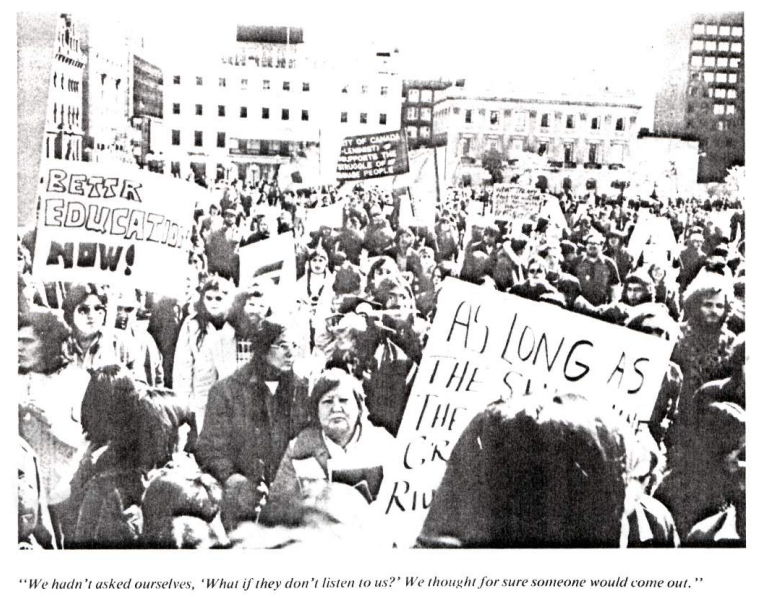
The following images from newspapers at the time:

The Manifesto of the Native Peoples Caravan:

1 NPManifesto Following The Red Path 1979 HarperDownload
2 NPManifesto Following The Red Path 1979 HarperDownload
3 NPManifesto Following The Red Path 1979 HarperDownload
4 NPManifesto Following The Red Path 1979 HarperDownload

DECLARATION OF THE INDIAN CHIEFS IN THE SOUTHERN INTERIOR OF BC

01 Friday Mar 2024

Posted by Admin in aboriginal title, Indigenous Declarations

≈ Leave a comment

July 16, 1910

Chiefs from the Southern Interior met at Spences Bridge in 1910, to study the demands of the Indian Rights Association of BC. The Interior Chiefs decided to affiliate with the coast Indian Rights Association and stand with them to demand certain rights for Indian people and a settlement of the land issue. But the Chiefs also understood how important it was for them to carefully define, and speak for, their own concerns. They had translator James Teit write it all down in point-by point form so it could be easily distributed. The points were made in the form of a declaration and dated the 16th day of July, 1910.

The DECLARATION OF THE INDIAN CHIEFS IN THE SOUTHERN INTERIOR OF BC begins:

To Whom It May Concern:

We, the underwritten Chiefs of Indian Bands in the Southern Interior of British Columbia, hereby make known our position in regard to the question of Indian rights, and the policy of the Indian Rights Association of BC, as follows:

First, we stand for treaty rights with the dominion government, the same as all the Indian tribes in the other provinces of Canada, and that all matters of present importance to the people of each of our tribes be subject to these treaties, so that we shall have a definite understanding regarding lands, water, timber, game, fish, etc., and we consider such matters as schools, doctors, aid to the aged, Indian funds, etc., and general assistance by the government should also be included in these treaties.

Second, we stand for compensation to us by the British Columbia government for all lands of ours appropriated, or held by them, including all lands preempted or bought by settlers, miners, lumbermen, etc.

Third, we stand for the enlargement of our reservations wherever we consider it necessary, by having a sufficiency of land allotted to us so as to enable us to compete on better terms with whites in the way of making a living.

Fourth, we stand for the obtaining of a permanent and secure title (to be acknowledged by the government as such) of our ownership of our present reservations, and of such lands as may be added thereto.

Fifth, we stand for the carrying of our claims before the Privy Council of England for settlement, and in the event of our obtaining justice as we expect, we ask such compensation as may be awarded us for our lands, etc., shall be paid to us, half in cash, and the other half to be retained by the dominion government, and used as occasion may require for our benefit.

Sixth, we ask for and expect the dominion government to support us in our claims, and help us to obtain our rights to the best of their ability.

Seventh, we believe the Indian Rights Association of BC (which has been formed by other Indians of this country) has the same object and claims that we stand for, there- fore we declare our agreement with the members of the same, and our resolve to join them, and support them in the furtherance of our mutual interests, and the attainment of our rights.

Eighth, we believe that the Indian Rights Association of BC has hired Mr. Clark, K.C., of Toronto, to look after their interests and conduct their case in harmony with their desires, and those of the dominion government, and we hereby declare our agreement with this step, and our intention to support it financially and otherwise, as well as we are able.

02.24.2024 ~ Today is a great day for history!

24 Saturday Feb 2024

Posted by Admin in aboriginal title, BC treaty process, Children, Comprehensive Claims - Policy and Protest, Government Commissions, Indian Residential School, Indigenous Declarations, Non-Status Indian Era, Reconciliation, UN Engagement, Uncategorized, Union of BC Indian Chiefs

≈ Leave a comment

Tags

Archive Quarterly

Introducing:    Archive Quarterly

It’s The West Wasn’t Won’s own journal, like a news clipping service across the last two or three hundred years.

Did you know? This month marks a hundred years since the Allied Tribes of British Columbia petitioned to shut down the Indian Reserve Commission report.

If you didn’t, a subscription to Archive Quarterly will really help!

What was hidden from history is what’s needed now.

AQ shakes out the archives for primary sources on Indigenous land and British Columbia, sharing:

~ key extracts from archival artifacts

~ quotes and interviews on the issues as they were

~ relatable commentary and a few side-notes

~ images and timelines that connect past and present

The first April issue will be here in three weeks!

READ ON  for more info

TAKE A LINK  to the Archive Quarterly website to see more and click your Subscription

FOLLOW  AQ on Facebook  for updates 

Archive Quarterly is about it, the west wasn’t won!

BC history is lit from one side – showing settler progress to advantage, while rendering the Indigenous reality of that “progress” indiscernible.

This magazine aims to balance the view. As well as the written records, interviews with Elders reveal circumstances leading up to political movements, court actions and roadblocks, and conditions in their communities at the time.

Excerpts in the journal will be presented in full documents online, where they are accessible to download.

See the highlights from the first issues this year!

Get your subscription now and you can start sharing.

Print subscriptions will hit the mailboxes in the middle of March, and the first issue of AQ will be in bookstores before April.

When you buy a $44 print subscription, you’ll be the first to receive each issue by mail and get a digital copy in your inbox as well.

That’s right, Archive Quarterly comes out four times a year, in April, July, October, and January. It’s $15 in stores.

Digital subscriptions for the year are just $18, and you can share AQ with your contacts.

Subscribe to print or digital here: AQ Subscribe

You can also donate to AQ to become a founding sponsor – thanks!

Group and bulk print subs available, just drop us a line.

If you just can’t afford the subscription, get in touch and we’ll get you in.

By subscribing to AQ today, you’ll be helping to get work done.

Special Issues

Did you know? The ongoing denial of Aboriginal land title – and the tiny size of First Nations reserves – contributes directly to child apprehensions from young Aboriginal families. The situation can’t change without land to build on and live in.

Special Issues are on the way for AQ, focusing on Aboriginal Title, the Non-Status Indian era, Roadblocks, and more. The Special series dives deep and provides historical overviews and insight, and the development takes time and research and communications.

AQ’s online digital archive

It keeps growing, as old docs are scanned and processed and uploaded. The physical archive costs money for storage, and the digital archive costs money for web space.

The magazine comes out of a collection kept up by Electromagnetic Print – EMP, a book label founded to print voices seldom heard in the media, especially the voices of native sovereigntists.

Thank you very much for reading and have a great day!

Kerry Coast, Publisher

Electromagnetic Print

The Best Of All Titles – Gitwangat Chiefs, 1884

11 Monday Dec 2017

Posted by Admin in Indigenous Declarations

≈ Leave a comment

Tags

aboriginal rights, aboriginal title, Colonialism on Trial, Delgamuukw, Gitksan, Indigenous Peoples, Sovereignty

We would liken this district to an animal, and our village, which is situated in it, to its heart. Lorne Creek, which is almost at one end of it, may be likened to one of the animal’s feet.

We feel that the whitemen, by occupying this creek, are, as it were, cutting off a foot. We know that an animal may live without one foot, or even without both feet; but we also know that every such loss renders him more helpless, and we have no wish to remain inactive until we are almost or quite helpless

We have carefully abstained from molesting the whiteman during the past summer. We felt that, though we were being wronged and robbed, as we had not given you the time nor opportunity to help us, it would not be right for us to take the matter into our own hands. Now we bring the matter before you, and respectfully call upon you to prevent the inroads of any whiteman upon the land within the fore-named district.

In making this claim, we would appeal to your sense of justice and right. We would remind you that it is the duty of the Government to uphold the just claims of all peaceable and law-abiding persons such as we have proved ourselves to be. We hold these lands by the best of all titles. We have received them as the gift of the Creator to our Grandmothers and Grandfathers, and we believe that we cannot be deprived of them by anything short of direct injustice.

In conclusion, we would ask you, would it be right for our Chiefs to give licenses to members of the tribe to go to the district of Victoria to measure out, occupy, and build upon lands in that district now held by whitemen as grazing or pasture land? Would the whitemen now in possession permit it, even if we told them that, as we were going to make a more profitable use of the land, they had no right to interfere? Would the Government permit it? Would they not at once interfere and drive us out? If it would not be right for us so to act, how can it be right for the whiteman to act so to us?

—Gitwangak Chiefs, 1884

As copied from the book, Colonialism on Trial: Indigenous land rights and the Gitksan and Wet’suwet’en sovereignty case, New Society Publishers, 1992

Image: Delgamuukw as he was in 1987, Albert Tait

STATEMENT OF THE NISHGA NATION OR TRIBE OF INDIANS. 1913

09 Sunday Jul 2017

Posted by Admin in Indigenous Declarations

≈ Leave a comment

Tags

Land claims, Naas, Nisga'a, Nishga

From time immemorial the Nishga Nation or Tribe of Indians possessed, occupied and used the territory generally known as the Valley of the Naas River, the boundaries of which are well defined. The claims which we make in respect of this territory are clear and simple. We lay claim to the rights of men. We claim to be aboriginal inhabitants of this country and to have rights as such. We claim that our aboriginal rights have been guaranteed by Proclamation of King George Third and recognized by Acts of the Parliament of Great Britain. We claim that holding under the words of that Proclamation a tribal ownership of the territory, we should be dealt with in accordance with its provision, and that no part of our lands should be taken from us or in any way disposed of until the same has been purchased by the Crown. By reason of our aboriginal rights above stated, we claim tribal ownership of all fisheries and other natural resources pertaining to the territory above-mentioned.

For more than twenty-five years, being convinced that the recognition of our aboriginal rights would be of very great material advantage to us and would open the way for the intellectual, social and industrial advance of our people, we have, in common with other tribes of British Columbia, actively pressed our claims upon the Governments concerned. In recent years, being more than ever convinced of the advantages to be derived from such recognition and fearing that without such the advance of settlement would endanger our whole future, we have pressed these claims with greatly increased earnestness.

Some of the advantages to be derived from establishing our aboriginal rights are

  1. That it will place us in a position to reserve for own use and benefit such portions of our territory as are required for the future well-being of our people.
  2. That it will enable us to a much greater extent and in a free and independent manner to make use of the fisheries and other natural resources pertaining to our territory.
  3. That it will open the way for bringing to an end as rapidly as possible the system of Reserves and substituting a system of individual ownership.
  4. That it will open the way for putting an end to all uncertainty and unrest, bringing about a permanent and satisfactory settlement between the white people and ourselves, and thus removing the danger of serious trouble which now undoubtedly exists.
  5. That it will open the way for our taking our place as not only loyal British subjects but also Canadian citizens, as for many years we have desired to do.

In thus seeking to realize what is highest and best for our people, we have encountered a very serious difficulty in the attitude which has been assumed by the Government of British Columbia. That Government has neglected and refused to recognize our claims, and for many years has been selling over our heads large tracts of our lands. We claim that every such transaction entered into in respect of any part of these lands under the assumed authority of the Provincial Land Act has been entered into in violation of the Proclamation above mentioned. These transactions have been entered into notwithstanding our protests, oral and written, presented to the Government of British Columbia, surveyors employed by that Government and intending purchasers.

The request of the Indian Tribes of British Columbia made through their Provincial Organization, that the matter of Indian title be submitted to the Judicial Committee of His Majesty’s Privy Council, having been before the Imperial Government and the Canadian Government for three years, and grave constitutional difficulties arising from the refusal of British Columbia to consent to a reference, having been encountered in dealing with that request, we resolved independently and directly to place a petition before His Majesty’s Privy Council. In following that course we desire to act to the fullest possible extent in harmony both with other tribes of British Columbia and with the Government of Canada.

We are informed that Mr. J. A. J. McKenna sent out by the Government of Canada has made a report in which he does not mention the claims which the Indians of the Province have been making for so many years, and assigns as the cause of all the trouble, the reversionary claim of the Province. Whatever other things Mr. McKenna found out during his stay, we are sure that he did not find out our mind or the real cause of the trouble. We are also informed of the agreement relating only to the so-called reserves which was entered into by Mr. McKenna and Premier McBride. We are glad from its provisions to know that the Province has expressed willingness to abandon to a large extent the reversionary claim which has been made. We cannot, however, regard that agreement as forming a possible basis for settling the land question. We cannot concede that the two Governments have power by the agreement in question or any other agreement to dispose of the so-called Reserves or any other lands of British Columbia, until the territory of each nation or tribe has been purchased by the Crown as required by the Proclamation of King George Third.

We are also informed that in the course of recent negotiations, the Government of British Columbia has contended that under the terms of Union the Dominion of Canada is responsible for making treaties with the Indian Tribes in settlement of their claims. This attempt to shift responsibility to Canada and by doing so render it more difficult for us to establish our rights, seems to us utterly unfair and unjustifiable. We cannot prevent the Province from persisting in this attempt, but we can and do respectfully declare that we intend to persist in making our claim against the Province of British Columbia for the following among other reasons:

  1. We are advised that at the time of Confederation all lands embraced within our territory became the property of the province subject to any interest other than that of the province therein.
  2. We have for a long time known that in 1875 the Department of Justice of Canada reported that the Indian Tribes of British Columbia are entitled to an interest in the lands of the province.
  3. Notwithstanding the report then made and the position in accordance with that report consistently taken by every representative of Canada from the time of Lord Dufferin’s speeches until the spring of the present year, and in defiance of our frequent protests, the Province has sold a large proportion of the best lands of our territory and has by means of such wrongful sales received a large amount of money.
  4. While we claim the right to be compensated for those portions of our territory which we may agree to surrender, we claim as even more important the right to reserve other portions permanently for our own use and benefit, and beyond doubt the portions which we would desire so to reserve would include much of the land which has been sold by the Province.

We are not opposed to the coming of the white people into our territory provided this be carried out justly and in accordance with the British principles embodied in the Royal Proclamation. If, therefore, as we expect, the aboriginal rights which we claim should be established by the decision of His Majesty’s Privy Council, we would be prepared to take a moderate and reasonable position. In that event, while claiming the right to decide for ourselves the terms upon which we would deal with our territory, we would be willing that all matters outstanding between the Province and ourselves should be finally adjusted by some equitable method to be agreed upon which should include representation of the Indian Tribes upon any Commission which then might be appointed.

The above statement was unanimously adopted at a meeting of the Nishga Nation or Tribe of Indians held at Kincolith on the 22nd day of January, 1913, and it was resolved that a copy of same be placed in the hands of each of the following:—The Secretary of State for the Colonies, the Prime Minister of Canada, the Minister of Indian Affairs, the Minister of Justice, Mr. J. M. Clark, K.C., Counsel for the Indian Rights Association of British Columbia, and the Chair-man of the ” Friends of the Indians of British Columbia.”

  1. J. LINCOLN, Chairman of Meeting.

Xwe-Nal-Mewx Declaration, 1988

28 Saturday Jan 2017

Posted by Admin in Indigenous Declarations

≈ Leave a comment

Tags

aboriginal title, Coast Salish, Declaration, Sovereignty, Xwe Nal Mewx

Also called, Coast Salish Declaration

Begins:

“We know the Creator put us here. We know our Creator gave us laws that govern all our relationships to live in harmony with nature and mankind; defined our rights and responsibilities.

“We have the right to govern ourselves and the right to self-determination. Our rights and responsibilities cannot be altered or taken away by any other nation.

“We have our spiritual beliefs, our languages, our culture, and a place on Mother Earth which provides us with all our needs.

“We have maintained our freedom since time immemorial. …We declare and affirm to the people that… the Xwe-Nal-Mewx have held and till hold title to all lands, waters and resources within our traditional territories. ….”

Full text: xwe-nal-mewx-declaration-coast-salish

Musqueam Declaration 1976

05 Thursday Jan 2017

Posted by Admin in Indigenous Declarations

≈ Leave a comment

musqueam-declaration-1976-low-resolution


Declaration of the Tahltan Tribe, 1910 

07 Wednesday Dec 2016

Posted by Admin in Indigenous Declarations

≈ Leave a comment

Tags

aboriginal rights, aboriginal title, Land claims, Sovereignty

We, the undersigned members of the Tahltan tribe, speaking for ourselves, and our entire tribe, hereby make known to all whom it may concern, that we have heard of the Indian Rights movement among the Indian tribes of the Coast, and of the southern interior of B.C.. Also we have read the Declaration made by the chiefs of the southern interior tribes at Spences Bridge on the 16th July last, and we hereby declare our complete agreement with the demands of same, and with the position taken by the said chiefs, and their people on all the questions stated in the said Declaration, and we furthermore make known that it is our desire and intention to join with them in the fight for our mutual rights, and that we will assist in the furtherance of this object in every way we can, until such time as all these matters of moment to us are finally settled. We further declare as follows:—

Firstly—We claim the sovereign right to all the country of our tribe—this country of ours which we have held intact from the encroachments of other tribes, from time immemorial, at the cost of our own blood. We have done this because our lives depended on our country. We have never treated with them, nor given them any such title. (We have only very lately learned the B.C. government makes this claim, and that it has for long considered as its property all the territories of the Indian tribes in B.C.)

Secondly--We desire that a part of our country, consisting of one or more large areas (to be erected by us),be retained by us for our own use, said lands and all thereon to be acknowledged by the government as our absolute property. The rest of our tribal land we are willing to relinquish to the B.C. government for adequate compensation.

Thirdly—We wish it known that a small portion of our lands at the mouth of the Tahltan river, was set apart a few years ago by Mr. Vowell as an Indian reservation. These few acres are the only reservation made for our tribe. We may state we never applied for the reservation of this piece of land, and we had no knowledge why the government set it apart for us, nor do we know exactly yet.

Fourthly–-We desire that all questions regarding our lands, hunting, fishing, etc., and every matter concerning our welfare, be settled by treaty between us and the Dominion and B.C. governments.

Fifthly—We are of the opinion it will be better for ourselves, also better for the governments and all concerned, if these treaties are made with us at a very early date, so all friction, and misunderstanding between us and the whites may be avoided, for we hear lately much talk of white settlement in the region, and the building of railways, etc., in the near future.


Signed at Telegraph Creek, B.C., this eighteenth day of October, nineteen hundred and ten, by

Nanok, Chief of the Tahltans

Nastulta, alias Little Jackson

George Assadza, Kenetl, alias Big Jackson

and eighty other members of the tribe

North American Indian Nation Government, 1945

06 Tuesday Dec 2016

Posted by Admin in Indigenous Declarations

≈ Leave a comment

The Second Session, held in Detroit Michigan, USA, at the Wolverine Hotel, September 1947

north-american-indian-government-2nd-session-1947-from-ubcic-archive

Excerpt, first paragraphs:

This National Indian Government which did not exist since 1763 has re-established in June 21, 1945, a great meeting was held at the Chateau Laurier in the City of Ottawa, Canada.

All the delegates who did attend the meeting at that time, they have all discussed their situation so, when they all realized that the Federal Government do not treat the Indian population with justice then they all decided to approve a National Indian Government established by the Indian and for the Indian, immediately they all voted for a new Indian Constitution act, right there the Indian Government was re-established…

…all the delegates present at that time did approve the first Indian law book to interest all the Indian people to read and learn what this National Indian Government expects to do for his people in the future.

At the Second Session, the following were elected:

Supreme Chief: Bernard Commanda, Nipissing Lake

Assistant Supreme Chief: John Chabot, Maniwaki Band

Secretary-Treasurer: Jules Sioui, Lorette Band

Assistant Secretary-Treasurer: Silver Star (E. Matteson), Pontiac Branch Band

Article 1. The Indian language has to be taught in the school by the teacher to safeguard the National Indian language(s).

1.A. Chief and Council of each Band has to govern the school, the teacher, and anything else that may pertain to the education of their children.

Note the report of the meeting was published in English and French in a single volume.

Oweekeno-Kitasoo-Nuxalk Tribal Council: re. land claim settlements

06 Tuesday Dec 2016

Posted by Admin in BC treaty process, Indigenous Declarations

≈ Leave a comment

Tags

Canada, Land claims

Delivered to the First Nations Summit meeting in Vancouver, February 4, 1991. (Note – The First Nations Summit is the party representing Indigenous parties to the BC Treaty Commission.)

oweekeno-kitasoo-nuxalk-re-land-claim-settlement-to-fns-meeting-feb-4-1991

Excerpt:

In the beginning the Creator bestowed upon our forefathers all the lands, waters, air and all its natural resources. This is a fact we all know as it has been handed down to us for generations and generations. With the blessings of the Creator, which today we now call Aboriginal Title and Rights, our First Nations cultivated our tribal territories in harmony with nature and perpetually sustained all natural resources and our peoples through good government, peace and order. Before we talk about land claims today, let us all stand so that we may share with you a few words with the Creator…

… When we talk about land claims we must never forget that the Creator provided all our First Nations with tribal territories adjacent to each other.

… Today, because the leaders of both the Governments of Canada and British Columbia, who we will call the “Crown”, want to totally eliminate our claim to traditional tribal territories, there are efforts made that appear to be dealing with the resolution of land claims, self-government and whatever other “aboriginal title and right” the First Nations claim to still hold. We must not forget the fact that our ancestors gained international recognition that the Crown must gain the consent of the First Nations if they want to take our traditional tribal territories. We must not forget the fact that the Crown, in spite of treaties with many First Nations throughout Canada, have consistently imposed cultural genocide policies and practices on all our First Nations. It is these two key facts that prove the Crown is still trying to eliminate our claim to traditional tribal territories while appearing to try to resolve the Indian problem.

If the Crown is serious and sincere about resolving the land claims question with all our First Nations, then it must consider the following recommendations:

← Older posts

Subscribe

  • Entries (RSS)
  • Comments (RSS)

Archives

  • December 2025
  • October 2025
  • June 2025
  • May 2025
  • February 2025
  • September 2024
  • August 2024
  • July 2024
  • April 2024
  • March 2024
  • February 2024
  • September 2023
  • August 2023
  • June 2023
  • June 2018
  • December 2017
  • July 2017
  • January 2017
  • December 2016
  • July 2015
  • March 2015
  • February 2015
  • January 2015
  • December 2014
  • September 2014

Categories

  • Archive Quarterly
  • BC treaty process
  • Children
  • Commentary, editorial
    • Uncategorized
  • Comprehensive Claims – Policy and Protest
    • aboriginal title
  • Government Commissions
  • Gustafsen Lake Standoff 1995 – Ts'peten Defense, Secwepemc
  • Haida title
  • Indian Residential School
  • Indigenous Declarations
  • Non-Status Indian Era
  • Reconciliation
  • Roadblock
  • UN Engagement
  • Union of BC Indian Chiefs

Meta

  • Create account
  • Log in

Blog at WordPress.com.

  • Subscribe Subscribed
    • The West Wasn't Won
    • Already have a WordPress.com account? Log in now.
    • The West Wasn't Won
    • Subscribe Subscribed
    • Sign up
    • Log in
    • Report this content
    • View site in Reader
    • Manage subscriptions
    • Collapse this bar
 

Loading Comments...