• About The West Wasn’t Won archive project
  • Archive Quarterly
  • Children
  • Fisheries
  • Land of the Peoples
  • Lawfare
  • Non-Status Era
  • Roadblocks and Restitution
    • Gustafsen Lake
    • Haida
    • Líl’wat
    • Nisga’a

The West Wasn't Won

~ Outlive the colonial world.

The West Wasn't Won

Category Archives: Indigenous Declarations

Nuxalk Nation Position 1995

05 Monday Jan 2015

Posted by Admin in Indigenous Declarations

≈ 1 Comment

Tags

aboriginal rights, aboriginal title, Canadian Charter, House of Smayusta, INTERFOR, Ista, Nuxalk, Royal Proclamation 1763, Sovereignty

Nuxalk Nation Position

September 10, 1995

First of all we, the Nuxalk Nation, would like to acknowledge Tatau, The Creator, through Manakays, the Great Spirit, for all that he has provided since the beginning of time and still provides today.

We, the Nuxalk Nation, stand in the position of sovereignty against International Forest Products (INTERFOR). We cannot and will never as the Nuxalk Nation compromise this position.

The Sovereignty of the Nuxalk Nation comes from Tatau, the Creator. It is not granted nor subject to the approval of any other nation. As the Nuxalk Nation we have the sovereign right to jurisdictional rule within our own territory. Our lands are a sacred gift. The land is provided for the continued use, benefit and enjoyment of our people, the Nuxalkmc, and it is our ultimate obligation to Tatau, the Creator, to care for and protect it.

INTERFOR has continually raped our lands and continues to do so today! Our old villages, hunting grounds, fishing grounds, grave sites and sacred areas are being destroyed. Our fish and animals that we need to feed our peoples are disappearing. Our food plants, medicinal plants and trees are being trampled on and destroyed, all for the corporate value of the lumber.

We, the Nuxalk Nation, take this stand today and forever to state: “That we are appalled at what INTERFOR has done and is still doing today, to our Nuxalkmc Territory. We have never nor will we ever give our consent to INTERFOR or any other corporation to develop within our territory.

“Our territory is ours, the Nuxalkmc, and we have never ceded it to the Canadian or B.C. provincial government.

“Our nation is not interested in entering into any treaties (B.C. Treaty Commission), agreements or any sort of arrangement with the Canadian government or the British Columbia government concerning our Nuxalk Nation hereditary rights and title.”

The power that these two governments claim to have over our territory is an illegal power within their own jurisdiction as shown in the Constitution which reflects to the Royal Proclamation of 1763.

The following section is from the Canadian Charter of Rights and Freedoms to remind you that the Royal Proclamation is still legal and binding.

CANADIAN CHARTER OF RIGHTS AND FREEDOMS

Whereas Canada is founded upon principles that recognize the supremacy of God and the rule of law:

Guarantee of Rights and Freedoms….

General

  1. The guarantee in this Charter of certain rights and freedoms shall not be construed so as to abrogate or derogate from any aboriginal, treaty or other rights or freedoms that pertain to the aboriginal people of Canada including
  2. a) any rights or freedoms that have been recognized by the Royal Proclamation of October 7, 1763; and
  3. b) any rights or freedoms that now exist by way of land claim agreements or may be so acquired.

The following section is recited from the Royal Proclamation of October 7, 1763:

The Royal Proclamation of October 7, 1763, (by the King, A proclamation, George R)

And whereas it is just and reasonable, and essential to Our Interest and the Security of Our Colonies, that the several Nations or Tribes of Indians, with whom We are connected, and who live under Our Protection, should not be molested or disturbed in the Possession of such Parts of Our Dominions and Territories as, not having been ceded to, or purchased by Us, are reserved to them, or any of them, as their Hunting Grounds;

… beyond the Heads or Sources of any of the Rivers which fall into the Atlantick Ocean from the West and North-West, or upon any Lands whatever, which, not having been ceded to, or purchased by Us as aforesaid, are reserved to the said Indians, or any of them. And

…lying to the Westward of the Sources of the Rivers which fall into the Sea from the West and North West, as aforesaid; and We do hereby strictly forbid, …Our loving Subjects from making any Purchases or Settlements whatever, or taking Possession of any of the Lands above reserved, without Our especial Leave and Licence for that Purpose first obtained. And We …strictly …require all Persons… who have either wilfully or inadvertently seated themselves upon … Lands, which, not having been ceded to, or purchased by Us, are still reserved to the said Indians as aforesaid, forthwith to remove themselves from such Settlements.

… if, at any Time, any of the said Indians should be inclined to dispose of the said Lands, that same shall be purchased only for Us, in Our Name, at some publick Meeting or Assembly of the said Indians to be held for that Purpose by the Governor or Commander in Chief of Our Colonies  … and in case they shall lie within the Limits of any Proprietary Government, they shall be purchased only for the Use and in the Name of such Proprietaries, conformable to such Directions and Instructions as We or they shall think proper to give for that Purpose…

The sovereign Nuxalk Nation Chiefs have given INTERFOR notice that they are trespassing on Nuxalk Nation Territory that has never been sold or ceded, and that the Canadian court system has no jurisdiction over our territory. This is also to serve notice that we do not recognize any court injunctions served to any Nuxalkmc or to our guests (Forest Action Network) of the Nuxalk Nation invited into our traditional territory by our hereditary leadership.

So, with this, we, the Nuxalk Nation will do whatever we have to within our own traditional Nuxalk jurisdiction to stop INTERFOR from any development on our territory. We do this as our obligation to Tatau, the Creator, and also to ensure that our lands provided for our children, grandchildren and children yet unborn.

Way!

NUXALK STRONG NUXALK FOREVER

Signed:

Chief Nuximlayc (Lawrence Pootlass)

Chief Qwatsinas (Edward Moody)

Chief Liciwmutu7gayc (Taylor T)

Chief Slicxwliqw’ (Charles Nelson)

Chief Sats’alanlh (Peter Schooner)

…and others

House of Smayusta

PO Box 8, Bella Coola, V0T 1C0

Nuxalk Nation Position 1995 p.1Nuxalk Nation Position 1995 p.2Nuxalk Nation Position 1995 p.3

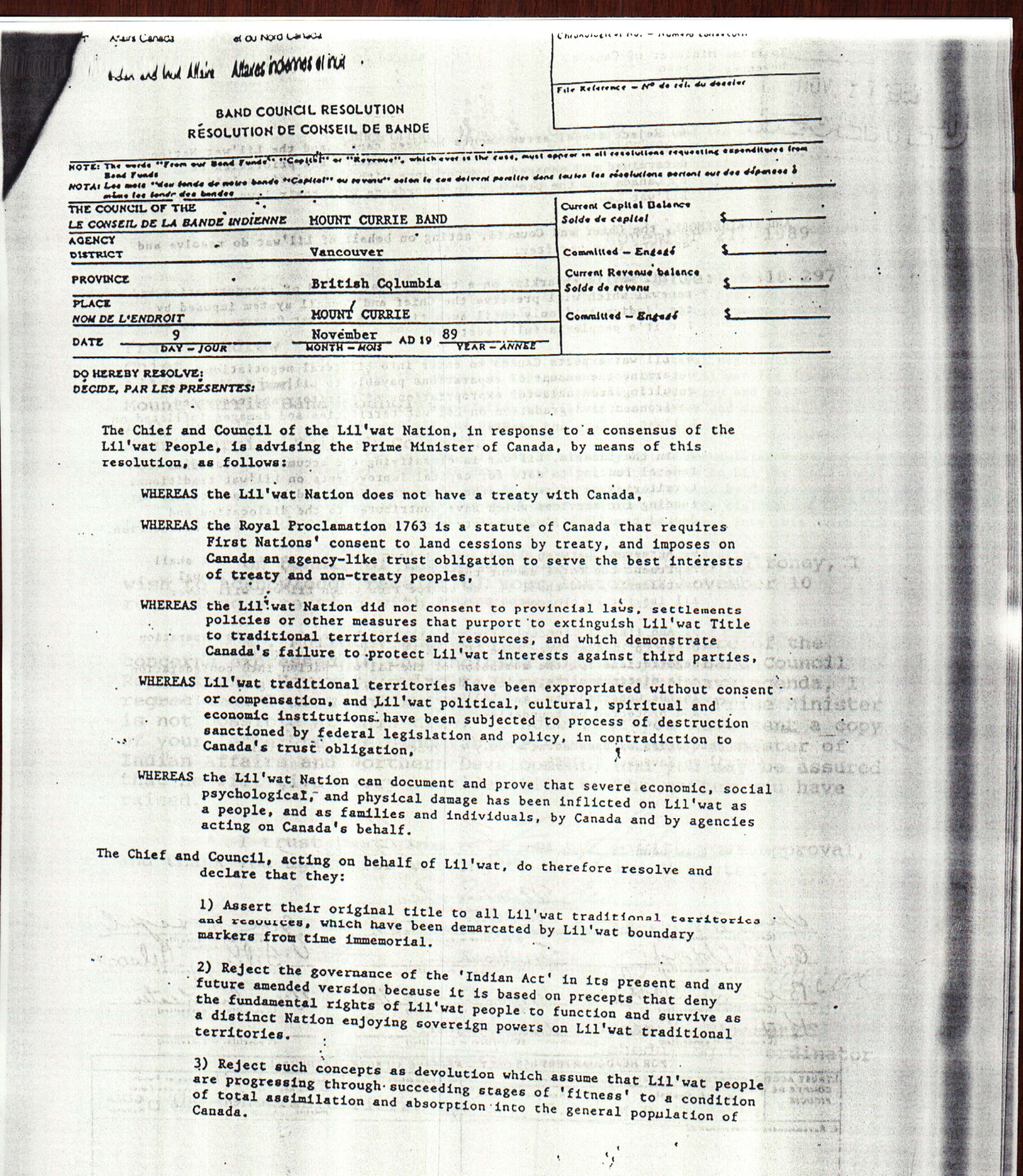
Lil’wat BCR 1989: to dissolve imposed ‘Indian Act’ band council

05 Monday Jan 2015

Posted by Admin in Indigenous Declarations

≈ 1 Comment

Tags

aboriginal rights, BCR, Canada, Canadian Constitution, Lil'wat

Band Council Resolution

The Council of the Mount Currie Band

Vancouver District

British Columbia

November 9, 1989

Do Hereby Resolve:

The Chief and Council of the Líl’wat Nation, in response to a consensus of the Líl’wat People, is advising the Prime Minister of Canada, by means of this resolution, as follows:

WHEREAS the Líl’wat Nation does not have a treaty with Canada,

WHEREAS the Royal Proclamation 1763 is a statute of Canada that requires First Nations’ consent to land cessions by treaty, and imposes on Canada an agency-like trust obligation to serve the best interests of treaty and non-treaty peoples,

WHEREAS the Líl’wat Nation did not consent to provincial laws, settlements, policies or other measures that purport to extinguish Líl’wat Title to traditional territories and resources, and which demonstrate Canada’s failure to protect Líl’wat interests against third parties,

WHEREAS Líl’wat traditional territories have been expropriated without consent or compensation, and Líl’wat political, cultural, spiritual and economic institutions have been subjected to process of destruction sanctioned by federal legislation and policy, in contradiction to Canada’s trust obligation,

WHEREAS the Líl’wat Nation can document and prove that severe economic, social, psychological, and physical damage has been inflicted on Líl’wat as a people, and as families and individuals, by Canada and by agencies acting on Canada’s behalf,

The Chief and Council, acting on behalf of Líl’wat, do therefore resolve and declare that they:

  • Assert their original title to all Líl’wat traditional territories and resources, which have been demarcated by Líl’wat boundary markers from time immemorial.
  • Reject the governance of the ‘Indian Act’ in its present and any future amended versions because it is based on precepts that deny the fundamental rights of Líl’wat people to function and survive as a distinct Nation enjoying sovereign powers on Líl’wat traditional territories.
  • Reject such concepts as devolution which assume the Líl’wat people are progressing through succeeding stages of ‘fitness’ to a condition of total assimilation and absorption into the general population of Canada.
  • Reject fiscal arrangements between Canada and the Líl’wat Nation which require that program design, standards and priorities be determined and managed in accordance with prescriptions laid down by Canada and the province in accordance with their laws, rather than Líl’wat laws.

AND FURTHERMORE, the Chief and Council, acting on behalf of Líl’wat do resolve and declare that hereafter:

  • Líl’wat is embarking on a transitional period of reconstruction and renewal which will preserve the Chief and Council system imposed by the ‘Indian Act’ only until such time as a Líl’wat Government by and for its people is fully restored.
  • Líl’wat expects Canada to enter into bilateral negotiations to determine the amount of reparations payable to Líl’wat for damages resulting from unlawful expropriations of territory and resources, environmental degradation on Líl’wat territories and damages inflicted on Líl’wat society and people.
  • In the interim, Líl’wat is classifying the accumulated value of federal funding to date for capital improvements on Líl’wat traditional territories as offsets to the reparation debt owed by Canada to Líl’wat. Funding for services which have contributed to the dislocation and degradation of Líl’wat society shall not be entered into this calculation.
  • Agreement between Canada and Líl’wat on a reparation amount shall represent the total amount that will be paid to Líl’wat in annual instalments, and shall be the source from which Líl’wat will cover all its future program costs.
  • And finally, concurrently with the discharge of Canada’s reparation debts to Líl’wat over time, Canada and Líl’wat will enter into negotiations for the admission of the Líl’wat Nation into confederation as a distinct society with a defined sphere of sovereignty entrenched in the Constitution, and Líl’wat territories permanently established and protected by boundaries.

This resolution was passed at a duly convened meeting of the Chief and Council on November 9, 1989.

A quorum of this Band is seven.

(Signed)

Chief Fraser Andrew

Councillors

Marie Leo

Vera Edmonds

Cecil M. Edmonds

Brian Lester

Katherine Wallace

Allan Stager

George Leo

Marvin Wells

Shirley Wallace

Joe Joseph

Felicity Nelson

Normaline Lester

MCIB BCR Nov 9 1989 - p 1MCIB BCR Nov 9 1989 - p 2

“ALL OUR RELATIONS” A DECLARATION OF THE SOVEREIGN INDIGENOUS NATIONS OF BRITISH COLUMBIA

05 Monday Jan 2015

Posted by Admin in Indigenous Declarations, Union of BC Indian Chiefs

≈ 1 Comment

Tags

aboriginal rights, aboriginal title, All Our Relations, Declaration, Indigenous Peoples, UBCIC

We, the Indigenous leaders of British Columbia, come together united and celebrate the victory of the Tsilhqot’in and Xeni Gwet’in peoples in securing recognition of their Aboriginal title and rights – and all those Indigenous Nations and individuals that have brought important court cases over the years resulting in significant contributions in the protection and advancement of Aboriginal title and rights, including the Nisga’a, Gitxsan, Wet’suwet’in, Haida, Taku River Tlingit, Musqueam, Heiltsuk and Sto:lo – shining light on the darkness of years of Crown denial of our title and rights. After pursuing different pathways, we now come together to make this solemn Declaration out of our common desire to be unified in affirming our Aboriginal title.

As the original Peoples to this land, we declare:

  • We have Aboriginal title and rights to our lands, waters and resources and that we will exercise our collective, sovereign and inherent authorities and jurisdictions over these lands, waters and resources,
  • We respect, honour and are sustained by the values, teachings and laws passed to us by our ancestors for governing ourselves, our lands, waters and resources.
  • We have the right to manage and benefit from the wealth of our territories.
  • We have the inalienable sovereign right of self-determination. By virtue of this right, we are free to determine our political status and free to pursue our economic, social, health and well-being, and cultural development.
  • We have diverse cultures, founded on the ways of life, traditions and values of our ancestors, which include systems of governance, law and social organization.
  • We have the right to compensation and redress with regard to our territories, lands and resources which have been confiscated, taken, occupied, used or damaged without our free, prior and informed consent.
  • We will only negotiate on the basis of a full and complete recognition of the existence of our title and rights throughout our entire lands, waters, territories and resources.
  • We acknowledge the interdependence we have with one another and respectfully honour our commitment with one another where we share lands, waters and resources. We commit to resolving these shared lands, waters and resources based on our historical relationship through ceremonies and reconciliation agreements.
  • We endorse the provisions of the UN Declaration on the Rights of Indigenous Peoples and other international standards aimed at ensuring the dignity, survival and well-being of Indigenous peoples.

We commit to:

  • Stand united today and from this time forward with the Tsilhqot’in and with each other in protecting our Aboriginal title and rights.
  • Recognize and respect each other’s autonomy and support each other in exercising our respective title, rights and jurisdiction in keeping with our continued interdependency.
  • Work together to defend and uphold this Declaration.

We, the undersigned, represent First Nations who carry a mandate to advance Title and Rights in our homelands today referred to as British Columbia and exercise our authorities in making this Declaration. We welcome other First Nations not present today to adhere to this Declaration if they so choose.

Signed by UBCIC Chiefs on November 29, 2007

Líl’wat Nation Declaration January 14, 1983

05 Monday Jan 2015

Posted by Admin in Indigenous Declarations

≈ 1 Comment

Tags

Canadian Constitution, Lil'wat

We, the People of the Líl’wat Nation declare that our land and rights as a Nation have never been relinquished by ourselves. The Creator placed us here on our land with the right to self-determination. The right to self-determination and the right to exist as a people is sacred in our way, and we believe we have that right.

Canada’s unilateral action in patriating its constitution without the consent of the Indian people and its blatant disregard of rights to self-determination of Indian People is regarded by the Líl’wat Nation as a bold and callus act against sovereign people.

To ensure the protection of our Lil’wat Nation against any aggressive action by another nation or infringement by any colonial power or government,

WE, THE LIL’WAT NATION THUS SHALL AND FOREVER MORENEVER AGREE TO ASSIGN OUR RIGHTS TO ANY PERSON OR COLONIAL POWER OF GOVERNMENT, THUS:

  1. We will not be invitees to a conference where our rights as a sovereign people is to be discussed. Our attending such a conference will be as equal participants.
  2. Lil’wat People’s participation must be full, equal and ongoing at all levels of discussion whether preparatory or otherwise.
  3. Our representation will be chosen by our people and not by anyone or by any other colonial power or government.
  4. No decision affecting Lil’wat Peoples’ rights shall be made withut first receiving our consent and bearing the Lil’wat Government’s seal.
  5. Lil’wat people will decide how our consent is to be given.

Signed by: Chief Leonard Andrew

Lil'wat delegation meeting with UN Special Rapporteur on the Rights of Indigenous Peoples, S. James Anaya, October 10, 2013, Musqueam.

Lil’wat delegation meeting with UN Special Rapporteur on the Rights of Indigenous Peoples, S. James Anaya, October 10, 2013, Musqueam.

Gitksan-Carrier (Wet’suwet’en) Declaration, 1977

01 Thursday Jan 2015

Posted by Admin in Indigenous Declarations

≈ 1 Comment

Tags

Carrier, Gitksan, Gitxsan, Nishga Declaration 1980, Wet'suwet'en

Since time immemorial, we. The Gitksan and Carrier People of Kitwanga, Kitseguecla, Gitanmaax, Sikadoak, Kispiox, Hagwilget and Moricetown, have exercised Sovereignty over our land. We have used and conserved the resources of our land with care and respect. We have governed ourselves. We have governed the land, the waters, the fish and the animals. This is written on our totem poles. It is recounted in our songs and dances. It is present in our language and in our spiritual beliefs. Our Sovereignty is our Culture.

Our Aboriginal Rights and Title to this Land have never been extinguished by treaty or by any agreement with the Crown. Gitksan and Carrier Sovereignty continue within these tribal areas.

We have suffered many injustices. In the past, the development schemes of public and private enterprise have seriously altered Indian life and culture. These developments have not included, in any meaningful way, our hopes, aspirations and needs.

The future must be different. The way of life of our people must be recognized, protected and fostered by the Governments of Canada and the Laws of Canada. Only then will we be able to participate fully in Canadian society.

We, the Gitksan and Carrier People, will continue to exercise our Sovereignty in the areas of Education, Social and Economic Development, Land Use and Conservation, Local and Regional Government.

We have waited one hundred years. We have been patient. Through serious negotiation, the basis for a meaningful and dignified relationship between the Gitksan and Carrier People and the Governments of Canada and of British Columbia will be determined. These negotiations require mutual and positive participation by the Federal Government and the Provincial Government.

Today, the Governments of Canada and British Columbia undertake a bold new journey to negotiate with the Gitksan and Carrier People. During this journey, we will fulfill the hopes and aspirations of our ancestors and the needs of future generations.

Let us begin negotiations.

Recognize our Sovereignty, recognize our rights, so that we may fully recognize yours.

Kispiox

November 7, 1977

Note: since this Declaration it has become usual to use the name “Wet’suwet’en” instead of “Carrier” in the case of the houses which allied with the Gitxsan in the Delgamuukw / Gisdayway court action.Gitxsan-Carrier Declaration

Carrier Sekani Declaration, 1982

01 Thursday Jan 2015

Posted by Admin in Indigenous Declarations

≈ 1 Comment

Tags

Carrier, Nishga Declaration 1980, Sekani

Carrier Sekani Declaration and Claim, 1982

April 15th, 1982

Whereas we of the Carrier and Sekani Tribes have been, since time immemorial, the original owners, occupants and users of the north central part of what is now called the province of British Columbia and more specifically that area of the said province outlined in red contained in the map attached hereto as schedule “A” [herein referred to as “the said lands”].

And whereas in addition to the original ownership, occupancy and use, we have exercised jurisdiction as a sovereign people over the said lands since time immemorial,

And whereas this original ownership, occupancy and use, and jurisdiction by our people over the said lands has never been surrendered by our people through conquest, treaty or any other legal means to the British Crown or to its colonial governments or to the Crown in right of the province of British Columbia or to the Crown in right of Canada or to any other government,

And whereas this original ownership, occupancy and use by our people, and jurisdiction over the said lands has never been superseded by law,

And whereas much of the said lands is, without our consent, now occupied and its resources used by peoples not indigenous to our lands,

And whereas such occupation and use by non indigenous people to the said lands is without compensation to our people,

We, the representatives of the Carrier and Sekani Tribes hereby declare and assert our continued original ownership, occupancy and use of, and jurisdiction over the said lands and all its resources,

And we further declare and assert the continued existence of those rights which flow from our original ownership, occupancy and use of, and the jurisdiction of the said lands and all its resources,

And further we hereby demand of the governments of Canada and British Columbia compensation for their past, present and proposed use and occupancy of our lands and all its resources.

Executive of the Carrier Sekani Tribal Council

Cowichan Petition, 1909

30 Tuesday Dec 2014

Posted by Admin in Indigenous Declarations

≈ 4 Comments

Tags

Arthur O'Meara, Charles Tate, Cowichan, Cowichan Petition full text, Privy Council

Cowichan Petition

March, 1909

Missionaries Charles Tate and Arthur O’Meara draft the Cowichan Petition on behalf of the Quw’utsun’ and present it to colonial authorities in London. The ten-page petition asserts Quw’utsun’ possession and occupation of their land since “time immemorial” and invokes the 1763 Royal Proclamation as a guarantee that these lands, not having been surrendered to the Crown, remain reserved for the Quw’utsun’. In doing so, the Quw’utsun’ regard the “Proclamation of their great father, King George III as the Charter of their rights.”

– UBCIC, Stolen Lands, Broken Promises. Chapter 1: Dispossession and Resistance in British Columbia.

Full Text of the Cowichan Petition:

The King’s Most Excellent Majesty:

The Humble Petition of the Cowichan Tribe of Indians in the Province of British Columbia in the Dominion of Canada one of Your Majesty’s Dominions Beyond the Seas.

SHOWETH:

  1. THAT from time immemorial the Cowichan Tribe of Indians have been the possessors and occupants of the territory including the Cowichan Valley containing a large area and situate within the Territorial limits of the said Province of British Columbia.
  2. The Indian title to said territory was always recognized by Your Majesty’s predecessors. This Indian Title was expressly recognized and affirmed by the Proclamation issued by Your Majesty’s predecessor King George III on the 7th of October, 1763. This proclamation ordained among other things as follows:

“And whereas it is just and reasonable, and essential to Our Interest and the Security of Our Colonies, that the several Nations or Tribes of Indians, with whom We are connected, and who live under Our Protection, should not be molested or disturbed in the Possession of such Parts of Our Dominions and Territories as, not having been ceded to, or purchased by Us, are reserved to them, or any of them, as their Hunting Grounds; We do therefore, with the Advice of Our Privy Council, declare it to be Our Royal Will and Pleasure, that no Governor or Commander in Chief in any of Our Colonies of Quebec, East Florida, or West Florida, do presume, upon any Pretence whatever, to grant Warrants of Survey, or pass any Patents for Lands beyond the Bounds of their respective Governments, as described in their Commissions; as also, that no Governor or Commander in Chief in any of Our other Colonies or Plantations in America, do presume, for the present, and until Our further Pleasure be known, to grant Warrants of Survey, or pass Patents for any Lands beyond the Heads or Sources of any of the Rivers which fall into the Atlantick Ocean from the West and North-West, or upon any Lands whatever, which, not having been ceded to, or purchased by Us as aforesaid, are reserved to the said Indians, or any of them.

“And We do further declare it to be Our Royal Will and Pleasure, for the present as aforesaid, to reserve under Our Sovereignty, Protection, and Dominion, for the Use of the said Indians, all the Lands and Territories not included within the Limits of Our said Three New Governments, or within the Limits of the Territory granted to the Hudson’s Bay Company, as also all the Lands and Territories lying to the Westward of the Sources of the Rivers which fall into the Sea from the West and North West, as aforesaid; and We do hereby strictly forbid, on Pain of Our Displeasure, all Our loving Subjects from making any Purchases or Settlements whatever, or taking Possession of any of the Lands above reserved, without Our especial Leave and Licence for that Purpose first obtained.

“And We do further strictly enjoin and require all Persons whatever, who have either wilfully or inadvertently seated themselves upon any Lands within the Countries above described, or upon any other Lands, which, not having been ceded to, or purchased by Us, are still reserved to the said Indians as aforesaid, forthwith to remove themselves from such Settlements.

“And whereas great Frauds and Abuses have been committed in the purchasing Lands of the Indians, to the great Prejudice of Our Interests, and to the great Dissatisfaction of the said Indians.

“In order therefore to prevent such Irregularities for the future, and to the End that the Indians may be convinced of Our Justice, and determined Resolution to remove all reasonable Cause of Discontent, We do, with the Advice of Our Privy Council, strictly enjoin and require, that no private Person do presume to make any Purchase from the said Indians of any Lands reserved to the said Indians, within those Parts of Our Colonies where We have thought proper to allow Settlement; but that if, at any Time, any of the said Indians should be inclined to dispose of the said Lands, that same shall be purchased only for Us, in Our Name, at some publick Meeting or Assembly of the said Indians to be held for that Purpose by the Governor or Commander in Chief of Our Colonies respectively, within which they shall lie.”

The lands belonging to and claimed by the said Cowichan Tribe as aforesaid were never ceded to or purchased by the Crown nor was the Indian title otherwise extinguished. These lands were not within the limits of the territory at the date of the said proclamation namely, 7th October, 1763, granted to the Hudson’s Bay Company.

The said lands were, therefore, within the terms of the said proclamation lands reserved for the said Indians.

The said Cowichan Tribe as well as all Indians in North America have always regarded the said Proclamation of their great father King George III as the Charter of their rights.

The proclamation was decided in the case of Campbell v. Hall, 1 Cowper 204, by Lord Mansfield, Chief Justice England, to have the effect and operation of a Statute of the Imperial Parliament.

Ever since the date of the said proclamation the Indians have continued to be the firm and faithful allies of the Crown and have rendered important military service especially in two wars, the war of the Revolution and that of 1812 and these services were expressly referred to in the judgment of Mr. Justice Strong in the St. Catharines Milling & Lumber Company v The Queen, 4 Cartwright page 137.

The title of the Indians is recognized in various Imperial Statutes relating to British Columbia before the Confederation of 1867 in which the lands in question are referred to as “Indian Territories.” This is also recognized by the fourteen Indian treaties made by Sir James Douglas as agent for the Hudson Bay Company which Treaties are set forth in the Sessional papers of British Columbia for 1876 at page 165 et seq. The same state of affairs is recognized in the correspondence between the Secretary of State for the Colonies and Sir James Douglas during the years 1858 to 1861. These are set forth in the said sessional papers at page 172 and following.

In a report made by the Indian Commissioners appointed by the Government of Canada dated 22nd January, 1844, and made while the Indian affairs of Canada were still under the direction of the Imperial Government the Indian Commissioners say “The subsequent proclamation of His Majesty George III issued in 1763 furnished them (the Indians) with a fresh guarantee for the possession of their hunting grounds and the protection of the Crown. This document the Indians look upon as their Charter. They have preserved a copy of it to the present time and have referred to it on several occasions in their representations to the Government.”

“Since 1763 the Government adhering to the Royal Proclamation of that year have not considered themselves entitled to dispossess the Indians of their lands without entering into an agreement with them and rendering them some compensation. For a considerable time after the conquest of Canada the whole of the Western part of the upper province with the exception of a few military posts on the frontier and a great extent of the eastern part was in their occupation. As the settlement of the country advanced and the land was required for new occupants rendered their removal desirable the British Government made successive agreements with them for the surrender of portions of their lands.”

The Indian title and rights were also fully recognized by the Legislature of Vancouver Island as shown by the petition of the House of Assembly of Vancouver Island referred to in the Sessional Papers of British Columbia 1876 page 179 et seq. And in reply to the said petition the Right Honourable the Secretary of State for the Colonies in his dispatch from Downing Street dated 19th October, 1861, says “I am fully sensible of the great importance of purchasing without loss of time the native title to the soil of Vancouver Island.”

In his judgment in the St. Catharine’s Milling case, 4 Cart, 181 Mr. Justice Gwynne quotes from a report made in 1856 by Royal Commissioners appointed to investigate the Indian Land question as follows: – “By the proclamation of 1763 territorial rights akin to those asserted by Sovereign Princes are recognized as belonging to the Indians, that is to say, that none of their land can be alienated except by Treaty made publicly between the Crown and them.”

At the time of the union of British Columbia with the Dominion of Canada section 109 of the British North America Act 1867 was incorporated in the terms of the union and expressly reserves and protect(s) the Indian title to the said lands.

The rights of your Petitioners in respect of said lands therefore at Confederation remained and still continue to be under the “sovereignty, protection and dominion” of Your Majesty by virtue of the said Proclamation of 7th October, 1763.

In the St. Catharines Milling and Lumber Company v The Queen, 14 Appeal Cases Pages 56 and 59 Lord Watson refers to the interest of the Indians in the land as a burden upon the estate of the Crown and an interest other than that of the Province in the same within the meaning of Section 109 of the British North America Act. It is contended therefore, that the Indian title to the said lands remains in full force and effect.

This Indian title was referred to in the address of Lord Dufferin Governor-General of Canada to the Legislative Assembly of British Columbia made on the 20th day of September, 1876.

“From my first arrival in Canada I have been very much pre-occupied with the condition of the Indians population in the Province. You must remember that the Indian population are not represented in Parliament and consequently that the Governor-General is bound to watch over their welfare with special solicitude. Now we must all admit that the condition of the Indian question in British Columbia is not satisfactory. Most unfortunately as I think there has been an initial error, ever since Sir James Douglas quitted office in the Government of British Columbia neglecting to recognize what is known as the Indian title. In Canada this has always been done: no Government whether Provincial or central has failed to acknowledge that the original title to the land existed in the Indian tribes and communities that hunted or wandered over them. Before we touch an acre we make a treaty with the Chiefs representing the bands we are dealing with, and having agreed upon and paid our stipulated price often times arrived at after a great deal of haggling and difficulty we enter into possession but not until then do we consider that we are entitled to deal with an acre. The result has been that in Canada our Indians are contented well affected to the white men and amenable to the laws and Government.”

The title of your Petitioners has been wrongfully repudiated and ignored by the Government of the Province of British Columbia.

By the Thirteenth Article of the terms of admission of British Columbia into Confederation it is provided “that the charge of the Indians and the trusteeship and management of the lands reserved for their use and benefit shall be assumed by the Dominion Government and a policy as liberal as that hitherto pursued by the British Columbia Government should be continued by the Dominion Government after union” and it was further provided “to carry out such policy tracts of land of such extent as it has hitherto been the practice of the British Columbia Government to appropriate for that purpose shall from time to time be conveyed from the local to the Dominion Government in trust for the use and benefit of the Indians on application of the Dominion Government: and in case of disagreement between the two Governments respecting the quantity of such tracts of land to be so granted the matter shall be referred for the decision of the Secretary of State for the Colonies.”

The Dominion Government endeavoured to have such reserves set aside but did not succeed in so doing and such reserves have not up to the present time been conveyed by the Provincial Government to the Dominion Government.

In a Memorandum dated the 2nd day of November, 1874, and approved by his Excellency the Governor-General on the 4th of November, 1874, the Minister of the Interior says “The undersigned would respectfully recommend that the Government of the Dominion should make an earnest appeal to the Government of British Columbia if they value the peace and prosperity of their Province – if they desire that Canada as a whole should retain the high character she has earned for herself by her just and honourable treatment of the red men of the forest to reconsider in a spirit of wisdom and patriotism the land grievances of which the Indians of that Province complain apparently with good reason and take such measures as may be necessary promptly and effectually to redress them.”

Up to the present time this appeal has been unsuccessful.

In the report of the Deputy Superintendent of Indian affairs 31st December, 1877, referring to British Columbia he says “The non-recognition in some instances by the Provincial Government of the title of the Indians to land occupied by them has for some time agitated the minds of the Indians of this province. Some of these lands have already been and others are being sold without reference to the Indian title thereto. Unless the equitable claims of the Indians in respect to the lands in question are recognized and met in a liberal spirit serious trouble may be the result.”

The memorandum of the Attorney-General of the province of British Columbia dated the 26th day of February, 1907, and approved by the Executive Council on the 28th of February, 1907, (included in the papers and correspondence between the Government of Canada and the Government of British Columbia) comprised in a return called for by the House of Commons on January 28th, 1908, the British Columbia Government says that the Dominion Government holds no proprietary rights in the reserves and denied the power of the Dominion to deal even with the reserves. These propositions of the provincial Government were controverted by a report of the Committee of the Privy Council approved on the 19th day of December, 1907, and the Dominion Government stating that it was ready to facilitate the Government of the Province of British Columbia in any steps it may be advised to test the question before the Courts. Subsequently by Order-in-Council dated the 8th day of August, 1908, certain questions were submitted to the Supreme Court of British Columbia for hearing and consideration. These questions do not include the question of the Indian title but the frame of the question submitted substantially amounts to a repudiation of your petitioners’ title and rights.

On the argument of the said questions before the Supreme Court of British Columbia the Dominion Government took no part. Your petitioners are informed that counsel for the Attorney-General on the said argument repudiated your petitioners’ title and stated that the St. Catharines case leaves little room for argument. In your petitioners’ view the judgment in that case is not applicable because the territory thee in dispute was acquired by Great Britain from France and in the second place because there the Indian title to lands in question had been surrendered to the Dominion by treaty and in consideration of substantial money payments and other advantages satisfactory to the Indians.

Your petitioners have waited patiently for long years in the hope and expectation that their rights would be recognized and justice done to them by the Government of British Columbia but have at length exhausted all other constitutional means known to them.

Your petitioners as a last resort appeal across the Seas to Your Majesty the fountain of Justice fully assured that Your Majesty in exercise of your Sovereignty and Dominion will protect your petitioners in their extremity.

YOUR PETITIONERS THEREFORE HUMBLY PRAY that steps be taken to protect the usufructuary right of your petitioners in all of the said lands, or, that in the alternative the whole question of the rights of the said Tribe be submitted to the Judicial Committee of the Privy Council for decision and determination.

AND YOUR PETITIONERS WILL EVER PRAY

March, 1909

British Seal of Agreement between the Crown and the Chiefs of the Interior of BC:  "As Long As the Sun Shines and the Three Rivers Flow..." the British will keep the peace with the peoples of these lands. Note that the arms have since been reversed, to place the Union Jack on top of the sun and rivers.

British Seal of Agreement between the Crown and the Chiefs of the Interior of BC: “As Long As the Sun Shines and the Three Rivers Flow…” the British will keep the peace with the peoples of these lands. Note that the arms have since been reversed, to place the Union Jack on top of the sun and rivers.

Declaration of Secwepemc Sovereignty, 1983

30 Tuesday Dec 2014

Posted by Admin in Indigenous Declarations

≈ 1 Comment

Tags

Secwepemc, Shuswap, Sovereignty

Secwepemc Chiefs and Representatives, collectively the only spokespersons for Secwepemc, declare that on this day, January 17, 1983, that we reaffirm our sovereignty over our traditional territory.

We follow the path of our Elders and our Forefathers in standing firm for our sovereignty over our territory so that the future generations of our children will also have what has been handed down to us by our Creator. Today through this Declaration we ensure that Secwepemc sovereignty over our territory comes from the past, to the present and forever on into the future.

We have governed, managed, controlled, developed, protected and defended our territory since time immemorial. We have never abandoned our territory or sold it. We have never conceded our sovereignty by agreement or by conquest to any other nation.

We declare our sovereignty over all our lands, waters, air and all their resources in the Interior of what is now known as British Columbia, the land generally speaking that lays between latitude 50degrees, 30 minutes and 53degrees north, from the Fraser River area to the Rocky Mountains.

We will work arm in arm with Secwepemc and other peoples who are willing to support our mandate which is to affirm our sovereignty over our traditional territory.

We, Secwepemc, will work towards self-reliance on the basis of co-operation.

We declare our support in the struggle for self-determination and independence of Indigenous and Third World Nations.

Nishga Declaration 1980

29 Monday Dec 2014

Posted by Admin in Indigenous Declarations

≈ 1 Comment

Tags

Naas, Nisga'a, Nishga, Nishga Declaration 1980

Nishga Chief Gideon Minesque, c. 1915

Nishga Chief Gideon Minesque, c. 1915

The Nishga People is a distinct and unique society within the many faceted cultural mosaic that is Canada. The issue is whether the Nishga element within this mosaic will be allowed to face the ‘difficulties,’ will be allowed to become full participants contributing in a positive way to the well-being of the Naas Valley in particular and the country in general. The positive aspect of this participation, we feel, must be through self-determination, self-determination that is dependent on the shared and mutual responsibility of governments and Nishga People.

If Canadian Society and Nishga Society of which it is a part, is to be truly free, we as a distinct people and as citizens, must be allowed to face the difficulties and find the answers, answers that can only be found by determining our own social, economic and political participation in Canadian life. Governments, both Federal and Provincial, must be persuaded that Nishga self-determination is the path that will lead to a fuller and richer life for Nishga People and all Canadians.

We, as Nishgas, are living in a world where dynamic initiatives must be taken to achieve self-determination especially in respect to the natural resources of the Naas Valley, in order to control our own process of development within the larger Canadian society and to make decisions that affect our lives and the lives of our children. We realize that our struggle for self-determination will be a difficult one, but we refuse to believe that it is vain, if governments and the Nishga People agree to their mutual responsibility for that growth and development. Nishga self-determination of resource development within the Naas Valley is the economic base that will allow for self-determination of the other aspects of modern 20th Century society that makes up this Canada of ours.

In 1969, Nishga Tribal Council agreed in principle with the “statement of the Government of Canada on Indian Policy,” in the face of strong opposition from other Native Peoples across the nation. That agreed principle was incorporated in the policy statement: “true equality presupposes that the Indian people have the right to full and equal participation in the cultural, social, economic and political life of Canada.” Such an agreement in principle, however, does not necessarily mean the acceptance of the steps to implement as suggested by the 1969 Policy Statement. Co-existent with the NTC agreement of the stated principle is also the NTC agreement with the Hawthorne Report, that “Indians should be regarded as Citizens Plus; in addition to the normal rights and duties of citizenship, Indians possess certain rights as charter members of the Canadian Community.”

Undergirding the whole of the above, is the demand that, as the inhabitants since time immemoriam of the Naas Valley, all plans for resource extraction and “development” must cease until aboriginal title is accepted by the Provincial Government. Also, we, the Nishga People, believe that both the Government of BC and the Government of Canada must be prepared to negotiate with the Nishgas on the basis that we, the Nishgas, are inseparable from our land; that it cannot be bought or sold in exchange for “extinguishing of title.”

Conclusion

What we seek is the right to survive as a People and a Culture. This, we believe, can only be accomplished through free, open-minded and just negotiations with the provincial and federal authorities, negotiations that are based on the understanding that self-determination is the ‘answer’ that government seeks to the ‘difficulties’ as they apply to the Nishga People.

Printed in “Citizens Plus – the Nishga people of the Naas River Valley in Northwestern British Columbia; Nishga Land is not for sale” Revised Edition, April, 1980. Published by the Nishga Tribal Council, New Aiyansh, BC, V0J 1A0, (604) 633 2215. Produced by Hugh McCullum, Project North, 154 Glenrose Ave., Toronto, Ontario, M4T 1K8, (416) 481 3574. 

Elders Position Okanagan Nation, 1981

29 Monday Dec 2014

Posted by Admin in Indigenous Declarations

≈ 1 Comment

Tags

Elders' Position, Okanagan

  1. The Okanagan Nation is a sovereign nation. This originates from the Creator when he placed us on this island in our territory. We were given instructions under which our people have lived in health for nobody knows how many generations. Those instructions are explained in the teachings of Coyote. Our rights are contained in those teachings.
  2. Those are still our rights. Our sovereignty is still the same. The only one who can change that is the one who made it so. That is our understanding of aboriginal title and aboriginal rights.
  3. No other Nation in this world can give us what we already have. Our Nationhood and our sovereignty. When European Nations first encountered North America, there was an agreement signed by the King that obliged them to respect that. That agreement does not set out our sovereignty or our rights. All it does is establish the white peoples’ rights in the territories of the various Indian nations. We already have our rights. The white people need to define what they are doing in our country and how they will act toward our people. That is the basis of treaty-making. It defines white peoples’ rights that we will allow them to have.
  4. When the white people came to our territory there was an effort by the Queen’s representatives to establish white people’s rights that we would allow them to have in our territory. Our people agreed to define for them their rights so there would be no war. The Shuswap and Okanagan jointly agreed to stand together on what they would agree to, as far as what white people’s rights were to be.
  5. The agreement they reached was that white people could live in our territory as long as they in no way interfered with our people and the way our people lived. Four Chiefs representing the Okanagan and the Shuswap declared before the English Crown that we were a sovereign people and would always remain so within all of the practices handed down to us and that we would live in peace with the Crown’s children in certain campgrounds set out and marked by four corner posts. The other land which white people did not directly live on belongs to our people in all respects of how we practice our sovereignty. If anything was to be removed from the resources then they would have to buy that from us.
  6. That is the declaration that we make now. We cannot change what has been put in place by our Creator under the instructions of our Great Chief Coyote. We can in no way compromise that by being included within the Constitution of Canada or any other Nation of the world. We have declared this position at the United Nations Non-governmental Organization Conference in Geneva on Aboriginal Rights in September of 1981 and have documented it fully.

We are committed to maintain that before all the other Nations of the world and will pursue to strategize with any other Indian Nation that is committed to the same position. What we need to do now is to make a re-definition of white people’s rights because they have not respected the agreements our people defined for them to live in our territory in the first place. WE WILL NOT COMPROMISE BY BEING INCLUDED IN THE CANADIAN CONSTITUTION. We have to put them back in their place at whatever cost.

Reprinted from “Ka-Nata – a vision of social revolution’ magazine, Spring, 1982; ‘Voice of KANATA Anti-Imperialist Organizing Committee.”

← Older posts
Newer posts →

Subscribe

  • Entries (RSS)
  • Comments (RSS)

Archives

  • December 2025
  • October 2025
  • June 2025
  • May 2025
  • February 2025
  • September 2024
  • August 2024
  • July 2024
  • April 2024
  • March 2024
  • February 2024
  • September 2023
  • August 2023
  • June 2023
  • June 2018
  • December 2017
  • July 2017
  • January 2017
  • December 2016
  • July 2015
  • March 2015
  • February 2015
  • January 2015
  • December 2014
  • September 2014

Categories

  • Archive Quarterly
  • BC treaty process
  • Children
  • Commentary, editorial
    • Uncategorized
  • Comprehensive Claims – Policy and Protest
    • aboriginal title
  • Government Commissions
  • Gustafsen Lake Standoff 1995 – Ts'peten Defense, Secwepemc
  • Haida title
  • Indian Residential School
  • Indigenous Declarations
  • Non-Status Indian Era
  • Reconciliation
  • Roadblock
  • UN Engagement
  • Union of BC Indian Chiefs

Meta

  • Create account
  • Log in

Blog at WordPress.com.

  • Subscribe Subscribed
    • The West Wasn't Won
    • Already have a WordPress.com account? Log in now.
    • The West Wasn't Won
    • Subscribe Subscribed
    • Sign up
    • Log in
    • Report this content
    • View site in Reader
    • Manage subscriptions
    • Collapse this bar
 

Loading Comments...