• About The West Wasn’t Won archive project
  • Archive Quarterly
  • Children
  • Land of the Peoples
  • Lawfare
  • Non-Status Era
  • Roadblocks and Restitution
    • Gustafsen Lake
    • Haida
    • Líl’wat
    • Nisga’a

The West Wasn't Won

~ Outlive the colonial world.

The West Wasn't Won

Category Archives: Reconciliation

How did the National Day of Action become Canada’s “Aboriginal Day”?

19 Thursday Jun 2025

Posted by Admin in Reconciliation, Uncategorized

≈ Leave a comment

Tags

Aboriginal Day Canada, aboriginal title, Indigenous Peoples, National Day of Action

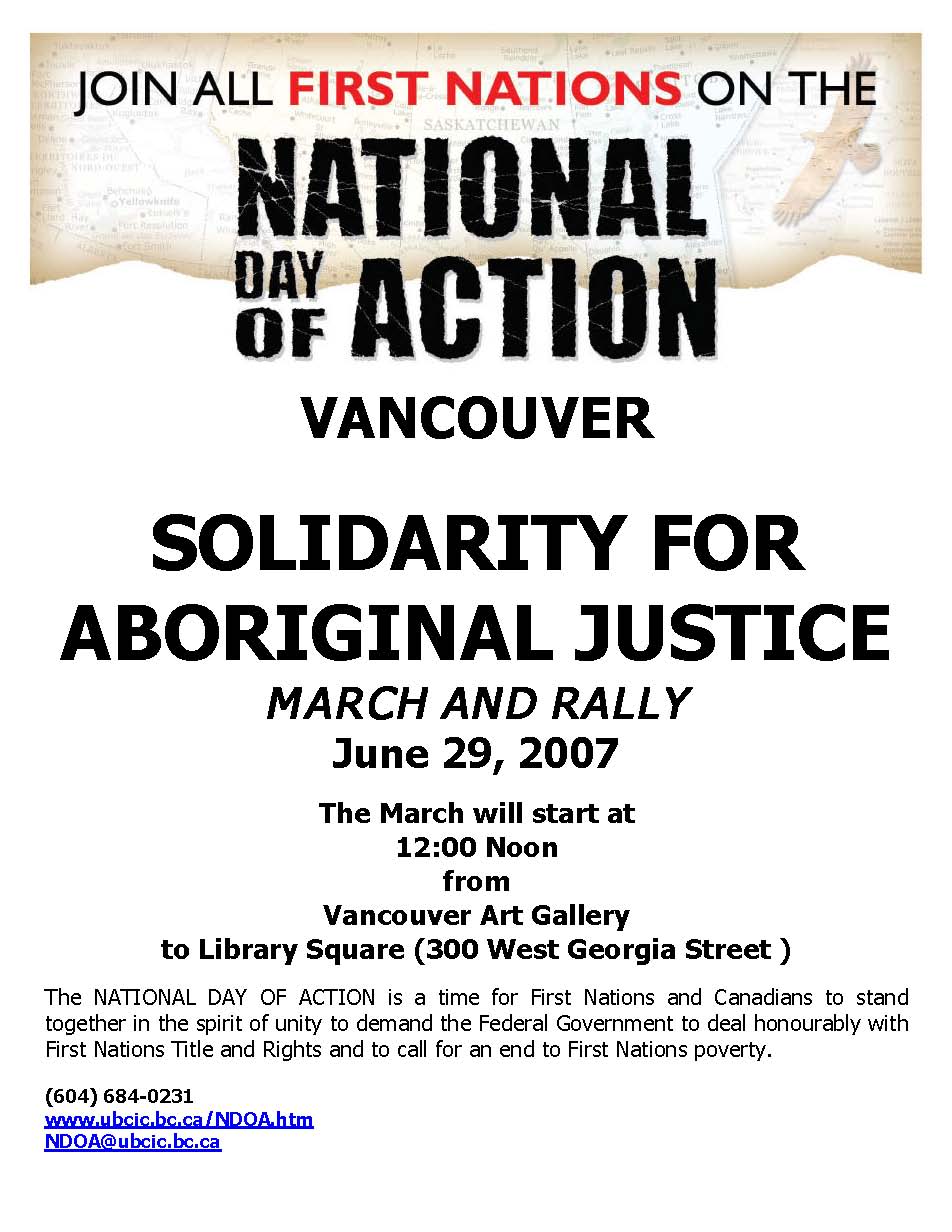
The Assembly of First Nations called for a National Day of Action in 2007. The call was answered in over 100 locations across Canada, where people stopped traffic, trains, and TV news on June 29th.

AFN Chief Phil Fontaine made the call for immediate action to address the situation of Indigenous Peoples in Canada.

      At the end of the first National Day of Action, June 29, the AFN press release explained:

“The national chief called on the federal government to honour its promises to First Nations; to implement the plan agreed to at the first ministers meeting on aboriginal issues in Kelowna, BC; to apologize to survivors of residential schools; and to work with First Nations to give life to their rights as recognized in Canada’s constitution.”

Indigenous communities and organizations took the chance to promote the urgency of issues on the ground, while they could rely, for the day, on “law enforcement officials for their commitment to a measured and non-confrontational approach,” according to the AFN Chief’s press statement, June 2007.

A poster advertising the first ever National Day of Action in 2007.

A second National Day of Action was called for May 29, 2008. And a third – unannounced – continued in their tracks in June 2009.
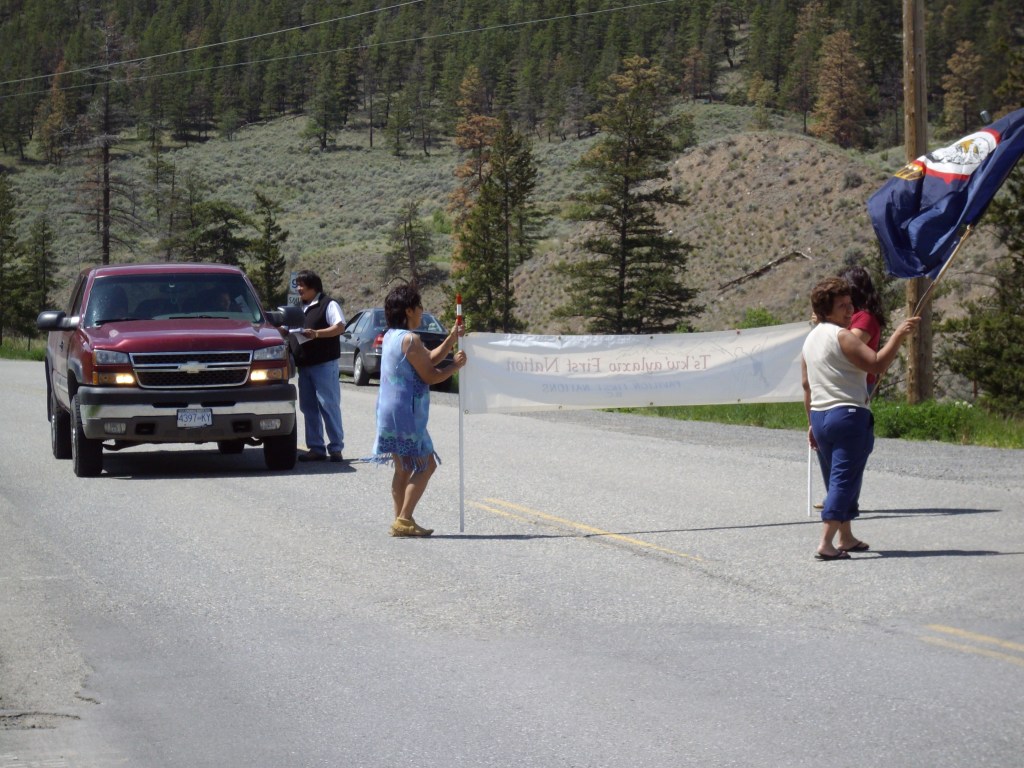

“The message we gave was, our rights are being trampled on and Canada goes out to international governments and makes it look like everything’s alright, and it’s not. Canada is actually in denial. The government may put out a positive message, but if you go back to the First Nations, they’re not happy with any of it.” Chief Desmond Peter, pictured, at an information roadblock on Highway 12 through Tsk’wáy’laxw. May 29, 2008. (The St’át’imc Runner newspaper, July 2009)

On June 19, 2009, Canada’s Governor General broke in to what was becoming an annual thing: 24-hour roadblocks truly marking the solstice season with “the longest day of the year” for Canada.

      GG Michaelle Jean declared, in a three-paragraph news release, that “National Aboriginal Day is celebrated on June 21, 2009.”

      Remarking on the first anniversary of Prime Minister Stephen Harper’s formal apology to Indian Residential School students in 2008, Jean said:

      “The time has come to move beyond the injustices of the past and build a future together that history will show brought us together in respect, dignity, equality and solidarity. This is how we will break down the solitudes that, for too long, have isolated us from one another. In the spirit of this new age, let us look to our youth, whose full participation in creating a new era of harmony is our best chance for success.”

Ever after, Canada looked to the youth and funded all manner of song and dance displays, made funds available for celebrations in every town and city, and called it reconciliation in action.

The National Day of Action was displaced from the calendar, as communities supported their young people to enjoy some pride in their identity and talents, and pick up a cheque for their otherwise little-noticed culture.

      The issues which brought out the information roadblocks, signs, banners, speeches, and occupation of railways, were not reconciled.

      In Vancouver, 2009, an “Aboriginal Solidarity Day” took place at Trout Lake on June 29th, and on June 24th the Olympic Resistance Network marched downtown; but by June of 2010 there was no continuation of the coast-to-coast-to-coast event.
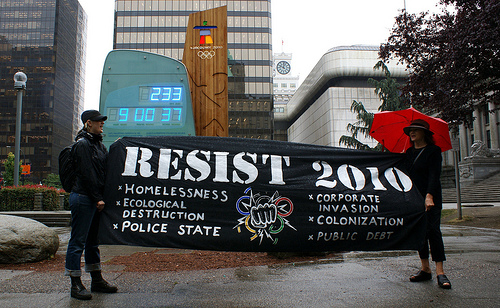
The first National Day of Action got results. Federal damage-control went into effect within days of the first call to action in 2007.

      “Indian Affairs Minister Jim Prentice has been conducting a cross-country campaign to deflect wide-spread direct action campaigns during the June 29 Day of Action. In particular, a long-outstanding specific claim has apparently been settled, expanding the Roseau River First Nation reserve territory on the eve of June 21, National Aboriginal Day (although important questions have already been raised about the future uses of the land parcel). Chief Terrance Nelson has publicly acknowledged this settlement. While he has emphasized that problems with Ottawa remain, he has called off his threat to block major rail lines. This use of recent specific-claims reforms as an immediate tool to neutralize protest this month reflects the wider tendency of the present government to drive policy change primarily in response to immediate political embarrassment.” So reported James Lawson, a teacher at UVic, in the Socialist Project’s “The Bullet.”

The 2007 Day of Action had raised the visibility of severe circumstances, endured under protest, for generations. They are circumstances that have been rationalized all along by Canada’s quest for development, and to “build this country.”

      Land claims negotiations were going nowhere. In BC, $975million in funding to the BC treaty process over 15 years (most of it to federal and provincial teams), had settled nothing.

      Canada’s Supreme Court continued in its unilateral and assimilationist strategy to turn “Aboriginal title” into “the right to be consulted,” confirming the “pleasure of the crown” over poorly defined rights in its 1997 Delgamuukw ruling and subsequent interpretations; and in its Haida and Taku, ruling, 2004; and in Tsilhqot’in Nation, 2007.

      Prime Minister Paul Martin’s very brief attempt to release $5billion in Transformative Change Accord funding, to housing, education, land issues, and more, had just brought down his government. The Liberals were swept away by a vote of no-confidence in Parliament just days after the first chapter of that Accord was signed in BC, the Kelowna Accord, at the end of 2005. Martin tried to push a Private Member’s Bill through to disperse the assembled budget, but it failed and suddenly in its place – six months later – a $2billion Indian Residential Schools Survivors Settlement Agreement was presented.

    One of the cringey details amplified in the call for action was the federal government’s ongoing 2% limit on annual funding increases to Aboriginal communities, clamped on in 1986 at a time when the housing deficit in Native communities was estimated to be worth $400million, and climbing. Reckoning by the federal subsidy of about $10,000 per new house build, at that time, those 40,000 houses still haven’t been built. The 2% cap didn’t move until 2016.

The National Day of Action was called to touch the brakes on Canada’s relentless extractive industries, shipping the natural wealth of Indigenous Nations off the continent by the super tanker, and leaving First Nations futures in the clear-cuts, toxic tailings dumps, encroaching settler suburbia, and hydro and pipeline rights-of-way.

    The unmitigated Canadian legacies were then, and are now: denial of the registrable values of their land titles; running circles in policy whirlwinds around education and child welfare – that all puffed out before any traction was gained; virtual landlessness; and the shackles of an Indian Act which, to date, prevents all manner of economic development on-reserve.

      In the further spirit of Canada’s “reconciliation of Aboriginal societies with the sovereignty of the crown,” (Van derPeet, 1996) First Nations have since been invited to import Canadian legislation over themselves by consent, thereby releasing their own laws along with the arbitrary Indian Act controls of all manner of socio-economic development. This is not seen as a suitable resolution by many.

Arguably, the National Day of Action never completed its work.

      On May 29, 2008, Ontario’s Minister of Aboriginal Affairs said of the NDOA, “I’m confident this day will serve to strengthen relationships based on mutual respect and understanding.”         

     “Aboriginal Day” 2025, however, brings an escalating situation in Canada’s idea that it can fast-track industrial development over Indigenous rights.

On June 29, 2007, Minister of Indian Affairs (as it was then) Jim Prentice said, “The express purpose of this day was to raise awareness of the serious issues facing Aboriginal People in this country.” But since Canada has taken charge of telling Canadians what those issues are, controlling the narrative with its flood of publicly-subsidized propaganda in aid of “Aboriginal Day,” it is made to seem that those serious issues don’t foremost include land and jurisdiction; reparation and restoration; and self-determination at an international standard of recognition, not the starvation afforded by a Canada UNDRIPA that has nothing in it.

Another consideration in taking the date was described by BC Premier Gordon Campbell in June 2009:

      “National Aboriginal Day, June 21, is an important opportunity for all Canadians… In just 236 days, the eyes of almost every continent will turn to British Columbia for the 2010 Olympic Winter Games. They will see our spectacular natural environment. … And they will no doubt see, and judge for themselves, our relationships with First Nations.”

      “We have signed modern-day treaties with six First Nations… We can all take pride as a province for the steps we have taken together to build a New Relationship… So as we celebrate National Aboriginal Day, and move towards Canada Day, we should recognize the tremendous contributions First Nations have made to our province and our country.”

“I congratulate the federal government on continuing this process of reconciliation by declaring June National Aboriginal History Month. The celebration of National Aboriginal Day on June 21 will now be bolstered by a month of cultural awareness.”

Campbell’s brief self-congratulatory affirmation of the announcement of Aboriginal Day was answered immediately, by many, including Chief Kakila, Hereditary Chief Clarke Smith of Tenas Lake, Samáhquam, St’át’imc:

      “Mr. Premier. Your words and statements are empty. Canada and BC Government purposely created laws against us Aboriginal people for over 100 years. … How can you even think that BC is trying to build a New Relationship? … All the Supreme Court Decisions such as the Delgamuukw mean nothing to you Greedy Leaders. Court Rulings you don’t follow. … Perhaps you need to really read the Delgamuukw Supreme Court Decision, it states that the “BC Government cannot extinguish Aboriginal Title and the Rights that flow from such Title.”

“All the evidence is in the Minutes of Decisions your governments made over the last century or so. How to rid of the Indians.”

The last-minute declaration by the Governor General in 2009 didn’t change the reality.

One Tribal newspaper carried three June events which dulled the media spin.

      “Ancestors Block Trans-Canada Highway Expansion. Neskonlith, Secwepemc. The disturbance of human remains believed to be more than 2,800 years old has halted work on the Trans-Canada Highway near Chase.”

     “Alberta oil held up on Highway 52. On June 20, the Kelly Lake Cree Nation, near Beaverlodge, about 500 kilometres from Edmonton, began stopping all oil and gas rigs from passing along Highway 52, a remote highway mainly used by crews traveling between Alberta and B.C.”

     “Mohawks at Akwesasne stop border guards. Canadian border guards at the Akwesasne Reserve international crossing are involved in a militarization of the Canada-US border. However, the presence of Canadian police carrying guns on and around the Reserve is not welcome. It has been described by Akwesasne leaders as an open conflict. Mohawk sovereigntists blocked entry to the guards. Canada and USA are also demanding new ID for natives crossing the border, apparently in violation of the Jay Treaty.”

In 2007, the Assembly of First Nations stretched its considerable wingspan to shelter more than 100 community-based demonstrations. In 2009, the unmistakeable message of the Governor General was that only celebrations of reconciliation are safe on Canadian streets.
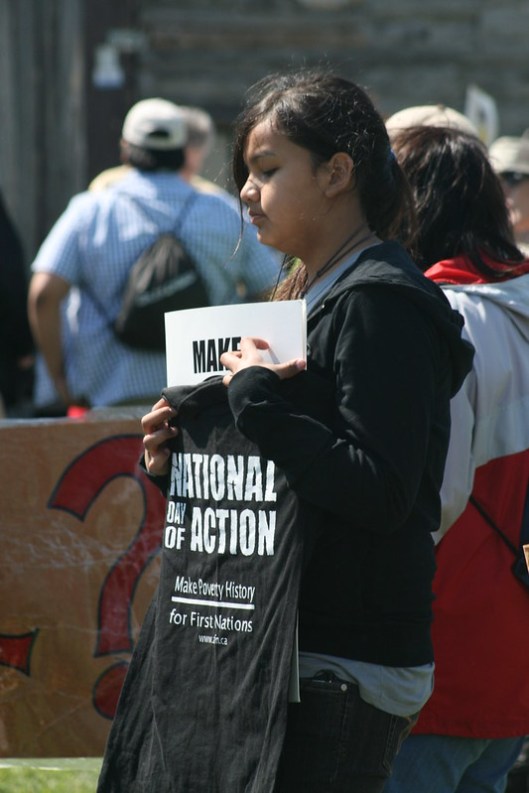
With the T-shirt for the day, on May 29, 2008, in Ottawa. Photo by Powless, on Flickr.
On August 15, 1824…

15 Thursday Aug 2024

Posted by Admin in aboriginal title, Government Commissions, Indian Residential School, Reconciliation

≈ Leave a comment

Tags

Christian mission, Colony of British Columbia, Fort Simpson, HBC Governor Simpson, Indian Residential School, Oregon Treaty, Origin of BC, Sovereignty

The first HBC Governor west of the Rockies made his first tour of the forts with a note to himself in mind: the potential profit in Christian conversion of his newly acquired, autonomous Indigenous trading partners.

On August 15, 1824, George Simpson, Governor of Hudson’s Bay Company “North” (mostly west), left York Factory for the Oregon Territory.

      His mission was to make the newly acquired west coast trading posts profitable.

      After a bloody competition with the North West Company, and a decisive gunfight at Seven Oaks near the Red River, HBC had absorbed its rival trading company by Imperial British decision in 1821. Fraser, Thompson, and McKenzie had been NWCo. men.

      Like those ‘explorers,’ Simpson set out on the river highway with some colonial paddlers and the essential Indian Guide.

Unlike the previous company, he set out with a mission to test the west coast peoples’ receptiveness to Christianity; to introduce it and recommend it. A Company-and-King minded man, Simpson noted the profit that religious conversion would bring. He made a lot of notes.

      It was a key part of Simpson’s overall mission, which was to secure British North America in the west by making its trade competitive and resistant to America’s northward aspirations.

      The War of 1812 between the British and USA had only demarcated a 49th parallel border between them so-far into the Great Plains.

      On the west coast, the British Crown sought treaties with Spain, Russia, and the Americans long before it ever made any treaties concerning land interests with the Nations who enjoyed ancient sovereignties there. Simpson’s work resulted in the Russia treaty at Alaska in 1825, and the Oregon Treaty with America in 1846.

200 years later, the actual role of the Christian churches among Indigenous Peoples has only just begun to be acknowledged for the Trojan Horse it was.

      Not until the indescribably tragic case of Blackwater v. Plint, 1997 – so unbearable to testify to, half of the dozen plaintiffs took their own lives during the hearings into church and state’s crimes against them as children in Indian Residential School – did BC settlers even acknowledge that its early work towards “Christian civilization” of Native Peoples was “flawed” and “regrettable” in 1998.

      They/we, the BC settlers, certainly have never come to terms with the way we profit from the most unforgivable truth about Britain’s churches’ role: to dehumanize the Peoples as they were; to peddle the myth that Britain’s God is superior to the Gods of these Peoples; and preach the associated divine right of its kings as if European domination was a natural inevitability – denying the sovereignties, jurisdictions, and land titles of the Native Nations to this day in colonial courts and international forums.

When today’s Indigenous Elders are questioned about why their people moved away from productive, beautifully situated, spiritually connected, and traditional seasonal villages – to the ill-suited, waterless, and usually barren Indian Reserves (all that was left to them by BC and Canada’s Indian Reserve Commissions, finally legislated in 1924) – one reason recalled is to be close to the church. Every Reserve had one.

      Terrorized by biological warfare, and with the only access to treatment or vaccination coming (when it inconsistently did) from a handful of legitimate Reverends, the connection between church and survival was often made.

Although moving to Indian Reserves was forced by two much more compelling reasons – government armed and escorted relocation, and deadly settler violence outside the reserves – community organizing around the on-Reserve church played a part.

      Most every traditional spiritual practice and ceremony of governance was criminalized under the Indian Act for over 75 years. Indigenous politics and religion sometimes survived just under the skin of a church, because gathering at church was the only kind of gathering not broken up by Indian Agents. Sometimes with a watchman posted outside, holding a cross and a Bible; and with raised voices signing Onwards Christian Soldiers inside; the secretly illegal gathering was sheltered. The Native Brotherhood, the Shaker religion, the Native Church, all ended up using the cross as a shield from the ills of the world, just not in the same way the Missionaries told them it would work.

      Christianity was used, in the end, as west coast Peoples’ defense against the invading foreigners who sold it to them. At least the physical symbols and the deceptive cloak of singing was effective.

Simpson, during his time, used his knowledge of the Sinixt, Sto:lo, and coastal Salishan Peoples to drive a hard inter-colonial boundary through their countries. The Oregon Treaty split their countries apart, on either side of today’s Canada-US border.

      The first western Governor of the HBC produced a legacy of bad faith and betrayal: promoting the lie of a beneficent Christian mission, making agreements for Britain’s essential trade in furs and geographical knowledge based on recognition of the Tribes, when he relied entirely on them, while at the same time engineering the infrastructure that would purposefully overtake and dispossess them. This legacy was the making of British Columbia.

As Native politicians famously orated in the 1970s, and ever since: “In the beginning, we had the land and all they had was the Bible. Now we have the Bible and they have the land.”

It started today, 200 years ago, with the first visit of the HBC Governor to the trading forts of the west. It continues today, with the Christian monarch’s head on every piece of Canadian currency and mounted on the wall behind every Canadian judge.

~

For more on the early Oregon Territory, Simpson, European treaties over Indigenous lands, Missions and biological warfare mentioned in this article, see:

The Oregon Encyclopedia online

The Hudson’s Bay Company Archives, Manitoba Archives

The Canadian Encyclopedia online

Archive Quarterly ~ journal of “the west wasn’t won archive project”

Hudson’s Bay Company Archives, UK https://discovery.nationalarchives.gov.uk/details/r/C29

Friends of Clayoquot, Summer 1994

27 Saturday Jul 2024

Posted by Admin in Reconciliation

≈ Leave a comment

Tags

Clayoquot Sound, environmental alliance, Eva Jacobs, Friends of Clayoquot, Lavina White, mass arrests, Nuu-Chah-nulth, Simon Lucas, Valerie Langer

The largest demonstration of solidarity with Indigenous Peoples and their land titles until Fairy Creek, mass arrests at Clayoquot Sound in 1993 are said to have been at least 850 persons strong. 300 arrests in one day, to stop logging in the Nuu-chah-nulth coastal old-growth forests.

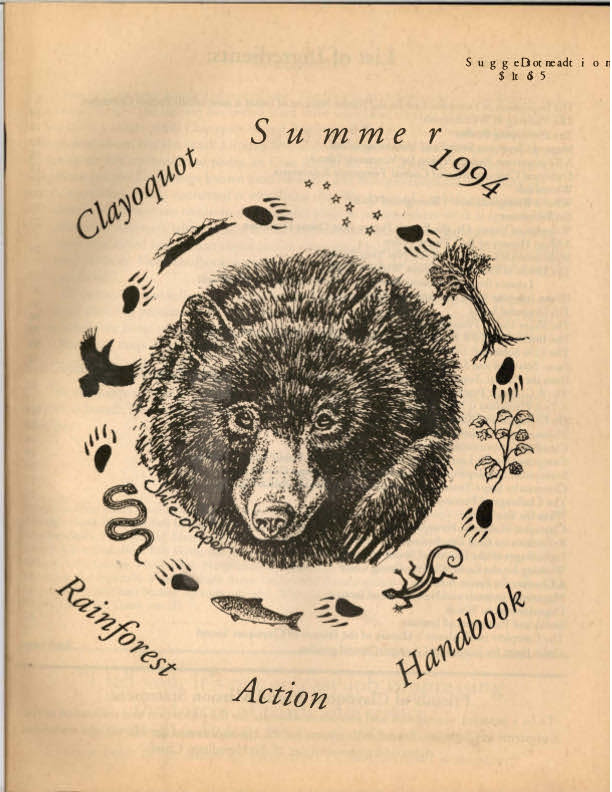
In 1994, the Friends of Clayoquot organization published a journal to document their thinking at the time.

Clayoquot Summer 1994 Rainforest Action Handbook Lavina White. Simon Lucas. Eve KtunaxaDownload

Friends of Clayoquot Sound Mission Statement:

To be a peaceful, courageous and consistent advocate for the protection and restoration of the ecosystems of Clayoquot Sound with respect for the Ha-houlthee of the Ha-wii – the traditional rights and responsibilities of the Hereditary Chiefs.


Excerpt from the 1994 Handbook:

The Thriving of Wild Salmon, a presentation by Simon Lucas,

co-chair of the B.C. Aboriginal Fisheries Commission and the Nuu-Chah-Nulth Tribal Council. He was speaking to the participants of the Suzuki Foundation’s Wild Salmon conference held November 18th, 1988:

“If we are going to rebuild our wild stocks, we have to think about all the things that we have inherited. You and I could stand here for days about the inheritance. Lakes, rivers and creeks, and salmon stocks large and small, no matter how many hatcheries we have, they can never begin to match the abilities of our rivers and creeks and wild stocks to produce fish. If we protect them we have to say “no” to industrial pollution and to the idea of safe levels of poison chemicals. How long are we going to continue to self-destruct? If we befoul the rivers, streams, creeks and lakes, we are befouling ourselves. We have to say NO!

We keep seeing government after government allowing pulp mills to be built before safeguards. They are in place, finally, and we say, “what about the pollution?” “Oh, but that’s going to cost $40 million to see that we’re pollution-free.” Right now we have “safe levels” for our people in this country. We’ve got to say “No, no more.” Otherwise, all of us are just paying lip-service to wild stock.

My vision of the rebuilding of the Kennedy Lake sockeye stocks is an impossible dream if we add the insult of spraying toxic chemicals alongside the stream, as they are doing today, in addition to the painful injury of steep, clear-cut slopes. Our inlets will not provide the environment needed by our young salmon to grow and survive if we allow the salmon farming to grow unchecked. We have many examples: pulp mills, lumber mills, the Fraser River is an example.”


Contents

of “Clayoquot Summer 1994, Rainforest Action Handbook”:

The Imposition of European Law on the Native Nations of (what is now called) British Columbia, by Lavina White and Eva Jacobs

The Thriving of Wild Salmon, a presentation by Simon Lucas, Chair of the Aboriginal Peoples’ Fisheries Commission of British Columbia

The Developing Reality, by Valerie Langer

Maps of Clayoquot Sound and Vancouver Island  

A Conservation Biology Vision for Vancouver Island

Ecological Characteristics of Coastal Temperate Rainforests

Watersheds

What is Bioregionalism?, by Peter Berg

On Extinction

Welcome to Venus: Or, the Earth’s Future after Ozone Depletion

A Short History of B.C. Forest Policy

Multinational Corporations Are Not Your Friends

The Limits of Environmentalism Without Class: Lessons from the Ancient Forest Struggle of the Pacific Northwest

Eleven Inherent Rules of Corporate Behaviour

The Shameful Seven

The Share Group Phenomenon

The International PR Machine: Environmentalism a la Burson-Marsteller

The 12% Solution?

Facts, Statistics and Stuff!!!

Does the Public … Support Clearcutting? Trust the Government to Regulate Logging?

The B.C. Forest Practices Code

A Tree Plantation is Not a Forest

On Ecological and Cultural Restoration

Making Paper Without Trees

Canadian Government Violating International Law

Compensation for Lost Logging Rights: Who Owns Public Lands, Anyway?

Sustainable Development is Possible Only if We Forego Growth

Community Steps Toward an Ecologically Sustainable Forest Culture

The Challenge of Feminism

What Do You Value?

Clayoquot Makes the Newspaper

Reflections on Civil Disobedience

Eight Stages in the Process of Social Movement Success

Working for the Earth Without Going Crazy

A Glossary for Forest Activists

Magazines, Journals and Newsletters of Interest

Organizations to Watch

Books and Publishers of Interest

The Complete (well, almost!) History of the Friends of Clayoquot Sound

02.24.2024 ~ Today is a great day for history!

24 Saturday Feb 2024

Posted by Admin in aboriginal title, BC treaty process, Children, Comprehensive Claims - Policy and Protest, Government Commissions, Indian Residential School, Indigenous Declarations, Non-Status Indian Era, Reconciliation, UN Engagement, Uncategorized, Union of BC Indian Chiefs

≈ Leave a comment

Tags

Archive Quarterly

Introducing:    Archive Quarterly

It’s The West Wasn’t Won’s own journal, like a news clipping service across the last two or three hundred years.

Did you know? This month marks a hundred years since the Allied Tribes of British Columbia petitioned to shut down the Indian Reserve Commission report.

If you didn’t, a subscription to Archive Quarterly will really help!

What was hidden from history is what’s needed now.

AQ shakes out the archives for primary sources on Indigenous land and British Columbia, sharing:

~ key extracts from archival artifacts

~ quotes and interviews on the issues as they were

~ relatable commentary and a few side-notes

~ images and timelines that connect past and present

The first April issue will be here in three weeks!

READ ON  for more info

TAKE A LINK  to the Archive Quarterly website to see more and click your Subscription

FOLLOW  AQ on Facebook  for updates 

Archive Quarterly is about it, the west wasn’t won!

BC history is lit from one side – showing settler progress to advantage, while rendering the Indigenous reality of that “progress” indiscernible.

This magazine aims to balance the view. As well as the written records, interviews with Elders reveal circumstances leading up to political movements, court actions and roadblocks, and conditions in their communities at the time.

Excerpts in the journal will be presented in full documents online, where they are accessible to download.

See the highlights from the first issues this year!

Get your subscription now and you can start sharing.

Print subscriptions will hit the mailboxes in the middle of March, and the first issue of AQ will be in bookstores before April.

When you buy a $44 print subscription, you’ll be the first to receive each issue by mail and get a digital copy in your inbox as well.

That’s right, Archive Quarterly comes out four times a year, in April, July, October, and January. It’s $15 in stores.

Digital subscriptions for the year are just $18, and you can share AQ with your contacts.

Subscribe to print or digital here: AQ Subscribe

You can also donate to AQ to become a founding sponsor – thanks!

Group and bulk print subs available, just drop us a line.

If you just can’t afford the subscription, get in touch and we’ll get you in.

By subscribing to AQ today, you’ll be helping to get work done.

Special Issues

Did you know? The ongoing denial of Aboriginal land title – and the tiny size of First Nations reserves – contributes directly to child apprehensions from young Aboriginal families. The situation can’t change without land to build on and live in.

Special Issues are on the way for AQ, focusing on Aboriginal Title, the Non-Status Indian era, Roadblocks, and more. The Special series dives deep and provides historical overviews and insight, and the development takes time and research and communications.

AQ’s online digital archive

It keeps growing, as old docs are scanned and processed and uploaded. The physical archive costs money for storage, and the digital archive costs money for web space.

The magazine comes out of a collection kept up by Electromagnetic Print – EMP, a book label founded to print voices seldom heard in the media, especially the voices of native sovereigntists.

Thank you very much for reading and have a great day!

Kerry Coast, Publisher

Electromagnetic Print

BC attempts Centennial Lands Act Amendment

11 Sunday Feb 2024

Posted by Admin in Reconciliation, Uncategorized

≈ Leave a comment

Tags

aboriginal title, BC Lands Act, BC Recognition Act 2009, Canada, environment, history, indigenous, informed consent, Land claims, native-americans, Reconciliation, Statement of the Allied Indian Tribes of British Columbia

100 years ago this month, the Allied Tribes of British Columbia petitioned Parliament to shut down the report of the Indian Reserve Commission.

BC has very quietly set up a public consultation process on its plans to embed First Nations local governments within its Lands Act.

The lead is buried pretty deep: BC’s original assumption of control of all the land (without treaty or constructive arrangement) was in 1874. It was patently unconstitutional, and, at first, Canada’s Attorney General disallowed it.

What unfolded then was: replacement of the troublesome AG – Telesphore Fournier, with Edward Blake who allowed a new 1875 BC Lands Act, equally unconstitutional and an act of wholesale annexation, on the basis of settler convenience. Then Canada passed the Indian Act, locking Indigenous Peoples into a second-class-state of outlaw and criminalization. Meanwhile the Province of British Columbia sold off and settled prime Indigenous real estate, fencing communities decimated by smallpox into an-acre-a-person Reserves.

Fifty years of protest, petition, and physical defense of the land (1874-1924) did nothing to remedy the situation at the time, but increased BC and Canada’s resolve to the point of legislating the tiny Reserve Boundaries and making litigation on behalf of Indians… illegal (1927).

A hundred years ago this month, the Allied Tribes of British Columbia petitioned Parliament to shut down the report of the Indian Reserve Commission. BC and Canada had set out to finalize the Indian Land question in 1912, with the McKenna-McBride Commission, and unilaterally “quiet the Indian title,” all the while diplomatically shutting the land issue out of courts and the Privy Council forum.

In their 1926 Petition, the Allied Tribes wrote:

14. By Memorandum which was presented to the Government of Canada on 29th February, 1924, the Allied Tribes opposed the passing of Order-in-Council of the Government of Canada adopting the Report of the Royal Commission upon the ground, among other grounds, that no matter whatever relating to Indian affairs in British Columbia having been fully adjusted and important matters such as foreshore rights, fishing rights and water rights not having been to any extent adjusted, the professed purpose of the Agreement and the Act had not been accomplished.
15. By Order-in-Council passed 19th July, 1924, the Government of Canada, acting under Chapter 51 of the Statutes of the year 1920 and upon recommendation of the Minister of the Interior adopted the Report of the Royal Commission.

50 years before that, the Petition of the Douglas Tribes was brutally clear about the Indian Reserve crisis. And the Reserve boundaries have rarely, and barely, shifted since the final cuts of 1924.

The BC plan now, apparently, is to gain the consent of the Indigenous nations, in the form of the individual Indian Bands / First Nations, to their Lands Act after all.

It is appearing like a visitation of the 2009 BC Recognition and Reconciliation Legislation, which was put to death, in ceremony, in 2009 – once the grassroots people caught wind of it. The grassroots people tend to be very cautious about allowing their elected representatives to sign-on with government initiatives, and acknowledge the crown as the legitimate source of power over their lands, peoples, and futures.

However, little is known about this 2024 draft legislation except that it is proceeding as quickly and mysteriously as the 2009 event, which suddenly surfaced early in the Spring and was submerged by the end of summer.

For more information, you can check the:

BC government’s public consultation process

The BC Treaty Negotiating Times – Summer 2009 Analysis and report on the Proposed Recognition and Reconciliation Legislation, opposition, and events.

And this Blog’s timeline of docs under “Land Claims – policy and protest.” for more on the 2009 legislation, Indigenous Alliances and protest of government assumptions.

Check out Archive Quarterly – a new publication featuring newly digitized history that informs the present here in British Columbia. The first issue arrives April 2024. Every issue features key archival papers and artifacts; quotes and interviews with Elders on the issues; and relatable commentary to connect past and present.

Readers can Subscribe, Support, and Contribute: there are many ways to be engaged!

Take a link to the Archive Quarterly website or AQ on Facebook.

Reconciliation means Municipalization

29 Friday Sep 2023

Posted by Admin in Reconciliation

≈ Leave a comment

Tags

aboriginal rights, aboriginal title, Federal Liberals Comprehensive Claims Policy, Indigenous Peoples, Land claims, Reconciliation

Part 5 of this week’s blog, No More “Reconciliation Sticks”

In the 1970s, at least one informant in the Canadian government was relaying the state’s plans to Indigenous political leaders.

        The obvious question is, why did the Governors Attorney and General, the Superintendents, judges and Ministers have secret plans?

In one easily cracked nutshell, the Canadian state was already wildly liable for attacking the British Crown’s “Allies; the Tribes and Indian nations with whom We are Connected” – and fur trading partners – in their own protected territories, so peace and good faith would be hard to recover. And because, in the case of the Colony of British Columbia, the British wouldn’t give them any money for Treaties. So the politicians and judges could not very well speak out about what they had in mind – at least not plainly.

The many-headed word “reconciliation” aids them there.

In Canada, it has taken three centuries of brutal tactics, and the martial law of Indian Act Band Councils, and the colony has still not convinced the nations to become consenting colonial districts.

Today, Canada is more desperate than ever to manufacture this consent.

Using the “concept of reconciliation,” among many coercive tactics, a replacement Indian Act targets Indigenous communities under duress.

            Attempting to transform constitutionally and internationally protected peoples, owners of rich and substantial land bases, into virtually landless provincial municipalities, Canada has passed into law an entire framework to replace the Indian Act. You may remember the First Nations Governance Act, revised; the First Nations Fiscal Accountability Act; the First Nations Land Management Act, et al, as the omnibus Bill C-45, 2012, which sparked the Idle No More protests.

            The crucial difference with this municipalization plan, is that the present day First Nations’ entry into confederation would be achieved by consent. Consent to the state and recognition of “crown interests” are achieved incrementally in delegated jurisdiction agreements concerning education, child welfare, housing, health, and such; as well as in negotiation of land claims under the 1974(78) Comprehensive Claims Policy and the 1995 Inherent Rights Policy (the leading extinguishment programmes in Canada today),

There, reconstituted under Canadian law – having ratified an individual First Nation constitution; having released and indemnified the colonizers; having accepted cash as the full and final settlement of Aboriginal rights – the First Nations will be outnumbered in provincial unions of municipalities. There, First Nations will be dependent on five-year provincial funding agreements and occasional aid for natural disasters, and will not retain their autonomy, or sovereignty, or even those controversial Aboriginal rights.

Today’s article looks at the mechanism of the “concept of reconciliation” at play in the municipalization of Indigenous communities. Municipalization is the only future, under Canada’s runaway judges, consistent with their regularized practice of complete abrogation and derogation from “Aboriginal and treaty rights.” It is the only possibility that conforms to the reconciliation program, as described by the Supreme Court of Canada.

            It will not be achieved by any means consistent with the UN Declaration on the Rights of Indigenous Peoples.

            But hey, if First Nations want to make Final Agreements that extinguish their rights, who’s to stop them.

From unilateral legislation to coercion

So, in the 1970s, Walter Rudnicki was working for the federal government. He shared confidential information with the leaders of the Union of BC Indian Chiefs. He confirmed the intention of Canada to finally coerce the assimilation of every Indian Band as a provincial municipality, and thereby liberate itself from the burden of acquiring title. A consensual union would also indemnify the state of past harms.

Here’s the setting.

            The legendary 1969 White Paper, the Statement of the Government of Canada on Indian Policy, had just failed spectacularly up: forging extensive political allegiances from coast to coast to coast. It had been a play to unilaterally assimilate the nations by legislation, demolishing the Indian Act and every line of constitutional ink that described the burden of legally acquiring title to the Indian territories.

            The Nishga case, Calder v. The Attorney General of British Columbia, got a 1973 admission from the Supreme Court of Canada that Aboriginal title continues to exist in Canada, unextinguished.

            Trudeau the First and his Minister of Indian Affairs, Jean Chretien, passed the federal Comprehensive Claims Policy within the year. Any Indigenous nation could apply within the process it enabled, and they could get small cash and smaller land deeds as a final settlement of their title, rights, and interests in the surrendered area.

The Comprehensive Claims Policy, 1978 update, is the leading negotiating policy today.

Indigenous leaders did not particularly need an inside informant to confirm the meaning and intent of that. But it may have been helpful, in some cases, to have a little advance warning of the next strategy being formulated.

            It was helpful in 1981, in the case of Trudeau’s next best plan, the attempt to get a new Constitution from Britain: one which did not include any obligations to the now occupied nations.

            It was helpful in 2009, when British Columbia had tried to simply legislate the Bands under provincial jurisdiction.

Someone gave the Union of BC Indian Chiefs a copy of the September, 2004 “Secret Framework for Renewing Canada’s Policies with Respect to Aboriginal and Treaty Rights.” Emphasis in the original.

The draft Framework begins by reminding us that the Speech from the Throne, April 2004, stressed finding more efficient ways of concluding self-government agreements. (Self-government means municipalization under Canadian law and abandonment of original Indigenous titles and jurisdictions, at least the way Canada uses the term.)

            It mentions the “sectoral follow-up table on expediting land claims,” which are “a key component for transforming relationships.” (That is, until First Nations abandon original claims and accept delegated Canadian authorities in Final Agreements, they won’t get any.)

            It says,

“The Speech from the Throne and the establishment of the sectoral table on land claims and self-government reflects the reality that establishing cooperative relationships with Aboriginal peoples on quality of life issues must be underpinned by effective policies and processes for addressing Aboriginal and treaty rights.” (That is, there won’t be any improvement in on-Reserve quality of life until extinguishment agreements are signed – as above.)

            The Aboriginal participants at the same sectoral follow-up voiced the exact opposite set of priorities:

“Aboriginal groups emphasized that joint work on quality of life issues must be situated in the broader transformative agenda based on recognition and respect for Aboriginal and treaty rights.”

The secret draft writers resolved that stitch by reminding the secret reader,

“The Supreme Court of Canada has stated that the basic purpose of section 35 of the Constitution Act, 1982, is the reconciliation of the pre-existence of Aboriginal societies with the sovereignty of the crown. Reconciliation has become the key organizing principle which the courts have used in addressing issues related to Aboriginal and treaty rights.” (That is, the court has taken the political lead and reduced legal rights to issues, so the government’s job is just to follow suit.)

            Note: We looked at that in Part 2 – Theft by Chief Justice, where the term “reconciliation” was coined.

The 2009 British Columbia “Recognition and Reconciliation Legislation” was crafted under Premier Gordon Campbell and his cabinet of hungry skeletons, particularly Mike deJong, Wally Oppal, and former QC Geoff “they never had any title and if they did it was extinguished by the presence of the crown” Plant.

            This legislative flop was certainly influenced by the 2004 secret plan – if nothing else, it must have been lent audacity. The province’s 2009 Re&Re Legislation even came with sign-off from the First Nations Leadership Council (FNLC)[i] and their lawyers from Mandell Pinder.

            Only thing was, the FNLC hadn’t mentioned anything about the legislation to its members, or their respective peoples and constituents, when the right honourable Mike deJong announced to media the “seismic shift” that was about to occur in BC.

            And consent is sacrosanct. The bluff was called, retracted, and turned to ash – like the White Paper Policy 1969.

            The government’s only working plan now is coercion.

Instead of consent, all these years, there’s only forcible imposition

Canada has forcibly imposed the Indian Reserve and Indian Band structures – on non-treaty and treaty nations alike.

            British Columbia plays a huge part in the necessity that mothered that invention.

The province of BC was written into existence in 1858, unbeknownst to any Indigenous leaders west of the Rockies, by the Queen of the British Empire – precisely one-half the circumference of the globe away. Then she forgot about it, and nobody in England wanted to pay for treaties there.

            There is no need for me to re-write what happened once the Indigenous protest reached a critical level. This is from Bruce Clark’s “The Error in the Tsilhqot’in Case,” 2018:

“In 1874 British Columbia enacted a Crown Lands Act that regarded all crown land as if it were public land available for disposition, even though the land is part of the continental reserve for the Nations or Tribes of Indians, not being “ceded to, or purchased by Us.” In a report to the Canadian Privy Council, Attorney General Télésphore Fournier recommended disallowance under section 90 of the Constitution Act, 1867, on the ground of conflict with the proclamation and section 109. The report was approved in a Minute in Council dated 23rd January 1875 and endorsed by the Governor General.”

“British Columbia then made a proposal to Canada to resolve the Indian problem by establishing a commission to investigate and “set apart” provincial Crown lands as “reserves” for Indian use. This led directly to the Indian Act, 1876. The Acting Minster of Interior Affairs in a report dated 5th November 1875 recommended approval of the provincial plan, which was done by the Canadian Privy Council pursuant to Minute in Council dated 10th November 1875. This entailed leaving the originally disallowed Crown Lands Act to its operation, i.e., reviving it. Attorney General Fournier was elevated to the Supreme Court and was replaced in office by Attorney General Edward Blake. Blake reported under letter dated 6th May 1876 to the Governor General explaining that “Great inconvenience and confusion might result from its disallowance.” As recommended, on second thought, the Governor General did leave the statute to its operation. Treaties were not made thereafter in mainland British Columbia. There was no need, since all Crown land was thereafter unconstitutionally regarded as public land available for disposition. It was as if the Royal Proclamation of 1763 and the “subject to” proviso in section 109, BNA Act, duly had been repealed or had never existed.”

When Canada passed the Indian Act, everything an Indigenous nation would need to do to survive was criminalized. In the legislation, Indians were defined negatively as “a person is anyone other than an Indian.”

If Indigenous Nations didn’t consent to be governed by the Indian Act, why go along with it?

Because someone had to take those roles in the leadership and administration of the office; in the Band Council.

            No, they really had to.

You can’t have an economy based on the resources in a few acres of Indian Reserve, and you’re not allowed to sell anything anyway. Not even vegetables or produce, when it makes competition for settlers at their markets.

            In 1935 the Indian Act was amended to reflect that there must be one (1) Chief Counselor per Band, and that he should be elected by popular vote, in the prescribed fashion. This did not resemble any Indigenous structures.

            But without that, the Band can not receive the relief funds provided by the government which took their land. That relief program started approximately at the time the plains peoples were starving because the settlers wiped out the buffalo… to make sure they would starve.

            In BC, it started in 1927, after DC Scott and his colleagues in the Judicial Committee, in Ottawa, dismissed the Claims of the Allied Indian Tribes, formally. The relief was the “BC Special” – $100,000 per year, “In lieu of treaties.”

            There were more than 200 Bands at that time. The <$500 per Indian Band per year, a pittance – and most of it paid to the Minister of the Interior to administrate the fund, hasn’t quite kept up with inflation here in 2023.

This is what makes things like “economic reconciliation” sound attractive to First Nations. This is how “the reconciliation of aboriginal societies with the sovereignty of the crown” is achieved: under duress.

Pitawanakwat, 2000

In an Oregon County court, Justice Stewart compared OJ Pitawanakwat’s situation in Canada with members of the Irish Republican Army in Ireland. She found it was manifestly the same. Just as Spain refused, in the 1990s, to extradite IRA members to Britain, Justice Stewart refused Canada’s extradition request.

            Pitawanakwat was present at the Gustafsen Lake police siege, 1995, and had subsequently been charged, detained, and released on bail after two years. He fled to the USA.

            Now, because of the facts that “his conviction was of a political character,” and in a “politically charged climate,” were recognized by an American judge, he lives there still, unable to return home to Anishinabek territory.

At Gustafsen Lake, they said no to the Indian Act; they said no to municipalization; and they said no to extinguishment in full and final settlements. The Attorney General declared war on them.

“We’re not going to agree to anything that will affect our economy.”

Thus spake the province’s negotiator at the St’át’imc Chiefs Council protocol table, in 2008. He might as well have been speaking on behalf of the Canadian state.

The “reconciliation” proposed by Canada would be achieved, if ever, because it is the only prescription for change that Canada will agree to. And that change is: Indigenous nations must submit to their bisection and reduction to scattered postage-stamp communities, where less than a quarter of their own Band membership has room (or housing) to live. They also must relinquish all claims against the province, the state, and “anyone else” for past harm. They must reconstitute themselves, starting with a new Constitution for each First Nation, and enter the hallowed halls of the Union of BC Municipalities.

The conditions under which that kind of “consent” would be achieved, would not hold up under international scrutiny.

It would be achieved under a colonially imposed, extra-legal regime, rather than by authentic governance procedures. It would be achieved by denying Indigenous titles, and capitalizing on the financial ruin which has resulted from this. It would be achieved by refusing to recognize authentic and legitimate holders of the rights to political decisions, who can be marginalized by the imposed ratification procedures.

But, to the great credit of humanity – which will go down in history forever – Indigenous Peoples may be cash poor, but they’ll surely survive these lean, mean years and live their own way.

Thank you very much for reading. Takem i nsnukw’nukw’a.


[i] Executives of the First Nations Summit (BC Treaty Process); Assembly of First Nations (BC region); and Union of BC Indian Chiefs.

Enforcement of Reconciliation

28 Thursday Sep 2023

Posted by Admin in Reconciliation

≈ Leave a comment

Tags

aboriginal rights, aboriginal title, Canada, Indigenous Peoples, Land claims, United Nations

Part 4 of this week’s blog: No More “Reconciliation Sticks”

Now that we have reconciled ourselves to the reality, as described in the last three parts of this blog, of bottom-line, extinguishment-policy reconciliation, all those orange T-shirts look different. You can bet they mean something different to the wearer, depending on whether they are Indigenous or not.

Still, maybe we go to Capital “R” Reconciliation events at the city venue, to show up for the spirit of it. When our hearing is not muddied by the emotional speeches, we hear the MP say, “we can continue to witness, to learn, and do everything we can to address the past.” That’s his closing line: no particulars, and definitely nothing about addressing the present.

            The School District rep cries and says, “we’re learning how to teach children.” She says there are “powerful examples of how our communities have not done things in a good way,” but doesn’t describe any of them.

The City Councillor says, referring to one of the distinguished visiting Chiefs, “Hey there’s Jimmy. It always makes me happy to see Jimmy visiting us.”

The awkwardness of these emotional people making hollow statements is easily explained by the superficial nature of the assignation. There is confusion around what is expected from a government official who is well aware that his tax revenue comes from the unceded, non-treaty Indigenous lands his city is occupying, and if any native whomever tries to exercise his rights there he will be snapped up and incarcerated as per reconciliation rules (business as usual), but he is supposed to say something that sounds like he cares.

Canada has produced exalted and venerated leaders in obscuring this problem, ensuring that the “reconciliation” of Aboriginal titles, and societies, will be enforced and will usher in the time of “no more Indian question,” with a big smile and a small cheque and some native motif pinned to their suit jacket. But most politicians are not so smooth, so it’s bizarre to watch.

Right next to the “reconciliation” event is the business-as-usual land developer scraping away the river foreshore to build condos, and police patrolling to protect the desecration of the traditional, local, unsurrendered supemarket, pharmacy, and fishery access point.

Because “reconciliation” doesn’t actually mean anything other than what the courts and the legislators and extractive industries and police actually do.

They reinforce the supremacy of the colonial economy – socially, militarily, legally; every way – and chastise land defenders, traditionalists, cultural people, to reconcile themselves to it.

Acceptance, resignation, and reconciliation is required of Indigenous Peoples.

The Truth and Reconciliation Commission’s role in enforcement

The TRC issued its report in 2015. They may have accomplished a few things that Canada wanted “out of the way” before it ratified the UNDRIP.

Without getting personal about the Commissioners – they were just people selected on the likelihood of doing what they were told – the Report of the TRC is a blinding misrepresentation of the situation in Canada. Surely work was done, meetings were held, and people benefitted by their involvement in the course of Commission events; but other work was done as well.

Let’s nip back along a shady trail. In 2007, Canada voted against the United Nations Declaration on the Rights of Indigenous Peoples (UNDRIP) during the General Assembly’s ratification process. It was one of only four member states to do so, out of a total 192 states. It is reliably rumoured that Canada threatened several African countries with cessation of aid funding if they voted in favour of the DRIP.

            Loudly explaining themselves to anyone who would listen, Canada spoke (and issued all manner of written statements) about how Aboriginal rights in Canada are already constitutionalized and superior to the UNDRIP articles.

            Slight further digression: Canada pays various reputable Indigenous individuals to tour the world: Pakistan, Mexico, Australia, several west African countries, among many others, to promote the Band Council system; the Tribal Council system; and also to tell outright lies. “The Assembly of First Nations has a place in Parliament and they are part of the Canadian government,” I heard from an Indigenous South African delegate at the UN Permanent Forum on Indigenous Issues. He had been told as much by an Indigenous presenter from Canada.

So when Canada later ratified the DRIP in 2016, they took the chance to make a grand appearance at the UN Permanent Forum on Indigenous Issues in New York City, with Ministers Carolyn Bennett and Jody Wilson Raybould meeting and greeting. It was odd, then, that when Minister Wilson Raybould returned to Ottawa, she soon was despatched to address the Assembly of First Nations and tell them that implementing the UNDRIP was “not practicable.”

            Five years later, we got the Canadianized legislation of the UNDRIP.

Canada was slow, and incomplete with importing the 1948 Geneva Convention, too. When they incorporated a few articles of that Convention on the Prevention and Punishment of the Crime of Genocide into the Criminal Code, in the 1960s, the “forcible removal of children from the group to another group” was not written as such.

            The “reconciliation of aboriginal rights with the broader society” has been under way long before Chief Justice Antonio Lamer came up with this new and improved, and ambiguous, term. Canadians will handle human rights their own way, and they might need to adjust the dictionary.

See here, one of the very first things out of Senator Murray Sinclair’s mouth, when he delivered the opening statement of the Truth and Reconciliation Commission’s report, was that Canada has committed “cultural genocide.” But that doesn’t exist.

The Report, in its opening paragraphs, erases and redefines one of the only legal tools we Canadians have to grapple with what was not “cultural genocide” – whatever that is, it doesn’t have an accepted definition in international legal instruments – but “genocide,” according to the five definitions of the crime identified in the 1948 Geneva Convention.

Any one of these actions is genocide:

“Forcible removal of children from the group to another group.”

“Deliberately imposing conditions calculated to bring about the destruction of the group.”

“Killing members of the group.”

“Inflicting serious physical or mental harm on members of the group.”

“Forcible sterilization of members of the group.”

According to the TRC, when they describe these intentional actions, this is “cultural genocide” – which is not justiciable, because there is no Convention for the Prevention of Cultural Genocide, and anyway all of the crimes listed above are documented by the TRC in their report and justiciable under the Genocide Convention.

Why did the Commission do this? They were enforcing reconciliation.

            Reconciliation means resigning; it means making compatible; and a finding of genocide really does not fit this “superior to the DRIP,” advanced Canadian culture. The Commission had to enforce “the concept of reconciliation,” as well as the underlying, extra-legal policy of extinguishment. They did a remarkable job, using the word “reconciliation” fluidly between both meanings and even managing to leave the term undefined.

            The Anglican Church letter incorporated in the TRC Report straight-out asked them, “What is reconciliation”? It was not a rhetorical or philosophical question.

Why “must” Indigenous people commit to “mutual respect and recognition”?

This was, for all intents and purposes, ordered by the Truth and Reconciliation Commission. But the TRC was not also offering a path to justice. They just wrote in their report that, in order for reconciliation to work, Aboriginal individuals and groups “must” give respect and recognition to the colonizer.

The Supreme Court of Canada’s Chief Justice, Beverly McLachlin, confirmed the current usage of “reconciliation” in Tsilhqot’in Nation, 2014:

“[83] What interests are potentially capable of justifying an incursion on Aboriginal title?  In Delgamuukw, this Court, per Lamer C.J., offered this:

“In the wake of Gladstone, the range of legislative objectives that can justify the infringement of aboriginal title is fairly broad. Most of these objectives can be traced to the reconciliation of the prior occupation of North America by aboriginal peoples with the assertion of Crown sovereignty, which entails the recognition that “distinctive aboriginal societies exist within, and are a part of, a broader social, political and economic community” (at para. 73). In my opinion, the development of agriculture, forestry, mining, and hydroelectric power, the general economic development of the interior of British Columbia, protection of the environment or endangered species, the building of infrastructure and the settlement of foreign populations to support those aims, are the kinds of objectives that are consistent with this purpose and, in principle, can justify the infringement of aboriginal title. Whether a particular measure or government act can be explained by reference to one of those objectives, however, is ultimately a question of fact that will have to be examined on a case-by-case basis. [Emphasis added; emphasis in original deleted; para 165]”

These justifiable infringements of reconciliation are enforced all the time, at Fairy Creek, Sun Peaks, Burnt Church, and Gitdimt’en.

No Canadian Commission has ever questioned the issue of the Canadian courts’ assumption of entitlement to all legal questions in Canada, and its bias: in favour of Canada; and the resulting lack of access to a fair trial for any Indigenous person who would want to rely on their own laws.

The police who broke up the pipeline-barricade camp at Gidimt’en in 2019 had a clear understanding of their role in reconciliation.

I wasn’t there in Wet’suwet’en territory, but I heard. The Emergency Response Team officers referred to their guns as “reconciliation sticks,” as they proceeded into the unsurrendered, sovereign Wet’suwet’en lands to enforce the Canadian occupation.

Perhaps they are more fluent in colonial law than the average Canadian who is distracted by the TRC’s promise of hearing fabulous Indigenous mythologies, traditions, and histories in youth arts and crafts sessions, or digitization projects, or new landmark signage. Those activities make up the majority of the “94 Calls to Action” articulated by Canada’s Truth and Reconciliation Commission (TRC).

Because the crown (look at any piece of Canadian money) refuses to respect Indigenous law and land, and Indigenous Peoples still aren’t going to give it all up, those mutually exclusive refusals have to be reconciled: if, suspiciously, almost always in favour of the “broader society,” and their several justifiable infringements – immigration, logging, mining, development, etc. According to the Canadian courts. No one has reported much on the thoughts of capable and juridically solvent Indigenous courts.

“Reconciliation” is not the tool of the colonized. “Reconciliation” needs to be enforced.

Thank you very much for reading. Takem i nsnukw’nukw’a.

Check in tomorrow for Part 5 – Reconciliation is Municipalization

and an Indigenous nationalist who fled persecution in Canada, to the USA, and were protected by an American court under the “political prisoners” exception to the extradition treaty.

Reconciliation as Subtergfuge

27 Wednesday Sep 2023

Posted by Admin in Commentary, editorial, Reconciliation

≈ Leave a comment

Tags

aboriginal title, Comprehensive Claims Policy, extinguishment policy, Reconciliation, TRC, Truth and Reconciliation

Part 3 of this week’s blog, No More “Reconciliation Sticks”

The term “reconciliation” has morphed from the 1996 Van der Peet ruling into government “Statements on reconciliation,” into the 2009 formation of the Truth and Reconciliation Commission (TRC), into the judicial results of aboriginal title cases.

            What has not morphed is the Canadian government’s policies.

Does the PR campaign match the policy?

“The concept of reconciliation,” as the federal government more cleverly put it in their secret policy, four years before the TRC would be mandated by the Indian Residential Schools Settlement Agreement, might butter more toast than the reality of the government’s Comprehensive Claims Policy (CCP). 

The secret policy writers noted that the concept of reconciliation would secure investment, because it sounds good, without adding any liabilities by talking about it, because they don’t mean anything good by it: just making Aboriginal societies conform and resign to colonial control.

Government policy on “land claims,” the bottle neck corridor through which any and all state recognition of Indigenous land ownership is achieved, is book-ended by discretionary suspension of Indian Act relief funds in the case of non-compliance, or roadblocking, or refusal of an Indian Band (First Nation) to negotiate its way into becoming a provincial municipality and releasing the government from liability for past harm.

“Reconciliation” has not shifted this policy.

Reconciliation in the decisions of aboriginal title cases

In 2017, the 20th anniversary of the Supreme Court of Canada’s Delgamuukw decision (1997) was marked by heavy equipment building pipeline access roads over the unsurrendered, unceded properties of Wet’suwet’en Chiefs whose title to the land was fully evidenced at trial. Any Canadian can read the transcripts and see the maps.

Briefly, the head chiefs Delgamuukw (Gitxsan) and Gisdayway (Wet’suwet’en) were suing for a declaration of title and jurisdiction on behalf of their nations, with small exception. The Supreme Court of BC and CJ Allen MacEachern dispatched the Gitxsan and Wet’suwet’en claim in 1991 with some of the most racist language ever heard in a court room.

            In Delgamuukw v. British Columbia at trial in BC in 1990 and 91, British Columbia had counterclaimed for a declaration that the appellants have no right or interest in and to the territory or alternatively, that the appellants’ cause of action ought to be for compensation from the Government of Canada. MacEachern agreed with them, on the whole. The province’s lawyers were, after all, from his old law firm of Russell and DuMoulin. MacEachern pointed out the impossibility of wandering “vagrants” such as the plaintiffs to have title to land. And if they ever did, he reasoned, it was displaced by the presence of the crown.

At the Supreme Court of Canada, Chief Justice Antonio Lamer didn’t declare any title either. He found a lot of errors in MacEachern’s reasons and in the province’s arguments, ultimately confirming the clear appearance of Gitxsan and Wet’suwet’en title; ordered a retrial; and took the chance to tell them:

“Ultimately, it is through negotiated settlements, with good faith and give and take on all sides, reinforced by the judgments of this Court, that we will achieve what I stated in Van der Peet, supra, at para. 31, to be a basic purpose of s. 35(1) — “the reconciliation of the pre-existence of aboriginal societies with the sovereignty of the Crown”.  Let us face it, we are all here to stay.”

It’s effectively the same as the Truth and Reconciliation Commission reporting that Indigenous Peoples “must” come to “mutual respect and recognition” with the colonizer. Presumably, complete forgiveness on the part of the Indigenous goes along with that.

Neither “reconciliation” nor court rulings have altered the bottom line in Canadian policy and practice.

Antonio Lamer’s successor as Chief Justice of the Supreme Court of Canada is CJ Beverly McLachlin. She has picked up the torch of reconciliation with total enthusiasm, letting the truth of reconciliation’s subversive powers burn brightly.

            In Tsilhqot’in Nation, 2014, she reasoned:

“The Court in Delgamuukw confirmed that infringements of Aboriginal title can be justified under s. 35 of the Constitution Act, 1982 pursuant to the Sparrow test and described this as a “necessary part of the reconciliation of [A]boriginal societies with the broader political community of which they are part” (at para. 161), quoting R. v. Gladstone, [1996] 2 S.C.R. 723, at para. 73.” [16]

                Just to rephrase: infringement of Aboriginal title is a necessary part of reconciliation. Incidentally, so is impairment of Aboriginal title and rights; and, apparently, the extinguishment of Aboriginal title and rights by negotiation under the Comprehensive Claims Policy.

            She further clarified:

“As Delgamuukw explains, the process of reconciling Aboriginal interests with the broader interests of society as a whole is the raison d’être of the principle of justification.” [82]

(Note: The Supreme Court of Canada devised the “justification test” in 1990, when it ruled on the Sparrow fishing case. The category keeps growing, but Aboriginal rights and titles can justifiably be infringed that Canada and the provinces want rally badly: logging, mining, the settlement of foreign populations to do those things; development; ski resorts; hydro-electric facilities; roads; etc.)

The result of Tsilhqot’in Nation was a declaration of Aboriginal title to part of the Tsilhqot’in traditional territory. It is the first and only land with such a designation, arriving 40 years since the first admission of Aboriginal title in the Canadian common law, in 1973 with Calder.

                Ten years later, jurisdiction on the ground remains rather fully snarled in bureaucratic reluctance. Justifiable infringements carry on like business as usual.

This is the policy that “reconciliation” is all about.

Subterfuge is consistent with the historical record

Even in a brief survey of examples which come to mind right away, the legacy of deceit – from bad faith to fraud – make it hard to believe the idea that Canadians are going to do the right thing this time. It makes no sense to ignore the past. Indigenous Peoples aren’t going to.

To make a clean sweep that encompasses the beginning and the present, we should start with the fact that the British crown honoured none of its promises. It has never held Canada accountable to the Executive Orders it delivered by the monarchs and the Privy Councils, and, from the Canadian side, the Governors and Attorneys General have only ever stonewalled Indigenous attempts to access “British justice.”

It’s a pattern repeated around the globe, where British forces route whole villages, coastlines and interiors; supplant Chieftains with Magistrates propped up by force and coercion; populate the place with re-purposed chattel shipped out from Scotland, Ireland, prisons or orphanages; funnel resources out of the newly colonized and re-populated country; and later some Governor or judge scratches his head, for the record, and notes that the law as it was written appears to have been mislaid.

Canada is no exception.

In 2007 the First Nations Unity Protocol Agreement saw the alignment of every Band involved in the BC treaty process (except one) stage massive protests: the government’s negotiating mandate was not consistent with the basis of the BC Treaty Commission, the 19 Recommendations made by the BC Task Force that formed it in 1991. Furthermore, the Delgamuukw decision, SCC 1997, elevated judicial recognition of Aboriginal title well beyond British Columbia’s working definitions, but this did not change the negotiating mandate.

            The negotiating mandate follows the Comprehensive Claims Policy, 1974, updated in 1978. The province knew that was its mandate when it entered negotiations, loaning hundreds of millions to First Nations and putting them within the purview of third-party remedial management, based on their Indian Act financial responsibilities.

            Now, in these times of Reconciliation, that negotiating mandate has not changed. The only possible result of a land claims negotiation between First Nations and the state is that the unsurrendered Indigenous land in question will be relinquished for a financial settlement, sometimes including fee-simple packages of land which are now the property of the province. This is extinguishment of Aboriginal title.

For three decades, UN Committees for implementation of international treaties on Racial Discrimination, Civil and Political Rights, Social and Economic Rights, and more, have made long lists of unresolved violations. Extinguishment, recently re-named as “certainty,” is one of those violations. They have little to show in response to their recommendations to Canada.

The Inter American Court of Human Rights has admitted two national Indigenous-led cases against British Columbia and Canada that there is no “domestic remedy” to the Indigenous dispute with Canada. Among many other reasons, that’s because Canadian courts aren’t an impartial tribunal. One case was brought by the Hulquminem Treaty Group when it reached the above mentioned impasses in the BC treaty process. The international court’s findings have also not affected the government’s negotiating mandate.

            The Tsawwassen Final Agreement was ratified later that year, about 1% of the claimed land area, a cash settlement, and offering a $15,000 payment for every yes vote. The Minister of Aboriginal Affairs and Northern Development Canada, Chuck Strahl, said “who am I to say it’s a bad deal?”

After the 2007 BC Supreme Court decision in R. v. William, the Tsilhqotin Nation case, communities across British Columbia lit up June 21 with roadblocks, information check-points on major highways, and various demonstrations. It really was meant to be the longest day of the year for Canadians.

            As of 2010, Canada announced “Aboriginal Day” on June 19th. Grants and organizations piled up in displays of culture and dancing in parks, and the year that Vancouver hosted the Winter Games was cleared of protest ahead of advance delegations of international journalists preparing to cover the Olympics. Coincidence?

Can everyone remember as far back as 2012 and Prime Minister Harper’s Bill C-45? It gutted funding to Aboriginal organizations. Tribal Councils and Friendship Centers lost 75% of their income overnight. That was four years after he apologized for the Canadian government’s role in Indian residential Schools.

            (Note: the funding cuts weren’t related to any corresponding reduction in diamond mining, fracking, logging, fishing, industrial agriculture, or other reduction in exploitation of unceded lands.)

            But the intention of the Indian Residential Schools was exactly the same as the intention of the Bill C-45 budget cuts, and the omnibus bill’s corresponding legislative architecture to municipalize First Nations. (Check back for Part 5: Reconciliation as Municipalization)

Canada’s prima facie goal is assimilation of the Indigenous nations and polities into “the body politic of Canada. Then there will be no Indian Department and no Indian question.” The Superintendent of the Interior, as he was then, Duncan Campbell Scott, was clear and unapologetic about the goal in 1920.

            The only discernible difference today is the performance of apologetic behaviour by leading Canadian politicians like Prime Minister Justin Trudeau. But the same goal is clearly defined by the only possible result of the only negotiations, and the only political or judicial recognition, that Canada will engage or afford Indigenous Nations: assimilation into the body politic of Canada.

Which brings us to the Truth and Reconciliation Commission.

Whose truth? And whose reconciliation?

The TRC wasn’t really looking for the Canadian government’s truth. It interviewed survivors of Indian Residential Schools; it held events for the former students and their families; it catalogued testimonials. It did not collect stories from the surviving perpetrators of the crimes, and the architects and financiers of the institutions. It did not search archived government memos concerning the receipt of visiting doctors’ reports that children were starving, being abused, and dying.

            Wouldn’t it be helpful to know – and collect statements – whether the government of Canada knew that the schools were turning into graveyards? If the government officials in charge of those schools deliberately recruited disgraced “teachers” from the notorious Irish industrial schools run by the Christian Brothers? If there is a record of that political decision to ignore what was happening, because it was furthering the stated objective of “killing the Indian in the child”?

            Keep in mind that was the mandate of the “schools.”

At some point the question has to be answered: is it really possible for the perpetrator of the crime to sit in judgment of it and prescribe the actions of atonement?

If the TRC’s report and recommendations can possibly be taken seriously, they would have to be matched equally by a Commission of the Indigenous Nations’ own making. They would have to be qualified and heavily amended to include the recommendations of the Indigenous Peoples. And Indigenous parties would have to have the power to ensure those recommendations would be met.

            Alternatively, why not have an Indigenous-mandated Commission, and that party to the dispute can run the reconciliation program? Does that sound absurd? More absurd than having a Commission that’s mandated and run by Canada – one of the named perpetrators of the crimes under investigation?

But the TRC did not contemplate any crime other than what happened at Indian Residential Schools. And yet, the “reconciliation” that fills the media and the municipal, provincial, and federal government statements are made to refer to all matters of imbalance and grievance between Indigenous Peoples and the state.

Many former students and their family members attended the ceremonial report of the TRC. Many were raptly attentive to the Pope’s apology. And many of them were not able to accept the conditional, highly qualified TRC report; many found they were not able to accept the Pope’s brief apology and extended remarks on the Christian faith.

            Why is that? That’s because Canada still has all the land and all the money from the resources and all the power to enforce all the decisions they make about how to exploit the land. The churches haven’t given back any land that was gifted to them, either by hopeful indigenous leaders or by the government, and the churches are not going to bat for indigenous Peoples on the broader issues.

It’s because Canada still has control of the governance structures that Indigenous nations are forced to crouch under; it has control of the fate of the little children and their families who struggle “on a weekly, daily, and hourly basis”[i] to make ends meet. It has everything – except the consent of the Indigenous Peoples.

It is a very ungainly suggestion that the TRC makes when it reports that Indigenous Peoples “must” engage “mutual respect and recognition” in order for reconciliation to work.

The TRC itself was expressly forbidden, by mandate, to engage in “fault finding” as it heard evidence of gross, mass crimes. The mandate forbade Commissioners to subpoena witnesses, to form criminal charges, and even to record the names of perpetrators proven out in testimonies.

Come a little further away from the mass media noise, and consider. Investigation of the school graveyards was Call to Action numbers 75 and 76. A Commission with no mandate to “find fault” has made itself the authority on proceedings to uncover the victims of first and second degree murder.

            Is it likely that “reconciliation” proceed while “justice” is denied?

The biggest hoax since the Trojan Horse

But we have to stop talking about reconciliation as if it means anything other than what the judges said it does: making Indigenous Peoples conform to the Canadian way of doing things, at least to the point where there’s no competition or conflict for the Canadians.

            This is also the “reconciliation” of the TRC, and the apologies. It’s procedural; it’s “getting over it;” it’s saying “sorry” to make the injured party say, “it’s okay,” and justifying business as usual, as if it has been consented to in the receipt of the apology.

The “reconciliation” of Prime Minister Justin Trudeau’s tear-stained camera opps – the imaginary world where Canadians are moved by understanding the harm they have caused, and actually change everything – is a Public Relations campaign. Not only in Canada but all over the world.

            The policy is the policy, and it has nothing to do with contrition. Nothing to do with balancing the scales; nothing about Indigenous self-determination, jurisdiction, and title; nothing like reparations or cooperating with an independent tribunal. Nothing about exposing a Supreme Court that is prima facie guilty of judicial inactivity in the presence of genocide, and clearly abetting it.

The Public Relations “reconciliation” bears no resemblance to the policy. The policy constructs a funnel of release and indemnification of “the provinces, Canada, and anyone else” for any and all past harms. It requires that “this is the final settlement of Aboriginal claims.”

~

Thank you very much for reading. Today’s post has been interrupted by a computer crash, so it may be improved a little once that’s resolved!

Takem i nsnukw’nukw’a.

Check back for Part 4 – Enforcement of Reconciliation, tomorrow; and Part 5 – Reconciliation means Municipalization, Friday.


[i] The Reconciliation Manifesto, Arthur Manuel, 2017.

Reconciliation: Theft by Chief Justice

27 Wednesday Sep 2023

Posted by Admin in Reconciliation

≈ Leave a comment

Part 2 of this week’s blog: No more “Reconciliation Sticks”

“Justice delayed is justice denied.” It’s an old legal maxim.

Reconciliation, or “the concept of reconciliation” – as the government of Canada talks to itself about the tool in secret policy drafts (that got leaked) – is demonstrably a mechanism of delay.

What’s wanting in Canada is justice. What’s abundant is denial. Reconciliation has ballooned into a public relations campaign, a substitute for justice, and it’s based on judicial tinkerings with constitutional instruments that they have no power to change or interpret.

However.

Chief Justice Antonio Lamer came up with “reconciliation,” and the novel idea that the Canadian constitution really just provides a “platform from which to negotiate Aboriginal rights.”

      Most people don’t think of their constitutional rights as bargaining points, but Lamer understood his role in the judicial branch to be one of saving the Canadian society from the liabilities it has incurred over 150 years of ransacking non-treaty and treaty lands belonging to Indigenous Peoples.

And to ensure Canadian industry wouldn’t be inconvenienced by the rule of law – much like Attorney General Blake did in 1875. Edward Blake approved British Columbia’s legislation over all the non-treaty nations west of the Rocky Mountains, giving ownership of it all to itself. Blake didn’t intervene, although the BC Lands Act had already been disallowed once, and just said: “great inconvenience and confusion might result” if the Act was denied. Then he passed the Indian Act. Interesting? More on that in Part 3 – Reconciliation as Subterfuge, tomorrow.

But we don’t have a nickel for every time a Canadian representative, sworn to truth and justice and the honour of the Crown, used his position to stonewall access to justice. The extractive industries have that – multiplied by many billions – and the entire Canadian culture revolves around employment there.

So we’ll just press on with getting to the start of the “national Day for (Truth and) Reconciliation” this weekend.

“Reconciliation” – an origin story

It was August of 1996, and British Columbia’s war for the woods (and rivers, and sub-surface mineral rights, and investment certainty) was in full swing. Let’s set the scene.

The Sto:lo community of Cheam was under siege by the RCMP and Canadian military, again, for fishing on the Fraser river just like they have done throughout history. They are, after all, the people of the river.

Less than a year before, 300 provincial police and RCMP had surrounded about fifteen people at Ts’peten (Gustafsen Lake) near the central Secwepemc settler town of 100 Mile House. BC’s Attorney General gave the cops a “green light to shoot to kill” the “terrorists” (two Secwepemc political and spiritual leaders, and a number of Sundancers and supporters at a Sundance site, where they fenced out free-range cows). That story is too long to tell here, suffice to say it was the largest Canadian ground assault since the Korean War. More on that on Part 4 – Enforcement of Reconciliation. But briefly, while that siege was going on:

In a Supreme Court of Canada sitting in Vancouver, Chief Justice Antonio Lamer – the same fellow who coined the term “reconciliation” a few months later – was asked to address the constitutional question raised by the Secwepemc in their refusal to be ordered off their own land. He was asked to do it on September 15, 1995, as the bullets flew and the Armoured Personnel Carriers rolled and the fixed-wing aircraft circled the site, transmitting video feed of the people in the camp below. He was told that opening a hearing on the matter must stop the assaults, going on across the country even to the east coast, which were based on the forcible assumption of crown jurisdiction on non-treaty Indian Land, and the equal and opposite Indigenous resistance. Lamer was asked to consider that the contentious lands were “reserved to them or any of them as their Hunting Grounds,” as per the Canadian Constitution.

Lamer decided not to hear arguments.

            The week before, in Ipperwash, Ontario, Premier Mike Harris had instructed the police to “get the Indians out of the park,” and they did kill someone: Dudley George, for protesting the forcible withholding of land from the people; for trying to hold the land for his people.

In 1996, the entire hereditary government of Nuxalk had just been arrested at Ista, near Bella Coola, for blocking the logging of the island. The island is the site of the nation’s creation story, where Tatau and Manakays brought the Nuxalk people into being many thousands of years ago.

The Royal Commission on Aboriginal Peoples, prompted by a military siege of Mohawk people at Kahnawake in 1990, was about to release its final report in November, 1996.

That is not all, but it brings us roughly into the context of R. v. Van der Peet, where “reconciliation” was born.

Dorothy Van der Peet, a Sto:lo woman, had been charged and convicted for selling ten sockeye salmon to a neighbour. The case was appealed to the Supreme Court of Canada.

Chief Justice Antonio Lamer wrote the ruling; decided that such subsistence activity as selling ten fish for $100 was not the kind of commercial activity prohibited by the BC Fisheries Act; that, instead, this was the type of activity protected as an Aboriginal right under Section 35 of the Canadian Constitution, and no justification could be found to infringe it.

Then he made a lot of observations and suggestions about the Canadian Constitution and the Aboriginal rights in it. He said,

“Section 35(1) provides the constitutional framework through which the fact that aboriginals lived on the land in distinctive societies, with their own practices, customs and traditions, is acknowledged and reconciled with the sovereignty of the Crown.” (emphasis added)

            That was his first trick. Section 35 just says, “the existing aboriginal and treaty rights of the aboriginal peoples of Canada are hereby recognized and affirmed.” They’re not “acknowledged and reconciled.”

He said, about fishing and jurisdiction and owning the land: “It is those distinctive features that need to be acknowledged and reconciled with the sovereignty of the Crown.”

Translation: I’m deciding here and now that the correct interpretation of Section 35 is that Indigenous sovereignty is gone; Canadian sovereignty is paramount; and Canadian courts – without having acquired jurisdiction that belongs to the Indigenous Nations – will decide what to do about the Indigenous claims arising.

So that’s called a “coup” in rule of law societies. In the 180-page Van der Peet ruling, Lamer repeated the statement, explaining it in different ways, almost 40 times.

            Justice Beverly McLachlin, also present to decide the van der Peet case, actually put the word in quotation marks when she respectfully disagreed with the Chief Justice’s use of it (paragraph 310 of the ruling). She also noted his approach was “more political than legal” (302).

            The most rounded version of CJ Lamer’s fishing-case-come-treatise-on-reconciliation-instead-of-rights is probably this:

“It is possible, of course, that the Court could be said to be “reconciling” the prior occupation of Canada by aboriginal peoples with Crown sovereignty through either a narrow or broad conception of aboriginal rights; the notion of “reconciliation” does not, in the abstract, mandate a particular content for aboriginal rights.  However, the only fair and just reconciliation is, as Walters suggests, one which takes into account the aboriginal perspective while at the same time taking into account the perspective of the common law. True reconciliation will, equally, place weight on each.” (50)

For the record, Canadian courts have yet to place weight on the aboriginal perspective.

Before 1996, no one had ever heard of reconciling Aboriginal societies.

The term “reconciliation” as used in the August 1996 Van der Peet ruling was transmitted immediately to the Report of the Royal Commission on Aboriginal Peoples, November 1996. It certainly did not have any content, mandated or not, in Aboriginal rights.

It then took a headline place in the government of Canada’s response to the RCAP, in the 1998 “Statement on reconciliation.”

Policy makers ran with it, as if the constitutional rights of those pre-existing societies, confirmed by the Constitution Act 1982 as the “existing Aboriginal and treaty rights”, such as:

“the several Nations or Tribes of Indians with whom We are connected, and who live under Our Protection, should not be molested or disturbed in the Possession of such Parts of Our Dominions and Territories as, not having been ceded to, or purchased by Us, are reserved to them or any of them as their Hunting Grounds.”

And,

“…no Governor or Commander in Chief…do presume, upon any Pretence whatever, to grant Warrants of Survey, or pass any Patents for Lands…upon any Lands whatever, which, not having been ceded to, or purchased by Us as aforesaid, are reserved to the said Indians, or any of them.”

… could actually be reconciled away.

The province of British Columbia came up with its own “Recognition and Reconciliation Legislation” in 2009. It was given a swift death by the grassroots Indigenous, who demanded the draft legislation be presented in meetings across the province. More on that tomorrow, in Part 3 – Reconciliation as Subterfuge.

Courts across Canada use Lamer’s term for… whatever they want. Reconciliation has a real ring to it. It just doesn’t mean anything, other than the further abandonment of respect for autonomy and self-determination (the constitutional instruments affirmed in Section 35), for forced assimilation, annexation, and subjugation to the whims of Canadian judges.

Rest in… reconciliation, Antonio Lamer.

Lamer was appointed Chief Justice of the SCC on Canada Day, 1990. It so happened that this appointment replaced Chief Justice Dickson only sixty days after Dickson had found in favour of acquitting Ronald Sparrow, a Musqueam fisherman convicted of using a gill net that was too long.

            Lamer was probably pretty clear about the nature of his assignment.

In September 1999, Lamer presided over a decision to confirm the rights of Miq Maq people to fish and sell their catch year-round, as per the Articles of Montreal, 1760, and the Two Row Wampum, 1761. He was visited forthwith by a delegation of three of his peers, who are reported to have told him his work was “not what it once was.” Lamer resigned in the year 2000. He went back to work with a big law firm, and died in 2007.

Is the Aboriginal perspective really required for reconciliation?

If you’re Indigenous, a Canadian judge is probably just about the last person you would want to be influencing a national strategy called “reconciliation.” You’d gotta know it wasn’t going to be what it’s made to sound like.

            Abuses in court are absolutely epic. It spans the decades as surely as the tide comes back to cover the beach. Grand Chief George Manuel used to say, “every time we go to court we lose a right.”

in 1997, BC’s Chief Justice, Al MacEachern, told the Gitxsan and Wet’suwet’en that their lives were “nasty, brutish, and short.” Supreme Court of Canada’s (SCC) Chief Justice McLachlin told the Tsilhqot’in, in 2014, that their title was subject to “certain carve-outs.” Nobody knows what that means; it’s not a thing. The Lil’wat Peoples Movement went before thirteen judges in 1991, trying to defend themselves from charges of disobeying an injunction to get off their own road and let the loggers in. Not one of the thirteen judges would allow their defense to be entered! But, aside, one of those judges did explain himself to the Elder who approached him about this problem: “Who would I drink cocktails with, if I sided with you?”

            You can’t raise the constitutional question in the lower courts, so you can’t appeal it to the Supreme Court. Maybe “reconciliation” doesn’t actually mean considering the Indigenous point of view? It seems like a pretty flexible concept, as long as it’s bending in favour of “the broader society.”

            The SCC, in Paul, 2003, confirmed that a native man cannot cut a few trees to finish building his house. Four trees, which his community had approved when he asked about it. The court confirmed that BC’s Forestry Appeals Board was completely qualified to handle the matter of Aboriginal title arising in that case. Then the SCC decided in 2015 that a regional district was well within its right to approve logging out an area full of culturally modified trees: the manager had considered everything, and made a good decision. The Minister also made a good decision in Ktunaxa, 2017, apparently: the Kootenay People’s sacred mountain – center of their spiritual life and home of the Grizzly Spirit – was not sufficiently important to deny the local economy its ski resort.

But we don’t have a nickel for every time a judge wiped out a key area of Indigenous culture, language, law, and heritage. The politicians, judges, and their friends have that – times many billion.

So we must end here, with this key reflection:

The colonial courts don’t have jurisdiction over people who never joined with Canada; never made any treaty or constructive arrangement to be governed; and never sold their land. And Canada’s courts are not impartial: they are squarely on the side of the crown, a portrait of which is in every court room.

So there aren’t going to be any fair trials where they are concerned, not around here. Not even constitutional rights: just “reconciliation.” We’ll find out what that is on a case by case basis, apparently, as Aboriginal rights are squared away to complement the Canadian plans.

Thank you very much for reading. Takem i nsnukw’nukw’a.

Check in tomorrow for Part 3: Reconciliation as Subterfuge

No more “Reconciliation Sticks”

26 Tuesday Sep 2023

Posted by Admin in Reconciliation

≈ Leave a comment

Tags

aboriginal rights, Canada, Indigenous Peoples, Land claims, Sovereignty

Part 1 – What do you mean, “reconciliation”?

September 30th is the “National Day for Truth and Reconciliation.”

There aren’t enough calendar days in a year to mark the trespasses, and ensuing debts to humanity, amassed by the colonial Canadian project. For instance, when is “Compensation Day”? When is “Land Back Day”? And, “White women got Indian Status by Marriage, and Native women lost it.” Lest we forget.

For now, let’s talk about “Reconciliation.” “Truth” was abandoned fairly early on in the proceedings.

Traditionally, “reconciliation” of legal issues refers to the fulfillment of actions that will be taken to restore the peace and justice, as in a judicially prescribed schedule of reparations following a court decision.

We just don’t have the court decision, unless you count the Indian Residential Schools Survivors Settlement Agreement and the report of the Truth and Reconciliation Commission. But you can’t count those, because they were both mandated, conducted, written, and decided by one of the parties to the dispute. The dispute is between Canada and every Indigenous nation, so the judge can’t be one of those parties.

Imagine if somebody wrongs someone else and then conducts the inquiry as to what should be done about it. That is pretty much what Canadian “reconciliation” is.

If a judge – a court – is impartial to the outcome of a question, then they can have jurisdiction. But Canadian courts are not impartial to the outcome of the Indian land question, because those Canadian judges and all their friends and family and everyone who works for those courts have an interest in Canada winning the competition, so they lose jurisdiction because they’re not impartial.

Most unbiased observers would also notice that Canada has no treaties with Indigenous Peoples that include subjugation of Indigenous Peoples to arbitrary and unilateral Canadian decisions and values, to the total exclusion of the native right of law and jurisdiction.

If there were any application of “truth” to these affairs, “reconciliation” would involve an independent, impartial tribunal. And it would be well-defined.

The Prime Minister has formally stated a national pursuit of something that has no definition. Cities and provinces use the word “reconciliation” to mean anything from “business as usual, but with a big native art motif,” to “we said reconciliation, what more do you want?”

“Reconciliation” lacks all definition.

What it is and what it ain’t: what we know for sure about reconciliation

We definitely don’t know what it is. The Truth and Reconciliation Commission, Canada, itself did not offer a definition and did not have one written into its mandate. In fact, the TRC’s Call to Action #65 recommends the government work with policy and educational institutes to flesh out an understanding of reconciliation.

We do know a lot about what Canadian reconciliation isn’t. It’s not a legally defined process. It’s not binding. It has not been, and will not be, overseen by an independent, impartial, third party. It clearly does not mean that the RCMP will stop terrorizing and arresting land defenders when “negotiations” reach an impasse over cutting a 150km road through pristine forest and putting an oil pipeline there. And courts won’t stop finding them guilty and jailing them, as they did to Gidimt’en defenders in 2022.

We know how the police and RCMP think about reconciliation. The cops sent to stand off against the roadblock were heavily armed, and they arrested people with guns drawn. They referred to their guns as “reconciliation sticks.” We’ll talk about the meaning of that in Part 4 – Enforcement of Reconciliation.

Canadian “reconciliation” is so different than the reconciliation articulated by an Indigenous “Reconciliation Manifesto,” written by the late Arthur Manuel in 2017, that we very quickly apprehend the double entendre of the term. Manuel made it clear that, for Indigenous nations, there is a clearly marked reality to reconciliation – if there is any point to it at all:

“We will know that Canada is fully decolonized when Indigenous Peoples are exercising our inherent political and legal powers in our own territories up to the standard recognized by the United Nations, when your government has instituted sweeping policy reform based on Indigenous rights standards and when our future generations can live in sustainable ways on an Indigenous designed and driven economy.”

There are more than two distinct uses for the word reconciliation. One use refers to the restoration of peace, as described by Manuel – in very similar terms to thousands of native leaders since 1871 – and it refers to human relations. The other use of “reconciliation” is mainly applied to non-human imbalances: while building a house, you can literally reconcile a floor joist to match the door frame. Or you can achieve reconciliation in the budget, if you make some nips and tucks.

It is these latter, mechanical definitions which Chief Justice Antonio Lamer first used, in 1996, when he wrote that Section 35 of the Constitution is a tool with which to ensure the,

“…reconciliation of the prior existence of aboriginal societies with the sovereignty of the crown,”

Chief Justice Lamer, head of the Supreme Court of Canada from 1990 to 2000: right after Sparrow, through Delgamuukw, was talking about bringing round the as-yet unconvinced and unceded nations into Canada – whittling away the incompatible worldviews, traditions, and legal rights to the soil that don’t fit the colony’s vision for itself. He wants to reconcile those ill-fitting, autonomous Indigenous Nations, into Canadian structures. He was hardly the first.

Lamer was not interested in the way that Section 35 confirms the “existing Aboriginal and treaty rights” described in the Royal Proclamation 1763 and the British North America Act, with its Section 109. But the last time Canada tried to get rid of those, in 1976, when it made itself a new constitution that deleted those parts and any reference whatsoever to His Majesty’s independent Allies, there was an intercontinental movement called the “Constitution Express” mobilized by the Indigenous Peoples to remind their one-time Ally, Britain, about them. The British House of Lords was reminded, and forbade Canada to cut its legal roots. Hence Section 35 (1), affirming them in the Constitution Act, 1982.

So Justice Lamer said that section 35 is a “mechanism” to achieve “reconciliation.”

     What he actually meant, following his wordplay through the dozens of illustrations he elaborated in the van der Peet ruling, was extinguishment of Aboriginal rights by negotiation. That was his prescription for reconciling the “pre-existing” societies with Canada, and, in the meantime, defining Aboriginal rights under the Constitution – one sockeye salmon at a time.

(Note: In Lamer’s ruling, Ms. van der Peet was affirmed in her sale of ten sockeye under an Aboriginal Food, Social, and Ceremonial fishing license. She sold them to a friend for $10 a piece.)

The only negotiations available to Indigenous Peoples are defined unilaterally by Canada, and they end in relinquishment of rights and claims in exchange for a little money and a little less land (very little) in fee simple title. This result is widely referred to as extinguishment, because… it eliminates the existing rights.

     We’ll look at that more closely in Part 2, Reconciliation: Theft by Chief Justice.

Meantime, Canadians need to realize that the ‘spirit of reconciliation’ issuing from the upper echelons of their state is a mean one. That’s undoubtedly why the leaders of the society skirt the issue of defining it, and hide behind whatever hopeful face that sincere people want to project on it, and carry right on with business as usual.

The one term has so many uses

The term “reconciliation” has been wash-boarded across the media, which rolls it into play indiscriminately, no matter whether its usage is coming from the judicial, legislative, or executive branches of state; or from individual experiences; or from former Indian Residential School students’ families, who reasonably hope it means change. Unfortunately, it has two more working meanings that are really freezing cold in the shadow of Canadian denial.

     Reconciliation also means “being resigned to something undesirable, or the process of reaching that state; acceptance.” And, finally, the word is used by Roman Catholics specifically to refer to penance, where perpetrators are forgiven by their god.

The Truth and Reconciliation Commission explained, in one of only a handful of attempts to positively define the term they were named for, that in the case of Indian Residential Schools (IRS),

“…reconciliation is similar to dealing with a situation of family violence.”

“Reconciliation is an ongoing individual and collective process, and will require commitment from all those affected including First Nations, Inuit and Metis former Indian Residential School students, their families, communities, religious entities, former school employees, government and the people of Canada. Reconciliation may occur between any of those groups.”

This seems like a categorically inadequate and vague suggestion. But that is the strength of the concept of reconciliation, and, as such, it serves the exact purpose which Justice Antonio Lamer invented it for: to turn real, well-defined, constitutional rights – section 35 (1) – into a ‘platform for negotiation.’

It’s now a quarter century since the government of Canada’s “Statement on reconciliation,” was read out, in ceremony, by Minister of Indian Affairs Jane Stewart. It came two years after the Supreme Court of Canada’s new invention.

      She was announcing Canada’s response to the Royal Commission on Aboriginal Peoples, RCAP 1992-96, and their 4,000 page report. The government’s “Gathering Strength” action plan, 1998, was focused on issues raised by the Commission like early childhood education for Aboriginal communities; housing, water and sewer systems; welfare reform; major injections to the land claims negotiation process, to produce final agreements; and a $350m healing fund – the Aboriginal Healing Foundation.

     Keep in mind that the RCAP was forced by an armed stand-off at Oka, where control of the land was at issue – not preschools; not increased welfare relief; not affirmative action schemes; not expediting land claims, but jurisdiction over the land.

     Minister Stewart famously announced that the government of Canada “regrets” its role in the Indian Residential School system. The government demonstrably regrets nothing: Canadian money is still a solid eighty-cents-on-the-dollar coming directly out of the land. Indian Residential School enforced every child’s attendance for fifty years, and was one of the most effective strategies to destroy Indigenous groups, right along with smallpox, wiping out the buffalo, and the Indian Act. It’s one of the main reasons Canada gained access to their lands.

By the time Canada stated its “regrets,” every church involved had already given public apologies. But the Indigenous people had to wait until 2008 – after the ratification of the IRS Settlement Agreement – before Canada apologized.

Why is it that Indigenous Peoples, or individuals, have to sign something in order for Canada or provinces to apologize, or recognize, or “reconcile”? We’ll look at that more closely in “Part 4 – Enforcement of Reconciliation,” where the business-end of Canadian reconciliation is mutual recognition.

Canada has been importing and exporting its Indigenous title workarounds for decades. They echo back, and British colonies support each other. Hey, the first treaties in British Columbia were signed blank by Snuneymuxw Chiefs with “X”, and sent to New Zealand for the most current Imperial text. Australia cottoned on to ‘reconciliation’ by the year 1991. They made up a Bill,

“To establish a Council for Aboriginal Reconciliation (the Council) to promote a process of
reconciliation between Aborigines and Torres Strait Islanders and the wider Australian community.”

The Bill passed. Today, they use it in a very similar way to Canadian “reconciliation,” with “Reconciliation Australia” providing online portals for Australian businesses to post slides about mounting native art in the lobby, or Aboriginal customers – but not about justice, land back, compensation, reparation, or restitution. On October 14 this year, Australians voted overwhelmingly against giving Aborigines a voice to their Parliament.

There is something called “Global Affairs Canada’s action plan for reconciliation with Indigenous Peoples 2021-25.” They mean Indigenous Peoples all around the world. Presumably they want to make Indigenous Peoples everywhere conform to their interests, as per “reconciliation Def. #2 – to make compliant with” like they do here.

     GAC says, “Global Affairs Canada is committed to applying a reconciliation lens across its diplomacy and advocacy, trade and investment, security, international assistance, and consular and management affairs.” This will be informed by the TRC’s Calls to Action, and the Report on Missing and Murdered Indigenous Women. Suffice to say neither of those Canadian commissions’ reports deal with land title, self-determination, jurisdiction, or reparation either.

Canada and British Columbia have both unilaterally passed legislation concerning the UN’s Declaration on the Rights of Indigenous Peoples. The Canadian UN DRIP Act is a fretful talk-and-log strategy which does nothing to improve Indigenous rights, but legislates that Indigenous Rights should be observed, whenever Canadians and the Indigenous agree on how that should be done. Canada ratified the International Declaration almost ten years after it first passed the UN General Assembly – but not before getting a few sub-standard “reconciliation” issues entrenched first in the 2015 TRC report. We look at that in Part 4 – Enforcement of Reconciliation.

Although they do not act like it, “…all Canadians are treaty people, bearing the responsibilities of Crown commitments and enjoying the rights and benefits of being Canadian.” That is how George Erasmus put it, when he was longtime-President of the Aboriginal Healing Foundation, in “Cultivating Canada; Reconciliation through the lens of cultural diversity.” It’s a 2011 Aboriginal Healing Foundation publication.1

The treaty people aren’t acting properly: they pass legislation and think it should affect the self-determining people.

The self-determination of Peoples means that which is arrived at, by Indigenous Peoples, freely determining their political status, on their own territories. And not by any means to be coerced out of their natural wealth. It’s in the International Bill of Rights, 1969, which is two Conventions: one for the rights of Peoples to Economic, Social, and Cultural Rights (CESCR), and one for Civil and Political Rights (CCPR). Canada hasn’t come around to recognizing that Indigenous Peoples are “Peoples” within the meaning of such international treaties and statutes.

The Standing Committee on Indigenous and Northern Affairs has, this year, embarked on a study of Restitution of Land to Indigenous Communities. A similar investigation was called for by the former Prime Minister, John Diefenbaker, fifty years ago. At that time, for the first time, three Supreme Court of Canada judges ruled that Aboriginal title exists in Canada and it hasn’t been, couldn’t have been, shifted by any unilateral action of the state.

     Will restitution be made to self-determining Peoples and nations? Or to treaty First Nations which have traded their sovereignty (in exhaustion and duress) and unextinguished land claims for a few acres and municipal status? “Reconciliation” doesn’t say, it doesn’t offer guidelines consistent with international law and convention; it says wait and see.

     We’ll look a lot more closely at that in Part 3 – Reconciliation as Subterfuge.

In 2004, the feds lost track of a secret policy document, it was leaked, and it explained all about how “the concept of reconciliation” would “secure investment, stabilize certainty,” and – always last in line – “promote socioeconomic development in Aboriginal communities.” The government has told us what it wants out of this reconciliation project, and it has a lot more to do with starving-and-coercing Indigenous leaders into major releases.

How should Canadians understand their role, or their government, and the urgent task of averting genocide before them, when their elected leaders are clearly using a term of utmost importance in a duplicitous way?

    For too long Canadians have been slaves to greed and desperation, partly informed, no doubt, by many of their own flights from genocide and colonization. The Sto:lo word for the white people, when they arrived in the Fraser Valley, translates as “the hungry ones.” But not just hungry; “insatiably hungry and never satisfied.”

When Canadians talk about “reconciliation,” they should be specific:

“I mean hurrying up land claims so we have certainty for investment,” as per federal policy.

“I mean enacting Canadian legislation to improve the way native families interact with social workers in the Ministry of Children and Families,” as per the TRC calls to action.

“I mean forcing impoverished communities to relinquish their rights, under duress, in the only negotiated land claim settlements Canada will offer,” as per the Supreme Court of Canada.

“I mean redecorating the academy, you know, and making a list of Indigenous gift shops so professors can buy suitable thankyou presents for guest speakers,” as per university ‘decolonization handbooks.’

“I mean hurrying up self-government agreements with the First Nations, following Canada’s “Inherent Rights Policy,” and as augmented by the First Nations Governance Act, the First Nations Fiscal Responsibility Act, and the First Nations Land Management Act,” as per federal policy. “You know, to reconcile their pre-existence with the sovereignty of the crown.”

Or maybe they mean something sincere, but on a personal level:

“I mean – holy cow – I have sat up all night and all day all week and just tried to come to grips with the realization that everything that happened to us in Ireland, the British took our worst monsters – graduated up through the Christian Brothers industrial schools, and brought them here to do the same to these people,” as per the individual journey.

And even,

“I just heard about “Namwayut” and I’m learning to be reminded that: “we are one in the universe, and we are one with the universe,” as per readers of Chief Robert Joseph’s book, “Namwayut ~ A Pathway to Reconciliation.”

But …

If Canadians want to talk about unqualified Land Back; if they mean RCMP out; if they mean recognition of and restitution of authentic governments; justice for crimes of genocide; and if they mean reparations and compensation, they are not talking about the reconciliation promoted by Canadian institutions and the legal and executive branches.

     The “True Reconciliation” sticks are rattled to drum out and silence unassimilated, autonomous people who want to determine their own future: who know their rights come from their Creator and ancestors – not from Canada.

Peace and justice are the more appropriate objectives.

Tsawwassen, Musqueam, Tsleil Waututh, and Squamish Peoples, among others from Sto:lo to Tagish, are internationally protected people. They are protected from us – Canadians – and you can see why.

Let’s reconcile, and I mean here, “accept the very uncomfortable fact,” with that: Canada does not have the treaties – it does not have the consent or agreement – with Indigenous land title holders.

Currently, “reconciliation” is a coercive process, enforcing colonial control and interference, and denying the Peoples’ rights.

Thank you very much for reading. Takem i nsnukw’nukw’a.

Check in tomorrow for Part 2 of No more “Reconciliation Sticks” – Theft by Chief Justice.

  1. Note that the Aboriginal Healing Foundation abruptly lost its federal funding, after a dozen years of good work, when it advised against lump-sum settlement in the Indian Residential Schools Survivors Settlement Agreement; and then produced a report counting the suicide, overdose, accident, and other damage resulting from Canada’s lump-sum settlement. ↩︎
← Older posts

Subscribe

  • Entries (RSS)
  • Comments (RSS)

Archives

  • October 2025
  • June 2025
  • May 2025
  • February 2025
  • September 2024
  • August 2024
  • July 2024
  • April 2024
  • March 2024
  • February 2024
  • September 2023
  • August 2023
  • June 2023
  • June 2018
  • December 2017
  • July 2017
  • January 2017
  • December 2016
  • July 2015
  • March 2015
  • February 2015
  • January 2015
  • December 2014
  • September 2014

Categories

  • Archive Quarterly
  • BC treaty process
  • Children
  • Commentary, editorial
    • Uncategorized
  • Comprehensive Claims – Policy and Protest
    • aboriginal title
  • Government Commissions
  • Gustafsen Lake Standoff 1995 – Ts'peten Defense, Secwepemc
  • Haida title
  • Indian Residential School
  • Indigenous Declarations
  • Non-Status Indian Era
  • Reconciliation
  • Roadblock
  • UN Engagement
  • Union of BC Indian Chiefs

Meta

  • Create account
  • Log in

Blog at WordPress.com.

  • Subscribe Subscribed
    • The West Wasn't Won
    • Already have a WordPress.com account? Log in now.
    • The West Wasn't Won
    • Subscribe Subscribed
    • Sign up
    • Log in
    • Report this content
    • View site in Reader
    • Manage subscriptions
    • Collapse this bar
 

Loading Comments...