• About The West Wasn’t Won archive project
  • Archive Quarterly
  • Children
  • Fisheries
  • Land of the Peoples
  • Lawfare
  • Non-Status Era
  • Roadblocks and Restitution
    • Gustafsen Lake
    • Haida
    • Líl’wat
    • Nisga’a

The West Wasn't Won

~ Outlive the colonial world.

The West Wasn't Won

Tag Archives: aboriginal rights

The “Inalienable Aboriginal Title” and the “Crown’s Fiduciary Duty”

07 Monday Aug 2023

Posted by Admin in aboriginal title, Commentary, editorial

≈ Leave a comment

Tags

aboriginal rights, aboriginal title, doctrine of discovery, Indigenous Peoples, Johnson v. McIntosh, Land claims, Marshall, Sovereignty

Reflecting on two centuries since Johnson & Graham’s Lessee v. McIntosh, 1823

When Europeans found out about North America, they fought each other – and made treaties with each other – for the right to exclusive trading and treaty making there.

     African emissaries didn’t do that. They merged and mixed, and made something of themselves among the Original Inhabitants, apparently, when you look at the gift of an ancient stone head which the Government of Mexico made to UN headquarters in New York City, early this century. The several-ton sculpture was distinctly an African head, made in Mexico, and older than Columbus by centuries. Mexico chose its moment well, at the time of ratification of the Declaration on the Rights of Indigenous Peoples.

     But in 1823, the exact meaning of French, Spanish, and British dealings on the Atlantic coast of this continent were the subject of an elaborate judicial review by US Chief Justice John Marshall. The case at trial was a question of whether inheritors and tenants of land bought from the Illinois and Piankeshaw could keep their arrangement after the nations’ leadership made a treaty with the USA.

    The appeal, or writ of error, was put to the Supreme Court primarily because the question of the foundations of land title in “British” North America required clarification generally.

     In order to decide whether Johnson’s party (the plaintiff) had a claim against McIntosh (the defendant) for the right of possession, Marshall had to review all the facts. That is, what happens when an immigrant individual buys land from an independent American nation, and that nation subsequently sells their title, by way of treaty, to the new colonial US government? That is:

“The plaintiffs in this cause claim the land in their declaration mentioned under two grants purporting to be made, the first in 1773 and the last in 1775, by the chiefs of certain Indian tribes constituting the Illinois and the Piankeshaw nations, and the question is whether this title can be recognized in the courts of the United States?

“The facts, … show the authority of the chiefs who executed this conveyance …were in rightful possession of the land they sold. The inquiry, therefore, is in a great measure confined to the power of Indians to give, and of private individuals to receive, a title which can be sustained in the courts of this country.”

To track the foundation of land title in North America, distinct from in Europe, through both constitutional and common law, he noted the inter-European treaties:

“But as they [Europeans] were all in pursuit of nearly the same object, it was necessary, in order to avoid conflicting settlements and consequent war with each other, to establish a principle which all should acknowledge as the law by which the right of acquisition, which they all asserted, should be regulated as between themselves. This principle was that discovery gave title to the government by whose subjects or by whose authority it was made against all other European governments, which title might be consummated by possession.”

“The exclusion of all other Europeans, necessarily gave to the nation making the discovery the sole right of acquiring the soil from the natives, and establishing settlements upon it. It was an exclusive principle which shut out the right of competition among those who had agreed to it; not one which could annul the previous rights of those who had not agreed to it. It regulated the right given by discovery among the European discoverers, but could not affect the rights of those already in possession, …. It gave the exclusive right to purchase, but did not found that right on a denial of the right of the possessor to sell.”

To skip to the end of McIntosh, Marshall found that the USA could not credit, inherit, or guarantee, a previous land deal made by another nation. As he said earlier, the chiefs who executed the conveyance were in rightful possession of the land they sold. It was the USA who could not recognize their sale to anyone but “the sovereign claiming discovery.”

     The USA was bound by the European treaties to only recognize an Indian surrender or sale of their title to the sovereign power which had made “discovery.” Thus the Plaintiff’s title derived by grant from the Indians could not be recognized by Marshall’s court. Mr. Johnson was not a sovereign power. He was, however, a Supreme Court Justice of the state: he should have known better.

And that is “the inalienable title” in Canada today: the crown had staked its right, against any other, to acquire title to the soil. The crown offered to the prospective sellers its protection in exchange. And that is the “fiduciary duty” – the crown would be nothing more than a hostage taker; a brute captor and slave driver (which it also was until 1807); unless it acted honourably towards the peoples it had just isolated from the free market by force of might. The duty is one of care; trust; and fair and equitable dealing.

     Having acquired the exclusive right to buy the land, honour would not permit the discovering sovereign to deal sharply, to coerce a sale, nor to deny the Original Inhabitants their right to occupation and possession until a sale was made.

*

Aboriginal title – in spite of Marshall, or as aided by the Chief Justice?

Marshall’s decision has provided a pivot in verifying land titles against the US and Canada across North America, since those countries presumed to abandon their foundations in constitutional democracy; the one-truth of Christianity; the rule of law; etcetera, in the 1870s. Both countries put the land race ahead of law.

It is a live issue in British Columbia, if not all of Canada, as Bruce Clark wrote in 2019:

10. Faced with the prospect that the Indians might not “sell” at ridiculously low prices the “Protection” duty of the crown and its law officers knowingly and intentionally was corrupted by the judiciary, not necessarily for the direct benefit of any individual judge or lawyer, but rather in the service of the newcomer public’s interest in stealing the Indians’ possession and usurping their jurisdiction.

11. Specifically, in the 1870s the governments of both the USA and Canada dealt with this threat by invading, occupying, and governing the yet unceded indigenous national territories under the auspices of their own legislation, regardless of the absence of treaties. The legal profession and judges permitted and led the invasion.[i]

The Indian Act, 1876, is one of the most well-known mechanisms of this invasion and arbitrary government.

     In R. v. White and Bob, 1964, the Snuneymuxw defendants cited Marshall extensively. They were defending their 1854 treaty right to “hunt as formerly” around Nanaimo against a rogue Canadian province that had, by 1964, invested almost a century’s worth of Indian Agents to illegally and extra-judicially stamp out their economic activities down to the most basic, essential, sustenance hunting and fishing. The Snuneymuxw hunters won, and their treaty with Governor James Douglas, Vancouver’s Island, was recognized as a treaty by the Supreme Court of British Columbia. The government appealed, and the Supreme Court of Canada sent it back in 1965 with a one-line ruling confirming the provincial court’s decision.

Else the court would have had to contend with this excerpt, among others, in a 131-page Defendants’ Factum prepared for a potential hearing in front of the Supreme court of Canada:

“c. Aboriginal title and aboriginal occupancy in Anglo-Saxon jurisprudence

“The concept of aboriginal title and native rights flowing therefrom has long been recognized by Anglo-Saxon jurisprudence. In a series of famous judgments in the 19th century the Supreme Court of the United States dealt with questions relating to the nature of Indian title

The Respondents submit the judgment in Johnson vs. McIntosh is of great importance in determining the aboriginal rights of the Indians of the West Coast, for the reasons given by Norris J.A.:

…The judgment in Johnson vs. McIntosh (supra) was delivered at an early stage of exploration of this continent and when controversy as to those rights was first becoming of importance. Further on the consideration of the subject matter of this Appeal, it is to be remembered that it was delivered only five years after the Convention of 1818 between Great Britain and the United States providing that the northwest coast of America should be free and open for the term of ten years to the vessels, citizens, and subjects of both powers in order to avoid disputes between the powers. The rights of Indians were naturally an incident of the implementation of a common policy which was perforce effective as applying to what is now Vancouver Island and the territory of Washington and Oregon, all of which were then Hudson’s Bay territories. For these reasons and because the judgment in Johnson v. McIntosh was written at a time of active exploration and exploitation of the West by the Americans, it is of particular importance.”

It is still of particular importance. Modern judgments in Canada’s Supreme Court have whittled the meaning of Aboriginal title down to “reconciliation” and “the right to be consulted and accommodated.” They have defined the meaning of “land title” almost completely out of “Aboriginal title.”

     In 2014 the Tsilhqot’in won a Declaration of Aboriginal Title to much of their national territory. Ten years later, the governments refuse to know how to implement that, and precious little has changed – while gold mining corporations have since barged on with work in the declared title areas, and there is no taxation scheme in place to direct property taxes to the Tsilhqot’in.

     Today’s Chief Justices do not encourage or support declarations of title, they fight them as they just did in the case of the Nuu-chat-laht this year, and they all say that the “existing Aboriginal and treaty rights” of the 1982 Constitution Act will find their full expression through negotiated final agreements. But those negotiations are financed, mandated, controlled, and arbitrated by the federal government of Canada.

     If the fiduciary duty were intact, the government would have investigated and positively identified Aboriginal title areas, in accordance with the Aboriginal perspective in each case; protect the constitutional rights that flow from them; offer a competitive purchase price for any land that might be considered for sale by the Aboriginal title holders; and otherwise stay out of them.

     Instead, the negotiations – the governments insisting on denying any real property rights in the Original Inhabitants – are conducted under duress, where forced deprivation and subordination surround and isolate small Indian Reserves which were never accepted as a settlement of anything; against a backdrop of unaffordable and adversarial litigation before biased judges; and, on the other hand, roadblocks crashed by Emergency Response Teams and the military. The fiduciary duty is not intact.

In his follow-up to the omnibus sweep of Johnson v. McIntosh, Marshall said more clearly:

“The extravagant and absurd idea, that the feeble settlements made on the sea coast, or the companies under whom they were made, acquired legitimate power by them to govern the people or occupy the lands from sea to sea, did not enter the mind of any man. They were well understood to convey the title which, according to the common law of European sovereigns respecting America, they might rightfully convey, and no more. This was the right of purchasing such lands as the natives were willing to sell. The crown could not be understood to grant what the crown did not affect claim; nor was it so understood.

… “The king purchased their lands when they were willing to sell, at a price they were willing to take; but never coerced a surrender of them. He also purchased their alliance and dependence by subsidies; but never intruded into the interior of their affairs, or interfered with their self government, so far as respected themselves only.”

That was in Worcester v. Georgia, 1832, and a political response was soon issued. President Andrew Jackson told the world: “Marshall has made his decision, now let him enforce it.” The great state of Georgia sent the Cherokee away, out of their homeland, on a Trail of Tears.

     In 2006, the Indigenous Peoples and Nations Coalition of Alaska and Hawaii completely rejected the USA’s application of the 1823 ruling, in their shadow report to the UN Human Rights Committee concerning the USA’s implementation report:

“The Tee-Hit-Ton (1955) and Johnson v. McIntosh cases affirmed the direct application of the racist Doctrine of Manifest Destiny, Doctrine of Incorporation and several other ‘doctrines’ or derogatory principles to effectively subjugate, dominate and exploit Alaska and Hawaii under the auspices of domestic dependent Federal Indian Law right under the noses of the Decolonization Committee and the General Assembly of the United Nations.”[ii]

Perhaps the States relied only on key selections of Marshall’s law, not to be confused with martial law, going to the markedly ethnic superiority of lines like,

“On the discovery of this immense continent, the great nations of Europe were eager to appropriate to themselves so much of it as they could respectively acquire. Its vast extent offered an ample field to the ambition and enterprise of all, and the character and religion of its inhabitants afforded an apology for considering them as a people over whom the superior genius of Europe might claim an ascendency. The potentates of the old world found no difficulty in convincing themselves that they made ample compensation to the inhabitants of the new by bestowing on them civilization and Christianity in exchange for unlimited independence.”

Incidentally, property owners in Hawaii buy “title insurance” along with their home insurance. It protects their interests in the event of a successful Hawaiian title claim against the property they bought from an American government which never legally acquired title to it.

If the 1823 ruling is to be thrown out, then out with it goes the foundation of every claim to a right to lawfully proceed in treaty making in North America. Along with it, the concept of the rule of law as a basis for constitutional democracy. If the 1823 ruling is to be kept, in its entirety, then out goes every Canadian or US claim to ownership of lands which did not conform to the constitutional requirement set out therein:

“According to the theory of the British Constitution, the royal prerogative is very extensive so far as respects the political relations between Great Britain and foreign nations. The peculiar situation of the Indians, necessarily considered in some respects as a dependent and in some respects as a distinct people occupying a country claimed by Great Britain, and yet too powerful and brave not to be dreaded as formidable enemies, required that means should be adopted for the preservation of peace, and that their friendship should be secured by quieting their alarms for their property. This was to be effected by restraining the encroachments of the whites, and the power to do this was never, we believe, denied by the colonies to the Crown.”

  • CJ Marshall, in Johnson v. McIntosh

*

Magna Carta, 1215, and the Royal Proclamation, 1763

Britain may have asserted sovereignty on the Atlantic seaboard, and across North America, but they knew they did not own the land. At least, their American successors at law knew it in 1823 – but they later seemed not to know it in, say, 1876; 1912; 1926; 1973; etc.

What they knew in 1823, what Marshall knew, was:

“Those relations which were to exist between the discoverer and the natives were to be regulated by themselves. The rights thus acquired being exclusive, no other power could interpose between them.

“In the establishment of these relations, the rights of the original inhabitants were in no instance entirely disregarded, but were necessarily to a considerable extent impaired. They were admitted to be the rightful occupants of the soil, with a legal as well as just claim to retain possession of it, and to use it according to their own discretion; but their rights to complete sovereignty as independent nations were necessarily diminished, and their power to dispose of the soil at their own will to whomsoever they pleased was denied by the original fundamental principle that discovery gave exclusive title to those who made it.”

The concept of “sovereignty” following chartered sailors across an ocean becomes difficult to translate to pluri-national, multi-theistic states of the 21st century, and non-stop global migration by princes, billionaires, and multi-national companies. To wit, in 1823 (and long since before 1492) the Romans of conquered Europe considered themselves descendants of the One True God, bar none. The superiority of Christianity simply melted competing nations’ founding mythologies, according to the colonial lore.

      Still, they were held to a standard, and the local feudal lords of England enforced a standard as well – Magna Carta, 1215 – in much the same way Pontiac and his Allies forced the Royal Proclamation of 1763.

       It had been about the same amount of time between contact and manifesto in both cases; from 1066-1215 for the British, and from about 1550-1763 for the North American nations. Magna Carta, by order of the Roman Catholic King, constitutionalized the monarch’s rights and their limitations. For instance, if the crown made a claim to possessing title to land, they had to prove their claim in court against any challenger. Landholders were protected “against arbitrary exercise of power by a sovereign that enjoyed immunity in its own courts prior to the enactment of modern crown liability statutes.”[iii]

     And also, according to the common law (which predates the Roman law): “the dignity of the crown” prevents it from acquiring possession, rightly or wrongly, by physical occupation of the land. For the crown to have possession, of its own, in land, it must have a title of record, as in a memorial of a court or legislative body.

     In America, the Royal Proclamation was, in effect, an Executive Order extending the sense of Magna Carta to the colonial governors. King George III just wrote it up specific to North America.

      In the same way that Roman and Norman colonizers of England, centuries before, were held to the judicious standard they professed to be introducing to “the heathens” – they were made to recognize the titles and jurisdictions of the peoples who built Stonehenge; so the new British monarchy found itself unable to hold any ground without the support of the Original Inhabitants (and their military leaders) in North America.

     By 1763, France had lost the Seven Years War against Britain. Along with the war, France lost its Native Allies to Britain, and its interests in settlements, trading, and treaty making specific to a massive series of nations from the St. Lawrence River to Nova Scotia, and south of there.

     And King George sent the Royal Proclamation to the Governors to arrest the settler invasion-in-progress of “the Indian Nations, with Whom We are Aligned.” They call that proclamation the “Indian Charter of Rights.”

     Several American colonies revolted two years later and declared Independence from Britain over the next decade. The Americans took exception to a number of provisions in that “Charter,” and a few unrelated taxation issues, and what had been colonies of Virginia, Pennsylvania, Maryland et al, became independent states – soon to be united states.

     In 1823, Chief Justice Marshall trod carefully in his young nation, but he did bring up the Proclamation in consideration of those North American nations whose land had not been, “… ceded to or purchased by Us”:

And whereas it is just and reasonable, and essential to Our Interest and the Security of Our Colonies, that the several Nations or Tribes of Indians, with whom We are connected, and who live under Our Protection, should not be molested or disturbed in the Possession of such Parts of Our Dominions and Territories as, not having been ceded to, or purchased by Us, are reserved to them, or any of them, as their Hunting Grounds; We do therefore, with the Advice of Our Privy Council, declare it to be Our Royal Will and Pleasure, that no Governor or Commander in Chief…do presume, upon any Pretence whatever, to grant Warrants of Survey, or pass any Patents for Lands…upon any Lands whatever, which, not having been ceded to, or purchased by Us as aforesaid, are reserved to the said Indians, or any of them.”

*

The Christian nations of Europe assumed their dominion over new lands,

“… ‘then unknown to all Christian people,’… Thus asserting a right to take possession notwithstanding the occupancy of the natives, who were heathens, and at the same time admitting the prior title of any Christian people who may have made a previous discovery.”

In another way, other faith-based empires encouraged conversion by recognizing rights based on personal religious beliefs. The spread of Islam, for instance, was improved by the clause for protection of Muslims from enslavement by other Muslims. In areas like Indonesia, when, at the relevant time, slavery was a real part of the social strata, individuals could give themselves into indentured service if they had no land or tenure. Islam was often embraced by people of that class.

Perhaps the Europeans’ law is really a matter of faith. There have been plenty of dark nights of the soul where law and faith were lost. For instance, Henry III sent John Cabot out on a royal charter to get colonies in the Americas, in direct contravention of the 1493 Papal Bull assigning half of… whatever lay to the west of Europe… to Spain, and half to Portugal. At that time, the Pope would have been the head of Henry’s church and the touchstone of monarchic divinity.

     Nevertheless, Christian Britain did indeed outcompete Christian Spain and Portugal. And France. And Christian Spain did war with Christian France; Portugal with Spain; Holland with Britain; etcetera.

In the case we’re discussing here, Thomas Johnson was, in fact, a Supreme Court Judge. If anyone, in 1773 and 1775, should have known that the content of the Royal Proclamation of 1763 forbade any individual from making purchases in their own name from the Indians, it was Thomas Johnson, SCJ.

*

References:

Full text of the US Supreme Court’s decision in Johnson v. McIntosh, 1823: https://supreme.justia.com/cases/federal/us/21/543/

R. v White and Bob, 1965 Respondent’s Factum to Supreme Court of Canada


[i] Bruce Clark, LL.B., in “Ongoing Genocide caused by Judicial Suppression of the “Existing” Aboriginal Right,” 2019.

[ii] Shadow report to UN Human Rights Committee concerning the USA’s implementation report, by the Indigenous Peoples and Nations Coalition, 2006

2006-usa-universal-periodic-review-un-shadow-report-by-indigenous-peoples-and-nations-council.-alaska.hawaiiDownload

[iii] Professor Kent McNeil, in “The Onus of Proof of Aboriginal Title,” Osgoode Hall Law School, 1999.
SUFFER THE LITTLE CHILDREN Genocide, Indigenous Nations and the Canadian State

04 Monday Jun 2018

Posted by Admin in Indian Residential School

≈ Leave a comment

Tags

aboriginal rights, Canada, Indigenous Peoples, Sovereignty

New book batters Canadian denial, launches in Vancouver this week

Suffer the Little Children – Genocide, Indigenous Nations and the Canadian State
By Tamara Starblanket

Clarity Press, 2018
Foreword by Ward Churchill
Afterword by Sharon H. Venne

Official launch Thursday, June 7, 6pm at the Vancouver Native Education Center.

This much-anticipated book places Canada’s Indian Residential School programme among the world’s leading crimes against humanity: genocide. From the Introduction: This book is meant to serve as a battering ram to hammer through the wall of denial. 

         Advance remarks on this book by Noam Chomsky, Steven Newcomb and Irene Watson indicate its importance to leading thinkers today. The Foreword by Ward Churchill and Afterword by Sharon Venne, an international legal expert on the rights of Indigenous Peoples, lend even more credibility to the work. It’s a subject of pivotal importance in Canada, and yet few have had the fortitude to approach it. Far fewer have had the endurance to complete such a painful analysis.

One of the most important things about this book is its refusal to allow Canada to be considered a “post-colonial” state. The evidence against Canada’s genocidal “forcible removal of children” during the Indian Residential School era is connected to the present-day foster care system, which targets young Aboriginal families in particular: still forcibly removing children from the genocidally-targeted group and placing them with members of another group. With the colonizing group: be they white, yellow, beige, or brown families. And still removing those Indigenous children with the same genocidal objective of “bringing about the destruction of the group, in whole or in part,” in order to continue colonizing and absorbing the yet-unceded Indigenous homelands.

Starblanket’s thesis, on which the book is based, was argued successfully for a Master of Laws degree from the University of Saskatchewan.

​         Another of the book’s most important accomplishments is Starblanket’s assessment of Canada’s official federal treatment of the Indian Residential School fallout as having only to do with individuals. Individual survivors were compensated under the 2006 Indian Residential Schools Survivors’ Settlement Agreement. In fact, the intended and effective result of the “schools” was a series of national crises among the Indigenous Nations whose lands Canada tries to claim. With their children gone, and their languages and systems of culture and governance uncertain, the crime was against nations – not individuals. Starblanket breaks down the very different legal implications.

​         The crime of removing the children was against nations and peoples with the right to self-determination, land, language, history and future: individuals do not have such rights.

​         But it is Canada’s special reservation to deny the nationhood and national characters of some fifty nations. This is in keeping with Canada’s posture that the state has the ability to absorb various Indigenous “minorities” within its stolen borders, and award them various “Aboriginal rights” in place of their internationally-recognized rights as nations and peoples.

Canada’s assault on these nations is justiciable – for all the reasons Starblanket puts forward – under the Vienna Convention on the Law of Treaties, 1969; under the Geneva Convention for the Prevention and Punishment of the Crime of Genocide, 1948; and, in some ways, under more recent international norms, such as the International Convention on Economic, Social and Cultural Rights, and the International Convention on Civil and Political Rights. These latter two are equipped by the United Nations with Treaty Bodies – with Committees which have repeatedly reviewed and severely criticized Canada for its denial of the self-determination of Indigenous Peoples. Starblanket concludes that self-determination is the answer. Not “reconciliation,” which she debunks as a public relations scam.

​         Information does not make change, however. There is no Committee to receive reports on, or review violations of the Geneva or the Vienna Conventions. Only states can take other states to the International Court of Justice for that. And, so far, no other state has been willing to intervene in what is known as the “domestic judicial complicity in genocide,” such as it is within Canada. This book may help with that.

If there must be a shortcoming in Suffer the Little Children, it is the absence of international legal prescriptions for justice. Genocide is not a crime which a state can be allowed to rule on domestically when its own government is one of the parties to the crime. There is an important precedent. In 2007, Menchu v. Montt was heard by the Constitutional Court of Spain. That case concerned Guatemala’s genocide against the Mayan people, and it found General Rios Montt guilty of genocide. Unfortunately, the presiding Spanish judge, Justice Garçon, died suddenly and unexpectedly shortly thereafter. And the ruling was reversed.

​         The importance of this book is that it makes available, to the people of Canada and to the people of the world, the trial of Canada – if not the actual court room. These things take time, and this book keeps the clock ticking.

​         If the empires and invading nations cannot be relied on to deliver justice, even when their Constitutional Courts decide a fairly obvious matter, perhaps the people of the world can do better. If not the colonizing people of Canada, who have a vested interest in the displacement, denial and dispossession of the original nations; then perhaps the people of the world – as the overthrow of apartheid in South Africa was achieved, in part, by outside groups.

​         And if the example of Menchu v. Montt could be brought to bear in the case of Canada, might we get the next chapter of this story? Something like Starblanket v. The Director of Child and Family Services? The case has certainly been laid out: the Ministry has been advised, time and again, over decades, of the effects its actions are having – and it keeps doing them.

The book will be officially launched this Thursday, June 7, at the Vancouver Native Education Center. Event starts at 6pm.

Follow this link to the book : Suffer the Little Children


Quotes from the book:

“While other aspects of Canada’s “Indian policies” can be seen to fit the definition of genocide, specifically at issue in this book is its century-long program of forcibly removing indigenous children from their families, communities, societies—in sum, from their Nations—and placing them for sustained periods in “residential schools” where the stated goal was to strip them of their cultural identities and “remake” them into “end products” deemed useful to Canada’s colonizing and ever-growing settler population.”

“I am the sole member of my birth family still alive. My grandparents, maternal and paternal, as well as my late mother and her siblings, were all forced to spend their formative years in the schools, an experience from which none of them would ever recover.”

About TamaraStarblanket:

Tamara Starblanket is Spider Woman, a Nehiyaw iskwew (Cree Woman) from Ahtahkakoop First Nation in Treaty Six Territory.  Tamara holds an LLM (Master of Laws) from the University of Saskatchewan, and an LLB from the University of British Columbia. She is the Co-Chair of the North American Indigenous Peoples’ Caucus (NAIPC) at the UN Permanent Forum on Indigenous Issues. She presently coordinates and teaches in the criminology program at Native Education College in Vancouver, BC.

Early Reviews:

“Settler-colonialism reveals the brutal face of imperialism in
some of its most vicious forms.  This carefully researched and
penetrating study focuses on one of its ugliest manifestations,
the forcible transferring of indigenous children, and makes a
strong case for Canadian complicity in a form of ‘cultural
genocide’ – with implications that reach to the Anglosphere
generally, and to some of the worst crimes of the ‘civilized
world’ in the modern era.”
Noam Chomsky

“Tamara Starblanket’s work is confident, clear and succinct;
her work is ground-breaking and provides us with new ways of
looking at how the states treatment of First Nations Peoples
has gone unrecognised for its genocidal affect. This work
provides an excellent critique on the exclusion of cultural
genocide from how genocide is defined in international law.”
Professor Irene Watson,
Research Professor of Law, University of South Australia

“Tamara Starblanket’s book provides a much needed
examination and critique of the ‘residential school’ system that
forcibly transferred Indigenous children from their families,
communities, and nations into institutions run by the colonizer
state—in this case, Canada. Despite the fact that the United
Nations 1948 Convention on Genocide explicitly includes
‘forcibly transferring children of the group to another group’ in
its definition of ‘genocide,’ there are those who deny that the
colonial ‘civilizing’ project amounted to genocide. Starblanket
demonstrates that the residential schools in fact aimed at
destroying the most intimate level of Indigenous life—the child-
parent relation—employing brutal beatings, solitary
confinement and other horrible punishments, often resulting in
children’s deaths. The goal of the schools was to prevent
Indigenous societies from perpetuating themselves. Though
officially repudiated, the residential schools produced a
continuing social and institutional legacy. Starblanket’s work
brings this history and its legacy effects to our awareness and
shows that ‘the road home’ requires an emphasis on
Indigenous self-determination.”
Peter d’Errico,
Professor of Law, University of Massachusetts

“Tamara Starblanket has skillfully taken on one of the most
difficult and contentious issues, genocide. With intellectual
courage and determination, she has approached the issue
from the perspective of a Cree woman, scholar, and attorney
who has first-hand knowledge of the deadly and destructive
intergenerational impacts of Canada’s domination and
dehumanization of Original Nations and Peoples.”
Steven T. Newcomb (Shawnee, Lenape),
author, Pagans in the Promised Land Decoding the
Christian Doctrine of Discovery

“This is heavy stuff, about which much more should be said,
and Starblanket is unsparing in saying it…I am proud to call
her sister, and to thank her.”
from the Preface by Ward Churchill,
author, A Little Matter of Genocide

Delgamuukw v. The Queen

11 Monday Dec 2017

Posted by Admin in aboriginal title, BC treaty process, Comprehensive Claims - Policy and Protest

≈ Leave a comment

Tags

aboriginal rights, aboriginal title, Delgamuukw, Gitxsan, Indigenous Peoples, Land claims, Ron George, Sovereignty, Wet'suwet'en

20 years later, Gisdayway family produces searing report on a legacy of dispossession and division following the court ruling that Gitksan and Wetsuwet’en title survives.

On December 11, 1997, the Supreme Court of Canada ruled that British Columbia has not extinguished Gitksan and Wetsuwet’en title and rights. The watershed case collected essential elements of previously recognized Aboriginal rights and articulated a clear sum of those parts: Aboriginal title and rights have not been extinguished by the province; Aboriginal title is a real, economic interest in the land; and Aboriginal title affords the owner the right to use the land and choose what it can be used for.

After December 12, 1997, thousands of column inches rolled off the presses of BC’s daily newspapers in protest. Everyone who made a living in BC was making it off the back of resources extracted from non-treaty, unceded and unsurrendered Indian land, and they were not about to let a legal ruling interrupt that. Farmers, loggers, exporters, truckers and all the businessmen in between drew up their position much in the same way US President Andrew Jackson did, when Justice Marshall said the Cherokee owned their homelands: The judge has made his ruling, now let’s see him come and enforce it!

Well, it wasn’t enforced any more effectively than in Georgia, where Jackson marched the Cherokee away along the Trail of Tears.

Twenty years of unabated logging and mining and development later, the ruling has informed a handful of cases that advanced the legal character of Aboriginal rights – at least, Canada’s definition of those rights. But what has changed on the ground? What is the real legacy of Delgamuukw, when eighty cents on the BC dollar comes directly from extractive industries, and the Indigenous are as poor as ever?

Chief Na’Moks, a Chief of the Tsayu (Beaver Clan) of the Wet’suwet’en, commented on the anniversary of Delgamuukw Day:

When the SCC overturned BC’s Court Decision, we were elated, but that was short lived as the decision has been continually ignored. We hoped that BC and Canada would uphold the Ruling, but they, and industry, chose to “Bury their Heads in the Sand” and pretend it did not apply to them. Continual approvals of Proposed Projects have proven this to be a fact.

According to Ron George, Wet’suwet’en of the Gisdayway lineage, destitute are the grandchildren of those Chiefs who sacrificed a decade of their own lives to protect their lands and bah’lahts – hereditary governance system – in the Canadian courts. That, and the fact that even the Supreme Court of Canada is no match for the governments’ insistence that Indigenous peoples will be ruled according to the state’s convenience, is the subject of his academic report: YOU’VE GOT TO PADDLE YOUR OWN CANOE.

At the time of the trial in BC Supreme Court, 1987 to 1990, George was president of the United Native Nations, based in Vancouver. Urban Gitksan and Wetsuwet’en raised funds to support the cause, and UNN offices housed UBC law students supporting their legal teams when the trial was moved to Vancouver. George, along with most of his family, did not have Indian Status. Gisdayway, the leader of their house, refused to leave home on his ancestral lands and move to the Indian Reserve. So fervent was his refusal that the early-20th-century Indian Agent concerned simply, unilaterally, enfranchised Gisdayway – Thomas George, and his wife Tsaybaysa – Mary George. His home was registered as a pre-emption. Enfranchisement was a Canadian torture device designed to further the destruction of Aboriginal nations, creating “Non-Status Indians” who could not live on Indian Reserves nor participate in any of their business, nor exercise Aboriginal rights.

They still can’t, in spite of the fact that the Supreme Court of Canada ordered a new trial into the Gitksan and Wet’suwet’en complaint to better articulate:

that the common law should develop to recognize aboriginal rights (and title, when necessary) as they were recognized by either de facto practice or by the aboriginal system of governance.

– Delgamuukw v. British Columbia, 1997 SCC, at 159

The new trial was never held. A combination of factors must have interfered: the financial cost – the three year trial, then the longest in Canadian history, came in at $23million; the cost in lives – a number of Chiefs and Elders died during the trial of stress-induced strokes and heart attacks, one of the laments in PADDLE YOUR OWN CANOE; and that the people believed their vindication at court would be enough to force the province to deal fairly.

The Delgamuukw case can certainly be understood as the highest colonial court’s check on a province that never bothered to make treaties with Indigenous Nations, but the machinations of colonialism in British Columbia are so grizzly. As McEachern J. explained the colonizer’s view at the time, in his 1991 ruling on the trial in BC Supreme Court: no Aboriginal title or right could survive the presence of British subjects and the operation of their laws in this place.


The trial and the 1991 BC Supreme Court ruling

On March 8, 1991, the BC Supreme Court ruled against 71 Houses of the distinct Gitksan and Wet’suwet’en nations, in their attempt to prove sovereignty and jurisdiction in their homelands. The ruling was a devastating event. “It was the one day in my life that I was going to quit the practice of law. I just felt I had misled 69 Chiefs and hundreds of people to believe there was some kind of justice in this country,” Peter Grant, one of the plaintiffs’ lawyers, later said of the ruling.

71 Chiefs had stood together to launch the case against The Queen and see it through the courts over a seven year period. They decided the first Chief named, so the case would carry his name, would be Delgamuukw. His position at home was that of the Chief who brings all the other Chiefs together after a day of discussion and debate.

The first words spoken in the trial were this:

“My name is Gisdayway and I am a Wet’suwet’en Chief and a plaintiff in this case. My house owns territory. Each Wet’suwet’en Chief’s house owns several territories. Together we own and govern Wet’suwet’en territory.”

Chief Delgamuukw, Gitksan, spoke next:

“For us the ownership of territories is a marriage of Chief and land. Each Chief has an ancestor who encountered and acknowledged the life of the land. From such encounters come power. The land, the plants, the animals and the people all have spirit and they all must be shown respect; that is the basis of our law.”

The case was launched in 1984, amid blockades against logging and a Gitksan blockade of the CN Rail line, which eventually had forty trains backed up on either side and strangled off the northern BC port. Direct action was a second-last ditch attempt to stop the clearcutting that was bankrupting the land-based peoples, as no legal avenue was open and the governments were not negotiating circumstances around the total devastation of the peoples’ natural wealth.

A documentary film from the time, “Blockade,” by Nettie Wild, captured the moment when RCMP are denied entrance to the Gitwangak Indian Reserve and directed to proceed along their “so-called right of way” – the train tracks. There on the rails the police read out an injunction for the train blockaders’ removal and Art Loring, Eagle Clan of Gitksan, standing in the middle of the track, replied:

Pointing to a very old totem nearby: I’d like to draw your attention to that pole there. Those poles tell us we’re right. We own this land; not the court, not the province, not the federal government. That’s why we do this, because we have a right to. And your courts come in and take us away because you think you have a right. We don’t agree. We’ve lived here far longer than you guys have.

My name is ten thousand years old. My wife’s name is twelve thousand years old.

The last ditch was to sue The Queen for recognition of their sovereignty and jurisdiction. Between 1987 and 1991, the trial encompassed 374 days of argument and evidence: 318 days of testimony. There were 61 witnesses; 53 territorial affidavits; 23,000 pages of transcript evidence at trial. The Elders brought forth their way of life and presented it, through translators, to the court. Gwis Gyen (Stanley Williams), for example, said this:

All the Gitksan people use a common law. This is like an ancient tree that has grown the roots right deep into the ground. This is the way our law is. It’s sunk. This big tree’s roots are sunk deep into the ground, and that’s how our law is.

The results of the litigation were immediate, terrifying and violent. Logging in the territory accelerated. Native school children in Hazelton and Moricetown were beaten and dumped in ditches, informed by their white attackers that “this is for the land claims!”  And 400 pages of written reasons, reminiscent of 19th century colonial logic, were afforded by the presiding judge, Alan McEachern.

Chief Justice McEachern, as he was then, was not circumspect about his contempt for the plaintiffs. He failed to see how the presented histories, maps, villages, house posts, clan system or hereditary titles, demonstrated any sort of ownership or identifiable governance. The province of BC argued,

“Clan membership is even less helpful as a way of identifying the membership of the society of Gitksan. A Clan is not a corporate body. Clan membership is a way of lining people up at Feasts, of determining who is host and who is guest, and it is a way of organizing a rule of incest.”

McEachern dismissed the Elders’ oral histories. In his reasons for dismissing the plaintiffs, he described them as “vagrants” whose lives were “nasty, brutish and short.” Peter Grant put it this way:

It was an opportunity lost. The man who heard the case as the judge did not have the capability of understanding or hearing what was being said to him.


“Treaty process” follows denial of rights

A few months later the report of the BC Claims Task Force was released, and, without a hint of irony, the BC Treaty Commission was in business a year later – with the express purpose of negotiating the extinguishment of Aboriginal rights. A paradox to be sure, since the province’s Supreme Court had just decided there was nothing to negotiate.

This move repeated the governments’ response to the Calder decision of the Supreme Court of Canada in 1973. There, three judges reasoned that the Nisga’a title to Nisga’a lands had never been extinguished. Although the case was dismissed as inconclusive – three other judges disagreed and the seventh refused to rule – it was the first time Aboriginal title had won any judicial support at all. Calder was immediately followed by the introduction of the Comprehensive Claims Policy: a mechanism by which Aboriginal rights, including land rights, would be negotiated away before they were acknowledged as such. The Nisga’a engaged in that mechanism, along with four other “test cases” from across Canada.

It was during this time, at least by 1997, that the Supreme Court of Canada decided Aboriginal title was a form of Aboriginal right. This, they said, protected Aboriginal title under the Constitution of 1982, Section 35, where, “The existing aboriginal and treaty rights of the aboriginal peoples of Canada are hereby recognized and affirmed.” Judicial definition of these rights has progressed along a marked departure from the Indigenous position that Aboriginal rights flow from Aboriginal title, or, what Indigenous peoples meant when they said “Aboriginal title” does not seem to be the same thing that Canadian judges mean when they use the phrase. Indigenous peoples, for instance, don’t seem to agree that their title can be infringed as required by Canada.

The Supreme Court’s reasoning in demarcating a roadmap to Aboriginal title perpetuated fundamental colonial constructs that are anathema to reconciliation. The judges repeated the problematic notion that aboriginal rights are sui generis – a Canadian invention to mystify Indigenous property rights and attach an “inherent limit” on Aboriginal title. And the judges continued to rely on the idea that Great Britain gained sovereignty over the west in 1846 – as they pronounce to this day – simply because Britain had made treaty with every other European power that had previously expressed interest in the area.

In court, the Gitksan and Wet’suwet’en Chiefs categorically rejected the statement of British sovereignty over their lands. Unfortunately, they had given their question over to the jurisdiction of a BC court in the first place. That is the kind of conundrum Indigenous Peoples are in: if they go to a Canadian court for legal recourse against Canada, they will find a judge who is Canadian. It’s an obvious conflict of interest which has resulted in widespread Indigenous appeals to third parties out of the state, to the Inter-American Commission on Human Rights, and to United Nations treaty bodies and Special Rapporteurs.


DISC – then and now

In 1997, the Supreme Court of Canada overturned several of McEachern’s decisions and routed his reasons so that they could never be used again.

The next day, the front page of The Vancouver Sun newspaper featured a huge picture of Edward John, Chair of the First Nations Summit, stating his expectation that the ruling would revolutionize the state’s negotiating mandate within the BC treaty process. The ruling had said, after all:

Aboriginal title encompasses the right to exclusive use and occupation of the land held pursuant to that title for a variety of purposes, which need not be aspects of those aboriginal practices, customs and traditions which are integral to distinctive aboriginal cultures.  The protected uses must not be irreconcilable with the nature of the group’s attachment to that land.

Surely selling 98% of Aboriginal title land to the state, to be developed and parceled off as fee simple title, was a use “irreconcilable with the nature of the groups’ attachment to that land.” But that was about to become the blueprint for engagement under the BC Treaty Commission. The Nisga’a Final Agreement, negotiated under the Comprehensive Claims formula of 1974, was ratified in 1998 and came into law in the year 2000.

Against the First Nations Summit’s suspended disbelief, a group of Indigenous leaders formed to propose a bridge between the Gitksan/Wet’suwet’en ruling and Aboriginal rights on the ground: the Delgamuukw Implementation Steering Committee. “DISC” attempted to gain traction with the Assembly of First Nations and the federal government, to hammer out practical ways and means for Aboriginal peoples to benefit from the ruling. But the initiative was supplanted by an exploratory committee that eventually resulted in the First Nations Governance Institute.

The 1997 decision did not change the federal government’s 1974 policies concerning negotiated extinguishment, which is now referred to as “modified rights” and includes a First Nation’s indemnification of the state for “all past harms,” in the BC treaty process. Robert Nault, as Minister of Indian Affairs in 1999, stated that Canada wouldn’t do anything to alter its “flagship process,” the “made in BC” answer to treaty settlement (and renegotiation) across Canada. Ten years later, Minister of Indian Affairs Chuck Strahl stated that the BC Treaty Commission was not a rights-based approach. In 2009, three years of work by a Chiefs Task Force working with government negotiators at a Common Table reached a final impasse in attempts to bring treaty negotiating mandates up to a minimum that could be seen as equivalent to Aboriginal rights already won in Canadian courts.

Last month, the federal government announced a new sort of DISC: the Department of Indigenous Services, Canada. The Department of Indian Affairs (also known as INAC, AANDC, etc.) has been cleaved in two under the leadership of Trudeau 2, separating land claims from the administration of Aboriginal-specific (ie, underfunded) works and programs like health, education and welfare. The new DISC refers to the latter, while the iconic Canadian “Indian land question” will be split off into version 3.0 of the Comprehensive Claims Policy / BC Treaty process / post-Tsilhqot’in decision… which apparently does not have a name yet, according to government press releases, but will be managed by a new Ministry under Carolyn Bennett: Crown-Indigenous Relations and Northern Affairs.


Cases building on Delgamuukw

In Haida, 2004, the Supreme Court ruled that government agents had a duty to consult and accommodate Aboriginal peoples whenever they contemplated action, such as resource licensing, which might impact Aboriginal title – proven in court or not. The ruling relied on the definition of Aboriginal title defined in Delgamuukw.

The legal brain trust of the colonial state has diverted whatever relief that 2004 SCC ruling might have offered into dissipating channels of “consultation” and “accommodation,” through such mechanisms as Forest and Range Agreements and other revenue sharing agreements. Thus, Aboriginal peoples attempting to benefit from that legal decision have the option of signing off that their economic interests have been accommodated – to mobilize Forest Resource Management Plans, sometimes as yet unwritten – for a paltry per-capita sum. Instead of spending a decade in court, or watching business go on as usual. It’s a provincial scheme sculpted around the lowest common denominator that meets the government obligation to be seen to accommodate economic interests in Aboriginal title.

In 2007, the William case at the BC Supreme Court resulted in a preliminary ruling for a Declaration of Aboriginal title in Tsilhqot’in territory. Seven years later, that case resulted in the first ever declaration of Aboriginal title in Canada, at the Supreme Court of Canada. The case followed the method of proving Aboriginal title which was defined by the Delgamuukw case.

Jack Woodward has been legal counsel for the Tsilhqot’in since the 1980s. He commented on today’s anniversary and what might happen next:

The next step is obvious to me, but perhaps that is because I am a lawyer who thinks constantly about the remedies that are available within the legal system.  With Delgamuukw and Tsilhqot’in, and many other decisions, the courts have opened their doors to Aboriginal people to use the powerful tools found in Section 35 of the Constitution – Aboriginal title, Aboriginal rights and treaty rights.  These are some of the most powerful tools known to our legal system.  They are there to be used.  I believe that the use of those tools is as full an answer as we can ever expect to the questions of decolonization.   In the 20 years following Delgamuukw, Aboriginal people have been very restrained about the use of the courts to seek the available remedies.

According to Ron George’s new report, the governments have found even better ways to get cooperation for resource extraction and development: funding elected Band Council Chiefs to attend the Hereditary Chief feasts – where national business is done; and even funding the purchase of traditional positions within the Feast Hall. The government’s licensing bureau ensures that no Hereditary Chief or his family can avail themselves of their own natural wealth on the land base, by recognizing only the authority of offices which conform with Indian Act / Band Council modes of operation. This action is, in itself, the most fundamental exercise of bad faith on the part of Canadian governments – although the examples are many and chilling – in the legacy of Delgamuukw.

Those three syllables will resonate in the annals of Canadian history forever:                dell-gah-MOOQU. And what will this name call to mind? That Al McEachern got paid. That Indigenous Peoples will never stop fighting for their right to exist as a people, even when the colonizer’s government ignores its Supreme Court. That Canadian indifference to law is a matter of global significance.

In, YOU’VE GOT TO PADDLE YOUR OWN CANOE, Ron George notes the following legacy:

Although some people call the Indian Act an artificial barrier, Atna feels that barrier is very real and is manifested by these attitudes toward us when we ask questions they are unable to, or choose not to, answer. “At one traditional meeting, a chief told one of our family, ‘Well, you should be so fortunate that we allowed you back on reserve’. That was in a Wet’suwet’en traditional meeting. …the whole purpose of the court case was to address that and try to move it away…get away from that. We hang onto it. [our people] hang onto it because it’s a power base…and there’s authority that goes with it.” (Atna / Brian George)

The process may be working for other people, but that’s for them to say. … Lands and resources are being negotiated away, access to our traditional territories are diminishing through resource development, rights are taken away that are entrenched in the constitution and that are recognized in Delgamuukw-Gisdayway 1997. The rightful hereditary people who have rights and title to the land are not being consulted. Consulting with the wrong people is a fast track strategy to resource development, and a resource grab for the ‘sell-outs.’ We need to survive in the new economy and are by no means looking to stop progress, but it’s got to be done in a respectful manner so our kids and grandkids…..We have to survive. We survived thousands of years. We’re going to continue to survive. Well, we have to have a say in it. (Greg George)

What is the legacy of Delgamuukw v. The Queen? Earlier this year, a bronze statue of the late BC Chief Justice Allan McEachern, who died in 2008, was installed in the Great Hall of the Law Courts in downtown Vancouver. And suicide among the youth of Indigenous Nations occupied by Canada outstrips the national average by eight times.


References:

You’ve Got to Paddle Your Own Canoe: The effects of federal legislation on participation in, and exercising of, traditional governance while living off-reserve, by Tsaskiy (Ron George), Department of Educational Psychology and Leadership Studies, University of Victoria, December, 2017

Delgamuukw v. British Columbia, [1997] 3 S.C.R. 1010

Colonialism on Trial: Indigenous land rights and the Gitksan and Wet’suwet’en sovereignty case, Don Monet and Skanu’u (Ardythe Wilson), New Society Publishers, 1992

North at Trent 2015 Lecture Series with Peter Grant, youtube, by TrentFostCtr, 2015

And special thanks to Chief Na’Moks, Wet’suwet’en, and Jack Woodward for fielding a few questions about the impacts of the case.

The Best Of All Titles – Gitwangat Chiefs, 1884

11 Monday Dec 2017

Posted by Admin in Indigenous Declarations

≈ Leave a comment

Tags

aboriginal rights, aboriginal title, Colonialism on Trial, Delgamuukw, Gitksan, Indigenous Peoples, Sovereignty

We would liken this district to an animal, and our village, which is situated in it, to its heart. Lorne Creek, which is almost at one end of it, may be likened to one of the animal’s feet.

We feel that the whitemen, by occupying this creek, are, as it were, cutting off a foot. We know that an animal may live without one foot, or even without both feet; but we also know that every such loss renders him more helpless, and we have no wish to remain inactive until we are almost or quite helpless

We have carefully abstained from molesting the whiteman during the past summer. We felt that, though we were being wronged and robbed, as we had not given you the time nor opportunity to help us, it would not be right for us to take the matter into our own hands. Now we bring the matter before you, and respectfully call upon you to prevent the inroads of any whiteman upon the land within the fore-named district.

In making this claim, we would appeal to your sense of justice and right. We would remind you that it is the duty of the Government to uphold the just claims of all peaceable and law-abiding persons such as we have proved ourselves to be. We hold these lands by the best of all titles. We have received them as the gift of the Creator to our Grandmothers and Grandfathers, and we believe that we cannot be deprived of them by anything short of direct injustice.

In conclusion, we would ask you, would it be right for our Chiefs to give licenses to members of the tribe to go to the district of Victoria to measure out, occupy, and build upon lands in that district now held by whitemen as grazing or pasture land? Would the whitemen now in possession permit it, even if we told them that, as we were going to make a more profitable use of the land, they had no right to interfere? Would the Government permit it? Would they not at once interfere and drive us out? If it would not be right for us so to act, how can it be right for the whiteman to act so to us?

—Gitwangak Chiefs, 1884

As copied from the book, Colonialism on Trial: Indigenous land rights and the Gitksan and Wet’suwet’en sovereignty case, New Society Publishers, 1992

Image: Delgamuukw as he was in 1987, Albert Tait

Living Treaties, Lasting Agreements. 1985

11 Tuesday Jul 2017

Posted by Admin in Comprehensive Claims - Policy and Protest

≈ 1 Comment

Tags

aboriginal rights, Canada, Comprehensive Claims Policy, Federal Liberals Comprehensive Claims Policy, Land claims, Living Treaties Lasting Arrangements, Section 35, treaty rights

This book, produced by the federal government, is now very hard to find.

It was written after the 1982 Canadian Constitution Act had been formalized, but before the failure of the First Ministers Conferences to implement a meaningful “Section 35” – where Aboriginal and treaty rights are recognized and affirmed. This is possibly the single most candid publication the Canadian government has produced concerning Indigenous rights, and it admits a lot of Indigenous rights which have disappeared from the federal discourse since the failure of Canada to legislate implementation of Section 35.

Comprehensive Claims – policy & protest

Declaration of the Tahltan Tribe, 1910 

07 Wednesday Dec 2016

Posted by Admin in Indigenous Declarations

≈ Leave a comment

Tags

aboriginal rights, aboriginal title, Land claims, Sovereignty

We, the undersigned members of the Tahltan tribe, speaking for ourselves, and our entire tribe, hereby make known to all whom it may concern, that we have heard of the Indian Rights movement among the Indian tribes of the Coast, and of the southern interior of B.C.. Also we have read the Declaration made by the chiefs of the southern interior tribes at Spences Bridge on the 16th July last, and we hereby declare our complete agreement with the demands of same, and with the position taken by the said chiefs, and their people on all the questions stated in the said Declaration, and we furthermore make known that it is our desire and intention to join with them in the fight for our mutual rights, and that we will assist in the furtherance of this object in every way we can, until such time as all these matters of moment to us are finally settled. We further declare as follows:—

Firstly—We claim the sovereign right to all the country of our tribe—this country of ours which we have held intact from the encroachments of other tribes, from time immemorial, at the cost of our own blood. We have done this because our lives depended on our country. We have never treated with them, nor given them any such title. (We have only very lately learned the B.C. government makes this claim, and that it has for long considered as its property all the territories of the Indian tribes in B.C.)

Secondly--We desire that a part of our country, consisting of one or more large areas (to be erected by us),be retained by us for our own use, said lands and all thereon to be acknowledged by the government as our absolute property. The rest of our tribal land we are willing to relinquish to the B.C. government for adequate compensation.

Thirdly—We wish it known that a small portion of our lands at the mouth of the Tahltan river, was set apart a few years ago by Mr. Vowell as an Indian reservation. These few acres are the only reservation made for our tribe. We may state we never applied for the reservation of this piece of land, and we had no knowledge why the government set it apart for us, nor do we know exactly yet.

Fourthly–-We desire that all questions regarding our lands, hunting, fishing, etc., and every matter concerning our welfare, be settled by treaty between us and the Dominion and B.C. governments.

Fifthly—We are of the opinion it will be better for ourselves, also better for the governments and all concerned, if these treaties are made with us at a very early date, so all friction, and misunderstanding between us and the whites may be avoided, for we hear lately much talk of white settlement in the region, and the building of railways, etc., in the near future.


Signed at Telegraph Creek, B.C., this eighteenth day of October, nineteen hundred and ten, by

Nanok, Chief of the Tahltans

Nastulta, alias Little Jackson

George Assadza, Kenetl, alias Big Jackson

and eighty other members of the tribe

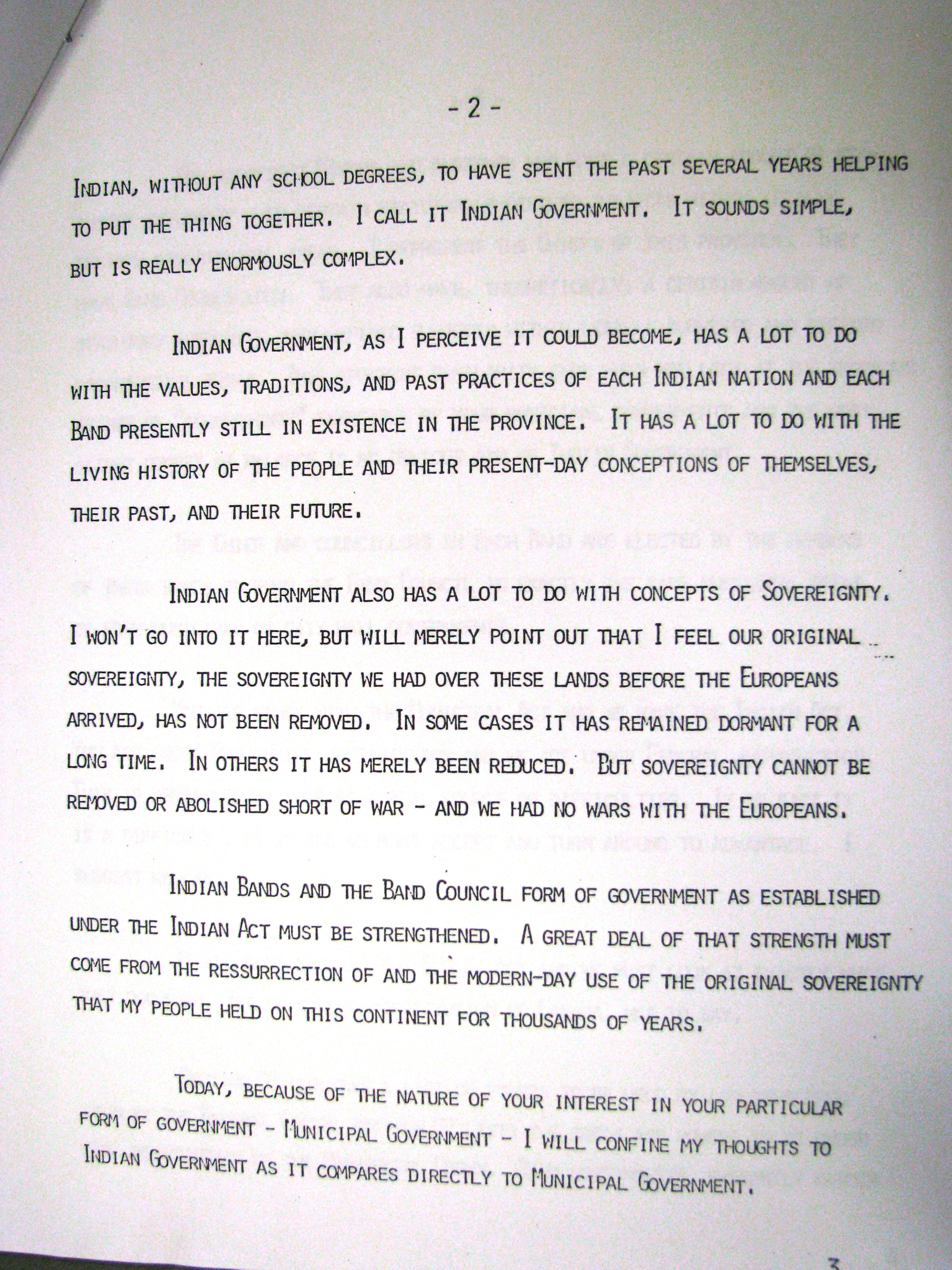
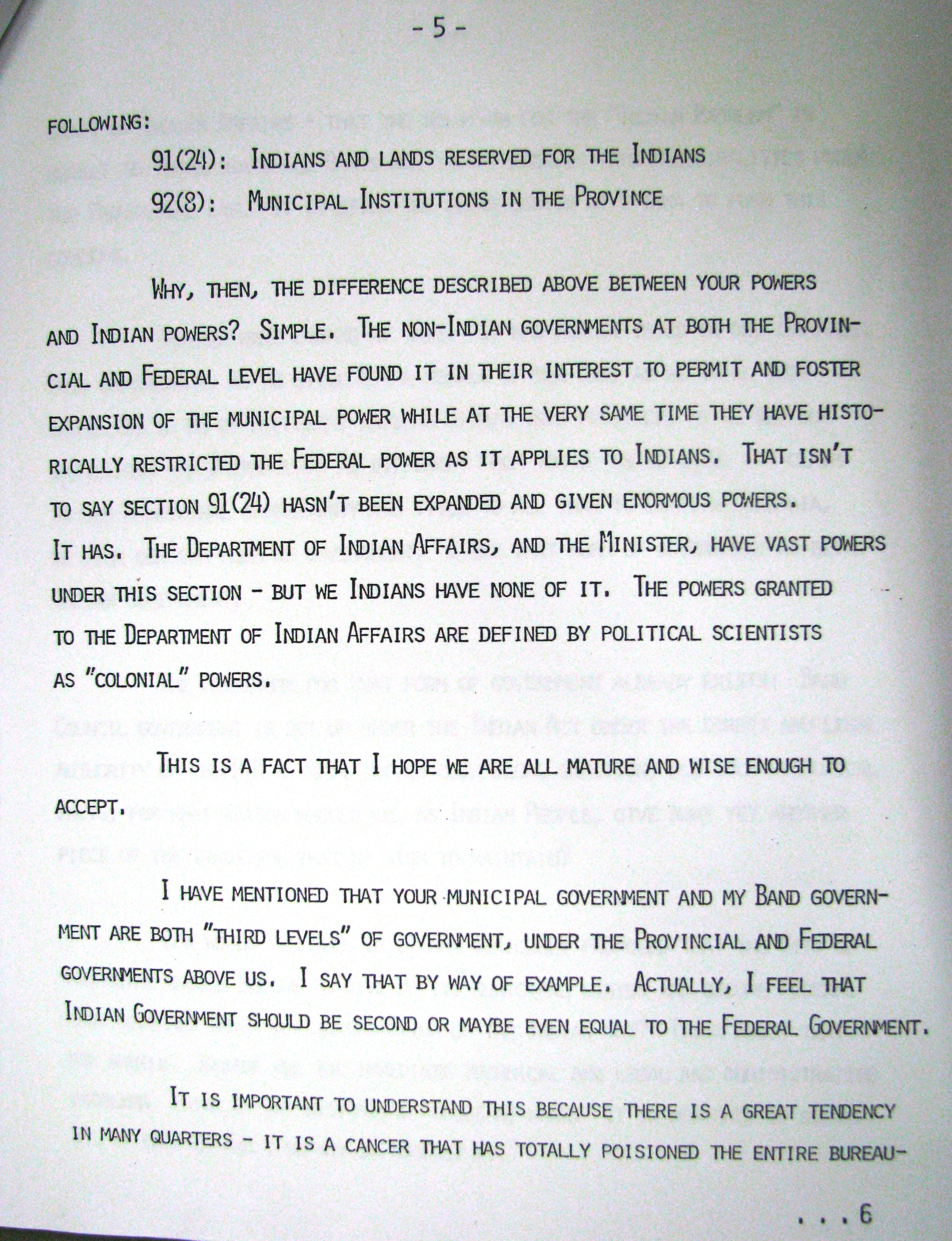
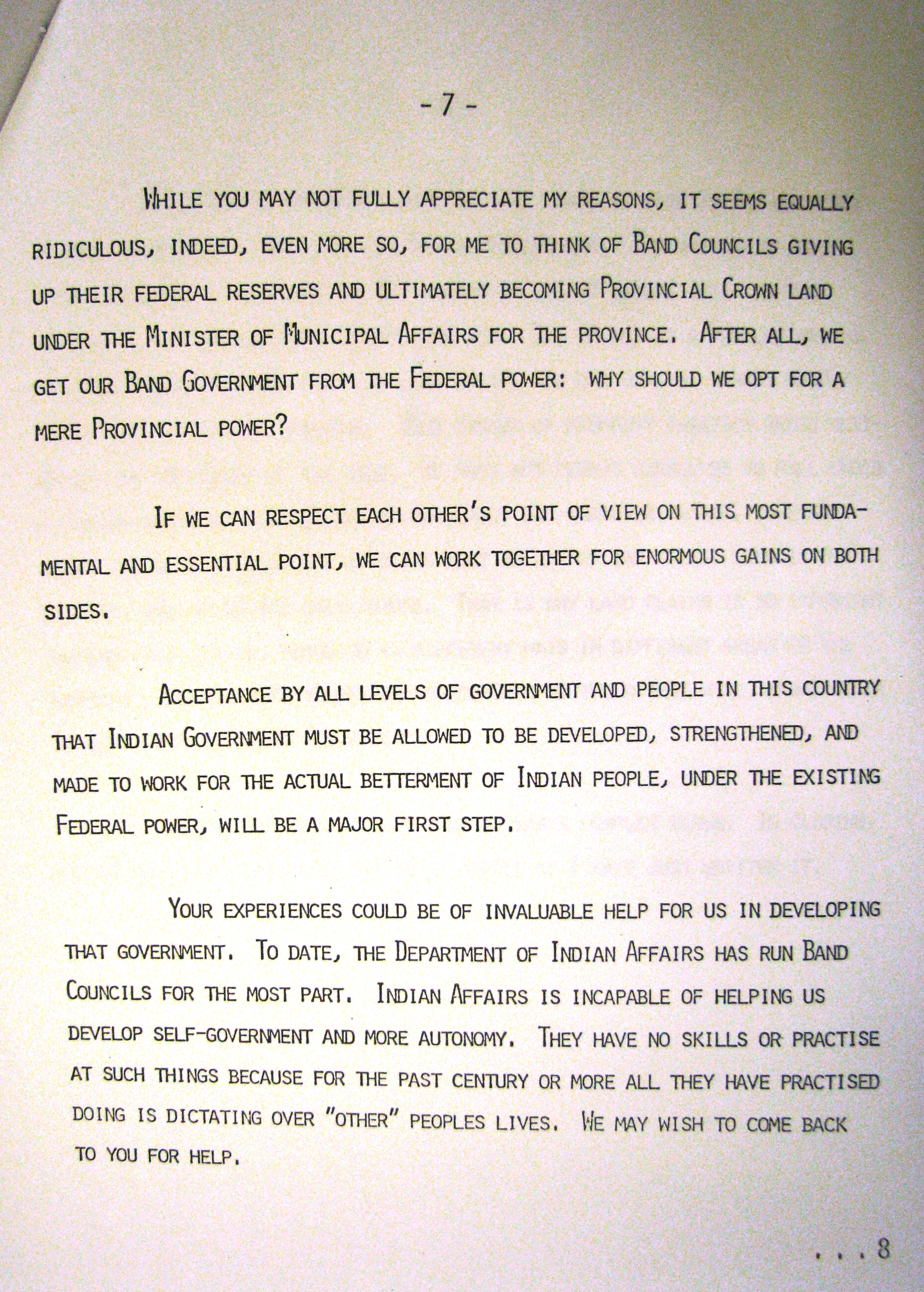
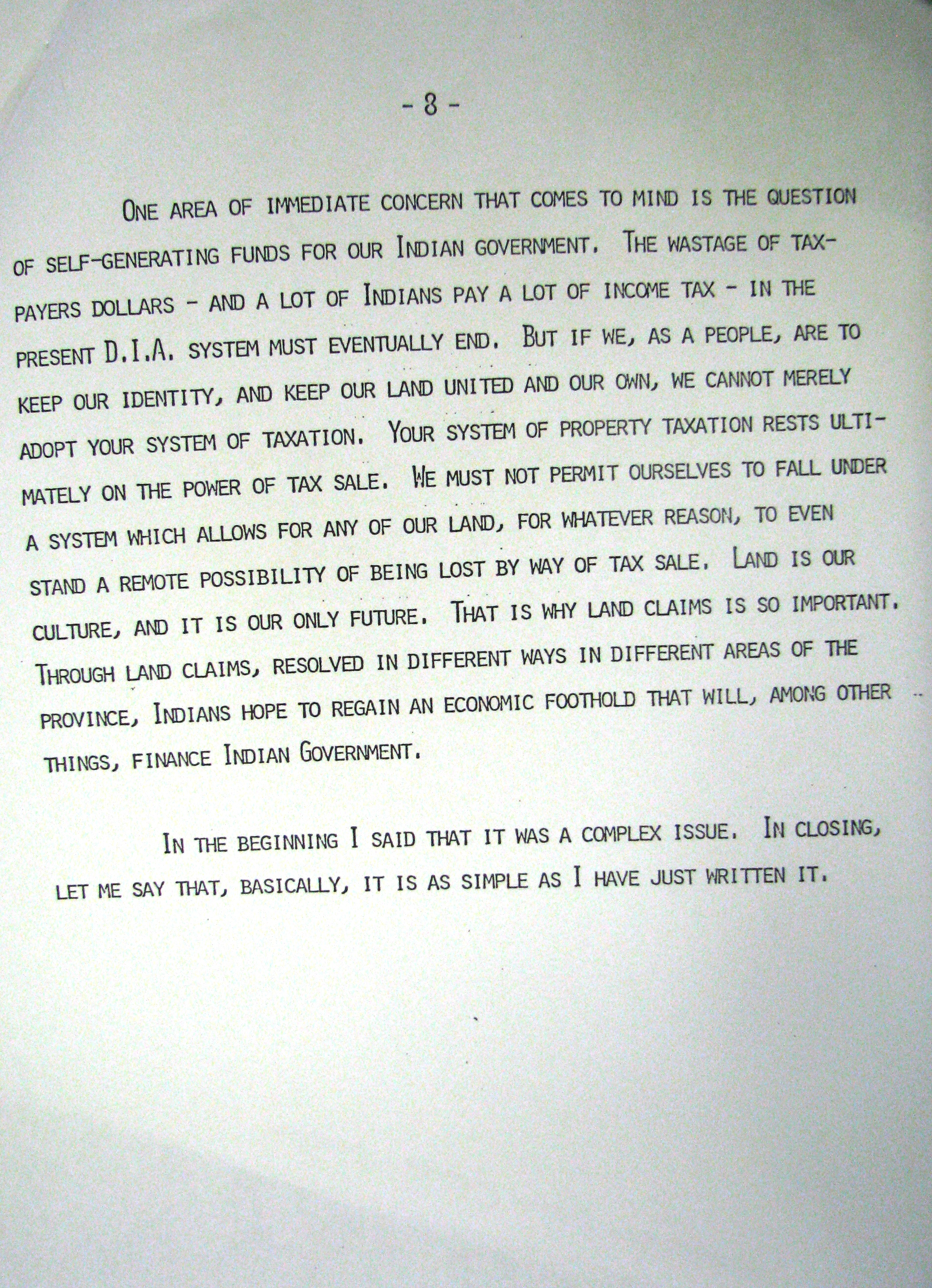
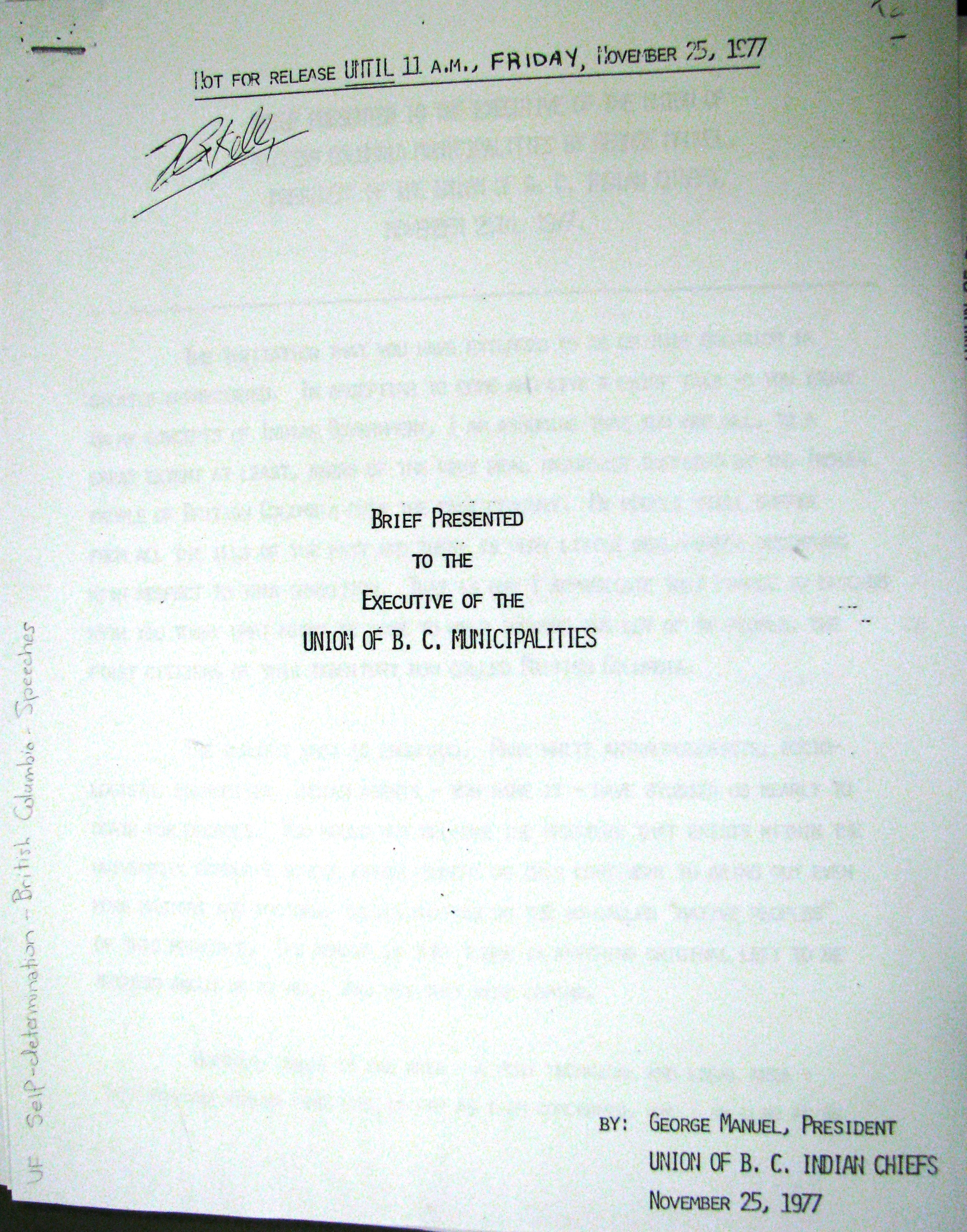
George Manuel addressing the Union of BC Municipalities, 1977

18 Sunday Jan 2015

Posted by Admin in Union of BC Indian Chiefs

≈ 1 Comment

Tags

aboriginal rights, aboriginal title, George Manuel, UBCIC

title page

page 1

page 2

page 3

page 4

page 5

page 6

page 7

page 8

Nuxalk Nation Position 1995

05 Monday Jan 2015

Posted by Admin in Indigenous Declarations

≈ 1 Comment

Tags

aboriginal rights, aboriginal title, Canadian Charter, House of Smayusta, INTERFOR, Ista, Nuxalk, Royal Proclamation 1763, Sovereignty

Nuxalk Nation Position

September 10, 1995

First of all we, the Nuxalk Nation, would like to acknowledge Tatau, The Creator, through Manakays, the Great Spirit, for all that he has provided since the beginning of time and still provides today.

We, the Nuxalk Nation, stand in the position of sovereignty against International Forest Products (INTERFOR). We cannot and will never as the Nuxalk Nation compromise this position.

The Sovereignty of the Nuxalk Nation comes from Tatau, the Creator. It is not granted nor subject to the approval of any other nation. As the Nuxalk Nation we have the sovereign right to jurisdictional rule within our own territory. Our lands are a sacred gift. The land is provided for the continued use, benefit and enjoyment of our people, the Nuxalkmc, and it is our ultimate obligation to Tatau, the Creator, to care for and protect it.

INTERFOR has continually raped our lands and continues to do so today! Our old villages, hunting grounds, fishing grounds, grave sites and sacred areas are being destroyed. Our fish and animals that we need to feed our peoples are disappearing. Our food plants, medicinal plants and trees are being trampled on and destroyed, all for the corporate value of the lumber.

We, the Nuxalk Nation, take this stand today and forever to state: “That we are appalled at what INTERFOR has done and is still doing today, to our Nuxalkmc Territory. We have never nor will we ever give our consent to INTERFOR or any other corporation to develop within our territory.

“Our territory is ours, the Nuxalkmc, and we have never ceded it to the Canadian or B.C. provincial government.

“Our nation is not interested in entering into any treaties (B.C. Treaty Commission), agreements or any sort of arrangement with the Canadian government or the British Columbia government concerning our Nuxalk Nation hereditary rights and title.”

The power that these two governments claim to have over our territory is an illegal power within their own jurisdiction as shown in the Constitution which reflects to the Royal Proclamation of 1763.

The following section is from the Canadian Charter of Rights and Freedoms to remind you that the Royal Proclamation is still legal and binding.

CANADIAN CHARTER OF RIGHTS AND FREEDOMS

Whereas Canada is founded upon principles that recognize the supremacy of God and the rule of law:

Guarantee of Rights and Freedoms….

General

  1. The guarantee in this Charter of certain rights and freedoms shall not be construed so as to abrogate or derogate from any aboriginal, treaty or other rights or freedoms that pertain to the aboriginal people of Canada including
  2. a) any rights or freedoms that have been recognized by the Royal Proclamation of October 7, 1763; and
  3. b) any rights or freedoms that now exist by way of land claim agreements or may be so acquired.

The following section is recited from the Royal Proclamation of October 7, 1763:

The Royal Proclamation of October 7, 1763, (by the King, A proclamation, George R)

And whereas it is just and reasonable, and essential to Our Interest and the Security of Our Colonies, that the several Nations or Tribes of Indians, with whom We are connected, and who live under Our Protection, should not be molested or disturbed in the Possession of such Parts of Our Dominions and Territories as, not having been ceded to, or purchased by Us, are reserved to them, or any of them, as their Hunting Grounds;

… beyond the Heads or Sources of any of the Rivers which fall into the Atlantick Ocean from the West and North-West, or upon any Lands whatever, which, not having been ceded to, or purchased by Us as aforesaid, are reserved to the said Indians, or any of them. And

…lying to the Westward of the Sources of the Rivers which fall into the Sea from the West and North West, as aforesaid; and We do hereby strictly forbid, …Our loving Subjects from making any Purchases or Settlements whatever, or taking Possession of any of the Lands above reserved, without Our especial Leave and Licence for that Purpose first obtained. And We …strictly …require all Persons… who have either wilfully or inadvertently seated themselves upon … Lands, which, not having been ceded to, or purchased by Us, are still reserved to the said Indians as aforesaid, forthwith to remove themselves from such Settlements.

… if, at any Time, any of the said Indians should be inclined to dispose of the said Lands, that same shall be purchased only for Us, in Our Name, at some publick Meeting or Assembly of the said Indians to be held for that Purpose by the Governor or Commander in Chief of Our Colonies  … and in case they shall lie within the Limits of any Proprietary Government, they shall be purchased only for the Use and in the Name of such Proprietaries, conformable to such Directions and Instructions as We or they shall think proper to give for that Purpose…

The sovereign Nuxalk Nation Chiefs have given INTERFOR notice that they are trespassing on Nuxalk Nation Territory that has never been sold or ceded, and that the Canadian court system has no jurisdiction over our territory. This is also to serve notice that we do not recognize any court injunctions served to any Nuxalkmc or to our guests (Forest Action Network) of the Nuxalk Nation invited into our traditional territory by our hereditary leadership.

So, with this, we, the Nuxalk Nation will do whatever we have to within our own traditional Nuxalk jurisdiction to stop INTERFOR from any development on our territory. We do this as our obligation to Tatau, the Creator, and also to ensure that our lands provided for our children, grandchildren and children yet unborn.

Way!

NUXALK STRONG NUXALK FOREVER

Signed:

Chief Nuximlayc (Lawrence Pootlass)

Chief Qwatsinas (Edward Moody)

Chief Liciwmutu7gayc (Taylor T)

Chief Slicxwliqw’ (Charles Nelson)

Chief Sats’alanlh (Peter Schooner)

…and others

House of Smayusta

PO Box 8, Bella Coola, V0T 1C0

Nuxalk Nation Position 1995 p.1Nuxalk Nation Position 1995 p.2Nuxalk Nation Position 1995 p.3

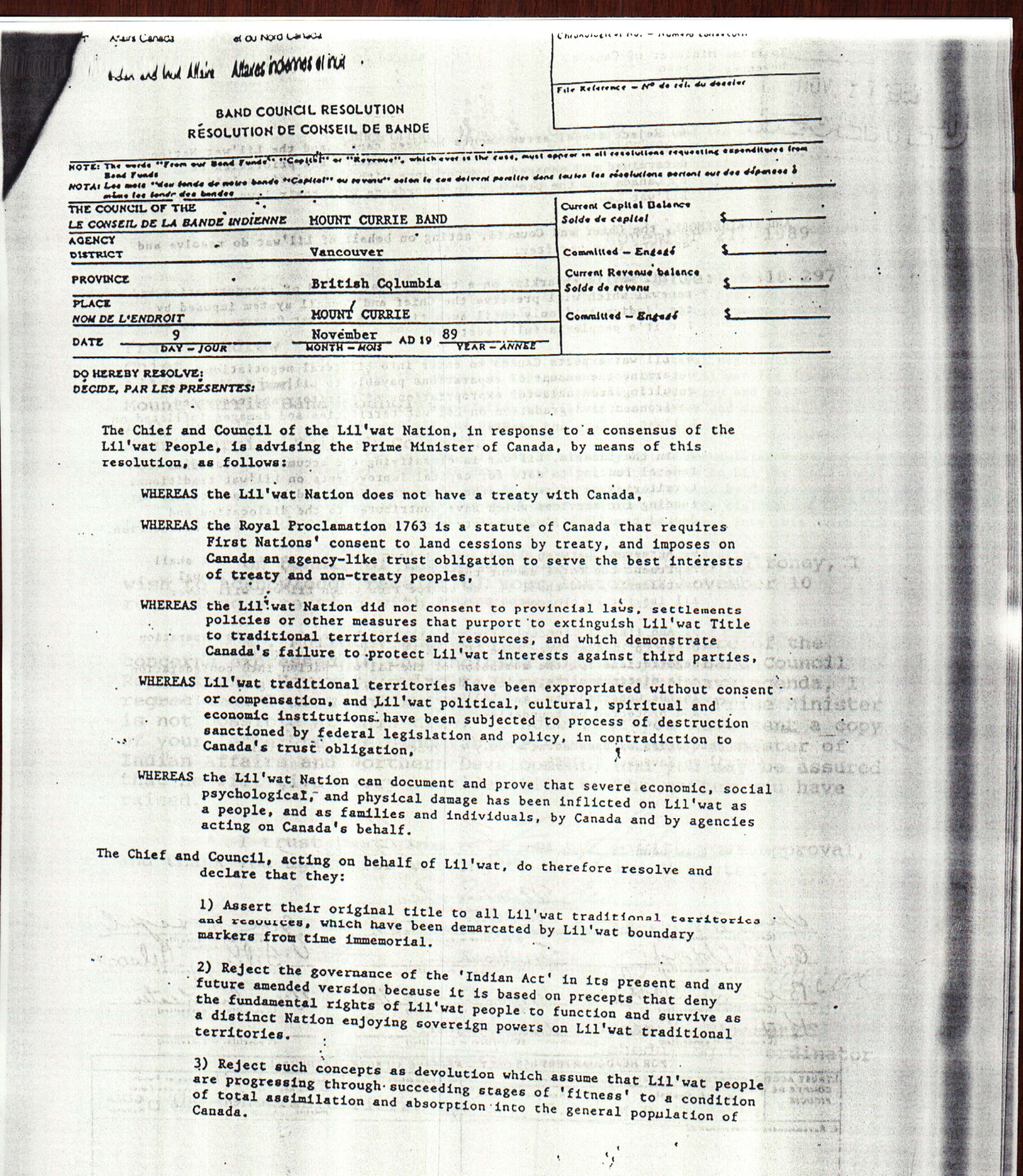
Lil’wat BCR 1989: to dissolve imposed ‘Indian Act’ band council

05 Monday Jan 2015

Posted by Admin in Indigenous Declarations

≈ 1 Comment

Tags

aboriginal rights, BCR, Canada, Canadian Constitution, Lil'wat

Band Council Resolution

The Council of the Mount Currie Band

Vancouver District

British Columbia

November 9, 1989

Do Hereby Resolve:

The Chief and Council of the Líl’wat Nation, in response to a consensus of the Líl’wat People, is advising the Prime Minister of Canada, by means of this resolution, as follows:

WHEREAS the Líl’wat Nation does not have a treaty with Canada,

WHEREAS the Royal Proclamation 1763 is a statute of Canada that requires First Nations’ consent to land cessions by treaty, and imposes on Canada an agency-like trust obligation to serve the best interests of treaty and non-treaty peoples,

WHEREAS the Líl’wat Nation did not consent to provincial laws, settlements, policies or other measures that purport to extinguish Líl’wat Title to traditional territories and resources, and which demonstrate Canada’s failure to protect Líl’wat interests against third parties,

WHEREAS Líl’wat traditional territories have been expropriated without consent or compensation, and Líl’wat political, cultural, spiritual and economic institutions have been subjected to process of destruction sanctioned by federal legislation and policy, in contradiction to Canada’s trust obligation,

WHEREAS the Líl’wat Nation can document and prove that severe economic, social, psychological, and physical damage has been inflicted on Líl’wat as a people, and as families and individuals, by Canada and by agencies acting on Canada’s behalf,

The Chief and Council, acting on behalf of Líl’wat, do therefore resolve and declare that they:

  • Assert their original title to all Líl’wat traditional territories and resources, which have been demarcated by Líl’wat boundary markers from time immemorial.
  • Reject the governance of the ‘Indian Act’ in its present and any future amended versions because it is based on precepts that deny the fundamental rights of Líl’wat people to function and survive as a distinct Nation enjoying sovereign powers on Líl’wat traditional territories.
  • Reject such concepts as devolution which assume the Líl’wat people are progressing through succeeding stages of ‘fitness’ to a condition of total assimilation and absorption into the general population of Canada.
  • Reject fiscal arrangements between Canada and the Líl’wat Nation which require that program design, standards and priorities be determined and managed in accordance with prescriptions laid down by Canada and the province in accordance with their laws, rather than Líl’wat laws.

AND FURTHERMORE, the Chief and Council, acting on behalf of Líl’wat do resolve and declare that hereafter:

  • Líl’wat is embarking on a transitional period of reconstruction and renewal which will preserve the Chief and Council system imposed by the ‘Indian Act’ only until such time as a Líl’wat Government by and for its people is fully restored.
  • Líl’wat expects Canada to enter into bilateral negotiations to determine the amount of reparations payable to Líl’wat for damages resulting from unlawful expropriations of territory and resources, environmental degradation on Líl’wat territories and damages inflicted on Líl’wat society and people.
  • In the interim, Líl’wat is classifying the accumulated value of federal funding to date for capital improvements on Líl’wat traditional territories as offsets to the reparation debt owed by Canada to Líl’wat. Funding for services which have contributed to the dislocation and degradation of Líl’wat society shall not be entered into this calculation.
  • Agreement between Canada and Líl’wat on a reparation amount shall represent the total amount that will be paid to Líl’wat in annual instalments, and shall be the source from which Líl’wat will cover all its future program costs.
  • And finally, concurrently with the discharge of Canada’s reparation debts to Líl’wat over time, Canada and Líl’wat will enter into negotiations for the admission of the Líl’wat Nation into confederation as a distinct society with a defined sphere of sovereignty entrenched in the Constitution, and Líl’wat territories permanently established and protected by boundaries.

This resolution was passed at a duly convened meeting of the Chief and Council on November 9, 1989.

A quorum of this Band is seven.

(Signed)

Chief Fraser Andrew

Councillors

Marie Leo

Vera Edmonds

Cecil M. Edmonds

Brian Lester

Katherine Wallace

Allan Stager

George Leo

Marvin Wells

Shirley Wallace

Joe Joseph

Felicity Nelson

Normaline Lester

MCIB BCR Nov 9 1989 - p 1MCIB BCR Nov 9 1989 - p 2

“ALL OUR RELATIONS” A DECLARATION OF THE SOVEREIGN INDIGENOUS NATIONS OF BRITISH COLUMBIA

05 Monday Jan 2015

Posted by Admin in Indigenous Declarations, Union of BC Indian Chiefs

≈ 1 Comment

Tags

aboriginal rights, aboriginal title, All Our Relations, Declaration, Indigenous Peoples, UBCIC

We, the Indigenous leaders of British Columbia, come together united and celebrate the victory of the Tsilhqot’in and Xeni Gwet’in peoples in securing recognition of their Aboriginal title and rights – and all those Indigenous Nations and individuals that have brought important court cases over the years resulting in significant contributions in the protection and advancement of Aboriginal title and rights, including the Nisga’a, Gitxsan, Wet’suwet’in, Haida, Taku River Tlingit, Musqueam, Heiltsuk and Sto:lo – shining light on the darkness of years of Crown denial of our title and rights. After pursuing different pathways, we now come together to make this solemn Declaration out of our common desire to be unified in affirming our Aboriginal title.

As the original Peoples to this land, we declare:

  • We have Aboriginal title and rights to our lands, waters and resources and that we will exercise our collective, sovereign and inherent authorities and jurisdictions over these lands, waters and resources,
  • We respect, honour and are sustained by the values, teachings and laws passed to us by our ancestors for governing ourselves, our lands, waters and resources.
  • We have the right to manage and benefit from the wealth of our territories.
  • We have the inalienable sovereign right of self-determination. By virtue of this right, we are free to determine our political status and free to pursue our economic, social, health and well-being, and cultural development.
  • We have diverse cultures, founded on the ways of life, traditions and values of our ancestors, which include systems of governance, law and social organization.
  • We have the right to compensation and redress with regard to our territories, lands and resources which have been confiscated, taken, occupied, used or damaged without our free, prior and informed consent.
  • We will only negotiate on the basis of a full and complete recognition of the existence of our title and rights throughout our entire lands, waters, territories and resources.
  • We acknowledge the interdependence we have with one another and respectfully honour our commitment with one another where we share lands, waters and resources. We commit to resolving these shared lands, waters and resources based on our historical relationship through ceremonies and reconciliation agreements.
  • We endorse the provisions of the UN Declaration on the Rights of Indigenous Peoples and other international standards aimed at ensuring the dignity, survival and well-being of Indigenous peoples.

We commit to:

  • Stand united today and from this time forward with the Tsilhqot’in and with each other in protecting our Aboriginal title and rights.
  • Recognize and respect each other’s autonomy and support each other in exercising our respective title, rights and jurisdiction in keeping with our continued interdependency.
  • Work together to defend and uphold this Declaration.

We, the undersigned, represent First Nations who carry a mandate to advance Title and Rights in our homelands today referred to as British Columbia and exercise our authorities in making this Declaration. We welcome other First Nations not present today to adhere to this Declaration if they so choose.

Signed by UBCIC Chiefs on November 29, 2007

← Older posts
Newer posts →

Subscribe

  • Entries (RSS)
  • Comments (RSS)

Archives

  • December 2025
  • October 2025
  • June 2025
  • May 2025
  • February 2025
  • September 2024
  • August 2024
  • July 2024
  • April 2024
  • March 2024
  • February 2024
  • September 2023
  • August 2023
  • June 2023
  • June 2018
  • December 2017
  • July 2017
  • January 2017
  • December 2016
  • July 2015
  • March 2015
  • February 2015
  • January 2015
  • December 2014
  • September 2014

Categories

  • Archive Quarterly
  • BC treaty process
  • Children
  • Commentary, editorial
    • Uncategorized
  • Comprehensive Claims – Policy and Protest
    • aboriginal title
  • Government Commissions
  • Gustafsen Lake Standoff 1995 – Ts'peten Defense, Secwepemc
  • Haida title
  • Indian Residential School
  • Indigenous Declarations
  • Non-Status Indian Era
  • Reconciliation
  • Roadblock
  • UN Engagement
  • Union of BC Indian Chiefs

Meta

  • Create account
  • Log in

Blog at WordPress.com.

  • Subscribe Subscribed
    • The West Wasn't Won
    • Already have a WordPress.com account? Log in now.
    • The West Wasn't Won
    • Subscribe Subscribed
    • Sign up
    • Log in
    • Report this content
    • View site in Reader
    • Manage subscriptions
    • Collapse this bar
 

Loading Comments...