• About The West Wasn’t Won archive project
  • Archive Quarterly
  • Children
  • Fisheries
  • Land of the Peoples
  • Lawfare
  • Non-Status Era
  • Roadblocks and Restitution
    • Gustafsen Lake
    • Haida
    • Líl’wat
    • Nisga’a

The West Wasn't Won

~ Outlive the colonial world.

The West Wasn't Won

Tag Archives: aboriginal title

“Establish Indigenous titles,” UN tells Canada

28 Tuesday Jul 2015

Posted by Admin in UN Engagement

≈ Leave a comment

Tags

aboriginal title, Canada, Human Rights Committee, Indigenous Peoples, National Inquiry into Missing and Murdered Indigenous Women, United Nations

2015

The Human Rights Committee has just released concluding observations on fifteen “principal matters of concern” with Canada. Five of those concerns pertain to Indigenous Peoples and the violation of their rights in the International Covenant on Civil and Political Rights.

The Committee’s recommendations leave little room for the kind of redirection and side-stepping that Canada’s delegation to the United Nations treaty body performed on July 7th and 8th in Geneva.

The state should find ways and means to establish Indigenous Peoples’ titles to their lands, as well as ensuring Indigenous consent to developments which might impact their titles and treaty rights.

As per its obligations under the Covenant, the state should conduct a national inquiry into the situation of missing and murdered Indigenous women and coordinate police responses across the country to prevent this type of violence, as well as completing investigations and prosecuting the perpetrators, providing reparations to the victims’ families, and addressing the root causes of this violence.

Canada should provide a report on its progress in these two areas within one year.

The state should resolve the gender inequity present in the Indian Act.

Canada is asked to “ensure the effectiveness of measures taken to prevent the excessive use of incarceration” of Indigenous individuals, and “further strengthen its efforts to promote and facilitate access to justice at all levels by indigenous peoples.”

And, under the umbrella of addressing “the precarious situation of Indigenous Peoples,” the Committee recommends “the State party should in consultation with indigenous people: a) implement and reinforce its existing programmes and policies to supply basic needs to indigenous peoples; b) reinforce its policies aimed at promoting the preservation of the languages of indigenous peoples; c) provide family and child care services on reserves with sufficient funding and; d) fully implement the recommendations of the Truth and Reconciliation Commission with regard to the Indian Residential Schools.”

Indigenous Peoples’ rights are taking up larger and larger proportions of the UN treaty bodies’ recommendations to Canada.

In March of this year, the UN Committee for Economic, Social and Cultural Rights put Indigenous Peoples’ rights to “freely dispose of their natural wealth” as the first matter on its List of Issues to the state. That was followed by requests for information on housing, health, physical safety, languages, standards of living and children and family protection among Indigenous Peoples. In 2012, the UN Committee for the Elimination of Racial Discrimination asked, in its Concluding Observations, for Canada to respond within one year on three issues concerning urgent human rights crises, resulting from racial discrimination, being experienced by Indigenous Peoples. Canada was scheduled for its next review under the Convention for the Elimination of all forms of Racial Discrimination this November – but it has been dropped from the list after asking for more time to prepare. Canada’s last review under the Convention for the Elimination of Discrimination Against Women led to the direct recommendation that Canada launch a national inquiry into the situation of missing and murdered Indigenous women.

After Canada’s Universal Periodic Review in 2013, two thirds of the statements made to Canada by the other member states of the United Nations were specific to Indigenous rights and violence against Indigenous women and girls. While all those were present in the advance unedited report, many were excluded from the edited final version.

The next treaty body to review Canada’s compliance with international human rights standards will be the Committee on Economic, Social and Cultural Rights, in March of 2016.

You can search for reports and recommendations from Canada’s reviews by United Nations treaty bodies here.

Canada’s laws, policy create “immunity” for perpetrators of violence against Indigenous women

12 Thursday Feb 2015

Posted by Admin in Commentary, editorial, Indian Residential School, Reconciliation

≈ Leave a comment

Tags

aboriginal title, IACHR, Missing Women, Murdered Women, National Inquiry into Missing and Murdered Indigenous Women

Report by Inter-American Commission highlights institutionalized discrimination; judicial ineffectiveness; culture of inequality.

The Inter American Commission on Human Rights has released a 125 page report on the situation of “Missing and Murdered Indigenous Women in British Columbia, Canada.” The IACHR is the most significant human rights mechanism in the Americas; it is an arm of the Organization of American States.

The report refers graphically to the many and frequent realities among indigenous women of violence, murder, suicide, poverty, discrimination, marginalization, imprisonment, psychological harm, child apprehension, social and cultural deprivation, lack of housing, lack of education; and it overwhelms the imagination.

“Discrimination” is the root cause of disproportionately high incidences of murder and disappearance of Indigenous Women, according to the report’s findings. In fact, its key recommendation to Canada focuses on the resolution of that deadly discrimination:

“…This means addressing the past and present institutional and structural inequalities confronted by indigenous women in Canada. This includes the dispossession of indigenous lands, as well as historical laws and policies that negatively affected indigenous people, the consequences of which continue to prevent their full enjoyment of their civil, political, economic, social and cultural rights.”[i]

Discriminatory practices and norms of the colonial process are now firmly embedded in Canadian law; in Canadian institutions such as the RCMP and the public education system; have caused very recent historical harms; and permit prejudice in the mainstream culture and society. The Commissioners have focused on substantial evidence of these many kinds of endemic discrimination and the link it makes to “immunity” for those who commit crimes against indigenous women.

It’s the real and perceived lack of consequences for crimes against indigenous women which results in their being eight times more likely to be murdered than Canadian women. (p.49 #90)

The Commissioners referenced a dozen major United Nations human rights treaties in order to deal with Canada’s rejection of the IACHR report (pp.57-63). The Inter American Commission has jurisdiction to look into human rights issues which are covered in the American Declaration on the Rights and Duties of Man, a treaty applicable to every state member of the Organization of American States, but in making its formal observations on the IACHR’s report, Canada suggested it “is not bound by obligations contained in human rights instruments to which it has not consented to be bound.”

An array of secondary factors contributing to the exceptional vulnerability of indigenous women are caused by the same dominant theme of discrimination. These are not the front-line brutalities of homicidal racists, but social and economic problems created by state laws and policies which expose indigenous women, uniquely, to those murderers. In its study the IACHR report has shown a number of mechanisms, many of them organized and funded by the state, which churn indigenous women out onto the street and into desperate circumstances.

The IACHR report is so extensive in its documentation and findings that Canada will now finally have the international reputation it deserves.

The types of recommendations the Commission concluded its report with were so basic, such as police training to accurately receive reports of missing women and girls; and so consistent with the calls for action coming from Indigenous Peoples and indigenous organizations for the past twenty years, such as support for victims’ families to pursue justice, and a national inquiry; that the “discrimination” Canada is charged with is clearly an institutionalized, active, and meaningful – if not coordinated – attack.

The Commission notes many instances of failures to prevent violence against these women and failure to properly punish, or even find, the offenders – but those failures have carried on for decades and even generations. The situation appears less like a “failure” of justice and more like a “success” for Canada’s overarching goal to control all the lands and resources without interference from Indigenous Peoples. But that reality is not contemplated in the IACHR’s highly political report.

The report is dated December 21, 2014, and was produced over the last two years from data provided by sources in Canada, international conferences, and interviews conducted by Commissioners during an official visit to investigate the circumstances surrounding the internationally infamous magnitude of violence against indigenous women and girls in Canada. The Commissioners travelled to and held meetings in Vancouver, Prince George and Ottawa in 2013.

The report focuses on British Columbia

The number of cases in BC is the highest across Canada with 160 cases: 28% of the database compiled by the Native Women’s Association of Canada (NWAC). The province with the second most cases is Alberta with only a little more than half the number from BC: 93 cases, 16% of the NWAC total. As of 2010, NWAC had compiled a list of 582 women and girls missing or murdered in the past 30 years. NWAC’s funding to pursue that documentation was cut off by the government of Canada in 2010.

The RCMP has disclosed a number of cases of murdered indigenous women which is double that of the NWAC data. In May of 2014, the report “Missing and Murdered Aboriginal Women: A National Operational Overview,” showed 1,181 cases of indigenous female homicides across Canada between 1980 and 2012. 120 of those cases have not been solved. This number only includes files held by the RCMP, and not provincial or territorial police organizations.

When the Walk4Justice group crossed Canada on foot, annually, between 2008-2011, organizers believed they had collected the names of over 3,000 indigenous women who had been murdered or disappeared.

While BC has the most documented cases of murder and disappearance, the IACHR report says:

“This figure does not include the potentially large number of cases that have not been documented due to marginalization and fear of the victims, and deficiencies in the investigation.” (p.17, A. 3)


Discrimination: in law, institutions and mainstream culture

RCMP and Discrimination

“The kinds of irregularities and deficiencies that have been denounced and documented include: poor report taking and follow up on reports of missing women; inadequate proactive strategies to prevent further harm to women in the Downtown Eastside; failure to consider and properly pursue all investigative strategies; failure to address cross-jurisdictional issues; ineffective coordination between police; and insensitive treatment of families.” (p.12 #6)

Relying on testimonials from family members of victims, Commissioners described a stark picture of the experience of reporting a missing woman or girl at a police station. Many families of victims told the Commissioners that “police officers did not take their complaints seriously and frequently stereotyped the women as transient.” (p. 35, #55) Stunned by the response of the RCMP when he tried to find out the progress of investigations into his sister’s disappearance, Siam Moody told Commissioners in Prince George, “For years the RCMP did not do anything, like if there were different rules for her.” (p. 35, #55)

A family member who went to RCMP to report a relative missing from the Downtown Eastside was told by the officer, “whoever is doing this is cleaning up the streets.” (p. 35, #57)

While the State advised IACHR Commissioners in 2013 that there is no waiting time to report a missing person, testimonies by families of missing women and girls repeatedly included being made to wait 72 hours before being allowed to report a person as missing, even if that person was a child. (p. 35, #58)

A report prepared by Human Rights Watch in 2013 documented the regular assault of Indigenous women by RCMP in northern British Columbia, and this was referenced by the IACHR in their study.

Commissioners often assumed a defensive posture in framing their report. Presumably this is because Canada’s response to their report was an attempt to dismiss or undermine the status of outstanding human rights violations on their own part. However, “…the Canadian state is obliged to continue the investigation of unsolved cases… The authorities cannot justify the failure to complete an investigation or prosecution on insufficient proof if the reason for the insufficiency is deficiencies or irregularities in the investigation.” (p.13 #12)

One of the fifteen recommendations the IACHR made to Canada to help it solve the problem of high rates of murdered and missing indigenous women was development of policy for officials responding to a case of a missing person, in particular an indigenous woman. Another recommendation suggested oversight of officials involved in such investigations, and mechanisms to hold them accountable. Of all the irregular and questionable actions taken by police, at least those analyzed in the BC Missing Women’s Commission of Inquiry, no charges were pursued against those officers – because they had retired.

The state has an obligation to prevent violence, through all kinds of means such as public education; prohibitively effective sentencing for offenders; and even warning potential victims when a threat has become noticeable. (p.77 #171-177) The failure to prevent demands compensation, and an investigation into what caused the failure. The Vancouver police, the RCMP and Crown counsel could have taken a number of measures to prevent the death toll exacted by Robert Pickton. Today there are over 90 children of the deceased victims who are eligible for compensation for that failure.

The IACHR referred to a Human Rights Council resolution from 2010 regarding the state’s obligation to “exercise due diligence to prevent, investigate, prosecute and punish the perpetrators of violence against women and girls, and that the failure to do so “violates and impairs or nullifies the enjoyment of their human rights and fundamental freedoms.”” (p.72 #156) And, significantly, “…a state may incur an international responsibility for failing to act with due diligence to prevent, investigate, sanction and offer reparations for acts of violence against women, a duty which may apply to actions committed by private actors in certain circumstances.” (p.73, #158)

The connection between police and the fact that Pickton continued to murder for two decades bears closer scrutiny. The word on the street is that a sex worker went in to the Vancouver Police Department to report her assault the night before at “Piggy’s Palace,” as the Pickton property was known, only to see one of the men from the incident standing on the other side of the counter in VPD uniform. She did not carry through with the report. A more heavily documented connection has appeared in the form of Corporal Jim Brown who, at the same time as working in an official capacity for the Missing Women’s Commission of Inquiry, posed in a staged series of photographs: kidnapping a dark haired woman from the Downtown Eastside of Vancouver; removing her to an isolated area; caging her; threatening her with knives; and showing sexual satisfaction. Brown was based in the RCMP detachment in Coquitlam, the same city where the remains of 49 women were found at Pickton’s pig farm. The Missing Women Commission of Inquiry was examining why it took police so long to catch Pickton. Brown played a “minor role” during the investigation of Pickton, according to VPD. Those connections aren’t questioned in the IACHR report but they include that in his report on the Missing Women Commission of Inquiry, Commissioner Oppal “noted that there were allegations of conspiracy and cover-up on the part of the police forces.” (p.90 #207)

The State provided one example of positive developments between RCMP and local people, the E-PANA Task Force which connects RCMP and the Carrier Sekani Family Services, among others. The CSFS at least reported improvements in safety and a positive experience. The Force was focused on increasing the speed of communication between police and community members, public outreach and more, and its funding was all but discontinued last year. The E-Pana task force, an RCMP investigation into eighteen deaths along the Highway of Tears, produced one suspect but was unable to link him to any other murders, most victims were Indigenous women, since it started in 2006 and spent $25 million.

Canadian Law and Discrimination

The Indian Act, and Indian Status, is identified in the report as a major cause of psychological, emotional, cultural and economic harm to indigenous women, leading to their increased vulnerability to predators. Poverty and homelessness are two of the main impacts of Canadian law concerning Indigenous women considered in the report.

Until 1985, indigenous women who married had to transfer their Band membership to the man’s Indian Band. Returning home from a failed marriage would be difficult, as Band membership is connected to eligibility for housing, and housing is inadequate for current needs on the Reserves to the effect that some waiting lists are fifteen years long. Indian women who married non-Indian men lost their Indian Status, they had children who could not be registered as Status Indians, and they lost rights to whatever minimal economic benefits may have come from Band membership. Although changes have been made, since 1985, to reverse some of these exclusions, the Indian Act “fails to fully address remaining concerns about gender equality.” (p 41, #68)

The resulting homelessness has been a major factor in exposing indigenous women to assault. Homelessness also makes all kinds of personal development, including economic and social, unreachable.

Canada has a very large carpet especially designed for sweeping problems connected to Indigenous Peoples under. It stretches out between the power of the federal government concerning aboriginal people, or Indians, and the provinces’ power over matters which affect aboriginal people. Sometimes, as in the case of on-reserve social services, only the federal government is involved – and other times, for instance when enforcing laws of general application, the province is involved. When there is a problem, an issue, or even a crisis of these proportions being studied here, the two governments can both refuse responsibility on the grounds that the problem is within the other’s jurisdiction. The State’s use of this trick was identified many times as having played a part in the ongoing nature of murders and disappearances of Indigenous women across Canada.

The BC Committee for the Elimination of Discrimination Against Women summarized another of the substantial impacts of the legal gap this way:

“Aboriginal women continue to be denied essential forms of assistance and to receive piece-meal services because of the lack of clarity about legislative jurisdiction and the competing interests of federal, provincial and territorial governments regarding governments’ constitutional, moral and financial responsibilities for providing services to Aboriginal peoples. This issue was first identified over 35 years ago, yet little has been done to ameliorate the situation.” (p.86, #191)

The IACHR report recommends Canada solve that problem.

The Commission identified the “structural discrimination” which is the Indian Act. It noted that in cases where discrimination is actually part of a State’s legal structure, work must be done not only to remove the sub-standard laws but to promote those who were discriminated against back into a position of equality. (p.66 #132)

Canadian Courts and Discrimination

The report summarizes the terrifying crimes of serial killer Robert Pickton, who is thought to have murdered 49 women around Vancouver – most of them Indigenous women. The Pickton case was closed by the courts after he had been found guilty of six counts of second degree murder and sentenced with six terms of life imprisonment. Trial to determine the fate of the other women believed to have been murdered by Pickton was never held, as those proceedings ‘couldn’t increase his sentence.’ The failure of the courts to see that justice was done for the other victims, and their families, does not seem to have been a consideration for the courts and this is noted by the Commission.

The report remarked on BC Judge David Ramsay sexually assaulting four Indigenous girls who had all appeared before him in youth or family court. The judge’s crimes continued for two years after an RCMP investigation began in 1999.

Unfortunately the IACHR never quite identifies what it is about Canadian law that is at the center of the “discrimination” they have uncovered. Canadian law and its imposition and enforcement in Indigenous homelands where there are no treaties to legitimize that law is the original, essential violation of the human rights in question. It is that dehumanization of Indigenous individuals and the centuries long all-out assault on their people, national economies, cultures, spiritual life – all in a competition for control of the land and resources – which is the wellspring of unrelenting hate, violence and dismissal today.

There are dozens of references to recent IACHR cases which should be informing Canada’s response to the crisis. Violence against Indigenous women is a not unique to Canada – it is widespread throughout the Americas. Cases from South America in particular are very clear on the fact that “judicial ineffectiveness” is the same as impunity for offenders against Indigenous women (p.81 #184). And judicial ineffectiveness is also widespread when it comes to providing a climate of impunity for crimes against Indigenous individuals, and women, throughout the Americas – but it is not acceptable, and instead of incorporating the development of human rights available through the IACHR, Canada isolates itself and has to be found out and directly advised of the dozens of precedents which should be influencing Canadian judges and the entire court system.

“The Inter-American system has consistently found that a lack of due diligence that leads to impunity, and engenders further incidents of the very violence that was to be targeted, is itself a form of discrimination in access to justice. The Inter-American jurisprudence has established that States have the obligation to use all the legal means at their disposal to combat such situations, “since impunity fosters chronic recidivism of human rights violations, and total defenselessness of victims and their relatives.”” (p.81, #183. Quote from I.A. Court H.R., Loayza Tamayo Case Reparations, 1998.)

After the Missing Women’s Commission of Inquiry, BC, an advisory committee was appointed to oversee the province’s implementation of the recommendations. In May of 2013, the Honourable Steven Point resigned as Chair and has not been replaced. The IACHR “has not been informed who is currently chairing the Advisory Committee and what other steps have been taken to implement the recommendations…” (p.117 #291)

Commissioner Oppal’s report highlighted two urgent actions: a grant to the WISH drop-in center in the Downtown Eastside, which has been achieved by BC, and a public transit system on Highway 16, on which subject no tangible progress has been seen. Oppal made no legal findings of discrimination during the Commission. The Union of BC Indian Chiefs made a statement about how: “the failed inquiry, far from assisting Indigenous women from the Downtown Eastside, ironically reinforced their marginalization.” (p. 97 #226)

Cultural Enforcement of Discrimination

Indigenous women have major barriers to keeping housing in their home communities, because of the Indian Act, and lack of housing is directly connected to the violence in question. Victims had levels of education far below Canadian averages, but in keeping with the fact that as of 2006, 35% of indigenous women over the age of 25 had not graduated from high school. There is a direct link between lack of education and victims of violent crime – and lack of success in public schools by Indigenous students is exacerbated by the climate of aggressive cultural assimilation in the school cultures, text books and exercises there. In 2005, the median income for indigenous women was $15,654. This group has double the poverty rate of non-indigenous women – a direct result of BC and Canada’s ongoing legacy of dispossessing indigenous nations, refusing to recognize their human rights and criminalizing the people for accessing the natural wealth and resources of their homelands. Poverty is a general state of vulnerability notoriously connected to violence.

Lawyers’ Rights Watch Canada and the BC CEDAW group made a submission to the UN Committee for the Elimination of all forms of Racial Discrimination that remarked on “institutional racism towards Aboriginal people, and towards Aboriginal women and girls… with respect to the child welfare and criminal justice systems, and in the provision of education… and other essential services.” (p.76 #165)

Perhaps the most obvious expression of discrimination, representing the whole of Canadian society, is the state’s total public and institutional dismissal of these facts among indigenous women and the resulting crises in their homes and communities and nations. The report includes state acknowledgment that there is no accurate, comprehensive government data on this issue, although the high rate of missing and murdered indigenous women and girls across the country has been identified at the national and international levels. Police still do not consistently report whether a victim is indigenous. Police often fail to take or properly process reports concerning indigenous women.

Canada has failed, after 29 official inquiries in various places across the country since 1996, even to implement an incident processing policy that would collect the proper data needed to move in an informed direction.

And Prime Minister Harper recently told CBC television viewers that a federal inquiry into the preponderance of murdered and missing indigenous women “isn’t really high on our radar, to be honest. You know, our ministers will continue to dialogue, ah, with, ah, those who are concerned about this.” The PM went on to say that the government is taking action by punishing criminal activity, making “significant investments into, ah, preventative measures,” and to “try and enhance the legal and social status of women in aboriginal communities and reserves. You know, things like, basic things like having protections under the Human Rights Act, matrimonial property rights, these kinds of things that were not done in the past.”

Harper said action would be better than more investigations. The quality of Canada’s investigations into this subject has been found objectionable by women’s and Indigenous Peoples’ organizations, in particular Canada’s “All Party Committee” report in March 2014. Apparently it was the same as a report from 2011. (p.93, 216) The IACHR referred to almost a dozen reports prepared by the State on missing and murdered Indigenous women – and along with each reference the disappointment and rejection of Indigenous parties was quoted.

Indigenous leaders from all over northern North America, and indeed from around the world, have been calling for a national inquiry into the genocidal proportions of the assault against Indigenous women and girls. Tribal Chief Shane Gottfriedson, Shuswap Tribal Council, Secwepemc, to CFJC tv news, Kamloops: “…a lot of our families have lost loved ones to the missing and murdered women file.

“This has got to stop. We cannot have our women and girls subject to this kind of treatment,” said Chief David Walkem, Cook’s Ferry, Nlaka’pamux. Chiefs Walkem and Gottfriedson, along with Grand Chief Stewart Phillip, Union of BC Indian Chiefs, held a news conference calling for a federal inquiry. They held the conference to publicly add their names to a list of Indigenous leaders across Canada who have directly petitioned the federal government for an investigation. “We call on Prime Minister Harper to initiate a national public inquiry into this to allow a comprehensive investigation of all police services and all agencies involved in this issue across the country and get to the bottom of the reasons why this has been allowed to carry on.” The Assembly of First Nations has repeatedly called for an inquiry, most recently at their Annual General Assembly in Halifax last Fall.

The Native Women’s Association of Canada collected 23,000 signatures to a petition calling for a national inquiry. Other notable characters who have made formal recommendations to Canada to conduct a national inquiry include the UN Committee for the Elimination of all forms of Racial Discrimination, in 2012; the UN Human Rights Committee, in 2013, on the occasion of Canada’s Universal Periodic Review; and UN Special Rapporteur on the Rights of Indigenous Peoples, in his report on his official country visit, in 2014; and now the IACHR.

The IACHR report notes “Violence against women is not the root problem in most societies, violence against women occurs because other forms of discrimination are allowed to flourish.” (p.68 #68) The Canadian Panel on Violence Against Women stated in its 1996 report, “Racism is a major contributing factor in the continuing violence, oppression and systemic abuse that confronts Aboriginal women in Canadian society today.” (p.69 #144) Commissioners needed three pages in their report to refer to the connections between racism and violence against women. (pp.68-70)

When BC established the Minister’s Advisory Council on Aboriginal Women, the Minister selected the women to populate the Council. The IACHR recommends BC seek recommendations or appointments to that Council from Indigenous Peoples’ organizations.

Canada’s disinterest in the crisis is a failure to meet its international obligations. The Inter-American human rights system confirms appropriate state response to human rights violations: the obligations to prevent, investigate, punish, and to make reparations for human rights violations. (#153, p.71)

The “seven point plan” provided by Canada to the IACHR Commissioners during their visit does not include prevention, investigation and increased sentencing – instead it pertains almost entirely to coordinating online databases and giving money to Indigenous organizations to express themselves on the point of missing and murdered Indigenous women. The State’s plan is about as obvious as if they had dressed up Robert Pickton as Mrs. Doubtfire and put him in charge of a new public Missing and Murdered Women liaison office. But Pickton died in prison only months into his sentence. Perhaps he had accomplices who were happy to remain anonymous.


Historical harms

The Commission identifies in detail two past genocidal, or “discriminatory” – as the IACHR puts it, practices which have particularly affected the present day victims. They are Indian Residential Schools, and the invention of Indian Status and selective enrolment in that group according to whether a person is male or female. They note this latter practice has not been fully resolved by recent changes to the Indian Act, but they overlook the fact that Indigenous children would be seized from their families if those families refused to send them to the racist and assimilationist public schools today. The Commission does note, however, that the number of Indigenous children in state “care,” ie, having been forcibly removed from their families, is three times higher now than it was at the peak of the Indian Residential School era.

Canada’s withholding of Indian Status from women who married non-native men, and from children of those women, “creates a perception that certain subsets of Indigenous women are less purely indigenous than those with “full” status. This can have severe negative social and psychological effects on the women in question, even aside from the consequences for a woman’s descendants.” (#69, p. 42) This is of course also a serious violation of an Indigenous People’s right to self-determination and to guarantee membership to their own.

Indian Status on Reserve has also been a source of absolute sex discrimination, where women could not own property, cannot keep their birth Band membership once married, cannot leave an abusive relationship because of the lack of housing and certainty that their children would be apprehended if they did leave because they could not provide a house for their children independently.

State apprehension of Indigenous children by Canada and the provinces is so extreme that, “The IACHR is alarmed by the over representation of indigenous children and youth in the child welfare system.” (#86, p.47)

The IACHR quoted a report by the UN Committee on the Rights of the Child in respect of those many Indigenous children who are seized from their homes by the State, placed in homes far away and consumed by the so-called child welfare system. “The UN Committee noted that such children are often unable to preserve their identity, claim their rights, and make and maintain connections to their families, communities and culture.” (#86, p.47)

Discrimination or Genocide

“This persistence of longstanding social and economic marginalization has given rise to large numbers of indigenous women living in vulnerable situations, including homelessness, and abusive relationships. It has led to the disproportionate engagement of indigenous women in high-risk activities such as hitchhiking, drug use, gang activity, and prostitution… making it more difficult for these indigenous women to escape the vicious cycle of violence.” (#78, p.44)

“…the root causes of these high levels of violence against Indigenous women… are related to a history of discrimination beginning with colonization and continuing through laws and policies… These root causes have laid the foundations of pervasive violence against indigenous women, and have created circumstances that contribute to the risks these women face, through economic poverty, social dislocation, and psychological trauma.” (#93, p.50)

Although the Commission never literally says so in the report, it has made statements like this one which match the definition of genocide, as defined in the UN Convention. Genocide is defined as any of five actions, the third of which is: “Deliberately inflicting on the group conditions of life calculated to bring about its physical destruction in whole or in part.” What has not been studied by the IACHR is the impact of these deadly circumstances for women, rooted in state laws and policies, on the collectives of Peoples.

“Mental harm” is referred to repeatedly throughout the report in the way it is experienced by indigenous women: as “psychological trauma” and “crisis of identity” and “suicide” – rates are seven times higher among indigenous women than Canadian women. The entire report is a demonstration of the ways that Canada is “Causing serious bodily or mental harm to members of the group” – or facillitating the bodily and mental harming by squeezing Indigenous women out of their homes and communities and failing to penalize offenders.

“Forcible removal of children” from the group has its own chapter in the IACHR report and is broken down into the many ways the State has removed indigenous children to other groups; the statistical nightmare lived by those removed children; and the incredible proportion of indigenous versus Canadian children who are apprehended by the state: they are overrepresented by five times the proportionate ratio in Canada’s population, and that does not include numbers of children in provincial and territorial care. The report includes documentation that the children are ten times more likely to be removed from their homes by the State than Canadian children are.

And of course, the first definition of genocide is: Killing members of the group.

About the IACHR’s role

Next to the Inter American Court, the Inter American Commission on Human Rights makes studied recommendations to states on the subject of upholding human rights and also mediates communication between states and their victims, sometimes referring those disputes to the Court.

Canada rejected the IACHR’s recommendations on the situation of the human rights of missing and murdered indigenous women in BC. Formally responding to the Commission in its observations of the report, Canada stated: “Canada… is not bound by obligations contained in human rights instruments to which it has not consented to be bound. … We give serious consideration to the views and recommendations of human rights bodies, but wish to emphasize that they are non-legally binding.” (#106, p.58)

However, the obligation to comply with the human rights standards expressed by the Charter of the Organization of American States is implicit in the action of becoming a member state of the OAS. The American Declaration on the Rights and Duties of Man, flowing to the American Convention, is the document against which the IACHR compares State activities and practices.

The Commission followed Canada’s reply by reiterating its jurisdiction as a mechanism of the OAS to which Canada belongs; remarking that human rights must not only be protected from active violation but also ensured the capability of being practiced effectively, for instance, an indigenous woman should be able to exercise her right to equality; and that while the Commission cannot apply the American Convention on Human Rights to Canada, because Canada has not ratified it, the Commission must rely on the Convention in interpreting Canada’s obligations under the American Declaration. (* A Declaration establishes rights and freedoms or duties, while the Convention is a pact between the states as to the legalistic phrasing of the exact obligations a state has towards an individual, against which a state would be judged in Court.)

The Commission reviewed Canada’s obligations to protect Indigenous Peoples and individuals, noting the State’s national legal framework and its international obligations. Canada’s constitutional structure, requiring treaty with land purchase before colonization, was noted by the IACHR. (#113, p.60)

Other IACHR hearings leading to this study:

March 28, 2012, “The Situation of Aboriginal Women and Girls in Canada.” Requested by NWAC, the Canadian Feminist Alliance for International Action, and the University of Miami Human Rights Clinic. A second hearing on this subject on March 12, 2013.

[i] If you look at Canada’s Sixth Periodic Report to the United Nations Human Rights Committee on the International Covenant on Civil and Political Rights, you will see that Canada does not report on Indigenous Peoples’ land rights under Article 1 on self-determination but under Article 27 as minorities subject to the federal and provincial government.  (Thanks to Arthur Manuel for this information.)

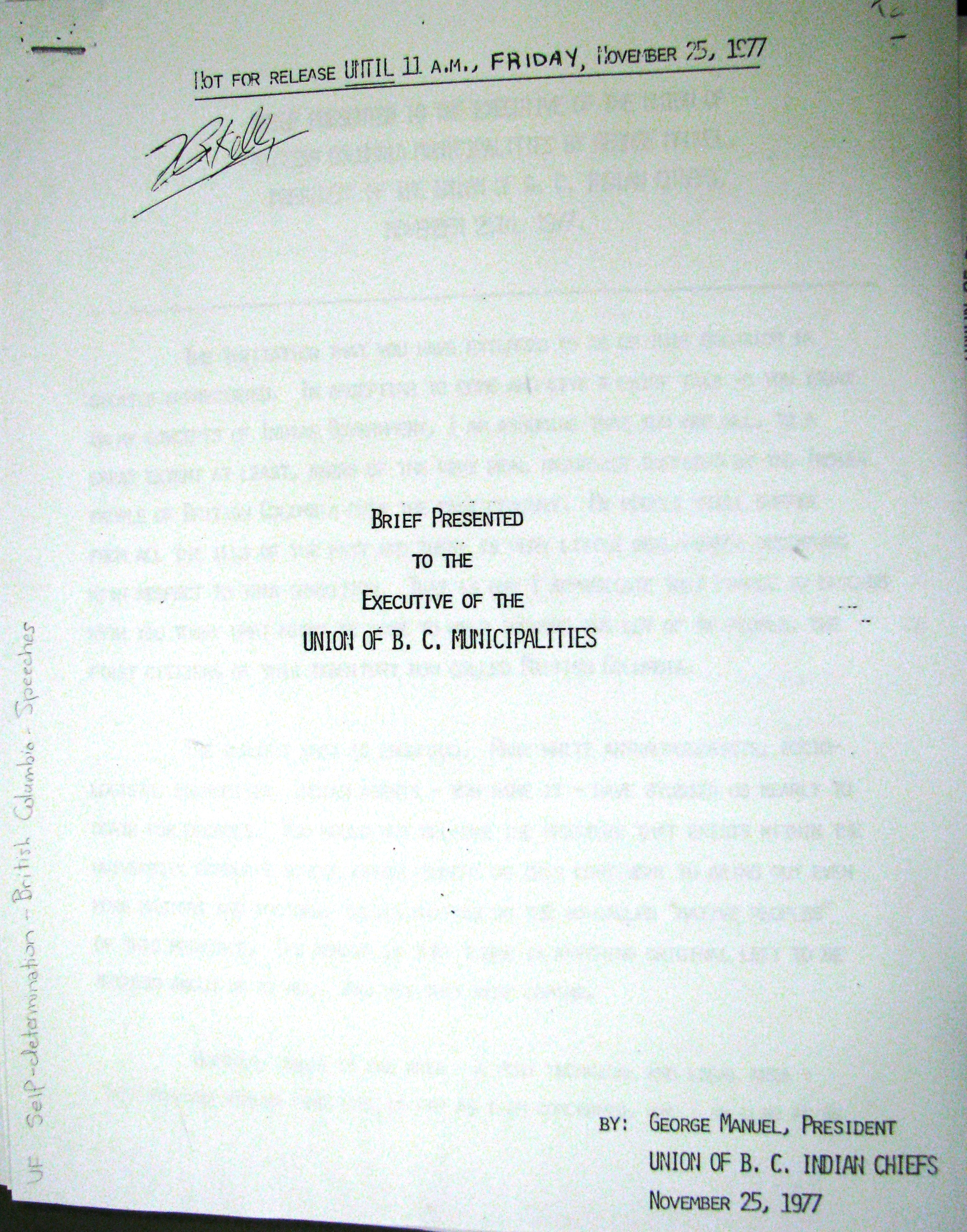
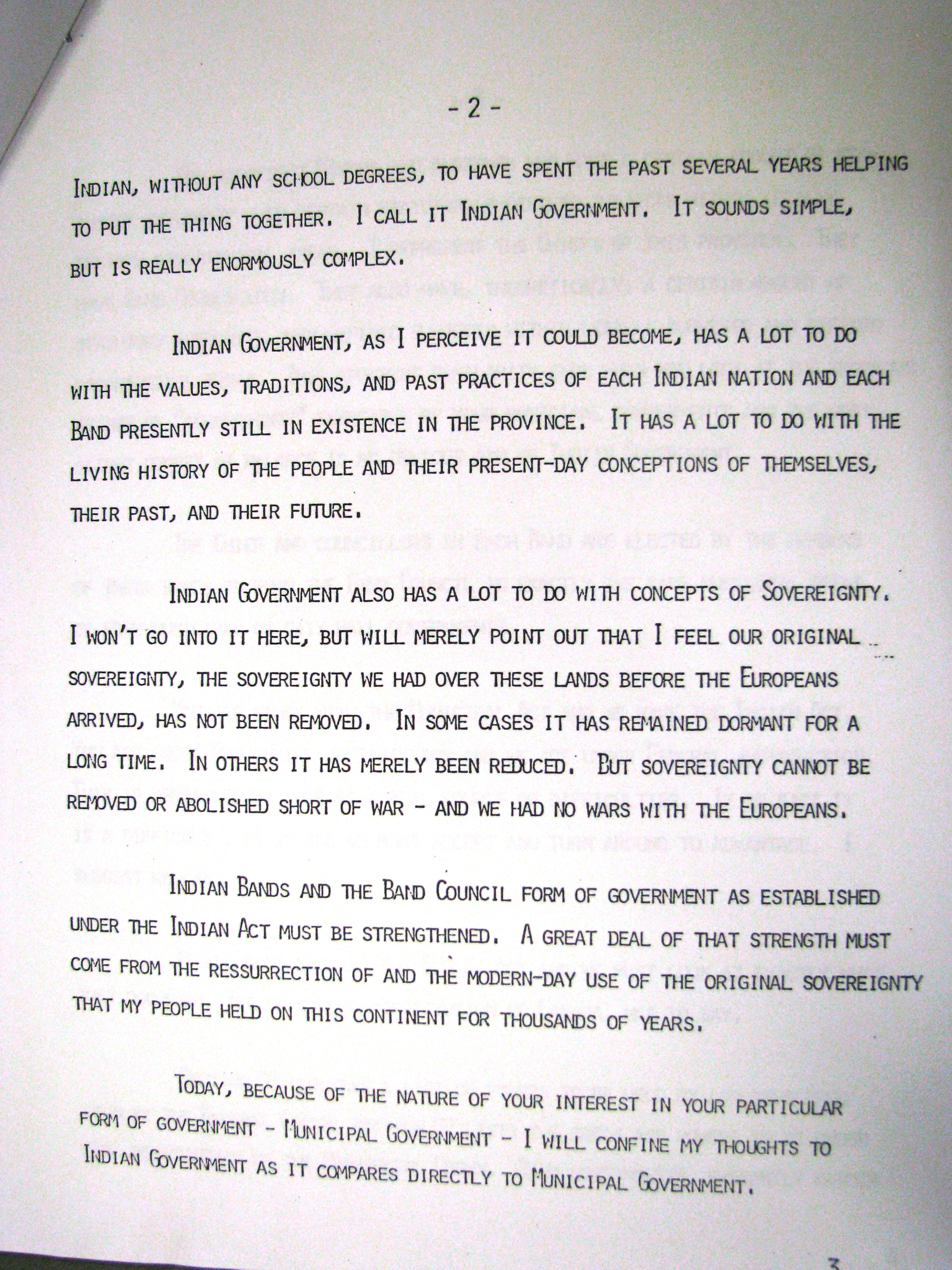
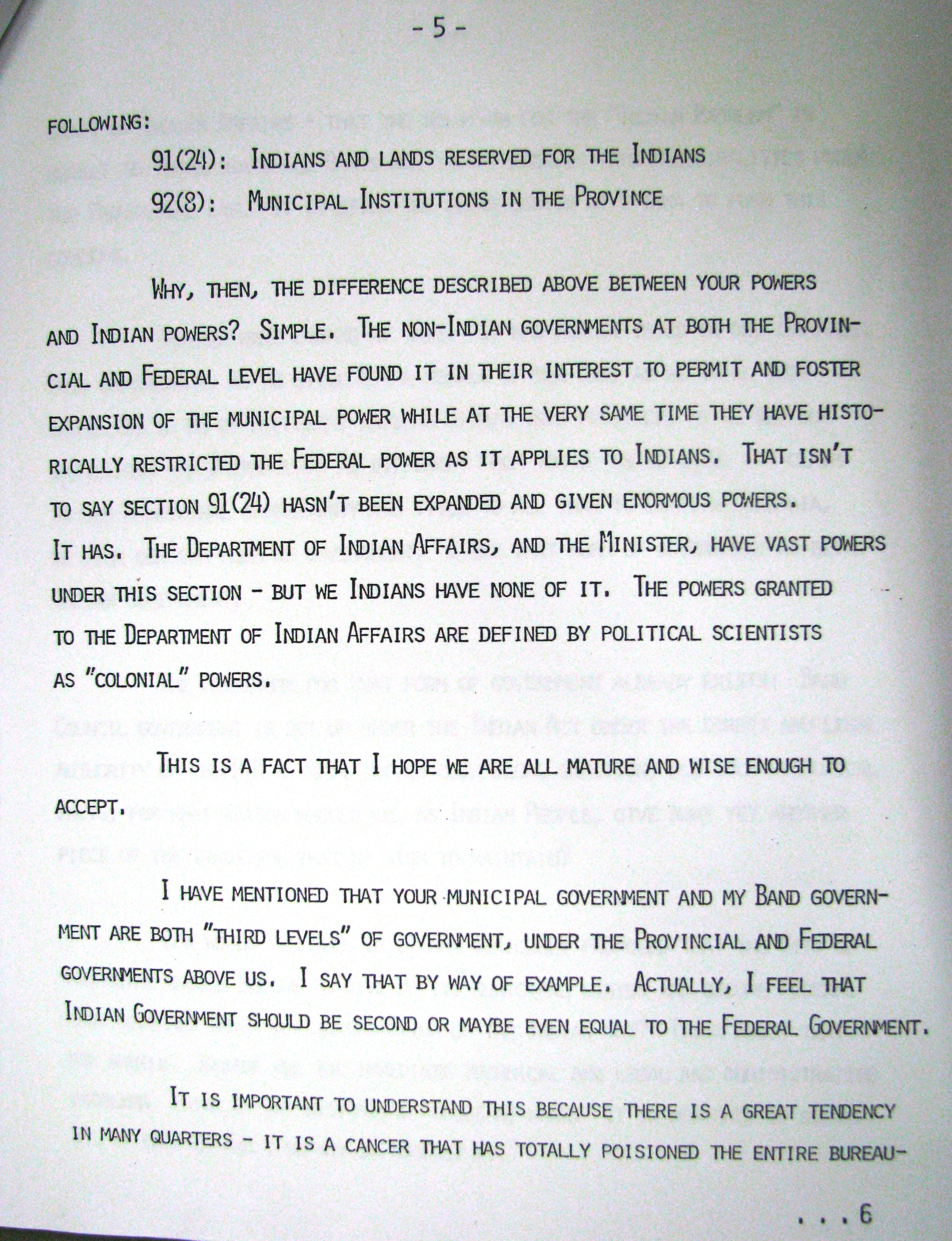
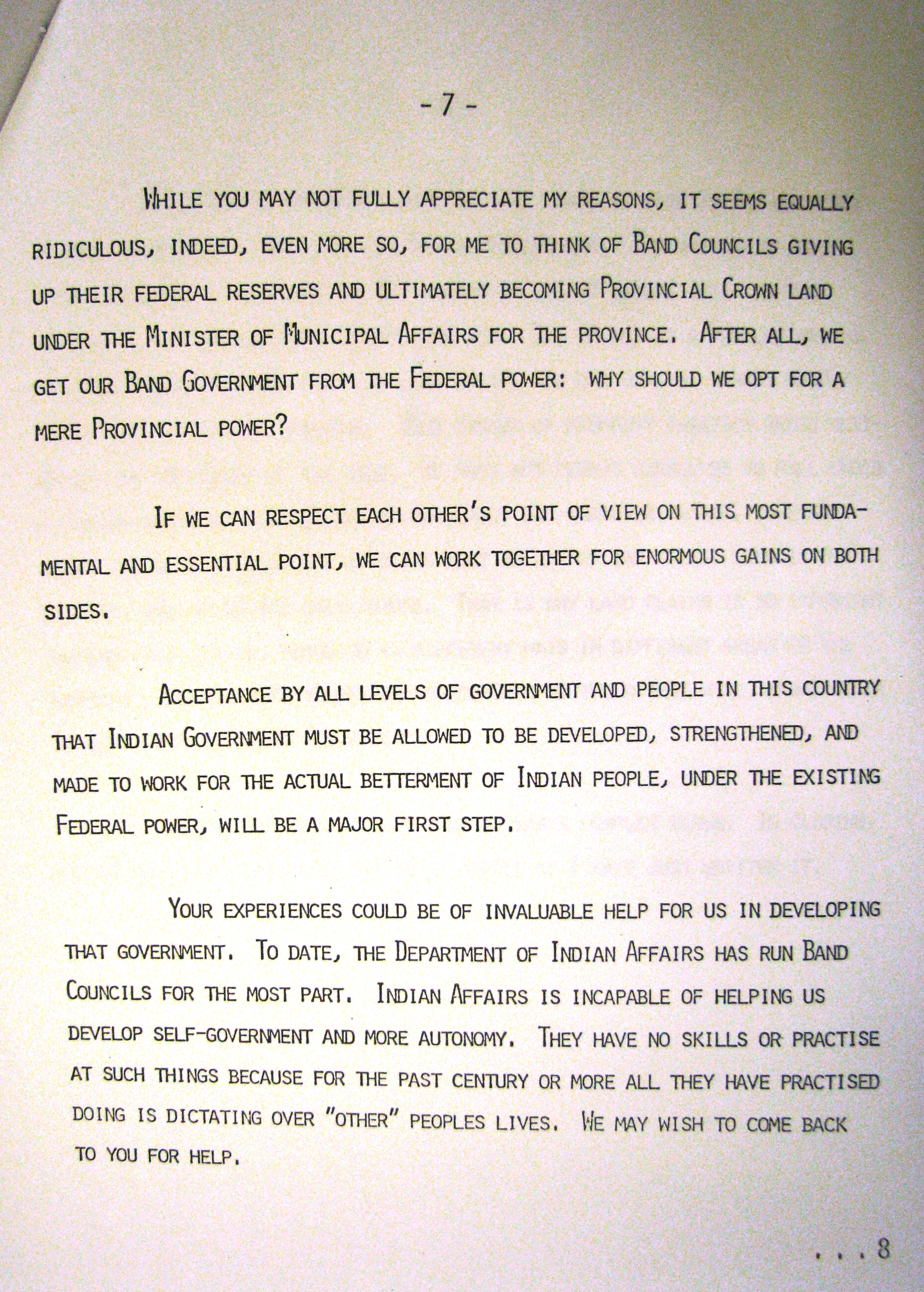
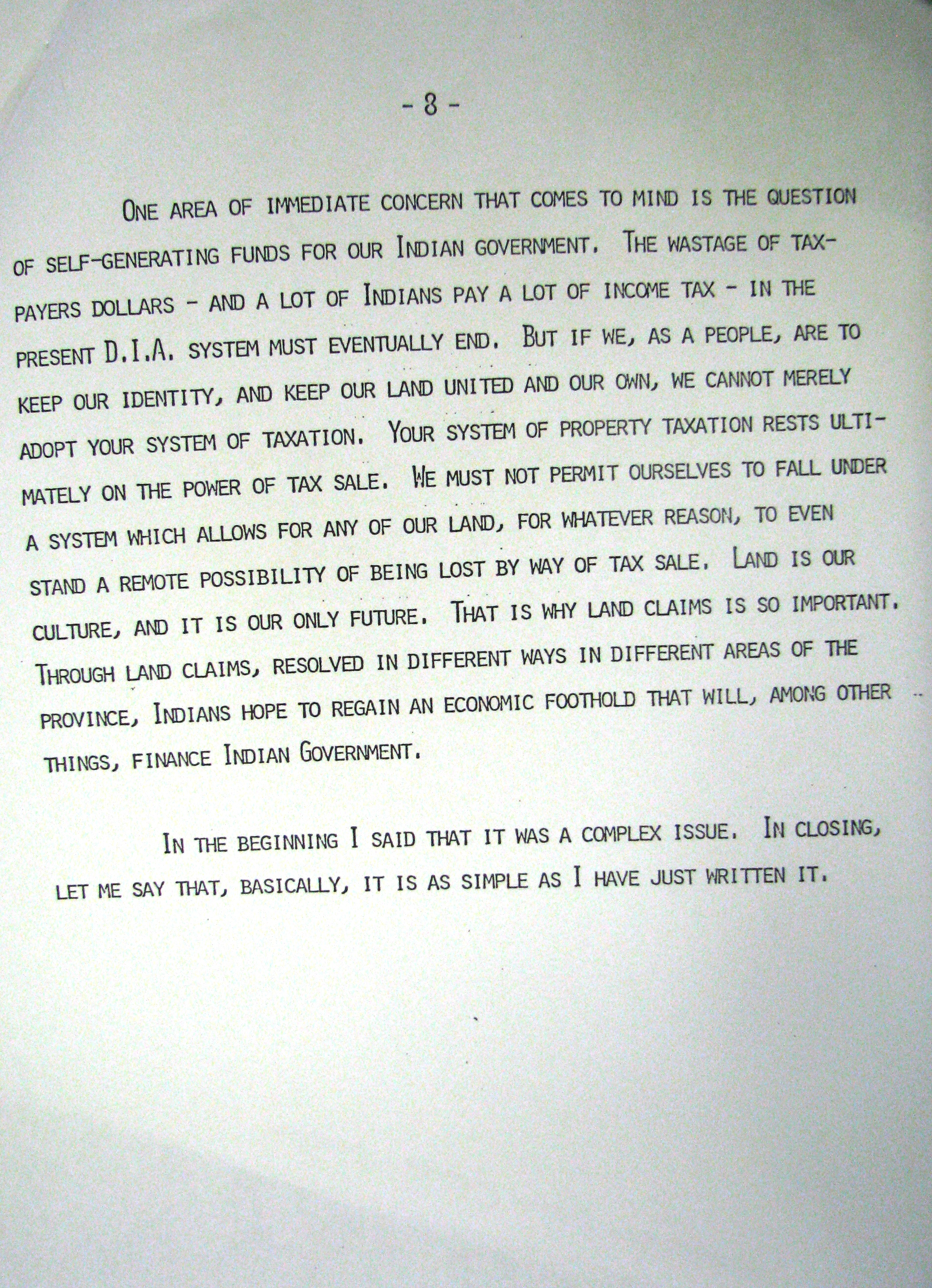
George Manuel addressing the Union of BC Municipalities, 1977

18 Sunday Jan 2015

Posted by Admin in Union of BC Indian Chiefs

≈ 1 Comment

Tags

aboriginal rights, aboriginal title, George Manuel, UBCIC

title page

page 1

page 2

page 3

page 4

page 5

page 6

page 7

page 8

Nuxalk Nation Position 1995

05 Monday Jan 2015

Posted by Admin in Indigenous Declarations

≈ 1 Comment

Tags

aboriginal rights, aboriginal title, Canadian Charter, House of Smayusta, INTERFOR, Ista, Nuxalk, Royal Proclamation 1763, Sovereignty

Nuxalk Nation Position

September 10, 1995

First of all we, the Nuxalk Nation, would like to acknowledge Tatau, The Creator, through Manakays, the Great Spirit, for all that he has provided since the beginning of time and still provides today.

We, the Nuxalk Nation, stand in the position of sovereignty against International Forest Products (INTERFOR). We cannot and will never as the Nuxalk Nation compromise this position.

The Sovereignty of the Nuxalk Nation comes from Tatau, the Creator. It is not granted nor subject to the approval of any other nation. As the Nuxalk Nation we have the sovereign right to jurisdictional rule within our own territory. Our lands are a sacred gift. The land is provided for the continued use, benefit and enjoyment of our people, the Nuxalkmc, and it is our ultimate obligation to Tatau, the Creator, to care for and protect it.

INTERFOR has continually raped our lands and continues to do so today! Our old villages, hunting grounds, fishing grounds, grave sites and sacred areas are being destroyed. Our fish and animals that we need to feed our peoples are disappearing. Our food plants, medicinal plants and trees are being trampled on and destroyed, all for the corporate value of the lumber.

We, the Nuxalk Nation, take this stand today and forever to state: “That we are appalled at what INTERFOR has done and is still doing today, to our Nuxalkmc Territory. We have never nor will we ever give our consent to INTERFOR or any other corporation to develop within our territory.

“Our territory is ours, the Nuxalkmc, and we have never ceded it to the Canadian or B.C. provincial government.

“Our nation is not interested in entering into any treaties (B.C. Treaty Commission), agreements or any sort of arrangement with the Canadian government or the British Columbia government concerning our Nuxalk Nation hereditary rights and title.”

The power that these two governments claim to have over our territory is an illegal power within their own jurisdiction as shown in the Constitution which reflects to the Royal Proclamation of 1763.

The following section is from the Canadian Charter of Rights and Freedoms to remind you that the Royal Proclamation is still legal and binding.

CANADIAN CHARTER OF RIGHTS AND FREEDOMS

Whereas Canada is founded upon principles that recognize the supremacy of God and the rule of law:

Guarantee of Rights and Freedoms….

General

  1. The guarantee in this Charter of certain rights and freedoms shall not be construed so as to abrogate or derogate from any aboriginal, treaty or other rights or freedoms that pertain to the aboriginal people of Canada including
  2. a) any rights or freedoms that have been recognized by the Royal Proclamation of October 7, 1763; and
  3. b) any rights or freedoms that now exist by way of land claim agreements or may be so acquired.

The following section is recited from the Royal Proclamation of October 7, 1763:

The Royal Proclamation of October 7, 1763, (by the King, A proclamation, George R)

And whereas it is just and reasonable, and essential to Our Interest and the Security of Our Colonies, that the several Nations or Tribes of Indians, with whom We are connected, and who live under Our Protection, should not be molested or disturbed in the Possession of such Parts of Our Dominions and Territories as, not having been ceded to, or purchased by Us, are reserved to them, or any of them, as their Hunting Grounds;

… beyond the Heads or Sources of any of the Rivers which fall into the Atlantick Ocean from the West and North-West, or upon any Lands whatever, which, not having been ceded to, or purchased by Us as aforesaid, are reserved to the said Indians, or any of them. And

…lying to the Westward of the Sources of the Rivers which fall into the Sea from the West and North West, as aforesaid; and We do hereby strictly forbid, …Our loving Subjects from making any Purchases or Settlements whatever, or taking Possession of any of the Lands above reserved, without Our especial Leave and Licence for that Purpose first obtained. And We …strictly …require all Persons… who have either wilfully or inadvertently seated themselves upon … Lands, which, not having been ceded to, or purchased by Us, are still reserved to the said Indians as aforesaid, forthwith to remove themselves from such Settlements.

… if, at any Time, any of the said Indians should be inclined to dispose of the said Lands, that same shall be purchased only for Us, in Our Name, at some publick Meeting or Assembly of the said Indians to be held for that Purpose by the Governor or Commander in Chief of Our Colonies  … and in case they shall lie within the Limits of any Proprietary Government, they shall be purchased only for the Use and in the Name of such Proprietaries, conformable to such Directions and Instructions as We or they shall think proper to give for that Purpose…

The sovereign Nuxalk Nation Chiefs have given INTERFOR notice that they are trespassing on Nuxalk Nation Territory that has never been sold or ceded, and that the Canadian court system has no jurisdiction over our territory. This is also to serve notice that we do not recognize any court injunctions served to any Nuxalkmc or to our guests (Forest Action Network) of the Nuxalk Nation invited into our traditional territory by our hereditary leadership.

So, with this, we, the Nuxalk Nation will do whatever we have to within our own traditional Nuxalk jurisdiction to stop INTERFOR from any development on our territory. We do this as our obligation to Tatau, the Creator, and also to ensure that our lands provided for our children, grandchildren and children yet unborn.

Way!

NUXALK STRONG NUXALK FOREVER

Signed:

Chief Nuximlayc (Lawrence Pootlass)

Chief Qwatsinas (Edward Moody)

Chief Liciwmutu7gayc (Taylor T)

Chief Slicxwliqw’ (Charles Nelson)

Chief Sats’alanlh (Peter Schooner)

…and others

House of Smayusta

PO Box 8, Bella Coola, V0T 1C0

Nuxalk Nation Position 1995 p.1Nuxalk Nation Position 1995 p.2Nuxalk Nation Position 1995 p.3

“ALL OUR RELATIONS” A DECLARATION OF THE SOVEREIGN INDIGENOUS NATIONS OF BRITISH COLUMBIA

05 Monday Jan 2015

Posted by Admin in Indigenous Declarations, Union of BC Indian Chiefs

≈ 1 Comment

Tags

aboriginal rights, aboriginal title, All Our Relations, Declaration, Indigenous Peoples, UBCIC

We, the Indigenous leaders of British Columbia, come together united and celebrate the victory of the Tsilhqot’in and Xeni Gwet’in peoples in securing recognition of their Aboriginal title and rights – and all those Indigenous Nations and individuals that have brought important court cases over the years resulting in significant contributions in the protection and advancement of Aboriginal title and rights, including the Nisga’a, Gitxsan, Wet’suwet’in, Haida, Taku River Tlingit, Musqueam, Heiltsuk and Sto:lo – shining light on the darkness of years of Crown denial of our title and rights. After pursuing different pathways, we now come together to make this solemn Declaration out of our common desire to be unified in affirming our Aboriginal title.

As the original Peoples to this land, we declare:

  • We have Aboriginal title and rights to our lands, waters and resources and that we will exercise our collective, sovereign and inherent authorities and jurisdictions over these lands, waters and resources,
  • We respect, honour and are sustained by the values, teachings and laws passed to us by our ancestors for governing ourselves, our lands, waters and resources.
  • We have the right to manage and benefit from the wealth of our territories.
  • We have the inalienable sovereign right of self-determination. By virtue of this right, we are free to determine our political status and free to pursue our economic, social, health and well-being, and cultural development.
  • We have diverse cultures, founded on the ways of life, traditions and values of our ancestors, which include systems of governance, law and social organization.
  • We have the right to compensation and redress with regard to our territories, lands and resources which have been confiscated, taken, occupied, used or damaged without our free, prior and informed consent.
  • We will only negotiate on the basis of a full and complete recognition of the existence of our title and rights throughout our entire lands, waters, territories and resources.
  • We acknowledge the interdependence we have with one another and respectfully honour our commitment with one another where we share lands, waters and resources. We commit to resolving these shared lands, waters and resources based on our historical relationship through ceremonies and reconciliation agreements.
  • We endorse the provisions of the UN Declaration on the Rights of Indigenous Peoples and other international standards aimed at ensuring the dignity, survival and well-being of Indigenous peoples.

We commit to:

  • Stand united today and from this time forward with the Tsilhqot’in and with each other in protecting our Aboriginal title and rights.
  • Recognize and respect each other’s autonomy and support each other in exercising our respective title, rights and jurisdiction in keeping with our continued interdependency.
  • Work together to defend and uphold this Declaration.

We, the undersigned, represent First Nations who carry a mandate to advance Title and Rights in our homelands today referred to as British Columbia and exercise our authorities in making this Declaration. We welcome other First Nations not present today to adhere to this Declaration if they so choose.

Signed by UBCIC Chiefs on November 29, 2007

UN Special Report on Indigenous Peoples in Canada

04 Thursday Sep 2014

Posted by Admin in UN Engagement

≈ 1 Comment

Tags

aboriginal rights, aboriginal title, Canada, Indigenous Peoples, James Anaya, Special Rapporteur, United Nations

Paragraph 99 – The Gretzky Clause is an Indigenous win

Published June 29, 2014 on Vancouver Media Co-op

The United Nations’ Special Rapporteur on the Rights of Indigenous Peoples has produced a review of the situation of Indigenous Peoples in Canada that seems to prescribe the diagnosis as the cure: death by bureaucracy. The documentary record is for the Human Rights Council, and it is as meticulous and specific as the Indian Act itself.

It might be just as limiting – save for two long sentences – paragraph 99. If Indigenous Peoples could “maximize” their benefit from revenues on “their lands,” as is recommended in the report’s final paragraph, Indigenous Peoples could pay their own way and make their own choices instead of having those choices legislated over top of them. They would not need the rest of this report.

In the meantime, some of the most significant crimes against humanity in the modern age have now been lifted out of the realms of colonial denial and set down in black international ink. The importance of this report is therefore unqualified: never before has an international observer summarized the gruesome history of Canadian imperialism in such unequivocal terms as the Special Rapporteur in his country report on Canada.

Professor James Anaya is a Regents Professor at the University of Arizona, lecturing on international law and indigenous peoples’ rights. He helped draft the Declaration on the Rights of Indigenous Peoples and has just completed his second and final term as Special Rapporteur at the same time as releasing the advance report on the Situation of Indigenous Peoples in Canada.


The Gretzky Clause

Professor Anaya recommended in paragraph #99, the very last words on the paper, “Resource development projects, where they occur, should be fully consistent with aboriginal and treaty rights, and should in no case be prejudicial to unsettled claims. The federal and provincial governments should strive to maximize the control of indigenous peoples themselves over extractive operations within their lands and the development of benefits derived therefrom.” That’s about the only thing Indigenous Peoples have been demanding of Canada, unsuccessfully, since Canada existed.

The age old question which Canada puzzles with in its Supreme Court is, “where is aboriginal land?” And the Court refuses to find any. Anaya did not recommend that Canada recognize aboriginal title, or get out a map and trace the old lines between the Indigenous nations of northernmost America and demand that those borders be respected or else double standards discrimination would be in effect, nor did he remark at all on the subject of what would be left of “Canada” if indigenous peoples were in control of their lands once again.

This is fairly plain talk for a lawyer though. Which square inch of Canada is not part of an unsettled claim? The Treaties are broken. The modern day negotiations are themselves a complete violation of human rights, requiring Indigenous parties to first surrender everything to the Crown in right of Canada before receiving various delegated and controlled powers in exchange. They are being negotiated by people put in power to represent the Indigenous side through systems of governance imposed by Canada. These problems were touched on in the report.


Negotiations and “land claims”

With a literal directness reputed of the “black letter lawyer,” his report states that “Over the past decades, Canada has taken determined action to address ongoing aspects of the history of misdealing and harm inflicted on aboriginal peoples in the country… Perhaps most significantly, it has legislation, policy and process in place to address historic grievances of indigenous peoples with respect to treaty and aboriginal rights. In this regard, Canada is an example to the world.” There are several notes to the fact that negotiations have been “mired” in difficulties. The statements are extremely political, and always extremely correct. Credit has been given for the appearance of attempting reconciliation, but it is taken away again by documented references to the failures of the process. The Rapporteur does not go so far as to say that the “mire” was by design, and that negotiations have clearly bought Canada the comparative peace of these past decades.

The negotiations programs are described as “…good practices, at least in their conception, such as Canada’s policy of negotiating modern treaties with aboriginal peoples and addressing their historic claims. A full exposition of these laws, policies and programmes is beyond the scope of this report.” Unfortunately, Canada’s policy of using Indigenous duress to accomplish surrender agreements with Indigenous communities is an exceptionally important example of the insidious perpetuation of the Canadian ultimatum: starve out or sell out. Ample information summarizing the slipknot effect of Canada’s “modern day treaty” making programmes were made available to the Special Rapporteur. He summarized that information: “In the comprehensive land claim processes, the Government minimizes or refuses to recognize aboriginal rights, often insisting on the extinguishment or non-assertion of aboriginal rights and title, and favours monetary compensation over the right to, or the return of, lands.”

One example that illuminates the carefully controlled core of modern “negotiations” was highlighted in the Special Rapporteur’s report. Regarding First Nations Education, a new act has emerged and shows the type of policy and procedure which Canada intends to legislate on all aboriginal peoples – if it’s not achieved through standardized, identical core provisions of self-government framework agreements and “land claims.” The First Nations Education Act was brought to the Special Rapporteur’s attention during his visit. The controversy over this Bill recently caused the National Chief of the Assembly of First Nations to resign.

The Rapporteur summarized Indigenous objections: “(1) the imposition of provincial standards and service requirements in the bill will undermine or eliminate First Nation control of their children’s education; (2) the bill lacks a clear commitment to First Nations languages, cultures, and ways of teaching and learning; (3) the bill does not provide for stable, adequate, and equitable funding to indigenous schools; and (4) the bill will displace successful education programs already in place, an issue that was raised particularly in British Columbia.”

It is exactly these problems – imposition of foreign standards; displacement of traditional structures; lack of financial certainty; a design for degradation of the delegated powers over time – which characterize all the other plans Canada has for First Nations negotiating under the present day policies. These problems characterize the results of all modern agreements between Canada and Indigenous Peoples today, covering the further six areas of lands and resources, self governance, health, children and families, housing and infrastructure, and finance.

Background context, exhibits on Canada’s record

The background provided in this report succinctly and definitively puts on record some of the most criminal tragedies wreaked by the colonizer on the Indigenous nations. Since Canada is officially in denial of many of these facts, the report is a categorical achievement for history. It qualifies the Indian Residential Schools, “the explicit purpose of which was to destroy their family and community bonds, their languages, their cultures, and even their names.” Canada still pretends those results might have been accidental, even in its formal apology of 2008.

The report acknowledges “…patterns of devastating human rights violations, including the banning of expressions of indigenous culture and religious ceremonies; exclusion from voting, jury duty, and access to lawyers and Canadian courts for any grievances relating to land; the imposition, at times forcibly, of governance institutions; and policies of forced assimilation through the removal of children from indigenous communities and “enfranchisement” that stripped indigenous people of their aboriginal identity and membership.” The significance of this single sentence in an official report to the Human Rights Council has not even begun to be appreciated, as it will be relied on in future international actions against Canada, in the pursuit of remedying the current hostile occupation of Indigenous homelands.

As for the most important colonial legal structures of imperialism in the Canadas, it was forced upon King George in 1763 by the military might of Pontiac and his many allies’ refusal to accept British retractions of their original treaties and compacts. The report gives that its place in relation to negotiations: “…the related policy of the British Crown of seeking formal permission and treaty relationships with indigenous peoples before permitting settlement in their territories.” And that Royal Proclamation, made exactly one quarter of a millenia before the Special Rapporteur’s visit, remains a pillar of the Canadian constitution; albeit one that has collapsed under the relentless weight of settlers fleeing other nations around the world and insisting on their own superior rights in Canada.

The collapse of that legal statute is not analyzed as a rotten cornerstone of the state of Canada and an object requiring closer scrutiny in the application of the rule of law in the first world; it might have been. It is the foundational instrument within Canada’s own laws which requires the consummation of honourable treaties.


The statistics of the minority

The international report emphasizes the statistical face of pan-Indigenous dispossession as it appears in census areas such as homelessness, poverty, low life expectancy, suicide, poor health, lack of education, overcrowded and dilapidated housing. “Of the bottom 100 Canadian communities on the Community Wellbeing Index, 96 are First Nations, and only one First Nation community is in the top 100.” Compared to Canadians, Indigenous individuals are exponentially worse off in every way. “At every level of education, indigenous people overall continue to lag far behind the general population.” There are many more.

But the Special Rapporteur is asked to comment on the situation of Indigenous Peoples, not indigenous individuals as minorities within a state. Indigenous Peoples have suffered every crime described by the Geneva Convention on the Prevention and Punishment of the Crime of Genocide. The report did not explicitly connect the impacts of Indigenous loss of life, loss of village sites, loss of power over community and national life and loss of control of lands and resources with the staggering present day economic sitution – the inability even to build adequate homes – except by implication in paragraph 99.

Worryingly, the summary statement suggests: “Indigenous peoples’ concerns merit higher priority at all levels and within all branches of Government, and across all departments.” This sounds like a proliferation of Indian Acts across the entire social, economic and cultural map. It is the general opinion, and most plausible legal situation, of Indigenous Peoples that their rights and remedies are not within the purview of the Canadian government or its departments – which have only ever contrived to suppress, co-opt and deny those concerns by every means available.

But when this statement is read together with the Gretzky Clause, paragraph 99, it now says: All branches of government should align themselves with ensuring the continuity and protection of aboriginal and treaty rights. All levels and departments should support Indigenous control of resources on Indigenous lands, especially extraction, and the benefits arising therefrom.


The Hazy Bering Land Bridge

There remains in the Special Reporter’s observations, conclusions, and recommendations, however, a missing link as dubious as the Bering Land Bridge. How can one file a report which begins with a summary of every crime of genocide, and ends with suggestions that the perpetrator be left in charge of remedying the situation? The report itself notes all manner of Canadian efforts to engage aboriginal peoples, and equally comments on indigenous representatives’ presentations to him on how unsatisfactory they are.

The reality is that every attempt at maximizing protection or use of “their lands” ends up in court, where “the adversarial approach leads to an abundance of pre-trial motions, which requires the indigenous claimants to prove nearly every fact, including their very existence as a people.”

Canada’s assumption of jurisdiction on unceded Indigenous land, as in British Columbia, or its most restrictive interpretations of treaty rights, are problems which merit third party, independent and impartial hearings. Canada cannot be the originator of a dispute and also the judge of its resolution. The Special Rapporteur never repeated this observation, made to him in person, in his report. It is in his mandate: Article 40 of the Declaration on the Rights of Indigenous Peoples, Indigenous peoples have the right to access to and prompt decision through just and fair procedures for the resolution of conflicts and disputes with States or other parties, as well as to effective remedies for all infringements of their individual and collective rights.

Instead: “Canada’s relationship with the indigenous peoples within its borders is governed by a well-developed legal framework a number of policy initiatives that in many respects are protective of indigenous peoples’ rights. But despite positive steps, daunting challenges remain. The numerous initiatives that have been taken at the federal and provincial/territorial levels to address the problems faced by indigenous peoples have been insufficient.”

Canada’s borders are in fact contested not to include many unceded, sovereign indigenous peoples and their lands in the first place, particularly in the west, and to this legal place the report does not proceed. Canada’s “well-developed legal framework” denies Indigenous Peoples’ own legal frameworks, and their jurisdictions on their homelands, and certainly has been well-developed to the point of the exclusion of the Canadian constitution where treaties are demanded before settlement is allowed. In fact, policy initiatives have entirely replaced legal instruments. And the objectives of those policies have not shifted by any measure since the 1857 Act for the Gradual Civilization of the Indian Tribes – an assimilation and dispossession policy. Just last year a more sophisticated option of the legislative release and indemnification of Canada by the Indigenous took the form of Bill C-45 and was passed in Canada’s Parliament. Fragments of Indigenous nations under duress participate in fragments of the Act. Finally, to suggest that the problems faced by Indigenous Peoples occupied by Canada could be sufficiently addressed by the perpetrator of the problems, the federal and provincial governments, is to fundamentally ignore many testimonies brought before the Special Rapporteur during his extraordinarily brief visit to Canada – October 8-15th, 2013. Some of those testimonies were brought by traditional governments of Indigenous nations, some were submitted only in writing, and they laid bare the urgent need for third party assistance in the conflict between their nations and the assumptive party, Canada.

The report is perhaps constrained by the state-biased mandate of the United Nations, reporting on implementation of the Declaration on the Rights of Indigenous Peoples, and it is in this way that the vulnerability of entrusting states with justice for Indigenous Peoples becomes obvious. The conflict at hand is between states and the Indigenous Peoples, and their lands, which states have assumed jurisdiction over. Or, “One of the most dramatic contradictions indigenous peoples in Canada face is that so many live in abysmal conditions on traditional territories that are full of valuable and plentiful natural resources. These resources are …targeted for extraction and development by non-indigenous interests.”


The report on the situation

There were many people and places that the UN delegation did not meet. Those who did manage to make meetings had less than one week’s notice of the time and location – and that was the work of Canada. Considering this, and the brevity of the visit, this first official report on the situation of Indigenous Peoples in Canada is of considerable scope and importance. If it is read.

The report is a good sweep of the situation:

“Parliament has jurisdiction over ‘Indians and lands reserved for Indians.’”

“First Nations communities that receive federal funding under the Indian Act regime, 70% of which have fewer than five hundred residents, typically have to produce over 100 or more reports a year to various federal agencies.”

“…indigenous leaders complain that the federal Government frequently uses a discourse of responsibility to Canadian taxpayers for the cost of First Nations treaty benefits, without a corresponding acknowledgment of the vast economic benefits that have accrued to non-indigenous Canadians as a result of the constitutional treaty relationships…”

“…the Government appears to view the overall interests of Canadians as adverse to aboriginal interests…”

The Special Rapporteur never mentions the astonishingly prolific, consistent and militant protest on the part of Indigenous peoples from coast to coast to coast, for centuries, and that these demonstrations and resistance movements are singly the cause of any of Canada’s good work noted in this report. The political tones resonate to good will and politesse and there is little within the report which Canada could reasonably take exception to.

But, as James Anaya characterizes his own work when speaking in public, he tries not to focus on the instances of conflict but on signs of progress and possibilities which might lead to peace and justice.

“Partnership” is recommended between the Indigenous and Canada, and that “…it is necessary for Canada to arrive at a common understanding with indigenous peoples of objectives and goals that are based on full respect for their constitutional, treaty, and internationally-recognized rights.”  This is optimistic.

But Anaya’s visit to Canada has already had effect. During his statement at the end of his official visit last Fall, he made the straightforward recommendation that the Truth and Reconciliation Commission be given an extension to continue its work in connection to Indian Residential School legacies. An extension of one year had been granted by the time the draft report was released this May, while the report calls for an open-ended mandate.

Paragraph 99, however, is the ace. It is nothing short of Wayne Gretzky in 1988, getting the goal that won the Oilers the Stanley Cup. And the Supreme Court of Canada has lost its shut-out. Development should be consistent with aboriginal and treaty rights; control and benefits of development on Indigenous lands should belong to the Indigenous.

It’s an optimistic coincidence that the key recommendation to Canada is numbered the same as the greatest Canadian hockey player, whose jersey number was retired by the National Hockey League in his honour. And it’s an enlightening coincidence that such an important icon was playing a Mohawk game. It’s possibly a pragmatic non-coincidence on the part of the author of the report, nominated for the Nobel Peace Prize this spring, to connect a source of national pride with a challenge worth meeting.


UN Special Rapporteur on the Rights of Indigenous Peoples, S. James Anaya, at Musqueam during his official visit to Canada. October 10, 2013.

UN Special Rapporteur on the Rights of Indigenous Peoples, S. James Anaya, at Musqueam during his official visit to Canada. October 10, 2013.

Consultation Standards in BC – or – The Trilogy of Despair

04 Thursday Sep 2014

Posted by Admin in Commentary, editorial

≈ 1 Comment

Tags

aboriginal rights, aboriginal title, Comprehensive Claims Policy, consultation and accommodation, Halfway River, infringement, justification, Taku

August 2009

Recent court rulings in Halfway River, Taku River Tlingit, and Douglas have brought consultation standards spiraling down to a single unreturned phone-call.

Participating in consultations with government is a double-edged sword for Aboriginal peoples. We already know that the government and the courts find aboriginal laws of upholding the sustainability and sacredness of the land to be “unreasonable conditions.’ If they do not participate, or walk away, Aboriginal peoples are described as unreasonable – and if they do participate, they are stuck within a process that the government dominates.

Even when Bands or First Nations bring court cases following “negotiations” that disregard their input, their assertion of their own laws and duty to uphold them are unacceptable in BC courts.

Halfway River, 1999, gives us this.

Halfway River contested that logging had infringed their way of life to an unjustifiable extent. The Halfway case found the province free to infringe their Treaty 8. Halfway also concluded in an obligation on the part of Aboriginal peoples to participate in the consultation process, and not frustrate it with such “unreasonable” demands as those of sustainability, regardless of the foregone- conclusion nature of such BC-led procedures.

In Taku River Tlingit, 2005, the Taku River people were suing BC for going ahead with permitting a mining access road over their sacred mountain, right through the hunting grounds. Taku had participated extensively in consultation procedures and the environmental impact assessment. The government did not respect their position that the road had to be redirected, and permitted it as preceded the legal challenge. The court found that Taku had been adequately consulted and accommodated, since they had been part of the development process, and that their proper course of action was to continue in negotiations to mitigate the impact of the road at a site-by-site specific level. This was the first case to test the duty to consult and accommodate, it came down at the same time as Haida.

We have a final angle in Douglas, 2007. It was found that the Department of Fisheries and Oceans had not only fulfilled their duty to consult, but also upheld their obligation to the aboriginal food fishing priority when they opened a sports fishery on Early Stuart sockeye in the Fraser, five years earlier.

The Department had faxed and telephoned a few invitations to meet on the subject to the Cheam Band prior to the openings. Cheam had not been able to participate in the processes on the schedule DFO offered.

Nevermind, the fact that DFO offered them meetings fulfilled their duty to consult and accommodate, ruled the judge. And since the Department has the privilege of managing the fishery, no notices of later management changes were necessary.

What this would seem to mean to BC is that: First Nations must participate in the consultation process; once they have been consulted, anything goes; and as little communication as an unanswered fax and a phone call can accomplish the consultation and justify the decisions made by government ministries. The “meaningful” part of this “consultation and accommodation” is that BC is the boss, anyway.

Are these the parameters of the “shared decision making” contemplated in BC’s proposal for Recognition and Reconciliation Legislation?

“I’ll see you in court!”

Newer posts →

Subscribe

  • Entries (RSS)
  • Comments (RSS)

Archives

  • December 2025
  • October 2025
  • June 2025
  • May 2025
  • February 2025
  • September 2024
  • August 2024
  • July 2024
  • April 2024
  • March 2024
  • February 2024
  • September 2023
  • August 2023
  • June 2023
  • June 2018
  • December 2017
  • July 2017
  • January 2017
  • December 2016
  • July 2015
  • March 2015
  • February 2015
  • January 2015
  • December 2014
  • September 2014

Categories

  • Archive Quarterly
  • BC treaty process
  • Children
  • Commentary, editorial
    • Uncategorized
  • Comprehensive Claims – Policy and Protest
    • aboriginal title
  • Government Commissions
  • Gustafsen Lake Standoff 1995 – Ts'peten Defense, Secwepemc
  • Haida title
  • Indian Residential School
  • Indigenous Declarations
  • Non-Status Indian Era
  • Reconciliation
  • Roadblock
  • UN Engagement
  • Union of BC Indian Chiefs

Meta

  • Create account
  • Log in

Blog at WordPress.com.

  • Subscribe Subscribed
    • The West Wasn't Won
    • Already have a WordPress.com account? Log in now.
    • The West Wasn't Won
    • Subscribe Subscribed
    • Sign up
    • Log in
    • Report this content
    • View site in Reader
    • Manage subscriptions
    • Collapse this bar
 

Loading Comments...