• About The West Wasn’t Won archive project
  • Archive Quarterly
  • Children
  • Fisheries
  • Land of the Peoples
  • Lawfare
  • Non-Status Era
  • Roadblocks and Restitution
    • Gustafsen Lake
    • Haida
    • Líl’wat
    • Nisga’a

The West Wasn't Won

~ Outlive the colonial world.

The West Wasn't Won

Tag Archives: Canada

UN CERD report is four years overdue – Canada.

12 Friday Dec 2025

Posted by Admin in Uncategorized

≈ Leave a comment

Tags

Canada, indigenous, uncerd

In 2017, the Committee for the Elimination of Racial Discrimination made 32 recommendations to Canada that pertain directly to Indigenous Peoples.

Canada’s last review by the UN Committee for the Elimination of all forms of Racial Discrimination concluded in 2017. The UNCERD provided concluding observations and recommendations, and Canada’s next report was due on November 15, 2021. This report has not been filed, and the corresponding meeting has not been scheduled.

      32 of the CERD’s most recent recommendations relate directly to Indigenous Peoples: from land rights to discrimination and racism in the public education system. They are copied below; the recommendations have not been achieved.

      Furthermore, the Committee drew Canada’s attention to recommendations it made in 1997, and has repeated at every review since then, concerning:

  • the right to consultation and to free, prior and informed consent of Aboriginal peoples whenever their rights may be affected by projects carried out on their lands, as set forth in international standards and the State party’s legislation;
  • to seek in good faith agreements with Aboriginal peoples with regard to their lands and resources
  • find means and ways to establish titles over their lands, and respect their treaty rights;
  • Take appropriate measures to guarantee that procedures before the Special Tribunal Claims are fair and equitable …

That was in 2012.

      When the CERD referred to its 1997 recommendations again in 2017, it got even more specific, adding the following to the list:

  • End the substitution of costly legal challenges as post facto recourse in place of obtaining meaningful free prior and informed consent of Indigenous Peoples.
  • Incorporate the free, prior and informed consent principle in the Canadian regulatory system
  • amend decision making processes around the review and approval of large-scale resource development projects like the Site C dam.
  • Immediately suspend all permits and approvals for the construction of the Site C dam.
  • Conduct a full review in collaboration with Indigenous Peoples of the violations of the right to free prior and informed consent, treaty obligations and international human rights law from the building of this dam and identify alternatives to irreversible destruction of Indigenous lands and subsistence which will be caused by this project.
  • Publicly release the results of any government studies of the Mount Polley disaster and the criminal investigation into the disaster, before the statute of limitations for charges under these Acts expires.
  • …take measures to mitigate the impact through … fair remedy and reparations.

As we all know, Site C is going ahead and BC media shut out Indigenous opposition. We also know the BC government took over a private prosecution of Mount Polley mine’s owners – and dropped the charges. West Coast Environmental Law wrote a great article about that.

As for “costly legal challenges,” they are the only way to identify Section 35 Aboriginal rights in Canada, on a case-by-case basis, unless you surrender your rights in toto and accept a deal with Canada instead.

No review of violations of free, prior, informed consent have gotten underway since 2017.

What will Canada tell the Committee this time?

That on top of a new record-breaking trial over Aboriginal title – the Cowichan 2025 decision is now the longest, at five years of trial – the positive decision in favour of the Tribes was appealed by settler governments before they could have possibly had time to finish reading it?

      And then every purveyor of news media – state or commercial – hammered the incitements to hatred spoken by ignorant civilians, on repeat? To the point that the Cowichan Tribes had to issue a statement concerning the “Misleading and False Information Regarding Aboriginal Title Case,” (October 27) tantamount to a cease and desist order? (October 27)

UN treaty bodies make a difference

In the last reporting cycle to the CERD treaty body, 75% of the reports from Non-Governmental Organizations and civil society were sent by Indigenous organizations – fifteen of them.

UN treaty bodies make a difference, even though Canada does not take its Charter obligation seriously when it comes to educating the public about international human rights law generally, and UN mechanisms in particular.

      The CERD passed remark on the BC treaty process in 2007:

“While acknowledging the information that the “cede, release and surrender” approach to Aboriginal land titles has been abandoned by the State party in favour of “modification” and “non-assertion” approaches, the Committee remains concerned about the lack of perceptible difference in results of these new approaches in comparison to the previous approach.

“The BC Treaty Commission version of the Canada comprehensive claims extinguishment policy has all but collapsed since then. Only one Final Agreement was completed after Tsawwassen and Maa-nulth were heavily lubricated through ratification – within weeks of the CERD report – in 2007, and BC has had to reinvent (yet again) the Indigenous surrender policy that has been formally in place since 1914.”

      They call them “reconciliation of rights” and “jurisdiction” agreements now.

      Reinvention is at the center of all Canada’s reports to treaty bodies, when it comes to Indigenous Peoples.

      Right before the August 2017 date for Canada’s appearance before the CERD, it sent four federal ministers to the Assembly of First Nations annual assembly, July 25-27, where they told everyone that Ottawa is going to rescind the Indian Act. Bennett (Minister of Indigenous Affairs), Wilson-Raybould (Minister of Justice), McKenna (Environment) and Goodale (Public Safety), all described a bright new future to come.

      They did this moments before the in-person report to CERD in Geneva, allowing Canada to reply to all of the issues raised in the fifteen Indigenous reports by referencing the July meeting and the appearance of an announcement there.

      However, the only substance to Ottawa’s mission to the AFN Chiefs in July – half of whom boycotted the all-expense-paid meeting in Regina – was that the Ministry of Crown-Indigenous Relations and Northern Development will no longer claw back unused capital funds after twelve months.

An excerpt from one of the independent reports to the last CERD review of Canada:

“Skeena watershed and coastal Indigenous communities depend on the salmon for food, their economies and cultures. This (LNG, Prince Rupert) project is a prime example of what’s wrong with Canada’s approach to engaging Indigenous communities in large-scale industrial developments: It continuously fails to honour the legal obligations to Indigenous Peoples in protecting their traditional resources; The Canadian government generally consults with Band Councils, which were created under the colonial Indian Act, and often fails to consult hereditary leadership or respect traditional governance systems; …”

  • Skeena Indigenous Groups Submission to UN CERD. July 6, 2017
Skeena groups parallel report to CERD re Canada review 2017Download

It is interesting to note that only weeks after this report to the CERD was posted for the Session, Petronas announced its withdrawal from this proposed project, “Pacific NorthWest LNG.”

About the UNCERD:

The International Convention on the Elimination of all forms of Racial Discrimination was adopted in UN General Assembly in 1965, and entered into force on January 4, 1969.

The Committee is the treaty body which oversees compliance, receiving reports from states and civil society; meeting with states parties at UN headquarters to discuss their progress; and making observations that other states and corporations take into consideration.

The Convention, among all the UN treaties, establishes certain human rights norms which are considered essential for fulfillment of the goals of world peace identified in the UN Charter.

      Colonialism, for instance, is identified as a threat to world peace in that Charter.

The CERD includes clarification in the preamble like,

Considering that the United Nations has condemned colonialism and all practices of segregation and discrimination associated therewith, in whatever form and wherever they exist, and that the Declaration on the Granting of Independence to Colonial Countries and Peoples of 14 December 1960 (General Assembly resolution 1514 (XV)) has affirmed and solemnly proclaimed the necessity of bringing them to a speedy and unconditional end,

Convinced that any doctrine of superiority based on racial differentiation is scientifically false, morally condemnable, socially unjust and dangerous, and that there is no justification for racial discrimination, in theory or in practice, anywhere,

and provisions like,

Article 2, 1.a)

Article 2 1.(a) Each State Party undertakes to engage in no act or practice of racial discrimination against persons, groups of persons or institutions and to ensure that all public authorities and public institutions, national and local, shall act in conformity with this obligation;

(b) Each State Party undertakes not to sponsor, defend or support racial discrimination by any persons or organizations;

(c) Each State Party shall take effective measures to review governmental, national and local policies, and to amend, rescind or nullify any laws and regulations which have the effect of creating or perpetuating racial discrimination wherever it exists;

(d) Each State Party shall prohibit and bring to an end, by all appropriate means, including legislation as required by circumstances, racial discrimination by any persons, group or organization;

Article 5

…equality before the law, notably in the enjoyment of the following rights:

(a) The right to equal treatment before the tribunals and all other organs administering justice;

(c) Political rights, … (v) The right to own property alone as well as in association with others;

The UN treaty bodies play a key role in international human rights law. Many international conventions joined by members of the UN Charter have Committees attached to the treaty, and they review the states on a five-year cycle to monitor compliance and implementation. Other treaty bodies pertain to the Convention Against Torture; the Convention on Civil and Political Rights; the Convention on Economic, Social and Cultural Rights; and so on.

Canada is not a member of the Global Alliance of National Human Rights Institutions, formed in 1993. Of the 192 member states in the United Nations, 110 of them have National Human Rights organizations with membership in GANHRI. The Global Alliance works in concert with the United Nations system, mobilizing human rights education and development within states.

Canada’s next review in Geneva, UN Headquarters, is in March 2026 with the Committee on Civil and Political Rights. The Committee for the CCPR has presented some informed questions to Canada, ahead of its review, about the implementation of Indigenous Peoples’ rights to self-determination. The reports that Canada has posted ahead of the meeting only mention Indigenous communities in terms of health measures that were taken during the COVID pandemic: to prevent transmission of the virus and promote safe operation of schools and daycares; emergency funding for basic needs; and “additional supports to Canada’s network of existing shelters on reserve and in Yukon to help manage or prevent outbreaks in their facilities.”

You can find out more about the UN system at www.ohchr.org


Quotable Concluding Observations of the CERD:

CERD/C/CAN/CO/18, 25 May 2007

21. While welcoming the commitments made in 2005 by the Federal Government and provincial/territorial governments under the Kelowna Accord, aimed at closing socio-economic gaps between Aboriginal and non-Aboriginal Canadians, the Committee remains concerned at the extent of the dramatic inequality in living standards still experienced by Aboriginal peoples. In this regard, the Committee, recognising the importance of the right of indigenous peoples to own, develop, control and use their lands, territories and resources in relation to their enjoyment of economic, social and cultural rights, regrets that in its report, the State party did not address the question of limitations imposed on the use by Aboriginal people of their land, as previously requested by the Committee. The Committee also notes that the State party has yet to fully implement the 1996 recommendations of the Royal Commission on Aboriginal Peoples (art. 5 (e)).

In light of article 5 (e) and of general recommendation no. 23 (1997) on the rights of indigenous peoples, the Committee urges the State party to allocate sufficient resources to remove the obstacles that prevent the enjoyment of economic, social and cultural rights by Aboriginal peoples. The Committee also once again requests the State party to provide information on limitations imposed on the use by Aboriginal people of their land, in its next periodic report, and that it fully implement the 1996 recommendations of the Royal Commission on Aboriginal Peoples without further delay.

22. While acknowledging the information that the “cede, release and surrender” approach to Aboriginal land titles has been abandoned by the State party in favour of “modification” and “non-assertion” approaches, the Committee remains concerned about the lack of perceptible difference in results of these new approaches in comparison to the previous approach. The Committee is also concerned that claims of Aboriginal land rights are being settled primarily through litigation, at a disproportionate cost for the Aboriginal communities concerned due to the strongly adversarial positions taken by the federal and provincial governments (art. 5 (d)(v)).

In line with the recognition by the State party of the inherent right of self-government of Aboriginal peoples under section 35 of the Constitution Act, 1982, the Committee recommends that the State party ensure that the new approaches taken to settle aboriginal land claims do not unduly restrict the progressive development of aboriginal rights. Wherever possible, the Committee urges the State party to engage, in good faith, in negotiations based on recognition and reconciliation, and reiterates its previous recommendation that the State party examine ways and means to facilitate the establishment of proof of Aboriginal title over land in procedures before the courts. Treaties concluded with First Nations should provide for periodic review, including by third parties, where possible.

CERD on Canada 2007 – p6 re cede release surrenderDownload

CERD/C/CAN/CO/21-23, 25 August 2017

Truth and Reconciliation Commission and UN DRIP

17. While welcoming the commitment made to implement all of the Truth and Reconciliation Commission’s (TRC) 94 Calls to Action, the Committee is concerned at the lack of an action plan and full implementation. The Committee is further concerned that the United Nations Declaration on the Rights of Indigenous Peoples (UN DRIP) Action Plan has not yet been adopted, while noting the Ministerial working group established in 2017 to bring laws into compliance with obligations towards Indigenous Peoples.

18. The Committee recommends that the State party:

(a) Develop a concrete action plan to implement the TRC’s 94 Calls to Action, in consultation with Indigenous Peoples.

(b) Implement the UN DRIP, and adopt a legislative framework to implement the Convention including a national action plan, reform of national laws, policies and regulations to bring them into compliance with the Declaration, and annual public reporting.

(c) Ensure that the action plans include regular monitoring, evaluation, and annual reporting of the implementation, including the use of statistical data to evaluate progress.

(d) Develop and implement training programs, in consultation with Indigenous Peoples, for State officials and employees on the TRC’s Calls to Action and the UN DRIP, to ensure their effective impact.

(e) Ensure that the Ministerial working group is transparent and inclusive of Indigenous Peoples. Land rights of Indigenous Peoples

19. Taking note of the recent release of a set of 10 Principles Respecting the Government of Canada’s Relationship with Indigenous Peoples in 2017, the Committee is deeply concerned that:

(a) Violations of the land rights of Indigenous Peoples continue in the State party, in particular environmentally destructive decisions for resource development which affect their lives and territories continue to be undertaken without the free, prior and informed consent of the Indigenous Peoples, resulting in breaches of treaty obligations and international human rights law.

(b) Costly, time consuming and ineffective litigation is often the only remedy in place of seeking free, prior and informed consent, resulting in the State party continuing to issue permits which allow for damage to lands.

(c) According to information received, permits have been issued and construction has commenced at the Site C dam, despite vigorous opposition of Indigenous Peoples affected by this project, which will result in irreversible damage due to flooding of their lands leading to elimination of plants medicines, wildlife, sacred lands and gravesites.

(d) According to information received the Site C dam project proceeded despite a joint environment review for the federal and provincial governments, which reportedly concluded that the impact of this dam on Indigenous Peoples would be permanent, extensive, and irreversible.

(e) According to information received the Mount Polley mine was initially approved without an environment assessment process, consultation with or free, prior and informed consent from the potentially affected Indigenous peoples, and that the mining disaster has resulted in a disproportionate and devastating impact on the water quality, food such as fish, fish habitats, traditional medicines and the health of Indigenous Peoples in the area (art. 5-6).

20. Recalling its general recommendation No. 23 (1997) on the rights of Indigenous Peoples and reiterating its previous recommendation (CERD/C/CO/19-20, para. 20) the Committee recommends that the State party:

(a) Ensure the full implementation of general recommendation 23, in a transparent manner with the full involvement of the First Nations, Inuit, Metis and other Indigenous Peoples with their free prior and informed consent for all matters concerning their land rights.

(b) Prohibit the environmentally destructive development of the territories of Indigenous Peoples, and allow Indigenous Peoples to conduct independent environmental impact studies.

(c) End the substitution of costly legal challenges as post facto recourse in place of obtaining meaningful free prior and informed consent of Indigenous Peoples.

(d) Incorporate the free, prior and informed consent principle in the Canadian regulatory system, and amend decision making processes around the review and approval of large-scale resource development projects like the Site C dam.

(e) Immediately suspend all permits and approvals for the construction of the Site C dam. Conduct a full review in collaboration with Indigenous Peoples of the violations of the right to free prior and informed consent, treaty obligations and international human rights law from the building of this dam and identify alternatives to irreversible destruction of Indigenous lands and subsistence which will be caused by this project.

(f) Publicly release the results of any government studies of the Mount Polley disaster and the criminal investigation into the disaster, before the statute of limitations for charges under these Acts expires.

(g) Monitor the impact of the disaster on affected Indigenous Peoples as a result of the disaster, and take measures to mitigate the impact through provision of safe water and food, access to healthcare, and fair remedy and reparations.
CERD_Cconcluding Observations 2017_CAN_CO_21-23_28714_EDownload

Archive Quarterly – Fall 2025

11 Thursday Dec 2025

Posted by Admin in Archive Quarterly, Uncategorized

≈ Leave a comment

Tags

Aboriginal fishing rights, BC Aboriginal Peoples Fisheries Commission, Canada, Cumulative Effects Framework, DFO, hunting moratorium, Indigenous Peoples, Roadblock, Ruby Dunstan, Sparrow, Stein Valley, Strategic Words and Tactics Team, traditional salmon fisheries, United Nations, World Council of Indigenous Peoples

Journal of “the west wasn’t won” archive project

FALL FEATURES:

Stein Valley and the Voices for the Wilderness

The Nlaka’pamux and St’at’imc nations first declared protection of the entire area in 1985.

A decade of organizing; profile-raising concert festivals; and unflinching determination at endless negotiations with government resulted in the Stein Valley Nlaka’pamux Heritage Park and an unspoiled wilderness.

Here, Chiefs Ruby Dunstan and Byron Spinks of Lytton share their roles, then and now, and personal connections to the Stein.

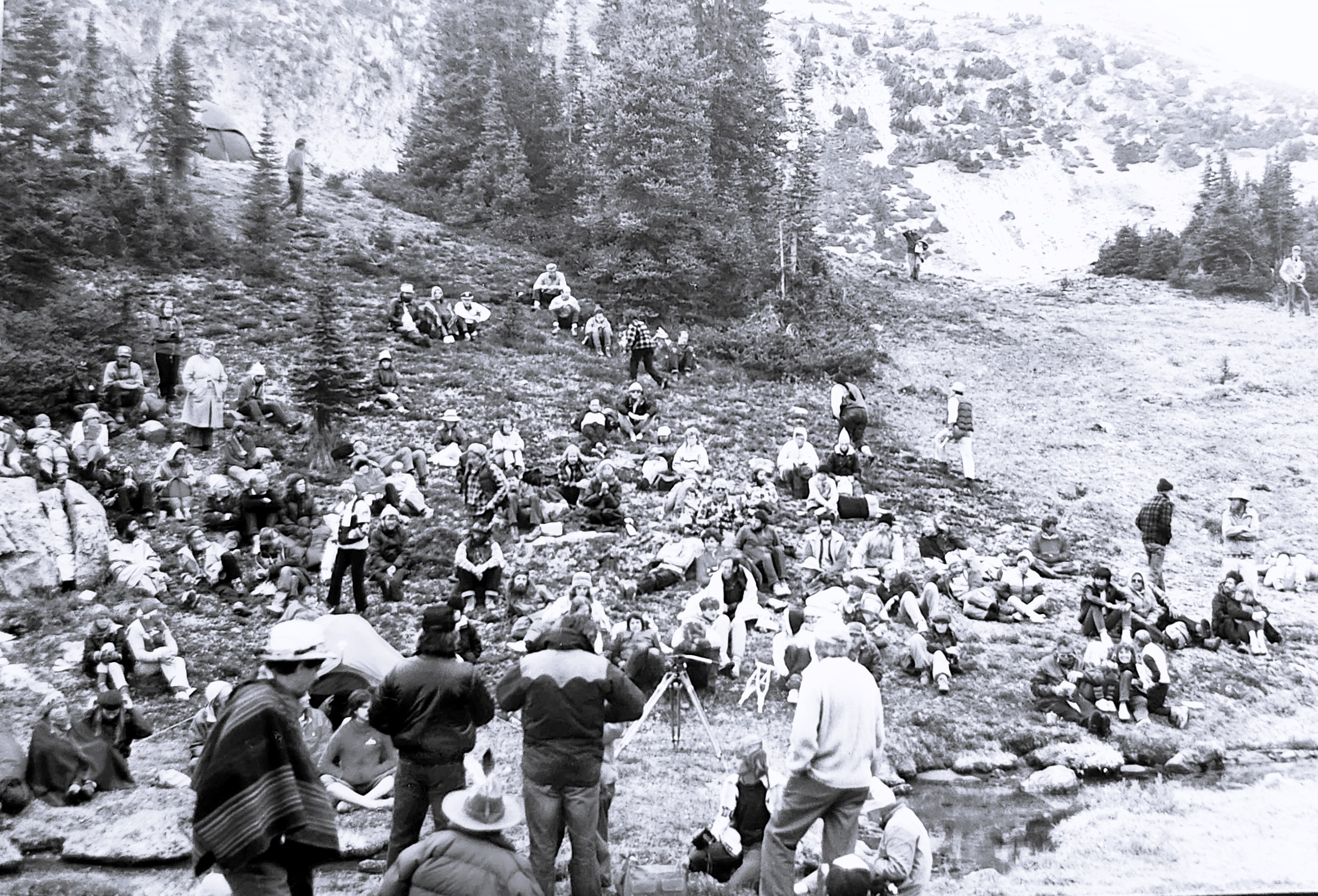
Park Board member John Haugen explains a little about the UNESCO process for World Heritage Site designation, and Vancouver-based sound ecologist Hildegard Westerkamp shares her photos and recollections of the first festival in the alpine.

At the first Stein Valley Festival, 1985. Photo by Hildegard Westerkamp.

Deer in the headlights.

Hunting moratoriums are issued across Indigenous Nations as resource extraction activity reduces habitat below critical levels amid over-hunting.

Many Peoples have enacted and posted rules on the ground, gone to court for injunctive relief against industries licensed by the crown, and put themselves on the roadblock: between the deer and the headlights.

A bull moose in Taku River Tlingit territory, where the people have appealed to BC hunters not to hunt moose, in spite of BC’s opening of Limited Entry Hunt lotteries. Photo: Taku River Tlingit First Nation.

The Nuxalk Defense of Ista, 1995

Head Chief Nuximlayc’s statement on the 30th Anniversary: “They had been harvesting five million cubic meters of wood – every year – in Nuxalk territory. After the EU stopped buying it, after that, the timber harvest dropped to 200,000 cubic meters. That’s why we still have trees today.”

Nuxalk leaders of the House of Smayusta invited environmentalists to stay and join the reoccupation of Ista, King Island, in September 1995. Many were detained for defying the court injunction, and, later, the court’s jurisdiction.

Nuxalk hereditary Chiefs at Ista, September 1995. Photo from Nuxalk Nation.

When DFO cut the Líl’wat Elders’ fishing nets

A five-week roadblock of the Lillooet Lake Road ensued, after fisheries officers came in and destroyed the Elders’ salmon fishery in 1975.

Wénemqen of Tilálus was 16 years old at the time, and he recalls the roadside discussions, the visiting Chiefs, patrolling the road, media tactics, and jail.

54 people were arrested for “obstructing a public highway” – their own road. The bogus charges were thrown out; the jurisdiction issue remains.

 Líl’wat people sit on the road through their village, blocking traffic from Pemberton to Lillooet. Photo – Lil’wat Peoples Movement, archived online with riseupfeministarchive.

That day in Court: the Sparrow decision turns 35

In 1986, Chief Joe Mathias of Squamish spoke to the BC Aboriginal Peoples Fisheries Commission about recognizing DFO’s right to define conservation.

Reflecting that each community represented at that meeting was grappling with multiple – if not dozens or hundreds – of fishing charges, Mathias asked the Committee to challenge the federal government’s monopoly on “conservation.”

A few years later, the BC Aboriginal Peoples Fisheries Commission developed the Inter-Tribal Fishing Treaty of Mutual Support and Understanding. Image: the Treaty logo.

More:

World Council of Indigenous Peoples

held its first Annual General Meeting in Tseshaht, Nuu-chah-nulth, in October of 1975. Delegates from nineteen countries attended the three-day conference, identifying their barriers to equality as self-determining Peoples and Nations occupied by settler states with foreign values. Their work set the pace for ongoing representation in the international United Nations forum for diplomacy and cooperation.

Welcoming people from around the world to the first WCIP conference. Photo: Ha-SHILTH-sa newspaper, Dec. 1975.

Canada’s “Strategic Words and Tactics Team”

was revealed to Native leaders by sympathetic individuals in government in the 1970s and 80s. The Team has kept busy. Canada’s policy to deny “undefined Aboriginal rights” – including title – provides instead a suite of legislation which enables First Nation Band Councils to surrender their rights, in favour of rights defined by Canada.

*

Archive Quarterly

is published in Vancouver, Musqueam

by Electromagnetic Print.

Fall 2025 AQ:

48 pages

8.5×11, black and white

ISSN 2819 585X (print)

ISSN 2819 5868 (online)

Subscribe to AQ print or digital

The Cowichan decision in five points

30 Thursday Oct 2025

Posted by Admin in aboriginal title

≈ Leave a comment

Tags

aboriginal title, Canada, Comprehensive Claims Policy, Cowichan, history, indigenous, Indigenous Peoples, Land claims, news, politics, Richmond, Tl'uqtinus

Concerning, how does a declaration of Aboriginal title affect the non-Native people now living in the ancestral village of Tl’uqtinus, where Cowichan title has been judicially declared?

Tl’uqtinus – tah-look-TEEN-oosh (*an approximate anglicism) – is a 1,846-acre area which overlaps the City of Richmond, lying along the Fraser River.

      On August 7 of this year, the Supreme Court of British Columbia gave a ruling on the Cowichan Tribes’ claim to Aboriginal title to that area. This case is now the longest-ever Aboriginal title case, running over 500 days in trial.

      The judge made a declaration of Aboriginal title to most of the area, which is a seasonal Cowichan fishing village. Madam Justice Young decided that, “The Crown grants of fee simple interest in the Cowichan Title Lands, and the Crown vesting of the soil and freehold interest in the Richmond Tl’uqtinus Lands (Highways) in the Cowichan Title Lands, unjustifiably infringe the Cowichan Nation Aboriginal title to these lands.” She concluded that most of the current land titles in the area are “defective.”

Since then, panic has gripped the province of British Columbia – just as it has after every successful Aboriginal rights case since the first one in 1964. The Province of BC, Canada, and the City of Richmond are appealing the ruling instead of entering negotiations with the Cowichan Tribes.

      The judge suspended the effect of her declaration for eighteen months, to provide time for transition, but all levels of settler government have made it clear they intend to fight cooperation with Cowichan interests and title every step of the way – as they have after every declaratory recognition of Aboriginal land rights since 1875.

The following analysis is based on an extensive survey of Aboriginal rights litigation arising west of the Rocky Mountains; an extensive survey of the circumstances leading up to such litigation and the clear public statements made by Indigenous plaintiffs, as well as the statements of claim; an extensive inventory of provincial behaviours since colonization; and a review of non-Native reaction to the Cowichan title case.

1. Aboriginal title is not the same as fee simple title

What Canada has all along been calling “Aboriginal title” – a sui generis and abnormal concept – are actually national titles, flowing from centuries and millennia of law and governance.

      “Aboriginal title” is a colonial construct used by the crown to obscure Indigenous Peoples’ land rights and subject them to the discretion of the crown. The Cowichan, among others, have now outlived that construct. They, like the Tsilhqot’in just before them, have forced the court to recognize the practical aspect of Aboriginal title. The court, in Cowichan, has ordered that the government of British Columbia must negotiate a resolution to the title conflict. (See the Summary of Declarations below)

      In case after case, for fifty years, crown courts have reduced the meaning of their own invention, “Aboriginal title lands,” to mean nothing more than the right to use and occupy “small spots,” or “postage stamp title” – around fishing rocks, hunting blinds, and “fenced village sites” – as if these were private holdings on crown land.

         Settlers have been left not understanding what Indigenous Peoples’ land titles really are, while the courts have attempted to define them out of existence.

2. Co-existence of Aboriginal title and fee-simple ownership

Because what “Aboriginal title” actually refers to is those national titles, and the underlying title belonging to that Indigenous Nation or People, the underlying Indigenous land title co-exists with individual property ownership in almost exactly the same way that fee simple title holders relate to what they thought was underlying crown title.

      There have always been individual land titles throughout Indigenous Nations. The nations are made up of Clan and House Lands, and titles which must be upheld in regular actions of governance and social obligation. Not unlike the taxes and bylaws of today’s settler regime.

Recently, many people have piped up to the tune that Aboriginal title, as a right to the land, cannot co-exist with fee-simple property ownership. This represents a level of ignorance that has moved into the hysterically incompetent. The same people who loudly make that statement are quite happily paying their taxes to BC and Canada, in full recognition of the idea that their fee-simple ownership co-exists with underlying crown title. They also fully expect to go along with crown appropriation schemes, maybe for a hydro right-of-way, or for a city works infrastructure project; to receive their non-negotiable compensation for that part of their property that was used; and to go on with their land-holding.

3. Displacement

Native plaintiffs have never set out to displace individual property owners in title litigation.

     Ever since the Nisga’a title case in 1973, every court action has specifically excluded claims to ownership of the fee-simple title of individual homes and properties. This includes the Cowichan claim.

Indigenous Peoples demand recognition of their underlying title.

       In this way, Native communities have protected settlers from their own colonial government’s theft, bad faith and lies.

     In many instances, First Nations have attempted to negotiate with the crown for the buy-out and return of lands which the crown sold to settlers or developers. These negotiations were not litigation.

4. Cowichan fishing rights

Tl’uqtinus is a fishing village. A thousand Cowichan people would go there – well into the 20th century – to harvest salmon returning up the Fraser River. They navigated the Salish Sea from their main territory on “Vancouver Island” with enough people and provisions to live for the season. Their big houses and a few residents stayed year-round on the lower Fraser at Tl’uqtinus.

       As of this decision, the Cowichan are one of only five Indigenous Peoples west of the Rocky Mountains to have a judicial declaration of their right to fish for food. This fact is provided to assist non-Native readers understand the extent of colonial repression of economic, social and cultural rights which they must now correct along with land title.

      The other peoples with recognized Aboriginal fishing rights – not just the very recent legislative “accommodation” of Aboriginal rights without explicit recognition and protection, or the modern-day treaty provisions by agreement – are the Musqueam (Sparrow 1990); the Heiltsuk (Gladstone, 1996); the Saik’uz and Stellat’en (Thomas, 2024); the Nuu-chah-nulth (Nuu-chah-nulth, 2021); and the Douglas Treaty nations (1850-54).

5. “Aboriginal title” is a politically-motivated colonial construct

What Madame Justice Young did not point out in her reasons for judgement in this case, is that “Aboriginal rights” is an invention of Imperial and Colonial British courts, along with Britain’s Privy Council and Foreign Secretary, to set aside the land rights of Original Inhabitants invaded and annexed by the British Empire.

There is currently no legal reality to Aboriginal title in Canada: it remains undefined as sui generis: Aboriginal title land can’t be (won’t be) registered by provincial Land Titles offices; the government says it has no market value because it can only be “surrendered” to the crown by agreement.

This archaic and internationally repugnant discrimination has been the subject of many UN treaty bodies’ observations concerning the situation of Indigenous Peoples in Canada. It is also the reason that the judge in Cowichan can do nothing more than urge the government to negotiate the surrender of the declared Aboriginal title lands, in exchange for rights by agreement. That is Canada’s policy. There is no mechanism to mobilize or actuate Aboriginal title land.

One participant at the Richmond City Hall meeting described the situation to a reporter, “If this brick in the wall comes loose, the whole thing’s going to come down.” That is the perspective of a non-Native person who knows absolutely nothing about the Cowichan Tribes.

A few more observations

The Richmond meeting, October 28

When Richmond’s Mayor Brodie called a little meeting for last Tuesday night, which was, in his words, “intended to influence the court,” the Cowichan representatives naturally did not attend. The Indigenous experience in the court of public opinion has been dismal: the 2002 BC Treaty Referendum; the 1992 Charlottetown Accord; etc.

      Unfortunately, while the province of BC has wasted no time appealing the decision in toto, and loudly repeated its historical refusal to recognize Indigenous Peoples’ equality to other Peoples, the Cowichan Tribes are not going to make a lot of public statements to reassure the Richmond citizens (however much they undoubtedly would like to), when those political statements could then be interpreted by the appeal court to undermine their legal position.

      Settlers might be interested to take their own initiative, to learn about the Cowichan Tribes, and to see if their racism survives education.

Life on Aboriginal title lands

Newcomers to BC have lived with the practical reality of national Indigenous titles underlying their fee-simple holdings since at least 1985, in the Sechelt Self-Government Agreement. Well, Indigenous titles have laid under the settler land tenure system all this time; the title-holders have just been very patient in waiting for the newcomers to gain consciousness in relation to their surroundings.

      More recently, the 2014 Supreme Court of Canada Tsilhqot’in decision – for the very first time – made a declaration of Aboriginal title to marked, mapped areas on the ground. Those areas also include lands which were sold to settlers by the crown that didn’t own them. No one has been evicted (although one guy who dredged a salmon spawning stream to improve irrigation will surely be reprimanded). In the Haida Rising Tides Agreement, 2024, settlers seem to have survived provincial recognition of Haida title to Haida Gwaii. In 2002 the Haida filed a statement of claim to their entire territory with the BC Supreme Court, but, such was its indefatigable certainty, BC was compelled to provide a series of stop-gap agreements since then, Rising Tides being the most recent, which have stopped that litigation from proceeding.

      Other jurisdictions where non-Native property owners have interests which are actively recognized, respected, and served by Indigenous Nations are in Tsawwassen, since the 2007 treaty; in Powell River, since the 2007 Sliammon treaty; in Nisga’a, since the 2000 Final Agreement; in Westbank, where people bought 99-year lease holds following the Westbank Self Government agreement; and in Kamloops, following an adjustment of the Indian Act to mobilize housing development on-reserve in the urban center.  

The difference here is that “Aboriginal title” is an “undefined Aboriginal right.” Extinguishing undefined Aboriginal rights is the lead purpose of government Agreements with First Nations today, whether it be under the BC Treaty Commission, or in the new Sectoral Agreement Strategy where the same suite of treaty rights are determined one at a time by stand-alone deals like the “Education Jurisdiction Agreements,” or, for Children and Families, under the federal enabling legislation in Bill C-92; or, for Lands, under the First Nations Lands Management Act; or in Health, Resources, or Taxation authorities.

The written decision in Cowichan

The decision in Cowichan Tribes v. Canada makes excellent reading. The judge has included many selections from the Quw’utsun Elders’ testimony at trial. Their way of life is truly awe inspiring, and the many descriptions of Quw’utsun ways of governance are enlightening. Justice Young has also included much of the pivotal evidence concerning the history of Tl’uqtinus, such as descriptions of the village provided by Captains of the British Navy, maps of the area made by colonists and showing the village site, et cetera.

      At the same time, Young has included all the parties’ positions on the issue, and the real extent of institutionalized settler denial and racism is there for all the world to read, in the Province, Canada’s, and the City of Richmond’s outrageous statements.

Title Insurance

      The State of Hawaii has adapted to a similar stolen-and-settled land situation by enabling “Title Insurance.” In the same way that homeowners buy fire or flood insurance, they also buy title insurance specific to mitigating the inevitable recognition of underlying Indigenous title to their property.

      This development followed a successful Indigenous Hawaiian title case against the state in about 2004.

Pleading ignorance

Pleading ignorance is very rarely a reasonable explanation for illegal behaviour with ongoing harms. What plagues the people of Richmond today is not Aboriginal title, but racist denial and the courts’, politicians’, and media’s refusal to do anything more than insult the title holders.

      The Supreme Court of Canada first swerved to avoid even hearing the title argument in 1965, in the Snuneymuxw hunting case, White and Bob. The courts have protected settler ignorance for as long as possible, but perhaps the Cowichan decision is a watershed moment – following many precipitous moments.

      The Tla-o-quiaht won an injunction against logging Meares Island in 1985 on the basis of their Aboriginal rights. The Nisga’a started negotiating their land claim in 1976 on the basis of their 1973 Calder ruling. The BC Treaty Commission was formed in 1992 to settle land claims. By 1981, Native claims were being pursued by almost every Indigenous tribe “in” BC, under the Office of Native Claims Commission, 1974. Canada’s policy on Native Claims has been so unfair that few agreements have been reached, west of the Rockies.

      No one can claim to be surprised that Indigenous Peoples have land rights.

Helpful quotes from previous rulings:

“The province has been violating Aboriginal title in an unconstitutional, and therefore illegal, fashion ever since it joined confederation”

  • Justice Vickers, BC Supreme Court, Tsilhqot’in 2007

“Aboriginal title and rights have never been extinguished by any action taken by the province of British Columbia.”

  • BC Court of Appeal, Delgamuukw, 2003

“The domestic remedy has been exhausted.”

  • Inter-American Court of Human Rights, Washington DC, Hunquminum Treaty Group v. BC 2009 (Note – the Hunquminum Treaty Group is a Cowichan organization)

EXCERPTS from the decision in Cowichan

Cowichan Tribes v. Canada (Attorney General), BC Supreme Court, August 7, 2025

The Full Ruling:

Cowichan v Canada BCSC August 7 2025Download

From the Introduction to the case, by Justice Young:

•         Between 1871–1914, Crown grants of fee simple interest were issued over the whole of the Claim Area, including the Cowichan Title Lands.

      The first purchase of Cowichan Title Lands was made by Richard Moody who was the first Chief Commissioner of Lands and Works for the Colony of British Columbia and was tasked with ensuring that Indian reserves were created at sites of Indian settlements. Because occupied Indian settlements were appropriated, and could not be sold, most of the Crown grants in the Cowichan Title Lands were made without statutory authority.

•         British Columbia was admitted into Canada on July 20, 1871 under the BC Terms of Union. The effect of Article 13 of the BC Terms of Union was to extend appropriation of Indian settlement lands post‑Confederation, limiting the Province’s ability to sell the land without first dealing with the Cowichan’s interest. As a result, the post-Confederation Crown grants in the Cowichan Title Lands were made without constitutional authority because they were made under legislation that was constitutionally limited by Article 13.

•         The Crown grants of fee simple interest deprived the Cowichan of their village lands, severely impeded their ability to fish the south arm of the Fraser River, and are an unjustified infringement of their Aboriginal title. Subsequent dispositions of the Cowichan’s land, including BC’s vesting of Richmond with fee simple interests and the soil and freehold of highways, are also unjustified infringements. Additionally, some of Canada and the VFPA’s activities on the Cowichan Title Lands unjustifiably infringe the Cowichan’s Aboriginal title.

•         The Province has no jurisdiction to extinguish Aboriginal title. The Crown grants of fee simple interest did not displace or extinguish the Cowichan’s Aboriginal title.

*emphasis added

Summary of the Cowichan Ruling, Justice Young

D.       SUMMARY OF THE DECLARATIONS

[3724]  In summary, I make the following declarations:

•         The descendants of the Cowichan Nation, including the Cowichan Tribes, Stz’uminus, Penelakut and Halalt, have Aboriginal title to a portion of the Lands of Tl’uqtinus, the Cowichan Title Lands, within the meaning of s. 35(1) of the Constitution Act, 1982.

•         The Crown grants of fee simple interest in the Cowichan Title Lands, and the Crown vesting of the soil and freehold interest in the Richmond Tl’uqtinus Lands (Highways) in the Cowichan Title Lands, unjustifiably infringe the Cowichan Nation Aboriginal title to these lands.

•         Canada’s fee simple titles and interests in Lot 1 in Sections 27 and 22 (except those in the YVR Fuel Project lands), Lot 2 in Section 23, and Lot 9 in Sections 23 and 26, and Richmond’s fee simple titles and interests in Lot E in Sections 23 and 26 and Lot K in Section 27, are defective and invalid.

•         With respect to the Cowichan Title Lands, Canada owes a duty to the descendants of the Cowichan Nation, including the Cowichan Tribes, Stz’uminus, Penelakut, and Halalt, to negotiate in good faith reconciliation of Canada’s fee simple interests in the YVR Fuel Project lands with Cowichan Aboriginal title, in a manner consistent with the honour of the Crown.

•         With respect to the Cowichan Title Lands, British Columbia owes a duty to the descendants of the Cowichan Nation, including the Cowichan Tribes, Stz’uminus, Penelakut, and Halalt, to negotiate in good faith reconciliation of the Crown granted fee simple interests held by third parties and the Crown vesting of the soil and freehold interest to Richmond with Cowichan Aboriginal title, in a manner consistent with the honour of the Crown.

•         The descendants of the Cowichan Nation, including the Cowichan Tribes, Stz’uminus, Penelakut and Halalt, have an Aboriginal right to fish the south (i.e., main) arm of the Fraser River for food purposes within the meaning of s. 35(1) of the Constitution Act, 1982.

E.       CONCLUSION

[3725]  Most of the Cowichan’s Aboriginal title lands at Tl’uqtinus were granted away over 150 years ago. Since that time, the Cowichan have pursued the return of their land, first through the JIRC process, causing Gilbert Sproat to write to the Lieutenant Governor in 1878: “The ancient fishing ground on the Lower Fraser of the Cowichan nation … has been sold and now belongs to a white non-resident. What can be done in such a matter?” Although it has taken a very long time, the Cowichan have now established their Aboriginal title to that land. These declarations will assist in restoring the Cowichan to their stl’ulnup at Tl’uqtinus and facilitating the revitalization of their historical practice of fishing for food on the Fraser River and teaching their children their traditional ways. Nevertheless, much remains to be resolved through negotiation and reconciliation between the Crown and the Cowichan.

[3726]  Additionally, the determinations in this case will impact the historic relationships between the Cowichan, Musqueam and TFN, and relations moving forward. The fact is all the parties have continued interests, rights and obligations around the south arm of the Fraser River and limited resources need to be shared and preserved.

[3727]  Much has been written about reconciliation. The principles of reconciliation defined by the Truth and Reconciliation Commission of Canada include the process of healing relationships that required public truth sharing, apology and commemoration that acknowledges and redresses past harms. Litigation is the antithesis of a healing environment as the adversarial system pits parties, and sometimes kin, against one another. Yet at times it is necessary in order to resolve impasses such as those that arose here, halting negotiations. Now that this multi‑year journey has concluded, it is my sincere hope that the parties have the answers they need to return to negotiations and reconcile the outstanding issues.

F.       COSTS

[3728]  The plaintiffs have been successful in this trial and are entitled to their costs. If the parties cannot agree on the scale or apportionment of costs they may apply to the Court for a hearing on the matter.

                 “B. M. Young, J.”                  

The Honourable Madam Justice Young

On the record – if you can find the record!

25 Tuesday Feb 2025

Posted by Admin in aboriginal title, Haida title, Uncategorized

≈ Leave a comment

Tags

aboriginal rights, aboriginal title, Canada, Haida Nation, history, indigenous, Indigenous Peoples, justice, Lawfare, news

Since 1951, when Indigenous people were allowed access to the colonial courts, the views of crown lawyers and judges are right there on the record.

Here are some case files from the archive project: factums, memos, early decisions, and case summaries from the time.
Most of these records are not maintained online. Only the ruling of the highest court is available, so, in cases that have been in the courts for decades and proceeded through numerous stages, the final result can be very difficult to understand. Lower court rulings are presented here.
In some cases, critical decisions are made in the court of appeal and are then never mentioned again. For example, in the famous Delgamuukw decision of 1997, the province of British Columbia abandoned its position that all the Gitksan and Wet’suwet’en “aboriginal rights” had been extinguished. They did this in 1993 at the BC Court of Appeal stage, when the court commissioned an independent expert study of the issue. This change of position was an about-face from BC’s original defense, and explains a lot in the development of the case.
To use the same case for another example, it’s essential to understand that both sides in the Delgamuukw litigation agreed to pause the next stage of the legal proceedings while they spent time attempting to negotiate a comprehensive approach to jurisdiction and land decisions. They did this on the recommendation of the Court of Appeal, in 1993. But by 1994, the government’s local forest managers were pushing through logging plans without regard for that condition, attempting to pass off meetings as “consultation” while the plans were a foregone conclusion. Gitksan Chiefs blocked the railway to stop it, and were promptly back in court in a new action: Ryan v Schultz.
Cases which are not reported in the BC or Canada Law Review are also difficult to find, unless you go to the courthouse of the trial and buy a copy, like with transcripts.

Here is a list of some of the new uploads in Lawfare!

These artifacts are all part of a bigger stories. These additions are provided here to add to the record.

R. v. Adams (Thomas Russel) – 1990

1990, October 30 Provincial Court ruling, Campbell River
Haida
“I have no option but to find that the defendant was not required to hold an Indian Food Fish Licence for the herring spawn on kelp in his possession and he is therefor entitled to acquittal on both charges.”

R. v. Adams – DFO letter to counsel: November 21, 1984
“I have directed the Chief of Finance for the Department of Fisheries and Oceans to draft a cheque for Mr. Thomas Russel Adams in the amount of $4,670.00, this being the amount received for the seventeen pails of roe on kelp seized by this Department. the other five pails were seized by the Department of Treasury United States Customs Service and therefore would not be included in the monies ordered returned by the court.”

Ahousaht First Nation v. Canada (Fisheries and Oceans) 2007

Federal Court of Canada
Nuu-chah-nulth
Case summary by Lawson Lundell LLP, July 20, 2007
“The Federal Court of Canada recently released its decision in Ahousaht First Nation v. Canada (Fisheries and Oceans). The court considered an application by 14 First Nations represented by the Nuu-chah-nulth Tribal Council (“NTC”) for judicial review of the Minister of Fisheries and Oceans regarding the implementation of a commercial groundfish pilot plan on the British Columbia coast (the “Pilot Plan”). The NTC challenged the Minister’s decision on the grounds that the Minister failed to fulfil his duty to consult and accommodate the NTC before implementing the Pilot Plan. After reviewing the process leading up to the Plan’s introduction Federal Court dismissed the application, finding that, although the consultation was not perfect, the flaws did not warrant changing the Minister’s decision.”

Bear Island Foundation and Temagami v. Ontario AG (c.1985)

Supreme Court of Canada.
Factum of Intervenor NIB-AFN
“The Royal Proclamation applies in the land claim area. It has the force of statute. The onus is on the Respondent to prove abrogation of the procedural requirements enshrined in the Proclamation.”
“There is no case law, except the judgments below, in support of the argument that the procedural requirements of the Proclamation were repealed by the Quebec Act.”

R. v. Bob (Bradley) 1979, August 2. British Columbia County Court.

Ruling. Unreported.
Lillooet
“The accused was charged with unlawfully fishing in contravention of a closure effected under the Fisheries Act and Regulation. The accused claimed he had a lawful excuse to fish because he was fishing pursuant to a reserve right, not an aboriginal or treaty right.”
“The historical background for the Defence… (includes) “Recognition of BC Indian Fish Rights by the Federal-Provincial Commission, prepared for UBCIC 1978. I refer to the instructions given to Dominion Commissioner, Mr. Anderson, dated August 25, 1870:
“While it appears theoretically desirable as a matter of general policy to diminish the number of small reserves held by an Indian Nation, the circumstances will permit them to concentrate on three or four large reserves, thus making them more accessible to missionaries and school teachers…”

Daniels v. Canada (Indian Affairs and Northern Development), 2016

Supreme Court of Canada.
Booklet, “Understanding the Daniels Case” by BC Metis Federation
“At its best, the Daniels ruling provides the possibility to “consider” Metis communities as self-determined and self-governing nations with a unique historical connection to the Crown and First Nations.”

R. v. Derriksan (1975)

BC Court of Appeal.
Okanagan
Ruling.
“Section 32 of the Regulations which makes special vision for licensing fishing by Indians reinforces the concept that Indians are not otherwise excepted from the Regulations.”

R. v. Douglas (c. 1985)

BC Provincial Court
Sto:lo
Defence counsel cross-examination of the crown’s witness, DFO officer Randy Nelson
“Q. In this letter you say: “neither released, so I hit their knuckles and arms harder and harder.” Do you agree with that statement?
A. Yes.
Q. Okay. Now in this letter you talk about Mr. Douglas and that’s Sam Douglas, the accused, right?
A. Yes, Your Honour.
Q. And you say as follows: “My concern …is that the D.F.O. negotiates with this animal, and that he is a representative on the Salmon Commission.” Now when you say “this animal” you’re talking about Sam Douglas, aren’t you?
A. That is correct in that letter, yes Your Honour.
…Q. Next paragraph: “If Mr. Douglas is continued to be met with, I would be most disappointed and would like to know the Department’s reasoning for this. It would make about as much sense as opening a Clifford Olsen Day Care Center.”
A That’s what the letter says, Your Honour.
Q. Now are you telling this Court, that this is humour on your part?
A. Humour… yes.”

Fletcher Challenger Canada Limited v. Miller… et al. 1991, Oct 21.

Supreme Court of BC.
(C915008 Vancouver Registry)
Court Transcript. Re. Walbran Valley. Defendant John Shafer and his Amicus curae, Bruce Clark:
“CLARK: Yes. The position in law is that since there is no treaty for the area in question, the legislature of British Columbia does not have jurisdiction. For the same reason the legislature does not have jurisdiction, this court does not have jurisdiction, because this court derives its jurisdiction under the Supreme Court Act which emanates from that legislature, which itself doesn’t have jurisdiction. …So what essentially we have is this jurisdictional question is genuinely preliminary to everything else.”
SHAFER: I’m a spokesperson for a native rights organization ca1led Concerned Citizens for Aboriginal Rights. It’s a group of 300 people in Victoria. All of my research and my readings indicated to me that there was — there was a major problem in the province concerning the fact that forest companies and third parties presumed to have the right to plunder unsurrendered native territory and I can see nowhere — in all my readings — I have yet to find a case where you will find an agreement between the native nations asking that Canada or BC rule over them.”

R. v. Gladstone BC Court of Appeal 1993, June 25.

Ruling.
Heiltsuk
“On or about the 28th day of April, 1988, at or near Vancouver in the Province of British Columbia, did unlawfully attempt to sell Herring Spawn on Kelp other than Herring Spawn on Kelp taken or collected under the authority of a Category J. Licence, contrary to Section 20 ( 3 ) of the Pacific Herring Fishery Regulation and did thereby commit an offence contrary to Section 6l ( 1 ) of the Fishery Act.”
Note – The judges of the BC Court of Appeal had widely differing reasons.

Haida Nation v British Columbia (Minister of Forests; Attorney General) BC Court of Appeal. 1997, November 7.

Ruling.
“The petitioners claim aboriginal title to a large area of British Columbia much of which is subject to tree farm licence no. 39 (T.F.L. 39) which was originally issued to the respondent MacMillan Bloedel in 1961.
“The preliminary issue of law is : whether the interest claimed by the Petitioners, namely aboriginal title, including ownership, title and other aboriginal rights over all of Haida Gwaii (the Queen Charlotte Islands), including the land, water, flora and fauna and resources thereof, is capable of constituting an encumbrance within the meaning of section 28 of the Forest Act.”

Haida Nation v British Columbia (Minister of Forests; Attorney General) 2000, Nov 21

BC Supreme Court

Ruling
“The evidence establishes that in September 1998, the Province published updated “British Columbia Consultation Guidelines” governing consultation with Aboriginal peoples concerning their Aboriginal rights and title, for all provincial ministries. Although the guidelines state that “…staff must not explicitly or implicitly confirm the existence of Aboriginal title when consulting with First Nations,”…

Haida Nation v British Columbia (Minister of Forests; Attorney Genera; Weyerhauser) 2002, Feb 27.

BC Court of Appeal.
Case analysis prepared for the Union of BC Municipalities by Bull, Housser & Tupper, Sept 2002
“The BC Court of Appeal delivered a landmark decision regarding the duty of the Crown and third parties to consult with First Nations who have asserted, but not proved, aboriginal rights or title. The order made by the Court was subsequently modified with supplemental reasons delivered on August 19, 2002.”
“The Court of Appeal made a declaration that the Province had in 2000, and the Province and Weyerhaeuser have now, legally enforceable duties to the Haida to consult with them in good faith.”


The west wasn’t won archive project relies on the work of volunteers for most aspects of building an archive! Drop a line to join the project, contribute documentation, or request research assistance, or… find out more.

Treaty of Imperial Non-interference

09 Sunday Feb 2025

Posted by Admin in aboriginal title, Uncategorized

≈ Leave a comment

Tags

aboriginal rights, aboriginal title, american-revolution, Articles of Montreal 1760, Canada, france, history, Indigenous Peoples, Pontiac, St. Pierre, Tecumseh, war

Treaty of Paris, February 10, 1763

The famous “Indian Magna carta,” or Royal Proclamation, 1763, was preceded by a European treaty of non-competition that ended a global war among imperial colonizers.

British entry to the countries which are now called Canada was not a result of Treaty or Trade with Indigenous Nations, but of war with France.
The young Captain Cook, later to visit the northwest coast of America, fought in the British Navy at the battle of Montreal, for control of the St. Lawrence River. A younger George Washington was a British General fighting the “French and Indian Wars.”
France was allied and partnered in trade with many tribes since the early 1600s, when French colonists were left to make settlements at Aix la Chappelle and Port Royal. The eventual survival of French settlers and trading forts was due to integration among the geopolitics and economies of the Tribal Nations.


Part of that allegiance was an ongoing military defense against the British. In 1670, the Hudson’s Bay Company was granted a trading and exploration charter to enter North America, north of the French settlements.
The “French and Indian Wars” were fought fervently by British Subjects who had moved to settle Colonies along the Atlantic Seaboard, south and east of the Indian-French alliances. A relentless British campaign began in 1754, and in 1760 France abandoned its place in northeastern North America, along with its trading partners and political presence in “the Canadas,” with the conditions of French surrender to Britain in the Articles of Montreal.
France surrendered to Britain, but the Shawnee, Algonquins, and Iroquois confederates did not. Their former peace and friendship, enjoyed by France, was succeeded to – was guaranteed by Britain – in the 1760 terms of surrender, the Articles of Montreal. That surrender was only signed by France and Britain, not by Chief Pontiac, for instance, or any other of France’s Algonquin and other Indigenous Allies. However it guaranteed, at France’s insistence:
Article 40: The Savage or Indian Allies of his Most Christian Majesty shall be maintained in the lands they occupy if they wish to remain there; they shall not be disturbed on any pretext whatever for having taken arms and served his Most Holy Majesty.

Britain quickly betrayed the terms signed at Montreal in 1760: the trade routes it had succeeded to owed Native nationals a supply of guns and ammunition, among other things, but these were now rationed to a minimal amount that effectively ended the benefit that European trade had brought, and promised. British fur traders bought furs at a fraction of the usual price.
Pontiac, the central figure and leader of the Indigenous confederacy, still expected France would return. Under his leadership, the united Tribes of the east coast, Ohio River Valley, and Great Lakes burned or took over every British fort in their lands.

Meanwhile war had broken out between French, Spanish, Portuguese, and British imperial colonists across dozens of places around the world – from Cuba to the Mississippi River; from Bengal to Sumatra – and in mainland Europe. The Seven Years War ended with the Treaty of Paris, February 10, 1763.
The “Most Christian” Kings pledged to peace among themselves in that Treaty, and to refuse “assistance or protection, directly or indirectly, to those who would cause any prejudice to either of the high contracting parties.”
The Christian Kings’ peace was founded on this pledge of non-interference in the exploitation of non-European, non-Christian Peoples.

While refusing to protect any of the Indigenous Allies who had made their global trade routes and settlements possible, the British King continued to rely on the decisive military might of the Peoples they called “partners,” ultimately fighting British subjects.
In an attempt to end or mitigate Pontiac’s continuing war and sacking of British forts, among other things, the Royal Proclamation, October 1763, was an Act to protect Britain’s future in North America. That future would depend on the good will of the Indigenous sovereigns there, and their military might. Desperate to correct His colonial subjects’ violations of the 1760 treaty at Montreal, and the violations of mutual trading agreements made along the Eastern Seaboard with such Chiefs as Powhattan, the King issued this Executive Order to the Governors of the Colonies there.
The King relied on his promise in the 1760 Articles of Montreal, now referring to the Native nations as “His Majesty’s Allies” in the 1763 Proclamation. The Indigenous Peoples would not be “molested or disturbed” in their “Hunting Grounds” which are “Reserved to Them or any of them;” and the only judicial jurisdiction any colonial British court would have would be on “Lands surrendered to Us,” by the Native Peoples in public meeting, and “on any Lands not purchased by or ceded to Us,” the Governors would have no rights except to pursue and apprehend colonists for violations of British law.

British Governors were the first to renege on these terms, with the pursuit of Pontiac. The several inter-tribal confederacies were essentially held together by this Shawnee Chief. The confederacies were continually sabotaged; General Amherst’s distribution of smallpox by trade items killed a mass of people; and when a person of great significance was kidnapped, Pontiac made a treaty to cease fighting in 1766 to secure her return. In 1769, Pontiac was murdered by an acquaintance. A fee of a barrel of rum from the fort was paid, it is said.

An image of Chief Pontiac.

The fight for American independence was a direct result of King George III of Britain’s 1763 Royal Proclamation, October 17. The British subjects of the Americas had paid for and fought the French and Indian Wars; they paid taxes while having no representation in England; and their most insatiable wish was to expand westwards across the unceded and unsurrendered lands of the Cherokee, Idaho, Mohegans, Seminoles, and all.
The War of Independence for the United States of America began in 1774 and continued until 1783.


British-American wars were ongoing, and fought substantially by the central confederacies led by Tecumseh, who aligned with the British General Brock in a temporary and mutual truce: to stop American expansion and to guarantee protected Native homelands. After Brock’s demise in battle, General Proctor replaced him and sacrificed Tecumseh’s army to the Kentucky Rifles, abandoning Detroit and the promises to protect Indian lands.
So ended the War of 1812, but the fighting continued in raids, massacres, and skirmishes along the 49th parallel as Britain expanded westward, relying on the defense of the Plains Peoples to rebuff American advances. That defense was encouraged and enabled by arms provided by Britain, while the cost in warriors and lands annexed by the USA was paid entirely by the Native nations.
The Oregon Boundary Treaty of 1846 brought open warfare to an end, drawing a line through Cree, Kootenay, Sinixt and Coast Salish nations without their participation or signatures.


Native militias fought in the French-British and then British-American wars for fully one century, from the Atlantic Ocean to the Rocky Mountains. Every time, they were promised an alliance worth fighting for: protection of their freedom in their own lands, and fair trade.

See the first part of the February 10 1763 Treaty of Paris below, or view the full doc:

treaty of paris Feb 10 1763Download

See also a chapter from “The Story of Canada,” 1760-1774, Pontiac’s War. By T. Fisher Unwin, 1897, Published by Putnam and Sons:

The Story of Canada – 1760-1774. By T Fisher Unwin, 1897. Putnam and SonsDownload

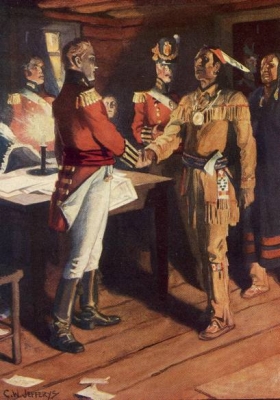
Below, Tecumseh and General Brock, “The Meeting of Isaac Brock and Tecumseh” by Charles William Jefferys

Treaty of Paris February 10, 1763
The Definitive Treaty of Peace and Friendship between his Britannick Majesty, the Most Christian King, and the King of Spain. Concluded at Paris the 10th day of February, 1763. To which the King of Portugal acceded on the same day.

In the Name of the Most Holy and Undivided Trinity, Father, Son, and Holy Ghost. So be it.
Be it known to all those whom it shall, or may, in any manner, belong,
It has pleased the Most High to diffuse the spirit of union and concord among the Princes, whose divisions had spread troubles in the four parts of the world, and to inspire them with the inclination to cause the comforts of peace to succeed to the misfortunes of a long and bloody war, which having arisen between England and France during the reign of the Most Serene and Most Potent Prince, George the Second, by the grace of God, King of Great Britain, of glorious memory, continued under the reign of the Most Serene and Most Potent Prince, George the Third, his successor, and, in its progress, communicated itself to Spain and Portugal: Consequently, the Most Serene and Most Potent Prince, George the Third, by the grace of God, King of Great Britain, France, and Ireland, Duke of Brunswick and Lunenbourg, Arch Treasurer and Elector of the Holy Roman Empire; the Most Serene and Most Potent Prince, Lewis the Fifteenth, by the grace of God, Most Christian King; and the Most Serene and Most Potent Prince, Charles the Third, by the grace of God, King of Spain and of the Indies, after having laid the foundations of peace in the preliminaries signed at Fontainebleau the third of November last; and the Most Serene and Most Potent Prince, Don Joseph the First, by the grace of God, King of Portugal and of the Algarves, after having acceded thereto, determined to compleat, without delay, this great and important work. For this purpose, the high contracting parties have named and appointed their respective Ambassadors Extraordinary and Ministers Plenipotentiary, viz. his Sacred Majesty the King of Great Britain… (dukes, lords, etc.)…Who, after having duly communicated to each other their full powers, in good form, copies whereof are transcribed at the end of the present treaty of peace, have agreed upon the articles, the tenor of which is as follows:
Article I. There shall be a Christian, universal, and perpetual peace, as well by sea as by land, and a sincere and constant friendship shall be reestablished between their Britannick, Most Christian, Catholick, and Most Faithful Majesties, and between their heirs and successors, kingdoms, dominions, provinces, countries, subjects, and vassals, of what quality or condition soever they be, without exception of places or of persons: So that the high contracting parties shall give the greatest attention to maintain between themselves and their said dominions and subjects this reciprocal friendship and correspondence, without permitting, on either side, any kind of hostilities, by sea or by land, to be committed from henceforth, for any cause, or under any pretence whatsoever, and every thing shall be carefully avoided which might hereafter prejudice the union happily reestablished, applying themselves, on the contrary, on every occasion, to procure for each other whatever may contribute to their mutual glory, interests, and advantages, without giving any assistance or protection, directly or indirectly, to those who would cause any prejudice to either of the high contracting parties: there shall be a general oblivion of every thing that may have been done or committed before or since the commencement of the war which is just ended.
II. The treaties of Westphalia of 1648; those of Madrid between the Crowns of Great Britain and Spain of 1661, and 1670; the treaties of peace of Nimeguen of 1678, and 1679; of Ryswick of 1697; those of peace and of commerce of Utrecht of 1713; that of Baden of 1714; the treaty of the triple alliance of the Hague of 1717; that of the quadruple alliance of London of 1118; the treaty of peace of Vienna of 1738; the definitive treaty of Aix la Chapelle of 1748; and that of Madrid, between the Crowns of Great Britain and Spain of 1750: as well as the treaties between the Crowns of Spain and Portugal of the 13th of February, 1668; of the 6th of February, 1715; and of the 12th of February, 1761; and that of the 11th of April, 1713, between France and Portugal with the guaranties of Great Britain, serve as a basis and foundation to the peace, and to the present treaty: and for this purpose they are all renewed and confirmed in the best form, as well as all the general, which subsisted between the high contracting parties before the war, as if they were inserted here word for word, so that they are to be exactly observed, for the future, in their whole tenor, and religiously executed on all sides, in all their points, which shall not be derogated from by the present treaty, notwithstanding all that may have been stipulated to the contrary by any of the high contracting parties: and all the said parties declare, that they will not suffer any privilege, favour, or indulgence to subsist, contrary to the treaties above confirmed, except what shall have been agreed and stipulated by the present treaty.
III. All the prisoners made, on all sides, as well by land as by sea, and the hostages carried away or given during the war, and to this day, shall be restored, without ransom, six weeks, at least, to be computed from the day of the exchange of the ratification of the present treaty, each crown respectively paying the advances which shall have been made for the subsistance and maintenance of their prisoners by the Sovereign of the country where they shall have been detained, according to the attested receipts and estimates and other authentic vouchers which shall be furnished on one side and the other. And securities shall be reciprocally given for the payment of the debts which the prisoners shall have contracted in the countries where they have been detained until their entire liberty. And all the ships of war and merchant vessels Which shall have been taken since the expiration of the terms agreed upon for the cessation of hostilities by sea shall likewise be restored, bon fide, with all their crews and cargoes: and the execution of this article shall be proceeded upon immediately after the exchange of the ratifications of this treaty.
IV. His Most Christian Majesty renounces all pretensions which he has heretofore formed or might have formed to Nova Scotia or Acadia in all its parts, and guaranties the whole of it, and with all its dependencies, to the King of Great Britain: Moreover, his Most Christian Majesty cedes and guaranties to his said Britannick Majesty, in full right, Canada, with all its dependencies, as well as the island of Cape Breton, and all the other islands and coasts in the gulph and river of St. Lawrence, and in general, every thing that depends on the said countries, lands, islands, and coasts, with the sovereignty, property, possession, and all rights acquired by treaty, or otherwise, which the Most Christian King and the Crown of France have had till now over the said countries, lands, islands, places, coasts, and their inhabitants, so that the Most Christian King cedes and makes over the whole to the said King, and to the Crown of Great Britain, and that in the most ample manner and form, without restriction, and without any liberty to depart from the said cession and guaranty under any pretence, or to disturb Great Britain in the possessions above mentioned. His Britannick Majesty, on his side, agrees to grant the liberty of the Catholick religion to the inhabitants of Canada: he will, in consequence, give the most precise and most effectual orders, that his new Roman Catholic subjects may profess the worship of their religion according to the rites of the Romish church. as far as the laws of Great Britain permit. His Britannick Majesty farther agrees, that the French inhabitants, or others who had been subjects of the Most Christian King in Canada, may retire with all safety and freedom wherever they shall think proper, and may sell their estates, provided it be to the subjects of his Britannick Majesty, and bring away their effects as well as their persons, without being restrained in their emigration, under any pretence whatsoever, except that of debts or of criminal prosecutions: The term limited for this emigration shall be fixed to the space of eighteen months, to be computed from the day of the exchange of the ratification of the present treaty.
V. The subjects of France shall have the liberty of fishing and drying on a part of the coasts of the island of Newfoundland, such as it is specified in the XIIIth article of the treaty of Utrecht; which article is renewed and confirmed by the present treaty, (except what relates to the island of Cape Breton, as well as to the other islands and coasts in the mouth and in the gulph of St. Lawrence:) And his Britannick Majesty consents to leave to the subjects of the Most Christian King the liberty of fishing in the gulph of St. Lawrence, on condition that the subjects of France do not exercise the said fishery but at the distance of three leagues from all the coasts belonging to Great Britain, as well those of the continent as those of the islands situated in the said gulph of St. Lawrence. And as to what relates to the fishery on the coasts of the island of Cape Breton, out of the said gulph, the subjects of the Most Christian King shall not be permitted to exercise the said fishery but at the distance of fifteen leagues from the coasts of the island of Cape Breton; and the fishery on the coasts of Nova Scotia or Acadia, and every where else out of the said gulph, shall remain on the foot of former treaties.
VI. The King of Great Britain cedes the islands of St. Pierre and Macquelon, in full right, to his Most Christian Majesty, to serve as a shelter to the French fishermen; and his said Most Christian Majesty engages not to fortify the said islands; to erect no buildings upon them but merely for the conveniency of the fishery; and to keep upon them a guard of fifty men only for the police.
VII. In order to reestablish peace on solid and durable foundations, and to remove for ever all subject of dispute with regard to the limits of the British and French territories on the continent of America; it is agreed, that, for the future, the confines between the dominions of his Britannick Majesty and those of his Most Christian Majesty, in that part of the world, shall be fixed irrevocably by a line drawn along the middle of the River Mississippi, from its source to the river lberville, and from thence, by a line drawn along the middle of this river, and the lakes Maurepas and Pontchartrain to the sea; and for this purpose, the Most Christian King cedes in full right, and guaranties to his Britannick Majesty the river and port of the Mobile, and every thing which he possesses, or ought to possess, on the left side of the river Mississippi, except the town of New Orleans and the island in which it is situated, which shall remain to France, provided that the navigation of the river Mississippi shall be equally free, as well to the subjects of Great Britain as to those of France, in its whole breadth and length, from its source to the sea, and expressly that part which is between the said island of New Orleans and the right bank of that river, as well as the passage both in and out of its mouth: It is farther stipulated, that the vessels belonging to the subjects of either nation shall not be stopped, visited, or subjected to the payment of any duty whatsoever. The stipulations inserted in the IVth article, in favour of the inhabitants of Canada shall also take place with regard to the inhabitants of the countries ceded by this article.
VIII. The King of Great Britain shall restore to France the islands of Guadeloupe, of Mariegalante, of Desirade, of Martinico, and of Belleisle; and the fortresses of these islands shall be restored in the same condition they were in when they were conquered by the British arms, provided that his Britannick Majesty’s subjects, who shall have settled in the said islands, or those who shall have any commercial affairs to settle there or in other places restored to France by the present treaty, shall have liberty to sell their lands and their estates, to settle their affairs, to recover their debts, and to bring away their effects as well as their persons, on board vessels, which they shall be permitted to send to the said islands and other places restored as above, and which shall serve for this use only, without being restrained on account of their religion, or under any other pretence whatsoever, except that of debts or of criminal prosecutions: and for this purpose, the term of eighteen months is allowed to his Britannick Majesty’s subjects, to be computed from the day of the exchange of the ratifications of the present treaty; but, as the liberty granted to his Britannick Majesty’s subjects, to bring away their persons and their effects, in vessels of their nation, may be liable to abuses if precautions were not taken to prevent them; it has been expressly agreed between his Britannick Majesty and his Most Christian Majesty, that the number of English vessels which have leave to go to the said islands and places restored to France, shall be limited, as well as the number of tons of each one; that they shall go in ballast; shall set sail at a fixed time; and shall make one voyage only; all the effects belonging to the English being to be embarked at the same time. It has been farther agreed, that his Most Christian Majesty shall cause the necessary passports to be given to the said vessels; that, for the greater security, it shall be allowed to place two French clerks or guards in each of the said vessels, which shall be visited in the landing places and ports of the said islands and places restored to France, and that the merchandize which shall be found t herein shall be confiscated.
IX. The Most Christian King cedes and guaranties to his Britannick Majesty, in full right, the islands of Grenada, and the Grenadines, with the same stipulations in favour of the inhabitants of this colony, inserted in the IVth article for those of Canada: And the partition of the islands called neutral, is agreed and fixed, so that those of St. Vincent, Dominico, and Tobago, shall remain in full right to Great Britain, and that of St. Lucia shall be delivered to France, to enjoy the same likewise in full right, and the high contracting parties guaranty the partition so stipulated.
X. His Britannick Majesty shall restore to France the island of Goree in the condition it was in when conquered: and his Most Christian Majesty cedes, in full right, and guaranties to the King of Great Britain the river Senegal, with the forts and factories of St. Lewis, Podor, and Galam, and with all the rights and dependencies of the said river Senegal.
XI. In the East Indies Great Britain shall restore to France, in the condition they are now in, the different factories which that Crown possessed, as well as on the coast of Coromandel and Orixa as on that of Malabar, as also in Bengal, …

BC attempts Centennial Lands Act Amendment

11 Sunday Feb 2024

Posted by Admin in Reconciliation, Uncategorized

≈ Leave a comment

Tags

aboriginal title, BC Lands Act, BC Recognition Act 2009, Canada, environment, history, indigenous, informed consent, Land claims, native-americans, Reconciliation, Statement of the Allied Indian Tribes of British Columbia

100 years ago this month, the Allied Tribes of British Columbia petitioned Parliament to shut down the report of the Indian Reserve Commission.

BC has very quietly set up a public consultation process on its plans to embed First Nations local governments within its Lands Act.

The lead is buried pretty deep: BC’s original assumption of control of all the land (without treaty or constructive arrangement) was in 1874. It was patently unconstitutional, and, at first, Canada’s Attorney General disallowed it.

What unfolded then was: replacement of the troublesome AG – Telesphore Fournier, with Edward Blake who allowed a new 1875 BC Lands Act, equally unconstitutional and an act of wholesale annexation, on the basis of settler convenience. Then Canada passed the Indian Act, locking Indigenous Peoples into a second-class-state of outlaw and criminalization. Meanwhile the Province of British Columbia sold off and settled prime Indigenous real estate, fencing communities decimated by smallpox into an-acre-a-person Reserves.

Fifty years of protest, petition, and physical defense of the land (1874-1924) did nothing to remedy the situation at the time, but increased BC and Canada’s resolve to the point of legislating the tiny Reserve Boundaries and making litigation on behalf of Indians… illegal (1927).

A hundred years ago this month, the Allied Tribes of British Columbia petitioned Parliament to shut down the report of the Indian Reserve Commission. BC and Canada had set out to finalize the Indian Land question in 1912, with the McKenna-McBride Commission, and unilaterally “quiet the Indian title,” all the while diplomatically shutting the land issue out of courts and the Privy Council forum.

In their 1926 Petition, the Allied Tribes wrote:

14. By Memorandum which was presented to the Government of Canada on 29th February, 1924, the Allied Tribes opposed the passing of Order-in-Council of the Government of Canada adopting the Report of the Royal Commission upon the ground, among other grounds, that no matter whatever relating to Indian affairs in British Columbia having been fully adjusted and important matters such as foreshore rights, fishing rights and water rights not having been to any extent adjusted, the professed purpose of the Agreement and the Act had not been accomplished.
15. By Order-in-Council passed 19th July, 1924, the Government of Canada, acting under Chapter 51 of the Statutes of the year 1920 and upon recommendation of the Minister of the Interior adopted the Report of the Royal Commission.

50 years before that, the Petition of the Douglas Tribes was brutally clear about the Indian Reserve crisis. And the Reserve boundaries have rarely, and barely, shifted since the final cuts of 1924.

The BC plan now, apparently, is to gain the consent of the Indigenous nations, in the form of the individual Indian Bands / First Nations, to their Lands Act after all.

It is appearing like a visitation of the 2009 BC Recognition and Reconciliation Legislation, which was put to death, in ceremony, in 2009 – once the grassroots people caught wind of it. The grassroots people tend to be very cautious about allowing their elected representatives to sign-on with government initiatives, and acknowledge the crown as the legitimate source of power over their lands, peoples, and futures.

However, little is known about this 2024 draft legislation except that it is proceeding as quickly and mysteriously as the 2009 event, which suddenly surfaced early in the Spring and was submerged by the end of summer.

For more information, you can check the:

BC government’s public consultation process

The BC Treaty Negotiating Times – Summer 2009 Analysis and report on the Proposed Recognition and Reconciliation Legislation, opposition, and events.

And this Blog’s timeline of docs under “Land Claims – policy and protest.” for more on the 2009 legislation, Indigenous Alliances and protest of government assumptions.

Check out Archive Quarterly – a new publication featuring newly digitized history that informs the present here in British Columbia. The first issue arrives April 2024. Every issue features key archival papers and artifacts; quotes and interviews with Elders on the issues; and relatable commentary to connect past and present.

Readers can Subscribe, Support, and Contribute: there are many ways to be engaged!

Take a link to the Archive Quarterly website or AQ on Facebook.

Enforcement of Reconciliation

28 Thursday Sep 2023

Posted by Admin in Reconciliation

≈ Leave a comment

Tags

aboriginal rights, aboriginal title, Canada, Indigenous Peoples, Land claims, United Nations

Part 4 of this week’s blog: No More “Reconciliation Sticks”

Now that we have reconciled ourselves to the reality, as described in the last three parts of this blog, of bottom-line, extinguishment-policy reconciliation, all those orange T-shirts look different. You can bet they mean something different to the wearer, depending on whether they are Indigenous or not.

Still, maybe we go to Capital “R” Reconciliation events at the city venue, to show up for the spirit of it. When our hearing is not muddied by the emotional speeches, we hear the MP say, “we can continue to witness, to learn, and do everything we can to address the past.” That’s his closing line: no particulars, and definitely nothing about addressing the present.

            The School District rep cries and says, “we’re learning how to teach children.” She says there are “powerful examples of how our communities have not done things in a good way,” but doesn’t describe any of them.

The City Councillor says, referring to one of the distinguished visiting Chiefs, “Hey there’s Jimmy. It always makes me happy to see Jimmy visiting us.”

The awkwardness of these emotional people making hollow statements is easily explained by the superficial nature of the assignation. There is confusion around what is expected from a government official who is well aware that his tax revenue comes from the unceded, non-treaty Indigenous lands his city is occupying, and if any native whomever tries to exercise his rights there he will be snapped up and incarcerated as per reconciliation rules (business as usual), but he is supposed to say something that sounds like he cares.

Canada has produced exalted and venerated leaders in obscuring this problem, ensuring that the “reconciliation” of Aboriginal titles, and societies, will be enforced and will usher in the time of “no more Indian question,” with a big smile and a small cheque and some native motif pinned to their suit jacket. But most politicians are not so smooth, so it’s bizarre to watch.

Right next to the “reconciliation” event is the business-as-usual land developer scraping away the river foreshore to build condos, and police patrolling to protect the desecration of the traditional, local, unsurrendered supemarket, pharmacy, and fishery access point.

Because “reconciliation” doesn’t actually mean anything other than what the courts and the legislators and extractive industries and police actually do.

They reinforce the supremacy of the colonial economy – socially, militarily, legally; every way – and chastise land defenders, traditionalists, cultural people, to reconcile themselves to it.

Acceptance, resignation, and reconciliation is required of Indigenous Peoples.

The Truth and Reconciliation Commission’s role in enforcement

The TRC issued its report in 2015. They may have accomplished a few things that Canada wanted “out of the way” before it ratified the UNDRIP.

Without getting personal about the Commissioners – they were just people selected on the likelihood of doing what they were told – the Report of the TRC is a blinding misrepresentation of the situation in Canada. Surely work was done, meetings were held, and people benefitted by their involvement in the course of Commission events; but other work was done as well.

Let’s nip back along a shady trail. In 2007, Canada voted against the United Nations Declaration on the Rights of Indigenous Peoples (UNDRIP) during the General Assembly’s ratification process. It was one of only four member states to do so, out of a total 192 states. It is reliably rumoured that Canada threatened several African countries with cessation of aid funding if they voted in favour of the DRIP.

            Loudly explaining themselves to anyone who would listen, Canada spoke (and issued all manner of written statements) about how Aboriginal rights in Canada are already constitutionalized and superior to the UNDRIP articles.

            Slight further digression: Canada pays various reputable Indigenous individuals to tour the world: Pakistan, Mexico, Australia, several west African countries, among many others, to promote the Band Council system; the Tribal Council system; and also to tell outright lies. “The Assembly of First Nations has a place in Parliament and they are part of the Canadian government,” I heard from an Indigenous South African delegate at the UN Permanent Forum on Indigenous Issues. He had been told as much by an Indigenous presenter from Canada.

So when Canada later ratified the DRIP in 2016, they took the chance to make a grand appearance at the UN Permanent Forum on Indigenous Issues in New York City, with Ministers Carolyn Bennett and Jody Wilson Raybould meeting and greeting. It was odd, then, that when Minister Wilson Raybould returned to Ottawa, she soon was despatched to address the Assembly of First Nations and tell them that implementing the UNDRIP was “not practicable.”

            Five years later, we got the Canadianized legislation of the UNDRIP.

Canada was slow, and incomplete with importing the 1948 Geneva Convention, too. When they incorporated a few articles of that Convention on the Prevention and Punishment of the Crime of Genocide into the Criminal Code, in the 1960s, the “forcible removal of children from the group to another group” was not written as such.

            The “reconciliation of aboriginal rights with the broader society” has been under way long before Chief Justice Antonio Lamer came up with this new and improved, and ambiguous, term. Canadians will handle human rights their own way, and they might need to adjust the dictionary.

See here, one of the very first things out of Senator Murray Sinclair’s mouth, when he delivered the opening statement of the Truth and Reconciliation Commission’s report, was that Canada has committed “cultural genocide.” But that doesn’t exist.

The Report, in its opening paragraphs, erases and redefines one of the only legal tools we Canadians have to grapple with what was not “cultural genocide” – whatever that is, it doesn’t have an accepted definition in international legal instruments – but “genocide,” according to the five definitions of the crime identified in the 1948 Geneva Convention.

Any one of these actions is genocide:

“Forcible removal of children from the group to another group.”

“Deliberately imposing conditions calculated to bring about the destruction of the group.”

“Killing members of the group.”

“Inflicting serious physical or mental harm on members of the group.”

“Forcible sterilization of members of the group.”

According to the TRC, when they describe these intentional actions, this is “cultural genocide” – which is not justiciable, because there is no Convention for the Prevention of Cultural Genocide, and anyway all of the crimes listed above are documented by the TRC in their report and justiciable under the Genocide Convention.

Why did the Commission do this? They were enforcing reconciliation.

            Reconciliation means resigning; it means making compatible; and a finding of genocide really does not fit this “superior to the DRIP,” advanced Canadian culture. The Commission had to enforce “the concept of reconciliation,” as well as the underlying, extra-legal policy of extinguishment. They did a remarkable job, using the word “reconciliation” fluidly between both meanings and even managing to leave the term undefined.

            The Anglican Church letter incorporated in the TRC Report straight-out asked them, “What is reconciliation”? It was not a rhetorical or philosophical question.

Why “must” Indigenous people commit to “mutual respect and recognition”?

This was, for all intents and purposes, ordered by the Truth and Reconciliation Commission. But the TRC was not also offering a path to justice. They just wrote in their report that, in order for reconciliation to work, Aboriginal individuals and groups “must” give respect and recognition to the colonizer.

The Supreme Court of Canada’s Chief Justice, Beverly McLachlin, confirmed the current usage of “reconciliation” in Tsilhqot’in Nation, 2014:

“[83] What interests are potentially capable of justifying an incursion on Aboriginal title?  In Delgamuukw, this Court, per Lamer C.J., offered this:

“In the wake of Gladstone, the range of legislative objectives that can justify the infringement of aboriginal title is fairly broad. Most of these objectives can be traced to the reconciliation of the prior occupation of North America by aboriginal peoples with the assertion of Crown sovereignty, which entails the recognition that “distinctive aboriginal societies exist within, and are a part of, a broader social, political and economic community” (at para. 73). In my opinion, the development of agriculture, forestry, mining, and hydroelectric power, the general economic development of the interior of British Columbia, protection of the environment or endangered species, the building of infrastructure and the settlement of foreign populations to support those aims, are the kinds of objectives that are consistent with this purpose and, in principle, can justify the infringement of aboriginal title. Whether a particular measure or government act can be explained by reference to one of those objectives, however, is ultimately a question of fact that will have to be examined on a case-by-case basis. [Emphasis added; emphasis in original deleted; para 165]”

These justifiable infringements of reconciliation are enforced all the time, at Fairy Creek, Sun Peaks, Burnt Church, and Gitdimt’en.

No Canadian Commission has ever questioned the issue of the Canadian courts’ assumption of entitlement to all legal questions in Canada, and its bias: in favour of Canada; and the resulting lack of access to a fair trial for any Indigenous person who would want to rely on their own laws.

The police who broke up the pipeline-barricade camp at Gidimt’en in 2019 had a clear understanding of their role in reconciliation.

I wasn’t there in Wet’suwet’en territory, but I heard. The Emergency Response Team officers referred to their guns as “reconciliation sticks,” as they proceeded into the unsurrendered, sovereign Wet’suwet’en lands to enforce the Canadian occupation.

Perhaps they are more fluent in colonial law than the average Canadian who is distracted by the TRC’s promise of hearing fabulous Indigenous mythologies, traditions, and histories in youth arts and crafts sessions, or digitization projects, or new landmark signage. Those activities make up the majority of the “94 Calls to Action” articulated by Canada’s Truth and Reconciliation Commission (TRC).

Because the crown (look at any piece of Canadian money) refuses to respect Indigenous law and land, and Indigenous Peoples still aren’t going to give it all up, those mutually exclusive refusals have to be reconciled: if, suspiciously, almost always in favour of the “broader society,” and their several justifiable infringements – immigration, logging, mining, development, etc. According to the Canadian courts. No one has reported much on the thoughts of capable and juridically solvent Indigenous courts.

“Reconciliation” is not the tool of the colonized. “Reconciliation” needs to be enforced.

Thank you very much for reading. Takem i nsnukw’nukw’a.

Check in tomorrow for Part 5 – Reconciliation is Municipalization

and an Indigenous nationalist who fled persecution in Canada, to the USA, and were protected by an American court under the “political prisoners” exception to the extradition treaty.

No more “Reconciliation Sticks”

26 Tuesday Sep 2023

Posted by Admin in Reconciliation

≈ Leave a comment

Tags

aboriginal rights, Canada, Indigenous Peoples, Land claims, Sovereignty

Part 1 – What do you mean, “reconciliation”?

September 30th is the “National Day for Truth and Reconciliation.”

There aren’t enough calendar days in a year to mark the trespasses, and ensuing debts to humanity, amassed by the colonial Canadian project. For instance, when is “Compensation Day”? When is “Land Back Day”? And, “White women got Indian Status by Marriage, and Native women lost it.” Lest we forget.

For now, let’s talk about “Reconciliation.” “Truth” was abandoned fairly early on in the proceedings.

Traditionally, “reconciliation” of legal issues refers to the fulfillment of actions that will be taken to restore the peace and justice, as in a judicially prescribed schedule of reparations following a court decision.

We just don’t have the court decision, unless you count the Indian Residential Schools Survivors Settlement Agreement and the report of the Truth and Reconciliation Commission. But you can’t count those, because they were both mandated, conducted, written, and decided by one of the parties to the dispute. The dispute is between Canada and every Indigenous nation, so the judge can’t be one of those parties.

Imagine if somebody wrongs someone else and then conducts the inquiry as to what should be done about it. That is pretty much what Canadian “reconciliation” is.

If a judge – a court – is impartial to the outcome of a question, then they can have jurisdiction. But Canadian courts are not impartial to the outcome of the Indian land question, because those Canadian judges and all their friends and family and everyone who works for those courts have an interest in Canada winning the competition, so they lose jurisdiction because they’re not impartial.

Most unbiased observers would also notice that Canada has no treaties with Indigenous Peoples that include subjugation of Indigenous Peoples to arbitrary and unilateral Canadian decisions and values, to the total exclusion of the native right of law and jurisdiction.

If there were any application of “truth” to these affairs, “reconciliation” would involve an independent, impartial tribunal. And it would be well-defined.

The Prime Minister has formally stated a national pursuit of something that has no definition. Cities and provinces use the word “reconciliation” to mean anything from “business as usual, but with a big native art motif,” to “we said reconciliation, what more do you want?”

“Reconciliation” lacks all definition.

What it is and what it ain’t: what we know for sure about reconciliation

We definitely don’t know what it is. The Truth and Reconciliation Commission, Canada, itself did not offer a definition and did not have one written into its mandate. In fact, the TRC’s Call to Action #65 recommends the government work with policy and educational institutes to flesh out an understanding of reconciliation.

We do know a lot about what Canadian reconciliation isn’t. It’s not a legally defined process. It’s not binding. It has not been, and will not be, overseen by an independent, impartial, third party. It clearly does not mean that the RCMP will stop terrorizing and arresting land defenders when “negotiations” reach an impasse over cutting a 150km road through pristine forest and putting an oil pipeline there. And courts won’t stop finding them guilty and jailing them, as they did to Gidimt’en defenders in 2022.

We know how the police and RCMP think about reconciliation. The cops sent to stand off against the roadblock were heavily armed, and they arrested people with guns drawn. They referred to their guns as “reconciliation sticks.” We’ll talk about the meaning of that in Part 4 – Enforcement of Reconciliation.

Canadian “reconciliation” is so different than the reconciliation articulated by an Indigenous “Reconciliation Manifesto,” written by the late Arthur Manuel in 2017, that we very quickly apprehend the double entendre of the term. Manuel made it clear that, for Indigenous nations, there is a clearly marked reality to reconciliation – if there is any point to it at all:

“We will know that Canada is fully decolonized when Indigenous Peoples are exercising our inherent political and legal powers in our own territories up to the standard recognized by the United Nations, when your government has instituted sweeping policy reform based on Indigenous rights standards and when our future generations can live in sustainable ways on an Indigenous designed and driven economy.”

There are more than two distinct uses for the word reconciliation. One use refers to the restoration of peace, as described by Manuel – in very similar terms to thousands of native leaders since 1871 – and it refers to human relations. The other use of “reconciliation” is mainly applied to non-human imbalances: while building a house, you can literally reconcile a floor joist to match the door frame. Or you can achieve reconciliation in the budget, if you make some nips and tucks.

It is these latter, mechanical definitions which Chief Justice Antonio Lamer first used, in 1996, when he wrote that Section 35 of the Constitution is a tool with which to ensure the,

“…reconciliation of the prior existence of aboriginal societies with the sovereignty of the crown,”

Chief Justice Lamer, head of the Supreme Court of Canada from 1990 to 2000: right after Sparrow, through Delgamuukw, was talking about bringing round the as-yet unconvinced and unceded nations into Canada – whittling away the incompatible worldviews, traditions, and legal rights to the soil that don’t fit the colony’s vision for itself. He wants to reconcile those ill-fitting, autonomous Indigenous Nations, into Canadian structures. He was hardly the first.

Lamer was not interested in the way that Section 35 confirms the “existing Aboriginal and treaty rights” described in the Royal Proclamation 1763 and the British North America Act, with its Section 109. But the last time Canada tried to get rid of those, in 1976, when it made itself a new constitution that deleted those parts and any reference whatsoever to His Majesty’s independent Allies, there was an intercontinental movement called the “Constitution Express” mobilized by the Indigenous Peoples to remind their one-time Ally, Britain, about them. The British House of Lords was reminded, and forbade Canada to cut its legal roots. Hence Section 35 (1), affirming them in the Constitution Act, 1982.

So Justice Lamer said that section 35 is a “mechanism” to achieve “reconciliation.”

     What he actually meant, following his wordplay through the dozens of illustrations he elaborated in the van der Peet ruling, was extinguishment of Aboriginal rights by negotiation. That was his prescription for reconciling the “pre-existing” societies with Canada, and, in the meantime, defining Aboriginal rights under the Constitution – one sockeye salmon at a time.

(Note: In Lamer’s ruling, Ms. van der Peet was affirmed in her sale of ten sockeye under an Aboriginal Food, Social, and Ceremonial fishing license. She sold them to a friend for $10 a piece.)

The only negotiations available to Indigenous Peoples are defined unilaterally by Canada, and they end in relinquishment of rights and claims in exchange for a little money and a little less land (very little) in fee simple title. This result is widely referred to as extinguishment, because… it eliminates the existing rights.

     We’ll look at that more closely in Part 2, Reconciliation: Theft by Chief Justice.

Meantime, Canadians need to realize that the ‘spirit of reconciliation’ issuing from the upper echelons of their state is a mean one. That’s undoubtedly why the leaders of the society skirt the issue of defining it, and hide behind whatever hopeful face that sincere people want to project on it, and carry right on with business as usual.

The one term has so many uses

The term “reconciliation” has been wash-boarded across the media, which rolls it into play indiscriminately, no matter whether its usage is coming from the judicial, legislative, or executive branches of state; or from individual experiences; or from former Indian Residential School students’ families, who reasonably hope it means change. Unfortunately, it has two more working meanings that are really freezing cold in the shadow of Canadian denial.

     Reconciliation also means “being resigned to something undesirable, or the process of reaching that state; acceptance.” And, finally, the word is used by Roman Catholics specifically to refer to penance, where perpetrators are forgiven by their god.

The Truth and Reconciliation Commission explained, in one of only a handful of attempts to positively define the term they were named for, that in the case of Indian Residential Schools (IRS),

“…reconciliation is similar to dealing with a situation of family violence.”

“Reconciliation is an ongoing individual and collective process, and will require commitment from all those affected including First Nations, Inuit and Metis former Indian Residential School students, their families, communities, religious entities, former school employees, government and the people of Canada. Reconciliation may occur between any of those groups.”

This seems like a categorically inadequate and vague suggestion. But that is the strength of the concept of reconciliation, and, as such, it serves the exact purpose which Justice Antonio Lamer invented it for: to turn real, well-defined, constitutional rights – section 35 (1) – into a ‘platform for negotiation.’

It’s now a quarter century since the government of Canada’s “Statement on reconciliation,” was read out, in ceremony, by Minister of Indian Affairs Jane Stewart. It came two years after the Supreme Court of Canada’s new invention.

      She was announcing Canada’s response to the Royal Commission on Aboriginal Peoples, RCAP 1992-96, and their 4,000 page report. The government’s “Gathering Strength” action plan, 1998, was focused on issues raised by the Commission like early childhood education for Aboriginal communities; housing, water and sewer systems; welfare reform; major injections to the land claims negotiation process, to produce final agreements; and a $350m healing fund – the Aboriginal Healing Foundation.

     Keep in mind that the RCAP was forced by an armed stand-off at Oka, where control of the land was at issue – not preschools; not increased welfare relief; not affirmative action schemes; not expediting land claims, but jurisdiction over the land.

     Minister Stewart famously announced that the government of Canada “regrets” its role in the Indian Residential School system. The government demonstrably regrets nothing: Canadian money is still a solid eighty-cents-on-the-dollar coming directly out of the land. Indian Residential School enforced every child’s attendance for fifty years, and was one of the most effective strategies to destroy Indigenous groups, right along with smallpox, wiping out the buffalo, and the Indian Act. It’s one of the main reasons Canada gained access to their lands.

By the time Canada stated its “regrets,” every church involved had already given public apologies. But the Indigenous people had to wait until 2008 – after the ratification of the IRS Settlement Agreement – before Canada apologized.

Why is it that Indigenous Peoples, or individuals, have to sign something in order for Canada or provinces to apologize, or recognize, or “reconcile”? We’ll look at that more closely in “Part 4 – Enforcement of Reconciliation,” where the business-end of Canadian reconciliation is mutual recognition.

Canada has been importing and exporting its Indigenous title workarounds for decades. They echo back, and British colonies support each other. Hey, the first treaties in British Columbia were signed blank by Snuneymuxw Chiefs with “X”, and sent to New Zealand for the most current Imperial text. Australia cottoned on to ‘reconciliation’ by the year 1991. They made up a Bill,

“To establish a Council for Aboriginal Reconciliation (the Council) to promote a process of
reconciliation between Aborigines and Torres Strait Islanders and the wider Australian community.”

The Bill passed. Today, they use it in a very similar way to Canadian “reconciliation,” with “Reconciliation Australia” providing online portals for Australian businesses to post slides about mounting native art in the lobby, or Aboriginal customers – but not about justice, land back, compensation, reparation, or restitution. On October 14 this year, Australians voted overwhelmingly against giving Aborigines a voice to their Parliament.

There is something called “Global Affairs Canada’s action plan for reconciliation with Indigenous Peoples 2021-25.” They mean Indigenous Peoples all around the world. Presumably they want to make Indigenous Peoples everywhere conform to their interests, as per “reconciliation Def. #2 – to make compliant with” like they do here.

     GAC says, “Global Affairs Canada is committed to applying a reconciliation lens across its diplomacy and advocacy, trade and investment, security, international assistance, and consular and management affairs.” This will be informed by the TRC’s Calls to Action, and the Report on Missing and Murdered Indigenous Women. Suffice to say neither of those Canadian commissions’ reports deal with land title, self-determination, jurisdiction, or reparation either.

Canada and British Columbia have both unilaterally passed legislation concerning the UN’s Declaration on the Rights of Indigenous Peoples. The Canadian UN DRIP Act is a fretful talk-and-log strategy which does nothing to improve Indigenous rights, but legislates that Indigenous Rights should be observed, whenever Canadians and the Indigenous agree on how that should be done. Canada ratified the International Declaration almost ten years after it first passed the UN General Assembly – but not before getting a few sub-standard “reconciliation” issues entrenched first in the 2015 TRC report. We look at that in Part 4 – Enforcement of Reconciliation.

Although they do not act like it, “…all Canadians are treaty people, bearing the responsibilities of Crown commitments and enjoying the rights and benefits of being Canadian.” That is how George Erasmus put it, when he was longtime-President of the Aboriginal Healing Foundation, in “Cultivating Canada; Reconciliation through the lens of cultural diversity.” It’s a 2011 Aboriginal Healing Foundation publication.1

The treaty people aren’t acting properly: they pass legislation and think it should affect the self-determining people.

The self-determination of Peoples means that which is arrived at, by Indigenous Peoples, freely determining their political status, on their own territories. And not by any means to be coerced out of their natural wealth. It’s in the International Bill of Rights, 1969, which is two Conventions: one for the rights of Peoples to Economic, Social, and Cultural Rights (CESCR), and one for Civil and Political Rights (CCPR). Canada hasn’t come around to recognizing that Indigenous Peoples are “Peoples” within the meaning of such international treaties and statutes.

The Standing Committee on Indigenous and Northern Affairs has, this year, embarked on a study of Restitution of Land to Indigenous Communities. A similar investigation was called for by the former Prime Minister, John Diefenbaker, fifty years ago. At that time, for the first time, three Supreme Court of Canada judges ruled that Aboriginal title exists in Canada and it hasn’t been, couldn’t have been, shifted by any unilateral action of the state.

     Will restitution be made to self-determining Peoples and nations? Or to treaty First Nations which have traded their sovereignty (in exhaustion and duress) and unextinguished land claims for a few acres and municipal status? “Reconciliation” doesn’t say, it doesn’t offer guidelines consistent with international law and convention; it says wait and see.

     We’ll look a lot more closely at that in Part 3 – Reconciliation as Subterfuge.

In 2004, the feds lost track of a secret policy document, it was leaked, and it explained all about how “the concept of reconciliation” would “secure investment, stabilize certainty,” and – always last in line – “promote socioeconomic development in Aboriginal communities.” The government has told us what it wants out of this reconciliation project, and it has a lot more to do with starving-and-coercing Indigenous leaders into major releases.

How should Canadians understand their role, or their government, and the urgent task of averting genocide before them, when their elected leaders are clearly using a term of utmost importance in a duplicitous way?

    For too long Canadians have been slaves to greed and desperation, partly informed, no doubt, by many of their own flights from genocide and colonization. The Sto:lo word for the white people, when they arrived in the Fraser Valley, translates as “the hungry ones.” But not just hungry; “insatiably hungry and never satisfied.”

When Canadians talk about “reconciliation,” they should be specific:

“I mean hurrying up land claims so we have certainty for investment,” as per federal policy.

“I mean enacting Canadian legislation to improve the way native families interact with social workers in the Ministry of Children and Families,” as per the TRC calls to action.

“I mean forcing impoverished communities to relinquish their rights, under duress, in the only negotiated land claim settlements Canada will offer,” as per the Supreme Court of Canada.

“I mean redecorating the academy, you know, and making a list of Indigenous gift shops so professors can buy suitable thankyou presents for guest speakers,” as per university ‘decolonization handbooks.’

“I mean hurrying up self-government agreements with the First Nations, following Canada’s “Inherent Rights Policy,” and as augmented by the First Nations Governance Act, the First Nations Fiscal Responsibility Act, and the First Nations Land Management Act,” as per federal policy. “You know, to reconcile their pre-existence with the sovereignty of the crown.”

Or maybe they mean something sincere, but on a personal level:

“I mean – holy cow – I have sat up all night and all day all week and just tried to come to grips with the realization that everything that happened to us in Ireland, the British took our worst monsters – graduated up through the Christian Brothers industrial schools, and brought them here to do the same to these people,” as per the individual journey.

And even,

“I just heard about “Namwayut” and I’m learning to be reminded that: “we are one in the universe, and we are one with the universe,” as per readers of Chief Robert Joseph’s book, “Namwayut ~ A Pathway to Reconciliation.”

But …

If Canadians want to talk about unqualified Land Back; if they mean RCMP out; if they mean recognition of and restitution of authentic governments; justice for crimes of genocide; and if they mean reparations and compensation, they are not talking about the reconciliation promoted by Canadian institutions and the legal and executive branches.

     The “True Reconciliation” sticks are rattled to drum out and silence unassimilated, autonomous people who want to determine their own future: who know their rights come from their Creator and ancestors – not from Canada.

Peace and justice are the more appropriate objectives.

Tsawwassen, Musqueam, Tsleil Waututh, and Squamish Peoples, among others from Sto:lo to Tagish, are internationally protected people. They are protected from us – Canadians – and you can see why.

Let’s reconcile, and I mean here, “accept the very uncomfortable fact,” with that: Canada does not have the treaties – it does not have the consent or agreement – with Indigenous land title holders.

Currently, “reconciliation” is a coercive process, enforcing colonial control and interference, and denying the Peoples’ rights.

Thank you very much for reading. Takem i nsnukw’nukw’a.

Check in tomorrow for Part 2 of No more “Reconciliation Sticks” – Theft by Chief Justice.

  1. Note that the Aboriginal Healing Foundation abruptly lost its federal funding, after a dozen years of good work, when it advised against lump-sum settlement in the Indian Residential Schools Survivors Settlement Agreement; and then produced a report counting the suicide, overdose, accident, and other damage resulting from Canada’s lump-sum settlement. ↩︎

SUFFER THE LITTLE CHILDREN Genocide, Indigenous Nations and the Canadian State

04 Monday Jun 2018

Posted by Admin in Indian Residential School

≈ Leave a comment

Tags

aboriginal rights, Canada, Indigenous Peoples, Sovereignty

New book batters Canadian denial, launches in Vancouver this week

Suffer the Little Children – Genocide, Indigenous Nations and the Canadian State
By Tamara Starblanket

Clarity Press, 2018
Foreword by Ward Churchill
Afterword by Sharon H. Venne

Official launch Thursday, June 7, 6pm at the Vancouver Native Education Center.

This much-anticipated book places Canada’s Indian Residential School programme among the world’s leading crimes against humanity: genocide. From the Introduction: This book is meant to serve as a battering ram to hammer through the wall of denial. 

         Advance remarks on this book by Noam Chomsky, Steven Newcomb and Irene Watson indicate its importance to leading thinkers today. The Foreword by Ward Churchill and Afterword by Sharon Venne, an international legal expert on the rights of Indigenous Peoples, lend even more credibility to the work. It’s a subject of pivotal importance in Canada, and yet few have had the fortitude to approach it. Far fewer have had the endurance to complete such a painful analysis.

One of the most important things about this book is its refusal to allow Canada to be considered a “post-colonial” state. The evidence against Canada’s genocidal “forcible removal of children” during the Indian Residential School era is connected to the present-day foster care system, which targets young Aboriginal families in particular: still forcibly removing children from the genocidally-targeted group and placing them with members of another group. With the colonizing group: be they white, yellow, beige, or brown families. And still removing those Indigenous children with the same genocidal objective of “bringing about the destruction of the group, in whole or in part,” in order to continue colonizing and absorbing the yet-unceded Indigenous homelands.

Starblanket’s thesis, on which the book is based, was argued successfully for a Master of Laws degree from the University of Saskatchewan.

​         Another of the book’s most important accomplishments is Starblanket’s assessment of Canada’s official federal treatment of the Indian Residential School fallout as having only to do with individuals. Individual survivors were compensated under the 2006 Indian Residential Schools Survivors’ Settlement Agreement. In fact, the intended and effective result of the “schools” was a series of national crises among the Indigenous Nations whose lands Canada tries to claim. With their children gone, and their languages and systems of culture and governance uncertain, the crime was against nations – not individuals. Starblanket breaks down the very different legal implications.

​         The crime of removing the children was against nations and peoples with the right to self-determination, land, language, history and future: individuals do not have such rights.

​         But it is Canada’s special reservation to deny the nationhood and national characters of some fifty nations. This is in keeping with Canada’s posture that the state has the ability to absorb various Indigenous “minorities” within its stolen borders, and award them various “Aboriginal rights” in place of their internationally-recognized rights as nations and peoples.

Canada’s assault on these nations is justiciable – for all the reasons Starblanket puts forward – under the Vienna Convention on the Law of Treaties, 1969; under the Geneva Convention for the Prevention and Punishment of the Crime of Genocide, 1948; and, in some ways, under more recent international norms, such as the International Convention on Economic, Social and Cultural Rights, and the International Convention on Civil and Political Rights. These latter two are equipped by the United Nations with Treaty Bodies – with Committees which have repeatedly reviewed and severely criticized Canada for its denial of the self-determination of Indigenous Peoples. Starblanket concludes that self-determination is the answer. Not “reconciliation,” which she debunks as a public relations scam.

​         Information does not make change, however. There is no Committee to receive reports on, or review violations of the Geneva or the Vienna Conventions. Only states can take other states to the International Court of Justice for that. And, so far, no other state has been willing to intervene in what is known as the “domestic judicial complicity in genocide,” such as it is within Canada. This book may help with that.

If there must be a shortcoming in Suffer the Little Children, it is the absence of international legal prescriptions for justice. Genocide is not a crime which a state can be allowed to rule on domestically when its own government is one of the parties to the crime. There is an important precedent. In 2007, Menchu v. Montt was heard by the Constitutional Court of Spain. That case concerned Guatemala’s genocide against the Mayan people, and it found General Rios Montt guilty of genocide. Unfortunately, the presiding Spanish judge, Justice Garçon, died suddenly and unexpectedly shortly thereafter. And the ruling was reversed.

​         The importance of this book is that it makes available, to the people of Canada and to the people of the world, the trial of Canada – if not the actual court room. These things take time, and this book keeps the clock ticking.

​         If the empires and invading nations cannot be relied on to deliver justice, even when their Constitutional Courts decide a fairly obvious matter, perhaps the people of the world can do better. If not the colonizing people of Canada, who have a vested interest in the displacement, denial and dispossession of the original nations; then perhaps the people of the world – as the overthrow of apartheid in South Africa was achieved, in part, by outside groups.

​         And if the example of Menchu v. Montt could be brought to bear in the case of Canada, might we get the next chapter of this story? Something like Starblanket v. The Director of Child and Family Services? The case has certainly been laid out: the Ministry has been advised, time and again, over decades, of the effects its actions are having – and it keeps doing them.

The book will be officially launched this Thursday, June 7, at the Vancouver Native Education Center. Event starts at 6pm.

Follow this link to the book : Suffer the Little Children


Quotes from the book:

“While other aspects of Canada’s “Indian policies” can be seen to fit the definition of genocide, specifically at issue in this book is its century-long program of forcibly removing indigenous children from their families, communities, societies—in sum, from their Nations—and placing them for sustained periods in “residential schools” where the stated goal was to strip them of their cultural identities and “remake” them into “end products” deemed useful to Canada’s colonizing and ever-growing settler population.”

“I am the sole member of my birth family still alive. My grandparents, maternal and paternal, as well as my late mother and her siblings, were all forced to spend their formative years in the schools, an experience from which none of them would ever recover.”

About TamaraStarblanket:

Tamara Starblanket is Spider Woman, a Nehiyaw iskwew (Cree Woman) from Ahtahkakoop First Nation in Treaty Six Territory.  Tamara holds an LLM (Master of Laws) from the University of Saskatchewan, and an LLB from the University of British Columbia. She is the Co-Chair of the North American Indigenous Peoples’ Caucus (NAIPC) at the UN Permanent Forum on Indigenous Issues. She presently coordinates and teaches in the criminology program at Native Education College in Vancouver, BC.

Early Reviews:

“Settler-colonialism reveals the brutal face of imperialism in
some of its most vicious forms.  This carefully researched and
penetrating study focuses on one of its ugliest manifestations,
the forcible transferring of indigenous children, and makes a
strong case for Canadian complicity in a form of ‘cultural
genocide’ – with implications that reach to the Anglosphere
generally, and to some of the worst crimes of the ‘civilized
world’ in the modern era.”
Noam Chomsky

“Tamara Starblanket’s work is confident, clear and succinct;
her work is ground-breaking and provides us with new ways of
looking at how the states treatment of First Nations Peoples
has gone unrecognised for its genocidal affect. This work
provides an excellent critique on the exclusion of cultural
genocide from how genocide is defined in international law.”
Professor Irene Watson,
Research Professor of Law, University of South Australia

“Tamara Starblanket’s book provides a much needed
examination and critique of the ‘residential school’ system that
forcibly transferred Indigenous children from their families,
communities, and nations into institutions run by the colonizer
state—in this case, Canada. Despite the fact that the United
Nations 1948 Convention on Genocide explicitly includes
‘forcibly transferring children of the group to another group’ in
its definition of ‘genocide,’ there are those who deny that the
colonial ‘civilizing’ project amounted to genocide. Starblanket
demonstrates that the residential schools in fact aimed at
destroying the most intimate level of Indigenous life—the child-
parent relation—employing brutal beatings, solitary
confinement and other horrible punishments, often resulting in
children’s deaths. The goal of the schools was to prevent
Indigenous societies from perpetuating themselves. Though
officially repudiated, the residential schools produced a
continuing social and institutional legacy. Starblanket’s work
brings this history and its legacy effects to our awareness and
shows that ‘the road home’ requires an emphasis on
Indigenous self-determination.”
Peter d’Errico,
Professor of Law, University of Massachusetts

“Tamara Starblanket has skillfully taken on one of the most
difficult and contentious issues, genocide. With intellectual
courage and determination, she has approached the issue
from the perspective of a Cree woman, scholar, and attorney
who has first-hand knowledge of the deadly and destructive
intergenerational impacts of Canada’s domination and
dehumanization of Original Nations and Peoples.”
Steven T. Newcomb (Shawnee, Lenape),
author, Pagans in the Promised Land Decoding the
Christian Doctrine of Discovery

“This is heavy stuff, about which much more should be said,
and Starblanket is unsparing in saying it…I am proud to call
her sister, and to thank her.”
from the Preface by Ward Churchill,
author, A Little Matter of Genocide

Indigenous reports force feds ahead of UN review

29 Saturday Jul 2017

Posted by Admin in BC treaty process, Commentary, editorial, UN Engagement

≈ Leave a comment

Tags

Canada, Indigenous Peoples, Sovereignty, UN, United Nations

75% of reports to Committee on racial discrimination sent by Indigenous organizations.

Last week, Canada switched arrogance and condescension for gestures of off-kilter desperation at the Assembly of First Nations’ general assembly. That is probably because on August 14 and 15, Canada will be under the microscope at UN headquarters in Geneva. Fifteen Indigenous Peoples’ organizations have already submitted extensive reports for the Session, detailing Canada’s “seek and destroy” approach to their internationally recognized human rights.

It is a typical Canadian tactic to invent meaningless distractions right before a review by a UN treaty body: their delegates to the Session can then reply to the Committee’s independent experts by talking about “initiatives” or “joint meetings” which do not substantially exist, instead of answering directly.

This time Canada sent four federal ministers to the AFN’s annual assembly, July 25-27, where they implied that Ottawa is going to rescind the Indian Act. Bennett (Minister of Indigenous Affairs), Wilson-Raybould (Minister of Justice), McKenna (Environment) and Goodale (Public Safety), all made vague references to bright promises yet to come.

The only concrete message from Ottawa to the AFN Chiefs – only half of whom showed up at the all-expense-paid meeting in Regina – was that it will no longer claw back unused capital funds to First Nation communities after twelve months of dispersal.

This miserable material figure can and should be unsuccessfully compared to the immaterial, yet golden, future intimated by Bennett’s and Wilson-Raybould’s reported remarks.  “How will your nation and Indigenous government be organized? What is your territory?” Their remarks, on the other hand, will certainly be judged against the picture of Indigenous life under Canada which has been detailed in reports to the UN CERD.

“ Skeena watershed and coastal Indigenous communities depend on the salmon for food, their economies and cultures. This (LNG, Prince Rupert) project is a prime example of what’s wrong with Canada’s approach to engaging Indigenous communities in large-scale industrial developments: It continuously fails to honour the legal obligations to Indigenous Peoples in protecting their traditional resources; The Canadian government generally consults with Band Councils, which were created under the colonial Indian Act, and often fails to consult hereditary leadership or respect traditional governance systems; …”

. Skeena Indigenous Groups’ Submission to UN CERD. July 6, 2017

It is interesting to note that only weeks after this report to the CERD was posted for the Session, Petronas announced its withdrawal from this proposed project, “Pacific NorthWest LNG.”

The UN Committee for the Elimination of Racial Discrimination has dealt Canada sharp rebukes over the last two decades: stop extinguishing Indigenous Peoples’ titles; stop ignoring murderers who target Indigenous women; stop trying to destroy the Lubicon Cree to get oil access.

The UN treaty bodies have an internationally recognized judicial power to issue recommendations to member states in keeping with upholding international human rights conventions. Each committee periodically receives reports from the state under review, and also from non-governmental organizations, civil society, academia, and now from Indigenous Peoples’ organizations.

It is typically the reports from Indigenous Peoples and NGOs which have, in the past, resulted in strong recommendations from UN Committees to Canada. Many of those have produced changes in the government’s behaviour, although such changes have been isolated and usually only in direct connection to the issues reported. In British Columbia this includes instances of forgiveness of government treaty negotiation loans to small Bands; dissolution of treaty societies formed to negotiate in the BC treaty process – against community members’ protests; and possibly the current standstill in BC Treaty Commission business altogether.

Extinguishment “negotiations” are an ongoing problem that is at the center of the CERD’s focus on Canada:

“There are no viable options other than legal court action to counter the BCTC “treaty” process about these overlaps into St’át’imc territory. As negotiations with the outside First Nations progress, the eventual outcome will be the extinguishment of significant portions of St’át’imc territory without the St’át’imc having been involved in any negotiations to this effect.”

. SHADOW REPORT BY THE INTERIOR ALLIANCE: CANADA’S ONGOING                               COLONIZATION OF INDIGENOUS PEOPLES.   UN CERD COMMITTEE JULY 2017

In contradiction to the Interior Alliance’s extensive documentation of the extinguishment effect of Canadian “negotiations,” however, Minister Wilson-Raybould remarked to the press on her government’s plans: “They are explicit in rejecting certain long-standing federal positions—such as the focus on extinguishment, surrender or denial of rights.” Incidentally, that’s what Canada told the CERD in 2007.


Extinguishment, surrender and denial are precisely what Canada offers Indigenous Peoples. There is a veritable firestorm of examples of this, enveloping Indigenous Peoples. It is highly suspect that a Canadian Minister climbs a prominent national stage and says “we’re just about to change,” (again) only days before Canada has to answer a lot of very pointed questions in front of the world.

Consistent Canadian practices are to assimilate and co-opt economic development, to municipalize isolated communities under provincial legislation, to criminalize traditional economies, to rigidly maintain dependency by an overbearing and constantly metamorphosing bureaucracy which can never be finally functional. There is the “First Nations Land Codes” – where a community votes to recognize Canadian supremacy in its traditional territories, just for the privilege to enjoy managerial duties on-reserve. There are the “Strategic Land Use Planning Agreements” – where communities have shared maps of their territories showing cultural values and inadvertently given tacit approval to development in huge “low cultural value” lands. In the national Inquiry into Missing and Murdered Indigenous Women, crucial voices have undoubtedly been denied. Indigenous Peoples’ rights under Article 1 of the International Covenants on Civil and Political, and Social, Economic and Cultural Rights are completely denied. Canada specializes in the forcible removal of Indigenous children from their homes and communities, requiring parents and families to submit and surrender to provincial courts which have no jurisdiction whatsoever in the case of children and families who are not Canadian until they produce a referendum from their nation joining Canada.

Minister Wilson-Raybould, apparently speaking for those Indigenous individuals who have exercised their right to choose a nationality, appealed to the Chiefs to imagine their future as Canadians whose Indigenous rights are recognized and respected.

Ultimately, the Supreme Court of Canada expresses the state’s right to own Indigenous nations it has no treaties with. It is certainly a matter of interest in any investigation of racial discrimination. Apparently the key to Canada’s jurisdiction over nations with which it has no constructive agreements is owing to the fact that the British monarch, appointed by the Christian god, had sent a sailor with orders to discover and possess others’ lands in His name, and he was successful in this because the Christian god was superior, so the Supreme Court of Canada seems to say, to any of the existing nations’ gods. We know it is the presence of other Christian nations which is at issue in the matter of the Canadian court’s opinion on sovereign possession, because the issue was finally settled in 1846, according to Canadian judges, when the USA agreed in the Oregon Treaty to withdraw from pursuing any interests north of the 49th parallel. From that date, Great Britain and now Canada enjoys sovereign possession of all lands from the Pacific Ocean to the Atlantic Ocean above that parallel, except Alaska, as per SCC, because all other Christian nations had, by that time, also promised Great Britain they would pursue no interests there.

Unfortunately for that internationally repugnant display of Canadian faith, which is the state’s current legal precedent, it is not clear that any Indigenous Peoples have formally joined and adhered to Canada. Wilson-Raybould was referring to that popular understanding among the Chiefs. The CERD has been made aware of that understanding, and again in the reports for this Session:

“In particular, we bring to the Committee’s attention the state’s use of its own  imposed Indian Band administration, under the Indian Act, on the state-defined Indian Reserve, to manufacture the appearance of Líl’wat consent to Canada’s disposal of the remainder of Líl’wat customary titles to lands and wealth outside the Reserve.

“Líl’watmc ask that the Committee question Canada about the origins of any rights of jurisdiction it may have in relation to Líl’wat which could justify Canadian licensing and development without the consent and against the Interests of the Líl’watmc under the Convention, and resulting in the continuing displacement and dispossession of Líl’wat.”

Líl’wat report to UNCERD, July 2017, with the International Human Rights                                         Association of American Minorities

The picture developed by fifteen Indigenous Peoples’ organizations shows Canada’s unabated attempts to assimilate Indigenous Peoples – their worldview, identity, economies, individuals, children, histories, and especially their lands and natural wealth – into Canada. Unilateral, non-consensual assimilation is categorically prohibited as a matter of human rights norms, and yet that end of the spectrum of Canada’s colonization is not the worst.

“If Ontario and Canada insist on excluding us from meaningful consultations on the Agreement in Principle, then we insist that Canada and Ontario exclude the areas where our First Nations’ asserted Aboriginal title and rights overlap with the “Algonquins of Ontario” claims, or at least suspend negotiations over  such areas, until such time as we have engaged in meaningful consultations and reached an acceptable accommodation.

“Despite our objections in March 2016, the “Algonquins of Ontario”, Canada and Ontario have proceeded to hold a referendum vote on the AIP.”

ALGONQUIN NATION SECRETARIAT  TO THE UN CERD COMMITTEE                                                          July 2017


“How does one start to describe the horrific conduct of Canada in their relentless efforts to extinguish the rights of Indigenous peoples within their ancestral homelands?”

“While the Supreme Court of Canada has determined that the Canadian and provincial governments have a duty to consult, negotiate, and accommodate Indigenous rights, the governments use these consultation and negotiation processes to coerce, terrorize, terminate, extinguish, and discriminate against Indigenous peoples and our rights.”

Submission to the UNCERD 93rd Session, July 31-August 25, 2017.                                             On behalf of the Mothers and Grandmothers of the Maliseet Nation


“Asubpeeschoseewagong Netum Anishinabek, also known as Grassy Narrows First Nation, is located on the English-Wabigoon River system in North Western Ontario, and is infamous for mercury contamination from an upstream pulp and paper mill. … In 2016, a former mill worker came forward to confess the mill had illegally buried barrels of waste along the river, leading to the persisting contamination and inability of the river system to recover naturally.”

Chiefs of Ontario report to UNCERD, July 2017


“On November 29, 2016, the Canadian Federal Cabinet directed the National Energy Board to approve the Kinder Morgan Trans Mountain pipeline expansion. This pipeline poses an unacceptable risk to the health, safety and livelihoods of First Nations throughout British Columbia, and will contribute to the negative environmental and health impacts experienced by Indigenous Peoples downstream of the tar sands, and of all peoples throughout the world as a result of accelerating global climate change. The Tsleil-Waututh, Squamish, Musqueam, Coldwater, Upper Nicola, Stk’emlupsemc te Secwepemc, Aithchelitz, Shxwhay Village, Yakweakwioose, Kwawkwaw-apilt, Tzeachten, Skowkale, Soowalie, and Squiala peoples have commenced legal proceedings seeking to challenge the federal approval for the Trans Mountain project… It is well established that diluted bitumen contains toxic chemicals that are a threat to drinking water, health, and the well-being of salmon and other beings.”

Submission to the UNCERD 93rd Session, 2017.                                                                                 Union of British Columbia Indian Chiefs.

Minister Bennett, for the federal department of Indigenous and Northern Affairs, said to the AFN Chiefs last week: “We want to partner with you on building on the strengths and assets you have in your communities. You have the power to determine the future of your communities.”

The international community is quite aware that Canada still wishes to build on the strengths and benefits belonging to Indigenous communities, whether Canada co-opts the participation of those communities through “benefits sharing” or “land management” or other agreements achieved under duress. The international community is also aware that Indigenous Peoples have the power to determine the future of their communities, and that Minister Bennett and her government may well have nothing to do with that.

As the Union of BC Indian Chiefs’ report articulated, “We are presently witnessing a great divide between the words of the Canadian government and its actions on the ground. We would like to highlight the term “rights ritualism” for the consideration of the Committee in respect to Canada’s present actions: a way of embracing the language of human rights precisely to deflect real human rights scrutiny and to avoid accountability for human rights abuses. Countries are often willing to accept human rights treaty commitments to earn international approval, but they resist the changes that the treaty obligations require.”


← Older posts

Subscribe

  • Entries (RSS)
  • Comments (RSS)

Archives

  • December 2025
  • October 2025
  • June 2025
  • May 2025
  • February 2025
  • September 2024
  • August 2024
  • July 2024
  • April 2024
  • March 2024
  • February 2024
  • September 2023
  • August 2023
  • June 2023
  • June 2018
  • December 2017
  • July 2017
  • January 2017
  • December 2016
  • July 2015
  • March 2015
  • February 2015
  • January 2015
  • December 2014
  • September 2014

Categories

  • Archive Quarterly
  • BC treaty process
  • Children
  • Commentary, editorial
    • Uncategorized
  • Comprehensive Claims – Policy and Protest
    • aboriginal title
  • Government Commissions
  • Gustafsen Lake Standoff 1995 – Ts'peten Defense, Secwepemc
  • Haida title
  • Indian Residential School
  • Indigenous Declarations
  • Non-Status Indian Era
  • Reconciliation
  • Roadblock
  • UN Engagement
  • Union of BC Indian Chiefs

Meta

  • Create account
  • Log in

Blog at WordPress.com.

  • Subscribe Subscribed
    • The West Wasn't Won
    • Already have a WordPress.com account? Log in now.
    • The West Wasn't Won
    • Subscribe Subscribed
    • Sign up
    • Log in
    • Report this content
    • View site in Reader
    • Manage subscriptions
    • Collapse this bar
 

Loading Comments...