• About The West Wasn’t Won archive project
  • Archive Quarterly
  • Children
  • Fisheries
  • Land of the Peoples
  • Lawfare
  • Non-Status Era
  • Roadblocks and Restitution
    • Gustafsen Lake
    • Haida
    • Líl’wat
    • Nisga’a

The West Wasn't Won

~ Outlive the colonial world.

The West Wasn't Won

Tag Archives: history

The Cowichan decision in five points

30 Thursday Oct 2025

Posted by Admin in aboriginal title

≈ Leave a comment

Tags

aboriginal title, Canada, Comprehensive Claims Policy, Cowichan, history, indigenous, Indigenous Peoples, Land claims, news, politics, Richmond, Tl'uqtinus

Concerning, how does a declaration of Aboriginal title affect the non-Native people now living in the ancestral village of Tl’uqtinus, where Cowichan title has been judicially declared?

Tl’uqtinus – tah-look-TEEN-oosh (*an approximate anglicism) – is a 1,846-acre area which overlaps the City of Richmond, lying along the Fraser River.

      On August 7 of this year, the Supreme Court of British Columbia gave a ruling on the Cowichan Tribes’ claim to Aboriginal title to that area. This case is now the longest-ever Aboriginal title case, running over 500 days in trial.

      The judge made a declaration of Aboriginal title to most of the area, which is a seasonal Cowichan fishing village. Madam Justice Young decided that, “The Crown grants of fee simple interest in the Cowichan Title Lands, and the Crown vesting of the soil and freehold interest in the Richmond Tl’uqtinus Lands (Highways) in the Cowichan Title Lands, unjustifiably infringe the Cowichan Nation Aboriginal title to these lands.” She concluded that most of the current land titles in the area are “defective.”

Since then, panic has gripped the province of British Columbia – just as it has after every successful Aboriginal rights case since the first one in 1964. The Province of BC, Canada, and the City of Richmond are appealing the ruling instead of entering negotiations with the Cowichan Tribes.

      The judge suspended the effect of her declaration for eighteen months, to provide time for transition, but all levels of settler government have made it clear they intend to fight cooperation with Cowichan interests and title every step of the way – as they have after every declaratory recognition of Aboriginal land rights since 1875.

The following analysis is based on an extensive survey of Aboriginal rights litigation arising west of the Rocky Mountains; an extensive survey of the circumstances leading up to such litigation and the clear public statements made by Indigenous plaintiffs, as well as the statements of claim; an extensive inventory of provincial behaviours since colonization; and a review of non-Native reaction to the Cowichan title case.

1. Aboriginal title is not the same as fee simple title

What Canada has all along been calling “Aboriginal title” – a sui generis and abnormal concept – are actually national titles, flowing from centuries and millennia of law and governance.

      “Aboriginal title” is a colonial construct used by the crown to obscure Indigenous Peoples’ land rights and subject them to the discretion of the crown. The Cowichan, among others, have now outlived that construct. They, like the Tsilhqot’in just before them, have forced the court to recognize the practical aspect of Aboriginal title. The court, in Cowichan, has ordered that the government of British Columbia must negotiate a resolution to the title conflict. (See the Summary of Declarations below)

      In case after case, for fifty years, crown courts have reduced the meaning of their own invention, “Aboriginal title lands,” to mean nothing more than the right to use and occupy “small spots,” or “postage stamp title” – around fishing rocks, hunting blinds, and “fenced village sites” – as if these were private holdings on crown land.

         Settlers have been left not understanding what Indigenous Peoples’ land titles really are, while the courts have attempted to define them out of existence.

2. Co-existence of Aboriginal title and fee-simple ownership

Because what “Aboriginal title” actually refers to is those national titles, and the underlying title belonging to that Indigenous Nation or People, the underlying Indigenous land title co-exists with individual property ownership in almost exactly the same way that fee simple title holders relate to what they thought was underlying crown title.

      There have always been individual land titles throughout Indigenous Nations. The nations are made up of Clan and House Lands, and titles which must be upheld in regular actions of governance and social obligation. Not unlike the taxes and bylaws of today’s settler regime.

Recently, many people have piped up to the tune that Aboriginal title, as a right to the land, cannot co-exist with fee-simple property ownership. This represents a level of ignorance that has moved into the hysterically incompetent. The same people who loudly make that statement are quite happily paying their taxes to BC and Canada, in full recognition of the idea that their fee-simple ownership co-exists with underlying crown title. They also fully expect to go along with crown appropriation schemes, maybe for a hydro right-of-way, or for a city works infrastructure project; to receive their non-negotiable compensation for that part of their property that was used; and to go on with their land-holding.

3. Displacement

Native plaintiffs have never set out to displace individual property owners in title litigation.

     Ever since the Nisga’a title case in 1973, every court action has specifically excluded claims to ownership of the fee-simple title of individual homes and properties. This includes the Cowichan claim.

Indigenous Peoples demand recognition of their underlying title.

       In this way, Native communities have protected settlers from their own colonial government’s theft, bad faith and lies.

     In many instances, First Nations have attempted to negotiate with the crown for the buy-out and return of lands which the crown sold to settlers or developers. These negotiations were not litigation.

4. Cowichan fishing rights

Tl’uqtinus is a fishing village. A thousand Cowichan people would go there – well into the 20th century – to harvest salmon returning up the Fraser River. They navigated the Salish Sea from their main territory on “Vancouver Island” with enough people and provisions to live for the season. Their big houses and a few residents stayed year-round on the lower Fraser at Tl’uqtinus.

       As of this decision, the Cowichan are one of only five Indigenous Peoples west of the Rocky Mountains to have a judicial declaration of their right to fish for food. This fact is provided to assist non-Native readers understand the extent of colonial repression of economic, social and cultural rights which they must now correct along with land title.

      The other peoples with recognized Aboriginal fishing rights – not just the very recent legislative “accommodation” of Aboriginal rights without explicit recognition and protection, or the modern-day treaty provisions by agreement – are the Musqueam (Sparrow 1990); the Heiltsuk (Gladstone, 1996); the Saik’uz and Stellat’en (Thomas, 2024); the Nuu-chah-nulth (Nuu-chah-nulth, 2021); and the Douglas Treaty nations (1850-54).

5. “Aboriginal title” is a politically-motivated colonial construct

What Madame Justice Young did not point out in her reasons for judgement in this case, is that “Aboriginal rights” is an invention of Imperial and Colonial British courts, along with Britain’s Privy Council and Foreign Secretary, to set aside the land rights of Original Inhabitants invaded and annexed by the British Empire.

There is currently no legal reality to Aboriginal title in Canada: it remains undefined as sui generis: Aboriginal title land can’t be (won’t be) registered by provincial Land Titles offices; the government says it has no market value because it can only be “surrendered” to the crown by agreement.

This archaic and internationally repugnant discrimination has been the subject of many UN treaty bodies’ observations concerning the situation of Indigenous Peoples in Canada. It is also the reason that the judge in Cowichan can do nothing more than urge the government to negotiate the surrender of the declared Aboriginal title lands, in exchange for rights by agreement. That is Canada’s policy. There is no mechanism to mobilize or actuate Aboriginal title land.

One participant at the Richmond City Hall meeting described the situation to a reporter, “If this brick in the wall comes loose, the whole thing’s going to come down.” That is the perspective of a non-Native person who knows absolutely nothing about the Cowichan Tribes.

A few more observations

The Richmond meeting, October 28

When Richmond’s Mayor Brodie called a little meeting for last Tuesday night, which was, in his words, “intended to influence the court,” the Cowichan representatives naturally did not attend. The Indigenous experience in the court of public opinion has been dismal: the 2002 BC Treaty Referendum; the 1992 Charlottetown Accord; etc.

      Unfortunately, while the province of BC has wasted no time appealing the decision in toto, and loudly repeated its historical refusal to recognize Indigenous Peoples’ equality to other Peoples, the Cowichan Tribes are not going to make a lot of public statements to reassure the Richmond citizens (however much they undoubtedly would like to), when those political statements could then be interpreted by the appeal court to undermine their legal position.

      Settlers might be interested to take their own initiative, to learn about the Cowichan Tribes, and to see if their racism survives education.

Life on Aboriginal title lands

Newcomers to BC have lived with the practical reality of national Indigenous titles underlying their fee-simple holdings since at least 1985, in the Sechelt Self-Government Agreement. Well, Indigenous titles have laid under the settler land tenure system all this time; the title-holders have just been very patient in waiting for the newcomers to gain consciousness in relation to their surroundings.

      More recently, the 2014 Supreme Court of Canada Tsilhqot’in decision – for the very first time – made a declaration of Aboriginal title to marked, mapped areas on the ground. Those areas also include lands which were sold to settlers by the crown that didn’t own them. No one has been evicted (although one guy who dredged a salmon spawning stream to improve irrigation will surely be reprimanded). In the Haida Rising Tides Agreement, 2024, settlers seem to have survived provincial recognition of Haida title to Haida Gwaii. In 2002 the Haida filed a statement of claim to their entire territory with the BC Supreme Court, but, such was its indefatigable certainty, BC was compelled to provide a series of stop-gap agreements since then, Rising Tides being the most recent, which have stopped that litigation from proceeding.

      Other jurisdictions where non-Native property owners have interests which are actively recognized, respected, and served by Indigenous Nations are in Tsawwassen, since the 2007 treaty; in Powell River, since the 2007 Sliammon treaty; in Nisga’a, since the 2000 Final Agreement; in Westbank, where people bought 99-year lease holds following the Westbank Self Government agreement; and in Kamloops, following an adjustment of the Indian Act to mobilize housing development on-reserve in the urban center.  

The difference here is that “Aboriginal title” is an “undefined Aboriginal right.” Extinguishing undefined Aboriginal rights is the lead purpose of government Agreements with First Nations today, whether it be under the BC Treaty Commission, or in the new Sectoral Agreement Strategy where the same suite of treaty rights are determined one at a time by stand-alone deals like the “Education Jurisdiction Agreements,” or, for Children and Families, under the federal enabling legislation in Bill C-92; or, for Lands, under the First Nations Lands Management Act; or in Health, Resources, or Taxation authorities.

The written decision in Cowichan

The decision in Cowichan Tribes v. Canada makes excellent reading. The judge has included many selections from the Quw’utsun Elders’ testimony at trial. Their way of life is truly awe inspiring, and the many descriptions of Quw’utsun ways of governance are enlightening. Justice Young has also included much of the pivotal evidence concerning the history of Tl’uqtinus, such as descriptions of the village provided by Captains of the British Navy, maps of the area made by colonists and showing the village site, et cetera.

      At the same time, Young has included all the parties’ positions on the issue, and the real extent of institutionalized settler denial and racism is there for all the world to read, in the Province, Canada’s, and the City of Richmond’s outrageous statements.

Title Insurance

      The State of Hawaii has adapted to a similar stolen-and-settled land situation by enabling “Title Insurance.” In the same way that homeowners buy fire or flood insurance, they also buy title insurance specific to mitigating the inevitable recognition of underlying Indigenous title to their property.

      This development followed a successful Indigenous Hawaiian title case against the state in about 2004.

Pleading ignorance

Pleading ignorance is very rarely a reasonable explanation for illegal behaviour with ongoing harms. What plagues the people of Richmond today is not Aboriginal title, but racist denial and the courts’, politicians’, and media’s refusal to do anything more than insult the title holders.

      The Supreme Court of Canada first swerved to avoid even hearing the title argument in 1965, in the Snuneymuxw hunting case, White and Bob. The courts have protected settler ignorance for as long as possible, but perhaps the Cowichan decision is a watershed moment – following many precipitous moments.

      The Tla-o-quiaht won an injunction against logging Meares Island in 1985 on the basis of their Aboriginal rights. The Nisga’a started negotiating their land claim in 1976 on the basis of their 1973 Calder ruling. The BC Treaty Commission was formed in 1992 to settle land claims. By 1981, Native claims were being pursued by almost every Indigenous tribe “in” BC, under the Office of Native Claims Commission, 1974. Canada’s policy on Native Claims has been so unfair that few agreements have been reached, west of the Rockies.

      No one can claim to be surprised that Indigenous Peoples have land rights.

Helpful quotes from previous rulings:

“The province has been violating Aboriginal title in an unconstitutional, and therefore illegal, fashion ever since it joined confederation”

  • Justice Vickers, BC Supreme Court, Tsilhqot’in 2007

“Aboriginal title and rights have never been extinguished by any action taken by the province of British Columbia.”

  • BC Court of Appeal, Delgamuukw, 2003

“The domestic remedy has been exhausted.”

  • Inter-American Court of Human Rights, Washington DC, Hunquminum Treaty Group v. BC 2009 (Note – the Hunquminum Treaty Group is a Cowichan organization)

EXCERPTS from the decision in Cowichan

Cowichan Tribes v. Canada (Attorney General), BC Supreme Court, August 7, 2025

The Full Ruling:

Cowichan v Canada BCSC August 7 2025Download

From the Introduction to the case, by Justice Young:

•         Between 1871–1914, Crown grants of fee simple interest were issued over the whole of the Claim Area, including the Cowichan Title Lands.

      The first purchase of Cowichan Title Lands was made by Richard Moody who was the first Chief Commissioner of Lands and Works for the Colony of British Columbia and was tasked with ensuring that Indian reserves were created at sites of Indian settlements. Because occupied Indian settlements were appropriated, and could not be sold, most of the Crown grants in the Cowichan Title Lands were made without statutory authority.

•         British Columbia was admitted into Canada on July 20, 1871 under the BC Terms of Union. The effect of Article 13 of the BC Terms of Union was to extend appropriation of Indian settlement lands post‑Confederation, limiting the Province’s ability to sell the land without first dealing with the Cowichan’s interest. As a result, the post-Confederation Crown grants in the Cowichan Title Lands were made without constitutional authority because they were made under legislation that was constitutionally limited by Article 13.

•         The Crown grants of fee simple interest deprived the Cowichan of their village lands, severely impeded their ability to fish the south arm of the Fraser River, and are an unjustified infringement of their Aboriginal title. Subsequent dispositions of the Cowichan’s land, including BC’s vesting of Richmond with fee simple interests and the soil and freehold of highways, are also unjustified infringements. Additionally, some of Canada and the VFPA’s activities on the Cowichan Title Lands unjustifiably infringe the Cowichan’s Aboriginal title.

•         The Province has no jurisdiction to extinguish Aboriginal title. The Crown grants of fee simple interest did not displace or extinguish the Cowichan’s Aboriginal title.

*emphasis added

Summary of the Cowichan Ruling, Justice Young

D.       SUMMARY OF THE DECLARATIONS

[3724]  In summary, I make the following declarations:

•         The descendants of the Cowichan Nation, including the Cowichan Tribes, Stz’uminus, Penelakut and Halalt, have Aboriginal title to a portion of the Lands of Tl’uqtinus, the Cowichan Title Lands, within the meaning of s. 35(1) of the Constitution Act, 1982.

•         The Crown grants of fee simple interest in the Cowichan Title Lands, and the Crown vesting of the soil and freehold interest in the Richmond Tl’uqtinus Lands (Highways) in the Cowichan Title Lands, unjustifiably infringe the Cowichan Nation Aboriginal title to these lands.

•         Canada’s fee simple titles and interests in Lot 1 in Sections 27 and 22 (except those in the YVR Fuel Project lands), Lot 2 in Section 23, and Lot 9 in Sections 23 and 26, and Richmond’s fee simple titles and interests in Lot E in Sections 23 and 26 and Lot K in Section 27, are defective and invalid.

•         With respect to the Cowichan Title Lands, Canada owes a duty to the descendants of the Cowichan Nation, including the Cowichan Tribes, Stz’uminus, Penelakut, and Halalt, to negotiate in good faith reconciliation of Canada’s fee simple interests in the YVR Fuel Project lands with Cowichan Aboriginal title, in a manner consistent with the honour of the Crown.

•         With respect to the Cowichan Title Lands, British Columbia owes a duty to the descendants of the Cowichan Nation, including the Cowichan Tribes, Stz’uminus, Penelakut, and Halalt, to negotiate in good faith reconciliation of the Crown granted fee simple interests held by third parties and the Crown vesting of the soil and freehold interest to Richmond with Cowichan Aboriginal title, in a manner consistent with the honour of the Crown.

•         The descendants of the Cowichan Nation, including the Cowichan Tribes, Stz’uminus, Penelakut and Halalt, have an Aboriginal right to fish the south (i.e., main) arm of the Fraser River for food purposes within the meaning of s. 35(1) of the Constitution Act, 1982.

E.       CONCLUSION

[3725]  Most of the Cowichan’s Aboriginal title lands at Tl’uqtinus were granted away over 150 years ago. Since that time, the Cowichan have pursued the return of their land, first through the JIRC process, causing Gilbert Sproat to write to the Lieutenant Governor in 1878: “The ancient fishing ground on the Lower Fraser of the Cowichan nation … has been sold and now belongs to a white non-resident. What can be done in such a matter?” Although it has taken a very long time, the Cowichan have now established their Aboriginal title to that land. These declarations will assist in restoring the Cowichan to their stl’ulnup at Tl’uqtinus and facilitating the revitalization of their historical practice of fishing for food on the Fraser River and teaching their children their traditional ways. Nevertheless, much remains to be resolved through negotiation and reconciliation between the Crown and the Cowichan.

[3726]  Additionally, the determinations in this case will impact the historic relationships between the Cowichan, Musqueam and TFN, and relations moving forward. The fact is all the parties have continued interests, rights and obligations around the south arm of the Fraser River and limited resources need to be shared and preserved.

[3727]  Much has been written about reconciliation. The principles of reconciliation defined by the Truth and Reconciliation Commission of Canada include the process of healing relationships that required public truth sharing, apology and commemoration that acknowledges and redresses past harms. Litigation is the antithesis of a healing environment as the adversarial system pits parties, and sometimes kin, against one another. Yet at times it is necessary in order to resolve impasses such as those that arose here, halting negotiations. Now that this multi‑year journey has concluded, it is my sincere hope that the parties have the answers they need to return to negotiations and reconcile the outstanding issues.

F.       COSTS

[3728]  The plaintiffs have been successful in this trial and are entitled to their costs. If the parties cannot agree on the scale or apportionment of costs they may apply to the Court for a hearing on the matter.

                 “B. M. Young, J.”                  

The Honourable Madam Justice Young

On the record – if you can find the record!

25 Tuesday Feb 2025

Posted by Admin in aboriginal title, Haida title, Uncategorized

≈ Leave a comment

Tags

aboriginal rights, aboriginal title, Canada, Haida Nation, history, indigenous, Indigenous Peoples, justice, Lawfare, news

Since 1951, when Indigenous people were allowed access to the colonial courts, the views of crown lawyers and judges are right there on the record.

Here are some case files from the archive project: factums, memos, early decisions, and case summaries from the time.
Most of these records are not maintained online. Only the ruling of the highest court is available, so, in cases that have been in the courts for decades and proceeded through numerous stages, the final result can be very difficult to understand. Lower court rulings are presented here.
In some cases, critical decisions are made in the court of appeal and are then never mentioned again. For example, in the famous Delgamuukw decision of 1997, the province of British Columbia abandoned its position that all the Gitksan and Wet’suwet’en “aboriginal rights” had been extinguished. They did this in 1993 at the BC Court of Appeal stage, when the court commissioned an independent expert study of the issue. This change of position was an about-face from BC’s original defense, and explains a lot in the development of the case.
To use the same case for another example, it’s essential to understand that both sides in the Delgamuukw litigation agreed to pause the next stage of the legal proceedings while they spent time attempting to negotiate a comprehensive approach to jurisdiction and land decisions. They did this on the recommendation of the Court of Appeal, in 1993. But by 1994, the government’s local forest managers were pushing through logging plans without regard for that condition, attempting to pass off meetings as “consultation” while the plans were a foregone conclusion. Gitksan Chiefs blocked the railway to stop it, and were promptly back in court in a new action: Ryan v Schultz.
Cases which are not reported in the BC or Canada Law Review are also difficult to find, unless you go to the courthouse of the trial and buy a copy, like with transcripts.

Here is a list of some of the new uploads in Lawfare!

These artifacts are all part of a bigger stories. These additions are provided here to add to the record.

R. v. Adams (Thomas Russel) – 1990

1990, October 30 Provincial Court ruling, Campbell River
Haida
“I have no option but to find that the defendant was not required to hold an Indian Food Fish Licence for the herring spawn on kelp in his possession and he is therefor entitled to acquittal on both charges.”

R. v. Adams – DFO letter to counsel: November 21, 1984
“I have directed the Chief of Finance for the Department of Fisheries and Oceans to draft a cheque for Mr. Thomas Russel Adams in the amount of $4,670.00, this being the amount received for the seventeen pails of roe on kelp seized by this Department. the other five pails were seized by the Department of Treasury United States Customs Service and therefore would not be included in the monies ordered returned by the court.”

Ahousaht First Nation v. Canada (Fisheries and Oceans) 2007

Federal Court of Canada
Nuu-chah-nulth
Case summary by Lawson Lundell LLP, July 20, 2007
“The Federal Court of Canada recently released its decision in Ahousaht First Nation v. Canada (Fisheries and Oceans). The court considered an application by 14 First Nations represented by the Nuu-chah-nulth Tribal Council (“NTC”) for judicial review of the Minister of Fisheries and Oceans regarding the implementation of a commercial groundfish pilot plan on the British Columbia coast (the “Pilot Plan”). The NTC challenged the Minister’s decision on the grounds that the Minister failed to fulfil his duty to consult and accommodate the NTC before implementing the Pilot Plan. After reviewing the process leading up to the Plan’s introduction Federal Court dismissed the application, finding that, although the consultation was not perfect, the flaws did not warrant changing the Minister’s decision.”

Bear Island Foundation and Temagami v. Ontario AG (c.1985)

Supreme Court of Canada.
Factum of Intervenor NIB-AFN
“The Royal Proclamation applies in the land claim area. It has the force of statute. The onus is on the Respondent to prove abrogation of the procedural requirements enshrined in the Proclamation.”
“There is no case law, except the judgments below, in support of the argument that the procedural requirements of the Proclamation were repealed by the Quebec Act.”

R. v. Bob (Bradley) 1979, August 2. British Columbia County Court.

Ruling. Unreported.
Lillooet
“The accused was charged with unlawfully fishing in contravention of a closure effected under the Fisheries Act and Regulation. The accused claimed he had a lawful excuse to fish because he was fishing pursuant to a reserve right, not an aboriginal or treaty right.”
“The historical background for the Defence… (includes) “Recognition of BC Indian Fish Rights by the Federal-Provincial Commission, prepared for UBCIC 1978. I refer to the instructions given to Dominion Commissioner, Mr. Anderson, dated August 25, 1870:
“While it appears theoretically desirable as a matter of general policy to diminish the number of small reserves held by an Indian Nation, the circumstances will permit them to concentrate on three or four large reserves, thus making them more accessible to missionaries and school teachers…”

Daniels v. Canada (Indian Affairs and Northern Development), 2016

Supreme Court of Canada.
Booklet, “Understanding the Daniels Case” by BC Metis Federation
“At its best, the Daniels ruling provides the possibility to “consider” Metis communities as self-determined and self-governing nations with a unique historical connection to the Crown and First Nations.”

R. v. Derriksan (1975)

BC Court of Appeal.
Okanagan
Ruling.
“Section 32 of the Regulations which makes special vision for licensing fishing by Indians reinforces the concept that Indians are not otherwise excepted from the Regulations.”

R. v. Douglas (c. 1985)

BC Provincial Court
Sto:lo
Defence counsel cross-examination of the crown’s witness, DFO officer Randy Nelson
“Q. In this letter you say: “neither released, so I hit their knuckles and arms harder and harder.” Do you agree with that statement?
A. Yes.
Q. Okay. Now in this letter you talk about Mr. Douglas and that’s Sam Douglas, the accused, right?
A. Yes, Your Honour.
Q. And you say as follows: “My concern …is that the D.F.O. negotiates with this animal, and that he is a representative on the Salmon Commission.” Now when you say “this animal” you’re talking about Sam Douglas, aren’t you?
A. That is correct in that letter, yes Your Honour.
…Q. Next paragraph: “If Mr. Douglas is continued to be met with, I would be most disappointed and would like to know the Department’s reasoning for this. It would make about as much sense as opening a Clifford Olsen Day Care Center.”
A That’s what the letter says, Your Honour.
Q. Now are you telling this Court, that this is humour on your part?
A. Humour… yes.”

Fletcher Challenger Canada Limited v. Miller… et al. 1991, Oct 21.

Supreme Court of BC.
(C915008 Vancouver Registry)
Court Transcript. Re. Walbran Valley. Defendant John Shafer and his Amicus curae, Bruce Clark:
“CLARK: Yes. The position in law is that since there is no treaty for the area in question, the legislature of British Columbia does not have jurisdiction. For the same reason the legislature does not have jurisdiction, this court does not have jurisdiction, because this court derives its jurisdiction under the Supreme Court Act which emanates from that legislature, which itself doesn’t have jurisdiction. …So what essentially we have is this jurisdictional question is genuinely preliminary to everything else.”
SHAFER: I’m a spokesperson for a native rights organization ca1led Concerned Citizens for Aboriginal Rights. It’s a group of 300 people in Victoria. All of my research and my readings indicated to me that there was — there was a major problem in the province concerning the fact that forest companies and third parties presumed to have the right to plunder unsurrendered native territory and I can see nowhere — in all my readings — I have yet to find a case where you will find an agreement between the native nations asking that Canada or BC rule over them.”

R. v. Gladstone BC Court of Appeal 1993, June 25.

Ruling.
Heiltsuk
“On or about the 28th day of April, 1988, at or near Vancouver in the Province of British Columbia, did unlawfully attempt to sell Herring Spawn on Kelp other than Herring Spawn on Kelp taken or collected under the authority of a Category J. Licence, contrary to Section 20 ( 3 ) of the Pacific Herring Fishery Regulation and did thereby commit an offence contrary to Section 6l ( 1 ) of the Fishery Act.”
Note – The judges of the BC Court of Appeal had widely differing reasons.

Haida Nation v British Columbia (Minister of Forests; Attorney General) BC Court of Appeal. 1997, November 7.

Ruling.
“The petitioners claim aboriginal title to a large area of British Columbia much of which is subject to tree farm licence no. 39 (T.F.L. 39) which was originally issued to the respondent MacMillan Bloedel in 1961.
“The preliminary issue of law is : whether the interest claimed by the Petitioners, namely aboriginal title, including ownership, title and other aboriginal rights over all of Haida Gwaii (the Queen Charlotte Islands), including the land, water, flora and fauna and resources thereof, is capable of constituting an encumbrance within the meaning of section 28 of the Forest Act.”

Haida Nation v British Columbia (Minister of Forests; Attorney General) 2000, Nov 21

BC Supreme Court

Ruling
“The evidence establishes that in September 1998, the Province published updated “British Columbia Consultation Guidelines” governing consultation with Aboriginal peoples concerning their Aboriginal rights and title, for all provincial ministries. Although the guidelines state that “…staff must not explicitly or implicitly confirm the existence of Aboriginal title when consulting with First Nations,”…

Haida Nation v British Columbia (Minister of Forests; Attorney Genera; Weyerhauser) 2002, Feb 27.

BC Court of Appeal.
Case analysis prepared for the Union of BC Municipalities by Bull, Housser & Tupper, Sept 2002
“The BC Court of Appeal delivered a landmark decision regarding the duty of the Crown and third parties to consult with First Nations who have asserted, but not proved, aboriginal rights or title. The order made by the Court was subsequently modified with supplemental reasons delivered on August 19, 2002.”
“The Court of Appeal made a declaration that the Province had in 2000, and the Province and Weyerhaeuser have now, legally enforceable duties to the Haida to consult with them in good faith.”


The west wasn’t won archive project relies on the work of volunteers for most aspects of building an archive! Drop a line to join the project, contribute documentation, or request research assistance, or… find out more.

Treaty of Imperial Non-interference

09 Sunday Feb 2025

Posted by Admin in aboriginal title, Uncategorized

≈ Leave a comment

Tags

aboriginal rights, aboriginal title, american-revolution, Articles of Montreal 1760, Canada, france, history, Indigenous Peoples, Pontiac, St. Pierre, Tecumseh, war

Treaty of Paris, February 10, 1763

The famous “Indian Magna carta,” or Royal Proclamation, 1763, was preceded by a European treaty of non-competition that ended a global war among imperial colonizers.

British entry to the countries which are now called Canada was not a result of Treaty or Trade with Indigenous Nations, but of war with France.
The young Captain Cook, later to visit the northwest coast of America, fought in the British Navy at the battle of Montreal, for control of the St. Lawrence River. A younger George Washington was a British General fighting the “French and Indian Wars.”
France was allied and partnered in trade with many tribes since the early 1600s, when French colonists were left to make settlements at Aix la Chappelle and Port Royal. The eventual survival of French settlers and trading forts was due to integration among the geopolitics and economies of the Tribal Nations.


Part of that allegiance was an ongoing military defense against the British. In 1670, the Hudson’s Bay Company was granted a trading and exploration charter to enter North America, north of the French settlements.
The “French and Indian Wars” were fought fervently by British Subjects who had moved to settle Colonies along the Atlantic Seaboard, south and east of the Indian-French alliances. A relentless British campaign began in 1754, and in 1760 France abandoned its place in northeastern North America, along with its trading partners and political presence in “the Canadas,” with the conditions of French surrender to Britain in the Articles of Montreal.
France surrendered to Britain, but the Shawnee, Algonquins, and Iroquois confederates did not. Their former peace and friendship, enjoyed by France, was succeeded to – was guaranteed by Britain – in the 1760 terms of surrender, the Articles of Montreal. That surrender was only signed by France and Britain, not by Chief Pontiac, for instance, or any other of France’s Algonquin and other Indigenous Allies. However it guaranteed, at France’s insistence:
Article 40: The Savage or Indian Allies of his Most Christian Majesty shall be maintained in the lands they occupy if they wish to remain there; they shall not be disturbed on any pretext whatever for having taken arms and served his Most Holy Majesty.

Britain quickly betrayed the terms signed at Montreal in 1760: the trade routes it had succeeded to owed Native nationals a supply of guns and ammunition, among other things, but these were now rationed to a minimal amount that effectively ended the benefit that European trade had brought, and promised. British fur traders bought furs at a fraction of the usual price.
Pontiac, the central figure and leader of the Indigenous confederacy, still expected France would return. Under his leadership, the united Tribes of the east coast, Ohio River Valley, and Great Lakes burned or took over every British fort in their lands.

Meanwhile war had broken out between French, Spanish, Portuguese, and British imperial colonists across dozens of places around the world – from Cuba to the Mississippi River; from Bengal to Sumatra – and in mainland Europe. The Seven Years War ended with the Treaty of Paris, February 10, 1763.
The “Most Christian” Kings pledged to peace among themselves in that Treaty, and to refuse “assistance or protection, directly or indirectly, to those who would cause any prejudice to either of the high contracting parties.”
The Christian Kings’ peace was founded on this pledge of non-interference in the exploitation of non-European, non-Christian Peoples.

While refusing to protect any of the Indigenous Allies who had made their global trade routes and settlements possible, the British King continued to rely on the decisive military might of the Peoples they called “partners,” ultimately fighting British subjects.
In an attempt to end or mitigate Pontiac’s continuing war and sacking of British forts, among other things, the Royal Proclamation, October 1763, was an Act to protect Britain’s future in North America. That future would depend on the good will of the Indigenous sovereigns there, and their military might. Desperate to correct His colonial subjects’ violations of the 1760 treaty at Montreal, and the violations of mutual trading agreements made along the Eastern Seaboard with such Chiefs as Powhattan, the King issued this Executive Order to the Governors of the Colonies there.
The King relied on his promise in the 1760 Articles of Montreal, now referring to the Native nations as “His Majesty’s Allies” in the 1763 Proclamation. The Indigenous Peoples would not be “molested or disturbed” in their “Hunting Grounds” which are “Reserved to Them or any of them;” and the only judicial jurisdiction any colonial British court would have would be on “Lands surrendered to Us,” by the Native Peoples in public meeting, and “on any Lands not purchased by or ceded to Us,” the Governors would have no rights except to pursue and apprehend colonists for violations of British law.

British Governors were the first to renege on these terms, with the pursuit of Pontiac. The several inter-tribal confederacies were essentially held together by this Shawnee Chief. The confederacies were continually sabotaged; General Amherst’s distribution of smallpox by trade items killed a mass of people; and when a person of great significance was kidnapped, Pontiac made a treaty to cease fighting in 1766 to secure her return. In 1769, Pontiac was murdered by an acquaintance. A fee of a barrel of rum from the fort was paid, it is said.

An image of Chief Pontiac.

The fight for American independence was a direct result of King George III of Britain’s 1763 Royal Proclamation, October 17. The British subjects of the Americas had paid for and fought the French and Indian Wars; they paid taxes while having no representation in England; and their most insatiable wish was to expand westwards across the unceded and unsurrendered lands of the Cherokee, Idaho, Mohegans, Seminoles, and all.
The War of Independence for the United States of America began in 1774 and continued until 1783.


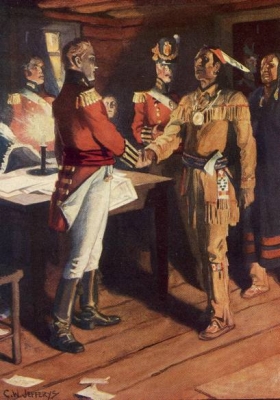
British-American wars were ongoing, and fought substantially by the central confederacies led by Tecumseh, who aligned with the British General Brock in a temporary and mutual truce: to stop American expansion and to guarantee protected Native homelands. After Brock’s demise in battle, General Proctor replaced him and sacrificed Tecumseh’s army to the Kentucky Rifles, abandoning Detroit and the promises to protect Indian lands.
So ended the War of 1812, but the fighting continued in raids, massacres, and skirmishes along the 49th parallel as Britain expanded westward, relying on the defense of the Plains Peoples to rebuff American advances. That defense was encouraged and enabled by arms provided by Britain, while the cost in warriors and lands annexed by the USA was paid entirely by the Native nations.
The Oregon Boundary Treaty of 1846 brought open warfare to an end, drawing a line through Cree, Kootenay, Sinixt and Coast Salish nations without their participation or signatures.


Native militias fought in the French-British and then British-American wars for fully one century, from the Atlantic Ocean to the Rocky Mountains. Every time, they were promised an alliance worth fighting for: protection of their freedom in their own lands, and fair trade.

See the first part of the February 10 1763 Treaty of Paris below, or view the full doc:

treaty of paris Feb 10 1763Download

See also a chapter from “The Story of Canada,” 1760-1774, Pontiac’s War. By T. Fisher Unwin, 1897, Published by Putnam and Sons:

The Story of Canada – 1760-1774. By T Fisher Unwin, 1897. Putnam and SonsDownload

Below, Tecumseh and General Brock, “The Meeting of Isaac Brock and Tecumseh” by Charles William Jefferys

Treaty of Paris February 10, 1763
The Definitive Treaty of Peace and Friendship between his Britannick Majesty, the Most Christian King, and the King of Spain. Concluded at Paris the 10th day of February, 1763. To which the King of Portugal acceded on the same day.

In the Name of the Most Holy and Undivided Trinity, Father, Son, and Holy Ghost. So be it.
Be it known to all those whom it shall, or may, in any manner, belong,
It has pleased the Most High to diffuse the spirit of union and concord among the Princes, whose divisions had spread troubles in the four parts of the world, and to inspire them with the inclination to cause the comforts of peace to succeed to the misfortunes of a long and bloody war, which having arisen between England and France during the reign of the Most Serene and Most Potent Prince, George the Second, by the grace of God, King of Great Britain, of glorious memory, continued under the reign of the Most Serene and Most Potent Prince, George the Third, his successor, and, in its progress, communicated itself to Spain and Portugal: Consequently, the Most Serene and Most Potent Prince, George the Third, by the grace of God, King of Great Britain, France, and Ireland, Duke of Brunswick and Lunenbourg, Arch Treasurer and Elector of the Holy Roman Empire; the Most Serene and Most Potent Prince, Lewis the Fifteenth, by the grace of God, Most Christian King; and the Most Serene and Most Potent Prince, Charles the Third, by the grace of God, King of Spain and of the Indies, after having laid the foundations of peace in the preliminaries signed at Fontainebleau the third of November last; and the Most Serene and Most Potent Prince, Don Joseph the First, by the grace of God, King of Portugal and of the Algarves, after having acceded thereto, determined to compleat, without delay, this great and important work. For this purpose, the high contracting parties have named and appointed their respective Ambassadors Extraordinary and Ministers Plenipotentiary, viz. his Sacred Majesty the King of Great Britain… (dukes, lords, etc.)…Who, after having duly communicated to each other their full powers, in good form, copies whereof are transcribed at the end of the present treaty of peace, have agreed upon the articles, the tenor of which is as follows:
Article I. There shall be a Christian, universal, and perpetual peace, as well by sea as by land, and a sincere and constant friendship shall be reestablished between their Britannick, Most Christian, Catholick, and Most Faithful Majesties, and between their heirs and successors, kingdoms, dominions, provinces, countries, subjects, and vassals, of what quality or condition soever they be, without exception of places or of persons: So that the high contracting parties shall give the greatest attention to maintain between themselves and their said dominions and subjects this reciprocal friendship and correspondence, without permitting, on either side, any kind of hostilities, by sea or by land, to be committed from henceforth, for any cause, or under any pretence whatsoever, and every thing shall be carefully avoided which might hereafter prejudice the union happily reestablished, applying themselves, on the contrary, on every occasion, to procure for each other whatever may contribute to their mutual glory, interests, and advantages, without giving any assistance or protection, directly or indirectly, to those who would cause any prejudice to either of the high contracting parties: there shall be a general oblivion of every thing that may have been done or committed before or since the commencement of the war which is just ended.
II. The treaties of Westphalia of 1648; those of Madrid between the Crowns of Great Britain and Spain of 1661, and 1670; the treaties of peace of Nimeguen of 1678, and 1679; of Ryswick of 1697; those of peace and of commerce of Utrecht of 1713; that of Baden of 1714; the treaty of the triple alliance of the Hague of 1717; that of the quadruple alliance of London of 1118; the treaty of peace of Vienna of 1738; the definitive treaty of Aix la Chapelle of 1748; and that of Madrid, between the Crowns of Great Britain and Spain of 1750: as well as the treaties between the Crowns of Spain and Portugal of the 13th of February, 1668; of the 6th of February, 1715; and of the 12th of February, 1761; and that of the 11th of April, 1713, between France and Portugal with the guaranties of Great Britain, serve as a basis and foundation to the peace, and to the present treaty: and for this purpose they are all renewed and confirmed in the best form, as well as all the general, which subsisted between the high contracting parties before the war, as if they were inserted here word for word, so that they are to be exactly observed, for the future, in their whole tenor, and religiously executed on all sides, in all their points, which shall not be derogated from by the present treaty, notwithstanding all that may have been stipulated to the contrary by any of the high contracting parties: and all the said parties declare, that they will not suffer any privilege, favour, or indulgence to subsist, contrary to the treaties above confirmed, except what shall have been agreed and stipulated by the present treaty.
III. All the prisoners made, on all sides, as well by land as by sea, and the hostages carried away or given during the war, and to this day, shall be restored, without ransom, six weeks, at least, to be computed from the day of the exchange of the ratification of the present treaty, each crown respectively paying the advances which shall have been made for the subsistance and maintenance of their prisoners by the Sovereign of the country where they shall have been detained, according to the attested receipts and estimates and other authentic vouchers which shall be furnished on one side and the other. And securities shall be reciprocally given for the payment of the debts which the prisoners shall have contracted in the countries where they have been detained until their entire liberty. And all the ships of war and merchant vessels Which shall have been taken since the expiration of the terms agreed upon for the cessation of hostilities by sea shall likewise be restored, bon fide, with all their crews and cargoes: and the execution of this article shall be proceeded upon immediately after the exchange of the ratifications of this treaty.
IV. His Most Christian Majesty renounces all pretensions which he has heretofore formed or might have formed to Nova Scotia or Acadia in all its parts, and guaranties the whole of it, and with all its dependencies, to the King of Great Britain: Moreover, his Most Christian Majesty cedes and guaranties to his said Britannick Majesty, in full right, Canada, with all its dependencies, as well as the island of Cape Breton, and all the other islands and coasts in the gulph and river of St. Lawrence, and in general, every thing that depends on the said countries, lands, islands, and coasts, with the sovereignty, property, possession, and all rights acquired by treaty, or otherwise, which the Most Christian King and the Crown of France have had till now over the said countries, lands, islands, places, coasts, and their inhabitants, so that the Most Christian King cedes and makes over the whole to the said King, and to the Crown of Great Britain, and that in the most ample manner and form, without restriction, and without any liberty to depart from the said cession and guaranty under any pretence, or to disturb Great Britain in the possessions above mentioned. His Britannick Majesty, on his side, agrees to grant the liberty of the Catholick religion to the inhabitants of Canada: he will, in consequence, give the most precise and most effectual orders, that his new Roman Catholic subjects may profess the worship of their religion according to the rites of the Romish church. as far as the laws of Great Britain permit. His Britannick Majesty farther agrees, that the French inhabitants, or others who had been subjects of the Most Christian King in Canada, may retire with all safety and freedom wherever they shall think proper, and may sell their estates, provided it be to the subjects of his Britannick Majesty, and bring away their effects as well as their persons, without being restrained in their emigration, under any pretence whatsoever, except that of debts or of criminal prosecutions: The term limited for this emigration shall be fixed to the space of eighteen months, to be computed from the day of the exchange of the ratification of the present treaty.
V. The subjects of France shall have the liberty of fishing and drying on a part of the coasts of the island of Newfoundland, such as it is specified in the XIIIth article of the treaty of Utrecht; which article is renewed and confirmed by the present treaty, (except what relates to the island of Cape Breton, as well as to the other islands and coasts in the mouth and in the gulph of St. Lawrence:) And his Britannick Majesty consents to leave to the subjects of the Most Christian King the liberty of fishing in the gulph of St. Lawrence, on condition that the subjects of France do not exercise the said fishery but at the distance of three leagues from all the coasts belonging to Great Britain, as well those of the continent as those of the islands situated in the said gulph of St. Lawrence. And as to what relates to the fishery on the coasts of the island of Cape Breton, out of the said gulph, the subjects of the Most Christian King shall not be permitted to exercise the said fishery but at the distance of fifteen leagues from the coasts of the island of Cape Breton; and the fishery on the coasts of Nova Scotia or Acadia, and every where else out of the said gulph, shall remain on the foot of former treaties.
VI. The King of Great Britain cedes the islands of St. Pierre and Macquelon, in full right, to his Most Christian Majesty, to serve as a shelter to the French fishermen; and his said Most Christian Majesty engages not to fortify the said islands; to erect no buildings upon them but merely for the conveniency of the fishery; and to keep upon them a guard of fifty men only for the police.
VII. In order to reestablish peace on solid and durable foundations, and to remove for ever all subject of dispute with regard to the limits of the British and French territories on the continent of America; it is agreed, that, for the future, the confines between the dominions of his Britannick Majesty and those of his Most Christian Majesty, in that part of the world, shall be fixed irrevocably by a line drawn along the middle of the River Mississippi, from its source to the river lberville, and from thence, by a line drawn along the middle of this river, and the lakes Maurepas and Pontchartrain to the sea; and for this purpose, the Most Christian King cedes in full right, and guaranties to his Britannick Majesty the river and port of the Mobile, and every thing which he possesses, or ought to possess, on the left side of the river Mississippi, except the town of New Orleans and the island in which it is situated, which shall remain to France, provided that the navigation of the river Mississippi shall be equally free, as well to the subjects of Great Britain as to those of France, in its whole breadth and length, from its source to the sea, and expressly that part which is between the said island of New Orleans and the right bank of that river, as well as the passage both in and out of its mouth: It is farther stipulated, that the vessels belonging to the subjects of either nation shall not be stopped, visited, or subjected to the payment of any duty whatsoever. The stipulations inserted in the IVth article, in favour of the inhabitants of Canada shall also take place with regard to the inhabitants of the countries ceded by this article.
VIII. The King of Great Britain shall restore to France the islands of Guadeloupe, of Mariegalante, of Desirade, of Martinico, and of Belleisle; and the fortresses of these islands shall be restored in the same condition they were in when they were conquered by the British arms, provided that his Britannick Majesty’s subjects, who shall have settled in the said islands, or those who shall have any commercial affairs to settle there or in other places restored to France by the present treaty, shall have liberty to sell their lands and their estates, to settle their affairs, to recover their debts, and to bring away their effects as well as their persons, on board vessels, which they shall be permitted to send to the said islands and other places restored as above, and which shall serve for this use only, without being restrained on account of their religion, or under any other pretence whatsoever, except that of debts or of criminal prosecutions: and for this purpose, the term of eighteen months is allowed to his Britannick Majesty’s subjects, to be computed from the day of the exchange of the ratifications of the present treaty; but, as the liberty granted to his Britannick Majesty’s subjects, to bring away their persons and their effects, in vessels of their nation, may be liable to abuses if precautions were not taken to prevent them; it has been expressly agreed between his Britannick Majesty and his Most Christian Majesty, that the number of English vessels which have leave to go to the said islands and places restored to France, shall be limited, as well as the number of tons of each one; that they shall go in ballast; shall set sail at a fixed time; and shall make one voyage only; all the effects belonging to the English being to be embarked at the same time. It has been farther agreed, that his Most Christian Majesty shall cause the necessary passports to be given to the said vessels; that, for the greater security, it shall be allowed to place two French clerks or guards in each of the said vessels, which shall be visited in the landing places and ports of the said islands and places restored to France, and that the merchandize which shall be found t herein shall be confiscated.
IX. The Most Christian King cedes and guaranties to his Britannick Majesty, in full right, the islands of Grenada, and the Grenadines, with the same stipulations in favour of the inhabitants of this colony, inserted in the IVth article for those of Canada: And the partition of the islands called neutral, is agreed and fixed, so that those of St. Vincent, Dominico, and Tobago, shall remain in full right to Great Britain, and that of St. Lucia shall be delivered to France, to enjoy the same likewise in full right, and the high contracting parties guaranty the partition so stipulated.
X. His Britannick Majesty shall restore to France the island of Goree in the condition it was in when conquered: and his Most Christian Majesty cedes, in full right, and guaranties to the King of Great Britain the river Senegal, with the forts and factories of St. Lewis, Podor, and Galam, and with all the rights and dependencies of the said river Senegal.
XI. In the East Indies Great Britain shall restore to France, in the condition they are now in, the different factories which that Crown possessed, as well as on the coast of Coromandel and Orixa as on that of Malabar, as also in Bengal, …

BC attempts Centennial Lands Act Amendment

11 Sunday Feb 2024

Posted by Admin in Reconciliation, Uncategorized

≈ Leave a comment

Tags

aboriginal title, BC Lands Act, BC Recognition Act 2009, Canada, environment, history, indigenous, informed consent, Land claims, native-americans, Reconciliation, Statement of the Allied Indian Tribes of British Columbia

100 years ago this month, the Allied Tribes of British Columbia petitioned Parliament to shut down the report of the Indian Reserve Commission.

BC has very quietly set up a public consultation process on its plans to embed First Nations local governments within its Lands Act.

The lead is buried pretty deep: BC’s original assumption of control of all the land (without treaty or constructive arrangement) was in 1874. It was patently unconstitutional, and, at first, Canada’s Attorney General disallowed it.

What unfolded then was: replacement of the troublesome AG – Telesphore Fournier, with Edward Blake who allowed a new 1875 BC Lands Act, equally unconstitutional and an act of wholesale annexation, on the basis of settler convenience. Then Canada passed the Indian Act, locking Indigenous Peoples into a second-class-state of outlaw and criminalization. Meanwhile the Province of British Columbia sold off and settled prime Indigenous real estate, fencing communities decimated by smallpox into an-acre-a-person Reserves.

Fifty years of protest, petition, and physical defense of the land (1874-1924) did nothing to remedy the situation at the time, but increased BC and Canada’s resolve to the point of legislating the tiny Reserve Boundaries and making litigation on behalf of Indians… illegal (1927).

A hundred years ago this month, the Allied Tribes of British Columbia petitioned Parliament to shut down the report of the Indian Reserve Commission. BC and Canada had set out to finalize the Indian Land question in 1912, with the McKenna-McBride Commission, and unilaterally “quiet the Indian title,” all the while diplomatically shutting the land issue out of courts and the Privy Council forum.

In their 1926 Petition, the Allied Tribes wrote:

14. By Memorandum which was presented to the Government of Canada on 29th February, 1924, the Allied Tribes opposed the passing of Order-in-Council of the Government of Canada adopting the Report of the Royal Commission upon the ground, among other grounds, that no matter whatever relating to Indian affairs in British Columbia having been fully adjusted and important matters such as foreshore rights, fishing rights and water rights not having been to any extent adjusted, the professed purpose of the Agreement and the Act had not been accomplished.
15. By Order-in-Council passed 19th July, 1924, the Government of Canada, acting under Chapter 51 of the Statutes of the year 1920 and upon recommendation of the Minister of the Interior adopted the Report of the Royal Commission.

50 years before that, the Petition of the Douglas Tribes was brutally clear about the Indian Reserve crisis. And the Reserve boundaries have rarely, and barely, shifted since the final cuts of 1924.

The BC plan now, apparently, is to gain the consent of the Indigenous nations, in the form of the individual Indian Bands / First Nations, to their Lands Act after all.

It is appearing like a visitation of the 2009 BC Recognition and Reconciliation Legislation, which was put to death, in ceremony, in 2009 – once the grassroots people caught wind of it. The grassroots people tend to be very cautious about allowing their elected representatives to sign-on with government initiatives, and acknowledge the crown as the legitimate source of power over their lands, peoples, and futures.

However, little is known about this 2024 draft legislation except that it is proceeding as quickly and mysteriously as the 2009 event, which suddenly surfaced early in the Spring and was submerged by the end of summer.

For more information, you can check the:

BC government’s public consultation process

The BC Treaty Negotiating Times – Summer 2009 Analysis and report on the Proposed Recognition and Reconciliation Legislation, opposition, and events.

And this Blog’s timeline of docs under “Land Claims – policy and protest.” for more on the 2009 legislation, Indigenous Alliances and protest of government assumptions.

Check out Archive Quarterly – a new publication featuring newly digitized history that informs the present here in British Columbia. The first issue arrives April 2024. Every issue features key archival papers and artifacts; quotes and interviews with Elders on the issues; and relatable commentary to connect past and present.

Readers can Subscribe, Support, and Contribute: there are many ways to be engaged!

Take a link to the Archive Quarterly website or AQ on Facebook.

Subscribe

  • Entries (RSS)
  • Comments (RSS)

Archives

  • December 2025
  • October 2025
  • June 2025
  • May 2025
  • February 2025
  • September 2024
  • August 2024
  • July 2024
  • April 2024
  • March 2024
  • February 2024
  • September 2023
  • August 2023
  • June 2023
  • June 2018
  • December 2017
  • July 2017
  • January 2017
  • December 2016
  • July 2015
  • March 2015
  • February 2015
  • January 2015
  • December 2014
  • September 2014

Categories

  • Archive Quarterly
  • BC treaty process
  • Children
  • Commentary, editorial
    • Uncategorized
  • Comprehensive Claims – Policy and Protest
    • aboriginal title
  • Government Commissions
  • Gustafsen Lake Standoff 1995 – Ts'peten Defense, Secwepemc
  • Haida title
  • Indian Residential School
  • Indigenous Declarations
  • Non-Status Indian Era
  • Reconciliation
  • Roadblock
  • UN Engagement
  • Union of BC Indian Chiefs

Meta

  • Create account
  • Log in

Blog at WordPress.com.

  • Subscribe Subscribed
    • The West Wasn't Won
    • Already have a WordPress.com account? Log in now.
    • The West Wasn't Won
    • Subscribe Subscribed
    • Sign up
    • Log in
    • Report this content
    • View site in Reader
    • Manage subscriptions
    • Collapse this bar
 

Loading Comments...