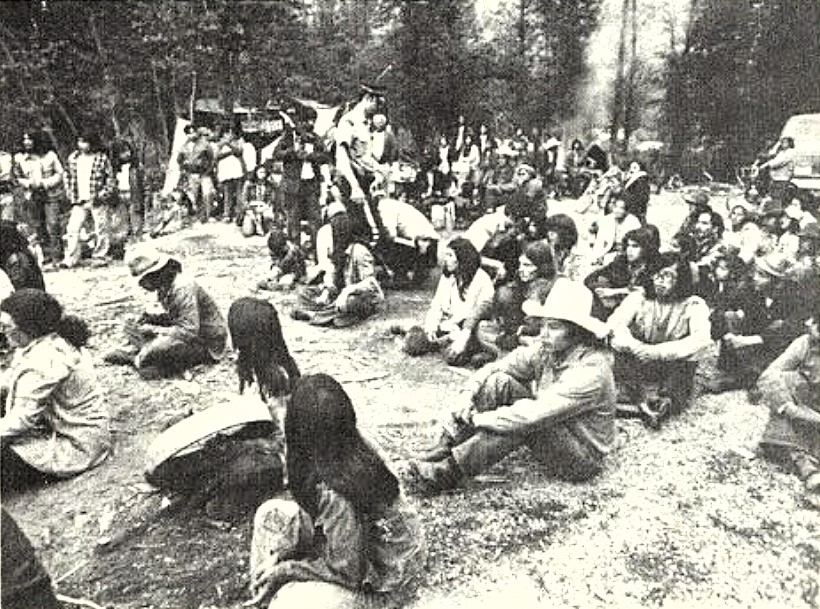
• About The West Wasn’t Won archive project
  • Archive Quarterly
  • Children
  • Fisheries
  • Land of the Peoples
  • Lawfare
  • Non-Status Era
  • Roadblocks and Restitution
    • Gustafsen Lake
    • Haida
    • Líl’wat
    • Nisga’a

The West Wasn't Won

~ Outlive the colonial world.

The West Wasn't Won

Tag Archives: United Nations

Archive Quarterly – Fall 2025

11 Thursday Dec 2025

Posted by Admin in Archive Quarterly, Uncategorized

≈ Leave a comment

Tags

Aboriginal fishing rights, BC Aboriginal Peoples Fisheries Commission, Canada, Cumulative Effects Framework, DFO, hunting moratorium, Indigenous Peoples, Roadblock, Ruby Dunstan, Sparrow, Stein Valley, Strategic Words and Tactics Team, traditional salmon fisheries, United Nations, World Council of Indigenous Peoples

Journal of “the west wasn’t won” archive project

FALL FEATURES:

Stein Valley and the Voices for the Wilderness

The Nlaka’pamux and St’at’imc nations first declared protection of the entire area in 1985.

A decade of organizing; profile-raising concert festivals; and unflinching determination at endless negotiations with government resulted in the Stein Valley Nlaka’pamux Heritage Park and an unspoiled wilderness.

Here, Chiefs Ruby Dunstan and Byron Spinks of Lytton share their roles, then and now, and personal connections to the Stein.

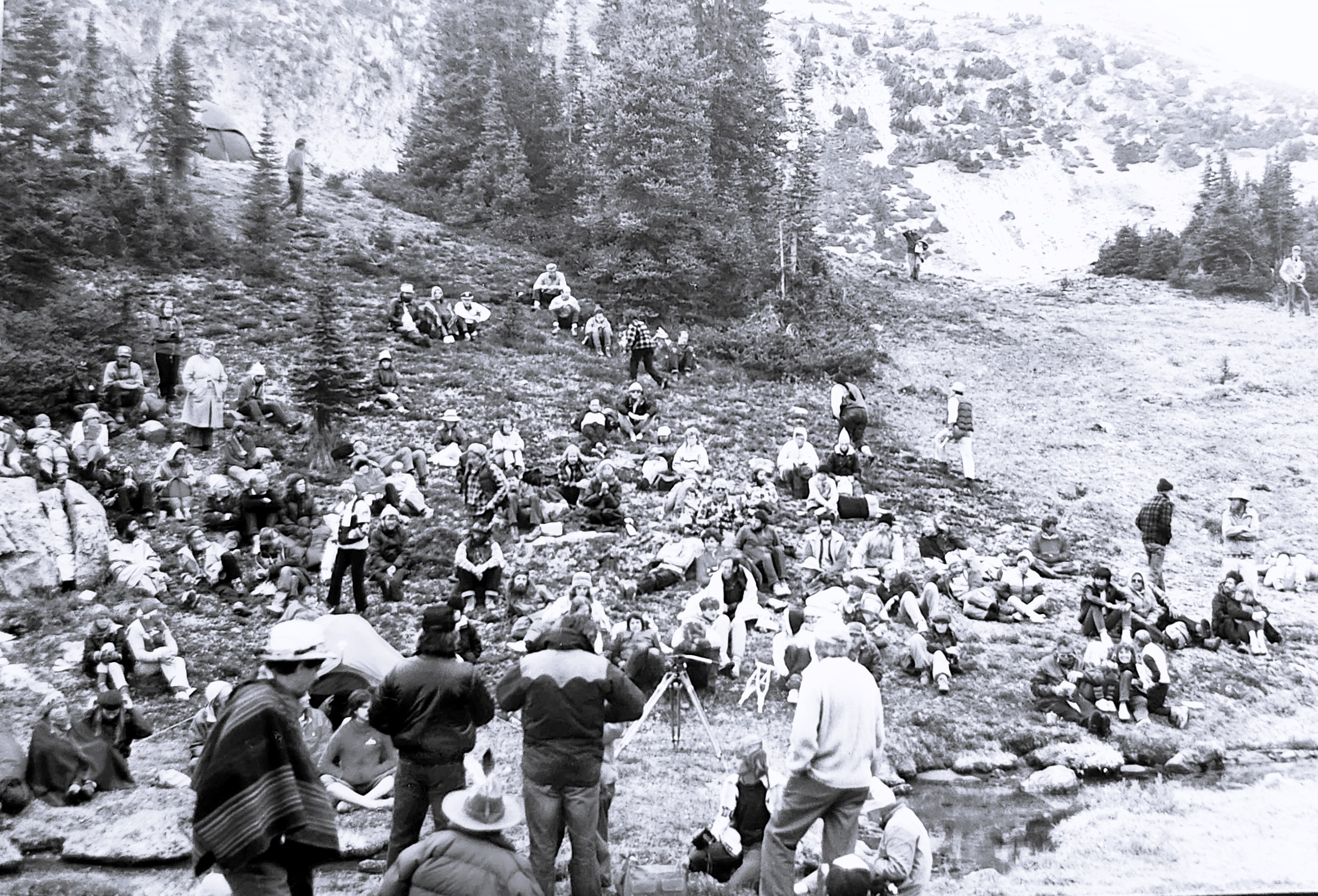
Park Board member John Haugen explains a little about the UNESCO process for World Heritage Site designation, and Vancouver-based sound ecologist Hildegard Westerkamp shares her photos and recollections of the first festival in the alpine.

At the first Stein Valley Festival, 1985. Photo by Hildegard Westerkamp.

Deer in the headlights.

Hunting moratoriums are issued across Indigenous Nations as resource extraction activity reduces habitat below critical levels amid over-hunting.

Many Peoples have enacted and posted rules on the ground, gone to court for injunctive relief against industries licensed by the crown, and put themselves on the roadblock: between the deer and the headlights.

A bull moose in Taku River Tlingit territory, where the people have appealed to BC hunters not to hunt moose, in spite of BC’s opening of Limited Entry Hunt lotteries. Photo: Taku River Tlingit First Nation.

The Nuxalk Defense of Ista, 1995

Head Chief Nuximlayc’s statement on the 30th Anniversary: “They had been harvesting five million cubic meters of wood – every year – in Nuxalk territory. After the EU stopped buying it, after that, the timber harvest dropped to 200,000 cubic meters. That’s why we still have trees today.”

Nuxalk leaders of the House of Smayusta invited environmentalists to stay and join the reoccupation of Ista, King Island, in September 1995. Many were detained for defying the court injunction, and, later, the court’s jurisdiction.

Nuxalk hereditary Chiefs at Ista, September 1995. Photo from Nuxalk Nation.

When DFO cut the Líl’wat Elders’ fishing nets

A five-week roadblock of the Lillooet Lake Road ensued, after fisheries officers came in and destroyed the Elders’ salmon fishery in 1975.

Wénemqen of Tilálus was 16 years old at the time, and he recalls the roadside discussions, the visiting Chiefs, patrolling the road, media tactics, and jail.

54 people were arrested for “obstructing a public highway” – their own road. The bogus charges were thrown out; the jurisdiction issue remains.

 Líl’wat people sit on the road through their village, blocking traffic from Pemberton to Lillooet. Photo – Lil’wat Peoples Movement, archived online with riseupfeministarchive.

That day in Court: the Sparrow decision turns 35

In 1986, Chief Joe Mathias of Squamish spoke to the BC Aboriginal Peoples Fisheries Commission about recognizing DFO’s right to define conservation.

Reflecting that each community represented at that meeting was grappling with multiple – if not dozens or hundreds – of fishing charges, Mathias asked the Committee to challenge the federal government’s monopoly on “conservation.”

A few years later, the BC Aboriginal Peoples Fisheries Commission developed the Inter-Tribal Fishing Treaty of Mutual Support and Understanding. Image: the Treaty logo.

More:

World Council of Indigenous Peoples

held its first Annual General Meeting in Tseshaht, Nuu-chah-nulth, in October of 1975. Delegates from nineteen countries attended the three-day conference, identifying their barriers to equality as self-determining Peoples and Nations occupied by settler states with foreign values. Their work set the pace for ongoing representation in the international United Nations forum for diplomacy and cooperation.

Welcoming people from around the world to the first WCIP conference. Photo: Ha-SHILTH-sa newspaper, Dec. 1975.

Canada’s “Strategic Words and Tactics Team”

was revealed to Native leaders by sympathetic individuals in government in the 1970s and 80s. The Team has kept busy. Canada’s policy to deny “undefined Aboriginal rights” – including title – provides instead a suite of legislation which enables First Nation Band Councils to surrender their rights, in favour of rights defined by Canada.

*

Archive Quarterly

is published in Vancouver, Musqueam

by Electromagnetic Print.

Fall 2025 AQ:

48 pages

8.5×11, black and white

ISSN 2819 585X (print)

ISSN 2819 5868 (online)

Subscribe to AQ print or digital

Enforcement of Reconciliation

28 Thursday Sep 2023

Posted by Admin in Reconciliation

≈ Leave a comment

Tags

aboriginal rights, aboriginal title, Canada, Indigenous Peoples, Land claims, United Nations

Part 4 of this week’s blog: No More “Reconciliation Sticks”

Now that we have reconciled ourselves to the reality, as described in the last three parts of this blog, of bottom-line, extinguishment-policy reconciliation, all those orange T-shirts look different. You can bet they mean something different to the wearer, depending on whether they are Indigenous or not.

Still, maybe we go to Capital “R” Reconciliation events at the city venue, to show up for the spirit of it. When our hearing is not muddied by the emotional speeches, we hear the MP say, “we can continue to witness, to learn, and do everything we can to address the past.” That’s his closing line: no particulars, and definitely nothing about addressing the present.

            The School District rep cries and says, “we’re learning how to teach children.” She says there are “powerful examples of how our communities have not done things in a good way,” but doesn’t describe any of them.

The City Councillor says, referring to one of the distinguished visiting Chiefs, “Hey there’s Jimmy. It always makes me happy to see Jimmy visiting us.”

The awkwardness of these emotional people making hollow statements is easily explained by the superficial nature of the assignation. There is confusion around what is expected from a government official who is well aware that his tax revenue comes from the unceded, non-treaty Indigenous lands his city is occupying, and if any native whomever tries to exercise his rights there he will be snapped up and incarcerated as per reconciliation rules (business as usual), but he is supposed to say something that sounds like he cares.

Canada has produced exalted and venerated leaders in obscuring this problem, ensuring that the “reconciliation” of Aboriginal titles, and societies, will be enforced and will usher in the time of “no more Indian question,” with a big smile and a small cheque and some native motif pinned to their suit jacket. But most politicians are not so smooth, so it’s bizarre to watch.

Right next to the “reconciliation” event is the business-as-usual land developer scraping away the river foreshore to build condos, and police patrolling to protect the desecration of the traditional, local, unsurrendered supemarket, pharmacy, and fishery access point.

Because “reconciliation” doesn’t actually mean anything other than what the courts and the legislators and extractive industries and police actually do.

They reinforce the supremacy of the colonial economy – socially, militarily, legally; every way – and chastise land defenders, traditionalists, cultural people, to reconcile themselves to it.

Acceptance, resignation, and reconciliation is required of Indigenous Peoples.

The Truth and Reconciliation Commission’s role in enforcement

The TRC issued its report in 2015. They may have accomplished a few things that Canada wanted “out of the way” before it ratified the UNDRIP.

Without getting personal about the Commissioners – they were just people selected on the likelihood of doing what they were told – the Report of the TRC is a blinding misrepresentation of the situation in Canada. Surely work was done, meetings were held, and people benefitted by their involvement in the course of Commission events; but other work was done as well.

Let’s nip back along a shady trail. In 2007, Canada voted against the United Nations Declaration on the Rights of Indigenous Peoples (UNDRIP) during the General Assembly’s ratification process. It was one of only four member states to do so, out of a total 192 states. It is reliably rumoured that Canada threatened several African countries with cessation of aid funding if they voted in favour of the DRIP.

            Loudly explaining themselves to anyone who would listen, Canada spoke (and issued all manner of written statements) about how Aboriginal rights in Canada are already constitutionalized and superior to the UNDRIP articles.

            Slight further digression: Canada pays various reputable Indigenous individuals to tour the world: Pakistan, Mexico, Australia, several west African countries, among many others, to promote the Band Council system; the Tribal Council system; and also to tell outright lies. “The Assembly of First Nations has a place in Parliament and they are part of the Canadian government,” I heard from an Indigenous South African delegate at the UN Permanent Forum on Indigenous Issues. He had been told as much by an Indigenous presenter from Canada.

So when Canada later ratified the DRIP in 2016, they took the chance to make a grand appearance at the UN Permanent Forum on Indigenous Issues in New York City, with Ministers Carolyn Bennett and Jody Wilson Raybould meeting and greeting. It was odd, then, that when Minister Wilson Raybould returned to Ottawa, she soon was despatched to address the Assembly of First Nations and tell them that implementing the UNDRIP was “not practicable.”

            Five years later, we got the Canadianized legislation of the UNDRIP.

Canada was slow, and incomplete with importing the 1948 Geneva Convention, too. When they incorporated a few articles of that Convention on the Prevention and Punishment of the Crime of Genocide into the Criminal Code, in the 1960s, the “forcible removal of children from the group to another group” was not written as such.

            The “reconciliation of aboriginal rights with the broader society” has been under way long before Chief Justice Antonio Lamer came up with this new and improved, and ambiguous, term. Canadians will handle human rights their own way, and they might need to adjust the dictionary.

See here, one of the very first things out of Senator Murray Sinclair’s mouth, when he delivered the opening statement of the Truth and Reconciliation Commission’s report, was that Canada has committed “cultural genocide.” But that doesn’t exist.

The Report, in its opening paragraphs, erases and redefines one of the only legal tools we Canadians have to grapple with what was not “cultural genocide” – whatever that is, it doesn’t have an accepted definition in international legal instruments – but “genocide,” according to the five definitions of the crime identified in the 1948 Geneva Convention.

Any one of these actions is genocide:

“Forcible removal of children from the group to another group.”

“Deliberately imposing conditions calculated to bring about the destruction of the group.”

“Killing members of the group.”

“Inflicting serious physical or mental harm on members of the group.”

“Forcible sterilization of members of the group.”

According to the TRC, when they describe these intentional actions, this is “cultural genocide” – which is not justiciable, because there is no Convention for the Prevention of Cultural Genocide, and anyway all of the crimes listed above are documented by the TRC in their report and justiciable under the Genocide Convention.

Why did the Commission do this? They were enforcing reconciliation.

            Reconciliation means resigning; it means making compatible; and a finding of genocide really does not fit this “superior to the DRIP,” advanced Canadian culture. The Commission had to enforce “the concept of reconciliation,” as well as the underlying, extra-legal policy of extinguishment. They did a remarkable job, using the word “reconciliation” fluidly between both meanings and even managing to leave the term undefined.

            The Anglican Church letter incorporated in the TRC Report straight-out asked them, “What is reconciliation”? It was not a rhetorical or philosophical question.

Why “must” Indigenous people commit to “mutual respect and recognition”?

This was, for all intents and purposes, ordered by the Truth and Reconciliation Commission. But the TRC was not also offering a path to justice. They just wrote in their report that, in order for reconciliation to work, Aboriginal individuals and groups “must” give respect and recognition to the colonizer.

The Supreme Court of Canada’s Chief Justice, Beverly McLachlin, confirmed the current usage of “reconciliation” in Tsilhqot’in Nation, 2014:

“[83] What interests are potentially capable of justifying an incursion on Aboriginal title?  In Delgamuukw, this Court, per Lamer C.J., offered this:

“In the wake of Gladstone, the range of legislative objectives that can justify the infringement of aboriginal title is fairly broad. Most of these objectives can be traced to the reconciliation of the prior occupation of North America by aboriginal peoples with the assertion of Crown sovereignty, which entails the recognition that “distinctive aboriginal societies exist within, and are a part of, a broader social, political and economic community” (at para. 73). In my opinion, the development of agriculture, forestry, mining, and hydroelectric power, the general economic development of the interior of British Columbia, protection of the environment or endangered species, the building of infrastructure and the settlement of foreign populations to support those aims, are the kinds of objectives that are consistent with this purpose and, in principle, can justify the infringement of aboriginal title. Whether a particular measure or government act can be explained by reference to one of those objectives, however, is ultimately a question of fact that will have to be examined on a case-by-case basis. [Emphasis added; emphasis in original deleted; para 165]”

These justifiable infringements of reconciliation are enforced all the time, at Fairy Creek, Sun Peaks, Burnt Church, and Gitdimt’en.

No Canadian Commission has ever questioned the issue of the Canadian courts’ assumption of entitlement to all legal questions in Canada, and its bias: in favour of Canada; and the resulting lack of access to a fair trial for any Indigenous person who would want to rely on their own laws.

The police who broke up the pipeline-barricade camp at Gidimt’en in 2019 had a clear understanding of their role in reconciliation.

I wasn’t there in Wet’suwet’en territory, but I heard. The Emergency Response Team officers referred to their guns as “reconciliation sticks,” as they proceeded into the unsurrendered, sovereign Wet’suwet’en lands to enforce the Canadian occupation.

Perhaps they are more fluent in colonial law than the average Canadian who is distracted by the TRC’s promise of hearing fabulous Indigenous mythologies, traditions, and histories in youth arts and crafts sessions, or digitization projects, or new landmark signage. Those activities make up the majority of the “94 Calls to Action” articulated by Canada’s Truth and Reconciliation Commission (TRC).

Because the crown (look at any piece of Canadian money) refuses to respect Indigenous law and land, and Indigenous Peoples still aren’t going to give it all up, those mutually exclusive refusals have to be reconciled: if, suspiciously, almost always in favour of the “broader society,” and their several justifiable infringements – immigration, logging, mining, development, etc. According to the Canadian courts. No one has reported much on the thoughts of capable and juridically solvent Indigenous courts.

“Reconciliation” is not the tool of the colonized. “Reconciliation” needs to be enforced.

Thank you very much for reading. Takem i nsnukw’nukw’a.

Check in tomorrow for Part 5 – Reconciliation is Municipalization

and an Indigenous nationalist who fled persecution in Canada, to the USA, and were protected by an American court under the “political prisoners” exception to the extradition treaty.

Indigenous reports force feds ahead of UN review

29 Saturday Jul 2017

Posted by Admin in BC treaty process, Commentary, editorial, UN Engagement

≈ Leave a comment

Tags

Canada, Indigenous Peoples, Sovereignty, UN, United Nations

75% of reports to Committee on racial discrimination sent by Indigenous organizations.

Last week, Canada switched arrogance and condescension for gestures of off-kilter desperation at the Assembly of First Nations’ general assembly. That is probably because on August 14 and 15, Canada will be under the microscope at UN headquarters in Geneva. Fifteen Indigenous Peoples’ organizations have already submitted extensive reports for the Session, detailing Canada’s “seek and destroy” approach to their internationally recognized human rights.

It is a typical Canadian tactic to invent meaningless distractions right before a review by a UN treaty body: their delegates to the Session can then reply to the Committee’s independent experts by talking about “initiatives” or “joint meetings” which do not substantially exist, instead of answering directly.

This time Canada sent four federal ministers to the AFN’s annual assembly, July 25-27, where they implied that Ottawa is going to rescind the Indian Act. Bennett (Minister of Indigenous Affairs), Wilson-Raybould (Minister of Justice), McKenna (Environment) and Goodale (Public Safety), all made vague references to bright promises yet to come.

The only concrete message from Ottawa to the AFN Chiefs – only half of whom showed up at the all-expense-paid meeting in Regina – was that it will no longer claw back unused capital funds to First Nation communities after twelve months of dispersal.

This miserable material figure can and should be unsuccessfully compared to the immaterial, yet golden, future intimated by Bennett’s and Wilson-Raybould’s reported remarks.  “How will your nation and Indigenous government be organized? What is your territory?” Their remarks, on the other hand, will certainly be judged against the picture of Indigenous life under Canada which has been detailed in reports to the UN CERD.

“ Skeena watershed and coastal Indigenous communities depend on the salmon for food, their economies and cultures. This (LNG, Prince Rupert) project is a prime example of what’s wrong with Canada’s approach to engaging Indigenous communities in large-scale industrial developments: It continuously fails to honour the legal obligations to Indigenous Peoples in protecting their traditional resources; The Canadian government generally consults with Band Councils, which were created under the colonial Indian Act, and often fails to consult hereditary leadership or respect traditional governance systems; …”

. Skeena Indigenous Groups’ Submission to UN CERD. July 6, 2017

It is interesting to note that only weeks after this report to the CERD was posted for the Session, Petronas announced its withdrawal from this proposed project, “Pacific NorthWest LNG.”

The UN Committee for the Elimination of Racial Discrimination has dealt Canada sharp rebukes over the last two decades: stop extinguishing Indigenous Peoples’ titles; stop ignoring murderers who target Indigenous women; stop trying to destroy the Lubicon Cree to get oil access.

The UN treaty bodies have an internationally recognized judicial power to issue recommendations to member states in keeping with upholding international human rights conventions. Each committee periodically receives reports from the state under review, and also from non-governmental organizations, civil society, academia, and now from Indigenous Peoples’ organizations.

It is typically the reports from Indigenous Peoples and NGOs which have, in the past, resulted in strong recommendations from UN Committees to Canada. Many of those have produced changes in the government’s behaviour, although such changes have been isolated and usually only in direct connection to the issues reported. In British Columbia this includes instances of forgiveness of government treaty negotiation loans to small Bands; dissolution of treaty societies formed to negotiate in the BC treaty process – against community members’ protests; and possibly the current standstill in BC Treaty Commission business altogether.

Extinguishment “negotiations” are an ongoing problem that is at the center of the CERD’s focus on Canada:

“There are no viable options other than legal court action to counter the BCTC “treaty” process about these overlaps into St’át’imc territory. As negotiations with the outside First Nations progress, the eventual outcome will be the extinguishment of significant portions of St’át’imc territory without the St’át’imc having been involved in any negotiations to this effect.”

. SHADOW REPORT BY THE INTERIOR ALLIANCE: CANADA’S ONGOING                               COLONIZATION OF INDIGENOUS PEOPLES.   UN CERD COMMITTEE JULY 2017

In contradiction to the Interior Alliance’s extensive documentation of the extinguishment effect of Canadian “negotiations,” however, Minister Wilson-Raybould remarked to the press on her government’s plans: “They are explicit in rejecting certain long-standing federal positions—such as the focus on extinguishment, surrender or denial of rights.” Incidentally, that’s what Canada told the CERD in 2007.


Extinguishment, surrender and denial are precisely what Canada offers Indigenous Peoples. There is a veritable firestorm of examples of this, enveloping Indigenous Peoples. It is highly suspect that a Canadian Minister climbs a prominent national stage and says “we’re just about to change,” (again) only days before Canada has to answer a lot of very pointed questions in front of the world.

Consistent Canadian practices are to assimilate and co-opt economic development, to municipalize isolated communities under provincial legislation, to criminalize traditional economies, to rigidly maintain dependency by an overbearing and constantly metamorphosing bureaucracy which can never be finally functional. There is the “First Nations Land Codes” – where a community votes to recognize Canadian supremacy in its traditional territories, just for the privilege to enjoy managerial duties on-reserve. There are the “Strategic Land Use Planning Agreements” – where communities have shared maps of their territories showing cultural values and inadvertently given tacit approval to development in huge “low cultural value” lands. In the national Inquiry into Missing and Murdered Indigenous Women, crucial voices have undoubtedly been denied. Indigenous Peoples’ rights under Article 1 of the International Covenants on Civil and Political, and Social, Economic and Cultural Rights are completely denied. Canada specializes in the forcible removal of Indigenous children from their homes and communities, requiring parents and families to submit and surrender to provincial courts which have no jurisdiction whatsoever in the case of children and families who are not Canadian until they produce a referendum from their nation joining Canada.

Minister Wilson-Raybould, apparently speaking for those Indigenous individuals who have exercised their right to choose a nationality, appealed to the Chiefs to imagine their future as Canadians whose Indigenous rights are recognized and respected.

Ultimately, the Supreme Court of Canada expresses the state’s right to own Indigenous nations it has no treaties with. It is certainly a matter of interest in any investigation of racial discrimination. Apparently the key to Canada’s jurisdiction over nations with which it has no constructive agreements is owing to the fact that the British monarch, appointed by the Christian god, had sent a sailor with orders to discover and possess others’ lands in His name, and he was successful in this because the Christian god was superior, so the Supreme Court of Canada seems to say, to any of the existing nations’ gods. We know it is the presence of other Christian nations which is at issue in the matter of the Canadian court’s opinion on sovereign possession, because the issue was finally settled in 1846, according to Canadian judges, when the USA agreed in the Oregon Treaty to withdraw from pursuing any interests north of the 49th parallel. From that date, Great Britain and now Canada enjoys sovereign possession of all lands from the Pacific Ocean to the Atlantic Ocean above that parallel, except Alaska, as per SCC, because all other Christian nations had, by that time, also promised Great Britain they would pursue no interests there.

Unfortunately for that internationally repugnant display of Canadian faith, which is the state’s current legal precedent, it is not clear that any Indigenous Peoples have formally joined and adhered to Canada. Wilson-Raybould was referring to that popular understanding among the Chiefs. The CERD has been made aware of that understanding, and again in the reports for this Session:

“In particular, we bring to the Committee’s attention the state’s use of its own  imposed Indian Band administration, under the Indian Act, on the state-defined Indian Reserve, to manufacture the appearance of Líl’wat consent to Canada’s disposal of the remainder of Líl’wat customary titles to lands and wealth outside the Reserve.

“Líl’watmc ask that the Committee question Canada about the origins of any rights of jurisdiction it may have in relation to Líl’wat which could justify Canadian licensing and development without the consent and against the Interests of the Líl’watmc under the Convention, and resulting in the continuing displacement and dispossession of Líl’wat.”

Líl’wat report to UNCERD, July 2017, with the International Human Rights                                         Association of American Minorities

The picture developed by fifteen Indigenous Peoples’ organizations shows Canada’s unabated attempts to assimilate Indigenous Peoples – their worldview, identity, economies, individuals, children, histories, and especially their lands and natural wealth – into Canada. Unilateral, non-consensual assimilation is categorically prohibited as a matter of human rights norms, and yet that end of the spectrum of Canada’s colonization is not the worst.

“If Ontario and Canada insist on excluding us from meaningful consultations on the Agreement in Principle, then we insist that Canada and Ontario exclude the areas where our First Nations’ asserted Aboriginal title and rights overlap with the “Algonquins of Ontario” claims, or at least suspend negotiations over  such areas, until such time as we have engaged in meaningful consultations and reached an acceptable accommodation.

“Despite our objections in March 2016, the “Algonquins of Ontario”, Canada and Ontario have proceeded to hold a referendum vote on the AIP.”

ALGONQUIN NATION SECRETARIAT  TO THE UN CERD COMMITTEE                                                          July 2017


“How does one start to describe the horrific conduct of Canada in their relentless efforts to extinguish the rights of Indigenous peoples within their ancestral homelands?”

“While the Supreme Court of Canada has determined that the Canadian and provincial governments have a duty to consult, negotiate, and accommodate Indigenous rights, the governments use these consultation and negotiation processes to coerce, terrorize, terminate, extinguish, and discriminate against Indigenous peoples and our rights.”

Submission to the UNCERD 93rd Session, July 31-August 25, 2017.                                             On behalf of the Mothers and Grandmothers of the Maliseet Nation


“Asubpeeschoseewagong Netum Anishinabek, also known as Grassy Narrows First Nation, is located on the English-Wabigoon River system in North Western Ontario, and is infamous for mercury contamination from an upstream pulp and paper mill. … In 2016, a former mill worker came forward to confess the mill had illegally buried barrels of waste along the river, leading to the persisting contamination and inability of the river system to recover naturally.”

Chiefs of Ontario report to UNCERD, July 2017


“On November 29, 2016, the Canadian Federal Cabinet directed the National Energy Board to approve the Kinder Morgan Trans Mountain pipeline expansion. This pipeline poses an unacceptable risk to the health, safety and livelihoods of First Nations throughout British Columbia, and will contribute to the negative environmental and health impacts experienced by Indigenous Peoples downstream of the tar sands, and of all peoples throughout the world as a result of accelerating global climate change. The Tsleil-Waututh, Squamish, Musqueam, Coldwater, Upper Nicola, Stk’emlupsemc te Secwepemc, Aithchelitz, Shxwhay Village, Yakweakwioose, Kwawkwaw-apilt, Tzeachten, Skowkale, Soowalie, and Squiala peoples have commenced legal proceedings seeking to challenge the federal approval for the Trans Mountain project… It is well established that diluted bitumen contains toxic chemicals that are a threat to drinking water, health, and the well-being of salmon and other beings.”

Submission to the UNCERD 93rd Session, 2017.                                                                                 Union of British Columbia Indian Chiefs.

Minister Bennett, for the federal department of Indigenous and Northern Affairs, said to the AFN Chiefs last week: “We want to partner with you on building on the strengths and assets you have in your communities. You have the power to determine the future of your communities.”

The international community is quite aware that Canada still wishes to build on the strengths and benefits belonging to Indigenous communities, whether Canada co-opts the participation of those communities through “benefits sharing” or “land management” or other agreements achieved under duress. The international community is also aware that Indigenous Peoples have the power to determine the future of their communities, and that Minister Bennett and her government may well have nothing to do with that.

As the Union of BC Indian Chiefs’ report articulated, “We are presently witnessing a great divide between the words of the Canadian government and its actions on the ground. We would like to highlight the term “rights ritualism” for the consideration of the Committee in respect to Canada’s present actions: a way of embracing the language of human rights precisely to deflect real human rights scrutiny and to avoid accountability for human rights abuses. Countries are often willing to accept human rights treaty commitments to earn international approval, but they resist the changes that the treaty obligations require.”


“Establish Indigenous titles,” UN tells Canada

28 Tuesday Jul 2015

Posted by Admin in UN Engagement

≈ Leave a comment

Tags

aboriginal title, Canada, Human Rights Committee, Indigenous Peoples, National Inquiry into Missing and Murdered Indigenous Women, United Nations

2015

The Human Rights Committee has just released concluding observations on fifteen “principal matters of concern” with Canada. Five of those concerns pertain to Indigenous Peoples and the violation of their rights in the International Covenant on Civil and Political Rights.

The Committee’s recommendations leave little room for the kind of redirection and side-stepping that Canada’s delegation to the United Nations treaty body performed on July 7th and 8th in Geneva.

The state should find ways and means to establish Indigenous Peoples’ titles to their lands, as well as ensuring Indigenous consent to developments which might impact their titles and treaty rights.

As per its obligations under the Covenant, the state should conduct a national inquiry into the situation of missing and murdered Indigenous women and coordinate police responses across the country to prevent this type of violence, as well as completing investigations and prosecuting the perpetrators, providing reparations to the victims’ families, and addressing the root causes of this violence.

Canada should provide a report on its progress in these two areas within one year.

The state should resolve the gender inequity present in the Indian Act.

Canada is asked to “ensure the effectiveness of measures taken to prevent the excessive use of incarceration” of Indigenous individuals, and “further strengthen its efforts to promote and facilitate access to justice at all levels by indigenous peoples.”

And, under the umbrella of addressing “the precarious situation of Indigenous Peoples,” the Committee recommends “the State party should in consultation with indigenous people: a) implement and reinforce its existing programmes and policies to supply basic needs to indigenous peoples; b) reinforce its policies aimed at promoting the preservation of the languages of indigenous peoples; c) provide family and child care services on reserves with sufficient funding and; d) fully implement the recommendations of the Truth and Reconciliation Commission with regard to the Indian Residential Schools.”

Indigenous Peoples’ rights are taking up larger and larger proportions of the UN treaty bodies’ recommendations to Canada.

In March of this year, the UN Committee for Economic, Social and Cultural Rights put Indigenous Peoples’ rights to “freely dispose of their natural wealth” as the first matter on its List of Issues to the state. That was followed by requests for information on housing, health, physical safety, languages, standards of living and children and family protection among Indigenous Peoples. In 2012, the UN Committee for the Elimination of Racial Discrimination asked, in its Concluding Observations, for Canada to respond within one year on three issues concerning urgent human rights crises, resulting from racial discrimination, being experienced by Indigenous Peoples. Canada was scheduled for its next review under the Convention for the Elimination of all forms of Racial Discrimination this November – but it has been dropped from the list after asking for more time to prepare. Canada’s last review under the Convention for the Elimination of Discrimination Against Women led to the direct recommendation that Canada launch a national inquiry into the situation of missing and murdered Indigenous women.

After Canada’s Universal Periodic Review in 2013, two thirds of the statements made to Canada by the other member states of the United Nations were specific to Indigenous rights and violence against Indigenous women and girls. While all those were present in the advance unedited report, many were excluded from the edited final version.

The next treaty body to review Canada’s compliance with international human rights standards will be the Committee on Economic, Social and Cultural Rights, in March of 2016.

You can search for reports and recommendations from Canada’s reviews by United Nations treaty bodies here.

UN Special Report on Indigenous Peoples in Canada

04 Thursday Sep 2014

Posted by Admin in UN Engagement

≈ 1 Comment

Tags

aboriginal rights, aboriginal title, Canada, Indigenous Peoples, James Anaya, Special Rapporteur, United Nations

Paragraph 99 – The Gretzky Clause is an Indigenous win

Published June 29, 2014 on Vancouver Media Co-op

The United Nations’ Special Rapporteur on the Rights of Indigenous Peoples has produced a review of the situation of Indigenous Peoples in Canada that seems to prescribe the diagnosis as the cure: death by bureaucracy. The documentary record is for the Human Rights Council, and it is as meticulous and specific as the Indian Act itself.

It might be just as limiting – save for two long sentences – paragraph 99. If Indigenous Peoples could “maximize” their benefit from revenues on “their lands,” as is recommended in the report’s final paragraph, Indigenous Peoples could pay their own way and make their own choices instead of having those choices legislated over top of them. They would not need the rest of this report.

In the meantime, some of the most significant crimes against humanity in the modern age have now been lifted out of the realms of colonial denial and set down in black international ink. The importance of this report is therefore unqualified: never before has an international observer summarized the gruesome history of Canadian imperialism in such unequivocal terms as the Special Rapporteur in his country report on Canada.

Professor James Anaya is a Regents Professor at the University of Arizona, lecturing on international law and indigenous peoples’ rights. He helped draft the Declaration on the Rights of Indigenous Peoples and has just completed his second and final term as Special Rapporteur at the same time as releasing the advance report on the Situation of Indigenous Peoples in Canada.


The Gretzky Clause

Professor Anaya recommended in paragraph #99, the very last words on the paper, “Resource development projects, where they occur, should be fully consistent with aboriginal and treaty rights, and should in no case be prejudicial to unsettled claims. The federal and provincial governments should strive to maximize the control of indigenous peoples themselves over extractive operations within their lands and the development of benefits derived therefrom.” That’s about the only thing Indigenous Peoples have been demanding of Canada, unsuccessfully, since Canada existed.

The age old question which Canada puzzles with in its Supreme Court is, “where is aboriginal land?” And the Court refuses to find any. Anaya did not recommend that Canada recognize aboriginal title, or get out a map and trace the old lines between the Indigenous nations of northernmost America and demand that those borders be respected or else double standards discrimination would be in effect, nor did he remark at all on the subject of what would be left of “Canada” if indigenous peoples were in control of their lands once again.

This is fairly plain talk for a lawyer though. Which square inch of Canada is not part of an unsettled claim? The Treaties are broken. The modern day negotiations are themselves a complete violation of human rights, requiring Indigenous parties to first surrender everything to the Crown in right of Canada before receiving various delegated and controlled powers in exchange. They are being negotiated by people put in power to represent the Indigenous side through systems of governance imposed by Canada. These problems were touched on in the report.


Negotiations and “land claims”

With a literal directness reputed of the “black letter lawyer,” his report states that “Over the past decades, Canada has taken determined action to address ongoing aspects of the history of misdealing and harm inflicted on aboriginal peoples in the country… Perhaps most significantly, it has legislation, policy and process in place to address historic grievances of indigenous peoples with respect to treaty and aboriginal rights. In this regard, Canada is an example to the world.” There are several notes to the fact that negotiations have been “mired” in difficulties. The statements are extremely political, and always extremely correct. Credit has been given for the appearance of attempting reconciliation, but it is taken away again by documented references to the failures of the process. The Rapporteur does not go so far as to say that the “mire” was by design, and that negotiations have clearly bought Canada the comparative peace of these past decades.

The negotiations programs are described as “…good practices, at least in their conception, such as Canada’s policy of negotiating modern treaties with aboriginal peoples and addressing their historic claims. A full exposition of these laws, policies and programmes is beyond the scope of this report.” Unfortunately, Canada’s policy of using Indigenous duress to accomplish surrender agreements with Indigenous communities is an exceptionally important example of the insidious perpetuation of the Canadian ultimatum: starve out or sell out. Ample information summarizing the slipknot effect of Canada’s “modern day treaty” making programmes were made available to the Special Rapporteur. He summarized that information: “In the comprehensive land claim processes, the Government minimizes or refuses to recognize aboriginal rights, often insisting on the extinguishment or non-assertion of aboriginal rights and title, and favours monetary compensation over the right to, or the return of, lands.”

One example that illuminates the carefully controlled core of modern “negotiations” was highlighted in the Special Rapporteur’s report. Regarding First Nations Education, a new act has emerged and shows the type of policy and procedure which Canada intends to legislate on all aboriginal peoples – if it’s not achieved through standardized, identical core provisions of self-government framework agreements and “land claims.” The First Nations Education Act was brought to the Special Rapporteur’s attention during his visit. The controversy over this Bill recently caused the National Chief of the Assembly of First Nations to resign.

The Rapporteur summarized Indigenous objections: “(1) the imposition of provincial standards and service requirements in the bill will undermine or eliminate First Nation control of their children’s education; (2) the bill lacks a clear commitment to First Nations languages, cultures, and ways of teaching and learning; (3) the bill does not provide for stable, adequate, and equitable funding to indigenous schools; and (4) the bill will displace successful education programs already in place, an issue that was raised particularly in British Columbia.”

It is exactly these problems – imposition of foreign standards; displacement of traditional structures; lack of financial certainty; a design for degradation of the delegated powers over time – which characterize all the other plans Canada has for First Nations negotiating under the present day policies. These problems characterize the results of all modern agreements between Canada and Indigenous Peoples today, covering the further six areas of lands and resources, self governance, health, children and families, housing and infrastructure, and finance.

Background context, exhibits on Canada’s record

The background provided in this report succinctly and definitively puts on record some of the most criminal tragedies wreaked by the colonizer on the Indigenous nations. Since Canada is officially in denial of many of these facts, the report is a categorical achievement for history. It qualifies the Indian Residential Schools, “the explicit purpose of which was to destroy their family and community bonds, their languages, their cultures, and even their names.” Canada still pretends those results might have been accidental, even in its formal apology of 2008.

The report acknowledges “…patterns of devastating human rights violations, including the banning of expressions of indigenous culture and religious ceremonies; exclusion from voting, jury duty, and access to lawyers and Canadian courts for any grievances relating to land; the imposition, at times forcibly, of governance institutions; and policies of forced assimilation through the removal of children from indigenous communities and “enfranchisement” that stripped indigenous people of their aboriginal identity and membership.” The significance of this single sentence in an official report to the Human Rights Council has not even begun to be appreciated, as it will be relied on in future international actions against Canada, in the pursuit of remedying the current hostile occupation of Indigenous homelands.

As for the most important colonial legal structures of imperialism in the Canadas, it was forced upon King George in 1763 by the military might of Pontiac and his many allies’ refusal to accept British retractions of their original treaties and compacts. The report gives that its place in relation to negotiations: “…the related policy of the British Crown of seeking formal permission and treaty relationships with indigenous peoples before permitting settlement in their territories.” And that Royal Proclamation, made exactly one quarter of a millenia before the Special Rapporteur’s visit, remains a pillar of the Canadian constitution; albeit one that has collapsed under the relentless weight of settlers fleeing other nations around the world and insisting on their own superior rights in Canada.

The collapse of that legal statute is not analyzed as a rotten cornerstone of the state of Canada and an object requiring closer scrutiny in the application of the rule of law in the first world; it might have been. It is the foundational instrument within Canada’s own laws which requires the consummation of honourable treaties.


The statistics of the minority

The international report emphasizes the statistical face of pan-Indigenous dispossession as it appears in census areas such as homelessness, poverty, low life expectancy, suicide, poor health, lack of education, overcrowded and dilapidated housing. “Of the bottom 100 Canadian communities on the Community Wellbeing Index, 96 are First Nations, and only one First Nation community is in the top 100.” Compared to Canadians, Indigenous individuals are exponentially worse off in every way. “At every level of education, indigenous people overall continue to lag far behind the general population.” There are many more.

But the Special Rapporteur is asked to comment on the situation of Indigenous Peoples, not indigenous individuals as minorities within a state. Indigenous Peoples have suffered every crime described by the Geneva Convention on the Prevention and Punishment of the Crime of Genocide. The report did not explicitly connect the impacts of Indigenous loss of life, loss of village sites, loss of power over community and national life and loss of control of lands and resources with the staggering present day economic sitution – the inability even to build adequate homes – except by implication in paragraph 99.

Worryingly, the summary statement suggests: “Indigenous peoples’ concerns merit higher priority at all levels and within all branches of Government, and across all departments.” This sounds like a proliferation of Indian Acts across the entire social, economic and cultural map. It is the general opinion, and most plausible legal situation, of Indigenous Peoples that their rights and remedies are not within the purview of the Canadian government or its departments – which have only ever contrived to suppress, co-opt and deny those concerns by every means available.

But when this statement is read together with the Gretzky Clause, paragraph 99, it now says: All branches of government should align themselves with ensuring the continuity and protection of aboriginal and treaty rights. All levels and departments should support Indigenous control of resources on Indigenous lands, especially extraction, and the benefits arising therefrom.


The Hazy Bering Land Bridge

There remains in the Special Reporter’s observations, conclusions, and recommendations, however, a missing link as dubious as the Bering Land Bridge. How can one file a report which begins with a summary of every crime of genocide, and ends with suggestions that the perpetrator be left in charge of remedying the situation? The report itself notes all manner of Canadian efforts to engage aboriginal peoples, and equally comments on indigenous representatives’ presentations to him on how unsatisfactory they are.

The reality is that every attempt at maximizing protection or use of “their lands” ends up in court, where “the adversarial approach leads to an abundance of pre-trial motions, which requires the indigenous claimants to prove nearly every fact, including their very existence as a people.”

Canada’s assumption of jurisdiction on unceded Indigenous land, as in British Columbia, or its most restrictive interpretations of treaty rights, are problems which merit third party, independent and impartial hearings. Canada cannot be the originator of a dispute and also the judge of its resolution. The Special Rapporteur never repeated this observation, made to him in person, in his report. It is in his mandate: Article 40 of the Declaration on the Rights of Indigenous Peoples, Indigenous peoples have the right to access to and prompt decision through just and fair procedures for the resolution of conflicts and disputes with States or other parties, as well as to effective remedies for all infringements of their individual and collective rights.

Instead: “Canada’s relationship with the indigenous peoples within its borders is governed by a well-developed legal framework a number of policy initiatives that in many respects are protective of indigenous peoples’ rights. But despite positive steps, daunting challenges remain. The numerous initiatives that have been taken at the federal and provincial/territorial levels to address the problems faced by indigenous peoples have been insufficient.”

Canada’s borders are in fact contested not to include many unceded, sovereign indigenous peoples and their lands in the first place, particularly in the west, and to this legal place the report does not proceed. Canada’s “well-developed legal framework” denies Indigenous Peoples’ own legal frameworks, and their jurisdictions on their homelands, and certainly has been well-developed to the point of the exclusion of the Canadian constitution where treaties are demanded before settlement is allowed. In fact, policy initiatives have entirely replaced legal instruments. And the objectives of those policies have not shifted by any measure since the 1857 Act for the Gradual Civilization of the Indian Tribes – an assimilation and dispossession policy. Just last year a more sophisticated option of the legislative release and indemnification of Canada by the Indigenous took the form of Bill C-45 and was passed in Canada’s Parliament. Fragments of Indigenous nations under duress participate in fragments of the Act. Finally, to suggest that the problems faced by Indigenous Peoples occupied by Canada could be sufficiently addressed by the perpetrator of the problems, the federal and provincial governments, is to fundamentally ignore many testimonies brought before the Special Rapporteur during his extraordinarily brief visit to Canada – October 8-15th, 2013. Some of those testimonies were brought by traditional governments of Indigenous nations, some were submitted only in writing, and they laid bare the urgent need for third party assistance in the conflict between their nations and the assumptive party, Canada.

The report is perhaps constrained by the state-biased mandate of the United Nations, reporting on implementation of the Declaration on the Rights of Indigenous Peoples, and it is in this way that the vulnerability of entrusting states with justice for Indigenous Peoples becomes obvious. The conflict at hand is between states and the Indigenous Peoples, and their lands, which states have assumed jurisdiction over. Or, “One of the most dramatic contradictions indigenous peoples in Canada face is that so many live in abysmal conditions on traditional territories that are full of valuable and plentiful natural resources. These resources are …targeted for extraction and development by non-indigenous interests.”


The report on the situation

There were many people and places that the UN delegation did not meet. Those who did manage to make meetings had less than one week’s notice of the time and location – and that was the work of Canada. Considering this, and the brevity of the visit, this first official report on the situation of Indigenous Peoples in Canada is of considerable scope and importance. If it is read.

The report is a good sweep of the situation:

“Parliament has jurisdiction over ‘Indians and lands reserved for Indians.’”

“First Nations communities that receive federal funding under the Indian Act regime, 70% of which have fewer than five hundred residents, typically have to produce over 100 or more reports a year to various federal agencies.”

“…indigenous leaders complain that the federal Government frequently uses a discourse of responsibility to Canadian taxpayers for the cost of First Nations treaty benefits, without a corresponding acknowledgment of the vast economic benefits that have accrued to non-indigenous Canadians as a result of the constitutional treaty relationships…”

“…the Government appears to view the overall interests of Canadians as adverse to aboriginal interests…”

The Special Rapporteur never mentions the astonishingly prolific, consistent and militant protest on the part of Indigenous peoples from coast to coast to coast, for centuries, and that these demonstrations and resistance movements are singly the cause of any of Canada’s good work noted in this report. The political tones resonate to good will and politesse and there is little within the report which Canada could reasonably take exception to.

But, as James Anaya characterizes his own work when speaking in public, he tries not to focus on the instances of conflict but on signs of progress and possibilities which might lead to peace and justice.

“Partnership” is recommended between the Indigenous and Canada, and that “…it is necessary for Canada to arrive at a common understanding with indigenous peoples of objectives and goals that are based on full respect for their constitutional, treaty, and internationally-recognized rights.”  This is optimistic.

But Anaya’s visit to Canada has already had effect. During his statement at the end of his official visit last Fall, he made the straightforward recommendation that the Truth and Reconciliation Commission be given an extension to continue its work in connection to Indian Residential School legacies. An extension of one year had been granted by the time the draft report was released this May, while the report calls for an open-ended mandate.

Paragraph 99, however, is the ace. It is nothing short of Wayne Gretzky in 1988, getting the goal that won the Oilers the Stanley Cup. And the Supreme Court of Canada has lost its shut-out. Development should be consistent with aboriginal and treaty rights; control and benefits of development on Indigenous lands should belong to the Indigenous.

It’s an optimistic coincidence that the key recommendation to Canada is numbered the same as the greatest Canadian hockey player, whose jersey number was retired by the National Hockey League in his honour. And it’s an enlightening coincidence that such an important icon was playing a Mohawk game. It’s possibly a pragmatic non-coincidence on the part of the author of the report, nominated for the Nobel Peace Prize this spring, to connect a source of national pride with a challenge worth meeting.


UN Special Rapporteur on the Rights of Indigenous Peoples, S. James Anaya, at Musqueam during his official visit to Canada. October 10, 2013.
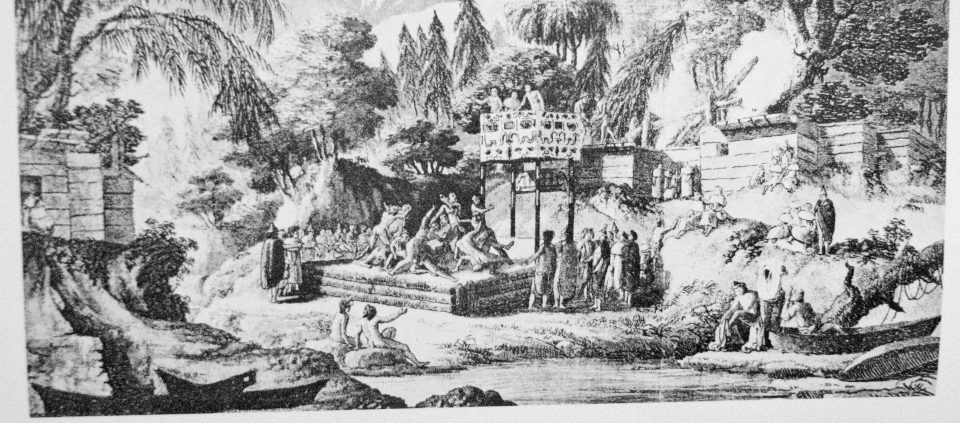
UN Special Rapporteur on the Rights of Indigenous Peoples, S. James Anaya, at Musqueam during his official visit to Canada. October 10, 2013.

Subscribe

  • Entries (RSS)
  • Comments (RSS)

Archives

  • December 2025
  • October 2025
  • June 2025
  • May 2025
  • February 2025
  • September 2024
  • August 2024
  • July 2024
  • April 2024
  • March 2024
  • February 2024
  • September 2023
  • August 2023
  • June 2023
  • June 2018
  • December 2017
  • July 2017
  • January 2017
  • December 2016
  • July 2015
  • March 2015
  • February 2015
  • January 2015
  • December 2014
  • September 2014

Categories

  • Archive Quarterly
  • BC treaty process
  • Children
  • Commentary, editorial
    • Uncategorized
  • Comprehensive Claims – Policy and Protest
    • aboriginal title
  • Government Commissions
  • Gustafsen Lake Standoff 1995 – Ts'peten Defense, Secwepemc
  • Haida title
  • Indian Residential School
  • Indigenous Declarations
  • Non-Status Indian Era
  • Reconciliation
  • Roadblock
  • UN Engagement
  • Union of BC Indian Chiefs

Meta

  • Create account
  • Log in

Blog at WordPress.com.

  • Subscribe Subscribed
    • The West Wasn't Won
    • Already have a WordPress.com account? Log in now.
    • The West Wasn't Won
    • Subscribe Subscribed
    • Sign up
    • Log in
    • Report this content
    • View site in Reader
    • Manage subscriptions
    • Collapse this bar
 

Loading Comments...