It’s The West Wasn’t Won’s own journal, like a news clipping service across the last two or three hundred years.
Did you know? This month marks a hundred years since the Allied Tribes of British Columbia petitioned to shut down the Indian Reserve Commission report.
If you didn’t, a subscription to Archive Quarterly will really help!
What was hidden from history is what’s needed now.
AQ shakes out the archives for primary sources on Indigenous land and British Columbia, sharing:
~ key extracts from archival artifacts
~ quotes and interviews on the issues as they were
~ relatable commentary and a few side-notes
~ images and timelines that connect past and present
The first April issue will be here in three weeks!
Archive Quarterly is about it, the west wasn’t won!
BC history is lit from one side – showing settler progress to advantage, while rendering the Indigenous reality of that “progress” indiscernible.
This magazine aims to balance the view. As well as the written records, interviews with Elders reveal circumstances leading up to political movements, court actions and roadblocks, and conditions in their communities at the time.
Excerpts in the journal will be presented in full documents online, where they are accessible to download.
You can also donate to AQ to become a founding sponsor – thanks!
Group and bulk print subs available, just drop us a line.
If you just can’t afford the subscription, get in touch and we’ll get you in.
By subscribing to AQ today, you’ll be helping to get work done.
Special Issues
Did you know? The ongoing denial of Aboriginal land title – and the tiny size of First Nations reserves – contributes directly to child apprehensions from young Aboriginal families. The situation can’t change without land to build on and live in.
Special Issues are on the way for AQ, focusing on Aboriginal Title, the Non-Status Indian era, Roadblocks, and more. The Special series dives deep and provides historical overviews and insight, and the development takes time and research and communications.
AQ’s online digital archive
It keeps growing, as old docs are scanned and processed and uploaded. The physical archive costs money for storage, and the digital archive costs money for web space.
The magazine comes out of a collection kept up by Electromagnetic Print – EMP, a book label founded to print voices seldom heard in the media, especially the voices of native sovereigntists.
Thank you very much for reading and have a great day!
100 years ago this month, the Allied Tribes of British Columbia petitioned Parliament to shut down the report of the Indian Reserve Commission.
BC has very quietly set up a public consultation process on its plans to embed First Nations local governments within its Lands Act.
The lead is buried pretty deep: BC’s original assumption of control of all the land (without treaty or constructive arrangement) was in 1874. It was patently unconstitutional, and, at first, Canada’s Attorney General disallowed it.
What unfolded then was: replacement of the troublesome AG – Telesphore Fournier, with Edward Blake who allowed a new 1875 BC Lands Act, equally unconstitutional and an act of wholesale annexation, on the basis of settler convenience. Then Canada passed the Indian Act, locking Indigenous Peoples into a second-class-state of outlaw and criminalization. Meanwhile the Province of British Columbia sold off and settled prime Indigenous real estate, fencing communities decimated by smallpox into an-acre-a-person Reserves.
Fifty years of protest, petition, and physical defense of the land (1874-1924) did nothing to remedy the situation at the time, but increased BC and Canada’s resolve to the point of legislating the tiny Reserve Boundaries and making litigation on behalf of Indians… illegal (1927).
A hundred years ago this month, the Allied Tribes of British Columbia petitioned Parliament to shut down the report of the Indian Reserve Commission. BC and Canada had set out to finalize the Indian Land question in 1912, with the McKenna-McBride Commission, and unilaterally “quiet the Indian title,” all the while diplomatically shutting the land issue out of courts and the Privy Council forum.
14. By Memorandum which was presented to the Government of Canada on 29th February, 1924, the Allied Tribes opposed the passing of Order-in-Council of the Government of Canada adopting the Report of the Royal Commission upon the ground, among other grounds, that no matter whatever relating to Indian affairs in British Columbia having been fully adjusted and important matters such as foreshore rights, fishing rights and water rights not having been to any extent adjusted, the professed purpose of the Agreement and the Act had not been accomplished. 15. By Order-in-Council passed 19th July, 1924, the Government of Canada, acting under Chapter 51 of the Statutes of the year 1920 and upon recommendation of the Minister of the Interior adopted the Report of the Royal Commission.
50 years before that, the Petition of the Douglas Tribes was brutally clear about the Indian Reserve crisis. And the Reserve boundaries have rarely, and barely, shifted since the final cuts of 1924.
The BC plan now, apparently, is to gain the consent of the Indigenous nations, in the form of the individual Indian Bands / First Nations, to their Lands Act after all.
It is appearing like a visitation of the 2009 BC Recognition and Reconciliation Legislation, which was put to death, in ceremony, in 2009 – once the grassroots people caught wind of it. The grassroots people tend to be very cautious about allowing their elected representatives to sign-on with government initiatives, and acknowledge the crown as the legitimate source of power over their lands, peoples, and futures.
However, little is known about this 2024 draft legislation except that it is proceeding as quickly and mysteriously as the 2009 event, which suddenly surfaced early in the Spring and was submerged by the end of summer.
And this Blog’s timeline of docs under “Land Claims – policy and protest.” for more on the 2009 legislation, Indigenous Alliances and protest of government assumptions.
Check out Archive Quarterly – a new publication featuring newly digitized history that informs the present here in British Columbia. The first issue arrives April 2024. Every issue features key archival papers and artifacts; quotes and interviews with Elders on the issues; and relatable commentary to connect past and present.
Readers can Subscribe, Support, and Contribute: there are many ways to be engaged!
Part 3 of this week’s blog, No More “Reconciliation Sticks”
The term “reconciliation” has morphed from the 1996 Van der Peet ruling into government “Statements on reconciliation,” into the 2009 formation of the Truth and Reconciliation Commission (TRC), into the judicial results of aboriginal title cases.
What has not morphed is the Canadian government’s policies.
Does the PR campaign match the policy?
“The concept of reconciliation,” as the federal government more cleverly put it in their secret policy, four years before the TRC would be mandated by the Indian Residential Schools Settlement Agreement, might butter more toast than the reality of the government’s Comprehensive Claims Policy (CCP).
The secret policy writers noted that the concept of reconciliation would secure investment, because it sounds good, without adding any liabilities by talking about it, because they don’t mean anything good by it: just making Aboriginal societies conform and resign to colonial control.
Government policy on “land claims,” the bottle neck corridor through which any and all state recognition of Indigenous land ownership is achieved, is book-ended by discretionary suspension of Indian Act relief funds in the case of non-compliance, or roadblocking, or refusal of an Indian Band (First Nation) to negotiate its way into becoming a provincial municipality and releasing the government from liability for past harm.
“Reconciliation” has not shifted this policy.
Reconciliation in the decisions of aboriginal title cases
In 2017, the 20th anniversary of the Supreme Court of Canada’s Delgamuukw decision (1997) was marked by heavy equipment building pipeline access roads over the unsurrendered, unceded properties of Wet’suwet’en Chiefs whose title to the land was fully evidenced at trial. Any Canadian can read the transcripts and see the maps.
Briefly, the head chiefs Delgamuukw (Gitxsan) and Gisdayway (Wet’suwet’en) were suing for a declaration of title and jurisdiction on behalf of their nations, with small exception. The Supreme Court of BC and CJ Allen MacEachern dispatched the Gitxsan and Wet’suwet’en claim in 1991 with some of the most racist language ever heard in a court room.
In Delgamuukw v. British Columbia at trial in BC in 1990 and 91, British Columbia had counterclaimed for a declaration that the appellants have no right or interest in and to the territory or alternatively, that the appellants’ cause of action ought to be for compensation from the Government of Canada. MacEachern agreed with them, on the whole. The province’s lawyers were, after all, from his old law firm of Russell and DuMoulin. MacEachern pointed out the impossibility of wandering “vagrants” such as the plaintiffs to have title to land. And if they ever did, he reasoned, it was displaced by the presence of the crown.
At the Supreme Court of Canada, Chief Justice Antonio Lamer didn’t declare any title either. He found a lot of errors in MacEachern’s reasons and in the province’s arguments, ultimately confirming the clear appearance of Gitxsan and Wet’suwet’en title; ordered a retrial; and took the chance to tell them:
It’s effectively the same as the Truth and Reconciliation Commission reporting that Indigenous Peoples “must” come to “mutual respect and recognition” with the colonizer. Presumably, complete forgiveness on the part of the Indigenous goes along with that.
Neither “reconciliation” nor court rulings have altered the bottom line in Canadian policy and practice.
Antonio Lamer’s successor as Chief Justice of the Supreme Court of Canada is CJ Beverly McLachlin. She has picked up the torch of reconciliation with total enthusiasm, letting the truth of reconciliation’s subversive powers burn brightly.
In Tsilhqot’in Nation, 2014, she reasoned:
“The Court in Delgamuukw confirmed that infringements of Aboriginal title can be justified under s. 35 of the Constitution Act, 1982 pursuant to the Sparrow test and described this as a “necessary part of the reconciliation of [A]boriginal societies with the broader political community of which they are part” (at para. 161), quoting R. v. Gladstone, [1996] 2 S.C.R. 723, at para. 73.” [16]
Just to rephrase: infringement of Aboriginal title is a necessary part of reconciliation. Incidentally, so is impairment of Aboriginal title and rights; and, apparently, the extinguishment of Aboriginal title and rights by negotiation under the Comprehensive Claims Policy.
She further clarified:
“As Delgamuukw explains, the process of reconciling Aboriginal interests with the broader interests of society as a whole is the raison d’être of the principle of justification.” [82]
(Note: The Supreme Court of Canada devised the “justification test” in 1990, when it ruled on the Sparrow fishing case. The category keeps growing, but Aboriginal rights and titles can justifiably be infringed that Canada and the provinces want rally badly: logging, mining, the settlement of foreign populations to do those things; development; ski resorts; hydro-electric facilities; roads; etc.)
The result of Tsilhqot’in Nation was a declaration of Aboriginal title to part of the Tsilhqot’in traditional territory. It is the first and only land with such a designation, arriving 40 years since the first admission of Aboriginal title in the Canadian common law, in 1973 with Calder.
Ten years later, jurisdiction on the ground remains rather fully snarled in bureaucratic reluctance. Justifiable infringements carry on like business as usual.
This is the policy that “reconciliation” is all about.
Subterfuge is consistent with the historical record
Even in a brief survey of examples which come to mind right away, the legacy of deceit – from bad faith to fraud – make it hard to believe the idea that Canadians are going to do the right thing this time. It makes no sense to ignore the past. Indigenous Peoples aren’t going to.
To make a clean sweep that encompasses the beginning and the present, we should start with the fact that the British crown honoured none of its promises. It has never held Canada accountable to the Executive Orders it delivered by the monarchs and the Privy Councils, and, from the Canadian side, the Governors and Attorneys General have only ever stonewalled Indigenous attempts to access “British justice.”
It’s a pattern repeated around the globe, where British forces route whole villages, coastlines and interiors; supplant Chieftains with Magistrates propped up by force and coercion; populate the place with re-purposed chattel shipped out from Scotland, Ireland, prisons or orphanages; funnel resources out of the newly colonized and re-populated country; and later some Governor or judge scratches his head, for the record, and notes that the law as it was written appears to have been mislaid.
Canada is no exception.
In 2007 the First Nations Unity Protocol Agreement saw the alignment of every Band involved in the BC treaty process (except one) stage massive protests: the government’s negotiating mandate was not consistent with the basis of the BC Treaty Commission, the 19 Recommendations made by the BC Task Force that formed it in 1991. Furthermore, the Delgamuukw decision, SCC 1997, elevated judicial recognition of Aboriginal title well beyond British Columbia’s working definitions, but this did not change the negotiating mandate.
The negotiating mandate follows the Comprehensive Claims Policy, 1974, updated in 1978. The province knew that was its mandate when it entered negotiations, loaning hundreds of millions to First Nations and putting them within the purview of third-party remedial management, based on their Indian Act financial responsibilities.
Now, in these times of Reconciliation, that negotiating mandate has not changed. The only possible result of a land claims negotiation between First Nations and the state is that the unsurrendered Indigenous land in question will be relinquished for a financial settlement, sometimes including fee-simple packages of land which are now the property of the province. This is extinguishment of Aboriginal title.
For three decades, UN Committees for implementation of international treaties on Racial Discrimination, Civil and Political Rights, Social and Economic Rights, and more, have made long lists of unresolved violations. Extinguishment, recently re-named as “certainty,” is one of those violations. They have little to show in response to their recommendations to Canada.
The Inter American Court of Human Rights has admitted two national Indigenous-led cases against British Columbia and Canada that there is no “domestic remedy” to the Indigenous dispute with Canada. Among many other reasons, that’s because Canadian courts aren’t an impartial tribunal. One case was brought by the Hulquminem Treaty Group when it reached the above mentioned impasses in the BC treaty process. The international court’s findings have also not affected the government’s negotiating mandate.
The Tsawwassen Final Agreement was ratified later that year, about 1% of the claimed land area, a cash settlement, and offering a $15,000 payment for every yes vote. The Minister of Aboriginal Affairs and Northern Development Canada, Chuck Strahl, said “who am I to say it’s a bad deal?”
After the 2007 BC Supreme Court decision in R. v. William, the Tsilhqotin Nation case, communities across British Columbia lit up June 21 with roadblocks, information check-points on major highways, and various demonstrations. It really was meant to be the longest day of the year for Canadians.
As of 2010, Canada announced “Aboriginal Day” on June 19th. Grants and organizations piled up in displays of culture and dancing in parks, and the year that Vancouver hosted the Winter Games was cleared of protest ahead of advance delegations of international journalists preparing to cover the Olympics. Coincidence?
Can everyone remember as far back as 2012 and Prime Minister Harper’s Bill C-45? It gutted funding to Aboriginal organizations. Tribal Councils and Friendship Centers lost 75% of their income overnight. That was four years after he apologized for the Canadian government’s role in Indian residential Schools.
(Note: the funding cuts weren’t related to any corresponding reduction in diamond mining, fracking, logging, fishing, industrial agriculture, or other reduction in exploitation of unceded lands.)
But the intention of the Indian Residential Schools was exactly the same as the intention of the Bill C-45 budget cuts, and the omnibus bill’s corresponding legislative architecture to municipalize First Nations. (Check back for Part 5: Reconciliation as Municipalization)
Canada’s prima facie goal is assimilation of the Indigenous nations and polities into “the body politic of Canada. Then there will be no Indian Department and no Indian question.” The Superintendent of the Interior, as he was then, Duncan Campbell Scott, was clear and unapologetic about the goal in 1920.
The only discernible difference today is the performance of apologetic behaviour by leading Canadian politicians like Prime Minister Justin Trudeau. But the same goal is clearly defined by the only possible result of the only negotiations, and the only political or judicial recognition, that Canada will engage or afford Indigenous Nations: assimilation into the body politic of Canada.
Which brings us to the Truth and Reconciliation Commission.
Whose truth? And whose reconciliation?
The TRC wasn’t really looking for the Canadian government’s truth. It interviewed survivors of Indian Residential Schools; it held events for the former students and their families; it catalogued testimonials. It did not collect stories from the surviving perpetrators of the crimes, and the architects and financiers of the institutions. It did not search archived government memos concerning the receipt of visiting doctors’ reports that children were starving, being abused, and dying.
Wouldn’t it be helpful to know – and collect statements – whether the government of Canada knew that the schools were turning into graveyards? If the government officials in charge of those schools deliberately recruited disgraced “teachers” from the notorious Irish industrial schools run by the Christian Brothers? If there is a record of that political decision to ignore what was happening, because it was furthering the stated objective of “killing the Indian in the child”?
Keep in mind that was the mandate of the “schools.”
At some point the question has to be answered: is it really possible for the perpetrator of the crime to sit in judgment of it and prescribe the actions of atonement?
If the TRC’s report and recommendations can possibly be taken seriously, they would have to be matched equally by a Commission of the Indigenous Nations’ own making. They would have to be qualified and heavily amended to include the recommendations of the Indigenous Peoples. And Indigenous parties would have to have the power to ensure those recommendations would be met.
Alternatively, why not have an Indigenous-mandated Commission, and that party to the dispute can run the reconciliation program? Does that sound absurd? More absurd than having a Commission that’s mandated and run by Canada – one of the named perpetrators of the crimes under investigation?
But the TRC did not contemplate any crime other than what happened at Indian Residential Schools. And yet, the “reconciliation” that fills the media and the municipal, provincial, and federal government statements are made to refer to all matters of imbalance and grievance between Indigenous Peoples and the state.
Many former students and their family members attended the ceremonial report of the TRC. Many were raptly attentive to the Pope’s apology. And many of them were not able to accept the conditional, highly qualified TRC report; many found they were not able to accept the Pope’s brief apology and extended remarks on the Christian faith.
Why is that? That’s because Canada still has all the land and all the money from the resources and all the power to enforce all the decisions they make about how to exploit the land. The churches haven’t given back any land that was gifted to them, either by hopeful indigenous leaders or by the government, and the churches are not going to bat for indigenous Peoples on the broader issues.
It’s because Canada still has control of the governance structures that Indigenous nations are forced to crouch under; it has control of the fate of the little children and their families who struggle “on a weekly, daily, and hourly basis”[i] to make ends meet. It has everything – except the consent of the Indigenous Peoples.
It is a very ungainly suggestion that the TRC makes when it reports that Indigenous Peoples “must” engage “mutual respect and recognition” in order for reconciliation to work.
The TRC itself was expressly forbidden, by mandate, to engage in “fault finding” as it heard evidence of gross, mass crimes. The mandate forbade Commissioners to subpoena witnesses, to form criminal charges, and even to record the names of perpetrators proven out in testimonies.
Come a little further away from the mass media noise, and consider. Investigation of the school graveyards was Call to Action numbers 75 and 76. A Commission with no mandate to “find fault” has made itself the authority on proceedings to uncover the victims of first and second degree murder.
Is it likely that “reconciliation” proceed while “justice” is denied?
The biggest hoax since the Trojan Horse
But we have to stop talking about reconciliation as if it means anything other than what the judges said it does: making Indigenous Peoples conform to the Canadian way of doing things, at least to the point where there’s no competition or conflict for the Canadians.
This is also the “reconciliation” of the TRC, and the apologies. It’s procedural; it’s “getting over it;” it’s saying “sorry” to make the injured party say, “it’s okay,” and justifying business as usual, as if it has been consented to in the receipt of the apology.
The “reconciliation” of Prime Minister Justin Trudeau’s tear-stained camera opps – the imaginary world where Canadians are moved by understanding the harm they have caused, and actually change everything – is a Public Relations campaign. Not only in Canada but all over the world.
The policy is the policy, and it has nothing to do with contrition. Nothing to do with balancing the scales; nothing about Indigenous self-determination, jurisdiction, and title; nothing like reparations or cooperating with an independent tribunal. Nothing about exposing a Supreme Court that is prima facie guilty of judicial inactivity in the presence of genocide, and clearly abetting it.
The Public Relations “reconciliation” bears no resemblance to the policy. The policy constructs a funnel of release and indemnification of “the provinces, Canada, and anyone else” for any and all past harms. It requires that “this is the final settlement of Aboriginal claims.”
~
Thank you very much for reading. Today’s post has been interrupted by a computer crash, so it may be improved a little once that’s resolved!
Reflecting on two centuries since Johnson & Graham’s Lessee v. McIntosh, 1823
When Europeans found out about North America, they fought each other – and made treaties with each other – for the right to exclusive trading and treaty making there.
African emissaries didn’t do that. They merged and mixed, and made something of themselves among the Original Inhabitants, apparently, when you look at the gift of an ancient stone head which the Government of Mexico made to UN headquarters in New York City, early this century. The several-ton sculpture was distinctly an African head, made in Mexico, and older than Columbus by centuries. Mexico chose its moment well, at the time of ratification of the Declaration on the Rights of Indigenous Peoples.
But in 1823, the exact meaning of French, Spanish, and British dealings on the Atlantic coast of this continent were the subject of an elaborate judicial review by US Chief Justice John Marshall. The case at trial was a question of whether inheritors and tenants of land bought from the Illinois and Piankeshaw could keep their arrangement after the nations’ leadership made a treaty with the USA.
The appeal, or writ of error, was put to the Supreme Court primarily because the question of the foundations of land title in “British” North America required clarification generally.
In order to decide whether Johnson’s party (the plaintiff) had a claim against McIntosh (the defendant) for the right of possession, Marshall had to review all the facts. That is, what happens when an immigrant individual buys land from an independent American nation, and that nation subsequently sells their title, by way of treaty, to the new colonial US government? That is:
“The plaintiffs in this cause claim the land in their declaration mentioned under two grants purporting to be made, the first in 1773 and the last in 1775, by the chiefs of certain Indian tribes constituting the Illinois and the Piankeshaw nations, and the question is whether this title can be recognized in the courts of the United States?
“The facts, … show the authority of the chiefs who executed this conveyance …were in rightful possession of the land they sold. The inquiry, therefore, is in a great measure confined to the power of Indians to give, and of private individuals to receive, a title which can be sustained in the courts of this country.”
To track the foundation of land title in North America, distinct from in Europe, through both constitutional and common law, he noted the inter-European treaties:
“But as they [Europeans] were all in pursuit of nearly the same object, it was necessary, in order to avoid conflicting settlements and consequent war with each other, to establish a principle which all should acknowledge as the law by which the right of acquisition, which they all asserted, should be regulated as between themselves. This principle was that discovery gave title to the government by whose subjects or by whose authority it was made against all other European governments, which title might be consummated by possession.”
“The exclusion of all other Europeans, necessarily gave to the nation making the discovery the sole right of acquiring the soil from the natives, and establishing settlements upon it. It was an exclusive principle which shut out the right of competition among those who had agreed to it; not one which could annul the previous rights of those who had not agreed to it. It regulated the right given by discovery among the European discoverers, but could not affect the rights of those already in possession, …. It gave the exclusive right to purchase, but did not found that right on a denial of the right of the possessor to sell.”
To skip to the end of McIntosh, Marshall found that the USA could not credit, inherit, or guarantee, a previous land deal made by another nation. As he said earlier, the chiefs who executed the conveyance were in rightful possession of the land they sold. It was the USA who could not recognize their sale to anyone but “the sovereign claiming discovery.”
The USA was bound by the European treaties to only recognize an Indian surrender or sale of their title to the sovereign power which had made “discovery.” Thus the Plaintiff’s title derived by grant from the Indians could not be recognized by Marshall’s court. Mr. Johnson was not a sovereign power. He was, however, a Supreme Court Justice of the state: he should have known better.
And that is “the inalienable title” in Canada today: the crown had staked its right, against any other, to acquire title to the soil. The crown offered to the prospective sellers its protection in exchange. And that is the “fiduciary duty” – the crown would be nothing more than a hostage taker; a brute captor and slave driver (which it also was until 1807); unless it acted honourably towards the peoples it had just isolated from the free market by force of might. The duty is one of care; trust; and fair and equitable dealing.
Having acquired the exclusive right to buy the land, honour would not permit the discovering sovereign to deal sharply, to coerce a sale, nor to deny the Original Inhabitants their right to occupation and possession until a sale was made.
*
Aboriginal title – in spite of Marshall, or as aided by the Chief Justice?
Marshall’s decision has provided a pivot in verifying land titles against the US and Canada across North America, since those countries presumed to abandon their foundations in constitutional democracy; the one-truth of Christianity; the rule of law; etcetera, in the 1870s. Both countries put the land race ahead of law.
It is a live issue in British Columbia, if not all of Canada, as Bruce Clark wrote in 2019:
10. Faced with the prospect that the Indians might not “sell” at ridiculously low prices the “Protection” duty of the crown and its law officers knowingly and intentionally was corrupted by the judiciary, not necessarily for the direct benefit of any individual judge or lawyer, but rather in the service of the newcomer public’s interest in stealing the Indians’ possession and usurping their jurisdiction.
11. Specifically, in the 1870s the governments of both the USA and Canada dealt with this threat by invading, occupying, and governing the yet unceded indigenous national territories under the auspices of their own legislation, regardless of the absence of treaties. The legal profession and judges permitted and led the invasion.[i]
The Indian Act, 1876, is one of the most well-known mechanisms of this invasion and arbitrary government.
In R. v. White and Bob, 1964, the Snuneymuxw defendants cited Marshall extensively. They were defending their 1854 treaty right to “hunt as formerly” around Nanaimo against a rogue Canadian province that had, by 1964, invested almost a century’s worth of Indian Agents to illegally and extra-judicially stamp out their economic activities down to the most basic, essential, sustenance hunting and fishing. The Snuneymuxw hunters won, and their treaty with Governor James Douglas, Vancouver’s Island, was recognized as a treaty by the Supreme Court of British Columbia. The government appealed, and the Supreme Court of Canada sent it back in 1965 with a one-line ruling confirming the provincial court’s decision.
Else the court would have had to contend with this excerpt, among others, in a 131-page Defendants’ Factum prepared for a potential hearing in front of the Supreme court of Canada:
“c. Aboriginal title and aboriginal occupancy in Anglo-Saxon jurisprudence
“The concept of aboriginal title and native rights flowing therefrom has long been recognized by Anglo-Saxon jurisprudence. In a series of famous judgments in the 19th century the Supreme Court of the United States dealt with questions relating to the nature of Indian title
The Respondents submit the judgment in Johnson vs. McIntosh is of great importance in determining the aboriginal rights of the Indians of the West Coast, for the reasons given by Norris J.A.:
…The judgment in Johnson vs. McIntosh (supra) was delivered at an early stage of exploration of this continent and when controversy as to those rights was first becoming of importance. Further on the consideration of the subject matter of this Appeal, it is to be remembered that it was delivered only five years after the Convention of 1818 between Great Britain and the United States providing that the northwest coast of America should be free and open for the term of ten years to the vessels, citizens, and subjects of both powers in order to avoid disputes between the powers. The rights of Indians were naturally an incident of the implementation of a common policy which was perforce effective as applying to what is now Vancouver Island and the territory of Washington and Oregon, all of which were then Hudson’s Bay territories. For these reasons and because the judgment in Johnson v. McIntosh was written at a time of active exploration and exploitation of the West by the Americans, it is of particular importance.”
It is still of particular importance. Modern judgments in Canada’s Supreme Court have whittled the meaning of Aboriginal title down to “reconciliation” and “the right to be consulted and accommodated.” They have defined the meaning of “land title” almost completely out of “Aboriginal title.”
In 2014 the Tsilhqot’in won a Declaration of Aboriginal Title to much of their national territory. Ten years later, the governments refuse to know how to implement that, and precious little has changed – while gold mining corporations have since barged on with work in the declared title areas, and there is no taxation scheme in place to direct property taxes to the Tsilhqot’in.
Today’s Chief Justices do not encourage or support declarations of title, they fight them as they just did in the case of the Nuu-chat-laht this year, and they all say that the “existing Aboriginal and treaty rights” of the 1982 Constitution Act will find their full expression through negotiated final agreements. But those negotiations are financed, mandated, controlled, and arbitrated by the federal government of Canada.
If the fiduciary duty were intact, the government would have investigated and positively identified Aboriginal title areas, in accordance with the Aboriginal perspective in each case; protect the constitutional rights that flow from them; offer a competitive purchase price for any land that might be considered for sale by the Aboriginal title holders; and otherwise stay out of them.
Instead, the negotiations – the governments insisting on denying any real property rights in the Original Inhabitants – are conducted under duress, where forced deprivation and subordination surround and isolate small Indian Reserves which were never accepted as a settlement of anything; against a backdrop of unaffordable and adversarial litigation before biased judges; and, on the other hand, roadblocks crashed by Emergency Response Teams and the military. The fiduciary duty is not intact.
In his follow-up to the omnibus sweep of Johnson v. McIntosh, Marshall said more clearly:
“The extravagant and absurd idea, that the feeble settlements made on the sea coast, or the companies under whom they were made, acquired legitimate power by them to govern the people or occupy the lands from sea to sea, did not enter the mind of any man. They were well understood to convey the title which, according to the common law of European sovereigns respecting America, they might rightfully convey, and no more. This was the right of purchasing such lands as the natives were willing to sell. The crown could not be understood to grant what the crown did not affect claim; nor was it so understood.
… “The king purchased their lands when they were willing to sell, at a price they were willing to take; but never coerced a surrender of them. He also purchased their alliance and dependence by subsidies; but never intruded into the interior of their affairs, or interfered with their self government, so far as respected themselves only.”
That was in Worcester v. Georgia, 1832, and a political response was soon issued. President Andrew Jackson told the world: “Marshall has made his decision, now let him enforce it.” The great state of Georgia sent the Cherokee away, out of their homeland, on a Trail of Tears.
In 2006, the Indigenous Peoples and Nations Coalition of Alaska and Hawaii completely rejected the USA’s application of the 1823 ruling, in their shadow report to the UN Human Rights Committee concerning the USA’s implementation report:
“The Tee-Hit-Ton (1955) and Johnson v. McIntosh cases affirmed the direct application of the racist Doctrine of Manifest Destiny, Doctrine of Incorporation and several other ‘doctrines’ or derogatory principles to effectively subjugate, dominate and exploit Alaska and Hawaii under the auspices of domestic dependent Federal Indian Law right under the noses of the Decolonization Committee and the General Assembly of the United Nations.”[ii]
Perhaps the States relied only on key selections of Marshall’s law, not to be confused with martial law, going to the markedly ethnic superiority of lines like,
“On the discovery of this immense continent, the great nations of Europe were eager to appropriate to themselves so much of it as they could respectively acquire. Its vast extent offered an ample field to the ambition and enterprise of all, and the character and religion of its inhabitants afforded an apology for considering them as a people over whom the superior genius of Europe might claim an ascendency. The potentates of the old world found no difficulty in convincing themselves that they made ample compensation to the inhabitants of the new by bestowing on them civilization and Christianity in exchange for unlimited independence.”
Incidentally, property owners in Hawaii buy “title insurance” along with their home insurance. It protects their interests in the event of a successful Hawaiian title claim against the property they bought from an American government which never legally acquired title to it.
If the 1823 ruling is to be thrown out, then out with it goes the foundation of every claim to a right to lawfully proceed in treaty making in North America. Along with it, the concept of the rule of law as a basis for constitutional democracy. If the 1823 ruling is to be kept, in its entirety, then out goes every Canadian or US claim to ownership of lands which did not conform to the constitutional requirement set out therein:
“According to the theory of the British Constitution, the royal prerogative is very extensive so far as respects the political relations between Great Britain and foreign nations. The peculiar situation of the Indians, necessarily considered in some respects as a dependent and in some respects as a distinct people occupying a country claimed by Great Britain, and yet too powerful and brave not to be dreaded as formidable enemies, required that means should be adopted for the preservation of peace, and that their friendship should be secured by quieting their alarms for their property. This was to be effected by restraining the encroachments of the whites, and the power to do this was never, we believe, denied by the colonies to the Crown.”
CJ Marshall, in Johnson v. McIntosh
*
Magna Carta, 1215, and the Royal Proclamation, 1763
Britain may have asserted sovereignty on the Atlantic seaboard, and across North America, but they knew they did not own the land. At least, their American successors at law knew it in 1823 – but they later seemed not to know it in, say, 1876; 1912; 1926; 1973; etc.
What they knew in 1823, what Marshall knew, was:
“Those relations which were to exist between the discoverer and the natives were to be regulated by themselves. The rights thus acquired being exclusive, no other power could interpose between them.
“In the establishment of these relations, the rights of the original inhabitants were in no instance entirely disregarded, but were necessarily to a considerable extent impaired. They were admitted to be the rightful occupants of the soil, with a legal as well as just claim to retain possession of it, and to use it according to their own discretion; but their rights to complete sovereignty as independent nations were necessarily diminished, and their power to dispose of the soil at their own will to whomsoever they pleased was denied by the original fundamental principle that discovery gave exclusive title to those who made it.”
The concept of “sovereignty” following chartered sailors across an ocean becomes difficult to translate to pluri-national, multi-theistic states of the 21st century, and non-stop global migration by princes, billionaires, and multi-national companies. To wit, in 1823 (and long since before 1492) the Romans of conquered Europe considered themselves descendants of the One True God, bar none. The superiority of Christianity simply melted competing nations’ founding mythologies, according to the colonial lore.
Still, they were held to a standard, and the local feudal lords of England enforced a standard as well – Magna Carta, 1215 – in much the same way Pontiac and his Allies forced the Royal Proclamation of 1763.
It had been about the same amount of time between contact and manifesto in both cases; from 1066-1215 for the British, and from about 1550-1763 for the North American nations. Magna Carta, by order of the Roman Catholic King, constitutionalized the monarch’s rights and their limitations. For instance, if the crown made a claim to possessing title to land, they had to prove their claim in court against any challenger. Landholders were protected “against arbitrary exercise of power by a sovereign that enjoyed immunity in its own courts prior to the enactment of modern crown liability statutes.”[iii]
And also, according to the common law (which predates the Roman law): “the dignity of the crown” prevents it from acquiring possession, rightly or wrongly, by physical occupation of the land. For the crown to have possession, of its own, in land, it must have a title of record, as in a memorial of a court or legislative body.
In America, the Royal Proclamation was, in effect, an Executive Order extending the sense of Magna Carta to the colonial governors. King George III just wrote it up specific to North America.
In the same way that Roman and Norman colonizers of England, centuries before, were held to the judicious standard they professed to be introducing to “the heathens” – they were made to recognize the titles and jurisdictions of the peoples who built Stonehenge; so the new British monarchy found itself unable to hold any ground without the support of the Original Inhabitants (and their military leaders) in North America.
By 1763, France had lost the Seven Years War against Britain. Along with the war, France lost its Native Allies to Britain, and its interests in settlements, trading, and treaty making specific to a massive series of nations from the St. Lawrence River to Nova Scotia, and south of there.
And King George sent the Royal Proclamation to the Governors to arrest the settler invasion-in-progress of “the Indian Nations, with Whom We are Aligned.” They call that proclamation the “Indian Charter of Rights.”
Several American colonies revolted two years later and declared Independence from Britain over the next decade. The Americans took exception to a number of provisions in that “Charter,” and a few unrelated taxation issues, and what had been colonies of Virginia, Pennsylvania, Maryland et al, became independent states – soon to be united states.
In 1823, Chief Justice Marshall trod carefully in his young nation, but he did bring up the Proclamation in consideration of those North American nations whose land had not been, “… ceded to or purchased by Us”:
And whereas it is just and reasonable, and essential to Our Interest and the Security of Our Colonies, that the several Nations or Tribes of Indians, with whom We are connected, and who live under Our Protection, should not be molested or disturbed in the Possession of such Parts of Our Dominions and Territories as, not having been ceded to, or purchased by Us, are reserved to them, or any of them, as their Hunting Grounds; We do therefore, with the Advice of Our Privy Council, declare it to be Our Royal Will and Pleasure, that no Governor or Commander in Chief…do presume, upon any Pretence whatever, to grant Warrants of Survey, or pass any Patents for Lands…upon any Lands whatever, which, not having been ceded to, or purchased by Us as aforesaid, are reserved to the said Indians, or any of them.”
*
The Christian nations of Europe assumed their dominion over new lands,
“… ‘then unknown to all Christian people,’… Thus asserting a right to take possession notwithstanding the occupancy of the natives, who were heathens, and at the same time admitting the prior title of any Christian people who may have made a previous discovery.”
In another way, other faith-based empires encouraged conversion by recognizing rights based on personal religious beliefs. The spread of Islam, for instance, was improved by the clause for protection of Muslims from enslavement by other Muslims. In areas like Indonesia, when, at the relevant time, slavery was a real part of the social strata, individuals could give themselves into indentured service if they had no land or tenure. Islam was often embraced by people of that class.
Perhaps the Europeans’ law is really a matter of faith. There have been plenty of dark nights of the soul where law and faith were lost. For instance, Henry III sent John Cabot out on a royal charter to get colonies in the Americas, in direct contravention of the 1493 Papal Bull assigning half of… whatever lay to the west of Europe… to Spain, and half to Portugal. At that time, the Pope would have been the head of Henry’s church and the touchstone of monarchic divinity.
Nevertheless, Christian Britain did indeed outcompete Christian Spain and Portugal. And France. And Christian Spain did war with Christian France; Portugal with Spain; Holland with Britain; etcetera.
In the case we’re discussing here, Thomas Johnson was, in fact, a Supreme Court Judge. If anyone, in 1773 and 1775, should have known that the content of the Royal Proclamation of 1763 forbade any individual from making purchases in their own name from the Indians, it was Thomas Johnson, SCJ.
WARNING – this article refers to abuse of children
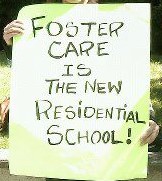
Two Indigenous people, a married couple, were sentenced on Friday June 23, the foster parents of young Indigenous siblings. They were charged with assault and manslaughter and sentenced to ten years in prison.
Our deepest condolences go to the children’s family, the perpetrators’ families, and the Sto:lo people in whose community these events – which are not unique – have unfolded.
That Sto:lo community is not alone, not in any part of this tragedy. The incomprehensible hurt and loss of innocent Indigenous children is part of a much larger, much older, ongoing and world-famous Canadian assault on Indigenous Peoples.
Another Indigenous mother presented her petition against British Columbia and Canada to an international arbiter, in 2007, for the senseless, routine, and indefensible apprehension of her children and their subsequent abuse in Ministry “care.”
Her case was admitted to the Inter-American Court in 2014: not only do Indigenous Peoples suffer for a lack of jurisdiction over their own children and families, but they suffer from the total denial of their title and rights over everything else – their land and jurisdiction – that would allow them to maintain their children and families according to their own traditions.
That is, losing children to the state is the direct result of the state’s denial of Indigenous Peoples’ land titles and the accompanying rights, wealth, national identity, authentic governance, and social and cultural structures.
The Lake Errock case in the news
The First Nations Leadership Council has called for the resignation of the Minister of Child and Family Development, Mitzie Dean, and the Premier of BC snapped back that the Ministry has his full support and confidence. The BC Greens Caucus has now backed them up on the demand for a resignation.
Are criminal charges pending against the Director of Child and Family Services of British Columbia? Children “in care” also died in 2020 and 2017 in BC. And 2015. And… the total lack of accountability or culpability in Indigenous child deaths “in care” is a signal from the colonial administration: they are only doing what they set out to do. This colony set out to supplant Indigenous Peoples, and the deaths of their children in mandated forcible removals is “just” a part of that mandate. It is no different from the “kill the Indian in the child” mandate established by the first Prime Minister of Canada, Sir John A. MacDonald, when he stated in 1910, “It is readily acknowledged that Indian children lose their natural resistance to illness by habitating so closely in these schools [Indian Residential Schools], and that they die at a much higher rate than in their villages. But this alone does not justify a change in the policy of this Department, which is being geared towards the final solution of our Indian Problem.”
Sixteen months after this eleven year old boy was killed in Lake Errock, by the foster mother, the Ministry’s culpability in the abuse and death is clearly a contributing factor. Seven months had passed since any agent of the Ministry, any social worker, checked the foster home or the children’s well being when the fatal events happened at the end of February 2021. There was not even a virtual check in by phone or online communication.
The trial has revealed that brutality was ongoing in that home, including coercing other children resident there to participate in abusing the 8 and 10 year old sister and brother.
While mainstream media is tip-toeing around the legendary mortality rate in Canada’s Indigenous child apprehension programs, there are some basic facts that we should be reminded of.
Aboriginal delegated agencies for children and families
There is, in British Columbia, a perpetual cycle of tragedy, inquiry, recommendation, ad hoc Indigenous involvement, delegated control capped by BC MCFD mandates, funding cuts, mismanagement, denial… tragedy, inquiry, recommendations…
The fact that this cycle has continued unchecked since the 1980s is proof positive of a mandate among BC social workers to disrupt and endanger young Indigenous families. Apprehension of children from young Aboriginal families, according to a career social worker who would rather not be named, is the unwritten but understood objective.
Indigenous communities have fought valiantly for the power to help their own families without interference. Indigenous Chiefs have rallied to several major commitments to step into roles of youth care and family support over the last four decades.
What they get is delegated powers from a colonial Ministry, which is perpetually determined to undervalue the cost of these responsibilities, and to control mandates and delivery.
The Indigenous foster parents of the two Indigenous foster children in this case were living in an area, Lake Errock, which is served by Xyolhemelh, a delegated Aboriginal child and family services society.
Xyolhemeylh is the agency that was responsible for Alex Gervais. In 2015, Gervais, age 17, died by falling out of an Abbotsford hotel room window where he had been “temporarily” housed by the society for 49 days.
The event was the subject of a February 2017 report on the dysfunction of B.C.’s Aboriginal child welfare system.
A press statement from the BC General Employees Union in 2017 explained:
“The Ministry of Children and Family Development (MCFD) is responsible for providing funding for a significant portion of the services that delegated Aboriginal agencies like Xyolhemeylh provide. A recent agreement between MCFD and the agency has brought caseload funding on par with levels within the MCFD, providing some relief from a dire recruitment and retention crisis at Xyolhemeylh.
“However, because MCFD has itself been drastically under-resourced for decades, the increase still isn’t enough to provide care that is appropriate to Aboriginal children and youth. “Unfortunately, staffing resources equal to MCFD is no answer for Xyolhemeylh workers who are desperately trying to provide services in culturally appropriate ways to children whose families are scarred with multigenerational trauma, and the dire poverty that so often accompanies it,” said BCGEU President Stephanie Smith.”
The cycle
The report, “Skye’s Legacy: A Focus on Belonging,” was submitted by B.C. Representative for Children and Youth Dr. Jennifer Charlesworth, explored the life of a youth named Skye, who died of an overdose on her 17th birthday in August 2017.
The report found that B.C.’s child welfare system left Skye without a sense of belonging, particularly as an Indigenous person, which contributed to her death. She was taken from her mother at age five and lived in fifteen different homes before her death twelve years later.
“Collaboration among ministry, Indigenous communities needed to assess living situations of kids in care: jury.” This headline refers to the death of a 17-year-old Cree teen in a group home in Abbotsford. The report recommended more family-based services for children in care and faster action when those children go missing.
Traevon Chalifoux-Desjarlais was found dead in a bedroom closet in September 2020, four days after he was first reported missing by a group home staffer.
The Timeline
2023, June 29 – The B.C. Green Caucus stands with the FNLC, calling for the resignation of Minister of Children and Family Development, Mitzi Dean, in light of the shocking and horrific systemic failures of the Ministry that have continued under their watch.
2023, June – First Nations Leadership Council calls for the resignation of the Minister of Child and Family Development, Mitzie Dean, over the 2021 death of a child in foster care in Lake Errock, after the trial and sentencing of the perpetrators. The children’s case was handled by a delegated aboriginal agency, which had not checked in for seven months when the child died.
2021, June – report by BC’s Children and Youth Advocate, “Skye’s Legacy: A Focus on Belonging,” explored the life of a youth named Skye, who died of an overdose on her 17th birthday in August 2017. The report found that B.C.’s child welfare system left Skye without a sense of belonging, particularly as an Indigenous person, which contributed to her death. She was taken from her mother at age five and lived in fifteen different homes before her death twelve years later.
2021, May – the unmarked graves of 215 children on the Kamloops Indian Residential School grounds are confirmed. This leads to examination of other Indian Residential School sites, and further confirmation of similar mass unmarked graves at every school inspected so far.
2020, September – Traevon Chalifoux-Desjarlais was found dead in a bedroom closet, four days after he was first reported missing by a group home staffer.
2020 – present: most First Nations have accepted the demise of the Aboriginal Peoples Family Accord, the Tsawwassen Accord, and the Indigenous Child at the Center Action Plan. Instead, they have implemented the recommendations of the 2015 Report of MCFD Special Advisor Grand Chief Ed John. The report called for a Social Worker on every Indian Reserve, and the January 2020 enabling legislation provided delegated agency, to fulfill the Ministry mandate, to each First Nation.
2020, January – Bill C-92, “The Act respecting First Nations, Inuit and Metis children, youth and families” applies to Indigenous groups, communities or peoples, regardless of status or residence within Canada, who bear existing and inherent Aboriginal rights as per section 35 of the Canadian Constitution.
It is designed to affirm the rights and jurisdiction of Indigenous Peoples in relation to child and family services, and to set out principles applicable, on a national level, to the provision of child and family services in relation to Indigenous children. The Act creates a set of National Standards that must apply when working with Indigenous children, youth and families, and provides for changes to jurisdiction when making decisions about Indigenous lives.
The Act contributes to the implementation of the United Nations Declaration on the Rights of Indigenous Peoples and provides an opportunity for Indigenous peoples to choose their own solutions for their children and families. Our children, our way.
2017, August – an Indigenous youth named Skye died of an overdose on her 17th birthday. She was taken from her mother at age five and lived in fifteen different homes before her death twelve years later.
2017 – A recent funding agreement between MCFD and the delegated aboriginal agencies brought caseload funding on par with levels within the MCFD.
2016 – APFA runs out of funding, dissolves.
2016 – 2014? – termination of regional delegated agencies – consultation and development program – follows from lack of support from individual communities for the regional, not community-based, process. Instead, most Bands sign on to deliver MCFD mandate themselves, following Ed John’s report recommending a social worker / agent on every reserve.
2016, November – Indigenous Resilience, Connectedness and Reunification–From Root Causes To Root Solutions; A Report on Indigenous Child Welfare in British Columbia Final Report of Special Advisor Grand Chief Ed John. The report calls for a Social Worker on every Indian Reserve.
2016, March – The B.C. Teachers’ Federation calls for Stephanie Cadieux, Minister of Children and Family Development, to resign after Patricia “Indigo” Evoy was found dead in a Burnaby, B.C., apartment March 10. She is the third aboriginal youth, in as many years, to die while receiving help from the B.C. Ministry of Children and Family Development.
2016, March – Patricia “Indigo” Evoy died while in Ministry “care.”
2015, December – Plecas Report part 1 released
2015, December
2015, December 22 – Sto:lo Tribal Council call for Bob Plecas and Ed John’s resignations, and reports to be shelved. They cite the misleading appearance of Indigenous representation with Ed John’s participation, which was not endorsed by Indigenous groups
2015, September – Grand Chief Edward John appointed Special Advisor on Indigenous Children in Care, “to engage First Nations and Aboriginal leaders in discussions to help the Province reduce the number of Aboriginal children in care; and, to engage with the federal government in meaningful work to enhance prevention and intervention work as well as address ‘root causes,’ as discussed in the report.” 6 month term
2015, September – NDP John Horgan calls for Minister of Children and Families Stephanie Cadieux to resign, following the death “in care” of Alex Gervais.
2015, September – Alex Gervais, age 17, died by falling out of an Abbotsford hotel room window where he had been “temporarily” housed by the Aboriginal delegated authority the Xylohmelh Society for 49 days.
2015, July – “Aboriginal Children in Care” report to Canadian Premiers identified “core housing need” among 40% of single parent families living on-reserve, among other major iniquities: in 2012, 40% of Indigenous children live in poverty; 43% of women in federal prisons are Aboriginal.
2014, December – The Lil’wat petition is admitted to the InterAmerican Court of Human Rights, which waived the requirement to prove exhaustion of the domestic remedy
2014, August – Canada’s Premiers directed provinces and territories to work together on solutions to reduce the number of Aboriginal children in child welfare systems. A report was provided to Premiers at the Council of the Federation (COF)
2013, November – report: When Talk Trumped Service: A Decade of Lost Opportunity for Aboriginal Children and Youth in B.C.
Mary Ellen Turpel-Lafonde, Representative for Children and Youth, BC
The report offered critical observations on how both Aboriginal organizations and BC’s Ministry of Children and Family Development (MCFD) have failed to meet the needs of children through what she has stated is a system of “fractured accountability”.
2011 – Child and Family Wellness Accord
Between leadership of the nine south island First Nations and urban Aboriginal community, known as the South Island Wellness Society, and the Province of B.C.
– to design and develop an Indigenous child services system for the care and protection of Aboriginal children, youth and families in the region.
-to restore, revitalize and strengthen the services in an effort to address the gaps and socio-economic barriers impacting the well-being of Aboriginal children and families
2011 – The Lil’wat petition to the InterAmerican Commission on Human Rights is accepted, the Edmonds petition, concerning the lack of Canadian jurisdiction to interfere in Lil’wat families living in Lil’wat territory
2010 – termination of APFA, end of funding for Child at the Center and Interim Child and Wellness Council
2008, July – Interim Child and Wellness Council established to gather further input for the Indigenous Child at the Centre Action Plan to ensure it reflects the knowledge of front line workers, youth, the community and leadership. The Council will then develop a workplan to advance and implement the Child at the Centre Action Plan.
2008, July – First Nations Leadership Council announces the Indigenous Child at the Centre Action Plan
2008, June – Prime Minister Stephen Harper apologizes for Indian Residential Schools
2008, April – VACFSS receives mandate from MCFD for “child protection,” meaning license to remove children from their homes and place them “in care”
2008, February – Overview of the Child Critical Injury and Death Investigation and Review Process in British Columbia
Prepared by The Children’s Forum: – BC Coroners Service – Ministry of Children and Family Development – Ombudsman – Public Guardian and Trustee – Provincial Health Officer – Representative for Children and Youth
2008, January 25 – the ‘Walking Together to Keep Indigenous Children at the Centre’ Declaration of Commitment among Indigenous Peoples “in” British Columbia
2008 Aboriginal Peoples Family Accord
A process of constituting regional delegated aboriginal agencies
2007, November 29 – the ‘All Our Relations’ Declaration of the Sovereign Indigenous Nations of British Columbia
2007 – GOOD PRACTICE ACTION PLAN
Ministry of Child and Family Development, BC
“Aboriginal peoples exercising their rights to jurisdiction over their children’s well-being, through self-determination, have strong and healthy children, youth and families.”
2006 – the Assembly of First Nations settles a number of individual and class-action suits against the Canadian government for harms caused by Indian Residential Schools.
the system for reviewing child deaths, including how these reviews are addressed within the Ministry,
advocacy for children and youth;
and the monitoring of government’s performance in protecting and providing services for children and youth
2005 – Opposition BC party NDP call for review into the two Aboriginal child deaths; advocates for other youth call for supports to youth in care
2002, September – toddler Sherry Charlie died in a foster home she was placed in by MCFD / delegated USMA (Nuu-chah-nulth) child services
2002, September – 23-month-old Chassidy Whitford was killed by her father on the Lakahahmen reserve near Mission in 2002, in Xyolhemelh / Fraser Valley Aboriginal Child and Family Services care.
2002, June – Formation of the First Nations Leadership Council, under the Tsawwassen Accord between the province of BC, BC region Assembly of First Nations, First Nations Summit, and the Union of BC Indian Chiefs.
2000-2001 – Ed John, an Indigenous Chief of the Carrier Sekani Tribal Council, is made the Minister for Children and Family Services, BC
2001, December 14 – VACFSS and the province sign the Delegation Enabling Agreement (DEA). VACFSS can provide a full range of delegated Resource and Guardianship services. It also provides non-delegated services through Indigenous Family Preservation and Reunification Services.
2000 – First Nations child and family services, national policy review – report by DIA and AFN
2000 – the Nisga’a Final Agreement includes agency over Children and Families, and the Nisga’a Child and Family Services is an extension of the provincial Child and Family Services law.
1999 – VACFSS began negotiations with the Ministry to deliver delegated services under the BC Act. The VACFSS Guardianship Pilot Project began.
1998 –A Review of the Implementation of the Report of the Gove Inquiry into Child Protection
1996 – creation of the Children’s Commission to review child deaths and oversee the activities of the new ministry
1996 – a series of community consultations leads to VACFSS receiving Indigenous support to get “designation status” – providing advocacy to families and notifying First Nations when their children were removed from their member families in the Lower Mainland
1994 – Gove Commission announced following murder of Matthew Vaudreille
1994, May – creation of Child, Family and Community Service Act, and the Child, Youth and Family Advocacy Act
1992 – “Liberating our Children, Liberating our Nation” – legislation review report calls for Indigenous jurisdiction over Indigenous children
(Community Panel Child Protection Legislation Review, British Columbia Report of the Aboriginal Committee: Eva Jacobs, Kwakiutle Nation and Lavina White, Haida; Fred Storey, Project Manager; Loretta Adams, Researcher; Faye Poirier, Administrative Support)
1989 -The Nuu-chah-nulth Department of Family and Child Services (Usma) becomes the first Aboriginal agency in Canada to exercise full delegated authority for child welfare.
1988 – the off-reserve advocacy union, United Native Nations, work in family reunification, and volunteerism spreading to child care and protection, is formalized as the Mamele Benevolent Society to facilitate in-home support programs, advocacy for families with children seized by the BC Ministry. This organization becomes the Vancouver Aboriginal Child and Family Services Society in 1992.
1986 – Child Welfare Committee
1980 – Child, Family and Community Service Act BC
1980 – Spallumsheen bylaw; child protection is carried out by the Band
1980 – Indian Child Caravan took place over Thanksgiving weekend, October 9-13, 1980. The Caravan began in Prince George and picked up more people along its route. The group advanced to Williams Lake and Mount Currie, and merged with people from the Interior and Vancouver Island communities before culminating with a rally in Vancouver. And sit-in outside the Minister’s house
1972-73 On March 9, 1973, the National Indian Brotherhood appeared at the Standing Committee of the House of Commons on Indian Affairs. Joe Clark, then a Member of Parliament from Alberta, moved that the Committee recommend to the House of Commons that the NIB’s
1972 Aboriginal Rights Position Paper be adopted as a description of aboriginal rights. It includes control of children and families.
1969 – Moccasin walk of a hundred miles, Indian Homemakers Association of BC,
raise funds for the British Columbia – wide Indigenous leadership gathering, which becomes the Union of BC Indian Chiefs, with a mandate to pursue the Indian Land Question.
1960s – “60’s scoop” indiscriminate and mass seizure of Indigenous children to state “care” and adoptions outside Canada. Follows delegation of social services from federal to provincial, and decriminalization of keeping children out of Indian Residential Schools
1920 – Indian Act amended to require Indigenous child attendance at Indian Residential Schools, on pain of imprisonment of the parents for non-compliance
BC’s first Superintendent of Neglected Children, 1919
1910 – Prime Minister John MacDonald: “It is readily acknowledged that Indian children lose their natural resistance to illness by habitating so closely in these schools [Indian Residential Schools], and that they die at a much higher rate than in their villages. But this alone does not justify a change in the policy of this Department, which is being geared towards the final solution of our Indian Problem.”
end list *
Please find archival material at: ihraamorg.wordpress.com and check the archive in “Children” on this site.
Fifty years since Calder v. The Attorney General of British Columbia: how Canadian policies – and judges – adapted to delay and deny recognition of Indigenous Peoples’ land title
On January 31, 1973, Indigenous people’s unextinguished right to “possession” of their lands was recognized in a Canadian court for the first time.
Three Supreme Court of Canada judges reasoned that the Indigenous Nisga’a People had never lost to British Columbia their “possession of the land,” and had the continuing “rights to enjoy the fruits of” their land.
In the case presented by the Nisga’a nation, with Frank Calder as the name plaintiff, the people established that their ancient rights to the soil had not, could not have been, diminished by any unilateral pronouncements or colonial legislative acts: the Nisga’a had never freely relinquished, sold, or made treaty to surrender them.
Supreme Court of Canada justices Hall, Spence, and Laskin wrote 50 of 72 pages in the Calder ruling, finding in favour of that position, as per the Canadian constitution.
The court ruling was split, however. Three judges ruled Nisga’a had no title and, if it ever did, the presence of a British colony nullified it. The seventh judge refused to decide, based on a procedural anomaly.
Prime Minister Pierre Trudeau’s reaction was to say, “I guess you had more rights than we thought, when we did the White Paper in ’69.” Unfortunately, the exact purpose of the federal government’s 1969 position and policy was to erase those rights which they were well aware had never been addressed.
Some politicians were more responsive. Because of the court finding in the Nass Valley case, the former prime minister John Diefenbaker immediately addressed the government, asking that the question of Aboriginal rights be referred to a full bench of nine Supreme Court of Canada judges “as this question can be settled once and for all.” The Justice Minister, Otto Lang, said he would consider the suggestion.
The judges were very responsive. In the past fifty years, the Canadian judiciary has defined that title down.
The politicians did not refer the question, they constructed a policy even more dangerous than their 1969 White Paper. The Comprehensive Claims Policy, a process of extinguishing Aboriginal title and rights by agreement, emerged in 1974 and is still the government’s bottom line. It predetermines the result of every engagement with Indigenous Peoples where land and jurisdiction are concerned: gains in Canadian titles to land, financial settlement, and limited forms of municipal self-governance are paid for by release of Aboriginal rights and indemnification of the governments – and “anyone else” – for past harm.
The agreements are invariably negotiated under duress: under the conditions of poverty and desperation imposed by another unconstitutional action, the Indian Act of 1876. Also, still in effect.
“Extinguishment with consent” remains Canada’s policy and enthusiastic practice to date. It has been heavily criticized by international treaty bodies for at least twenty years.
Government policy has been mirrored by the Canadian judiciary. In case after case, they defined “Aboriginal title” into something quite different.
Judge made law
In every Indigenous action that followed Calder, government lawyers began their argument by quoting Justice Gould of the BC Supreme Court, who made the original ruling of dismissal against the Nisga’a in 1969. Lawyers for the crown all began their prosecution of Indigenous land-defenders and rights-exercisers, or their defense against being sued for land and rights, by saying: if there was ever any right or title to extinguish, then any Aboriginal rights or titles were extinguished by denial, declarations, or legislation of the Imperial or provincial crowns.
But, since 1973 and the epic realization that if the Nisga’a had title, so did every other Indigenous Nation west of the Rockies, by the same logic, the Canadian judiciary began to define that title out of reach and out of all meaning.
Ignoring the clearly and passionately iterated expressions of the meaning of Indigenous titles, offered over the last century-and-a-half by Indigenous Peoples themselves, judges dismiss essential elements of those as “absurd;” they sift out definitions of Aboriginal rights which are not too inconvenient for the state; and the politicians pass legislation to mechanize pacification of the piecemeal rights arising from the litigation.
Judges confirmed that Aboriginal rights are sui generis: Aboriginal rights and titles are just not like other peoples’ rights and titles, in Canadian Pacific Ltd. V. Paul, 1988. They made lists of requirements about what Indigenous Peoples have to prove in order to convince courts they have rights, like exclusive and continuing and exclusive occupation, in Baker Lake v. The Minister of Indian and Northern Affairs, 1980. That becomes quite hard to show, when communities were forcibly displaced and replaced by settlers.
In R. v. Adams, 1996, judges said Aboriginal title, being unlike other peoples’ titles, is actually a form of Aboriginal right. They defined what “the core of Indianness” means, in Dick v. The Queen, 1985.
They figured out that Aboriginal rights are only those activities which were in play in 1846, effectively freezing Aboriginal Peoples out of the right to develop and to have that development recognized as within their rights.
The judiciary then put themselves, and Canada, squarely in charge of elaborating on the constitution, where it concerns Indigenous Peoples, because that, Chief Justice Antonio Lamer explained in R. v.van der Peet, 1996, is what Section 35(1) is for. “Aboriginal rights are aimed at the reconciliation of the prior occupation of North America by distinctive aboriginal societies, with the assertion of Crown sovereignty over Canadian territory, by bridging aboriginal and non-aboriginal cultures.”
The reconciliation demanded by Section 35, apparently, is to be defined and determined by Canada unilaterally. And they don’t have to reconcile with Aboriginal cultures when they can justify infringing them.
After they decided Aboriginal rights remain behind 1846, judges subsequently ruled that any Aboriginal commercial activities should really be in line with 1846 revenues. Nuu-chah-nulth, 20011.
Shortly after Delgamuukw, 1997, and that first positive definition of Aboriginal title as something other than sui generis, or unknown, courts went into high gear. With Taku River Tlingit, Halfway River, Haida, and Douglas, courts instructed the government that the issue here was not so much about Aboriginal title as it was about accommodating that title by consulting with Aboriginal Peoples when there probably is title, and then sharing benefits from industries that extract revenue from those probably-title lands.
But Indigenous Peoples’ land titles are protected from just that kind of exploitation by Canada’s constitution. Judges have stepped in to “bridge” any inconsistencies.
In fact, Prime Minister Justin Trudeau recently explained that, “we will not be revisiting the Constitution.”
Canada and British Columbia have devoted tens of billions to its legal defense against the Indigenous title holders; its out-of-court negotiations, which were often coercive and always divisive for the Peoples; and its settlement awards for relinquishment of claims, which funds were always alarmingly small.
They have not, however, spent any money on positively identifying Indigenous title lands.
Widespread judicial refusal to respect international norms and treaties is exactly the criteria required for third parties, that is, other states, to bring Canada before the World Court. If they haven’t done so yet, maybe cheap Canadian exports of raw resources, subsidized by denial of Indigenous titles, is clouding their vision.
International attention
In 2009 and 2014, the Inter-American Court of Human Rights (IACHR) found two cases from British Columbia admissible on the basis that there is no domestic remedy to grievances between the Indigenous parties and the state of Canada. The Hulqiminum Treaty Group and the Lil’wat plaintiff in Edmonds were both found to have exhausted any chance of a fair hearing within Canada.
This is what happens when state policies preclude access to an impartial court, or when an entire state judiciary demonstrates a refusal to recognize rights defined in international treaties: international courts gain jurisdiction over the matter. What has not happened so far is Canadian participation in the IACHR proceeding. Both cases have stalled.
One of the first international Indigenous cases turns fifty next year. Sandra Lovelace, Maliseet from Tobique, took her case to the UN Human Rights Committee. They found that Canada was in breach of its obligations under the International Covenant on Civil and Political Rights, 1969, (ICCPR) in its use of the Indian Act to discriminate against Indigenous women. Lovelace’s case succeeded to the international arbiter because the Attorney General of Canada and the Department of Indian Affairs had just sued Jeanette Corbiere Lavell, to overturn a decision in her favour regarding the same issue – gender-based loss of Indian Status. The Supreme Court had found for the state: “The Canadian Bill of Rights does not affect the Crown’s legislative authority with regard to Indians.”
It can only be a question of other countries’ love for cheap timber, minerals, gas, and fish – subsidized by Canada’s political denial of Indigenous Peoples’ rights – that has stopped the land question from being prosecuted in a similar way to Lovelace. The same ICCPR states in Article 1:
International Covenant on Civil and Political Rights
1. All peoples have the right of self-determination. 2. All peoples may, for their own ends, freely dispose of their natural wealth and resources without prejudice to any obligations arising out of international economic co-operation, based upon the principle of mutual benefit, and international law. In no case may a people be deprived of its own means of subsistence. 3. The States Parties to the present Covenant, including those having responsibility for the administration of Non-Self-Governing and Trust Territories, shall promote the realization of the right of self-determination, and shall respect that right, in conformity with the provisions of the Charter of the United Nations.
Nuchatlaht 2023
In May of this year, BC Supreme Court Justice Myers ruled that the Nuchatlaht “may” have aboriginal title to some areas. His decision is regressive, almost contemptuous, and turned a valuable opportunity into a colossal waste of time and money. BC courts do not tend to find for Indigenous rights – the Supreme Court of Canada (SCC) does that.
What’s more: the media didn’t even show up for it. A single report by the Canadian Press was picked up by BC outlets, who used stock photos of previous Nuchatlaht appearances to accompany the brief, mis-quoted, disturbingly disinterested article.
This case is the first Aboriginal title case to follow Tsilhqot’in, 2014, where, on appeal from BC to the SCC, Aboriginal title lands were declared, ruled upon, and drawn on a map for the first time. A great deal more attention to detail was deserved to this follow-up case.
One of the details is the fact that Indigenous Peoples are still paying a King’s ransom in time and money to plead for their rights, and that is in itself a travesty of justice.
The elected politicians have not pursued justice – they have fought it in their own courts for a century – and instead tighten their policies. The electorate continue to make Canada an acid environment for Indigenous individuals, families, businesses, communities. Logging, mining, fishing, and every kind of industrial development has continued on the disputed lands at a pace normally associated with plunder in times of war.
Fifty years from now
“If the Indians win, there will be a cloud on all the land titles issued by the province.” So said Duncan Campbell Scott, Minister of the Interior and Superintendent of Indian Affairs, as part of the 1926 Judicial Committee on the Claims of the Allied Tribes.
The question was not “if” the Indians win: the question was “when” the Indians win. And there certainly is a cloud on all the land titles issued by British Columbia. That’s why the Province of British Columbia has a line item for “treaty making” in its annual financial audits: everybody knows BC does not have title, even Standard and Poor’s, and BC’s creditors need to see that uncertainty mitigated.
In Hawaii, non-native homeowners buy Title Insurance. The Hawaiians have been making their way through the courts, proving their title to acre by acre, and banks won’t give out a mortgage for a property without it being insured against the inevitable claims of the rightful owner.
75% of reports to Committee on racial discrimination sent by Indigenous organizations.
Last week, Canada switched arrogance and condescension for gestures of off-kilter desperation at the Assembly of First Nations’ general assembly. That is probably because on August 14 and 15, Canada will be under the microscope at UN headquarters in Geneva. Fifteen Indigenous Peoples’ organizations have already submitted extensive reports for the Session, detailing Canada’s “seek and destroy” approach to their internationally recognized human rights.
It is a typical Canadian tactic to invent meaningless distractions right before a review by a UN treaty body: their delegates to the Session can then reply to the Committee’s independent experts by talking about “initiatives” or “joint meetings” which do not substantially exist, instead of answering directly.
This time Canada sent four federal ministers to the AFN’s annual assembly, July 25-27, where they implied that Ottawa is going to rescind the Indian Act. Bennett (Minister of Indigenous Affairs), Wilson-Raybould (Minister of Justice), McKenna (Environment) and Goodale (Public Safety), all made vague references to bright promises yet to come.
The only concrete message from Ottawa to the AFN Chiefs – only half of whom showed up at the all-expense-paid meeting in Regina – was that it will no longer claw back unused capital funds to First Nation communities after twelve months of dispersal.
This miserable material figure can and should be unsuccessfully compared to the immaterial, yet golden, future intimated by Bennett’s and Wilson-Raybould’s reported remarks. “How will your nation and Indigenous government be organized? What is your territory?” Their remarks, on the other hand, will certainly be judged against the picture of Indigenous life under Canada which has been detailed in reports to the UN CERD.
“ Skeena watershed and coastal Indigenous communities depend on the salmon for food, their economies and cultures. This (LNG, Prince Rupert) project is a prime example of what’s wrong with Canada’s approach to engaging Indigenous communities in large-scale industrial developments: It continuously fails to honour the legal obligations to Indigenous Peoples in protecting their traditional resources; The Canadian government generally consults with Band Councils, which were created under the colonial Indian Act, and often fails to consult hereditary leadership or respect traditional governance systems; …”
It is interesting to note that only weeks after this report to the CERD was posted for the Session, Petronas announced its withdrawal from this proposed project, “Pacific NorthWest LNG.”
The UN Committee for the Elimination of Racial Discrimination has dealt Canada sharp rebukes over the last two decades: stop extinguishing Indigenous Peoples’ titles; stop ignoring murderers who target Indigenous women; stop trying to destroy the Lubicon Cree to get oil access.
The UN treaty bodies have an internationally recognized judicial power to issue recommendations to member states in keeping with upholding international human rights conventions. Each committee periodically receives reports from the state under review, and also from non-governmental organizations, civil society, academia, and now from Indigenous Peoples’ organizations.
It is typically the reports from Indigenous Peoples and NGOs which have, in the past, resulted in strong recommendations from UN Committees to Canada. Many of those have produced changes in the government’s behaviour, although such changes have been isolated and usually only in direct connection to the issues reported. In British Columbia this includes instances of forgiveness of government treaty negotiation loans to small Bands; dissolution of treaty societies formed to negotiate in the BC treaty process – against community members’ protests; and possibly the current standstill in BC Treaty Commission business altogether.
Extinguishment “negotiations” are an ongoing problem that is at the center of the CERD’s focus on Canada:
“There are no viable options other than legal court action to counter the BCTC “treaty” process about these overlaps into St’át’imc territory. As negotiations with the outside First Nations progress, the eventual outcome will be the extinguishment of significant portions of St’át’imc territory without the St’át’imc having been involved in any negotiations to this effect.”
In contradiction to the Interior Alliance’s extensive documentation of the extinguishment effect of Canadian “negotiations,” however, Minister Wilson-Raybould remarked to the press on her government’s plans: “They are explicit in rejecting certain long-standing federal positions—such as the focus on extinguishment, surrender or denial of rights.” Incidentally, that’s what Canada told the CERD in 2007.
Extinguishment, surrender and denial are precisely what Canada offers Indigenous Peoples. There is a veritable firestorm of examples of this, enveloping Indigenous Peoples. It is highly suspect that a Canadian Minister climbs a prominent national stage and says “we’re just about to change,” (again) only days before Canada has to answer a lot of very pointed questions in front of the world.
Consistent Canadian practices are to assimilate and co-opt economic development, to municipalize isolated communities under provincial legislation, to criminalize traditional economies, to rigidly maintain dependency by an overbearing and constantly metamorphosing bureaucracy which can never be finally functional. There is the “First Nations Land Codes” – where a community votes to recognize Canadian supremacy in its traditional territories, just for the privilege to enjoy managerial duties on-reserve. There are the “Strategic Land Use Planning Agreements” – where communities have shared maps of their territories showing cultural values and inadvertently given tacit approval to development in huge “low cultural value” lands. In the national Inquiry into Missing and Murdered Indigenous Women, crucial voices have undoubtedly been denied. Indigenous Peoples’ rights under Article 1 of the International Covenants on Civil and Political, and Social, Economic and Cultural Rights are completely denied. Canada specializes in the forcible removal of Indigenous children from their homes and communities, requiring parents and families to submit and surrender to provincial courts which have no jurisdiction whatsoever in the case of children and families who are not Canadian until they produce a referendum from their nation joining Canada.
Minister Wilson-Raybould, apparently speaking for those Indigenous individuals who have exercised their right to choose a nationality, appealed to the Chiefs to imagine their future as Canadians whose Indigenous rights are recognized and respected.
Ultimately, the Supreme Court of Canada expresses the state’s right to own Indigenous nations it has no treaties with. It is certainly a matter of interest in any investigation of racial discrimination. Apparently the key to Canada’s jurisdiction over nations with which it has no constructive agreements is owing to the fact that the British monarch, appointed by the Christian god, had sent a sailor with orders to discover and possess others’ lands in His name, and he was successful in this because the Christian god was superior, so the Supreme Court of Canada seems to say, to any of the existing nations’ gods. We know it is the presence of other Christian nations which is at issue in the matter of the Canadian court’s opinion on sovereign possession, because the issue was finally settled in 1846, according to Canadian judges, when the USA agreed in the Oregon Treaty to withdraw from pursuing any interests north of the 49th parallel. From that date, Great Britain and now Canada enjoys sovereign possession of all lands from the Pacific Ocean to the Atlantic Ocean above that parallel, except Alaska, as per SCC, because all other Christian nations had, by that time, also promised Great Britain they would pursue no interests there.
Unfortunately for that internationally repugnant display of Canadian faith, which is the state’s current legal precedent, it is not clear that any Indigenous Peoples have formally joined and adhered to Canada. Wilson-Raybould was referring to that popular understanding among the Chiefs. The CERD has been made aware of that understanding, and again in the reports for this Session:
“In particular, we bring to the Committee’s attention the state’s use of its own imposed Indian Band administration, under the Indian Act, on the state-defined Indian Reserve, to manufacture the appearance of Líl’wat consent to Canada’s disposal of the remainder of Líl’wat customary titles to lands and wealth outside the Reserve.
“Líl’watmc ask that the Committee question Canada about the origins of any rights of jurisdiction it may have in relation to Líl’wat which could justify Canadian licensing and development without the consent and against the Interests of the Líl’watmc under the Convention, and resulting in the continuing displacement and dispossession of Líl’wat.”
Líl’wat report to UNCERD, July 2017, with the International Human Rights Association of American Minorities
The picture developed by fifteen Indigenous Peoples’ organizations shows Canada’s unabated attempts to assimilate Indigenous Peoples – their worldview, identity, economies, individuals, children, histories, and especially their lands and natural wealth – into Canada. Unilateral, non-consensual assimilation is categorically prohibited as a matter of human rights norms, and yet that end of the spectrum of Canada’s colonization is not the worst.
“If Ontario and Canada insist on excluding us from meaningful consultations on the Agreement in Principle, then we insist that Canada and Ontario exclude the areas where our First Nations’ asserted Aboriginal title and rights overlap with the “Algonquins of Ontario” claims, or at least suspend negotiations over such areas, until such time as we have engaged in meaningful consultations and reached an acceptable accommodation.
“Despite our objections in March 2016, the “Algonquins of Ontario”, Canada and Ontario have proceeded to hold a referendum vote on the AIP.”
“How does one start to describe the horrific conduct of Canada in their relentless efforts to extinguish the rights of Indigenous peoples within their ancestral homelands?”
“While the Supreme Court of Canada has determined that the Canadian and provincial governments have a duty to consult, negotiate, and accommodate Indigenous rights, the governments use these consultation and negotiation processes to coerce, terrorize, terminate, extinguish, and discriminate against Indigenous peoples and our rights.”
“Asubpeeschoseewagong Netum Anishinabek, also known as Grassy Narrows First Nation, is located on the English-Wabigoon River system in North Western Ontario, and is infamous for mercury contamination from an upstream pulp and paper mill. … In 2016, a former mill worker came forward to confess the mill had illegally buried barrels of waste along the river, leading to the persisting contamination and inability of the river system to recover naturally.”
“On November 29, 2016, the Canadian Federal Cabinet directed the National Energy Board to approve the Kinder Morgan Trans Mountain pipeline expansion. This pipeline poses an unacceptable risk to the health, safety and livelihoods of First Nations throughout British Columbia, and will contribute to the negative environmental and health impacts experienced by Indigenous Peoples downstream of the tar sands, and of all peoples throughout the world as a result of accelerating global climate change. The Tsleil-Waututh, Squamish, Musqueam, Coldwater, Upper Nicola, Stk’emlupsemc te Secwepemc, Aithchelitz, Shxwhay Village, Yakweakwioose, Kwawkwaw-apilt, Tzeachten, Skowkale, Soowalie, and Squiala peoples have commenced legal proceedings seeking to challenge the federal approval for the Trans Mountain project… It is well established that diluted bitumen contains toxic chemicals that are a threat to drinking water, health, and the well-being of salmon and other beings.”
Minister Bennett, for the federal department of Indigenous and Northern Affairs, said to the AFN Chiefs last week: “We want to partner with you on building on the strengths and assets you have in your communities. You have the power to determine the future of your communities.”
The international community is quite aware that Canada still wishes to build on the strengths and benefits belonging to Indigenous communities, whether Canada co-opts the participation of those communities through “benefits sharing” or “land management” or other agreements achieved under duress. The international community is also aware that Indigenous Peoples have the power to determine the future of their communities, and that Minister Bennett and her government may well have nothing to do with that.
As the Union of BC Indian Chiefs’ report articulated, “We are presently witnessing a great divide between the words of the Canadian government and its actions on the ground. We would like to highlight the term “rights ritualism” for the consideration of the Committee in respect to Canada’s present actions: a way of embracing the language of human rights precisely to deflect real human rights scrutiny and to avoid accountability for human rights abuses. Countries are often willing to accept human rights treaty commitments to earn international approval, but they resist the changes that the treaty obligations require.”
Grand Chief Ed John recommends MCFD rep in every reserve community
In September of 2015, Grand Chief Ed John was hired by the province of British Columbia “to provide advice on how to address the inordinate number of Indigenous children in care of government.” For clarification, the BC government asked for advice from the Chair of the First Nations Summit on how to stop itself from forcibly removing the children of Indigenous nations.
On November 21, 2016, John’s report was released: “Indigenous Resilience, Connectedness and Reunification – From Root Causes to Root Solutions.” Unfortunately, it does not feature the most obvious solution to the problem – the solution proposed over and over by Indigenous leaders; the solution which families and communities have fought for, tooth and nail: the removal of state child-apprehension programs from interference among peoples with whom Canada has no treaty, and over whom Canada has no jurisdiction.
Instead, the report calls firstly for increased funding to the provincial Ministry of Child and Family Services, in order to support the presence of more government-accredited social workers in a Ministry office on every reserve. And lastly, for Canada-wide legislation dictating the terms by which Indigenous Peoples may participate in child welfare.
There is a vast disconnect between the stories reported and the recommendations ensuing. The stories: anger, heartbreak, loss and irreparable harm caused by all-powerful MCFD agents demanding nuclear-family scenarios from extended-family cultures.
The recommendations: nothing less than re-institution of the Indian Agent. The highest recommended level of community engagement is a “nation-to-nation” protocol between the Indigenous party and the MCFD regional office (which is not a nation). After that, in the long term, an Indigenous community can take steps to replace the on-reserve agent with a bureaucrat of their own making, following federal prescriptions for the fulfillment of Ministry requirements.
There are several further, eerie shades to this report. One appears in the opening paragraphs, where the late Tl’azt’en warrior Chief, Harry Pierre, is quoted: “In our time, the helpers would come to help the mother and father…they would remind the parents of their responsibility.” Ed John does not refer in his report to any character resembling a “helper,” such as is described by Pierre, except the newly mandated on-reserve social worker.
John avoids directly identifying the “root causes” of BC’s excessive child-removal program, except to hint that they were planted in Indigenous communities by the government. And now –however unexpectedly – he lays out an agenda whereby those causes are to be corrected by planting alongside them the government itself. Thus providing “root solutions.”
No part of these recommendations pursues Indigenous autonomy in their continuing, unsurrendered jurisdiction over these matters. Although UN declarations are referenced, the report’s recommendations ignore international recognition of Indigenous Peoples’ rights to self-determination, control of their lands and resources and their own natural wealth, and control of their own social, economic and cultural business. The report also ignores a bloody, sweaty, tearful and epic campaign by Indigenous nations to bring their children home.
Jurisdiction over Indigenous children
A handful of news articles have appeared on the release of this report, all relying entirely on phrases provided by the government and Ed John’s public remarks. The journalists do not include the hard facts of his main recommendations, but parrot the buzzword jargon which John provided in his summary: “the essence of his 85 recommendations is a call for a jurisdictional transfer of aboriginal child welfare from governments, federal and provincial, to indigenous communities themselves,” reported Vaughn Palmer in The Vancouver Sun.
There arises a problem with the definition of “jurisdiction,” which the Grand Chief does not condescend to clarify. Indigenous Peoples expect that “jurisdiction” means their inherent and internationally recognized right of self-determination – their full International Bill of Rights and the wealth of their natural resources that comes with. In this Special Advisor’s report, the word “jurisdiction” is apparently used to refer to “powers delegated to a First Nation by the federal government after agreements releasing and indemnifying the governments and anyone else for past harms, and after ratification of self-government agreements modifying the Aboriginal right to be the rights included in this Agreement, as funded by periodic arrangements with the provincial and federal governments.”
Grand Chief Ed John has had 25 years of experience in promoting these extinguishment agreements, in his role as Chair of the First Nations Summit. The Summit is the regulatory approval and promotion mechanism for First Nations to negotiate Final Agreements under the terms of the BC Treaty Commission. Recently the government has exchanged the word “extinguished” for the word “modified” to describe the transformation of Indigenous Peoples’ rights into “the rights specified in the Agreement.”
He reports on his meeting with the Nisga’a, the first to ratify a Final Agreement in BC, where there have been “no removals of Nisga’a children in the last six years,” and all “because of the existing relationship between Nisga’a and MCFD.” Presumably this is because of their Final Agreement, under the terms of which “workers in Nisga’a communities are hired as auxiliary employees with MCFD.”
This is an example of the highest expression of “jurisdiction” possible under Ed John’s recommendations.
This is a very unimpressive example because it is not entirely true. According to a young Nisga’a woman living in Vancouver, she and her new family have been harassed by MCFD since she was six months pregnant. The Ministry has exacted dreadful invasions of her life, all on pain of losing her infant child if she does not comply. When questioned about assistance available to her as a Nisga’a citizen, who one would expect to have benefit of this “all possible because of the existing relationship between Nisga’a and MCFD,” she explained that this was not considered a good or even viable option by other young Nisga’a families she had asked. This particular young woman is mature, extremely intelligent, capable, and focused on her son – but she made the mistake of reporting to an Aboriginal liaison worker that she had had a fight with her boyfriend.
“Jurisdiction” here means perhaps even less.
Government Approved
The BC government press release announcing the report also included the news that “Of the recommendations directed at MCFD, work on 40 of them is either being wrapped into the ministry’s multi-year operations plan or is currently underway.” It seems that the report has outlined some extremely achievable goals for the provincial government.
Or is that a bad translation? The report was also described by the province as a key to “improve outcomes for Indigenous children and youth by changing focus from intervention and separation to strengthening families.” However, there are no recommendations pertaining to this at all – except possibly #17, a reminder list of procedural obligations for BC judges, including that they should “make every possible effort to keep siblings together in their orders.” And possibly #37? Another $4 million to INAC and MCFD in “family preservation funding”?
The 220 page report is largely made up of highlighted quotes from BC’s Child Family and Community Services Act, and is perhaps most useful as a guide to the Act itself. Most of the recommendations concern implementing the Act at deeper and deeper levels within Indigenous communities. Focusing heavily on government handouts about its finer instruments of inducting Indigenous youth into state “care”, the report runs the gamut of ‘Delegated Aboriginal Agencies’ and ‘Aboriginal Operational and Practice Standards and Indicators’ and ‘Wrapping our Ways Around Them’ – a guidebook “based on the understanding that Aboriginal peoples need to understand how to work within the current systems.”
And here, after summarizing all these, the first Recommendation appears:
#1: MCFD and INAC invest in the development and delivery of child and family services directly within First Nations communities in BC, through the following specific actions:
MCFD and INAC commit to invest an additional $8 million annually to increase the number of social workers, support workers, and others serving First Nations communities in BC by at least 92 FTEs over the next two years;
MCFD take immediate action to ensure that the additional front-line staff identified above are placed directly within First Nations communities in BC;
MCFD and INAC work together to ensure that a child and family liaison and advocate is funded for each First Nation community as a support service to parents, families, leaders, and members who require support within the community or to navigate the child welfare system; and
MCFD, with the objective of maximizing its child safety recruitment, review the entry-level qualifications for front-line workers to consider educational and experiential requirements for child safety positions.
Of all the grandmothers’ statements and community advocates’ outlines of internal remedy, those are not the characters elevated in the Grand Chief’s recommendations.
It is not until Recommendations 5 and 6 that First Nations – or any of them – are mentioned in the proposed new regime: their leaders should meet regularly with regional MCFD officers, and receive lists of the names of their children who are in state care.
A question arises concerning the discrepancy between the funding/hiring/state infrastructure recommendations, and contrary statements in the body of the report like this:
As this report will illustrate, I do not believe it is sufficient to simply refine the existing child welfare structure and authority base with an internally accountable quality assurance framework premised on greater centralization and improved lines of communication. Nor do I believe it will suffice to simply deploy more university-educated social workers, who – though often well intentioned – are without the knowledge and understanding of the Indigenous peoples with whom they work. A bigger and brighter version of the existing children welfare system will not address the concerns or meet the expectations of those Indigenous peoples with whom I met over the course of my engagements as Special Advisor.
And the question is this: did the same person who wrote that statement also write the recommendations? Because the recommendations are all about, are only about, expanding the existing structure; deploying more social workers; and delegating a “refined” version of the existing framework to Indigenous administration.
The Role of Special Advisor
John’s unique commission as “Special Advisor” started two months before his colleague, Bob Plecas, released his commissioned report on the same subject of child welfare. That report is unique in that it attached a dollar figure to the MCFD’s annual operating budget in BC: $2 billion. However, because of a self-disclosed business approach to the matter, when the Plecas Report came out in December, 2015, Indigenous leaders described is as “callous” and “ignorant”, as well as publicly urging John to remove himself from the situation and distance himself from the report. He did neither.
At least one Indigenous organization objected to this Special Advisor role early in the process. The Chilliwack Progress reported: “A resolution approved by Sto:lo Tribal Council is calling for Grand Chief Edward John to step down from his MCFD advisor role… The issues they raise about Chief John have to do with the irreconcilable contradiction between his role as MCFD advisor, as well as a B.C. Leadership Council and First Nations Summit Task Group member: “The Minister and Deputy Minister have stated in writing and in public that they are not required to consult First Nations leaders and organizations such as the First Nations Health Council because they hired Grand Chief Edward John.””
Others have commented in social media outlets since the release of the report. “Indigenous child welfare requires traditional ways, not white government interference!” exclaimed Hereditary Chief Kakila of Tenas Lake, St’at’imc. “The First Nations Summit is about money, not about solutions for community needs. In order to protect the child you must first protect the parents! You must build a healthy community that is the family structure! A child needs love, kindness and nurture – not millions of dollars for social workers!”
The First Nations Summit, the center of John’s career, is the state-constituted body which represents First Nations in BC treaty negotiations. This is not widely regarded as authentic representation of Indigenous peoples, although the BC government has always allowed the lines to blur: “Ed John has no mandate to represent anything. Another Christy Clark scam.” – Morris Amos, Haisla.
As to the legal reality of Indigenous Peoples’ jurisdiction, some traditional leaders are grim: “Unceded lands but tightly in the grip of these Uncle Tomahawks and Christy Clark. And they ignore us hereditary chiefs. There’s no way to get at them. It would take an organizing effort of epic proportions to combat this government-funded machine with so many entrenched “Grand Chiefs” and all those lofty titles they give themselves.” – Ron George, Hereditary leader from the Deskayway House of Wet’suwet’en:
A Note on the Cipher
Entrenched dominance jargon throws shade on the few bright Indigenous-led initiatives that are barely referenced in the Grand Chief’s report. In one of the only references to authentic Indigenous aspirations, John couches the internationally recognized Indigenous Peoples’ right of self-determination within Canadian-defined “self-government.” He literally presents the notion of “a First Nation to move toward fully exercising its right of self-determination as an aspect of self-government.”
In order to crack this code language, one must appreciate that whatever the government of Canada recognizes as an Aboriginal right, in this case “self-government” (now defined by the “First Nations Governance Act”), is therefore something that can only be safely exercised in a manner in which Canada approves and recognizes and legislates it. It is simply an act of deception to include the words “self-determination” in a context which precludes the meaning of that right.
In order to understand Grand Chief John’s report, one must have several elite keys to decipher the code. For example, a deconstruction of this paragraph:
“The report, however, also recognizes and speaks to the period of transition currently underway as Indigenous peoples and communities transition away from governance under the Indian Act, and work to rebuild our governance capacity, core governance institutions, and assert our jurisdiction based on the needs and priorities determined by our own communities. In recognition of this important period of transition, and motivated by the desire that no child, parent, family, or community be left behind, the report also recommends specific shorter-term actions that should be taken to improve legislative and administrative measures relating to the welfare of Indigenous children, families, and communities.”
Key:
“period of transition” = implementation of former Prime Minister Harper’s Bill C-45 omnibus legislation which sparked the Idle No More movement in reaction to its sweeping codification of limited and delegated Aboriginal rights, such as in the cutting of Constitutional Non-Derogation clauses; the First Nations Financial Transparency Act; First Nations Governance Act; First Nations Land Management Act; First Nations Education Act; etc. * also implementation of the federal government’s “Secret” (otherwise unnamed) document on adapting federal policy to “reconciliation” following the Supreme Court rulings on Haida and Taku in 2004.
“away from governance under the Indian Act” = towards Final Agreements in the BC treaty process and under the federal Comprehensive Claims Policy (extinguishment agreements), and effectively into corporate entities with municipal status under provincial legislations
“rebuild our governance capacity” = turn Indian Act Bands into corporate models under the First Nations Governance Act, exercising “Aboriginal rights” as allowed and delegated by Canada
“specific shorter-term actions” = also known as “Interim Measures” in the BC treaty process, referring to unilateral administrative actions, deals and programs by the state
“legislative and administrative measures” = actions taken by the state
“welfare of Indigenous children, families, and communities” = no clear meaning. When this phrase follows a recipe for assimilation into Canadian minority status such as in the paragraph above, “welfare” probably literally means measurable statistics and indicators such as educational achievement, life expectancy and economic status comparable to other Canadians, measured according to Canadian values rather than Indigenous values (which would also include identity, language, autonomy, independence, ecological sustainability, cultural cohesion)
The report is a collection of headlines unsupported by corroborating details. This way, a reporter can reference these headlines as if they are representative of the content of his report. Except the black and white recommendations, which do not support the headlines.
This is a writing genre that Ed John has perfected over many years of his career in the Indian Industry. John has dispersed empty rhetoric, while never taking any action whatsoever, as the Chair of the First Nations Summit; as BC Minister for Children and Families; as a member of the UN Permanent Forum on Indigenous Issues – in which capacity he often and profoundly misrepresented events in the state of Canada, most notably in his characterization of the Truth and Reconciliation Commission as a product of Indigenous decision.
The trouble with having such a career is that this tradesman actually depends on continuing, even enriching the Indian Industry. Or, as a comparable character, a junior minister in the BC cabinet, once put it: “It’s not about making it work – it’s about keeping it working.”
For relevant and meaningful reports on Indigenous mobilization to re-take control of their children and families, please see a developing archive on the subject of Canada’s forcibly removing Indigenous children from their homes and families:State of Indigenous Child Removal ihraamorg.wordpress.com
A timeline to put the Grand Chief’s recommendations in historical context:
In 1920 the Canadian legacy began, with enforcing attendance of all Indian children in Indian Residential Schools. This was, as we know, “to kill the Indian in the child” and make sure there would be “no more Indian problem.”
Into the 1960s, enforced attendance was relaxed and some children did not go to IRS.
In the 1960s and 70s, tens of thousands of Indigenous children were kidnapped from public places, from maternity wards, and from homes by state officials mandated to find neglect and remove children to non-native homes, severed from all knowledge of their true identity.
From the 1970s to present, the state has imposed impossible criteria on Indigenous families to keep their children, with no accountability, apparently, to anyone, and no real recourse for families. The only “deliverable” appears to be the children themselves: out of their communities and into foreign homes.
In 2016, Ed John recommends that the Ministry responsible for half a century of forcible removal of children be located by satellite offices directly inside Indigenous communities, thus rooting government control of family life in the heart of the community. With the option for Indigenous Peoples to eventually run that particular machine themselves, by agreement, and be accountable to Canadian taxpayers.
This federal policy draft, attached here, marks a major shift in Canada. The new strategy to “quiet” Indigenous titles and rights is by mutual agreement: “in the spirit of reconciliation.”
Finally realizing the Supreme Court of Canada’s repeated emphasis on “reconciliation”, which can be negotiated, the federal government revised its policies away from denial and towards vague statements of recognition. Along a program of “the concept of reconciliation,” Canada has been advancing Final Agreements and self-government agreements with renewed urgency, since the Haida people’s success in gaining the court’s recognition of their land rights.
Streams of government agreements with Indigenous Peoples, including agreements about child welfare, education, compensation for forestry operations, health care, land management, governance, and financial obligations have now, in specific instances, conceded key areas of Indigenous jurisdiction to Canada. Indigenous ratification of agreements with Canada, or even provinces or territories, becomes a reciprocal recognition. Whereas most peoples and nations never gave their countries away, nor struck a bargain with Canada for shared ownership, in the absence of constructive arrangements these agreements specifically require an Indigenous party to recognize Canadian interests. Once they are signed, and funding programs have shipped, these agreements are not constitutionally protected and “reconciliation” has no legal character.
Since 2004 we have seen “reconciliation” enter the scene to draw attention away from unilateral assertions of Indigenous rights on the ground, and away from litigation to prove claims. Instead: the Truth and Reconciliation Commission, where no more charges were to be laid in the trial of the residential schools; the flopped Recognition and Reconciliation Act in British Columbia, where a runaway band of elected Chiefs purported to provide recognition of Crown interests in unsurrendered territories; even “reconciliation in child welfare” – a numbing phrase designed to force Indigenous communities to accept existing Ministry interference as the baseline for ‘moving forward’; and so on.
And now we know that many Indigenous leaders have been complicit in those programs while they were completely aware that this is Canada’s strategy to side-step the Indigenous right. It was the Union of BC Indian Chiefs that copied and distributed this secret draft policy document in 2004. Attached above, it has been scanned and transcribed with OCR to recreate the original document. The draft spells out the fact that Canada is in a perilous legal and financial place, with investment evaporating every time Indigenous Peoples win in court – and that future wins are stacked up like an avalanche waiting to happen – and a big diversion is needed.
“Reconciliation” is now entering every area of “Aboriginal rights” negotiations – rights which can be exercised as Aboriginal Canadians – but it is a function of assimilating Indigenous nations into Canada. No one is really prepared to stand up and say “we don’t want reconciliation,” for obvious reasons.
But in this situation, Canada is abusing the concept to shame Indigenous leaders and representatives into subjugating themselves to Canada. Their nations never joined Canada – they were invaded and looted by Canada. And now the self-proclaimed country, having thrown its borders up around all these nations, wants to marry the one it robbed so there can be no more talk about separate possessions and interests and the little matter of injury.
“Reconciliation” is the New Deal. Canada is trying to buy land – and buy the people who own the land – with the promise that it will share the wealth once it has the deed.
More than 60 Lil’watemc were brutally arrested for blocking the Lillooet Lake Road. 25 years later, still pursuing justice and a Lil’wat future.
BC Supreme Court never allowed the Lil’wat defenders to deliver their legal defense in court.
The Lil’wat argument was that Canada has no treaty with Lil’wat and it therefore has no jurisdiction on Lil’wat territory. Neither does the RCMP. So the scenario of RCMP officers arresting Lil’wat people for defying a BC court injunction in Lil’wat territory was an illegal, extra-territorial move by Canada and unjustifiable at law.
25 years later Lil’wat is still suffering for Canada’s occupation of Lil’wat nation territory. The argument remains the same.
The resources leave, the environmental damage is catastrophic and the people are poor. Traditional government carries on at the office of the kitchen table, being unwelcome at the multi-million dollar Band office which accepted about $70 million from the province to go along with the 2010 Winter Olympics in Lil’wat territory.
Lil’wat Elders and sovereigntists pursue international remedies, with the case Edmonds v. Canadaat the Inter-American Court of Human Rights, Washington DC.
And they send communications to the UN treaty bodies. Canada’s occupation of the unceded nations of Turtle Island, and its justification for doing so – the Doctrine of Discovery and Canada’s repeated assertion that the inclusion of Aboriginal rights in the Canadian constitution is superior to Canada’s obligations under international law – are completely indefensible.
The following is a statement from Lil’wat to the United Nations Human Rights Committee on the occasion of the 6th review of Canada under the International Covenant on Civil and Political Rights:
“Líl’wat is concerned with the realization of its rights equal to other humans; its freedom and independence. We have always maintained and continue to maintain that we are a free and independent state.
“This has been acknowledged and publicly confirmed by our neighbouring nations. The international community of States Parties to the UN Charter have yet to recognize our political status however it must be noted that Líl’wat people have not been a participant in the creation or ratification of international human rights law. The resulting mechanism is therefore unable to provide a forum for the resolution of existing issues between Canada and Líl’wat.
“While Líl’wat is being referred to as “Aboriginal,” “Indian” or “First Nations,” by Canada, and referred to as an “Indigenous People” in the UN, we are Líl’watmec of Líl’wat. Líl’wat has no treaty with Canada. Líl’wat has never freely determined our political status as being integrated in any way with Canada.
“Líl’wat refuses to be treated as if it was a Canadian minority group and has therefore limited its participation in the 114th Session of the ICCPR to presenting this simple question:
“When will the International Community of States address the occupation of Líl’wat by Canada, by assisting in the formation of a third party, impartial, independent tribunal to hear the international dispute between Líl’wat and Canada?”