• About The West Wasn’t Won archive project
  • Archive Quarterly
  • Children
  • Fisheries
  • Land of the Peoples
  • Lawfare
  • Non-Status Era
  • Roadblocks and Restitution
    • Gustafsen Lake
    • Haida
    • Líl’wat
    • Nisga’a

The West Wasn't Won

~ Outlive the colonial world.

The West Wasn't Won

Category Archives: Commentary, editorial

First Nation Land Code voted down in Lil’wat

23 Monday Mar 2015

Posted by Admin in Commentary, editorial

≈ Leave a comment

Tags

Indigenous Peoples, informed consent, Lil'wat

Elders, traditionalists keep to sovereignty and deny Canada’s offer for “municipal” powers.

On Saturday, March 14, the Líl’wat people voted against a Land Code proposed by their elected Chief and Council.


“Líl’wat has spoken. NO land code. 399 NO and 202 Yes.”

“Way to go Líl’wat. It’s not about winning or losing the vote. It’s about the Fight for our Rights. No means that our Sovereignty and our Unceded territory stays intact. We keep our strength. We can keep on keeping on fighting for our Inherent Sovereign Rights.


-Tat7ush, Líl’watmc

Líl’wat is one of dozens of Indigenous communities involved in the development of on-reserve Land Codes. These are specific agreements between First Nations and Canada which, if ratified by the community, turn administration of Indian reserve lands over to the First Nation’s elected Council. Land Codes set out dozens of rules and procedures to streamline and standardize their decision making about reserve lands, and those decisions are then recognized by Canadian courts as authoritative. Without a Land Code, assent by the Ministry of Aboriginal Affairs and Northern Development, Canada, is required before First Nations can proceed with their decisions.

The Land Codes have been the subject of widely differing opinions within First Nations whose elected Chiefs and Councils are pursuing them. In the Líl’wat experience, a group of Elders have met regularly over the past year to coordinate sharing of information about the potential impacts of a Land Code, and to encourage a vote of “no.”

Rosa Andrew, a Líl’watmc woman and elementary school teacher, explained the reason for that:

“The land code was giving us control of the reserve land and our people said, why talk about reserve lands when we own 100% of our territory? Why have the queen give us permission to administrate on these reserve lands, when we never agreed to live in this little area and we never gave up any of our lands to her. It [the Land Code] was a form of consent, giving our consent to giving up the rights to our territory.”


That is perhaps the most significant reason for the “no” vote, but it is not the only one.

Land Codes come with a substantial budget for development and promotion towards community ratification, but those who seek further scrutiny or oppose the Land Code are not funded to promote their arguments and investigations.

Looking more closely at the Land Code, as people in Lil’wat did on their own time and resources, there is very little financing indeed for implementation of the new administrative powers. In the first two years of implementation, Líl’wat would have received $280,000 for administrative operations, including transition funding. After that, federal funding to the Líl’wat administration of its reserves would have been at the discretion of Parliament.

The Land Code process – now engaged by dozens of First Nations across Canada – results in documents that are not unique to the people developing them. While Land Codes are in progress from Cree territory to the west coast, and while these agreements are described as the “basis for all future laws” in the First Nation, the ratified Codes are all nearly identical. They do not reflect cultural or legal differences – the Codes are simply instruments of municipalizing land use on reserves and standardizing indigenous approaches to governance: the Land Codes are anticipated to become the foundational laws of modern First Nations! (It says so in the Codes themselves.)

The Land Codes introduce a new class of person, a First Nations Citizen, which calls to mind the incorporation process of the Alaska Native Claims Settlement Act, 1971. Under that Act, only people alive at the time of signing could be shareholders! Similarly, traditional customs of land ownership and succession appear to be endangered species within the Land Codes which narrowly define exchange of Certificates of Possession and transfers of lands at death, as well as other existing, more traditional, mechanisms for land transfer.

Several First Nations in BC have voted down Land Codes because of these and other faults.


Promoting the Land Codes on Reserve

“I express this in response to the deluge of promotional materials, through information meetings, face book presentations and Councillors going door-to-door like salesmen advocating the land code. “

  • Raymond Pierre, Líl’watmc, open letter dated February 17, 2015

Substantial resources were made available to the Líl’wat Chief and Council to promote the Land code and encourage a “yes” vote. A website designed entirely to promote the Land Code was developed a year ago and it features videos with comments from half a dozen influential Líl’watmc, including Chief Lucinda Phillips:

“The one thing with the land code is that we would like to make Líl’wat a more safe, fair and cared for place to call home.”

The promotional materials remained unhelpfully vague about the exact nature, strength and scope of the administrative powers under the new Land Code, but each video includes encouragement from the Chief to vote “yes.” Those people who were skeptical about ratifying the Land Code noted that the Band Council did not produce materials on any potential negative impacts whatsoever.

In Líl’wat, the Chief and Council held several community meetings, sometimes hosting visiting Chiefs from elsewhere, including Grand Chief Stewart Phillip and Chief Robert Louie, Syilx, to talk about the Land Code. There is funding connected to the Land Code development process to pay for these types of meetings and promotional materials. Chief Robert Louie, Westbank, Syilx, stated in a filmed interview,

“The Framework Agreement is a form of sectoral self-governance. The Framework is the basis for First Nations to assume the rightful jurisdiction over its lands and resources. It’s the agreement that puts the First Nation as the recognized government authority over First Nation lands. A Land Code is the beginning of the self-governance authority for a First Nation by a First Nation over their lands and resources. The Land Code is basically the framework of future laws that will govern its land and resources.”

Many Líl’wat people used their own money and time to hold meetings, print letters and distribute assessments of the Code. Those people would not have agreed with Chief Louie’s point of view that only by agreement with Canada would it be possible for themselves, an Indigenous People, to exercise their “rightful” jurisdiction, self-governance or laws.

One of the open letters sent to Chief and Council refutes Chief Louie’s presentation as follows:

This Land Code is like signing a Treaty with the Government. We do not need to sign a Treaty with them. If we implement the Land Code, we’ll be giving all of our power over our lands to the Government. They’re trying to implement these Land Codes because the B.C. Treaty system has fallen apart. …Simply put…the Land Code is an attempt by Canada to reduce native nationhood to less than municipal status! Don’t fall for this trap!!

The Land Code will not give us our own Government. We already have sovereign reign over our unceded territory. If we say yes to the Land Code we will be acknowledging that the Government and DIA have jurisdiction and power over our lands. But, they don’t! Why give up 100 % jurisdiction and sovereignty just so they can give us a little bit of jurisdiction back. It just does not make sense.

            – Statement by the no-land-code coalition

Líl’wat has 3,000 hectares of reserve lands marked off by Canada. The traditional territory is approximately 800,000 hectares, a quarter the size of Vancouver Island.


“Chief and Council Land Code is putting us into Canada’s system of how they manage Land and Resources as a municipality.”

  • Statements by the no-land-code coalition.
 

Traditional Governance or Municipalization?

Elected leaders in Líl’wat often made statements about how the Land Code would help strengthen traditional governance and principles. The Council’s official summary of the purpose and guiding principles of the Land Code says, “The Líl’wat Nation wishes to preserve, protect and promote the health, heritage, culture and traditions of its Citizens through its strong connection to the land and resources.” Many voters clearly took these claims at face value or were unable to see that such statements are not borne out by the content of the legalistic, hard to read Land Code document.

A brief introduction, before the preamble, in the Land Code is the only part which is written in Ucwalmícwts, and it appears to have been translated from English to the Líl’wat language. In fact the English version is printed first.

Josh Anderson is an elected Councilor with the Líl’wat Chief and Council, holding the On-reserve Lands Management portfolio. He said in one promotional video,

“Through this government to government agreement between Líl’wat and the government of Canada, it’s showing that we are the rightful owners of our traditional territories and also of our reserve lands.”

This statement is not supported by any part of the actual Land Code document – there is no reference to ownership of land except that Canada will “continue to” hold title to Líl’wat reserve lands. There is also no actual paragraph, article or clause in the Land Code that refers to any part of traditional Líl’wat laws. The phrase “traditional Líl’wat territory” does not appear in the Land Code.

In an open letter from Raymond Pierre, Líl’watmc, these contradictions are addressed:

“The preamble to the proposed Land Code implies recognition by Canada of our traditional territory, but the actual [Land Code document] does not.  The Land Code applies to ‘reserve lands’.  The preamble also alludes to the inclusion of our Nt’akmen [traditional laws] in the Land Code; actually it does not. The Land Code proposes a profoundly hierarchical top-down decision-making system; diametrically opposite to our Nt’akmen.  It propels the Chief and Council over the people and the Creator straight to the top along with their lawyers and advisors.”

While the text of the Land Code states that the document was “drafted by the Citizens of the Líl’wat Nation,” this Land Code is mostly identical to the Squamish Land Code (which was voted down in 2011) – and all the other Land Codes passed by Indigenous Communities since signing Framework Agreements with the federal government in the 1990s and early 2000s.

Several key features in common to all Land Codes are: executive powers over land-use decisions shall be held by a small committee in certain circumstances; in all Land Codes the people of the community have suddenly become capital-C “Citizens of X First Nation.” In each case, “this Land Code is hereby enacted as the fundamental land law of the (X) First Nation.” Every Land Code addresses the same areas: matrimonial property rights; the same law making powers; federal expropriation of First Nation Lands; First Nation government expropriation of community lands; land lease procedures. In fact, the Table of Contents of all the Land Codes have the same subjects in the same sections in the same order – and they all say that the Code was written by their citizens.

Rosa Andrew remarks on that, and the Elders’ “no-vote-coalition” concerns,

“They knew the people were not ready for something like this. They became even more concerned when they saw it was being pushed through without the peoples’ consent. They became even more concerned when it was non-native people who were going door to door with the papers about the code and saying here, you need to vote for this. They wondered why? Why do they want it so badly?”

Each Land Code states that it is the most important source of land law in the First Nation. The Codes are deemed to have replaced the traditional laws. The dozens of First Nation Land Codes currently in progress are products of Canada’s First Nations Lands Management Act, which was supposedly formed in consultation with over a dozen First Nations late in the 1990s. The delegation of administrative land management powers described in the Codes is dependent on the transfer of administration of the Indian Reserves from Her Majesty in Right of Canada to the First Nation.

Most objections to the land code process are centered on that point. In order for a First Nation to begin to manage its reserve lands, it must go through the ritual of receiving title to its reserves from Canada. This action is explicit: by allowing Canada to give land title to an Indian Band, or First Nation, on its own nation’s traditional territory, the voting community is participating in the myth that Canada somehow gained title to those lands and is in possession of them now. That is an idea which cannot be true in British Columbia, where there have been no sales of traditional territories by Indigenous Peoples to Canada or to Great Britain.

However, in the Líl’wat Nation Land Code, which would have become “law” if ratified in the vote, states:

7.2(a): “the administration of Líl’wat Nation Land [meaning the Indian reserves] and Canada’s rights in Líl’wat Nation Land, other than title, have been transferred to the Líl’wat Nation effective the date the Land Code comes into force.”

The ratified Land Code would also have released Canada from any liabilities for administration on Líl’wat reserves from the date the Land Code came into effect.

The fundamental objective of the state of Canada in the Land Code process, as with the BC treaty process and the suite of legislation restricting First Nations in Bill C-45, is to have every First Nation operate as a municipality. The lawfirm Ratcliffe and Co. prepared the “municipal” diagram of Lil’wat featured with this article: that is Canada’s vision for Indigenous Peoples. Total economic and cultural assimilation.


“Chief and Council are not selling out they are GIVING it away.”

  • Statements by the no-land-code coalition.
 

The Rush for Development

The Land Codes have been criticized for their immediate effect, and apparently their most urgent purpose, of allowing an influx of corporate and industrial development on reserves. This might have been a development which Canada could be criticized for allowing, considering the small size of Indian reserves in question and the pressing need for community development on whatever lands are ‘available.’ Canada might have trouble justifying the leasing of those lands, as administrator of the Indian reserve, when other priorities as housing are so obviously pressing.

When First Nations oversee and approve development on their reserves, even if it is an action forced by poverty, those approvals will not be criticized because there is no conflicting fiduciary obligation. The First Nation appears to be making its own decision.

Indian reserves across BC hold small amounts of undeveloped lands very near urban centers where developers and industry are running out of affordable land options. Impoverished Indian reserves are a perfect, i.e. desperate, landlord. The Land Code provides extremely favourable terms to such third parties, saying that third party interests cannot be adversely affected except by their agreement. This is possible because in the Land Code, Canada holds title to the Indian reserves.

Joanne John, an elected Líl’wat Councillor, appears in the promotional videos giving the following insight that the Land Code is:

“Definitely an improvement in the opportunity that would present itself where we would be able to create our own policies and regulations, our own rules over what is going to be built, or whatever we can have a joint venture in…”

Chief Lucinda Phillips said in the video, on the subject of allocating reserve lands for third party businesses:

“The other thing with regard to the Land Code, and interests in lands, is having the opportunity to work with businesses that would like to have a business on reserve.”

Aware that it is only Canada’s physical power – not its legal right – which affords it control over Líl’wat affairs, Raymond Pierre’s letter of February 17, 2015 contests:

“This amounts to yet one more trick or fraud to have Líl’wat people give up our true position as members of a free and independent state with full authority over our traditional lands.  In voting ‘yes’ for the land code, we would be acquiescing or accepting Canada’s claim of sovereignty over us and our limited reserve which our ancestors knew in 1911 to be unlawful.

“I express this in response to the deluge of promotional materials, through information meetings, face book presentations and Councillors going door-to-door like salesmen advocating the land code.  The underlying message seems to be that only the insane or idiots will vote against it. I am neither, I’m voting “NO”.”


Land Codes – Part of a Bigger Picture

Dozens of First Nations in BC are involved in this stage of the Aboriginal Horizontal Framework: Lands and Resources. Canada’s legislation to enable this devolution of the Indian Act is the First Nations Land Management Act. It defines the rules and procedure by which Canada will allow nations to administer reserve lands, as well as identifying the acceptable authorities to whom it will delegate that power.

The specific agreements relating to administration of Indian reserve lands are called “Land Codes.” Currently the Ministry of Aboriginal Affairs and Northern Development, Canada (previously the Department of Indian Affairs), approves or denies every single land-related decision put forward by a First Nation in a Band Council Resolution. Such a Resolution is an action taken by the elected Chief and Council on reserve.

The other areas addressed by the Aboriginal Horizontal Framework (AHF) are Education, Governance, Housing and Infrastructure, Finance and Taxation, Health, and Children and Families. The AHF was presented to Canada’s Treasury Board in a formally commissioned inventory and classification of all monies spent by the federal government in Indian Reserves. While First Nations engaged in the BC Treaty Commission are designing Final Agreements which will release Canada from its current obligations in all these areas, other First Nations are negotiating delegated powers over education, through the “Education Jurisdiction Agreements,” and Children and Family services, most notably through the Aboriginal Peoples Family Accord – or delegated childcare agencies.

In each area, the federal government seeks release and indemnification by the First Nations in the specific area. So if an education jurisdiction agreement is ratified, for example, the federal government is no longer responsible for providing education on that Indian reserve. The education agreements come with provincial funding and oversight. With each “jurisdiction” agreement under the AHF categories, the First Nation assumes control of delivery of services – often with less than five years’ worth of financial certainty for their operations, and always without adequate, independent sources of revenue to sustain those operations. The AHF set out a seven-section model of pursuing First Nations’ incorporation and release of federal fiduciary obligations, a plan which appears to favour the federal government disproportionately.

Interestingly, the government of Australia is pursuing an identical set of these seven areas of jurisdictional delegation, essentially treaty-making on an issue-by-issue basis. But the piecemeal treaties never address historic harms, nor the prospect of a viable future, nor the outstanding question of ownership of the other…99.5% of the Indigenous People’s land base.

The “jurisdiction” agreements (such as the Land Codes) do not feature schedules of reparations and compensation for past harm which might offset the present day poverty and lack of human resources, lands resources, and cultural resources which have resulted from Canada’s genocidal policies.


“Líl’wat has no treaty with Canada. Indigenous Peoples are not British Subjects.”

  • Statements by the no-land-code coalition.


If not the Land Code, then what do people want?

Rosa Andrew:

“We want Canada to acknowledge that we are the rightful owners of our traditional territory, we have never ceded or surrendered the rights to our traditional territory. And as a people we are in the process of re-forming our own government, envisioning our flag, and creating the declaration of the Líl’wat People.

We want our nationality. We’re saying Canada has no right to force a nationality upon us. We are Líl’wat. We have never ever said that we are Canadian, but Canada has forced that upon us.

I think our people are in recovery. That’s a part of the restitution. We need time to heal. But our people are coming back strong, and the elders we have are knowledgeable people.”

On the same day as the Land Code vote, Lil’wat went to the polls to elect the Band Council, Political Chief and Cultural Chief. On that Saturday, Dean Nelson was voted in as Political Chief, while Phillips lost. Former Chief Leonard Andrew was elected to the new position of Cultural Chief.

There had been a death in the community just before the vote. Rosa Andrew remarked,

“…and usually in our culture that means everything stops. But they kept the vote on, and the body was in the gym even while people were voting at the office. I think people realized with that that it was not our traditional people pushing the vote forward, but it was really part of the government agenda, or people who have been assimilated.”

The painful dilemma facing Indigenous nations is a question of fighting for the full rights of their Peoples, and suffering the sell-out-or-starve-out tactics of the colonial governments, or trying to gain footholds in slippery-slope agreements like Land Codes where too much power is conceded to the state, in exchange for too little money too late.

Those Elders, community leaders and young people who hold to their ancestors’ vision, a vision of their people’s independence and individuality, sacrificing short-term convenience, give everything for that future. In the words of the school teacher, Rosa Andrew:

They understand what the people before us did to protect our territory.

It adds to the continuation of the protection of our territory, continuing from the 1911 declaration – which was put in place to protect us – whereas a “yes” vote would have surrendered all that.

Something else the ‘no’ vote did was it woke up our young people. They noticed that the elders were not getting paid to do those meetings, they are doing it because they know they have to protect the territory for the next generations.


Chief and Council do not speak for Líl’wat Nation!  Chief and Council only speak as wards of the State. They are not a legal entity!!

  • Statements by the no-land-code coalition.


Canada’s laws, policy create “immunity” for perpetrators of violence against Indigenous women

12 Thursday Feb 2015

Posted by Admin in Commentary, editorial, Indian Residential School, Reconciliation

≈ Leave a comment

Tags

aboriginal title, IACHR, Missing Women, Murdered Women, National Inquiry into Missing and Murdered Indigenous Women

Report by Inter-American Commission highlights institutionalized discrimination; judicial ineffectiveness; culture of inequality.

The Inter American Commission on Human Rights has released a 125 page report on the situation of “Missing and Murdered Indigenous Women in British Columbia, Canada.” The IACHR is the most significant human rights mechanism in the Americas; it is an arm of the Organization of American States.

The report refers graphically to the many and frequent realities among indigenous women of violence, murder, suicide, poverty, discrimination, marginalization, imprisonment, psychological harm, child apprehension, social and cultural deprivation, lack of housing, lack of education; and it overwhelms the imagination.

“Discrimination” is the root cause of disproportionately high incidences of murder and disappearance of Indigenous Women, according to the report’s findings. In fact, its key recommendation to Canada focuses on the resolution of that deadly discrimination:

“…This means addressing the past and present institutional and structural inequalities confronted by indigenous women in Canada. This includes the dispossession of indigenous lands, as well as historical laws and policies that negatively affected indigenous people, the consequences of which continue to prevent their full enjoyment of their civil, political, economic, social and cultural rights.”[i]

Discriminatory practices and norms of the colonial process are now firmly embedded in Canadian law; in Canadian institutions such as the RCMP and the public education system; have caused very recent historical harms; and permit prejudice in the mainstream culture and society. The Commissioners have focused on substantial evidence of these many kinds of endemic discrimination and the link it makes to “immunity” for those who commit crimes against indigenous women.

It’s the real and perceived lack of consequences for crimes against indigenous women which results in their being eight times more likely to be murdered than Canadian women. (p.49 #90)

The Commissioners referenced a dozen major United Nations human rights treaties in order to deal with Canada’s rejection of the IACHR report (pp.57-63). The Inter American Commission has jurisdiction to look into human rights issues which are covered in the American Declaration on the Rights and Duties of Man, a treaty applicable to every state member of the Organization of American States, but in making its formal observations on the IACHR’s report, Canada suggested it “is not bound by obligations contained in human rights instruments to which it has not consented to be bound.”

An array of secondary factors contributing to the exceptional vulnerability of indigenous women are caused by the same dominant theme of discrimination. These are not the front-line brutalities of homicidal racists, but social and economic problems created by state laws and policies which expose indigenous women, uniquely, to those murderers. In its study the IACHR report has shown a number of mechanisms, many of them organized and funded by the state, which churn indigenous women out onto the street and into desperate circumstances.

The IACHR report is so extensive in its documentation and findings that Canada will now finally have the international reputation it deserves.

The types of recommendations the Commission concluded its report with were so basic, such as police training to accurately receive reports of missing women and girls; and so consistent with the calls for action coming from Indigenous Peoples and indigenous organizations for the past twenty years, such as support for victims’ families to pursue justice, and a national inquiry; that the “discrimination” Canada is charged with is clearly an institutionalized, active, and meaningful – if not coordinated – attack.

The Commission notes many instances of failures to prevent violence against these women and failure to properly punish, or even find, the offenders – but those failures have carried on for decades and even generations. The situation appears less like a “failure” of justice and more like a “success” for Canada’s overarching goal to control all the lands and resources without interference from Indigenous Peoples. But that reality is not contemplated in the IACHR’s highly political report.

The report is dated December 21, 2014, and was produced over the last two years from data provided by sources in Canada, international conferences, and interviews conducted by Commissioners during an official visit to investigate the circumstances surrounding the internationally infamous magnitude of violence against indigenous women and girls in Canada. The Commissioners travelled to and held meetings in Vancouver, Prince George and Ottawa in 2013.

The report focuses on British Columbia

The number of cases in BC is the highest across Canada with 160 cases: 28% of the database compiled by the Native Women’s Association of Canada (NWAC). The province with the second most cases is Alberta with only a little more than half the number from BC: 93 cases, 16% of the NWAC total. As of 2010, NWAC had compiled a list of 582 women and girls missing or murdered in the past 30 years. NWAC’s funding to pursue that documentation was cut off by the government of Canada in 2010.

The RCMP has disclosed a number of cases of murdered indigenous women which is double that of the NWAC data. In May of 2014, the report “Missing and Murdered Aboriginal Women: A National Operational Overview,” showed 1,181 cases of indigenous female homicides across Canada between 1980 and 2012. 120 of those cases have not been solved. This number only includes files held by the RCMP, and not provincial or territorial police organizations.

When the Walk4Justice group crossed Canada on foot, annually, between 2008-2011, organizers believed they had collected the names of over 3,000 indigenous women who had been murdered or disappeared.

While BC has the most documented cases of murder and disappearance, the IACHR report says:

“This figure does not include the potentially large number of cases that have not been documented due to marginalization and fear of the victims, and deficiencies in the investigation.” (p.17, A. 3)


Discrimination: in law, institutions and mainstream culture

RCMP and Discrimination

“The kinds of irregularities and deficiencies that have been denounced and documented include: poor report taking and follow up on reports of missing women; inadequate proactive strategies to prevent further harm to women in the Downtown Eastside; failure to consider and properly pursue all investigative strategies; failure to address cross-jurisdictional issues; ineffective coordination between police; and insensitive treatment of families.” (p.12 #6)

Relying on testimonials from family members of victims, Commissioners described a stark picture of the experience of reporting a missing woman or girl at a police station. Many families of victims told the Commissioners that “police officers did not take their complaints seriously and frequently stereotyped the women as transient.” (p. 35, #55) Stunned by the response of the RCMP when he tried to find out the progress of investigations into his sister’s disappearance, Siam Moody told Commissioners in Prince George, “For years the RCMP did not do anything, like if there were different rules for her.” (p. 35, #55)

A family member who went to RCMP to report a relative missing from the Downtown Eastside was told by the officer, “whoever is doing this is cleaning up the streets.” (p. 35, #57)

While the State advised IACHR Commissioners in 2013 that there is no waiting time to report a missing person, testimonies by families of missing women and girls repeatedly included being made to wait 72 hours before being allowed to report a person as missing, even if that person was a child. (p. 35, #58)

A report prepared by Human Rights Watch in 2013 documented the regular assault of Indigenous women by RCMP in northern British Columbia, and this was referenced by the IACHR in their study.

Commissioners often assumed a defensive posture in framing their report. Presumably this is because Canada’s response to their report was an attempt to dismiss or undermine the status of outstanding human rights violations on their own part. However, “…the Canadian state is obliged to continue the investigation of unsolved cases… The authorities cannot justify the failure to complete an investigation or prosecution on insufficient proof if the reason for the insufficiency is deficiencies or irregularities in the investigation.” (p.13 #12)

One of the fifteen recommendations the IACHR made to Canada to help it solve the problem of high rates of murdered and missing indigenous women was development of policy for officials responding to a case of a missing person, in particular an indigenous woman. Another recommendation suggested oversight of officials involved in such investigations, and mechanisms to hold them accountable. Of all the irregular and questionable actions taken by police, at least those analyzed in the BC Missing Women’s Commission of Inquiry, no charges were pursued against those officers – because they had retired.

The state has an obligation to prevent violence, through all kinds of means such as public education; prohibitively effective sentencing for offenders; and even warning potential victims when a threat has become noticeable. (p.77 #171-177) The failure to prevent demands compensation, and an investigation into what caused the failure. The Vancouver police, the RCMP and Crown counsel could have taken a number of measures to prevent the death toll exacted by Robert Pickton. Today there are over 90 children of the deceased victims who are eligible for compensation for that failure.

The IACHR referred to a Human Rights Council resolution from 2010 regarding the state’s obligation to “exercise due diligence to prevent, investigate, prosecute and punish the perpetrators of violence against women and girls, and that the failure to do so “violates and impairs or nullifies the enjoyment of their human rights and fundamental freedoms.”” (p.72 #156) And, significantly, “…a state may incur an international responsibility for failing to act with due diligence to prevent, investigate, sanction and offer reparations for acts of violence against women, a duty which may apply to actions committed by private actors in certain circumstances.” (p.73, #158)

The connection between police and the fact that Pickton continued to murder for two decades bears closer scrutiny. The word on the street is that a sex worker went in to the Vancouver Police Department to report her assault the night before at “Piggy’s Palace,” as the Pickton property was known, only to see one of the men from the incident standing on the other side of the counter in VPD uniform. She did not carry through with the report. A more heavily documented connection has appeared in the form of Corporal Jim Brown who, at the same time as working in an official capacity for the Missing Women’s Commission of Inquiry, posed in a staged series of photographs: kidnapping a dark haired woman from the Downtown Eastside of Vancouver; removing her to an isolated area; caging her; threatening her with knives; and showing sexual satisfaction. Brown was based in the RCMP detachment in Coquitlam, the same city where the remains of 49 women were found at Pickton’s pig farm. The Missing Women Commission of Inquiry was examining why it took police so long to catch Pickton. Brown played a “minor role” during the investigation of Pickton, according to VPD. Those connections aren’t questioned in the IACHR report but they include that in his report on the Missing Women Commission of Inquiry, Commissioner Oppal “noted that there were allegations of conspiracy and cover-up on the part of the police forces.” (p.90 #207)

The State provided one example of positive developments between RCMP and local people, the E-PANA Task Force which connects RCMP and the Carrier Sekani Family Services, among others. The CSFS at least reported improvements in safety and a positive experience. The Force was focused on increasing the speed of communication between police and community members, public outreach and more, and its funding was all but discontinued last year. The E-Pana task force, an RCMP investigation into eighteen deaths along the Highway of Tears, produced one suspect but was unable to link him to any other murders, most victims were Indigenous women, since it started in 2006 and spent $25 million.

Canadian Law and Discrimination

The Indian Act, and Indian Status, is identified in the report as a major cause of psychological, emotional, cultural and economic harm to indigenous women, leading to their increased vulnerability to predators. Poverty and homelessness are two of the main impacts of Canadian law concerning Indigenous women considered in the report.

Until 1985, indigenous women who married had to transfer their Band membership to the man’s Indian Band. Returning home from a failed marriage would be difficult, as Band membership is connected to eligibility for housing, and housing is inadequate for current needs on the Reserves to the effect that some waiting lists are fifteen years long. Indian women who married non-Indian men lost their Indian Status, they had children who could not be registered as Status Indians, and they lost rights to whatever minimal economic benefits may have come from Band membership. Although changes have been made, since 1985, to reverse some of these exclusions, the Indian Act “fails to fully address remaining concerns about gender equality.” (p 41, #68)

The resulting homelessness has been a major factor in exposing indigenous women to assault. Homelessness also makes all kinds of personal development, including economic and social, unreachable.

Canada has a very large carpet especially designed for sweeping problems connected to Indigenous Peoples under. It stretches out between the power of the federal government concerning aboriginal people, or Indians, and the provinces’ power over matters which affect aboriginal people. Sometimes, as in the case of on-reserve social services, only the federal government is involved – and other times, for instance when enforcing laws of general application, the province is involved. When there is a problem, an issue, or even a crisis of these proportions being studied here, the two governments can both refuse responsibility on the grounds that the problem is within the other’s jurisdiction. The State’s use of this trick was identified many times as having played a part in the ongoing nature of murders and disappearances of Indigenous women across Canada.

The BC Committee for the Elimination of Discrimination Against Women summarized another of the substantial impacts of the legal gap this way:

“Aboriginal women continue to be denied essential forms of assistance and to receive piece-meal services because of the lack of clarity about legislative jurisdiction and the competing interests of federal, provincial and territorial governments regarding governments’ constitutional, moral and financial responsibilities for providing services to Aboriginal peoples. This issue was first identified over 35 years ago, yet little has been done to ameliorate the situation.” (p.86, #191)

The IACHR report recommends Canada solve that problem.

The Commission identified the “structural discrimination” which is the Indian Act. It noted that in cases where discrimination is actually part of a State’s legal structure, work must be done not only to remove the sub-standard laws but to promote those who were discriminated against back into a position of equality. (p.66 #132)

Canadian Courts and Discrimination

The report summarizes the terrifying crimes of serial killer Robert Pickton, who is thought to have murdered 49 women around Vancouver – most of them Indigenous women. The Pickton case was closed by the courts after he had been found guilty of six counts of second degree murder and sentenced with six terms of life imprisonment. Trial to determine the fate of the other women believed to have been murdered by Pickton was never held, as those proceedings ‘couldn’t increase his sentence.’ The failure of the courts to see that justice was done for the other victims, and their families, does not seem to have been a consideration for the courts and this is noted by the Commission.

The report remarked on BC Judge David Ramsay sexually assaulting four Indigenous girls who had all appeared before him in youth or family court. The judge’s crimes continued for two years after an RCMP investigation began in 1999.

Unfortunately the IACHR never quite identifies what it is about Canadian law that is at the center of the “discrimination” they have uncovered. Canadian law and its imposition and enforcement in Indigenous homelands where there are no treaties to legitimize that law is the original, essential violation of the human rights in question. It is that dehumanization of Indigenous individuals and the centuries long all-out assault on their people, national economies, cultures, spiritual life – all in a competition for control of the land and resources – which is the wellspring of unrelenting hate, violence and dismissal today.

There are dozens of references to recent IACHR cases which should be informing Canada’s response to the crisis. Violence against Indigenous women is a not unique to Canada – it is widespread throughout the Americas. Cases from South America in particular are very clear on the fact that “judicial ineffectiveness” is the same as impunity for offenders against Indigenous women (p.81 #184). And judicial ineffectiveness is also widespread when it comes to providing a climate of impunity for crimes against Indigenous individuals, and women, throughout the Americas – but it is not acceptable, and instead of incorporating the development of human rights available through the IACHR, Canada isolates itself and has to be found out and directly advised of the dozens of precedents which should be influencing Canadian judges and the entire court system.

“The Inter-American system has consistently found that a lack of due diligence that leads to impunity, and engenders further incidents of the very violence that was to be targeted, is itself a form of discrimination in access to justice. The Inter-American jurisprudence has established that States have the obligation to use all the legal means at their disposal to combat such situations, “since impunity fosters chronic recidivism of human rights violations, and total defenselessness of victims and their relatives.”” (p.81, #183. Quote from I.A. Court H.R., Loayza Tamayo Case Reparations, 1998.)

After the Missing Women’s Commission of Inquiry, BC, an advisory committee was appointed to oversee the province’s implementation of the recommendations. In May of 2013, the Honourable Steven Point resigned as Chair and has not been replaced. The IACHR “has not been informed who is currently chairing the Advisory Committee and what other steps have been taken to implement the recommendations…” (p.117 #291)

Commissioner Oppal’s report highlighted two urgent actions: a grant to the WISH drop-in center in the Downtown Eastside, which has been achieved by BC, and a public transit system on Highway 16, on which subject no tangible progress has been seen. Oppal made no legal findings of discrimination during the Commission. The Union of BC Indian Chiefs made a statement about how: “the failed inquiry, far from assisting Indigenous women from the Downtown Eastside, ironically reinforced their marginalization.” (p. 97 #226)

Cultural Enforcement of Discrimination

Indigenous women have major barriers to keeping housing in their home communities, because of the Indian Act, and lack of housing is directly connected to the violence in question. Victims had levels of education far below Canadian averages, but in keeping with the fact that as of 2006, 35% of indigenous women over the age of 25 had not graduated from high school. There is a direct link between lack of education and victims of violent crime – and lack of success in public schools by Indigenous students is exacerbated by the climate of aggressive cultural assimilation in the school cultures, text books and exercises there. In 2005, the median income for indigenous women was $15,654. This group has double the poverty rate of non-indigenous women – a direct result of BC and Canada’s ongoing legacy of dispossessing indigenous nations, refusing to recognize their human rights and criminalizing the people for accessing the natural wealth and resources of their homelands. Poverty is a general state of vulnerability notoriously connected to violence.

Lawyers’ Rights Watch Canada and the BC CEDAW group made a submission to the UN Committee for the Elimination of all forms of Racial Discrimination that remarked on “institutional racism towards Aboriginal people, and towards Aboriginal women and girls… with respect to the child welfare and criminal justice systems, and in the provision of education… and other essential services.” (p.76 #165)

Perhaps the most obvious expression of discrimination, representing the whole of Canadian society, is the state’s total public and institutional dismissal of these facts among indigenous women and the resulting crises in their homes and communities and nations. The report includes state acknowledgment that there is no accurate, comprehensive government data on this issue, although the high rate of missing and murdered indigenous women and girls across the country has been identified at the national and international levels. Police still do not consistently report whether a victim is indigenous. Police often fail to take or properly process reports concerning indigenous women.

Canada has failed, after 29 official inquiries in various places across the country since 1996, even to implement an incident processing policy that would collect the proper data needed to move in an informed direction.

And Prime Minister Harper recently told CBC television viewers that a federal inquiry into the preponderance of murdered and missing indigenous women “isn’t really high on our radar, to be honest. You know, our ministers will continue to dialogue, ah, with, ah, those who are concerned about this.” The PM went on to say that the government is taking action by punishing criminal activity, making “significant investments into, ah, preventative measures,” and to “try and enhance the legal and social status of women in aboriginal communities and reserves. You know, things like, basic things like having protections under the Human Rights Act, matrimonial property rights, these kinds of things that were not done in the past.”

Harper said action would be better than more investigations. The quality of Canada’s investigations into this subject has been found objectionable by women’s and Indigenous Peoples’ organizations, in particular Canada’s “All Party Committee” report in March 2014. Apparently it was the same as a report from 2011. (p.93, 216) The IACHR referred to almost a dozen reports prepared by the State on missing and murdered Indigenous women – and along with each reference the disappointment and rejection of Indigenous parties was quoted.

Indigenous leaders from all over northern North America, and indeed from around the world, have been calling for a national inquiry into the genocidal proportions of the assault against Indigenous women and girls. Tribal Chief Shane Gottfriedson, Shuswap Tribal Council, Secwepemc, to CFJC tv news, Kamloops: “…a lot of our families have lost loved ones to the missing and murdered women file.

“This has got to stop. We cannot have our women and girls subject to this kind of treatment,” said Chief David Walkem, Cook’s Ferry, Nlaka’pamux. Chiefs Walkem and Gottfriedson, along with Grand Chief Stewart Phillip, Union of BC Indian Chiefs, held a news conference calling for a federal inquiry. They held the conference to publicly add their names to a list of Indigenous leaders across Canada who have directly petitioned the federal government for an investigation. “We call on Prime Minister Harper to initiate a national public inquiry into this to allow a comprehensive investigation of all police services and all agencies involved in this issue across the country and get to the bottom of the reasons why this has been allowed to carry on.” The Assembly of First Nations has repeatedly called for an inquiry, most recently at their Annual General Assembly in Halifax last Fall.

The Native Women’s Association of Canada collected 23,000 signatures to a petition calling for a national inquiry. Other notable characters who have made formal recommendations to Canada to conduct a national inquiry include the UN Committee for the Elimination of all forms of Racial Discrimination, in 2012; the UN Human Rights Committee, in 2013, on the occasion of Canada’s Universal Periodic Review; and UN Special Rapporteur on the Rights of Indigenous Peoples, in his report on his official country visit, in 2014; and now the IACHR.

The IACHR report notes “Violence against women is not the root problem in most societies, violence against women occurs because other forms of discrimination are allowed to flourish.” (p.68 #68) The Canadian Panel on Violence Against Women stated in its 1996 report, “Racism is a major contributing factor in the continuing violence, oppression and systemic abuse that confronts Aboriginal women in Canadian society today.” (p.69 #144) Commissioners needed three pages in their report to refer to the connections between racism and violence against women. (pp.68-70)

When BC established the Minister’s Advisory Council on Aboriginal Women, the Minister selected the women to populate the Council. The IACHR recommends BC seek recommendations or appointments to that Council from Indigenous Peoples’ organizations.

Canada’s disinterest in the crisis is a failure to meet its international obligations. The Inter-American human rights system confirms appropriate state response to human rights violations: the obligations to prevent, investigate, punish, and to make reparations for human rights violations. (#153, p.71)

The “seven point plan” provided by Canada to the IACHR Commissioners during their visit does not include prevention, investigation and increased sentencing – instead it pertains almost entirely to coordinating online databases and giving money to Indigenous organizations to express themselves on the point of missing and murdered Indigenous women. The State’s plan is about as obvious as if they had dressed up Robert Pickton as Mrs. Doubtfire and put him in charge of a new public Missing and Murdered Women liaison office. But Pickton died in prison only months into his sentence. Perhaps he had accomplices who were happy to remain anonymous.


Historical harms

The Commission identifies in detail two past genocidal, or “discriminatory” – as the IACHR puts it, practices which have particularly affected the present day victims. They are Indian Residential Schools, and the invention of Indian Status and selective enrolment in that group according to whether a person is male or female. They note this latter practice has not been fully resolved by recent changes to the Indian Act, but they overlook the fact that Indigenous children would be seized from their families if those families refused to send them to the racist and assimilationist public schools today. The Commission does note, however, that the number of Indigenous children in state “care,” ie, having been forcibly removed from their families, is three times higher now than it was at the peak of the Indian Residential School era.

Canada’s withholding of Indian Status from women who married non-native men, and from children of those women, “creates a perception that certain subsets of Indigenous women are less purely indigenous than those with “full” status. This can have severe negative social and psychological effects on the women in question, even aside from the consequences for a woman’s descendants.” (#69, p. 42) This is of course also a serious violation of an Indigenous People’s right to self-determination and to guarantee membership to their own.

Indian Status on Reserve has also been a source of absolute sex discrimination, where women could not own property, cannot keep their birth Band membership once married, cannot leave an abusive relationship because of the lack of housing and certainty that their children would be apprehended if they did leave because they could not provide a house for their children independently.

State apprehension of Indigenous children by Canada and the provinces is so extreme that, “The IACHR is alarmed by the over representation of indigenous children and youth in the child welfare system.” (#86, p.47)

The IACHR quoted a report by the UN Committee on the Rights of the Child in respect of those many Indigenous children who are seized from their homes by the State, placed in homes far away and consumed by the so-called child welfare system. “The UN Committee noted that such children are often unable to preserve their identity, claim their rights, and make and maintain connections to their families, communities and culture.” (#86, p.47)

Discrimination or Genocide

“This persistence of longstanding social and economic marginalization has given rise to large numbers of indigenous women living in vulnerable situations, including homelessness, and abusive relationships. It has led to the disproportionate engagement of indigenous women in high-risk activities such as hitchhiking, drug use, gang activity, and prostitution… making it more difficult for these indigenous women to escape the vicious cycle of violence.” (#78, p.44)

“…the root causes of these high levels of violence against Indigenous women… are related to a history of discrimination beginning with colonization and continuing through laws and policies… These root causes have laid the foundations of pervasive violence against indigenous women, and have created circumstances that contribute to the risks these women face, through economic poverty, social dislocation, and psychological trauma.” (#93, p.50)

Although the Commission never literally says so in the report, it has made statements like this one which match the definition of genocide, as defined in the UN Convention. Genocide is defined as any of five actions, the third of which is: “Deliberately inflicting on the group conditions of life calculated to bring about its physical destruction in whole or in part.” What has not been studied by the IACHR is the impact of these deadly circumstances for women, rooted in state laws and policies, on the collectives of Peoples.

“Mental harm” is referred to repeatedly throughout the report in the way it is experienced by indigenous women: as “psychological trauma” and “crisis of identity” and “suicide” – rates are seven times higher among indigenous women than Canadian women. The entire report is a demonstration of the ways that Canada is “Causing serious bodily or mental harm to members of the group” – or facillitating the bodily and mental harming by squeezing Indigenous women out of their homes and communities and failing to penalize offenders.

“Forcible removal of children” from the group has its own chapter in the IACHR report and is broken down into the many ways the State has removed indigenous children to other groups; the statistical nightmare lived by those removed children; and the incredible proportion of indigenous versus Canadian children who are apprehended by the state: they are overrepresented by five times the proportionate ratio in Canada’s population, and that does not include numbers of children in provincial and territorial care. The report includes documentation that the children are ten times more likely to be removed from their homes by the State than Canadian children are.

And of course, the first definition of genocide is: Killing members of the group.

About the IACHR’s role

Next to the Inter American Court, the Inter American Commission on Human Rights makes studied recommendations to states on the subject of upholding human rights and also mediates communication between states and their victims, sometimes referring those disputes to the Court.

Canada rejected the IACHR’s recommendations on the situation of the human rights of missing and murdered indigenous women in BC. Formally responding to the Commission in its observations of the report, Canada stated: “Canada… is not bound by obligations contained in human rights instruments to which it has not consented to be bound. … We give serious consideration to the views and recommendations of human rights bodies, but wish to emphasize that they are non-legally binding.” (#106, p.58)

However, the obligation to comply with the human rights standards expressed by the Charter of the Organization of American States is implicit in the action of becoming a member state of the OAS. The American Declaration on the Rights and Duties of Man, flowing to the American Convention, is the document against which the IACHR compares State activities and practices.

The Commission followed Canada’s reply by reiterating its jurisdiction as a mechanism of the OAS to which Canada belongs; remarking that human rights must not only be protected from active violation but also ensured the capability of being practiced effectively, for instance, an indigenous woman should be able to exercise her right to equality; and that while the Commission cannot apply the American Convention on Human Rights to Canada, because Canada has not ratified it, the Commission must rely on the Convention in interpreting Canada’s obligations under the American Declaration. (* A Declaration establishes rights and freedoms or duties, while the Convention is a pact between the states as to the legalistic phrasing of the exact obligations a state has towards an individual, against which a state would be judged in Court.)

The Commission reviewed Canada’s obligations to protect Indigenous Peoples and individuals, noting the State’s national legal framework and its international obligations. Canada’s constitutional structure, requiring treaty with land purchase before colonization, was noted by the IACHR. (#113, p.60)

Other IACHR hearings leading to this study:

March 28, 2012, “The Situation of Aboriginal Women and Girls in Canada.” Requested by NWAC, the Canadian Feminist Alliance for International Action, and the University of Miami Human Rights Clinic. A second hearing on this subject on March 12, 2013.

[i] If you look at Canada’s Sixth Periodic Report to the United Nations Human Rights Committee on the International Covenant on Civil and Political Rights, you will see that Canada does not report on Indigenous Peoples’ land rights under Article 1 on self-determination but under Article 27 as minorities subject to the federal and provincial government.  (Thanks to Arthur Manuel for this information.)

“Civil Courage Award” goes to would-be assassin of Sundancers

20 Tuesday Jan 2015

Posted by Admin in Commentary, editorial, Gustafsen Lake Standoff 1995 - Ts'peten Defense, Secwepemc

≈ 1 Comment

Tags

Chiune Sugihara, Civil Courage Award, Dosanjh, Gustafsen, Gustafsen Lake, Raoul Wallenberg, Sundance, Ts'peten, Wallenberg-Sugihara

Ujjal Dosanjh, former Premier of British Columbia, received the inaugural Wallenberg-Sugihara Civil Courage Award on January 18, 2015, from the Wallenberg-Sugihara Civil Courage Society.

Twenty years ago, Dosanjh was an elected member of BC’s New Democratic Party government. In August of 1995, he received his first portfolios, most unusually suddenly serving in the posts of Attorney General of BC and Minister for Human Rights, and he was appointed to those roles at the critical moment of an escalating situation near 100 Mile House, the central interior of BC, in Secwepemc country.

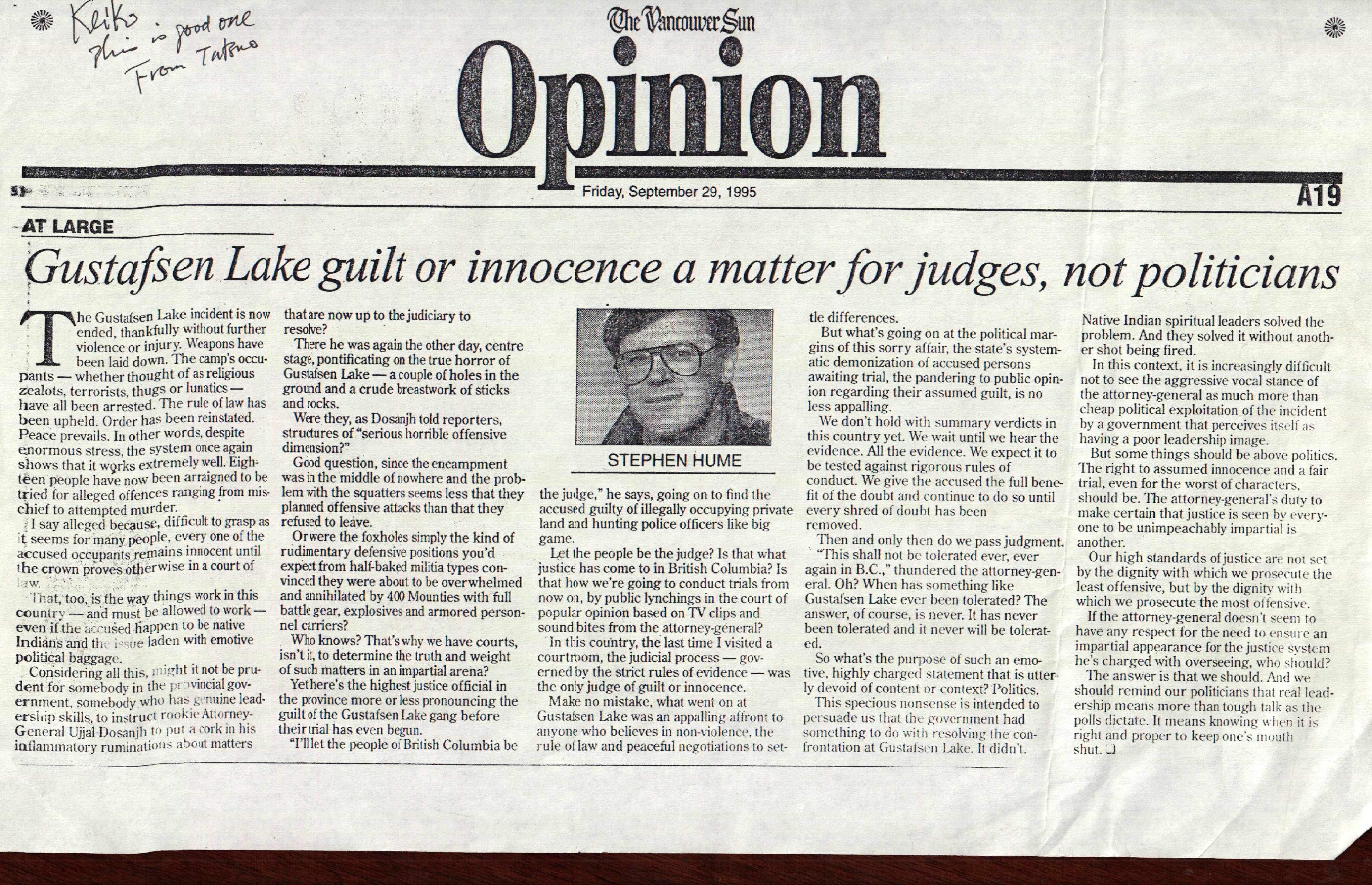
Within weeks of becoming AG and Minister for Multiculturalism and Human Rights, Dosanjh gave the “green light to shoot to kill” Sundancers at Gustafsen Lake in 1995.

Six months ahead of this astonishing directive, the office of BC’s Attorney General had received a powerful legal document from the “terrorists,” as Dosanjh repeatedly referred to them in the press, in Secwepemc country. Their communication was in the form of a petition for a third party hearing of the land dispute between themselves and British Columbia, indeed Canada. The traditionalist Secwepemc nationalists had petitioned the AG because that officer possessed the only existing and appropriate mechanism to deliver the complaint to the Governor General of Canada, who could forward it to The Queen. BC’s Attorney General did not forward the complaint and gave no explanation.

Instead, the highest ranking RCMP officers, according to Superintendent Len Olfert during the ensuing trial, began to plan “Operation Wallaby” – a ground assault on a scale not seen since the Korean War – to dislodge the Sundancers from their sacred site by launching offensives from “Camp Zulu” built next to it as the RCMP base of operations. They began this planning in April, according to Olfert; more than two months before the first violent exchanges at the Sundance site were initiated. The first conflict was initiated by a dozen of Lyle James’ cowboys who rode through on horseback, over tents, shooting guns, and posted an eviction notice to a sacred staff which explained it was a good time to “string up some red niggers.” Lyle James possessed a license to graze cattle on the Sundance site.

By the time Ujjal Dosanjh was made AG, five months of planning had gone into what would happen next – following the Secwepemc petition and their intended continuation of the annual Sundance. But Dosanjh was the individual who authorized the deployment of 400 RCMP officers with full tactical gear and assault weapons, fixed wing surveillance aircraft, several helicopters, C-4 explosive (in contravention of the UN Convention on the Prohibition of the Use, Stockpiling, Production and Transfer of Anti-Personnel Mines) and requested the use of six Armoured Personnel Carriers from the Canadian military. At the time that these resources were seconded, there were seventeen people at the Sundance site and no evidence that they were in possession of any weapon more powerful than a hunting rifle, nor any demand more extravagant than a court hearing. The police carried AK-47s, AR-15s, and had Brownings which fire 50mm cartridges. When the siege was over, the province had the entire place logged to destroy the trees which were riddled with gunshot and they also saw fit to remove the empty cartridges from the grounds – two piles each the size of a small house. Miraculously, none of the Sundancers were killed. One was shot in the bicep as she fled a police ambush on the way to fetch water; she had been running away back to camp with her hands raised high above her head.

After the fact, once the Sundancers had surrendered to police on the advice of their spiritual mentors who were finally allowed entry through the police barricade; once they had been arrested, caged and transported to holding cells in 100 Mile House and Williams Lake; Dosanjh peppered reporters with rhetorical vitriol. He described the foxholes Sundancers had dug at the site to avoid bullets as structures of “serious horrible offensive dimension.” The Attorney General then said to the press, on the matter of the upcoming trial of the Sundancers’ “terror” activities – which apparently included only the fact that they were not willing to be displaced from their sacred site on the strength of a cattle grazing permit issued by BC in unceded Secwepemc territory, “I’ll let the people of British Columbia be the judge.” He had spent the past two months instructing the BC public on the faults and crimes of the Sundancers via CBC and every other media outlet.

The RCMP had employed Mike Webster, recently returned from an engagement at the Waco, Texas massacre, as their negotiator.

And now the man who was British Columbia’s top legal officer, loudly proclaiming full responsibility for “whatever” might happen during the weeks-long full-frontal assault on the people at the camp at Gustafsen Lake, has received an award for helping “improve the lives of others and society, while defying unjust laws, norms or conventions of the time and place.” He is reported to have explained his qualifications for the honour: “Guns must not be allowed to win. … You can’t have a world ruled by guns…” The selection committee noted that Dosanjh “continues to be a consistent voice for social justice and a critic of sectarian violence.” Apparently the main substance of his suitability for this award was his strong statement, in about 1985, against Sikhs from his homeland using violence to regain independence from Britain.

It is a point of wonder, given the first ever recipient of the award in their names, that Raoul Wallenberg and Chiune Sugihara are famous for preventing the deaths of Jews fleeing Nazi areas before and during the Second World War. Holocaust conditions in Europe have been successfully compared with the modern Canadian institutions of Indian Reserves, the Indian Act and Indian Status, which social/cultural/economic death-traps have repeatedly led to horrifying human tragedies across the state and at other times produced armed resistance such as at Cache Creek in 1974, Oka in 1990 and Ipperwash in 1995.

The Convention on the Prevention and Punishment of the Crime of Genocide was nearly written in response to the Nazi modes of operation, at least along the lines of Raphael Lemkin’s response to the Nazi regime and others like it. The 1948 UN Convention categorizes the expressions of this crime against humanity, “acts committed with intent to destroy, in whole or in part, a national, ethnical, racial or religious group,” as: forcible removal of children to another group; killing members of the group; causing serious bodily or mental harm to members of the group; deliberately inflicting on the group conditions of life calculated to bring about its physical destruction in whole or in part; and imposing measures intended to prevent births within the group. The colonization of British Columbia has involved, and still involves today, actions described by every article in the Genocide Convention.

It may be appropriate to recall a few of Dosanjh’s activities following the Gustafsen Lake siege. Just before he became Premier of BC, he participated in a debate over the passage of the Nisga’a Final Agreement with Canada and BC. In that Agreement, the first of its kind in BC, less than half of Nisga’a adults voted to ratify the Agreement which modified their constitutionally protected aboriginal rights. Of the 3300 status Nisgaa adults, 2376 of them “enrolled” in the new Nisgaa Nation which would be created by the Agreement and constituted by Canada. 1451 of them voted in favour of the Agreement. The state considered only the votes of those people who had enrolled in the then-non-existent new Nisgaa nation to be created retroactively by the Final Agreement.

From the CPAC debate, January 19, 1999:

Geoff Plant (Reform) – “How did the [Nisga’a] Tribal Council become a nation? What is the process?”

Ujjal Dosanjh (NDP, Government of BC) – “This treaty has been initiated. This is the process of approval – at that point it is at the time of signing – transition from Tribal Council to First Nation.”

Plant – “The process of this legislative creation will constitute necessary recognition?”

Dosanjh – “Could have been by Order in Council, it didn’t have to be legislated… ”

Plant – “There is a problem of overlapping status and identity. Is there anything that would serve those persons Section 25 or 35 rights?”

Dosanjh – “No. Honourable Chair, I think the debate is going in the wrong direction.”

Jack Weisgerber (Reform) – “The first time there is a legally defined nation within Canada.”

Dosanjh – “This is not really a nation. All I care is what limitations, restrictions, restraints upon their rights are! The Nisgaa Nation would have attributes in this treaty, no more no less. This is all they get, this is all the rights they have (smiling). I don’t care if they call themselves Tribal Council or Nation.”

Mike DeJong (Liberal) – “Does this create liability if it’s wrong?”

Dosanjh – “We’re not transferring jurisdiction to the Nisgaa.”

DeJong – “If the Province lacks authority, does it create liability?”

Dosanjh – “It’s in the interest of protecting the honour of the Crown… We have the authority to enter this agreement: regarding the courts – that’s a hypothetical question.”

DeJong – “It’s not so hypothetical when there’s an action before the court.”

Glen Clark (NDP Government, Premier) – “It does not bestow right to go to court for Section 35 rights.”

Dosanjh – “This treaty is exhaustive definition of Nisgaa Section 35 rights (laughs), they will have no more rights than this; their rights under Section 35 have been exhausted, exhaustively defined. This does not create a third order of government, it creates municipal government, not requiring Royal assent – it proves the point we’ve been trying to make for a long time.”

So, in honour of people who got in the way of genocide and risked their own lives to save others, Ujjal Dosanjh is awarded recognition of exemplifying the achievement of “Civil Courage” and over many other nominees. A man who condemned Sikhs trying to regain their country; a man who condemned Secwepemc people to death – for protecting their sacred grounds and refusing to abandon their future as a people; a man who intentionally pushed to completion the Nisga’a vote for municipalization among voters who were not informed of the Spirit and intent of the “treaty.”

Congratulations, George Orwell – the only winner here.

Dosanjh - Hume opinion 1995 Van Sun

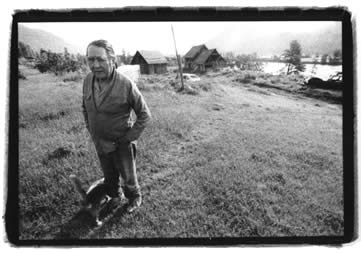
William Ignace, one of the "terrorists" on whom Dosanjh unleashed 400 RCMP with shoot-to-kill orders. Here he is at his farm in Chase.  Ignace, known as Wolverine, spent five years in prison for his role at Gustafsen Lake in 1995 - convicted of attempted murder - when what he actually did with his .22 hunting rifle was to disable an Armoured Personnel Carrier by shooting out the power steering column when it was exposed, under the tank, by a pine tree that partially lifted the tank off the ground as it rolled through/over the forest in pursuit of him. Meanwhile, a state shooter of unknown affiliation was standing up through the trap door on top of the tank, firing on Wolverine.

William Ignace, one of the “terrorists” on whom Dosanjh unleashed 400 RCMP with shoot-to-kill orders. Here he is at his farm in Chase.
Ignace, known as Wolverine, spent five years in prison for his role at Gustafsen Lake in 1995 – convicted of attempted murder – when what he actually did with his .22 hunting rifle was to disable an Armoured Personnel Carrier by shooting out the power steering column when it was exposed, under the tank, by a pine tree that partially lifted the tank off the ground as it rolled through/over the forest in pursuit of him. Meanwhile, a state shooter of unknown affiliation was standing up through the trap door on top of the tank, firing on Wolverine.

Consultation Standards in BC – or – The Trilogy of Despair

04 Thursday Sep 2014

Posted by Admin in Commentary, editorial

≈ 1 Comment

Tags

aboriginal rights, aboriginal title, Comprehensive Claims Policy, consultation and accommodation, Halfway River, infringement, justification, Taku

August 2009

Recent court rulings in Halfway River, Taku River Tlingit, and Douglas have brought consultation standards spiraling down to a single unreturned phone-call.

Participating in consultations with government is a double-edged sword for Aboriginal peoples. We already know that the government and the courts find aboriginal laws of upholding the sustainability and sacredness of the land to be “unreasonable conditions.’ If they do not participate, or walk away, Aboriginal peoples are described as unreasonable – and if they do participate, they are stuck within a process that the government dominates.

Even when Bands or First Nations bring court cases following “negotiations” that disregard their input, their assertion of their own laws and duty to uphold them are unacceptable in BC courts.

Halfway River, 1999, gives us this.

Halfway River contested that logging had infringed their way of life to an unjustifiable extent. The Halfway case found the province free to infringe their Treaty 8. Halfway also concluded in an obligation on the part of Aboriginal peoples to participate in the consultation process, and not frustrate it with such “unreasonable” demands as those of sustainability, regardless of the foregone- conclusion nature of such BC-led procedures.

In Taku River Tlingit, 2005, the Taku River people were suing BC for going ahead with permitting a mining access road over their sacred mountain, right through the hunting grounds. Taku had participated extensively in consultation procedures and the environmental impact assessment. The government did not respect their position that the road had to be redirected, and permitted it as preceded the legal challenge. The court found that Taku had been adequately consulted and accommodated, since they had been part of the development process, and that their proper course of action was to continue in negotiations to mitigate the impact of the road at a site-by-site specific level. This was the first case to test the duty to consult and accommodate, it came down at the same time as Haida.

We have a final angle in Douglas, 2007. It was found that the Department of Fisheries and Oceans had not only fulfilled their duty to consult, but also upheld their obligation to the aboriginal food fishing priority when they opened a sports fishery on Early Stuart sockeye in the Fraser, five years earlier.

The Department had faxed and telephoned a few invitations to meet on the subject to the Cheam Band prior to the openings. Cheam had not been able to participate in the processes on the schedule DFO offered.

Nevermind, the fact that DFO offered them meetings fulfilled their duty to consult and accommodate, ruled the judge. And since the Department has the privilege of managing the fishery, no notices of later management changes were necessary.

What this would seem to mean to BC is that: First Nations must participate in the consultation process; once they have been consulted, anything goes; and as little communication as an unanswered fax and a phone call can accomplish the consultation and justify the decisions made by government ministries. The “meaningful” part of this “consultation and accommodation” is that BC is the boss, anyway.

Are these the parameters of the “shared decision making” contemplated in BC’s proposal for Recognition and Reconciliation Legislation?

“I’ll see you in court!”

Missionary to Editor of Victoria Standard (BC newspaper), 1874

04 Thursday Sep 2014

Posted by Admin in Commentary, editorial

≈ Leave a comment

A Letter

To the Editor of the Victoria Standard: –

Okanagan Mission, August 28th, 1874.  

 * The writer, CJ Grandidier, ran the Okanagan Mission as a priest and missionary.

Printed in “Papers Relating to the Indian Land Question in British Columbia,” 1875, Queen’s Printer


SIR, – In your issue of the 12th instant you have an article entitled “AN Indian War,” which has called my especial attention. In it you attribute with correctness the never ceasing strife between the white and the Indian on the American side to the iniquitous treatment inflicted upon the latter. Your reflections have forcibly drawn mine to our native tribes, and to their present dissatisfaction about their lands, which dissatisfaction has not abated, for the visit of Colonel Powell, Indian Commissioner, has not had all the results which were anticipated from it.

            At Kamloops the Shuswap Indians gathered to welcome him, expecting that their grievance would be redressed. They exposed to him their needs, their earnest and unanimous wish to have more land. By the improvements which they had already accomplished on their reservations, without help from anybody, by their sole efforts, and by census of their cattle, they showed him that theirs was no idle wish.

            The Commissioner was pleased with them and gave substantial proofs of his interest, for which they feel very grateful; but for the land question it was out of his power to settle it according to their wish.

            When the Dominion Government took charge of the Indian tribes of British Columbia it was proposed to adopt the same policy towards them as towards their brothers of the other Provinces, and grant each family a large quantity of land. To this proposition the Local Government objected, and would not grant more than twenty (20) acres. Is it just and expedient for the Government to grant the natives as small a portion of land as possible? None will think so.

            Before the settlement of this Province the natives were in possession of it. There was no one to restrain them in that possession. Their horses had wide pasture lands to feed upon. The whites came, took land, fenced it, and little by little hemmed the Indians in their small reservations. They leased the land that they did not buy and drove the cattle of the Indians from their own pasture land. Many of these reservations have been surveyed without their consent, and sometimes without having received notice of it, so that they could not expose their needs and their wishes. Their reservations have been repeatedly cut off smaller for the benefit of the whites, and the best and most useful part of them taken away till some tribes are corralled on a small piece of land, as at Canoe Creek or elsewhere, or even have not an inch of ground, as at Williams Lake. The natives have protested against those spoliations, from the beginning. They have complained bitterly of that treatment, but they have not obtained any redress.

            Is that treatment according to the dictates of Justice? Who will wonder at the dissatisfaction that has been growing amongst the Indians? The land was theirs and their forefathers before the whites came; that land has been wrenched from them in virtue of might, not right; not a cent has been given them to extinguish their title to the land. They have been left to struggle on the parcel of land allotted them without any encouragement, any help, any agricultural implements from any quarter, and, because they are forbearing and peacefully disposed, they are to be granted the minimum possible of land.

            I appeal to every impartial mind, is that treatment according to Justice? And are not the natives justified in now claiming their rights? Reverse the case, and place the whites in the place of the Indians, which white settler would bear with it? And it is not correct to say that no injustice has been done to the Indians in taking away their land because they did not cultivate it. For they were the owners of the land, and the title to a property is not rendered valueless because the property is left to decay. Our American neighbours have recognized that title, since they have passed a treaty with all the tribes whose land they come to occupy. Whether they fulfilled that treaty or not is not the question; but they recognize the Indian title to the land, although those lands were not in the same condition then as it was here when the whites came. Besides their lands were valuable to the Indians for hunting, and now the game is receding far away before the whites. It was valuable to them for their horses, and now their horses and cattle have no ground to feed upon, and would starve in some places were it not for the forbearance of some white settlers.

            In former times the Indians did not cultivate land; now, taught by the example of the whites, they see its value. They are not unwilling to let the whites have the greater and the best portion of it, but not the whole or nearly so. Children and owners of the soil, they want a sufficient share of it to get a living from it. They do not think that when a white man can pre-empt 320 acres and buy as much more, besides the facility of leasing more, that they are unreasonable in asking 80 acres of their own land per family; and in that they are supported by the example of the Dominion Government’s conduct towards the other Indians, if they claim that it is to use it. And already on their reservations, or most of them, they carry on farming as far as their limited means and knowledge permit it. Both will improve in time, as the already effected improvement is a convincing proof. They must not be judged according to what they have been in past times, but according to what they are, and promise to be, useful and industrious men. It is better for every settler to have the Indians fixed contentedly on farms than wandering discontentedly, and looking with anxious eyes on the fat of the land which they are not allowed to share.

            Then it is but just to deal fairly by them, and lay for their use reservations amply sufficient for their future wants. For the reservations which are to be laid over are to be permanent for many generations.

            But will not twenty acres be sufficient for each family? What is the purpose of the Government? To civilize and make useful men of them. The first step to do it is to reclaim them from their wandering life and attach them by bonds of interest to the soil.

            But if the Indian leaves off his ordinary pursuits of life he expects to find a better compensation in the new means adopted by him to earn the livelihood of his family and his own. Will he find it in a tract of twenty acres? Will those twenty acres be all good cultivated land easy of irrigation? Probably not. Supposing them however to be so, how can he get from them a comfortable living for his family?

            Actually, the Indian cannot live as he used to formerly; his contact with the whites has created for him new and imperious needs which must be satisfied, in the way of clothing and food. Besides his family he will have to find enough of food on his twenty acres to keep his horses and cattle. Having no natural meadows whereon to cut hay, he will have to sow grass on a large piece of his twenty acres, for already the Indian begins to raise cattle, and the census taken last Spring shows 436 heads of horned cattle and about 1,300 horses between seven tribes, and they are only beginning. What will it amount to in ten or twenty years if they have land enough to feed them? Having set aside the part for hay they will cultivate the cultivable balance of their twenty acres; after a few years that land being light soil will require manure, but where will the Indians find it? Where are they to keep their horses and cattle to save manure? How many heads can they keep on twenty acres summer and winter, after the needs of their families have been attended to? Then what can they do with their exhausted land, without means of fertilizing it, and without any more of it to sow, while the old piece is left to rest? If a white man can scarcely eke out a living with his 320 acres how can an Indian do it with 20? They will have twenty (20) acres while the present head of the family lives, but at his death, his sons dividing his inheritance, will have ten or even five acres for their lot. Are such prospects attractive enough to lead the Indians to leave off their wanderings and turn all their energies to cultivate the soil?

            Is it possible to believe that the Indians can, any more than anybody else, live with their families out of the produce of 20 acres, keep horses and cattle there and meet all expenses? Besides, a good part of the reservation, with a  few exceptions, in either over-flooded in summer, or parched for want of water which cannot be brought there, covered with timber, or strewn with rocks, as any visitor may convince himself.

            Out of 320 acres a man may pick out the best spot to cultivate and make a living; out of twenty acres it is impossible; which white family would like to try it? And still they have more means and knowledge at their command than the Indians.

            If the Government be sincere in its intentions of civilizing the Indians, let sufficient land be allotted to them; as it is at present it is either too much or far too little; too much if the Government does not want them to cultivate their farms and live from the produce, too little by far if it does.

            The question is too important for the welfare of the country to stop at half measures. But those who want to cultivate on a large scale can pre-empt land as any other man, after they have obtained a special authorization from the Governor. That permission may be refused, and would be if many applications were sent, for that special permission is required against Indian pre-emption, and it is not the Government policy to let Indians pre-empt. Besides, suppose the permission granted, how can an Indian who has nothing, no provisions, no money, no implements of agriculture, remain for ten months on his claim with his family? When he leaves he cannot engage a white man, another Indian cannot take his place, so that in his absence to procure food for his family his land may be jumped.

            Pre-emption is but a nominal right to the Indian for whom it was not intended, and whose condition does not allow him to fulfill the provisions of the law.

            The natives are now quite awake to the necessity of following the example of the whites. They look into the future with fear for themselves and their children if they do not do so; they want reasonable means for doing it, and consequently demand 80 acres of a farm for each head of a family, and extensive mountain pasture for their cattle, so as to allow them to increase their number every year and improve their own condition. This they have asked from the Indian Commissioner; they are anxious to obtain no money, nor any other compensation will they accept in its stead.

            The Indians of this country, as a people, are honest, peaceful, law-abiding, and well disposed towards the whites; none can complain that they have done him any harm. On the contrary, they are industrious and of great service to the whites. Let not their good qualities be turned against their interests, but be one reason the more to secure to them the means of becoming useful members of society. If they obtain the right which they claim, the good feeling that reigns between them and the whites shall be strengthened for ever. The settlers need not entertain any fear of them; we shall never see in our midst the heart-rending scenes which desolate so many homes among our neighbours; and the comparison which you draw to the advantage of our Government and of its just treatment of the natives will remain an undisputed truth.

            But if the Indians are persistently refused their demands, if they are deprived of their fathers’ land without any hope of redress from the proper authorities, their dissatisfactions will increase, meetings shall be held again, as it has been about their grievances, until they come to an understanding, the end of which I am afraid to foresee. We may have very serious disturbances, which it might be impossible to suppress except at the cost of human life and large expenditure of money, as our past experience has taught us with the Chilcotin Indians; and those were only a handful of men, whilst the present dissatisfaction pervades all the tribes living amongst the whites.

            I beg to apologize for the length of this communication, but the matter is too important for me to keep silent. If it is my duty to teach the Indian to keep the commandments of God, and obey the just laws of man, it is no less my obligation to spare no effort in order that justice be done to them, and that peace and security be preserved in my adopted country.

                                    Believe me to remain, etc.,

                                                (Signed)    C. J. Grandidier

Newer posts →

Subscribe

  • Entries (RSS)
  • Comments (RSS)

Archives

  • December 2025
  • October 2025
  • June 2025
  • May 2025
  • February 2025
  • September 2024
  • August 2024
  • July 2024
  • April 2024
  • March 2024
  • February 2024
  • September 2023
  • August 2023
  • June 2023
  • June 2018
  • December 2017
  • July 2017
  • January 2017
  • December 2016
  • July 2015
  • March 2015
  • February 2015
  • January 2015
  • December 2014
  • September 2014

Categories

  • Archive Quarterly
  • BC treaty process
  • Children
  • Commentary, editorial
    • Uncategorized
  • Comprehensive Claims – Policy and Protest
    • aboriginal title
  • Government Commissions
  • Gustafsen Lake Standoff 1995 – Ts'peten Defense, Secwepemc
  • Haida title
  • Indian Residential School
  • Indigenous Declarations
  • Non-Status Indian Era
  • Reconciliation
  • Roadblock
  • UN Engagement
  • Union of BC Indian Chiefs

Meta

  • Create account
  • Log in

Blog at WordPress.com.

  • Subscribe Subscribed
    • The West Wasn't Won
    • Already have a WordPress.com account? Log in now.
    • The West Wasn't Won
    • Subscribe Subscribed
    • Sign up
    • Log in
    • Report this content
    • View site in Reader
    • Manage subscriptions
    • Collapse this bar
 

Loading Comments...