The international status of Indigenous Peoples’ rights are beyond Canadian attempts to domesticate, assimilate, and infringe them.
Note: these entries are not a complete history and are provided as part of a larger work in progress
1874 British Columbia Lands Act
Excerpt from,
An Act to amend and consolidate the Laws affecting Crown Lands in British Columbia:
Unsurveyed Land
- Any person being the head of a family, a widow, or single man over the age of eighteen
years, and being a British Subject, or any alien upon making a declaration of his intention to become a British subject, …may record any tract of unoccupied, unsurveyed, and unreserved Crown lands (not being an Indian settlement) not exceeding 320 acres in extent, in that portion of the Province situate to the northward and eastward of the Cascade or Coast Range of Mountains, and 160 acres in extent in the rest of the Province. Provided, that such right shall not be held to extend to any of the Aborigines of this Continent…
1874 Petition of the Douglas Tribes
Excerpt:
3. Our hearts have been wounded by the arbitrary way the Local Government of British Columbia have dealt with us in locating and dividing our Reserves. Chamiel, ten miles below Hope, is allowed 488 acres of good land for the use of twenty families: at the rate of 24 acres per family; Popkum, eighteen miles below Hope, is allowed 369 acres of good land for the use of their families: at the rate of 90 acres per family; Cheam, twenty miles below Hope, is allowed 375 acres of bad, dry and mountainous land for the use of twenty-seven families: at the rate of 13 acres per family; Yuk-Yuk-y-yoose, on Chilliwack River, with a population of seven families, is allowed 42 acres: 5 acres per family; Sumass, at the junction of Sumass River and Fraser, with a population of seventeen families, is allowed 43 acres of meadow for their hay, and 32 acres of dry land; Keatsy, numbering more than one hundred inhabitants, is allowed 108 acres of land. Langley and Hope have not yet got land secured to them, and white men are encroaching on them on all sides.
4. For many years we have been complaining of the land left us being too small. We have laid our complaints before Government officials nearest to us; they sent us to some others; so we had no redress up to the present;
1875 BC Lands Act disallowed by Canada Attorney General
Canada struck down British Columbia’s attempt to claim ownership and jurisdiction over all Indigenous territories. The Attorney General wrote, “considering… …the Indian Tribes of the Province never surrendered their Territorial rights; …the arbitrary Reserves are totally inadequate to their support and requirements, and without their assent; …they are not averse to hostilities to enforce rights which it is impossible to deny them; …the Act ignores those rights and prohibits them from recording or pre-empting Land: then, the BC Public Lands Act should be disallowed.”
1884
The Best Of All Titles – Gitwangat Chiefs
“We would liken this district to an animal, and our village, which is situated in it, to its heart. Lorne Creek, which is almost at one end of it, may be likened to one of the animal’s feet.
We feel that the whitemen, by occupying this creek, are, as it were, cutting off a foot. We know that an animal may live without one foot, or even without both feet; but we also know that every such loss renders him more helpless, and we have no wish to remain inactive until we are almost or quite helpless
We have carefully abstained from molesting the whiteman during the past summer. We felt that, though we were being wronged and robbed, as we had not given you the time nor opportunity to help us, it would not be right for us to take the matter into our own hands. Now we bring the matter before you, and respectfully call upon you to prevent the inroads of any whiteman upon the land within the fore-named district.
In making this claim, we would appeal to your sense of justice and right. We would remind you that it is the duty of the Government to uphold the just claims of all peaceable and law-abiding persons such as we have proved ourselves to be. We hold these lands by the best of all titles. We have received them as the gift of the Creator to our Grandmothers and Grandfathers, and we believe that we cannot be deprived of them by anything short of direct injustice.
In conclusion, we would ask you, would it be right for our Chiefs to give licenses to members of the tribe to go to the district of Victoria to measure out, occupy, and build upon lands in that district now held by whitemen as grazing or pasture land? Would the whitemen now in possession permit it, even if we told them that, as we were going to make a more profitable use of the land, they had no right to interfere? Would the Government permit it? Would they not at once interfere and drive us out? If it would not be right for us so to act, how can it be right for the whiteman to act so to us?
—Gitwangak Chiefs, 1884
As copied from the book, Colonialism on Trial: Indigenous land rights and the Gitksan and Wet’suwet’en sovereignty case, New Society Publishers, 1992
1909
Cowichan Petition
“The Humble Petition of the Cowichan Tribe of Indians in the Province of British Columbia in the Dominion of Canada one of Your Majesty’s Dominions Beyond the Seas.
SHOWETH:
- THAT from time immemorial the Cowichan Tribe of Indians have been the possessors and occupants of the territory including the Cowichan Valley containing a large area and situate within the Territorial limits of the said Province of British Columbia.
- The Indian title to said territory was always recognized by Your Majesty’s predecessors.
“The title of the Indians is recognized in various Imperial Statutes relating to British Columbia before the Confederation of 1867 in which the lands in question are referred to as “Indian Territories.” This is also recognized by the fourteen Indian treaties made by Sir James Douglas as agent for the Hudson Bay Company which Treaties are set forth in the Sessional papers of British Columbia for 1876 at page 165 et seq. The same state of affairs is recognized in the correspondence between the Secretary of State for the Colonies and Sir James Douglas during the years 1858 to 1861. These are set forth in the said sessional papers at page 172 and following.”…
….full text and comment on context continued below:
https://wordpress.com/post/thewestwasntwon.com/109
1910
Declaration of the Tahltan Tribe
“We, the undersigned members of the Tahltan tribe, speaking for ourselves, and our entire tribe, hereby make known to all whom it may concern, that we have heard of the Indian Rights movement among the Indian tribes of the Coast, and of the southern interior of B.C.. Also we have read the Declaration made by the chiefs of the southern interior tribes at Spences Bridge on the 16th July last, and we hereby declare our complete agreement with the demands of same, and with the position taken by the said chiefs, and their people on all the questions stated in the said Declaration, and we furthermore make known that it is our desire and intention to join with them in the fight for our mutual rights, and that we will assist in the furtherance of this object in every way we can, until such time as all these matters of moment to us are finally settled. We further declare as follows:—
Firstly—We claim the sovereign right to all the country of our tribe—this country of ours which we have held intact from the encroachments of other tribes, from time immemorial, at the cost of our own blood. We have done this because our lives depended on our country. …. continued in full post:
https://wordpress.com/post/thewestwasntwon.com/35
1910
Memorial to Wilfred Laurier, Prime Minister of Canada
This Memorial was written on the occasion of Canada’s Prime Minister, Laurier, visiting Kamloops and Prince Rupert in 1910. It was written by the Secwepemc, Nlaka’pamux (Thompson / Couteau), and Okanagan leaders and witnessed by over 80 other chiefs who had gathered in Spences Bridge to meet about the issues raised in this Memorial.
“We take this opportunity of your visiting Kamloops to speak a few words to you. We welcome you here, and we are glad we have met you in our country. We want you to be interested in us, and to understand more fully the conditions under which we live. We expect much of you as the head of this great Canadian Nation, and feel confident that you will see that we receive fair and honorable treatment. Our confidence in you has increased since we have noted of late the attitude of your government towards the Indian rights movement of this country and we hope that with your help our wrongs may at last be righted. We speak to you the more freely because you are a member of the white race with whom we first became acquainted, and which we call in our tongue “real whites.”
One hundred years next year they came amongst us here at Kamloops and erected a trading post. After the other whites came to this country in 1858 we differentiated them from the first whites as their manners were so much different, and we applied the term “real whites” to the latter (viz., the fur-traders of the Northwest and Hudson Bay companies. As the great majority of the companies’ employees were French speaking, the term latterly became applied by us as a designation for the whole French race.) The “real whites” we found were good people. We could depend on their word, and we trusted and respected them. They did not interfere with us nor attempt to break up our tribal organizations, laws, customs. They did not try to force their conceptions of things on us to our harm. Nor did they stop us from catching fish, hunting, etc. They never tried to steal or appropriate our country, nor take our food and life from us. They acknowledged our ownership of the country, and treated our chiefs as men. They were the first to find us in this country. We never asked them to come here, but nevertheless we treated them kindly and hospitably and helped them all we could. They had made themselves (as it were) our guests.
We treated them as such, and then waited to see what they would do. …Continued in full below:
https://wordpress.com/post/thewestwasntwon.com/40
1910
DECLARATION OF THE INDIAN CHIEFS IN THE SOUTHERN INTERIOR OF BC
July 16, 1910
“We, the underwritten Chiefs of Indian Bands in the Southern Interior of British Columbia, hereby make known our position in regard to the question of Indian rights, and the policy of the Indian Rights Association of BC, as follows:
First, we stand for treaty rights with the dominion government, the same as all the Indian tribes in the other provinces of Canada, and that all matters of present importance to the people of each of our tribes be subject to these treaties, so that we shall have a definite understanding regarding lands, water, timber, game, fish, etc., and we consider such matters as schools, doctors, aid to the aged, Indian funds, etc., and general assistance by the government should also be included in these treaties. …” continued in full doc:
https://wordpress.com/post/thewestwasntwon.com/1463
1911
MEMORIAL to Frank Oliver, Minister of the Interior, Canada
We the undersigned Chiefs of the Shuswap, Couteau or Thompson, Okanagan, Lillooet, Stalo or Lower Fraser, Chilcotin, Carrier and Tahltan Tribes in the interior of British Columbia, assembled at Spences Bridge, BC, this tenth day of May, 1911, hereby greet you, and make known to you as follows:
…You already know most of those grievances we complain of, and the position we take regarding them. …You know how the BC Government has laid claim to all our tribal territories, and has practically taken possession of same without treaty, and without payment. You know how they also claim the reservations, nominally set apart for us.
…. Premier McBride, speaking for the BC Government, said “We Indians had no right or title to the unsurrendered lands of the province.” We can not possibly have rights in any surrendered lands, because in the first place they would not be ours if we surrendered them, and, secondly we have never surrendered any lands. This means that the BC Government asserts that we have no claim or title to the lands of this country. Our tribal territories which we have held from time immemorial, often at cost of blood, are ours no longer if Premier McBride is correct. We are all beggars, and landless in our own country. Continued in full below:
https://wordpress.com/post/thewestwasntwon.com/43
1911
Declaration of the Lillooet Tribe
We the underwritten Chiefs of the Lillooet tribe (being all the Chiefs of said tribe) declare as follows: –
We speak the truth, and we speak for our whole tribe, numbering about 1400 people at the present time.
We claim that we are the rightful owners of our tribal territory, and everything pertaining thereto.
We have always lived in our country; at no time have we ever deserted it, or left it to others.
… We are aware the B.C. government claims our country, like all other Indian territories in B.C.; but we deny their right to it.
We never gave it nor sold it to them.
They certainly never got the title to the country from us, neither by agreement nor conquest, and none other than us could have any right to give them title. …continued in full doc below:
https://wordpress.com/post/thewestwasntwon.com/49
1849-1911
Reference to the establishment of Indian reserves in British Columbia, 1849-1911
Dorothy I. D. Kennedy
Ottawa : Indian and Northern Affairs, 1994. 132 p.
Claims and Historical Research Centre: K.105
1913
STATEMENT OF THE NISHGA NATION
From time immemorial the Nishga Nation or Tribe of Indians possessed, occupied and used the territory generally known as the Valley of the Naas River, the boundaries of which are well defined. The claims which we make in respect of this territory are clear and simple. We lay claim to the rights of men. We claim to be aboriginal inhabitants of this country and to have rights as such. We claim that our aboriginal rights have been guaranteed by Proclamation of King George Third and recognized by Acts of the Parliament of Great Britain. We claim that holding under the words of that Proclamation a tribal ownership of the territory, we should be dealt with in accordance with its provision, and that no part of our lands should be taken from us or in any way disposed of until the same has been purchased by the Crown. By reason of our aboriginal rights above stated, we claim tribal ownership of all fisheries and other natural resources pertaining to the territory above-mentioned. …. Continued in full doc:
https://wordpress.com/post/thewestwasntwon.com/407
1913-16
Confidential Report of the Royal Commission on Indian Affairs for the Province of British Columbia, 1913, 1916
Excerpt:
“AND WHEREAS serious dissatisfaction among the Indians is likely to be created if the Commission declines to consider and report upon such questions;
AND WHEREAS for the satisfactory disposal of such matters and questions it may be necessary to report upon conditions and make suggestions as to policy;
BE IT RESOLVED: That it be intimated to the Governments of the Dominion and the Province that if they so desire and instruct the Commission, the Board will be pleased to deal with all such questions and matters and report, submitting suggestions as to the action to be taken and the policy followed.”
1916
British Columbia Indian Conference
Excerpt:
“The main result of the Conference was that unanimously the following resolutions were adopted, the first on Tuesday, June 20th, and the second on Friday, June 23rd:
1. That this meeting of the Chiefs of the Indians of British Columbia with the Executive of the Indian Rights Association assembled, repudiate any suggestion that we are satisfied with the terms of the Order-in-Council passed in June, 1914, and Mr. Clark, K.C., of Toronto, quite misunderstood our instructions if he stated to Hon. Dr. Roche that the Indian Rights Association accepted the terms of such Order-in-Council.
2. That a committee be appointed to agree on a general plan of action for the Indians of British Columbia and report to all tribes the result of their deliberations, with power in meantime to take any necessary steps to preserve all rights and claims on the lines of co-operation with the Nishga Tribe.”
1919
Statement of the Allied Indian Tribes, British Columbia
Excerpt:
Grounds of Refusal to Accept
In addition to the grounds shown by our introductory remarks, we mention the following as the principle grounds upon which we refuse to accept as a settlement the findings of the Royal Commission:
1. We think it clear that fundamental matters such as tribal ownership of our territories require to be dealt with, either by concession of the governments, or by decision of the Judicial Committee, before subsidiary matters such as the findings of the Royal Commission can be equitably dealt with.
2. We are unwilling to be bound by the McKenna-McBride Agreement, under which the findings of the Royal Commission have been made.
3. The whole work of the Royal Commission has been based upon the assumption that Article 13 of the Terms of Union contains all obligations of the two governments towards the Indian Tribes of British Columbia, which assumption we cannot admit to be correct.
…full doc at: https://wordpress.com/post/thewestwasntwon.com/81
1922
Allied Tribes Resolution
“Whereas it is apparent that there are two factions of organization at the meeting, namely the Allied Tribes and independent party. To try and bring these two parties together, therefore, be it resolved that the Indians of B.C. join an organization of Indians to fight Bills 13 and 14 and adopt for its policy the statement of the Allied Indian Tribes of B.C. for the Government of B.C., said organization to have standing executive committee which will consist of Indians and others deemed acceptable by Interiors.”
1926
Allied Tribes Petition to Parliament
“6. By agreement which was entered into by the late Mr. J. A. J. McKenna Special Commissioner on behalf of the Dominion of Canada and the late Premier Sir Richard McBride on behalf of the Province of British Columbia in the month of September, 1912, and before the end of that year adopted by both Governments, it was stipulated that by means of a Joint Commission to be appointed, lands should be added to Indian Reserves and lands should be cut off from Indian reserves. By that agreement it was provided that the carrying out of its stipulations should be a “final settlement of all matters relating to Indian affairs in the Province of British Columbia.”
“14. By Memorandum which was presented to the Government of Canada on 29th February, 1924, the Allied Tribes opposed the passing of Order-in-Council of the Government of Canada adopting the Report of the Royal Commission upon the ground, among other grounds, that no matter whatever relating to Indian affairs in British Columbia having been fully adjusted and important matters such as foreshore rights, fishing rights and water rights not having been to any extent adjusted, the professed purpose of the Agreement and the Act had not been accomplished.
“15. By Order-in-Council passed 19th July, 1924, the Government of Canada, acting under Chapter 51 of the Statutes of the year 1920 and upon recommendation of the Minister of the Interior adopted the Report of the Royal Commission.”
1963
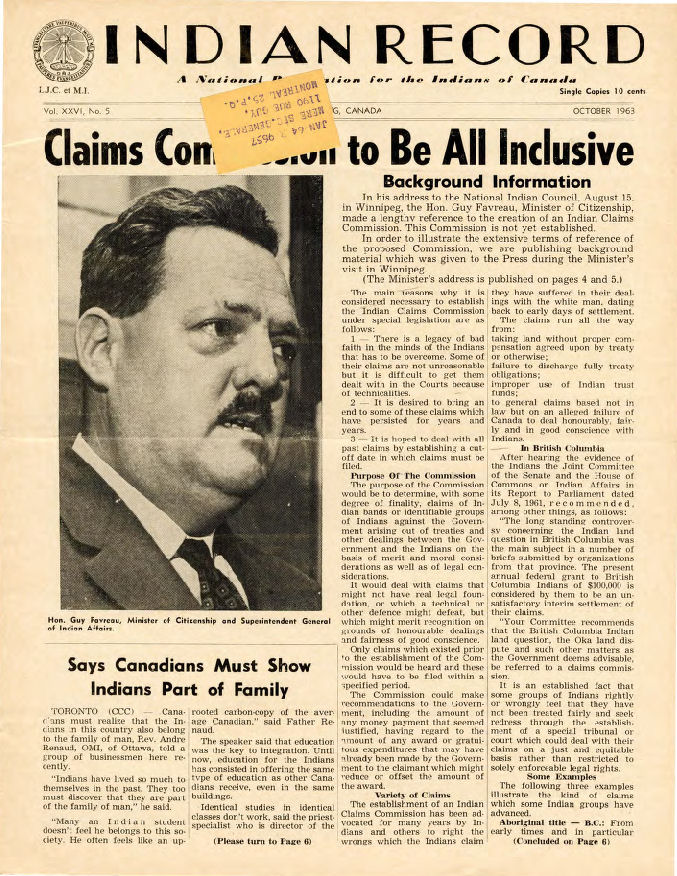
Indian Claims Commission: “Claims Commission to be all inclusive”
The Indian Record, October 1963
1969
White Paper Policy
The Statement of the Government of Canada
Excerpt:
Canadian society as a whole will have to recognize the need for changed attitudes and a truly open
society. Canadians should recognize the dangers of failing to strike down the barriers which frustrate
Indian people. If Indian people are to become full members of Canadian society they must be warmly
welcomed by that society.
…The government believes that the framework within which individual Indians and bands could
achieve full participation requires: 1. that the legislative and constitutional bases of discrimination be removed;
…Wind up that part of the Department of Indian Affairs and Northern Development which
deals with Indian Affairs. The residual responsibilities of the Federal Government for
programs in the field of Indian affairs would be transferred to other appropriate federal
departments.
In addition, the Government will appoint a Commissioner to consult with the Indians and to study
and recommend acceptable procedures for the adjudication of claims.
1970
A DECLARATION OF INDIAN RIGHTS
THE B.C. INDIAN POSITION PAPER
November 17, 1970
Union of BC Indian Chiefs
28pp. Excerpt:
#3. Principle Issues: Indians are concerned with: 1. Settlement of claims for the province of British Columbia. 2. Recognition of the various Indian nations. 3. Recognition of all rights due Indians such as: land title, foreshore and riparian rights, forest and timber, hunting and fishing, mineral and petroleum, and all other rights basic to Indian life that are hereditary, historical, usufructuary, moral, or of legal obligation. 4. That a claims commission be established which will recognize these native rights and prepare just compensation awards for settlement of all land and other native claims. 5. Reconciliation of injustices done by the imposition of restrictions by all forms of Federal / Provincial legislation. 6.
1971
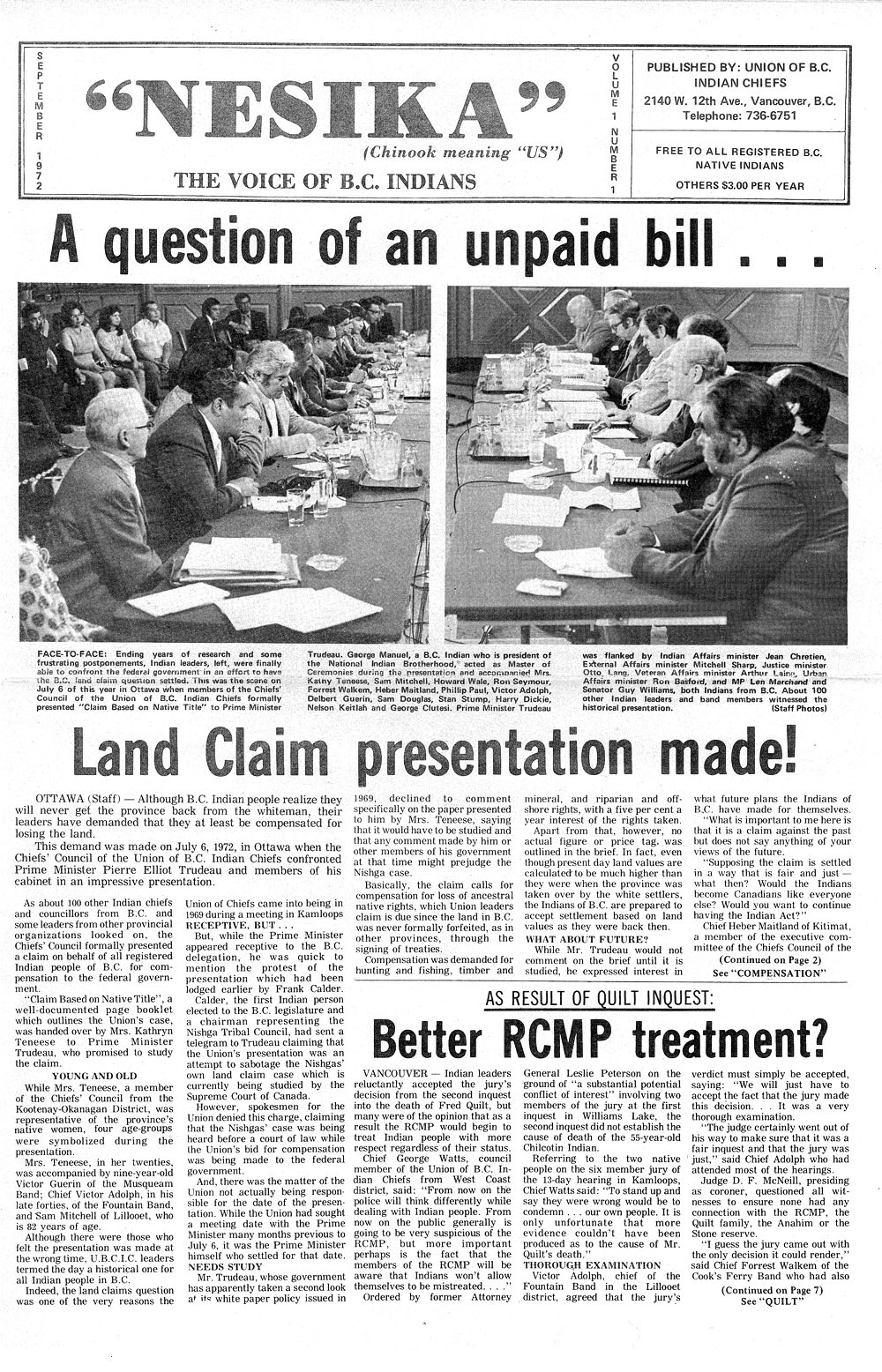
The Claim Based on Native Title:
SUBMISSION TO THE PRIME MINISTER AND GOVERNMENT OF CANADA BY THE UNION OF BRITISH COLUMBIA INDIAN CHIEFS AS TO THE CLAIM BASED ON NATIVE TITLE TO THE LANDS NOW FORMING BRITISH COLUMBIA AND THE WATERS CONTAINED THEREIN OR ADJACENT THERETO. Vancouver, B.C. December, 1971.
1974
Manifesto of the Native People’s Caravan
“We are against violence. The violence of racism, poverty, economic dependence alcoholism, land theft and educational warfare. This is the violence that has hurt our people. We say it is time for the democracy of Canada to end its political and social violence against our people.
“We say it is time for the Canadian political system to be reasonable and listen to the voice of our community.
1976
Musqueam Declaration
“We, the Musqueam people openly and publicly declare and affirm that we hold aboriginal title to our land, and aboriginal rights to exercise use of our land, the sea and fresh waters, and all their resources within that territory occupied and used by our ancestors, namely:
“The lands, lakes and streams defined and included by a line commencing at Harvey Creek in Howe Sound and proceeding Eastward….”
1977
Gitksan-Carrier (Wet’suwet’en) Declaration
Since time immemorial, we. The Gitksan and Carrier People of Kitwanga, Kitseguecla, Gitanmaax, Sikadoak, Kispiox, Hagwilget and Moricetown, have exercised Sovereignty over our land. We have used and conserved the resources of our land with care and respect. We have governed ourselves. We have governed the land, the waters, the fish and the animals. This is written on our totem poles. It is recounted in our songs and dances. It is present in our language and in our spiritual beliefs. Our Sovereignty is our Culture.
Our Aboriginal Rights and Title to this Land have never been extinguished by treaty or by any agreement with the Crown. Gitksan and Carrier Sovereignty continue within these tribal areas.
…Continued in doc below:
https://wordpress.com/post/thewestwasntwon.com/117
1979
UBCIC ABORIGINAL RIGHTS POSITION PAPER
Excerpt from the Introduction:
“It is our undeniable responsibility as leaders to clearly say what we have been directed by our Indian Governments to state which is contained within these pages.
Traditionally, as aboriginal people, we had uncontested, supreme and absolute power over our territories, our resources and our lives. We had the right to govern, to make laws and enforce laws, to decide citizenship, to wage war or make peace and to manage our lands, resources and institutions. We had our own political, legal, social and economic systems.
The power to govern rests with the people and, like our aboriginal rights, it comes from within the people and cannot be taken away.”
1981
Elders Position, Okanagan Nation
- The Okanagan Nation is a sovereign nation. This originates from the Creator when he placed us on this island in our territory. We were given instructions under which our people have lived in health for nobody knows how many generations. Those instructions are explained in the teachings of Coyote. Our rights are contained in those teachings.
- Those are still our rights. Our sovereignty is still the same. The only one who can change that is the one who made it so. That is our understanding of aboriginal title and aboriginal rights.
…. What we need to do now is to make a re-definition of white people’s rights because they have not respected the agreements our people defined for them to live in our territory in the first place. WE WILL NOT COMPROMISE BY BEING INCLUDED IN THE CANADIAN CONSTITUTION. We have to put them back in their place at whatever cost. ….full doc continued at link below
Reprinted from “Ka-Nata – a vision of social revolution’ magazine, Spring, 1982; ‘Voice of KANATA Anti-Imperialist Organizing Committee.”
https://wordpress.com/post/thewestwasntwon.com/91
1981
In All Fairness: A Native Claims Policy
Comprehensive Claims
1982
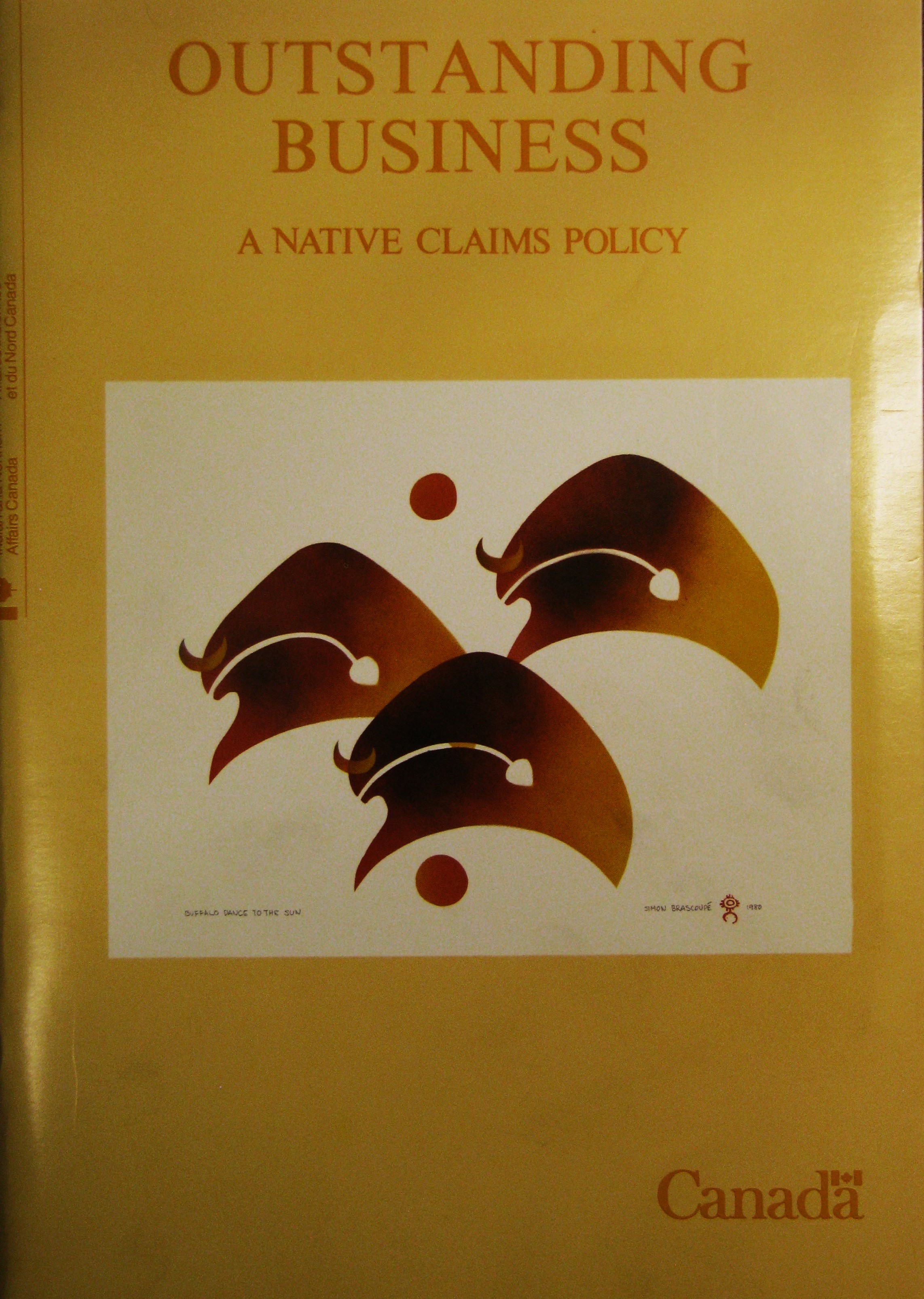
Outstanding Business ~ A Native Claims Policy
Canada’s first formal policy on Specific Claims.
1982
Carrier Sekani Declaration and Claim
April 15th, 1982
Whereas we of the Carrier and Sekani Tribes have been, since time immemorial, the original owners, occupants and users of the north central part of what is now called the province of British Columbia and more specifically that area of the said province outlined in red contained in the map attached hereto as schedule “A” [herein referred to as “the said lands”].
And whereas in addition to the original ownership, occupancy and use, we have exercised jurisdiction as a sovereign people over the said lands since time immemorial,
And whereas this original ownership, occupancy and use, and jurisdiction by our people over the said lands has never been surrendered by our people through conquest, treaty or any other legal means to the British Crown or to its colonial governments or to the Crown in right of the province of British Columbia or to the Crown in right of Canada or to any other government,
And whereas this original ownership, occupancy and use by our people, and jurisdiction over the said lands has never been superseded by law, …continued in doc below:
https://wordpress.com/post/thewestwasntwon.com/113
1983
Líl’wat Nation Declaration
January 14, 1983
We, the People of the Líl’wat Nation declare that our land and rights as a Nation have never been relinquished by ourselves. The Creator placed us here on our land with the right to self-determination. The right to self-determination and the right to exist as a people is sacred in our way, and we believe we have that right.
Continued in full article below:
https://wordpress.com/post/thewestwasntwon.com/121
1983
Declaration of Secwepemc Sovereignty
Secwepemc Chiefs and Representatives, collectively the only spokespersons for Secwepemc, declare that on this day, January 17, 1983, that we reaffirm our sovereignty over our traditional territory.
We follow the path of our Elders and our Forefathers in standing firm for our sovereignty over our territory so that the future generations of our children will also have what has been handed down to us by our Creator. Today through this Declaration we ensure that Secwepemc sovereignty over our territory comes from the past, to the present and forever on into the future. …continued in full doc below:
https://wordpress.com/post/thewestwasntwon.com/103
1985 Living Treaties, Lasting Agreements
Report of the Task Force to Review Comprehensive Claims Policy
This report is a timepiece – exposing a brief window of candor on the part of Canada’s political engineers. It is an analysis of the federal approach to minimizing Indigenous scope for land title restitution – after the Supreme Court failed to unanimously agree that Aboriginal rights no longer existed, after Calder in 1973, Canada wrote its Comprehensive Claims Policy. The report includes corresponding insight and recommendation.
The report attached here came in the midst of the First Ministers’ conferences on implementation of constitutional Aboriginal rights. Written after the 1982 Constitution Act, grappling with Section 35 where “Aboriginal and treaty rights are hereby affirmed” and before that process imploded in 1987 (accomplishing nothing except a formal return to “talk and log” politics), this report is unique in its unequivocal, explicit recognition of extensive Indigenous rights. The Task Force received submissions from 60 Indigenous nations and organizations during its work.
Note that this volume is now all but inaccessible. Also note this report’s extensive and useful bibliography.
living-treaties-lasting-arrangements-1985-part-1-introduction
living-treaties-lasting-arrangements-1985-part-2-history-of-treaty-making-and-land-claims-processes
living-treaties-lasting-arrangements-1985-part-3-alternative-process-and-framework-for-new-ccp
living-treaties-lasting-arrangements-1985-part-4-proposed-comprehensive-claims-policy
living-treaties-lasting-arrangements-1985-part-6-implications-for-canada-and-appendices
living-treaties-lasting-arrangements-1985-part-7-background-docs-and-tf-biographies-and-maps
1988 Xwe-Nal-Mewx Declaration
Also called, Coast Salish Declaration
Begins:
“We know the Creator put us here. We know our Creator gave us laws that govern all our relationships to live in harmony with nature and mankind; defined our rights and responsibilities.
“We have the right to govern ourselves and the right to self-determination. Our rights and responsibilities cannot be altered or taken away by any other nation.
“We have our spiritual beliefs, our languages, our culture, and a place on Mother Earth which provides us with all our needs.
“We have maintained our freedom since time immemorial. …We declare and affirm to the people that… the Xwe-Nal-Mewx have held and till hold title to all lands, waters and resources within our traditional territories. ….”
Full text: xwe-nal-mewx-declaration-coast-salish
https://wordpress.com/post/thewestwasntwon.com/377
1991 Oweekeno-Kitasoo-Nuxalk re land claim settlement
– to First Nations Summit meeting
February 1 1991
Excerpt: “If the Crown is serious and sincere about resolving the land claims question with all our First Nations, … “aboriginal title and rights” as defined by the First Nations must be entrenched within the Canadian Constitution. … The Crown, to show its good faith, should re-establish the First Nations / First Ministers conferences… “
1993 New Aboriginal Claims Settlement Process
Vancouver Conference, February 4 and 5
With materials from presentations by Geoff Plant, Russell & DuMoulin; Wendy Grant, Vice-Chief of BC AFN; Bryan Williams, QC, Swinton & Company; Harry Slade, Ratcliffe & Company.
1996 BC Lands Act
This Act is current to March 5, 2024
2007
“ALL OUR RELATIONS”
A DECLARATION OF THE SOVEREIGN INDIGENOUS NATIONS OF BRITISH COLUMBIA
We, the Indigenous leaders of British Columbia, come together united and celebrate the victory of the Tsilhqot’in and Xeni Gwet’in peoples in securing recognition of their Aboriginal title and rights – and all those Indigenous Nations and individuals that have brought important court cases over the years resulting in significant contributions in the protection and advancement of Aboriginal title and rights, including the Nisga’a, Gitxsan, Wet’suwet’in, Haida, Taku River Tlingit, Musqueam, Heiltsuk and Sto:lo – shining light on the darkness of years of Crown denial of our title and rights. After pursuing different pathways, we now come together to make this solemn Declaration out of our common desire to be unified in affirming our Aboriginal title.
As the original Peoples to this land, we declare:
- We have Aboriginal title and rights to our lands, waters and resources…. Continued in full doc:
https://wordpress.com/post/thewestwasntwon.com/124
2007
FNUPA protests government negotiating mandate
First Nations Unity Protocol Agreement joins every treaty table in British Columbia to protest the provincial and federal governments’ refusal to bring their negotiating mandate in line with recent court decisions and international human rights instruments.
BC Treaty Commission reduces Delgamuukw title case
BCTC commissions a “lay person” interpretation of the Delgamuukw decision, to support the government refusal to negotiate with properties registered to individual or corporate owners.
The BC Treaty Negotiating Times
A new publication to assist communications to isolated First Nations in negotiations
by a coalition of Tribal Councils, Bands, and Indigenous NGO
2009
Human rights ruling could change land claims process –
Hulquminem Treaty Group at Inter-American Court of Human Rights
The Vancouver Sun, December 14, 2009
2009
BC Recognition and Reconciliation legislation proposed by British Columbia and the First Nations Leadership Council
The BC Treaty Negotiating Times, Summer 2009
Analysis and report on the Proposed Legislation and events
Comments on the Legislation, FNLC
March 2009
Proposed Recognition and Reconciliation Act – FNLC Info Bulletin
Spring 2009
Arthur Manuel’s communique re British Columbia Land titles, 2009
2015
“Establish Indigenous titles,” UN tells Canada
The Human Rights Committee has just released concluding observations on fifteen “principal matters of concern” with Canada. Five of those concerns pertain to Indigenous Peoples and the violation of their rights in the International Covenant on Civil and Political Rights.
The Committee’s recommendations leave little room for the kind of redirection and side-stepping that Canada’s delegation to the United Nations treaty body performed on July 7th and 8th in Geneva.
The state should find ways and means to establish Indigenous Peoples’ titles to their lands, as well as ensuring Indigenous consent to developments which might impact their titles and treaty rights.
As per its obligations under the Covenant, …Continued in full article:
https://wordpress.com/post/thewestwasntwon.com/178
BC UNDRIP Act 2019
https://www.bclaws.gov.bc.ca/civix/document/id/complete/statreg/190
March 1, 2023
Criminalization of Wet’suwet’en land defenders
Background – 2023 – Amnesty International
As we begin yet another year, the Wet’suwet’en land defenders are still under continued surveillance and criminalization by the British Columbia (B.C.) provincial government and the Canadian federal government. At the source of the struggle is, the Coastal GasLink’s (CGL) pipeline construction that is cutting the Wet’suwet’en territory into two. The construction of the pipeline has been opposed by all five Wet’suwet’en clans. The Wet’suwet’en hold title and rights to their 22,000 km2 territory and their Chiefs say they have not consented to the pipeline according to their laws and customs.
 The West Wasn't Won