Tags
1926 Joint Committee on the Claims of the Allied Tribes, aboriginal rights, aboriginal title, BC Indian Conference 1916, book-review, Canada, decolonization proposal, Duncan Campbell Scott, history, ICCPR, Indian Act, Indian Residential Schools Settlement Agreement, Indigenous Peoples, Oregon Treaty 1846, politics, UBCIC Declaration 1976, William Blackwater
Special Feature: The Indian Act – not an AI summary.
How have Indigenous Peoples survived 150 years of this? Only to have Canadian courts and politicians and public deny any dignified alternative?
Perhaps because of cultural teachings, perhaps because of languages and ceremony that resonate with the land and ancestors, and probably because the Indian Act says a lot more about Canadians than it does about Indigenous Peoples.
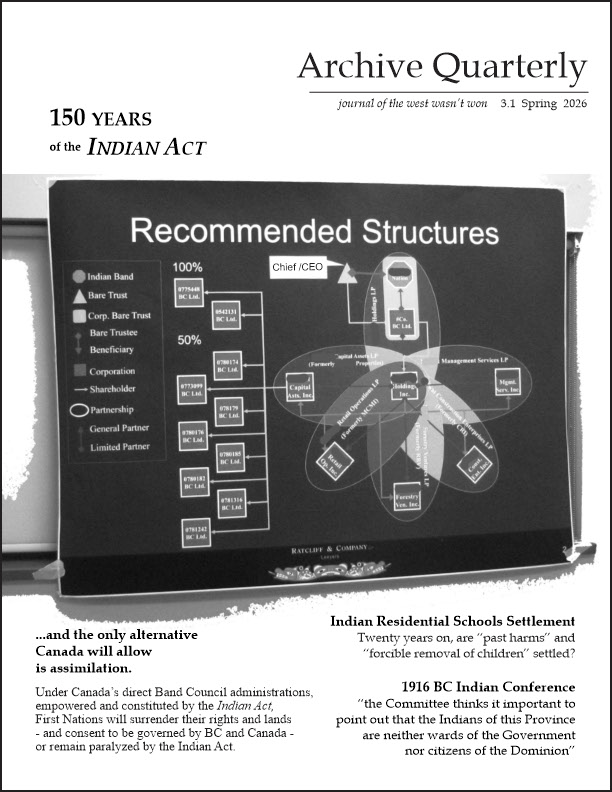
This Spring’s Archive Quarterly offers an unprecedented and total review of the origins and amendments of the Indian Act. More, the Act is compared with modern assimilative schemes that Canada extorts from fractured communities suffering under the duress and poverty caused by the brutal legislation.
In this special feature, AQ Spring includes:
– comments and insight by Indigenous leaders showing how the Act affects people, families, communities, and nations.
– a thorough comparison of Indian Act sections and their modern-day counterparts in sectoral Agreements with titles like “Reconciliation,” “Jurisdiction,” and “Self-Government.”
– key observations of Human Rights Committees on Canadian extinguishment language which has not changed since it was officially criticized in 2004
– a timeline of resistance, legal challenge, and amendments to the Indian Act, from 1971 to 2025
– comments by Canadian politicians, judges, Ministers, and negotiators exposing that the crises caused by the Indian Act were intended
– Canadian government diagram of assimilated First Nations municipalities, in contrast with an historical Indigenous diagram of autonomous self-government
– an exploration of what a Real Alternative to the Indian Act might involve
and
– margin notes to full sections of all the major Acts and amendments from 1850 to 2023, many of which remain current to date.
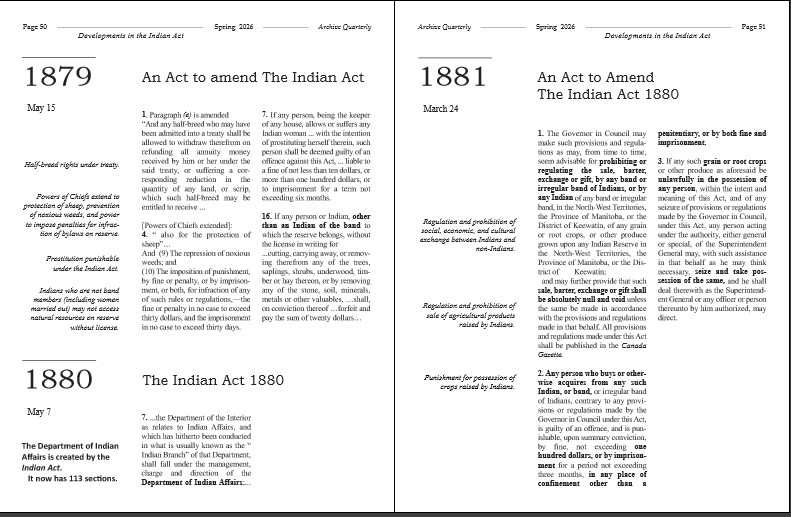
Like, “3. The Minister of the Interior shall be the Superintendent General of Indian affairs, and shall, as such, have the control and management of the lands and property of the Indians in Canada.” (1873). Just change the names to “Crown-Indigenous Relations and Northern Affairs Canada,” and the provisions of this section are live today.
In the historical Indian Acts, we find the cause of irreparable harms. If these are not understood, “reconciliation” can have no meaning, and decolonization will not include reparation.
For instance:
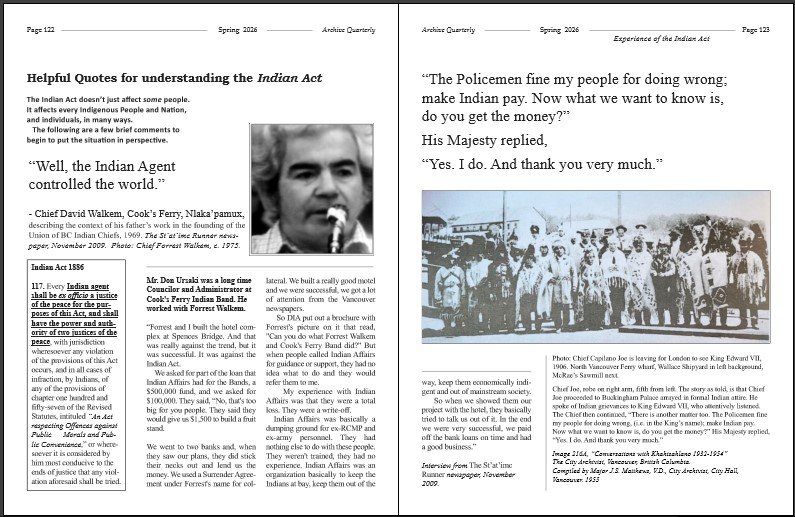
“every Indian Agent shall be ex officio a justice of the peace and have the power and authority of two justices of the peace anywhere in the said territories or provinces, whether or not the territorial limits of his jurisdiction as a justice, as defined in his appointment or otherwise defined as aforesaid, extend to the place where he may have occasion to act as such justice or to exercise such power or authority, and whether the Indians charged with or in any way concerned in or affected by the offence, matter or thing to be tried, investigated or otherwise dealt with, are or are not within his ordinary jurisdiction, charge or supervision as Indian agent.”
Or,
“…a Truant Officer has the powers of a peace officer and may enter any place where he believes, on reasonable grounds, that there are Indian children who are between the ages of seven and sixteen years of age, or who are required by the Minister to attend school;
… may take into custody a child whom he believes on reasonable grounds to be absent from school contrary to this Act and may convey the child to school, using as much force as the circumstances require.”
This season of AQ also includes:
Statement of the 1916 BC Indian Conference
Efforts to assist the Imperial, Colonial, Federal and Provincial governments in upholding their arrangements with Indigenous Peoples and Nations are ongoing since at least 1861. In 1915, all of the nations west of the Rockies converged in the Allied Tribes movement.
In 1916, they published a joint statement from their Vancouver conference.
Indian Residential Schools Settlement Agreement 2006
Twenty years later, are former students and their families better off?
A review of what the Settlement promised, the problematics, and an open letter from William Blackwater to the Indigenous
leadership at the time.
Oregon Treaty 1846
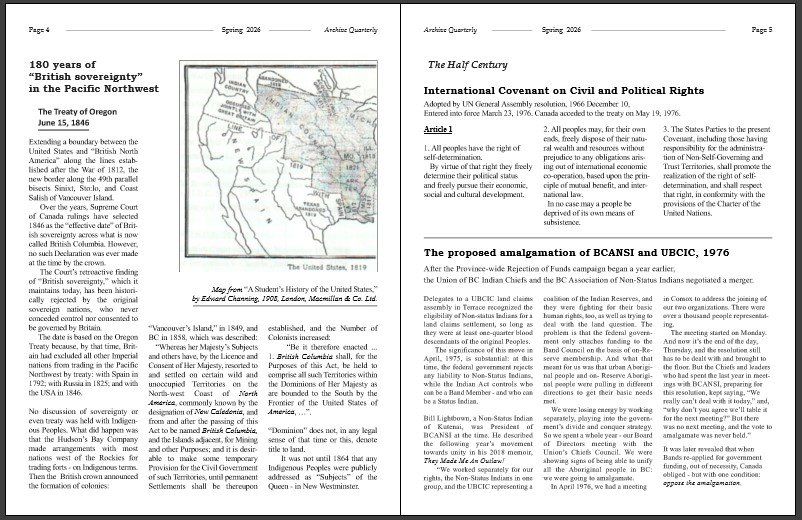
Text of the treaty and a map from the time. This event is relied on by BC and Canada as the date of “effective British sovereignty” west of the Rocky Mountains.
International Covenant on Civil and Political Rights 1976
Article 1
- All peoples have the right of self-determination.
By virtue of that right they freely determine their political status
and freely pursue their economic, social and cultural development.
UBCIC 1976 Declaration
“We, the Native people of the tribes of British Columbia, openly and publicly declare and affirm to the people and governments of Canada and British Columbia:
“That the Indian Tribes have held and still hold Native title, Aboriginal rights and ownership to all lands and resources of British Columbia, within our respective tribal territorial boundaries,…”
Reunification of Status and Non-Status Indians
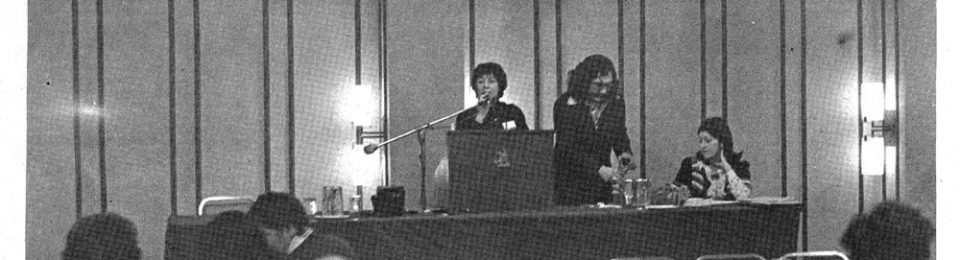
Divided by the Indian Act, people with and without Status, on and off reserve, attempted to form a single representative organization through the BC Association of Non-Status Indians and the Union of BC Indian Chiefs, in 1976.
You can visit Archive Quarterly, journal of the west wasn’t won archive project
at https://thewestwasntwon.com/archive-quarterly/
where you can:
– browse or download the digital copy
– subscribe to “the west wasn’t won” blog
– get a mail subscription for the print version of AQ
– use the online archive
– request research assistance
– join in with the work in progress!
Archive Quarterly is published by Electromagnetic Print in Vancouver, Musqueam.
Spring AQ 2026:
136 pages
8.5×11, black and white
ISSN 2819 585X (print)
ISSN 2819 5868 (online)